
























Religious institutions will be eligible for $250,000 in state grants for cameras, alarms, security training and cyber protection
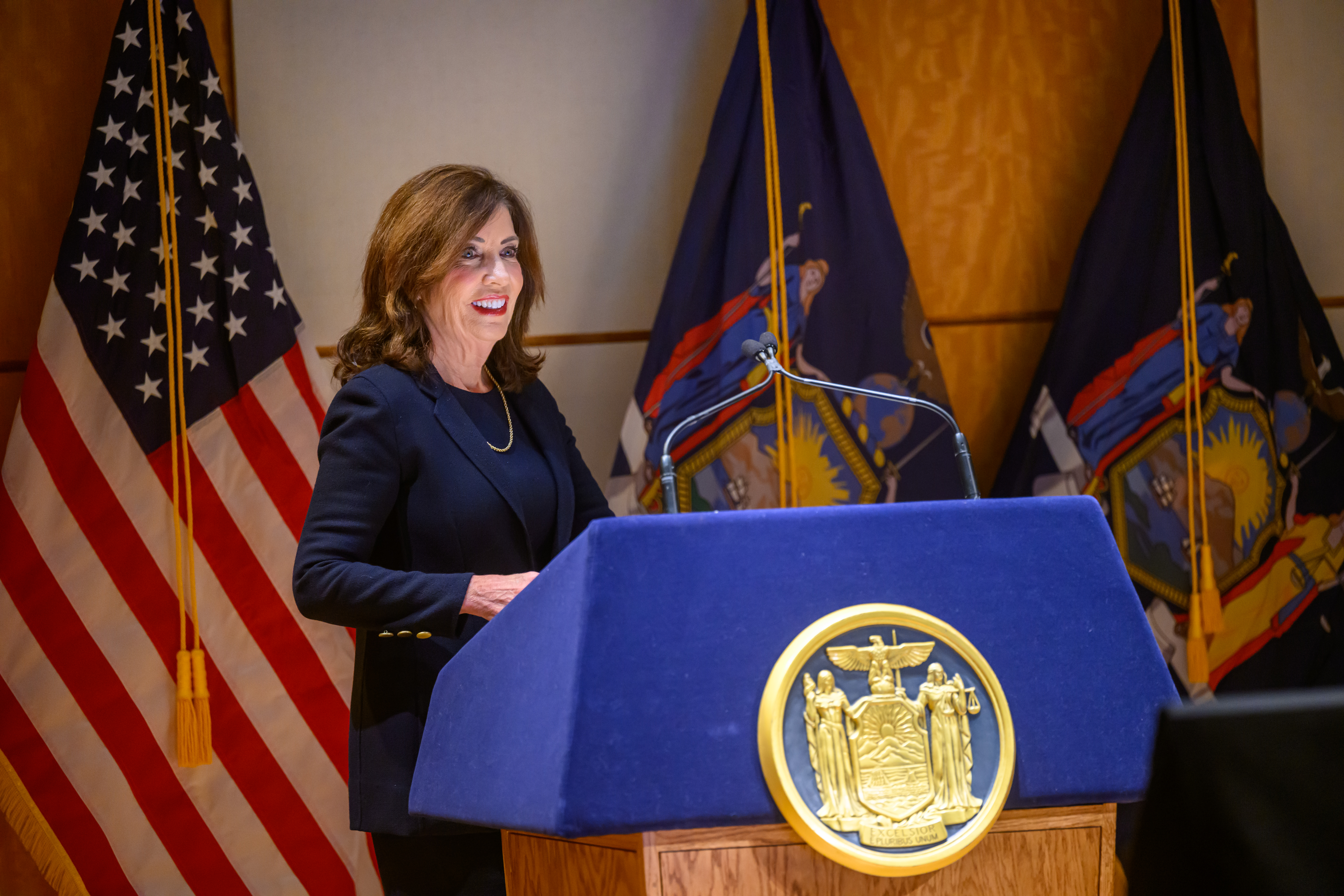
Susan Watts/Office of Governor Kathy Hochul
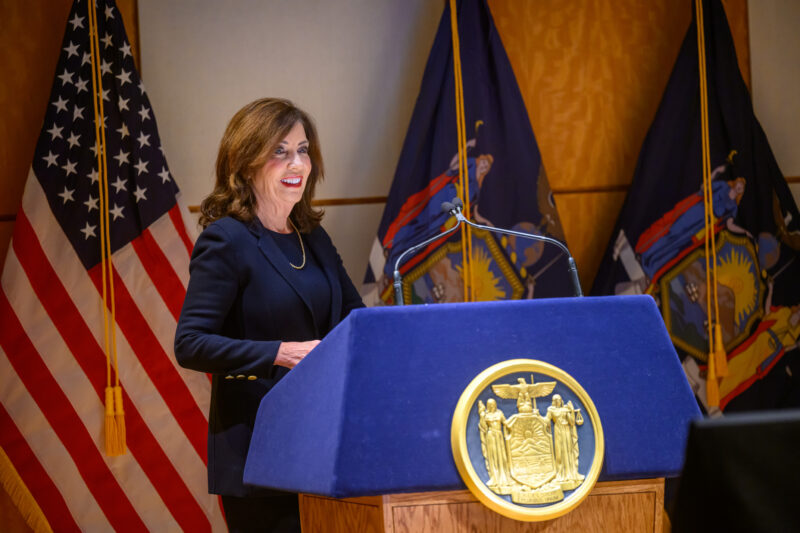
Gov. Kathy Hochul tours Anne Frank exhibit and delivers remarks at the Anti-Hate Center in Education at the Center for Jewish History.


 Add JewishInsider on Google
New York Gov. Kathy Hochul announced the release of $70 million in state hate crimes funding to “fortify” religious facilities across the state — as well as a “surge” in police presence — as the High Holy Days begin this weekend.
The Democratic governor opened her press conference on Tuesday with an early “shana tova” and vowed to be “not just a protector but an ally and friend to the Jewish people of New York State.” The nearly 300 schools, houses of worship and civic groups that will receive grants of up to $250,000 each for cameras, alarms, security training and cybersecurity enhancements are not exclusively Jewish institutions, her office told Jewish Insider.
But the spike in hate crimes against Jewish New Yorkers, and efforts to contain it, were Hochul’s focus as she recalled recent attacks against Jews in Manhattan and antisemitic graffiti in Queens.
“There has been more antisemitism and overt hatred levied against the people of Jewish faith than we can remember in recent history,” Hochul said.“We shouldn’t have to do this. We should never have to be thinking that these places of worship and places where children have to go to school have to be fortified against hate. And I pray that this time will pass.”
Hochul simultaneously announced increased state police deployments to houses of worship between Rosh Hashanah and Yom Kippur. She also highlighted the state’s recent passage of legislation that makes protesting within 50 feet of the entry points to a house of worship a misdemeanor.
“From Rosh Hashanah to Yom Kippur, our police officers will be out in force,” she said. “That means when a grandfather walks into a shul, he’ll have the peace of mind to know he’ll be protected.”
Sydney Altfield, CEO of Teach Coalition — an advocacy group for Jewish day schools and yeshivas — was on hand to laud the governor for defraying the increasing cost of protecting their students.
“Fear has a price tag,” Altfield said. “Thank you for recognizing the enormous financial burden that our communities simply cannot carry.” A recent study by the Jewish Federations of North America found that the American Jewish community now spends over $1 billion on security measures annually.
Anti-Jewish hate crimes also constituted the second-largest category of reported hate crimes of any kind in 2025
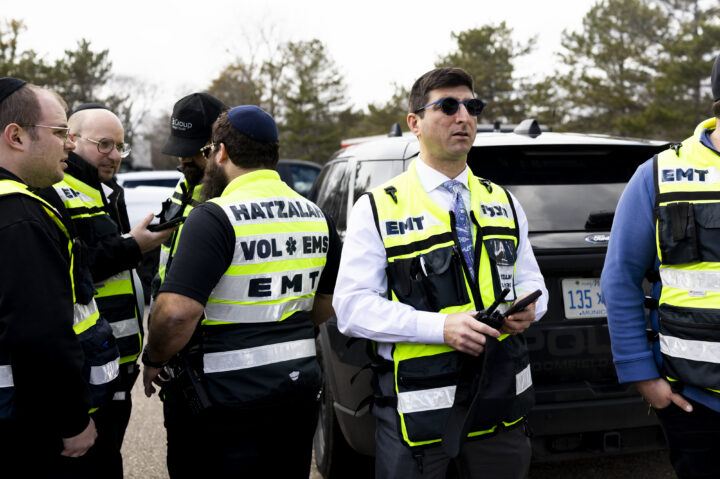
Emily Elconin/Getty Images
Members of Hatzalah of Michigan, a Jewish volunteer emergency medical service survey the area near Temple Israel following reports of an active shooter on March 12, 2026 in West Bloomfield, Michigan.
Anti-Jewish hate crimes constituted nearly two-thirds of all religious hate crimes in the country last year, according to FBI data released last week: Out of the 2,408 religiously motivated hate crimes reported across the country, 1,528 were targeted against Jews.
Anti-Jewish hate crimes also constituted the second-largest category of reported hate crimes of any kind in 2025, behind only anti-Black or African American hate crimes.
Jews remained the most-targeted religious group in the country. The total number of anti-Jewish hate crimes declined by 20% from 2024, when 1,938 anti-Jewish hate crimes were reported, and 1,832 incidents in 2023, making 2025 the third worst year on record for anti-Jewish hate crimes.
According to the FBI, anti-Jewish hate crimes in 2025 included three incidents of murder or non-negligent manslaughter; one incident of rape; 50 incidents of aggravated assault; 112
incidents of simple assault; 505 incidents of intimidation; 920 incidents of destruction, damage or vandalism; 68 incidents of theft, burglary and robbery of various kinds; and six incidents of arson.
A total of 1,685 anti-Jewish offenses were recorded in 2025, impacting 1,746 victims, committed by 866 perpetrators.
The FBI reported that overall hate crime incidents decreased 7% year-over-year.
“Year after year, we’ve seen alarming rates of antisemitic harassment and violence in this country,” Sens. Jacky Rosen (D-NV) and James Lankford (R-OK), who co-chair the Senate Antisemitism Task Force, said in a joint statement.
The two senators noted that antisemitic hate crimes remain higher than they were prior to the Oct. 7, 2023, Hamas attacks on Israel.
“This report shows the dark reality for Jewish Americans: antisemitic attacks make up more than 62 percent of religiously-motivated hate crimes in the United States, more than double all other kinds of religiously-motivated hate crimes combined,” Rosen and Lankford continued. “We’re faced with nothing less than a crisis, and we need collective action.”
They said that the data highlights the need to pass the Jewish American Security Act to respond and protect the Jewish community.
Anti-Defamation League CEO Jonathan Greenblatt emphasized in a statement that, “Behind every one of these numbers is a person who was targeted simply for being Jewish, whether through vandalism, intimidation, or violence.”
“We cannot allow a modest yet positive decline in the topline domestic numbers to obscure the reality that antisemitism remains one of the most persistent and dangerous forms of hate in this country and beyond,” Greenblatt continued, emphasizing that 2025 was the deadliest year for antisemitic attacks outside of Israel in more than 30 years.
In a release, the ADL noted that the data was consistent with its own findings that 2025 was the third-highest year on record for reported antisemitic incidents. The ADL’s data includes both criminal and non-criminal incidents.
Jewish Council for Public Affairs CEO Amy Spitalnick said, “Once again, the FBI’s data confirms what Jewish communities across this country already feel: the rising tide of hate means that we remain the most-targeted religious community in America,” noting that Jews constitute just 2% of the population but two-thirds of religious-based hate crimes.
Spitalnick also emphasized rising hate against other groups, arguing that “Jewish safety and the safety of our neighbors are inextricably linked — which is why we will never accept a strategy that protects one community by demonizing or ignoring another.”
She said that the slight decline in overall hate crimes is “welcome” but does not constitute safety and argued that a whole-of-government and whole-of-society approach to fighting hate remains necessary. She also emphasized that around 5% of the U.S. population was not covered by the data and that some local law enforcement agencies reported no hate crimes in areas where hate crimes are known to have occurred.
In 2025, 85.9% of all law enforcement agencies in the country submitted hate crimes data to the FBI — an optional program — covering 95.3% of the U.S. population. In some past years, reporting had been significantly hampered by non-participation by local law enforcement agencies, leading to what advocates said was an under-counting of hate crimes.
“The deeper problem is that we keep treating this crisis as a security problem to be managed rather than building resiliency to hate and extremism in the first place,” Spitalnick said, calling increased security funding necessary but “not a remedy” to hate.
“This new data tells us two things,” Spitalnick said. “Hate crimes remain far too high, and our national response is failing. We need the federal government to return its focus to protecting communities and building an inclusive, pluralistic democracy that is more resistant to hate in the first place.”
46-year old Larry Montes of the Bronx will be prosecuted for assault and criminal mischief after he struck a woman and damaged synagogue property
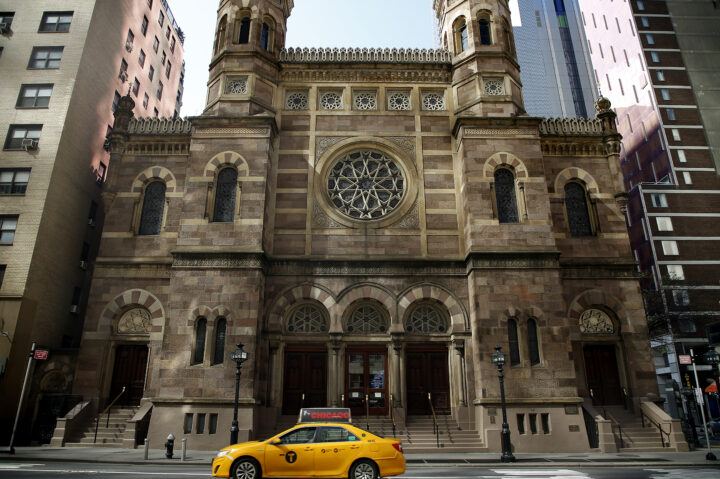
New York City's Central Synagogue on Lexington Avenue (Photo by John Lamparski/Getty Images)
New York City authorities have leveled hate crimes charges against a Bronx man arrested on Friday for attacking a woman and a guard during Shabbat services at Central Synagogue in Manhattan — marking the latest in a wave of antisemitic incidents targeting the world’s largest Jewish community outside Israel.
NYPD Commissioner Jessica Tisch revealed that 46-year-old Larry Montes will be prosecuted for assault and criminal mischief as hate crimes, “among other charges,” after police arrested him for striking a woman, damaging property and head-butting a member of the Reform synagogue’s security detail.
Video from the Upper East Side synagogue’s livestream captured the terrified reaction as a man, whom police have identified as Montes, burst screaming into Friday night Shabbat services before a guard forced him from the premises.
It was during his exit that Montes became physically violent, though victims experienced only minor injuries, Tisch wrote on X.
“I’m relieved that no one was seriously injured. Those who were hurt were evaluated at the scene and are doing well. There are no known additional threats at this time, and additional NYPD resources have been deployed to the synagogue,” Tisch posted, noting her personal connection to the congregation. “Central Synagogue is where I grew up. In joy and in sorrow, it has always been a place of comfort and peace. What happened there tonight is deeply painful. A place of worship should never be a crime scene.”
Mayor Zohran Mamdani offered his own condolences and assurances following the assault.
“I can only imagine the pain and fear an attack like this, during Shabbat services, causes for the congregation and for Jewish New Yorkers across our city,” he wrote in a post on X. “Every New Yorker must be able to observe their religion without fear of violence. This despicable act has no place in our city, and our administration will do everything in our power to keep Jewish New Yorkers safe.”
The arrest comes just weeks after Central Synagogue Rabbi Angela Buchdahl publicly castigated the mayor over a viral video released on his official social media channels denouncing Israeli Prime Minister Benjamin Netanyahu as a “war criminal.” Buchdahl warned that singling out the Jewish state as “uniquely monstrous” put Jewish New Yorkers in danger.
“You say you want to keep the Jews of New York City safe. But safety is not just about providing extra protection at parades and synagogues. Safety is about creating a climate in which Jews do not need to feel maligned or indicted by the city’s leaders, where we do not need to feel there is a bullseye on our backs,” Buchdahl wrote. “You cannot claim to protect Jews while using the power of your office to make Jewish identity morally tainted and imperiled.”
Days after Mamdani’s video, a Jewish man leaving another Manhattan synagogue was one of two victims of another alleged antisemitic attack, although a link between the mayor’s social media clip and the Upper West Side stabbing has not been established. The incident prompted Jewish civic and political leaders to demand Mamdani tone down his rhetoric about Israel, a call to which he did not respond.
Mamdani, whose anti-Israel activism helped propel him to prominence on the left, faced near-identical calls from a roundtable of rabbis he invited to City Hall on Monday. Among the groups represented at the event was the Union for Reform Judaism, which responded to the attack on Friday by encouraging Congress to pass the bipartisan Jewish American Security Act, and highlighting the funding the legislation would provide for enhanced security at synagogues.
“Jewish spiritual practice includes study, prayer and yes, action. Let us double down on all three,” URJ said in a statement.
Hate crimes against Jewish New Yorkers rose more than 50% in July and by almost 9% over the first seven months of Zohran Mamdani’s administration
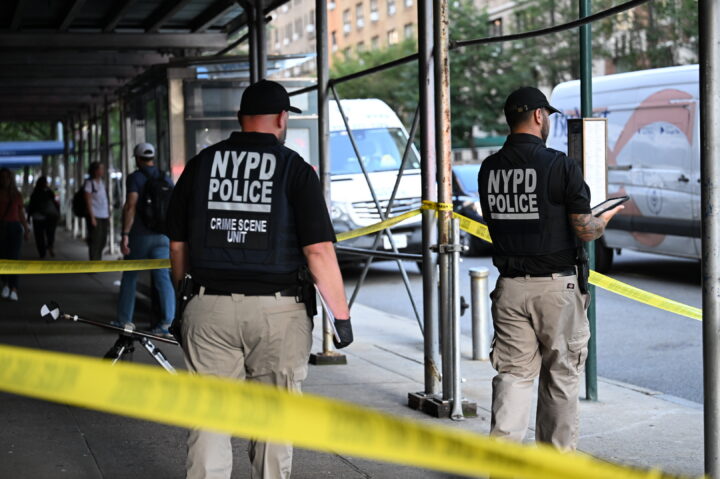
Kyle Mazza/Anadolu via Getty Images
Members of the NYPD Crime Scene Unit investigate the scene of a stabbing attack at the intersection of West 86th Street and Amsterdam Avenue in Manhattan, New York, United States, on July 23, 2026.
Hate crimes — particularly against Jews — have spiked in New York City during the first seven months of Mayor Zohran Mamdani’s administration, new data from the NYPD shows.
The police department’s July statistics show general declines thus far in 2026 shootings and murders, and even in hate crimes against certain ethnic groups. But bias offenses were up overall last month, and during the entire period since Mamdani took office on the first of the year, with hate crimes targeting Jewish New Yorkers continuing to make up the majority of such incidents.
“More than half of the confirmed hate crimes for the first seven months of the year, or 56.9%, were anti-Jewish hate crimes, despite Jewish New Yorkers making up only 10% of the city’s population,” the NYPD’s report states.
There were 23 confirmed hate crimes against Jewish people in July of this year, compared to 15 in July 2025. To date, the Jewish community has suffered 205 confirmed criminal antisemitic incidents during Mamdani’s first seven months at City Hall, compared to 189 such transgressions up to this point in the final year of Mayor Eric Adams’ tenure.
Mamdani, whose broadsides against Israel and its leadership have both powered his political ascent and provoked warnings over potential repercussions for the city’s Jewish community, faced questions over the uptick in bias crimes after an unrelated press conference Monday morning.
“There’s no room for hate in our city. It will never be tolerated, it will never be accepted, and we know that this is something that we have to fight with every single tool at our disposal,” the democratic socialist mayor said. “The work to uproot antisemitism out of the city is one that will continue until we see hate crimes come to an end in the city.”
The mayor again underscored his increased investment in a hate crime prevention program, which allocates millions of dollars to a range of nonprofits.
July witnessed a double stabbing of an Asian American and a Jewish man on the holiday of Tisha B’Av, during which the assailant allegedly shouted “Allahu Akbar” and “Justice for Islam” as he passed a synagogue displaying the Israeli flag, before attacking the second victim, who was wearing a kippah. The accused, Raul Morales, now faces a raft of hate crimes charges.
Politico reported that NYPD Commissioner Jessica Tisch visited The Jewish Center — the Modern Orthodox synagogue where the victim Moshe Grunhaus had been praying before the stabbing — on Friday to denounce “antisemitic rhetoric” and assure the community of her continued protection.
Mamdani decided to keep Tisch, an Adams appointee, in her role when he entered office. Tensions between the two have surfaced on several occasions, most recently when the mayor continued to publicly toy with the idea of arresting Israeli Prime Minister Benjamin Netanyahu despite lacking the legal authority to do so.
Anti-Muslim offenses have also risen under Mamdani, but in much smaller numbers: five this past month compared to two the July prior, and 26 so far this year as opposed to 16 during the same period in 2025.
The NYC mayor cited violence against Jews to justify his eight-figure funding boost for the city’s Office for the Prevention of Hate Crimes
Michael Nagle/Bloomberg via Getty Images
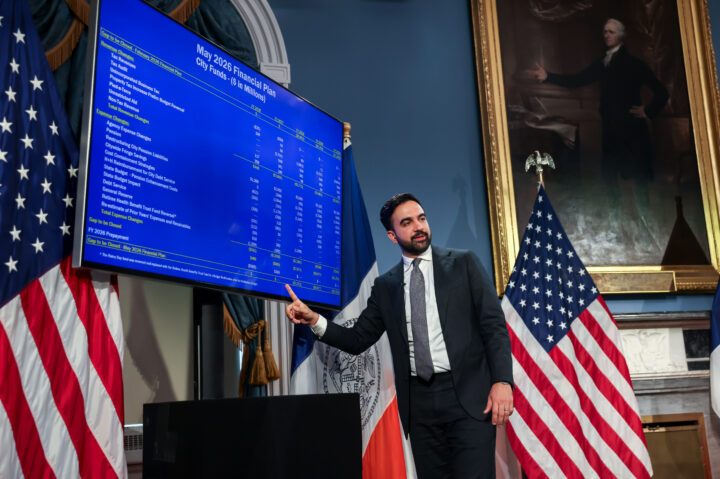
New York City Mayor Zohran Mamdani presents the fiscal year 2027 executive budget at City Hall in New York, US, on Tuesday, May 12, 2026.
New York City Mayor Zohran Mamdani announced his administration would allocate $26 million annually toward anti-hate crimes measures, signaling that the significant funding increase — promised during the campaign season — would go toward a program that funds both leading Jewish organizations and left-wing nonprofits.
The new funding, part of a sprawling $124.7 billion budget that would resolve the city’s fiscal woes largely by delaying pension payments, would go toward the city’s Office for the Prevention of Hate Crimes — though the mayor provided few details about the funds’ destination in a Tuesday afternoon press conference. He did, however, acknowledge that Jewish New Yorkers represent a minority of city residents yet a majority of hate crime victims, and promised the anti-hate crime campaign would operate “alongside” the Mayor’s Office to Combat Antisemitism to reduce the number of prejudice-inspired incidents.
“These are investments in programs that have been found to be effective. And too often the only response offered to a hate crime is exactly that, it’s a response to the hate crime. We want also to do the work of preventing those hate crimes,” he said, adding that his antisemitism czar, Phylisa Wisdom, would soon embark on a “listening tour” to develop a “municipal approach to fighting antisemitism.”
Additional details were not immediately available, and Mamdani’s office did not respond to questions from Jewish Insider.
Initial reports asserted that this represented a $23 million increase over a prior $3 million budget. That $3 million figure matches the amount the Partners Against the Hate (P.A.T.H.) FORWARD Initiative, which operates under the Office for the Prevention of Hate Crimes, provided last year to “50 community-based organizations representing the city’s diversity to help combat hate and bias motivated incidents,” according to an analysis the Mamdani administration also released on Tuesday.
A list of subvendors for the initiative released last year features a wide range of social service providers, including a number based in or supporting Jewish communities across the city. Sources at several of these participating nonprofits did not immediately answer questions as to whether P.A.T.H. Forward might benefit from the new spending — and one, Devorah Halberstam of the Jewish Children’s Museum of Crown Heights, told JI she had “no idea, because he just announced it.”
P.A.T.H. Forward also provides resources to multiple leftist organizations, such as Jews for Racial and Economic Justice and the Council on American-Islamic Relations, that supported Mamdani’s election through political affiliates.
The New York governor defended her plan to establish a felony penalty for protesters who come within 25 feet of a religious institution
Will Waldron/Albany Times Union via Getty Images
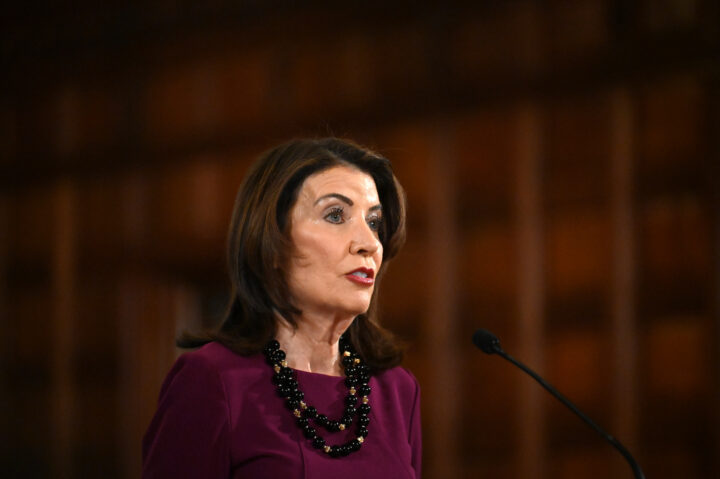
Gov. Kathy Hold takes questions following a roundtable with local government leaders on housing development on Monday, March 23, 2026, at the Capitol in Albany, N.Y.
New York Gov. Kathy Hochul issued a challenge Wednesday to those seeking to challenge her plan to penalize protesters who get too close to religious institutions — “Bring it on.”
Announcing new state programs to provide support and security for organizations deemed “vulnerable to hate crimes,” the governor, a Democrat, took questions regarding her proposal to bar demonstrations of more than two people from occurring within 25 feet of a house of worship. Violators would potentially face felony charges.
“I believe I have the right to protect people’s constitutional right to free exercise of religion,” Hochul told reporters when asked if she had concerns whether the legislation might provoke challenges on First Amendment grounds. “So if that means we test it in court, bring it on.”
Hochul’s bill, currently under consideration in the state Legislature, differs significantly from “buffer zone” legislation recently passed in the New York City Council: The municipal measure does not include new criminal penalties, but simply compels the NYPD to establish a written policy for securing access and egress for worshippers during protests. It originally suggested that police might keep rallies up to 100 feet from doorways and driveways at religious facilities, but Council Speaker Julie Menin’s team removed such language following consultations with attorneys and local law enforcement.
Observers consider the draft statute in Albany much stronger, and passing it has become a priority for leading Jewish organizations, after pro-Hamas demonstrators massed outside synagogues in Queens and Manhattan in recent months. Civil liberties groups have complained the law would restrict free speech. One reporter asked why the bill did not establish an even larger protest-free zone.
“I think 25 feet is reasonable,” Hochul said at the event.
The Supreme Court has in the past approved of limited restrictions on rallies so long as the rules are narrowly tailored and do not discriminate based on the content of demonstrators’ speech. But it also has struck down buffer-zone laws applying to abortion clinics for failing to meet those standards.
The potential terrorist attack against Temple Israel is a reminder of the consequences of what can happen when antisemitism is allowed to become normalized in our society
JEFF KOWALSKY/AFP via Getty Images
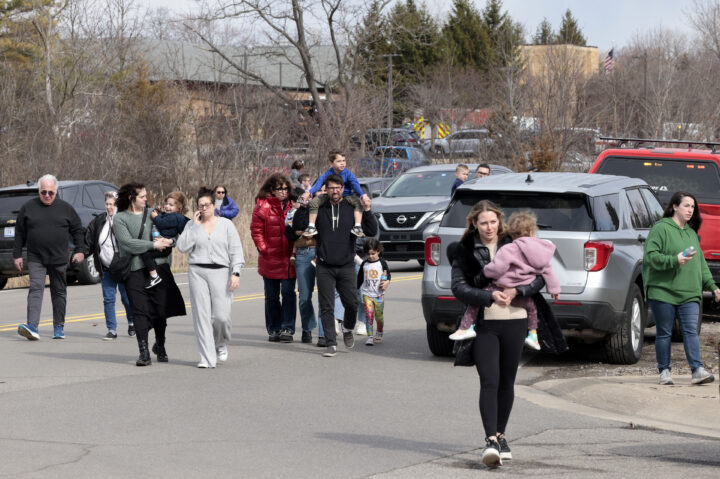
Families leave after being reunited outside Temple Israel synagogue after an assailant rammed his truck into the building in West Bloomfield, Michigan, a suburb of Detroit, on March 12, 2026.
It’s a testament to the level of security, staff preparation and good fortune that a potential terrorist attack against Temple Israel in suburban Detroit was foiled yesterday. The fact that no one other than the heavily armed perpetrator was killed after driving a vehicle filled with explosives into a synagogue filled with preschoolers, counts as something of a miracle.
It’s also a reminder of the consequences of what can happen when antisemitism is allowed to become normalized in our society, moving unchecked through our social media feeds and political discourse, all amid the record levels of hate crimes committed against Jews simply for their identity.
Even as politicians are reflexively speaking out against antisemitism in the aftermath of the attack, it’s hard to forget the poisonous rhetoric many on the extremes have advanced that could easily activate a lone-wolf extremist to commit an unspeakable crime.
On the hard left, opposition to Israel’s war in Gaza has morphed into accusations of genocide, attacks against AIPAC as a uniquely sinister organization, conspiracy theories that Israel tricked the U.S. into war with Iran and euphemizing the support of terrorism as merely being “pro-Palestinian.”
Rep. Ro Khanna (D-CA), who has emerged as one of his party’s leading anti-Israel voices as he mulls a presidential campaign, had the audacity to say he “stands with” antisemitic streamer Hasan Piker — along with New York City Mayor Zohran Mamdani, who has refused to condemn “globalize the intifada” rhetoric and anti-Israel Democratic Senate candidate Graham Platner — during the Michigan synagogue terror attack.
Former Obama deputy national security advisor Ben Rhodes and his “Pod Save America” colleagues are now declaring that anyone who supports the Iran war — a group that may well include some Jewish Democrats in Congress who are sympathetic to the operation’s aims, even if they have reservations — should be primaried, and have no place within the Democratic Party.
On the hard right, extremist podcasters are broadcasting the most undiluted antisemitism in media since the days of Father Coughlin in the 1930s. Tucker Carlson has devoted much of his show to promoting conspiracy theories about Jews, while other social media influencers have found that attacking Israel and questioning Jewish influence is a ticket to building a niche audience in online spaces. Gatherings of young right-wingers have all too often become cesspools of anti-Jewish hate.
Sen. Ted Cruz (R-TX), who has emerged as a leader in speaking out against right-wing antisemitism, cautioned that Republicans may be losing the fight to contain the scourge — especially among a younger generation of conservatives.
All this is happening amid relative bipartisan silence towards the social media companies that often profit through division, using tech-tailored algorithms to feed extreme content to unsuspecting audiences. It’s no coincidence that polls indicate dramatic levels of antisemitism and extremist views from the youngest Americans, who are marinating in echo chambers instead of reading the headlines dispassionately from newspapers, as the generation before them did.
That the only fatality from yesterday’s attack in West Bloomfield Township, Mich., was the assailant is a testament to the time, energy and money that the Jewish community, with some federal assistance, has dedicated to ensuring security for its many institutions across the country. The FBI’s recent active shooter preparedness drill held for clergy and staff at the synagogue undoubtedly led them to be prepared in that fraught moment Thursday.
But a strong defense — hardening security for Jewish institutions — requires a complementary offense, in leaders confronting rising extremism whenever it rears its ugly head. It shouldn’t take the avoidance of a mass casualty event to get candidates across the political spectrum to start speaking out against antisemitism, as Platner did on Thursday.
We saw some signs of growing courage from political leaders this week in calling out the hate emanating from their fringes. Cruz, who called Carlson “the single most dangerous demagogue in this country,” at an antisemitism conference this week co-sponsored by the Republican Jewish Coalition and National Review, was joined by Sens. Tom Cotton (R-AR) and Jim Banks (R-IN) in speaking out against anti-Jewish hate.
The moderate Democratic think tank Third Way directly confronted Khanna on Thursday for his praise of Piker and other anti-Israel figures in the party. “Our side has a real antisemitism problem too that too many Democrats are failing to face squarely,” Third Way VP Matt Bennett bluntly told JI, in one of the few public intraparty acknowledgements about the growing threat.
The country feels like it’s at a boiling point, with few institutional leaders providing the guardrails necessary to contain growing extremism and hate. We saw on Thursday where unchecked extremism leads. It will take leaders to put principles ahead of political expedience for the wave of antisemitism to subside.
As state Sen. Jeremy Moss, a Democrat who represents the district where the attack took place, wrote: “When I was growing up, antisemitism was primarily in history books and black and white film reels. Today it was in real color right up the road at Temple Israel … This is a fire that will take all of us to snuff out.”
The NYPD released more details on suspect Dan Sohail, who will face a raft of enhanced charges for driving repeatedly into 770 Eastern Parkway
Spencer Platt/Getty Images
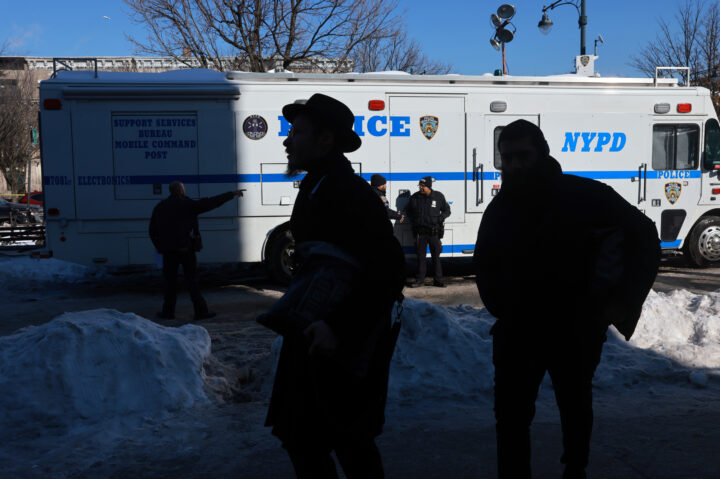
Members of the Hasidic Jewish community gather outside of the Chabad Lubavitch world headquarters, where a man was arrested Wednesday evening after repeatedly crashing his car into a door of the building on January 29, 2026, in New York City.
Police say the 36-year-old who ran his vehicle into the Chabad Lubavitch world headquarters in Brooklyn on Wednesday night had previously attended an event at the synagogue, and was again attempting “to connect with the Lubavitch Jewish community” — but will now face multiple hate crimes charges.
At a Thursday press conference, NYPD Chief of Detectives Joseph Kenny disclosed that Dan Sohail of Carteret, N.J., was the driver who plowed his Honda Accord into the Crown Heights synagogue and yeshiva of the late Lubavitcher Rebbe, Rabbi Menachem Mendel Schneerson. Kenny revealed that Sohail had “recently connected with the Lubavitch community” and attended a “social gathering” at the same location 10 days prior. The vehicle ramming occurred on Yud Shevat, the anniversary of the death of Rebbe Yosef Yitzchak Schneersohn, the previous Lubavitcher Rebbe, a highly significant date for the Lubavitch community that draws large crowds to the Crown Heights area.
“We believe he was in Brooklyn last night to continue his attempt to connect with the Lubavitch Jewish community,” said Kenny, who added: “There are currently no specific or credible threats to synagogues, Jewish sites or any houses of worship citywide.”
Kenny, however, reiterated NYPD Commissioner Jessica Tisch’s promise to add additional uniformed cops, patrol officers and even “counter-terrorism resources where appropriate” to religious institutions citywide, regardless of affiliation.
The police chief revealed the Brooklyn district attorney’s office would charge Sohail with multiple counts of attempted assault, reckless endangerment, criminal mischief and aggravated harassment — all with hate crime enhancements, subjecting the accused to further penalties.
Kenny said that Sohail told officers that “his foot slipped” while driving and he “lost control of the car because he was wearing chunky boots.” But this contrasts with security footage the NYPD official said the department recovered from nearby, which he stated showed Sohail parking his vehicle some distance away, approaching the synagogue on foot and removing bollards that blocked the driveway leading to the entrance. Kenny said Sohail then drove his vehicle up to the iconic red-brick building and got out to remove snow obstructing the sidewalk — then repeatedly drove into the entryway through the path he had cleared.
Kenny said that in video footage of Sohail attending an event at the Chabad headquarters earlier this month he “seemed to be very at home with the Jewish community.”
However, Kenny asserted that hate crime charges were appropriate because Sohail targeted the location due to its religious character.
“The hate crime right now is that he basically attacked a Jewish institution. This is a synagogue, it’s clearly marked as a synagogue, he knew it was a synagogue because he attended there previously,” Kenny said. “It’s a hate crime based on his attack of the Jewish synagogue.”
Kenny declined to confirm reports Sohail had visited Chabad houses in New Jersey, and stated he had no criminal record in New York City. In an interview with the New York Times, Sohail’s father denied that his son hated Jewish people, and had told family he planned to convert to Judaism.
Jewish groups praised the move for allowing law enforcement to increase its security presence at religious institutions, which is often paid for by the houses of worship themselves
Brandon Bell/Getty Images
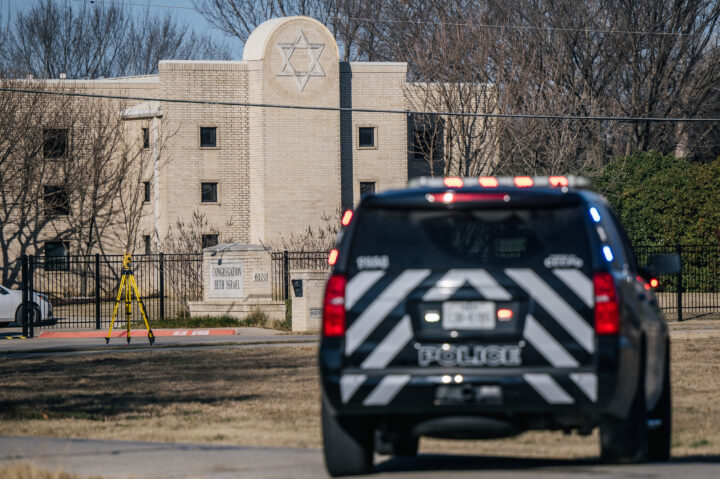
A law enforcement vehicle sits near the Congregation Beth Israel synagogue on January 16, 2022 in Colleyville, Texas.
The House and Senate’s negotiated 2026 funding package for the Department of Justice includes funding for state and local law enforcement specifically allocated for protecting religious institutions.
The explanatory report accompanying the bill, released Monday, instructs the Department of Justice to allocate at least $5 million in DOJ law enforcement grant funding to agencies “seeking to enhance security measures for at-risk religious institutions and to address the precipitous increases in hate crimes targeting individuals on the basis of religion.”
Such funding, aimed at providing law enforcement with additional resources to step up their security presence at synagogues and other houses of worship, has been pursued by Jewish community groups particularly amid rising antisemitic attacks in the wake of the Oct. 7, 2023, attacks in Israel.
Nathan Diament, the executive director of the Orthodox Union Advocacy Center, told Jewish Insider the issue is one that the OU has been working on for some time, noting that many police seen stationed outside synagogues are often off-duty and being paid by the synagogues themselves, not their municipalities.
“It always struck us as a little crazy that communities have to pay out of pocket” to ensure police protection, Diament said, while noting that local law enforcement are often low on funding and cannot always spare the personnel. By dedicating some of the pool of federal funds that the Department of Justice provides annually to local law enforcement, police would be able to deploy on regular duty or on overtime, Diament said.
He said that OU had worked with the Justice Department under the Biden administration to issue guidance to police instructing them that they can, but were not required to, use the grant funding to deploy officers to protect religious institutions. He said he’d had discussions with Trump administration DOJ personnel about specifically allocating existing grant funding to that purpose earlier this year, but the officials said that congressional authorization would be needed.
Diament described this language in the report as a first step forward. He said that OU is hoping to see the language incorporated into the bill text itself before passage.
He said that the program could grow in the future depending on needs and the political debates on police funding, and emphasized that — if the bill passes — OU will urge the DOJ to allocate more than the allotted minimum of $5 million.
Diament also noted that providing police protection at no cost to Jewish institutions can help other security funding provided through the Nonprofit Security Grant Program “go further” and be applied to other security needs.
Diament credited Sen. Jerry Moran (R-KS), the chair of the Senate Appropriations Committee subcommittee responsible for Justice Department funding, and Rep. Grace Meng (D-NY), the ranking member of the corresponding House committee, as key champions of the new provision.
Moran cited the killing of Sarah Milgrim, an Israeli Embassy employee and Kansas resident shot and killed at the Capital Jewish Museum last year, in a statement on the effort.
“In the months since then, the Jewish community has been rocked by numerous attacks that have prompted increased police presence at synagogues and houses of worship across the country,” he continued. “The freedom to worship is one of the most fundamental rights enshrined in our Constitution. While it is disheartening that places of worship and faith-based organizations are coming under attack, we have a responsibility to protect these institutions and in doing so, protect the rights of Americans of all faiths.”
“In recent years, there has been a significant rise in attacks on houses of worship of Americans of many faiths, including the Jewish community,” Meng said in a statement to JI. “As Ranking Member of the House Appropriations Subcommittee on Commerce, Justice, Science, and Related Agencies, public safety is a top priority for me. That’s why I was proud to work across the aisle to secure millions in federal funds to make it easier for houses of worship to hire security personnel. This bipartisan win will help stop incidents before they occur and builds on existing programs that help at-risk institutions enhance their physical security.”
The six-point security plan spearheaded by the Jewish Federations of North America and a coalition of more than 40 Jewish groups in response to the Capital Jewish Museum shooting also called for the government to “increase funding for local police and law enforcement to create capacity for both monitoring and protecting Jewish institutions” because “[t]he demands on local and state law enforcement far outpace their capacity to meet the need, which disproportionately affects targeted communities like the American Jewish community.”
“At a time when antisemitic threats are growing more frequent and more dangerous, federal funding to protect at-risk institutions, prevent hate crimes and support Holocaust education are essential,” Lauren Wolman, the Anti-Defamation League’s senior director of government relations and strategy, said in a statement. “ADL welcomes language in the FY2026 Conferenced CJS, E&W, and Interior funding bill that dedicates resources to help law enforcement enhance security for at-risk religious institutions and respond to the sharp rise in religion-based hate crimes.”
“We are pleased to see continued support for key programs that strengthen law enforcement, prevention and education,” Wolman continued. “The reality is that the need far outpaces current investment. Combating antisemitism requires sustained resources, coordination, and accountability across the federal government.”
Eric Fingerhut, the CEO of JFNA, also praised the new funding.
“It is critical that local law enforcement agencies have the resources to protect the Jewish communities they serve. Given the rising threats of violence to Jewish events and institutions, local law enforcement definitely needs federal help,” Fingerhut said. “This appropriation is an important recognition of that need and we look forward to working with Congress to develop the most effective and expansive assistance to local law enforcement possible.”
The negotiated bill also preserves funding for a series of hate crimes prevention grant programs supported by major Jewish community groups, providing $35 million under a series of programs, for which the original House version of the bill had not allocated any funding and which the Trump administration had aimed to slash. The Senate proposal included the $35 million in funding.
It also provides $20 million for the Department of Justice’s Community Relations Service — a cut of $4 million from 2025 funding levels. The House version of the bill and the administration had aimed to shutter the CRS, which is charged with helping to mediate communal conflicts based on various forms of hatred and discrimination, completely.
About one-quarter of Americans hold antisemitic attitudes, according to research from Robert Kraft’s Blue Square Alliance Against Hate
Erik McGregor/Getty Images
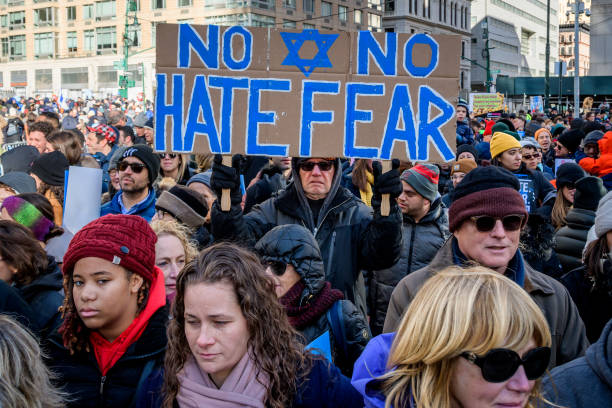
Participant holding a sign at the rally. Thousands of New Yorkers joined community leaders and city and statewide elected officials in Foley Square at the No Hate. No Fear. solidarity march in unity against the rise of anti-semitism.
Antisemitism in America has plateaued after a sharp rise in anti-Jewish hate incidents in the immediate aftermath of the Oct. 7, 2023, terrorist attacks in Israel — yet fewer Americans are pushing back against it, according to a survey released Thursday by the Blue Square Alliance Against Hate.
About 25% of the population has consistently held antisemitic attitudes since June 2024, the 2025 Antisemitism Landscape Survey reported. That’s a notable rise from the recent past, but the survey found that the growth of antisemitic views has slowed significantly.
The survey, which has been conducted twice a year since June 2023, polled 7,028 American adults from Aug. 1-Sept. 30. It found that 58% of respondents think antisemitism is a minor problem or not a problem at all, a sizable majority, though one that has remained fairly steady for the past two years.
“This is an alarming moment for the United States,” said Adam Katz, president of the Blue Square Alliance Against Hate, a nonprofit founded by New England Patriots owner Robert Kraft, which recently rebranded from the Foundation to Combat Antisemitism. “At a time when national data shows clear increases in antisemitic incidents and hate crimes, our survey results show a decline in the number of Americans who see antisemitism as a major problem.”
Katz called the stabilization of Americans expressing antisemitic attitudes a “glimmer of hope that hate is no longer spreading.”
At the same time, the report found that the number of Americans willing to speak out against antisemitic behavior is dropping compared to before Oct. 7.
The number of “allies” to American Jews — defined as “well informed and aware of antisemitism, already activated to stand up to Jewish hate” — stayed consistent at 9% between December 2024 and August 2025, though that’s down from 15% in June 2023.
The number of Americans categorized as “haters” — defined as “blatantly prejudiced against Jews and tend to be outspoken about it” — decreased slightly from 11% in 2024 to 10% in 2025, though that’s up from 6% in 2023.
Nearly half (46%) of Americans think Jews can “handle antisemitism on their own,” which has stayed largely consistent since 2024.
Only around a third (33%) of respondents expressed belief that other people will disapprove of them if they don’t stand up for Jews who are experiencing prejudice, a number that is consistent with the December 2024 poll and slightly less than 39% in December 2023.
Polling was conducted while the Israel-Hamas war was still underway, with many participants expressing the view that supporting Jews might be interpreted as siding against Palestinians.
Belief in classic antisemitic tropes — such as “Jews are penny pinchers” and “Jews run the media” — are softening slightly, the survey found, although they are still higher than 2023 numbers.
The last year has featured several high-profile attacks on Jews around the U.S., including the arson attack against Pennsylvania Gov. Josh Shapiro’s home, the Washington shooting of two Israeli Embassy staffers outside the Capital Jewish Museum and the Colorado firebombing of a hostage solidarity event.
The co-chairs of the Senate antisemitism task force called the latest FBI hate crimes report ‘troubling’ and ‘disturbing’

U.S. Senate
Sens. Jacky Rosen (D-NV) and James Lankford (R-OK)
Sens. James Lankford (R-OK) and Jacky Rosen (D-NV), the co-chairs of the Senate antisemitism task force, highlighted concerns about the latest FBI hate crimes statistics showing a record-high level of antisemitic hate crimes in 2024, and called for further action.
The FBI reported earlier this week that hate crimes against Jews accounted for 70% of all religiously motivated hate crimes in 2024 and hit their highest level since the FBI began collecting data in 1991, even as overall hate crimes rates across the country decreased. A total of 1,938 antisemitic hate crimes were reported to the FBI’s collection program last year.
“The FBI’s latest hate crimes report paints a troubling picture. Jewish Americans continue to be targeted simply because of their faith and heritage in schools, synagogues, and in their own neighborhoods,” Lankford said in a statement. “This disturbing trend demands urgent attention. I remain committed to confronting antisemitism and strengthening reporting to fully understand the scope of this threat. By working together, Congress, the Administration, and law enforcement can help ensure that every Jewish American can live without fear.”
Rosen said, “All Americans should be deeply troubled by the sharp increase in anti-Jewish hate crimes detailed in this report.”
“As one of the co-chairs of the Senate Bipartisan Task Forces for Combating Antisemitism, I remain steadfast in our commitment to work across party lines to root out the scourge of antisemitism,” Rosen continued. “We’ll continue pushing to ensure the federal government keeps Jewish Americans safe from discrimination, violence, and hate.”
It’s the highest number of anti-Jewish hate crimes ever recorded by the bureau since it began collecting data in 1991

Tom Brenner For The Washington Post via Getty Images
Metropolitan Police Department and Federal Bureau of Investigation officers stand guard at a perimeter near the Capital Jewish Museum on May 22, 2025 in Washington.
The FBI reported on Tuesday that the American Jewish community remains the most targeted religious group, accounting for nearly 70% of all religiously motivated hate crimes in 2024, even as overall hate crimes in the country have decreased.
Hate crimes targeting Jews had plateaued following a sharp increase immediately after the Oct. 7 Hamas terror attack.
In 2024, 1,938 anti-Jewish hate crimes were reported to the FBI’s data collection program out of 3,096 reported religiously motivated hate crimes. The year 2024 saw the highest number of anti-Jewish hate crimes ever recorded by the bureau since it began collecting data in 1991 — and an increase compared to 1,832 incidents the year prior, which accounted for 67% of all religiously motivated hate crimes that year.
Some of that increase could be attributed to improvement in data collection, according to the FBI. That increase comes as hate crime incidents across the country slightly decreased from 11,862 in 2023 to 11,679 in 2024.
Fifty percent of hate crime incidents across the country in 2024 were motivated by bias based on race, ethnicity or national origin, with reported anti-Black hate crimes comprising the single largest portion of those incidents (51% of 7,043 reported offenses).
The FBI also reported that the number of anti-Muslim hate crimes (228) and anti-LGBTQ+ hate crimes (2,390) were slightly down compared to 2023.
Jewish organizations responsible for tracking threats to the Jewish community expressed concern over the findings, which come months after two deadly antisemitic attacks in Washington and Boulder, Colo.
Michael Masters, national director and CEO of the Secure Community Network, said that the current threat environment for American Jews is “unlike anything in modern memory.”
“We have documented individuals echoing the rhetoric of designated foreign terrorist organizations and plotting heinous attacks on our houses of worship, schools, and centers of Jewish life,” Masters said in a statement. “This reality demands accurate, timely reporting so law enforcement and Jewish security partners can respond swiftly.”
Jonathan Greenblatt, CEO of the Anti-Defamation League, said in a statement, “Since the Hamas-led Oct. 7 massacre in Israel, Jewish Americans have not had a moment of respite and have experienced antisemitism at K-12 school, on college campuses, in the public square, at work and Jewish institutions. Our government and leaders must take these numbers seriously and enact adequate measures to protect all Americans from the scourge of hate crimes.”
Ted Deutch, CEO of the American Jewish Committee, called for “leaders of every kind — teachers, law enforcement officers, government officials, business owners [and] university presidents [to] confront antisemitism head-on” in response to the FBI data.
“Jews are being targeted not just out of hate, but because some wrongly believe that violence or intimidation is justified by global events,” Deutch said. “With the added climate of rising polarization and fading trust in democracy, American Jews are facing a perfect storm of hate. Whether walking to synagogue, dropping their kids off at school, sitting in restaurants, or on college campuses, Jews are facing a climate where fear of antisemitism is part of daily life.”
“This is unacceptable — the targeting of Jews is not a Jewish problem, it is a society-wide issue that demands a society-wide response.”
Please log in if you already have a subscription, or subscribe to access the latest updates.
 Continue with Google
 Continue with Apple