




































































Sen. Chris Coons (D-DE) and Rep. Greg Meeks (D-NY), who are both expected to hold powerful committee leadership roles if Democrats win both chambers, have recently made legislative moves that signal a harsher stance on Israel
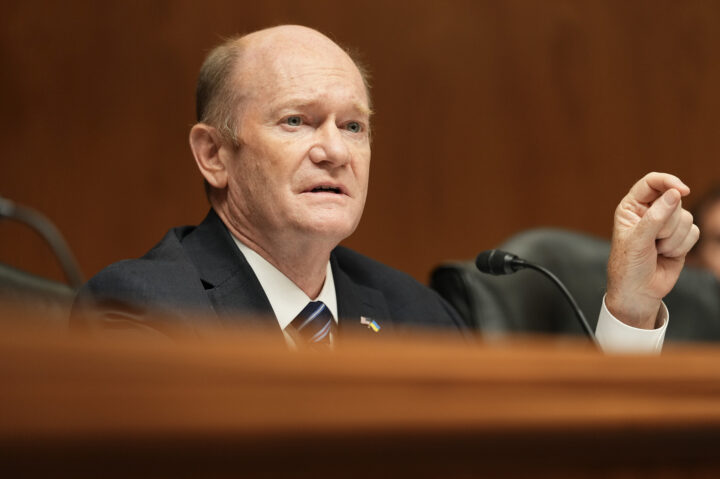
Eric Lee/Getty Images
Sen. Chris Coons (D-DE) speaks at the Senate Appropriations Committee on Capitol Hill on July 14, 2026 in Washington, DC.


 Add JewishInsider on Google
If Democrats take control of Congress next year — or even if they win back a majority in only the House of Representatives — expect a legislative agenda that’s a lot tougher on Israel than it has been in a long time.
With growing support among House Democrats for legislation restricting U.S. aid and arms sales to Israel, bills such as the Block the Bombs Act, the Ceasefire Compliance Act or measures similar to this summer’s vote on cutting aid to Israel could come to the House floor, and continued fights over the U.S.-Israel relationship in funding bills and other legislation seem likely.
But the top target for senior Democrats at the moment is targeting settlement activity and settler violence in the West Bank. Asked by Jewish Insider at a press conference on Wednesday what Israel-related legislation Democrats might bring forward for a vote, House Minority Leader Hakeem Jeffries (D-NY) — who has generally been a reliable supporter of the U.S.-Israel relationship — pointed to a bill imposing sanctions related to West Bank violence.
“That now has broad support across the House Democratic Caucus family [and] is certainly a legislative step that should be considered in order to push back aggressively against the out of control settler violence in the West Bank,” Jeffries told Jewish Insider. “That cannot continue.”
Responding to JI's @marcrod97, Hakeem Jeffries suggested the West Bank Violence Prevention Act — which seeks to curb settler violence by imposing sanctions on perpetrators and potentially Israeli officials — could be up for a vote next year should Democrats take back the House. pic.twitter.com/2S8upRRz37
— Jewish Insider (@jewishinsider) September 23, 2026
The West Bank Violence Prevention Act would reimplement the West Bank sanctions regime established by the Biden administration and repealed by the Trump administration, which sought to penalize Israeli settlers who commit acts of violence. But the legislation also clearly targets members of the Israeli government connected to or who have permitted settler violence, as well as others who have provided support for such activities, a step the Biden administration never took.
The bill has 173 total co-sponsors — more than any other Israel-related Democratic bill introduced this Congress. Its supporters include all top House Democratic leaders, as well as the leaders of several key committees and even several moderate pro-Israel lawmakers.
There’s similar movement on West Bank issues on the Senate side. Sen. Chris Coons (D-DE), generally a strong ally of Israel who is in line to chair the Senate Foreign Relations Committee if Democrats take the upper chamber, introduced a bill on Wednesday with nearly 20 colleagues to sanction companies, financial institutions and Israeli officials involved in settlement construction in the controversial E1 area of the West Bank, which critics say would sever the West Bank from east Jerusalem.
And a separate Senate measure demanding a report on violence in the West Bank and the killings of U.S. citizens by Israeli settlers and security forces — which could trigger the cut-off of U.S. aid to Israel — picked up more than 20 co-sponsors, including Sen. Richard Blumenthal (D-CT), generally a strong supporter of the Jewish state.
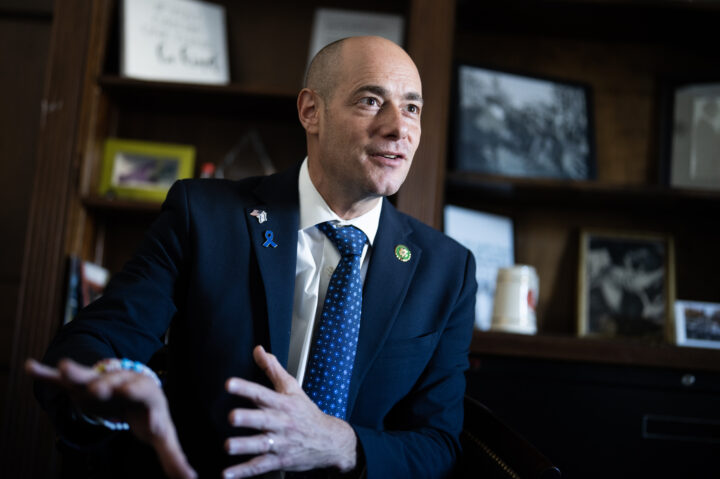
Also among those expected to hold positions of power Rep. Greg Meeks (D-NY), who is in line to chair the House Foreign Affairs Committee, recently announced a hold on a $2.8 billion sale of bombs to Israel, financed by U.S. foreign military funding.
From their anticipated committee leadership posts, Coons and Meeks would hold significant sway over the direction of Democratic policy on Israel and have particular power to guide hearings on and investigations into the U.S.-Israel relationship, the West Bank and more.
At the same time, Coons is one of the few Senate Democrats who have consistently opposed resolutions led by Sen. Bernie Sanders (I-VT) to halt various arms sales to Israel, and Meeks opposed the amendment led by Rep. Thomas Massie (R-KY) to cut off U.S. aid to Israel.
A Democratic-led Congress would also likely bring more of those efforts to restrict or cut off both aid and arms sales to Israel. More than 100 House Democrats, nearly half of the caucus, supported efforts to cut off U.S. aid to Israel earlier this year. In the Senate, 40 Democrats have voted for at least one of Sanders’ resolutions to halt specific arms sales to Israel, and several Democratic candidates have said they would have voted the same way.
In the House, two bills pushing for stringent conditions on U.S. arms sales to Israel have been gaining steam.
The most prominent — and most punitive — of the bills is the Block the Bombs Act, on which Congressional Progressive Caucus Chair Rep. Greg Casar (D-TX) has said his caucus would push for a floor vote in the next term.
The bill would impose unprecedented restrictions on U.S. arms sales to Israel not applied to any other U.S. ally, preventing the transfer or sale of bombs, bomb-guidance kits and tank and artillery ammunition to Israel unless Congress passes a specific law authorizing each individual sale or transfer.
Congress would be required to delineate what specific purposes for which those weapons could be used, and Israel would be asked to provide written assurances that it would comply with those restrictions. Given the gridlock on Capitol Hill and the months it would take to approve any arms sales to Israel — if they could be moved past objections from anti-Israel members at all — critics say the bill would effectively place an arms embargo on Israel for those systems.
Though the Block the Bombs Act started with just 22 co-sponsors in 2025, it has grown to 82, including a handful of more moderate Democrats, a number that is likely to grow further after the midterms, with numerous expected Democratic freshmen pledging on the campaign trail to support the bill.
Alternative measures have been introduced to condition U.S. arms sales to the Jewish state, including the Ceasefire Compliance Act, led by Rep. Sean Casten (D-IL), with 53 co-sponsors. That bill would cut off any arms transfers or sales to Israel if it conducts any strikes inside Gaza, which could only be restored subject to a specific agreement by Israel that it will not use any U.S.-origin weapons inside Gaza or the West Bank.
The legislation would also impose various other conditions on arms sales to Israel related to compliance with the 20-point peace plan for Gaza, the establishment of Palestinian Authority governance in Gaza and steps to prevent West Bank violence or annexation.
Casten’s bill is backed by J Street, the progressive Israel advocacy group that Democratic leaders have increasingly leaned on as a validator on Israel policy issues, such as during the debate in the caucus over the Massie amendment (which J Street opposed).
Speaking broadly, Jeffries told JI that Democrats’ policy should be “anchored in two different principles”: supporting “Israel’s right to exist as a Jewish and democratic state” alongside a peaceful and prosperous Palestinian state to provide “the Palestinian people … the dignity and self-determination that they long deserved.”
Also worth watching: the next U.S.-Israel memorandum of understanding on military aid is set to be finalized during the next Congress. Expect real fights on the Hill, under Democratic leadership, over whether to continue appropriating funding for military aid to Israel and even over the future of U.S.-Israel cooperative military programs in legislation like the National Defense Authorization Act.
Whether negotiators believe that further aid to Israel would actually be passed by a hostile Congress could also be a factor that shapes the MOU itself.
Democratic control of either chamber is also likely to further fuel fights over the future of the U.S. relationship with the United Nations Relief and Works Agency, which were a repeated battle in the divided Congress in 2024.
This term, 79 House Democrats introduced legislation to restore funding to the scandal-plagued agency, including Rep. Rosa DeLauro (D-CT), who is likely to chair the House Appropriations Committee in the upcoming term if the Democrats win back the House.
House Foreign Affairs Committee Ranking Member Greg Meeks said the sale ‘raises grave, unresolved concerns’ about how munitions would be used in Gaza and Lebanon

Kevin Carter/Getty Images
U.S. Capitol building on July 12, 2026 in Washington, DC.
Congressional Democrats are taking steps to attempt to halt a planned $2.8 billion sale of heavy bombs to Israel, which is reportedly set to be financed with U.S. foreign military funding.
Rep. Greg Meeks (D-NY), the ranking member of the House Foreign Affairs Committee, announced he is placing a procedural hold on the sale, citing concerns that the weapons would be used in violation of U.S. and international law.
“I remain firmly committed to Israel’s security and its ability to defend itself against serious regional threats,” Meeks said in a statement. “But the Trump administration’s proposed sale of 40,000 2,000-pound bombs, some of the most destructive munitions in our arsenal, raises grave, unresolved concerns about how these munitions could be used in densely populated areas of Gaza and Lebanon.”
Meeks, who has historically been a strong supporter of Israel, added that the administration had failed to provide “sufficient assurances” that the weapons would be used in line with American law and with protections for civilians.
“I therefore will not clear this sale at this time. This decision does not diminish Congressional support for Israel’s legitimate defense needs; it reflects Congress’s responsibility to ensure that U.S.-funded weapons are used lawfully, responsibly, and with meaningful safeguards for human life,” Meeks continued.
The administration can — and has in the past — sidestepped such efforts by Meeks, but doing so has historically been an unusual step.
Meanwhile, Sen. Chris Van Hollen (D-MD), who has helped lead efforts in the past to force Senate votes to block military sales to Israel, also vowed to step in.
“Trump is sending $2.8 BILLION of bombs paid for by YOU, the American taxpayer, to a govt led by a wanted war criminal,” Van Hollen said on X. “All while Netanyahu keeps bombing Gaza & blocks justice for Americans killed on his watch. How is this America First? We will work to stop it.”
‘That’s not where America is, that only happens in certain parts — like New York City now, apparently — deep, deep, deep blue,’ Meeks said

Michael M. Santiago/Getty Images
Congressional candidate Claire Valdez speaks during a Get Out the Vote (GOTV) rally at Kings Theater on June 18, 2026 in New York City.
Some moderate and establishment Democrats are raising alarms over the surge of democratic socialists in New York City congressional primaries on Tuesday — which took down two Democratic incumbents. But others are dismissing the phenomenon as one localized to New York City and not applicable to the party at large.
Rep. Greg Meeks (D-NY), a longtime Democratic leader from Queens, lamented Tuesday’s results, particularly Rep. Adriano Espaillat’s (D-NY) loss.
Meeks told reporters that the party as a whole is not a socialist party, and that socialist ideas are very much out of step with the country overall. He said he doesn’t see the party headed in that direction, potentially outside of certain cities.
“That’s not where America is, that only happens in certain parts — like New York City now, apparently — deep, deep, deep blue,” Meeks said. If the entire party follows the same path, “that means that all the other seats that are not [deep blue], we can never win, which means we will never be in the majority, and we [will] never get anything done.”
Meeks told reporters that he believes in capitalism, not socialism, but argued that free markets and opportunities are fully compatible with assistance to help uplift those in need.
He criticized chants of “you’re next” targeting House Minority Leader Hakeem Jeffries (D-NY) at candidate Claire Valdez’s victory party on Tuesday night as unproductive, and noted that ousting Jeffries would deprive New York of a potential speaker of the House, who would also be the first Black House speaker in history.
Meeks said he hopes that the far left doesn’t become a Democratic version of the GOP’s House Freedom Caucus, which routinely sparks gridlock on the House floor with various obstructionist tactics.
“You can’t criticize the MAGAs and then be like the MAGAs, that’s inconsistent,” Meeks said. “That’s why we have the most unproductive Congress right now. … We shouldn’t be that, we want to be the opposite of that. We want to be productive, we want to be able to go help folks.”
Meeks noted that Black and Hispanic communities in Espaillat’s district overwhelmingly sided with the congressman — with newcomers more supportive of his challenger, Darializa Avila Chevalier.
“I understand that neighborhoods don’t always stay the same … but we got to look at the people that have been there for a long period of time, also, so that they are not just pushed to the side. And how do you work collectively together to bring folks together?” Meeks said.
Pressed on whether some of the candidates’ past statements suggest they want to eliminate Israel, rather than see coexistence and a two-state solution, Meeks told Jewish Insider that “we’ll see when they get there” but “if you go by what they’ve said in the past, that would worry me if they stay [there].”
Rep. Tom Suozzi (D-NY), a leading moderate, told JI, “The results in New York City should be a wake-up call for every common-sense Democrat,” arguing that mainstream Democrats are being caught flat-footed by the far left. He called for the party to “reject extremism and embrace common sense.”
“The DSA is not the Democratic Party, and if moderates don’t organize, the far left will continue pushing our party toward an agenda that is increasingly disconnected from mainstream voters,” Suozzi, a co-chair of the House Problem Solvers Caucus, said. “Americans want leaders who solve problems and bring people together. They also expect Democrats to confront antisemitism clearly and unequivocally.”
He told reporters that Democratic moderates have to “work harder to organize. It’s not enough to just talk at a cocktail party” and complain, they need to “do the hard work necessary to provide solutions to the problems people face in their lives.”
Suozzi told JI that Democrats “should be able to support Israel’s right to exist and defend itself and still work toward a lasting peace that protects innocent lives” and “cannot allow those who excuse antisemitism, tolerate anti-Jewish hatred or traffic in division to define our party.”
Rep. Josh Gottheimer (D-NJ) said that the night was a victory for those who “hate America and hate the U.S.-Israel policy.
“This was a night where bomb throwers won, and problem solvers lost,” Gottheimer said. “Those who believe deeply in supporting the U.S.-Israel relationship, but beyond that, believe deeply in fighting antisemitism — your candidates didn’t win.”
Sen. John Fetterman (D-PA) called the winning NYC candidates “a treasure for Republicans,” referencing some past incendiary comments by Chevalier.
Meanwhile, multiple Democrats facing DSA-aligned challengers say they’re not concerned that the results are an omen for their own races.
Asked whether he’s worried about his primary challenge from state Sen. Julie Gonzales, a former DSA member who dominated internal Democratic Party proceedings, Sen. John Hickenlooper (D-CO) laughed and said simply, “No.”
Rep. Wesley Bell (D-MO), who is facing off next month against former Rep. Cori Bush (D-MO), also said he doesn’t see how Tuesday’s results are applicable to his own race.
“Why would primaries in New York concern me in my race?” Bell told JI. “All politics are local and our base, the folks in St. Louis, are going to make and we’re going to make our case — democracy in action.”
Rep. Jared Moskowitz (D-FL) told JI “they’re making blue seats bluer” and are “not helping us take control of Congress,” but also said that the DSA is “uniquely a New York problem” that doesn’t impact him in Florida. Moskowitz faces a primary challenge from DSA-endorsed challenger.
At the same time, Moskowitz described anti-Israel trends as a larger problem within the Democratic Party.
“I’m concerned about the entire movement, [through]out the whole party,” Moskowitz said. “It’s not just what happened in New York last night.”
Senate Minority Leader Chuck Schumer (D-NY) said that the primaries show that the party as a whole is energized.
“There’s tremendous energy in the Democratic Party in the more moderate places, like we saw in the governorships of New Jersey and Virginia, like Iowa this year, and from the more progressive places like New York, and we’re all fighting hard together to stop [President Donald] Trump,” Schumer said.
Rep. Pete Aguilar (D-CA), the No. 3 House Democrat, said he’s “not at all concerned” about the growing socialist bloc employing similar tactics to the Freedom Caucus, and downplayed the idea that radical nominees would be a drag on other Democrats in the midterms.
“They’re going to put folks in ads all the time,” he said, referring to concerns that Republicans will highlight far-left Democrats to defeat other members of the party. “Republicans don’t have a track record to run on, so they’re going to use other issues. We’ve seen that time and time again.”
Rep. Jamie Raskin (D-MD) said that you “never want to read too much into what’s essentially a local or regional political context.”
He said that he sees the results as an “indisputable” sign of Mayor Zohran Mamdani’s role as “the commanding political force” in the New York City area, and added that “there’s a lot of energy on the progressive side of the political equation in America today. That also seems pretty clear.”
Asked about the role Israel had played in the races, particularly the race between Goldman and Brad Lander, where there were few other obvious policy differences between the two candidates, Raskin noted that both Goldman and Lander “described themselves as liberal Zionists.”
He said that Israeli Prime Minister Benjamin Netanyahu is obviously unpopular in the Democratic Party, and argued that there are many in the party who strongly support Israel but reject Netanyahu, “and that sentiment undoubtedly carried the day.”
“It’s a loss to us on the Judiciary Committee to have Dan Goldman go because he was such an excellent prosecutor and he’s a great cross-examiner of administration witnesses and agendas,” Raskin continued. “But that race undoubtedly turned on questions of the Middle East.”
Sen. Ruben Gallego (D-AZ), a potential 2028 presidential contender, also said the results aren’t a reflection of the whole country or party.
“All politics is local,” Gallego said. “I think that’s what you … see right there. The candidates who ran very localized campaigns, that helped them [win].”
Gallego added that the results show the party is a “big tent, and that’s kind of coming through right now.”
“Every state is different, every place is different, every candidate’s going to be different,” he said.
Sen. Gary Peters (D-MI), who chaired the Democratic Senatorial Campaign Committee for two cycles, said that the results reflect the voter base in New York City.
“Those are really deep blue districts, so you expect that kind of vote in a Democratic primary,” Peters said.
Sen. Raphael Warnock (D-GA) also emphasized that his state is distinct from deep-blue New York City and said, “I think pundits are doing what pundits are doing. The takeaway from last night is that the Democratic Party is a big tent, and we’re having a robust conversation about how to make the lives of ordinary people better.”
Sen. Dick Durbin (D-IL), the outgoing No. 2 Senate Democrat, said he doesn’t know much about the races beyond that Mamdani-backed candidates won. He said he wasn’t aware of the fact that the candidates all shared an anti-Israel approach but called it “worrisome.”
Sen. Tim Kaine (D-VA) said he hadn’t followed the races closely enough to understand the outcomes, but said, “I am a Virginia elected official, and Virginia is what I know really well. I just don’t know enough about New York politics — and I think it would be not a good idea to extrapolate New York City to a national level.”
Meanwhile, members of the far left are treating the results as a mandate for the Democratic Party and a signal of rising popularity for their chosen policies.
“Last night, voters across New York delivered a powerful message: the era of status quo politics is over,” Sen. Bernie Sanders (I-VT) said. “If Democrats regain control of Congress next year, they must listen to the people who put them in office. Status quo establishment policies are not enough. We must be bold. We must take on Oligarchy. We must represent working families and create a government that works for all, not just the few.”
He also called the victories a rebuke of AIPAC, the cryptocurrency and artificial intelligence industries and other moneyed interests.
Rep. Ro Khanna (D-CA) said the results on Tuesday were “the beginning of a new, strong, bold Democratic Party” and pointed to other progressive victories outside of New York City.
All but one of the four Democrats who had opposed the previous war powers effort flipped their votes in support
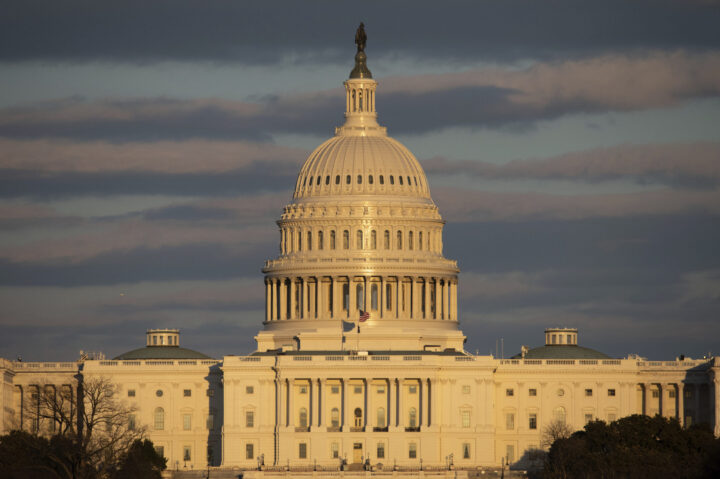
Graeme Sloan/Sipa via AP
The U.S. Capitol Building at sunset in Washington, D.C., on Saturday, March 6, 2021.
The House narrowly voted to block a Democratic resolution to force an end to the war in Iran by a vote of 214-213-1, with all but one of the four Democrats who opposed a similar effort in March changing their votes to support it on Thursday.
Rep. Greg Meeks (D-NY), the top Democrat on the House Foreign Affairs Committee, had held off on calling a vote on the resolution in hopes that he would be able to win over enough Democratic holdouts and Republican defectors to pass the legislation.
Reps. Greg Landsman (D-OH), Juan Vargas (D-CA) and Henry Cuellar (D-TX), who voted last month against a similar resolution, flipped their votes to support the war powers effort. But Rep. Jared Golden (D-ME), who is retiring at the end of his term, voted no again.
On the Republican side, Rep. Warren Davidson (R-OH), who voted for the war powers resolution last time, switched his vote to “present.” Rep. Thomas Massie (R-KY) was the only Republican who voted for the resolution.
A small number of Republicans who have expressed skepticism about the war effort and could have been potential swing votes, including Reps. Lauren Boebert (R-CO) and Nancy Mace (R-SC), did not vote.
Golden said in a statement that the war powers resolution would “weaken our hand” in negotiations with Iran.
“I believe we must maintain a strong negotiation position over Iran’s nuclear program, freedom of movement in the international waters at the Strait of Hormuz, and how to achieve a durable peace between our two nations,” Golden said in a statement.
Meeks said he will likely bring up a war powers resolution for a vote this week, and is waiting to see if several of his colleagues will flip their votes in favor

Tom Williams/CQ-Roll Call, Inc via Getty Images
Rep. Gregory Meeks (D-NY)
Rep. Greg Meeks (D-NY) said he’s aiming to call up a war powers resolution this week to force an end to the war in Iran, but that he’s still working to lock down the support of a few wavering Democratic and Republican lawmakers whose support will be necessary to pass the legislation.
Meeks had considered calling up the legislation before Congress’ two-week recess, but ultimately declined to do so, saying he was waiting until the legislation could pass and he didn’t yet have the votes.
“I’m probably going to do war powers this week. I’m still working [on] it. I’m very close,” Meeks told Jewish Insider. “I’ve got just about all of the Democrats — just about — and [some] Republicans. And I have some that are contemplating, but I don’t know what they’re going to do.”
He said that there are a few lawmakers who voted against a previous war powers effort in the House who are talking to him and considering now voting in favor, but haven’t disclosed their final plans to him yet.
Meeks said that he thinks he will get “just about every Democrat … maybe the exception of one.”
Of the four Democrats who voted against a previous war powers effort, two — Reps. Greg Landsman (D-OH) and Henry Cuellar (D-TX) — said that they would vote for the next war powers resolution, and Cuellar affirmed those plans to JI on Tuesday. Reps. Juan Vargas (D-CA) and Jared Golden (D-ME) haven’t announced their plans yet.
Vargas told JI on Tuesday that he has made up his mind, but declined to preview how he plans to vote. Golden, who is not running for reelection, could be the hardest of the four to flip.
On the Republican side, Rep. Lauren Boebert (R-CO), who said she would oppose a supplemental funding request for the war, declined to comment on how she would vote, saying she isn’t currently focused on a potential war powers resolution.
Meeks said that the current ceasefire makes it an important time for Congress to weigh in, and that he may ultimately bring the resolution forward for a vote even if he’s not sure if there are sufficient votes to pass it.
“We don’t know what the president may do or may not do afterwards,” Meeks explained. “I’ve been waiting to get commitments … it may be time for them to get on one side of the fence or the other, as opposed to staying on the fence. I may just do it. I haven’t decided yet, but I may just do it.”
Even if the resolution passes the House, it currently would not pass the Senate and would almost certainly be vetoed by the president. But Meeks argued that passing the resolution in the House would send an important message to the administration anyway.
“I think this is giving a message to the president — and it becomes really important, because the 60 days will be up soon, and they have to come to Congress for the money,” Meeks said, referring to a 60-day deadline for the operation cease or to come to Congress for authorization under the War Powers Act. “And it lets the president know that unless he comes to Congress and lets us know what the plan is, he’s not going to get the money.”
Rep. Don Bacon (R-NE), who has said the administration hasn’t properly articulated its plans and goals for the war to Congress, told reporters he will “support continued operations until we get this job done, or it’s clear to me it’s fruitless.”
“I support the military campaign. I think some of the commentary has not been helpful from the White House, but yes, I think the military has done a great job,” Bacon said, pointing to the destruction of Iran’s leadership and military capabilities.
He said that an Authorization for Use of Military Force would be legally required to continue the war beyond the 60-day deadline — a point that other Republicans have disputed — but said that he would be “inclined to support” such an authorization.
“Maybe not a blanket one, but yes, I think we should finish the job,” Bacon said. “These guys have been our enemy. These guys have been our enemy, they’ve killed young [U.S. troops].”
Jewish Insider’s Washington reporter Matthew Shea contributed reporting.
The Ohio congressman had been one of four Democrats to oppose the previous resolution to halt the war in Iran
Tom Williams/CQ-Roll Call, Inc via Getty Images
Rep. Greg Landsman (D-OH) is interviewed by CQ-Roll Call, Inc via Getty Images in his Longworth Building office on Friday, November 3, 2023.
Rep. Greg Landsman (D-OH), one of the few House Democrats who has supported strikes on Iran and opposed a war powers resolution to bring it to an end earlier this month, now says he wants to see the war wrapped up, and will vote for an upcoming resolution to end the conflict.
“It’s time to finish the operation in Iran. It’s time to be done,” Landsman said in a statement on Friday. “No expansion of the original operation. No ground troops.”
Landsman’s statement comes in advance of an anticipated vote on another war powers resolution to end the conflict next week, led by Rep. Greg Meeks (D-NY). Landsman said he plans to vote for the war powers resolution, and urged colleagues to do the same.
Reps. Henry Cuellar (D-TX), Jared Golden (D-ME) and Juan Vargas (D-CA) were the only other Democrats to vote against the previous war powers resolution earlier this month.
“The fact is, in three weeks, we have destroyed nearly all of the regime’s missile and drone launch capacity and eliminated their ability, for now, to produce ballistic missiles and drones,” Landsman said. “This means the objective to destroy the weapons shield built to protect their underground nuclear enrichment facilities has been achieved.”
“The cost of inaction was far too high to tolerate. But now it’s time to be done,” he continued, adding that U.S. military officials have successfully executed their mission, so it is “now it is time for the administration to end the operation before we become entangled in a conflict with no strategic logic.”
The Ohio congressman criticized the Trump administration for its communication around the war, while praising military officials for how they have conducted the U.S. operations.
Cuellar, Golden and Vargas did not comment on how they plan to vote on the next war powers resolution. Assuming full attendance, just three other lawmakers who opposed the previous war powers resolution would need to flip to allow the next one to pass.
Landsman, Cuellar, Golden and three other moderate House Democrats are also co-sponsoring an alternative war powers resolution that would limit the duration of the war to 30 days from its inception, which also should be eligible for a vote in the House soon.
That 30-day deadline from the war’s beginning — March 30 — is quickly approaching, raising the likelihood that other Democrats like Cuellar and Golden might support ending the war, based on the timeline they laid out.
The administration announced a $6 billion arms sale to Israel on Friday, in a move Meeks said ‘blatantly ignored long-standing Congressional prerogatives’
Tom Williams/CQ-Roll Call, Inc via Getty Images
Rep. Gregory Meeks (D-NY)
Rep. Gregory Meeks (D-NY), the ranking member of the House Foreign Affairs Committee, alleged on Friday that the Trump administration sidestepped standard congressional review procedures to fast-track a $6 billion arms sale to Israel.
“Just one hour before doing so, the Trump Administration informed me it would disregard Congressional oversight and years of standing practice, and immediately notify over $6 billion dollars in arms sales to Israel,” Meeks said in a statement.
Traditionally, the top members of the House Foreign Affairs Committee and the Senate Foreign Relations Committee are given advance notice of arms sales and are able to informally place holds on them before formal notification of such sales is sent to Congress. Meeks has, at times, temporarily placed such holds on sales to Israel during the war in Gaza, seeking additional information or assurances.
“Shamefully, this is now the second time the Trump Administration has blatantly ignored long-standing Congressional prerogatives while also refusing to engage Congress on critical questions about the next steps in Gaza and broader U.S.-Israel policy,” Meeks said.
He added that the administration has refused to provide the committee with briefings with White House Special Envoy Steve Witkoff or other senior administration officials and failed to provide a reason for bypassing standard procedures.
“In the United States we do not have kings — we are a democracy rooted in the Constitution, governed by laws,” Meeks continued. “Our founding fathers enshrined Congress’ role first in our Constitution — in Article I. Through his actions, President Trump has again made abundantly clear his disregard for Congress as a coequal branch of government and for the American people we represent.”
He also criticized Republican colleagues for not speaking out about the Trump administration’s moves.
The sale to Israel, announced by the administration on Friday, includes dozens of Apache attack helicopters, light utility helicopters, more than 3,000 light tactical vehicles and power packs for Namer armored personnel carriers, according to The Wall Street Journal.
“The proposed sale will enhance Israel’s capability to meet current and future threats by improving its ability to defend Israel’s borders, vital infrastructure, and population centers,” the Defense Security Cooperation Agency said in a statement. “This proposed sale will increase interoperability with U.S. forces and conveys U.S. commitment to Israel’s security and armed forces modernization. Israel will have no difficulty absorbing this equipment into its armed forces.”
The Pentagon said the sale “will not alter the basic military balance in the region.”
The administration also notified Congress of a $9 billion sale of Patriot interceptor missiles planned to Saudi Arabia.
The weapons in question would likely not be delivered to either country for multiple years.
Please log in if you already have a subscription, or subscribe to access the latest updates.
 Continue with Google

 Continue with Apple