









































Judging by polls published by six Hebrew-language media outlets after the merger on Sunday, not much has changed since the announcement that Bennett and Lapid were joining forces
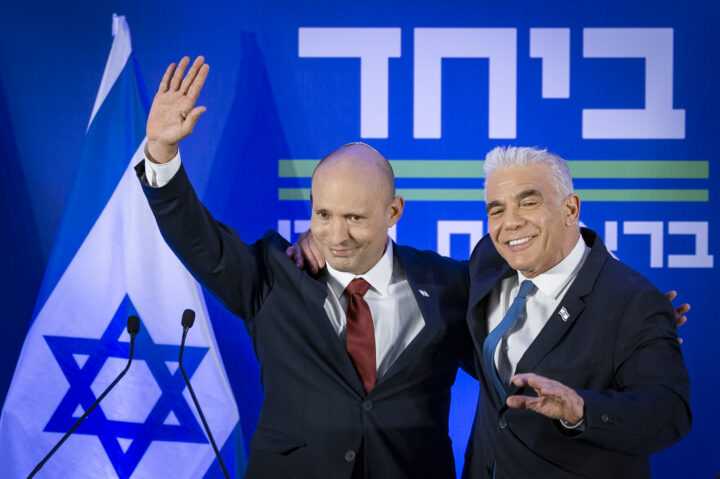
Chaim Goldberg/Flash90
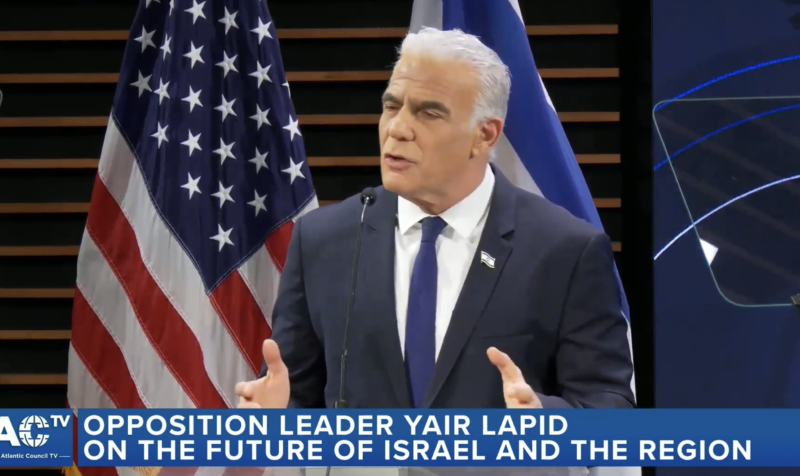
Opposition Leader and Head of the Yesh Atid party Yair Lapid and former Prime Minister Naftali Bennett speak during a press conference announcing a joint list named “Together” ahead of upcoming elections, to be led by Bennett, in Herzliya, central Israel, April 26, 2026.


 Add JewishInsider on Google
The near-consensus among Israeli political pundits is that the merger of the parties led by former Prime Ministers Naftali Bennett and Yair Lapid is a huge moment in the campaign ahead of the next Knesset election, scheduled for Oct. 27.
However, judging by polls published by six major Hebrew-language media outlets after the merger on Sunday, not much has changed since the announcement that Bennett and Lapid were joining forces.
The newly formed “Together” opposition party polled around 24 seats — nearly the same number of seats as the two parties combined before the merger. Israeli Prime Minister Benjamin Netanyahu’s Likud party is, according to the average of the latest polls, still the largest party at 29.
According to the latest polling, it would be difficult for either side to build a governing coalition. The opposition Zionist parties did not get a 61-seat majority in any of the six polls. The most favorable poll for the opposition showed the anti-Netanyahu Zionist parties at 60 seats in the 120-seat Knesset, while the current coalition received over 61 seats in two polls (from those commissioned by Channel 14 and I24NEWS, which are more sympathetic to Netanyahu than the other media outlets).
To be sure, polls taken within 24 hours of an event are not the most reliable, and much can change in the six months until the election.
The key question after the Bennett and Lapid merger is whether they are fighting other opposition candidates for dominance within their bloc – in which case, Bennett has likely solidified his status as Netanyahu’s main competition for the premiership – or to broaden the bloc’s appeal to win a majority in the Knesset.
Netanyahu famously said in 2018 and many times since, in reference to shifts in the opposition: “I don’t intervene in how the left divides up its votes.” That quip, made when Bennett was still in the pro-Netanyahu camp, is now reflective of Bennett’s weakness.
So far, the polling has shown that Bennett, who was solidly on the right for the first eight years of his political career, will struggle to peel off voters from the right-wing pro-Netanyahu bloc into his camp.
In his last election campaign in 2021, Bennett ran primarily on right-wing messages but ended up leading a coalition of mostly center and left parties, together with an Arab party in the government, something many right-wing voters, as well as two Knesset members who jumped ship, viewed as a betrayal.
Add to that the fact that Lapid is to Bennett’s left — something both acknowledged several times in their Sunday night press conference, referring to their “differences” – likely referring to Bennett’s support for settlements and opposition to a two-state solution, which Lapid supports. Both candidates emphasized their shared views on domestic policy in response.
Netanyahu has kept mostly quiet about the Bennett-Lapid merger, but his one response shows that he will try to widen the wedge between Bennett and the right.
Netanyahu’s social media accounts posted an image from 2021 showing Lapid and Bennett sitting with Mansour Abbas, head of Ra’am, the Islamist party in their governing coalition. Ominous music plays in the background, and the words “they already did it once; they will do it again” are splashed across the picture.
The Ra’am factor will also likely be key after the election. The Zionist opposition parties have said mixed things about whether they would be willing to have an Arab non-Zionist party in their coalition in a post-Oct. 7 Israel. Revelations about the Ra’am party’s financial and historic ties to Hamas will also likely come up in the campaign.
As of now, the Knesset’s three Arab parties have said they will run in a single Joint List this year, as they did in 2015-2021, increasing Arab voter turnout and their representation in the Knesset. Ra’am is the only one of the parties that has to date been willing to sit in a coalition, and unlike Abbas, the other party leaders, Ayman Odeh and Ahmed Tibi, do not accept Israel as a Jewish state.
Because of those realities, Bennett and Lapid’s Together party will likely have to make a concerted – and perhaps quixotic – effort to win over right-leaning voters if it wants to increase its bloc and unseat Netanyahu. That task will be easier said than done.
Netanyahu’s coalition promised Haredi parties to effectively bring back the draft exemption as IDF warns of dangerously low manpower
Yonatan Sindel/Flash90
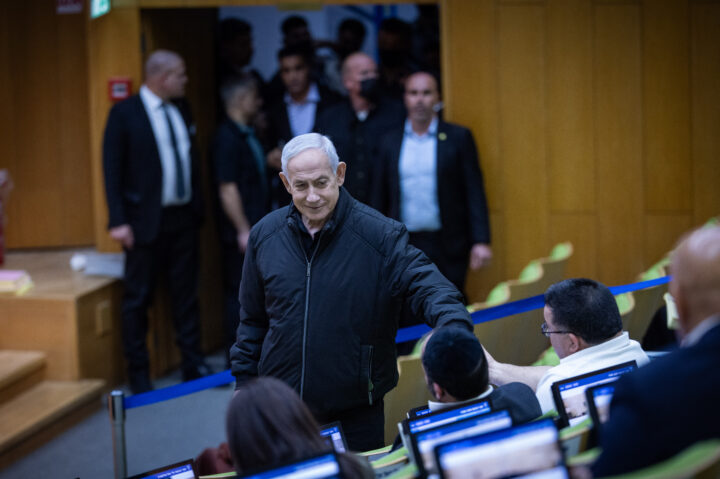
A vote on the state budget at the auditorium in the Knesset, the Israeli parliament in Jerusalem, during the war with Iran and Hezbollah, March 29, 2026.
Israeli Prime Minister Benjamin Netanyahu’s governing coalition narrowly beat a deadline that would have led to an early election, passing the 2026 state budget early Monday morning, a day before the March 31 deadline.
The budget passed after the coalition granted NIS 800 million ($255 million) in benefits to Haredi institutions, and promised Shas and United Torah Judaism that the government would pass a law that, in effect, would continue yeshiva students’ exemption from military service, even as Lt. Gen. Eyal Zamir, the IDF chief of staff, raised “10 red flags” about insufficient military manpower.
According to Israeli law, state budgets are meant to be passed by the end of the previous fiscal year, on December 31, but an extension is permitted to the end of March. If no budget is passed by the final deadline, the Knesset is automatically dissolved and an election is called for three months later.
This government had used that extension amid disputes over legislation reducing the penalties on Haredi yeshivas and young men who do not enlist in the IDF such that it would effectively continue their blanket exemption from military service. The matter remained unresolved, with Haredi parties threatening to vote against the budget, as the war with Iran began at the end of February.
Two weeks into the war, Netanyahu and Israeli Finance Minister Bezalel Smotrich announced that the coalition would set aside legislation under dispute, including Haredi conscription, in order to pass the budget.
As part of the conditions for Haredi parties Shas and United Torah Judaism to drop their demand to pass the conscription exemption bill, the budget included an increase of over NIS 1 billion (approximately $319 million) for Haredi yeshivas and other institutions. The funding would offset much of the sanctions on Haredi individuals and institutions in recent years, after the High Court of Justice struck down their exemption from IDF service.
Israeli Attorney-General Gali Baharav-Miara had blocked most of the funds from being included in the draft of the budget that went to a vote, because it was meant to circumvent the law, but the coalition voted it in soon after midnight Sunday as an amendment to the budget bill.
In addition, Knesset Foreign Affairs and Defense Committee chairman Boaz Bismuth, of Netanyahu’s Likud Party, said last week that the Haredi IDF exemption bill would be back on the Knesset agenda in two weeks, after Passover — meeting another demand by the Haredi parties that the exemption from the IDF be legislated as soon as possible after the budget.
Bismuth’s remarks about the return of the Haredi exemption bill came on the same day as a report on Israel’s Channel 13 that Zamir warned in a Security Cabinet meeting that the “IDF is going to collapse in on itself” if it does not increase its ranks.
In addition to the likelihood of Haredim no longer facing penalties for failing to serve, a law reducing mandatory IDF service from 36 months to 30 months is set to go into effect in January 2027. Zamir asked the government earlier this year to revert to the previous length of mandatory service.
”I am raising 10 red flags,” Zamir reportedly said. “The IDF needs a [Haredi] conscription law, a reserve duty [extension] law and a law to extend mandatory service. Before long, the IDF will not be ready for its routine missions and the reserve system will not last.”
The 2026 budget is the largest in Israel’s history, reaching NIS 850.6 billion ($271 billion), with an unprecedented NIS 143 billion ($45.8 billion) for the defense budget alone, amid the war with Iran and Hezbollah and continued operations in Gaza.
All other ministries were cut by 3% to fund the extra wartime spending.
The budget was passed in a final vote after over 13 hours of opposition filibustering, as well as repeated missile sirens stopping the proceedings, during which lawmakers voted from a fortified room, as opposed to the regular Knesset plenum.
The timing could be damaging, coming days before Saudi Crown Prince Mohammed bin Salman is set to visit the White House
Ronen Zvulun/Pool via AP
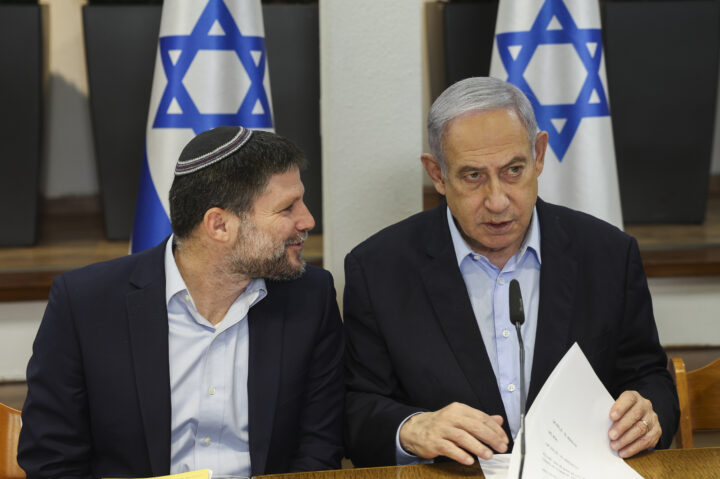
Israeli Prime Minister Benjamin Netanyahu, right, speaks with Minister of Finance Bezalel Smotrich during the weekly cabinet meeting at the Defence Ministry in Tel Aviv, Israel, Jan. 7, 2024.
The members of Israeli Prime Minister Benjamin Netanyahu’s governing coalition spent much of the weekend arguing over something on which they all ostensibly agree — opposition to a Palestinian state.
They may have been expressing their long and openly held opinions, but the timing could be damaging, coming days before Saudi Crown Prince Mohammed bin Salman is set to visit the White House. In the meeting, slated for Tuesday, President Donald Trump is expected to push for normalization between Riyadh and Jerusalem — something the Saudis have long conditioned on tangible steps towards a Palestinian state.
The latest debate started with far-right Israeli Finance Minister Bezalel Smotrich, who recently apologized for saying the Saudis can “keep riding camels” rather than normalize ties with Israel in exchange for a Palestinian state. On Saturday night, Smotrich said that Netanyahu was responsible for a “dangerous” increase in pressure on Israel, criticizing the prime minister for not speaking up more forcefully after nearly a dozen countries recognized a Palestinian state earlier this year. “Immediately come up with an appropriate and decisive response that will make clear to the entire world that a Palestinian state will not be established in our homeland,” Smotrich wrote on X.
Next came Likud ministers. “Israel will not agree to the establishment of a terror state in the heart of the Land of Israel,” Israeli Foreign Minister Gideon Sa’ar asserted. “Israel’s policy is clear: A Palestinian state will not be established,” chimed in Defense Minister Israel Katz.
The impetus for reiterating their position was the U.S.-proposed resolution at the United Nations Security Council backing Trump’s plan for Gaza and the formation of an International Stabilization Force, leading to a scenario in which “the conditions may finally be in place for a credible pathway to Palestinian self-determination and statehood.”
It’s unclear where these Cabinet ministers were in late September, when Netanyahu signed onto Trump’s 20-step plan, which uses the exact same language.
The Saudis saw Netanyahu’s agreement to a horizon for Palestinian statehood as satisfying their demand for a step in that direction, an Israeli diplomatic source who frequently advises Netanyahu said earlier this month.
But the pressure from the right was such that Netanyahu said at the opening of Sunday’s cabinet meeting that “our opposition to a Palestinian state in any territory west of the Jordan River exists and stands and has not changed at all.”
That apparent reversal of what Netanyahu agreed to less than two months ago could cause serious harm to Trump’s efforts to try to make Saudi Arabia the crown jewel of the Abraham Accords, a move that Netanyahu has long said would be greatly beneficial to Israel.
Elsewhere in Jerusalem, top opposition figures have sounded the alarm on the possibility of a Saudi domestic nuclear enrichment program and Riyadh purchasing F-35 planes. Former Prime Minister Naftali Bennett said that the government “lacks the ability to say ‘no.’ Faced with the initiative to establish a Palestinian state — silence. … Faced with those around us being armed with F-35s — silence.” Meanwhile, Israeli Ambassador to the U.S. Yechiel Leiter told The Jerusalem Post, “There’s no indication that Israel’s qualitative edge will be compromised.”
While Netanyahu and his ministers have been silent on other expected elements of MBS’ planned visit to Washington, there have been behind-the-scenes efforts to ensure Israel’s qualitative military edge is maintained.
The question remains, then, if these incentives are removed or downgraded, whether the Saudis will still want to normalize relations with Israel.
Haredi leaders threaten to bring down Israeli government as effort to revive draft exemptions stalls
Top rabbis order coalition parties to move towards toppling government as senior lawmaker in Netanyahu's party persists with conscription bill

RONALDO SCHEMIDT/AFP via Getty Images
Israel's Prime Minister Benjamin Netanyahu (R) speaks with Aryeh Deri (L), chairman of the ultra-Orthodox party Shas, during a parliament session in Jerusalem on July 24, 2023.
Israeli Prime Minister Benjamin Netanyahu’s governing coalition was thrown into disarray on Wednesday night after the spiritual leaders of Haredi factions threatened to bring about an early election if penalties for yeshiva students avoiding military service are not canceled.
The leading rabbis of Agudat Yisrael, the Hasidic party of United Torah Judaism, told party leader Yitzchak Goldknopf on Tuesday to move forward with vote next week on a bill to dissolve the Knesset, calling an election, because Netanyahu did not keep a promise to pass a bill exempting young Haredi men from military service by Shavuot, a holiday that was observed on Monday in Israel. On Wednesday morning, the other part of United Torah Judaism, Degel Hatorah, received a similar directive from the senior rabbis of the “Litvak” non-Hasidic Haredi community, Dov Lando and New York-native Moshe Hillel Hirsch.
Still, Netanyahu’s 68-seat coalition would retain a narrow majority in the Knesset even if he lost those Haredi parties’ seven seats.
The political threat became more acute on Wednesday evening, when Sephardic Haredi party Shas, which has 11 seats in the Knesset, supported UTJ’s move to call an election. Israeli media reported that Shas’ spiritual leader Rabbi Yitzhak Yosef told the party’s lead negotiator, former minister Ariel Atias, to tell Netanyahu that he will not have a government if agreements are not reached with the Haredi parties.
Shas has functioned as an electoral satellite of Netanyahu’s in recent years, with its base holding right-wing views and strongly supporting the prime minister. The party has campaigned with the slogan “Bibi [Netanyahu] needs a strong lion,” playing on the Hebrew meaning of Shas leader Aryeh Deri’s name. Yet Yosef reportedly told Atias that he should reach out to opposition parties, in effect ending Shas’ reflexive support for Netanyahu.
The Haredi parties’ threat to topple the coalition may be empty because they have no good alternatives. Opposition parties are even less likely to support the Haredi position, calling for a blanket exemption with no penalties for full-time yeshiva students who avoid the IDF draft – one poll from this year showed that 92% of left-wing voters and 82% of centrist voters oppose a Haredi draft exemption – and they disagree with Haredim on other major issues of religion and state.
Netanyahu met on Wednesday night with Haredi party representatives and, separately, with Knesset Foreign Affairs and Defense Committee Chairman Yuli Edelstein, the lead lawmaker on the conscription bill. Following the meeting, Netanyahu’s office said “there is a way to bridge the gaps on the topic of the draft,” and that the prime minister would hold another meeting with Atias, Edelstein and Cabinet Secretary Yossi Fuchs on Thursday evening to find a solution. Despite the positive readout from the Prime Minister’s Office, Yosef’s instruction to Atias to support the government’s dissolution reportedly came after the meeting.
The crux of the dispute between Edelstein, a senior Likud Knesset member, and the Haredi parties is that the former has persistently pursued sanctions for yeshiva students who avoid the draft, while Haredi parties consider such penalties to be a red line.
While the bill, whose text is not yet final, has not been made public, it reportedly includes a target of 10,500 new Haredi recruits in the next two years out of 82,000 eligible Haredi men aged 18-24. Sanctions on draft-dodgers would remain in place even if the targets are met, and reportedly include canceling discounts on municipal taxes and public transportation, exclusion from subsidized housing programs and daycare and a ban on receiving a drivers license until age 29. Those who avoid conscription could also be arrested when attempting to leave the country.
The Haredi parties also want volunteers in Magen David Adom emergency medical services, ZAKA, and civilian service in government offices to be officially recognized and avoid sanctions, but Edelstein has insisted that only IDF enlistment would count.
Following a meeting with Haredi lawmakers on Wednesday, Edelstein said, “There is nothing new under the sun. The enlistment bill outline that I presented last night in the meeting is the same one we have been discussing for over a year. A law without personal, effective sanctions, high enlistment targets with a rapid increasing rate is not enlistment but evasion, and therefore I have opposed it the entire time.”
“While IDF soldiers and commanders are in the middle of their efforts to defeat Hamas, I am committed to them and their families for Israel’s security to broaden the IDF’s base of conscription, to ensure we can build up our forces for generations and ease the burden on the reservists,” he added.
Full-time Haredi yeshiva students have been exempt from the IDF draft since the inception of the state; first unofficially in the hundreds, and then officially in the tens of thousands as of 1999. That exemption, known as the Tal Law, was struck down by Israel’s High Court of Justice in 2012, and disputes over the topic have been a constant, major feature of Israeli politics ever since.
In June 2024, the High Court ruled that the IDF and government must actively conscript Haredim, because there is no longer an exemption law in place.
The IDF reported last month that 5% of the 24,000 Haredim who received call-up letters in the past year reported to the recruitment office. In the first four months of 2025, 23% of Haredim who were called up reported for duty.
While the exemption was never popular in the general public, opposition to it surged following the Oct. 7, 2023, attacks on Israel, after which hundreds of thousands of Israelis were called up to fight the war in Gaza and the IDF has complained of personnel shortages. A January poll from the Israel Democracy Institute showed 68% of Israelis oppose a law allowing Haredim to avoid the draft, including 75% of non-Haredi Jews and 60% of voters for Netanyahu’s Likud party.
Please log in if you already have a subscription, or subscribe to access the latest updates.
 Continue with Google
 Continue with Apple