
































Sebastian Gorka said the administration intends to target other branches with the goal of destroying the entire Muslim Brotherhood
JIM WATSON/AFP via Getty Images
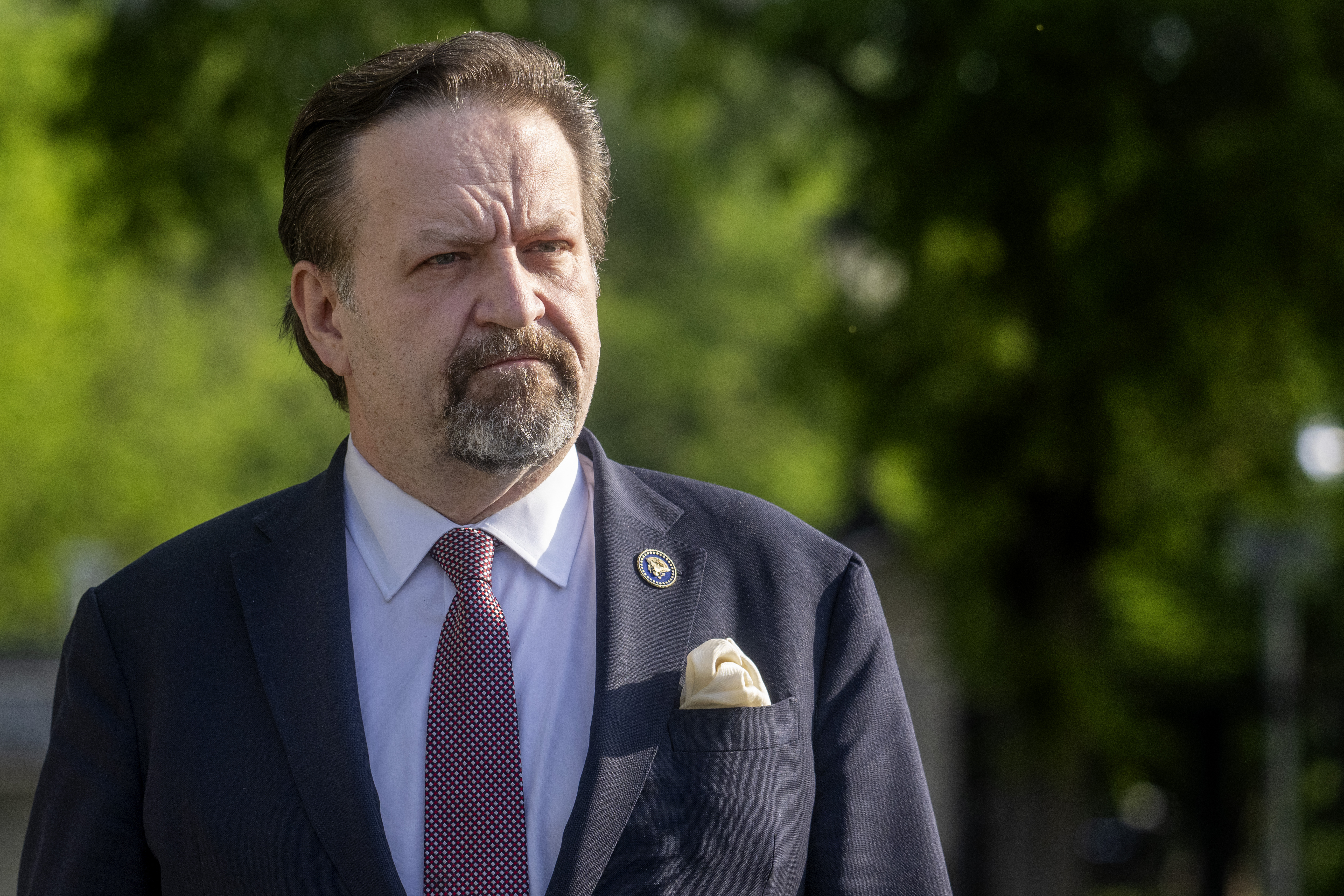
U.S. Senior Director for Counterterrorism Sebastian Gorka walks outside the White House in Washington, DC, on May 7, 2025.


 Add JewishInsider on Google
Sebastian Gorka, the National Security Council’s senior director for counterterrorism, defended the Trump administration’s executive order mandating the assessment of certain branches of the Muslim Brotherhood for designation as foreign terrorist organizations, which some critics have argued does not go far enough.
Gorka, speaking at a Hudson Institute conference on antisemitism on Friday, said that the administration is following the procedures and limitations laid out in federal law relating to terrorism designations, and said that the administration fully intends to target further branches of the Muslim Brotherhood with the ultimate goal of destroying the entire organization.
Analysts have criticized the administration for only naming the Egyptian, Lebanese and Jordanian branches of the Muslim Brotherhood for potential designation, not mentioning Turkey and Qatar’s backing of the group and not designating the entire Muslim Brotherhood from the start or explicitly laying out an intention to do so.
“It’s a statement of designation to occur, not a de facto designation, because we follow the law in the Trump administration. We believe in the Constitution and the statutes agreed upon by Congress and signed by the president. We don’t just do stuff because we want to,” Gorka said.
“FTO designation has to be done according to the law. According to the law a foreign terrorist organization must have killed Americans or must have gravely affected the national security of the United States, and that must be proven with predominantly unclassified information that stands up in a court of law and which is less than three years old,” he explained.
The NSC official said that the administration’s executive order had been “woefully misinterpreted and misrepresented by the clickbait prostitutes of social media, some of whom paint themselves as MAGA, who just need the clicks,” making specific reference to “Laura” — likely far-right influencer Laura Loomer, and “Mr. Carlson” — Tucker Carlson.
Gorka said that the three branches named in the executive order are “slam dunk cases,” and that the administration plans to go after additional branches.
“For the record, this is not the end, it is just the beginning, and we are assiduously working on the next tranche of designations right now,” Gorka said.
The executive order, on its own, does not designate branches. It names branches within the three countries to be assessed for potential designation.
“Please read the statute, you cretinous individuals. We’re not designating states, it’s organizations,” Gorka continued. “So if you think, ‘Oh my gosh, you left this country out,’ that’s because you cannot call a country a foreign terrorist organization by American law. Do your homework unless, of course, you’re in it for the ads and the clicks.”
He emphasized that the administration is “committed to one thing: destroying the Brotherhood, its offshoots and global jihadism writ large — and suppressing it to a point at which it is no longer a strategic threat.”
Some allies of the administration like Sen. Ted Cruz (R-TX) have said the administration intends to take a “bottom-up” approach to ultimately designate the entire organization.
Gorka said that the Muslim Brotherhood’s antisemitism is a key part of the reason the administration is going after the group.
“Rejection of the Jew is rejection of the West is the rejection of Christianity as well,” Gorka said.
“The Muslim Brotherhood is the progenitor of all modern global jihadism and the propagator, the transmission belt of the most heinous antisemitic Jew hatred today across the region and sadly in America as well,” Gorka continued.
Addressing antisemitism more broadly, Gorka said that some hide their hatred “behind geopolitics.”
“‘I just don’t like the government of [Israeli Prime Minister] Bibi Netanyahu’ — no, you’re a Jew hater, because there’s only one Jewish state,” Gorka continued. “It embeds itself in international organizations, in the curricula of our colleges and universities, in the voices of some who hide behind social media and even openly espouse this ancient poison. Quote, ‘From the river to the sea.’”
Citing the May murder of Israeli Embassy employees Yaron Lischnisky and Sarah Milgrim just minutes away from the conference’s location in the name of anti-Israel ideology, Gorka characterized antisemitism as a serious security threat to the homeland.
Jewish Insider’s senior national correspondent Gabby Deutch contributed reporting.
The order leaves out scrutiny of Qatar and Turkey — a strategy that experts say reflects both legal realities and geopolitical constraints
Yuri Gripas/Abaca/Bloomberg via Getty Images
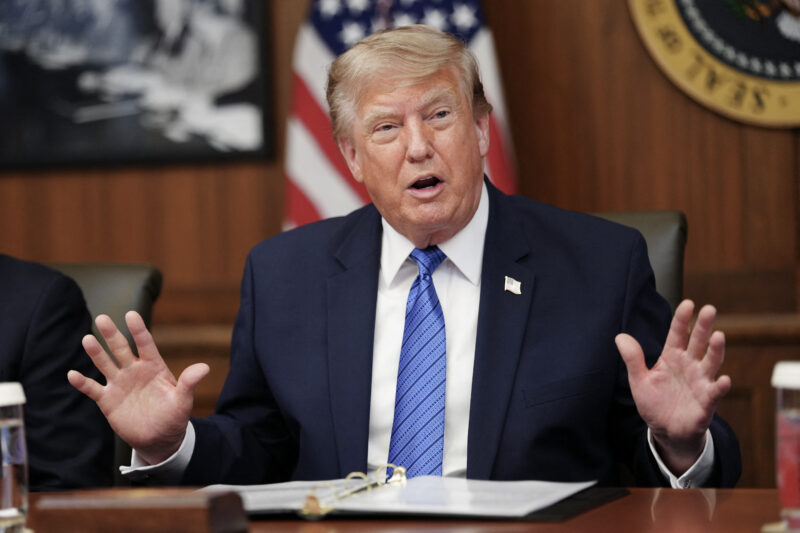
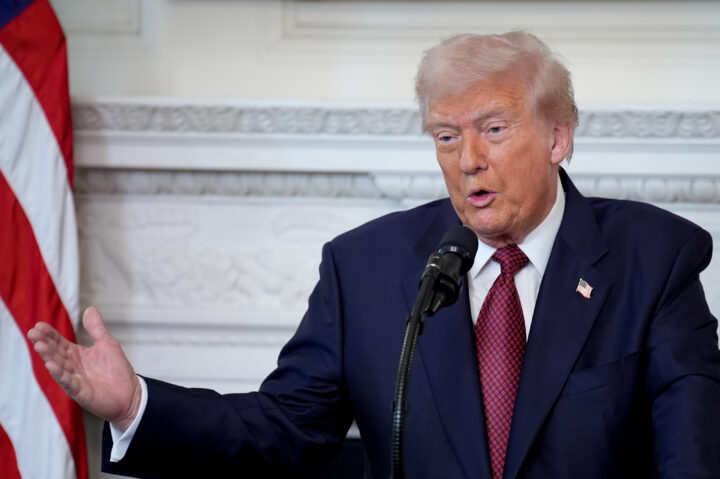
US President Donald Trump during a breakfast with Senate Republicans in the State Dining Room of the White House in Washington, DC, US, on Wednesday, Nov. 5, 2025.
President Donald Trump’s recent executive order directing a review of Muslim Brotherhood chapters for potential terrorism designations is limited in scope, and leaves out scrutiny of Qatar and Turkey — a strategy that experts say reflects both legal realities and geopolitical constraints.
The order, which was signed on Nov. 24, directs Secretary of State Marco Rubio and Treasury Secretary Scott Bessent to identify which branches of the Muslim Brotherhood — with a focus on chapters in Jordan, Lebanon and Egypt — should be designated as Foreign Terrorist Organizations and which should be deemed Specially Designated Global Terrorists.
Rather than apply a terrorist designation to the entire Muslim Brotherhood as a whole, Trump’s executive order first looks at individual branches. This strategy is echoed in a Senate bill, sponsored by Sen. Ted Cruz (R-TX), which requires an assessment of every branch of the Muslim Brotherhood in an effort to designate the organization for its involvement.
The House version of the legislation was modified in committee last week and now more closely resembles the Trump executive order.
Michael Jacobson, a senior fellow at The Washington Institute for Near East Policy, said the approach “makes sense,” adding that a “one-size-fits-all” designation would be unproductive. He also noted that it will allow the administration to more effectively pursue chapters of the organization.
“The bottom-up approach will allow the administration to proceed in a more strategic and calculated fashion,” said Jacobson. “Targeting individual chapters and entities could also open up additional avenues for investigation and action. Once individual branches are designated, the Treasury could then use its authorities to sanction those supporting these branches. I believe that this approach is also more likely to gain support from other governments.”
This same sentiment was echoed by Cruz, who called the “bottom-up” approach the “correct and sustainable strategy.”
“That strategy is built into both the president’s executive order, which was a bold and critical breakthrough in advancing American national security, and my bipartisan legislation,” Cruz told Jewish Insider. “It’s the consensus strategy, and it’s the right one.”
David Adesnik, vice president of research at the Foundation for Defense of Democracies, told JI that while a single designation done in “one fell swoop” might be appealing, it faces legal and factual challenges.
“The administration was rightly concerned that a judge could overturn a designation of the entire organization if he or she assessed that it didn’t meet the legal thresholds. This would have serious consequences in several respects,” said Michael Jacobson, a senior fellow at The Washington Institute for Near East Policy. “If a judge ruled against a Muslim Brotherhood ban, it would be interpreted by some as a signal that the MB is not a terrorist organization, end of story — also a message the administration was likely eager to avoid.”
“This is not a single unified organization,” said Adesnik. “There’s no headquarters, no address, no person who is the head. It’s very hard to make a terror designation if you’re not exactly sure who you’re designating.”
Jacobson said the administration also looked to avoid a blanket designation out of concern that any legal challenges that followed could hurt efforts to reign in the Muslim Brotherhood.
“The administration was rightly concerned that a judge could overturn a designation of the entire organization if he or she assessed that it didn’t meet the legal thresholds. This would have serious consequences in several respects,” said Jacobson. “If a judge ruled against a Muslim Brotherhood ban, it would be interpreted by some as a signal that the MB is not a terrorist organization, end of story — also a message the administration was likely eager to avoid.”
Some critics of the executive order, including far-right influencer Laura Loomer, who is a confidant of the president, have expressed frustration over the administration’s decision not to name Qatar and Turkey in the order.
“The Muslim Brotherhood designation signed by President Trump today doesn’t have any teeth,” Loomer posted on X on Nov. 24. “This designation is probably the weakest designation of the Muslim Brotherhood we could have ever received, as it doesn’t even apply to Qatar and Turkey.”
Both Qatar and Turkey have strengthened ties with the United States during Trump’s second term, however the two countries are also significant supporters of the Muslim Brotherhood and have been known to provide sanctuary for their members.
“Claiming to get tough on the Muslim Brotherhood without a serious strategy to clamp down on the support provided by the movement’s most important state sponsors in Qatar and Turkey is not a serious policy,” said John Hannah, a senior fellow at the Jewish Institute for National Security of America. “Out of consideration for America’s longstanding partnerships with both countries and President Trump’s particular affinity for their leaders, one hopes that there is a plan to bring real pressure to bear on both Doha and Ankara in private to cease and desist their wide-ranging support for MB affiliates across the Middle East and globally.”
But while Qatar and Turkey’s ties to the Muslim Brotherhood are problematic, experts said they were not included because they do not currently have chapters of the organization in their countries, which the executive order focuses on.
“If we’re targeting chapters of the Brotherhood, there are no Brotherhood chapters in those countries,” said Adesnik. “So the real question is, how do you deal with what are effectively state sponsors of the Brotherhood? And does that state sponsorship cross the line into terrorism or sponsorship of terrorism?”
The Senate bill also does not address how Turkey and Qatar would be targeted as state sponsors of the organization.
However, experts and legislators remain wary of the threat posed by the two nations and have expressed that plans to root out the Muslim Brotherhood should account for Turkey and Qatar.
“Claiming to get tough on the Muslim Brotherhood without a serious strategy to clamp down on the support provided by the movement’s most important state sponsors in Qatar and Turkey is not a serious policy,” said John Hannah, a senior fellow at the Jewish Institute for National Security of America. “Out of consideration for America’s longstanding partnerships with both countries and President Trump’s particular affinity for their leaders, one hopes that there is a plan to bring real pressure to bear on both Doha and Ankara in private to cease and desist their wide-ranging support for MB affiliates across the Middle East and globally.”
With the current executive order, the White House is seeking to first designate branches in countries that experts said are involved in violence from within the country. This will also likely include entities that finance other Foreign Terrorist Organizations, according to Jacobson.
In Jordan, Lebanon and Egypt, threats connected to the Muslim Brotherhood have become national issues of concern.
“The Islamic Group [Muslim Brotherhood chapter in Lebanon] clearly built up the ability to carry out attacks against Israel and cooperated very openly with Hezbollah,” said David Adesnik, vice president of research at the Foundation for Defense of Democracies. “Authorities there really aren’t doing anything about it, partly because they lack power and have other issues to address. So it’s a pretty fair point.”
In April 2025, Jordanian authorities arrested 16 individuals and thwarted a plot that was to involve rocket and drone attacks inside the country. The suspects were linked to the Muslim Brotherhood, which is the government’s largest opposition group. Following the arrests, the Jordanian government banned the group entirely.
Adesnik said that while Jordan has initiated a “thorough crackdown” to address the problem, it is notable that there was “clearly a branch that had migrated toward planning for terrorism.”
In Lebanon, he called the Muslim Brotherhood a “persistent issue.”
“The Islamic Group [Muslim Brotherhood chapter in Lebanon] pretty openly built up a capability to carry out attacks against Israel and cooperated very clearly and openly with Hezbollah,” said Adesnik. “Authorities there really aren’t doing anything about it, in part because they don’t have a lot of power and they have a lot of other problems to deal with. So it’s a pretty reasonable case.”
Adesnik called the administration’s targeting of Egypt the “thorniest case from a definitional perspective.” He noted that while Egyptian President Abdel Fattah el-Sissi’s regime in Cairo has spent more than a decade cracking down on the Brotherhood “aggressively,” concerns still remain over the presence of branches such as Harakat Sawa’d Misr, also known as Hasm, which was already designated by the U.S. as a Specially Designated Global Terrorist Entity in 2018.
“The question is just what’s left of the Brotherhood there?” said Adesnik. “Is it doing enough to merit a designation?”
Gov. Ron DeSantis’ executive order comes less than a month after Texas did the same

Joe Raedle/Getty Images
Florida Gov. Ron DeSantis on September 17, 2024 in West Palm Beach, Florida.
Florida Gov. Ron DeSantis, following a recent move by Texas Gov. Greg Abbott, signed an executive order on Monday designating the Muslim Brotherhood and Council on American-Islamic Relations as foreign terrorist organizations.
The order instructs the Florida Department of Law Enforcement and the Florida Highway Patrol to “undertake all lawful measures to prevent unlawful activities in Florida” by the Brotherhood or CAIR. It states that all executive and cabinet agencies may not provide “any contract, employment, funds, or other benefit or privilege” to either organization or individuals who have “provided material support or resources” to one or both groups.
The order also directs the state’s Domestic Security Oversight Council to “conduct a comprehensive review of existing statutory authorities, regulations, and policies for addressing threats” from the Brotherhood and CAIR, and to “submit recommendations for any additional action needed” from the governor or the state legislature by Jan. 6, 2026.
“The Muslim Brotherhood’s Islamist ideology is irreconcilable with foundational American principles of life, liberty, and the pursuit of happiness reflected in the Declaration of Independence and the United States Constitution, especially including the right to religious freedom and the equal protection of the laws,” the order states.
DeSantis said in a post on X on Monday, “Florida agencies are hereby directed to undertake all lawful measures to prevent unlawful activities by these organizations, including denying privileges or resources to anyone providing material support.”
CAIR and CAIR-Florida jointly responded to the order by vowing legal action against the DeSantis administration.
“We look forward to defeating Governor DeSantis’ latest Israel First stunt in a court of law, where facts matter and conspiracy theories have no weight,” the organizations said in a joint statement. “In the meantime, we encourage all Floridians and all Americans to speak up against this latest attempt to shred the Constitution for the benefit of a foreign government.”
The order comes less than a month after Abbott issued a similar declaration targeting both groups as foreign terrorist organizations, and weeks after President Donald Trump signed an executive order designating the Brotherhood as a foreign terrorist organization.
On Capitol Hill, Republicans in the House and Senate are working on advancing standalone legislation reinstating the Brotherhood’s FTO designation, though House lawmakers recently stripped a key provision from their bill mandating the designation of eligible Muslim Brotherhood branches and the entire Muslim Brotherhood as terrorist organizations.
The EO gives the secretary of state and the secretary of the Treasury 30 days to identify which branches should be designated Foreign Terrorist Organizations

Tasos Katopodis/Getty Images
President Donald Trump
President Donald Trump signed an executive order on Monday pledging to designate certain chapters of the Muslim Brotherhood as terrorist organizations, identifying the organization’s branches in Lebanon, Jordan and Egypt as particularly problematic.
“Its chapters in Lebanon, Jordan and Egypt engage in or facilitate and support violence and destabilization campaigns that harm their own regions, United States citizens and United States interests,” according to the executive order.
As evidence, the White House cited the participation of the Lebanese Muslim Brotherhood in the Oct. 7 terror attacks for Israel; the Jordanian chapter’s record of providing material support to Hamas; and the calls by a leader of the Muslim Brotherhood in Egypt to for violent attacks against U.S. partners.
The new policy gives the secretary of state and the secretary of the Treasury 30 days to identify which branches should be designated “Foreign Terrorist Organizations” and which should be deemed “Specially Designated Global Terrorists,” another formal designation by the U.S. government that comes with less severe consequences than the FTO designation.
According to the executive order, it is now official U.S. policy “to cooperate with its regional partners to eliminate the capabilities and operations of Muslim Brotherhood chapters designated as foreign terrorist organizations” and to “deprive those chapters of resources, and thereby end any threat such chapters pose to United States nationals or the national security of the United States.”
The executive order comes a week after Texas Gov. Greg Abbott, a Republican, issued an order designating the Muslim Brotherhood a terror group, though the move is largely symbolic at the state level.
Some Republicans have been pushing the White House to target the Muslim Brotherhood for months, though the effort stalled until a few weeks ago.
The Muslim Brotherhood, a transnational Islamist group, gained prominence in 2012, when Mohamed Morsi — who was affiliated with the movement — became Egypt’s president, following a revolution that ousted Egypt’s longtime leader Hosni Mubarak. Morsi was then removed from office in a coup d’etat in 2013.
A White House spokesperson did not immediately respond to a request for comment.
Legislation that would ban the group has received bipartisan support in both the House and Senate
Alex Wong/Getty Images
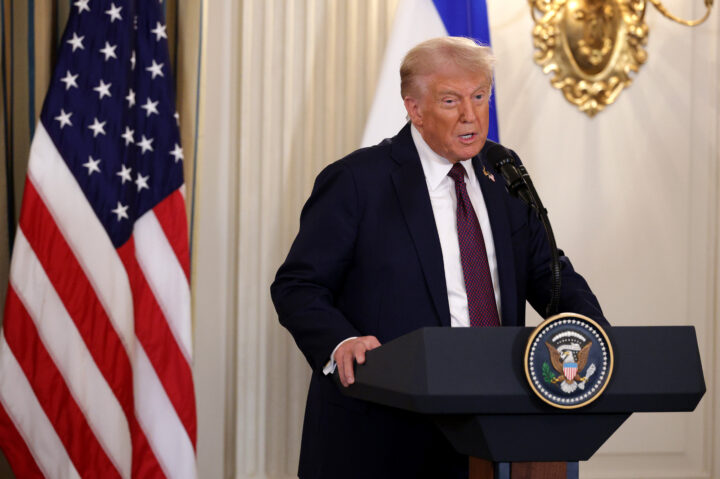
U.S. President Donald Trump delivers remarks at the White House on September 29, 2025 in Washington, DC.
President Donald Trump announced on Sunday that he plans to designate the Muslim Brotherhood as a Foreign Terrorist Organization following months of bipartisan calls for his administration to target the group.
Trump announced the move in an interview with journalist John Solomon of the conservative outlet Just the News on Sunday morning, saying that an executive order is being prepared for his signature.
“It will be done in the strongest and most powerful terms,” Trump said. “Final documents are being drawn.”
The White House did not respond to Jewish Insider’s request for comment on the announcement or details of the order being drafted for the president.
Trump considered designating the Brotherhood as a Foreign Terrorist Organization (FTO) during his first administration, though that effort never materialized. Sebastian Gorka, who serves as Trump’s deputy assistant for national security affairs and senior director for counterterrorism at the National Security Council, has been publicly and privately urging the president to do so since returning to office, as have a chorus of GOP lawmakers, along with a handful of Democrats in Congress.
Gorka posted on X on Sunday that the “time has come” to designate the group, which he called “the progenitor of all modern Jihadist terror groups, from al Qaeda to HAMAS.”
A Senate bill that would designate the Muslim Brotherhood as a terrorist group, led by Sen. Ted Cruz (R-TX), has 11 co-sponsors, including Sen. Tom Cotton (R-AR), Sen. Rick Scott (R-FL), Sen. Dave McCormick (R-PA) and Sen. John Fetterman (D-PA). The House version of the bill has 19 co-sponsors, including four House Democrats.
Trump’s announcement comes less than a week after Texas Gov. Greg Abbott, a Republican, issued a declaration designating the Muslim Brotherhood and Council on American-Islamic Relations as foreign terrorist groups and transnational criminal organizations, a move prohibiting both groups from buying land in Texas and allowing the AG’s office to sue to shut them down.
Secretary of State Marco Rubio said in August that the FTO designation was “in the works” for the Brotherhood.
“Obviously, there are different branches of the Muslim Brotherhood, so you’d have to designate each one of them,” Rubio told right-wing talk show host Sid Rosenberg on his radio program at the time, adding that the State Department needed to go through a lengthy “process which I didn’t fully appreciate until I came into this job.”
News of Trump’s comments was met with praise in the U.S. and in Israel, even as the details are still fuzzy over what he will be signing.
Israeli Prime Minister Benjamin Netanyahu said on Sunday that he wanted to “commend President Trump on his decision to outlaw and designate the Muslim Brotherhood organization as a terrorist organization.”
“This is an organization that endangers stability throughout the Middle East and also beyond the Middle East. Therefore, the State of Israel has already outlawed part of the organization, and we are working to complete this action soon,” Netanyahu said.
The Institute for the Study of Global Antisemitism and Policy (ISGAP) released a statement commending “the fact that the threat posed by the Muslim Brotherhood’s ideology is now being taken seriously at the highest levels of the U.S. government.”
“We welcome President Trump’s statements and the growing recognition that the Muslim Brotherhood, its ideology and network pose a serious challenge to the United States and democratic societies,” Charles Asher Small, ISGAP’s executive director, said to Jewish Insider..
“A formal U.S. designation would represent an important first step to confront the Muslim Brotherhood in the United States,” Small added. “This will require sustained, evidence-based policy, serious scrutiny of its affiliated structures and funding streams, and long-term investment in democratic resilience.”
Dan Schlessinger, the lead attorney for the Boim family in their lawsuit against American Muslims for Palestine regarding the murder of American teenager David Boim in 1996, told JI in a statement: “This is welcome news for many including the Boim family. The next question is what does this mean for U.S.-based, Hamas adjacent groups like American Muslims for Palestine and Students for Justice in Palestine. Our hope is they will be included in this designation as well.”
Schlessinger and his team have accused AMP in court of acting as an “alter ego” of a now-defunct group that shut down after it was found to have provided support to Hamas.
‘You can’t confer Article 5 protections by executive order, and I don’t think there’d be any appetite at all [in Congress] to do that through a treaty,’ Sen. Lindsey Graham (R-SC) said

Win McNamee/Getty Images
U.S. President Donald J. Trump and Emir of Qatar Tamim bin Hamad al Thani attend a signing ceremony at the Amiri Diwan, the official workplace of the emir, on May 14, 2025, in Doha, Qatar.
Several senators said on Friday that the administration’s unilateral offer of defense guarantees to Qatar — similar to those the U.S. has made to protect its NATO allies — deserves scrutiny from Congress.
The administration on Monday quietly issued an executive order stating that the U.S. would offer defensive guarantees to Qatar, “shall regard any armed attack on the territory, sovereignty, or critical infrastructure of the State of Qatar as a threat to the peace and security of the United States” and “shall take all lawful and appropriate measures — including diplomatic, economic, and, if necessary, military — to defend the interests of the United States and of the State of Qatar and to restore peace and stability.”
Sen. Todd Young (R-IN), a top Republican voice in favor of reclaiming congressional war powers, said that the deal “certainly strikes me as unconventional and the sort of thing that the Foreign Relations Committee might want to hold a hearing on.”
“In the end, it’s the chairman’s prerogative, but it does strike me as worthy of attention and explication in a public setting,” Young said.
Sen. Tim Kaine (D-VA), another leading advocate on war powers issues and in opposition to the administration’s acceptance of a Qatari luxury jet for use as Air Force One, said that the move will carry the perception of corruption.
“I’m very troubled by it,” Kaine said. “It just looks like it was a trade for the jet. Maybe it’s not that, but that’s the way it looks. And why would you pollute something that maybe has a good rationale — but now it’s polluted with the way everybody looks at it.”
Sen. Rick Scott (R-FL), a leading Republican critic of U.S. support for Qatar, said that he planned to speak to the president about the order. “I haven’t talked to him [the president] about it. I don’t understand why. He hasn’t explained it to me, but I’ll ask him about it,” Scott told Jewish Insider.
Sen. Richard Blumenthal (D-CT) said that the deal “will have to be reviewed carefully, depending on whether it serves our security interests and Israel’s.”
Multiple Republican senators emphasized that the deal does not carry the force of congressional ratification as a treaty.
“I don’t think you can do that by executive order,” Sen. Lindsey Graham (R-SC) said.
Asked about Congress granting Qatar those protections, Graham replied: “I don’t like its chances [of getting through Congress]. I appreciate trying to stand up for Qatar because they’re helpful, but they also have another side of the story. You can’t confer Article 5 protections by executive order, and I don’t think there’d be any appetite at all to do that through a treaty.”
Sen. Pete Ricketts (R-NE) framed the deal as part of Trump’s pressure campaign on Hamas to agree to his framework for peace in Gaza.
“The president is always thinking about negotiations, and certainly the president can have his policy,” Ricketts said. “However, it is not something that is a treaty, so it’s really, I think, meant as a negotiating thing to help get Qatar to get Hamas to surrender.”
Sen. James Lankford (R-OK) said he hadn’t reviewed the details of the agreement yet, but noted that any long-term foreign agreement would require congressional ratification to remain in effect.
“If we’re going to a national security agreement long term, that’s going to be lasting,” Congress should be consulted, Lankford said. “Things only last if they have the imprimatur of Congress actually put on it — whether it’s a trade agreement or a defense agreement. It’s got to be statute.”
Sen. Mike Rounds (R-SD) told JI he had “not heard anything about” the deal before noting, “It’s always up to the president to decide what he would like to suggest that he would like to do. Article 5 is part of a treaty right now, and if it is a treaty-type of an agreement, it would have to come before the Senate.”
Sen. Markwayne Mullin (R-OK) defended the president’s support for Qatar, telling JI, “Qatar is an important piece of the pie, a piece of the puzzle in the Middle East. We have to recognize that. We don’t always agree with everything they do, but we don’t agree with everything Israel does and we don’t agree with everything Jordan does, but they’re still close friends of ours. We know they want to be close to us and we want to, we can still use them as a strategic ally.”
The guarantee, which regards attacks on Qatar as direct threats to the U.S., is unprecedented between the U.S. and an Arab country
Win McNamee/Getty Images
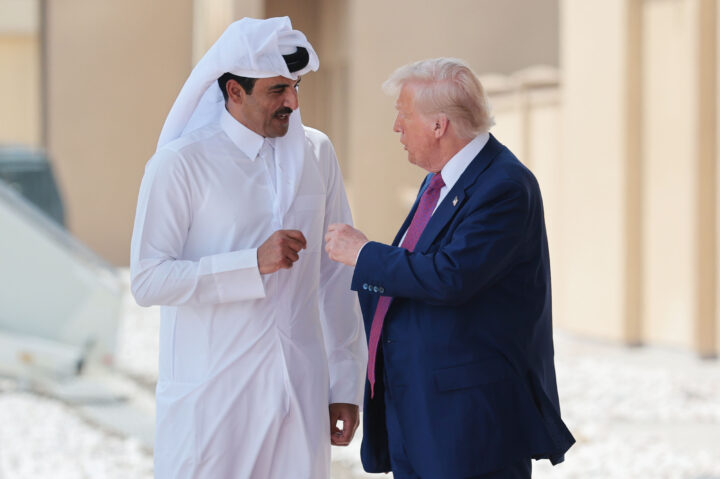
President Donald Trump speaks with Emir of Qatar Tamim bin Hamad al Thani as he departs the Al Udeid Air Base for Abu Dhabi on May 15, 2025, in Doha, Qatar.
President Donald Trump signed an executive order on Monday pledging to guarantee Qatar’s “security and territorial integrity” against “external attack.” The security guarantee, similar to NATO’s Article 5 mutual defense clause, is unprecedented for the U.S. with an Arab country.
Signed just weeks after Israel’s attempted strike on Hamas leaders in Doha, the EO says the move comes “in light of the continuing threats to the State of Qatar posed by foreign aggression” and promises that the U.S. “shall regard any armed attack” on Qatari territory, sovereignty or critical infrastructure as a “threat to the peace and security of the United States.”
Qatar also recently faced an attack from Iran, when Tehran launched missiles at the U.S.’ Al Udeied Air Base during the Israel-Iran war in June.
The order was signed on Sept. 29, the day that Israeli Prime Minister Benjamin Netanyahu met with Trump in the White House and called Qatari Prime Minister Sheikh Sheikh Mohammed bin Abdulrahman al-Thani to apologize for the strike, though it was only publicized after Netanyahu’s departure.
The order pledges that, should Qatar face any of the described threats, “the United States shall take all lawful and appropriate measures — including diplomatic, economic, and, if necessary, military — to defend the interests of the United States and of the State of Qatar.”
The U.S. does not have a similar security guarantee with Israel. Saudi Arabia has sought one from Washington as well, primarily through normalizing relations with Israel.
The AJC’s response echoes the cautious, skeptical but critical approach it and other major nonpartisan Jewish organizations have taken towards Trump’s antisemitism policies

Win McNamee/Getty Images
President Donald Trump holds up a signed executive order in the Oval Office of the White House May 23, 2025 in Washington, DC.
The American Jewish Committee criticized President Donald Trump for his executive order barring travel into the United States for citizens of 12 countries as lacking “a clear connection to the underlying problem” of domestic antisemitism and potentially having “an adverse impact on other longstanding immigration and refugee policies.”
The administration framed the announcement as a response to the antisemitic terrorist attack in Boulder, Colo., carried out by an immigrant from Egypt who overstayed a work permit. The AJC’s response echoes the cautious, skeptical approach it and other major nonpartisan Jewish organizations have taken to other actions by the Trump administration to combat antisemitism, including revoking visas from international students and cutting funding from universities.
Trump signed the directive on Wednesday restricting travel from seven countries and outright banned travel from 12 others, arguing the move was necessary to prevent “foreign terrorists” and other national security threats from entering the U.S. The countries whose citizens are now banned from entering the U.S. are Afghanistan, Myanmar, Chad, Republic of Congo, Equatorial Guinea, Eritrea, Haiti, Iran, Libya, Somalia, Sudan and Yemen.
Some citizens of Burundi, Cuba, Laos, Sierra Leone, Togo, Turkmenistan and Venezuela will be restricted from traveling to the U.S. Egypt is not covered under the order.
In a statement released on Thursday, the AJC expressed gratitude that the administration “is trying to mobilize as many levers as it can to counter” the surge in antisemitic attacks while noting its concern that the “broad” order will “prevent those in need of real refuge from entering the U.S. in line with the longstanding American tradition of welcoming those forced to leave their countries to escape war, persecution, or natural disaster.”
“We fully agree with the administration that entry of foreign nationals who are not properly vetted and those who overstay visas can pose national security threats. Being able to enter and stay in the United States is a privilege, and thorough protocols to ensure entry of foreign nationals to the U.S. in a way that protects national security are vital,” the statement reads, calling for proper funding for the State Department to vet visa applicants.
The Trump administration is pushing for sweeping State Department funding cuts.
“Throughout AJC’s nearly 120-year history, we have supported fair and just immigration policies for people of all races, religions, and national origins, and advocated for an inclusive America that provides safe haven for those fleeing persecution and seeking to contribute to the United States. It remains our strong belief that it is possible to allow for just immigration and refugee policies while upholding the national security of the United States,” the statement continued.
The organization went on to urge the Trump administration to lift its suspension of the U.S. Refugee Assistance Program (USRAP), arguing that the pause had left “many already vetted and cleared applicants for asylum with little hope.” It also called for a refugee admissions cap no lower than 75,000.
Several major Jewish groups, including the Anti-Defamation League, pushed in the first Trump administration to overturn its travel ban policy, which targeted seven majority-Muslim countries. ADL did not provide comment on the new announcement.
Many progressive-minded Jewish groups have condemned the new travel ban.
President Trump could sign an executive order implementing the ban as soon as Wednesday, an administration official told a meeting of Jewish leaders

JIM WATSON/AFP via Getty Images
President Donald Trump signs an executive order in the Roosevelt Room of the White House on May 12, 2025, in Washington, DC.
The White House is considering issuing a new executive order banning travel to the United States from certain countries, resurrecting a controversial policy from President Donald Trump’s first term, according to three people who attended a Wednesday White House meeting where the plan was discussed.
The planned executive order was mentioned in a meeting at the White House with Jewish leaders. The meeting, which had several dozen attendees, was organized in response to the deadly antisemitic attack in Washington last month that left two Israeli Embassy staffers dead outside the Capital Jewish Museum. The briefing took place three days after an antisemitic attack in Boulder, Colo., injured 15 people at a march to raise awareness about Israeli hostages in Gaza.
White House Staff Secretary Will Scharf told the group about the order but did not mention which countries would be included in the ban. Scharf said Trump could sign the order as soon as Wednesday.
“They were just saying that an executive order regarding a travel ban is in the works,” one of the sources told Jewish Insider after the meeting. “Everyone was very careful about what they said and didn’t say.”
Another source said the planned order was “not directly because of the events in Boulder,” but that the attack in Boulder was mentioned “as a rationale, as proof of why this executive order was so important.”
The alleged perpetrator in the Boulder attack is an Egyptian national who is in the U.S. illegally, having overstayed his visa, according to the Department of Homeland Security. The suspect’s wife and five children were taken into Immigration and Customs Enforcement custody on Tuesday and were set to be deported to Egypt, but a federal judge on Wednesday halted deportation proceedings against the family members.
In 2017, days after taking office in his first term, Trump signed an executive order barring travel to the United States from seven Muslim-majority nations. Egypt was not one of them.
Speakers at the meeting included Susie Wiles, White House chief of staff; Harmeet Dhillon, assistant attorney general for civil rights at the Department of Justice; evangelical pastor Paula White and Jenny Korn from the White House Faith Office; Noah Pollak, senior advisor at the Education Department; Sebastian Gorka, senior director for counterterrorism at the National Security Council; Adam Boehler, U.S. special envoy for hostage response; Martin Marks, White House Jewish liaison; and Leo Terrell, chair of the federal antisemitism task force. Yehuda Kaploun, Trump’s nominee to serve as U.S. special envoy to monitor and combat antisemitism, was in the room.
Attendees at the meeting included a wide range of Jewish communal leaders, with representatives from Chabad, Jewish Federations of North America, the Anti-Defamation League, the Orthodox Union, American Jewish Committee, the Conference of Presidents of Major American Jewish Organizations, AIPAC, Agudath Israel and several Brooklyn-based Orthodox institutions.
A White House spokesperson did not immediately respond to a request for comment.

Evan Vucci
President Donald Trump speaks about the mass shootings in El Paso, Texas and Dayton, Ohio, in the Diplomatic Reception Room of the White House, Monday, Aug. 5, 2019, in Washington.
Jewish Insider has obtained a draft of the executive order that President Donald Trump will sign this afternoon at the White House.
As first reported by The New York Times on Tuesday, the order formally calls on government departments enforcing Title VI of the Civil Rights Act of 1964 to adopt the International Holocaust Remembrance Alliance (IHRA) definition of antisemitism.
The order calls for the enforcement of “Title VI against prohibited forms of discrimination rooted in anti-Semitism as vigorously as against all other forms of discrimination prohibited by Title VI.” The order also calls on departments enforcing Title VI to consider “‘Contemporary Examples of Anti-Semitism’ identified by the IHRA, to the extent that any examples might be useful as evidence of discriminatory intent.”
Initial reporting indicated that the order would include language defining Judaism as a “national origin,” setting off a frenzy among major Jewish organizations, activists and lawmakers. The draft text of the order obtained by JI makes no such reference.
Of note: There is no mention of Israel in the text of the executive order draft shared with JI. However, IHRA includes as contemporary examples of antisemitism the accusation of dual loyalty, using symbols associated with antisemitism to characterize Israel or Israelis and “claiming that the existence of a State of Israel is a racist endeavor.” IHRA also notes in its working definition that “criticism of Israel similar to that leveled against any other country cannot be regarded as antisemitic.”
Please log in if you already have a subscription, or subscribe to access the latest updates.
 Continue with Google
 Continue with Apple