











































The statement was issued ahead of Trump’s meeting with Netanyahu
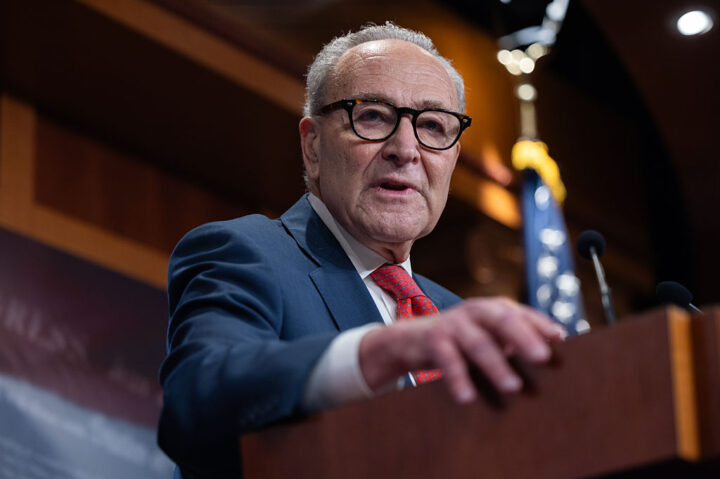
Nathan Posner/Anadolu via Getty Images
Senate Minority Leader Chuck Schumer (D-NY) speaks at a press conference following recent elections as the government shutdown continues in Washington, DC on November 5, 2025.


 Add JewishInsider on Google
A group of eight leading Senate Democrats released a statement on Tuesday evening urging President Donald Trump to “clearly reinforce the opposition of the U.S. government to Israeli government actions that set the conditions for irreversible annexation” of the West Bank when he meets with Israeli Prime Minister Benjamin Netanyahu at the White House on Wednesday.
The statement emphasizes Senate Democrats’ opposition to Israel expanding its control over settlements in the West Bank, which Israel’s Security Cabinet approved measures to help facilitate on Sunday ahead of Netanyahu’s visit to Washington this week.
“We are deeply troubled by the Israeli government’s decision to blatantly consolidate administrative control over and set the conditions to expand settlements into the West Bank,” the senators wrote. “The Israeli government’s actions contravene decades of bipartisan United States policy, including that expressed by President Trump, which asserts the United States supports a two-state solution and that it is not in the U.S. national security interest to support annexation of the West Bank.”
“We have long expressed our concern that these reckless moves make the possibility of a two-state solution, where Israelis and Palestinians can live side by side in peace and security, further out of reach,” the statement continued.
The group said they “urge Prime Minister Netanyahu to reverse course. When President Trump meets with Prime Minister Netanyahu this week, we also urge the President to clearly reinforce the opposition of the U.S. government to Israeli government actions that set the conditions for irreversible annexation.”
The statement was signed by Senate Minority Leader Chuck Schumer (D-NY); Sen. Dick Durbin (D-IL), the Senate Democratic whip; and Sens. Jack Reed (D-RI), Jeanne Shaheen (D-NH), Mark Warner (D-VA), Chris Coons (D-DE), Brian Schatz (D-HI) and Patty Murray (D-WA). The senators who joined Schumer and Durbin are, respectively, the ranking members of the Senate Armed Services Committee, Foreign Relations Committee, Intelligence Committee, the Senate Appropriations Subcommittee on Defense, the Senate Appropriations Subcommittee on State and Foreign Operations and the Senate Appropriations Committee.
Trump has held firm on his opposition to Israeli settlement expansion since saying last September that he would “not allow Israel to annex the West Bank.” Trump reiterated this position in an interview with Axios on Tuesday.
He said following a meeting with Netanyahu at his Mar-a-Lago estate in Palm Beach, Fla., in late December that the two were still on separate sides of the issue, but expressed confidence that all parties would reach “a conclusion,” though he declined to offer specifics.
“Well, we have had a discussion, big discussion, for a long time on the West Bank. And I wouldn’t say we agree on the West Bank 100%, but we will come to a conclusion on the West Bank,” Trump said at the time. “It’ll be announced at an appropriate time, but [Netanyahu] will do the right thing. I know that. I know him very well. He will do the right thing.”
One Jewish Democratic strategist said that none of the three major candidates have deep ties to the Jewish community, leaving Jewish voters up for grabs

Pete Marovich/Getty Images
Ranking Member Lauren Underwood (D-IL) questions acting FEMA Administrator Cam Hamilton as he appears before a Homeland Security Subcommittee Hearing on Oversight on Capitol Hill on May 7, 2025 in Washington, DC. Hamilton is testifying about the administration's disaster relief efforts, including why it has frozen nearly all FEMA's grant funding.
Rep. Lauren Underwood (D-IL) said on Monday that she would pass on an anticipated run for the Illinois Senate seat being vacated by Sen. Dick Durbin (D-IL) in 2026, leaving what’s likely to be a three-way race among Lt. Gov. Juliana Stratton and Reps. Raja Krishnamoorthi (D-IL) and Robin Kelly (D-IL).
“Our work is not done, and I’ve decided the most powerful way for me to defend our values and hold Donald Trump accountable is to help Democrats win back the House,” Underwood said in a statement, highlighting her leadership roles in the House Democratic Caucus and the Democratic Congressional Campaign Committee.
Stratton is backed by billionaire Illinois Gov. JB Pritzker, as well as Sen. Tammy Duckworth (D-IL), while Krishnamoorthi has $19 million in the bank for the race and members of the Congressional Black Caucus are backing Kelly.
Pritzker could put significant funding behind Stratton’s run and reportedly worked behind the scenes to block Underwood and other candidates from entering the race. Underwood, on CNN, denied that Pritzker had forced her to stay out of the race.
A Jewish Democratic strategist, speaking on condition of anonymity to discuss the race candidly, told Jewish Insider they see the Chicagoland Jewish vote — a sizable community — as largely still up for grabs given that none of the candidates have particularly deep ties to the Jewish community coming into the race. They said Jewish voters will likely take time to evaluate each of the candidates.
“I think there’s a lot of inroads for them to make,” the strategist said. “None of these have that long history with the Jewish community … [and] don’t come from natural Jewish areas.”
Kelly and Krishnamoorthi have mixed voting records on priority legislation for the Jewish community, having both opposed several bills and resolutions to combat antisemitism, counter Iran and sanction the Houthis and the International Criminal Court, among other issues.
On the handful of occasions the two have diverged on votes, Krishnamoorthi has generally come down on the side of Jewish and pro-Israel groups — for instance, he supported the Antisemitism Awareness Act, while Kelly opposed it.
The strategist said Kelly may have a shot at gathering Jewish voters’ support given that she has some existing connections with community leaders, from her time as state party chair in 2021 and 2022.
Krishnamoorthi does not currently represent a sizable Jewish community and has not been prominently involved in Jewish issues, the strategist added.
While Pritzker, who is Jewish, has strong ties to the Jewish community, he has led most of the Jewish outreach from the governor’s office, leaving less of a role for Stratton. The strategist said that Stratton “has a lot of room to grow, especially with Pritzker backing her,” and predicted she’ll make a play for the Jewish vote. “She has a very compelling story that I think will resonate with the Jewish community also.”
Chicago also has one of the nation’s largest Palestinian communities, potentially creating competing political incentives for candidates if Israel policy becomes a prominent issue in the race.
Frank Calabrese, a Chicago-based political strategist, said he sees Stratton and Krishnamoorthi as the likely frontrunners in the race overall at this early stage, with Stratton having an advantage given her relationship with Pritzker.
He said that Underwood’s decision not to run caught many, even well-connected political figures in the state, off guard. Calabrese said Underwood likely felt she would not be able to match Stratton and Krishnamoorthi in fundraising, even though she could have been an “ideal type of candidate.”
“I believe Robin Kelly is the weakest of the three just because it’s going to come down to fundraising,” Calabrese said, adding that Pritzker and his political operation have made strong inroads with the Black community, leaving Kelly at a disadvantage with a potential base. He noted that Kelly and Pritzker have preexisting tension — Pritzker forced her out as state party chair in 2022.
But Calabrese said that Stratton’s close ties to the state’s Democratic establishment — Pritzker and Duckworth — could end up being a liability with some Democrats and progressives, particularly the wing of the party that supported Sen. Bernie Sanders’ (I-VT) presidential campaigns. That said, Krishnamoorthi is not strongly aligned with the Sanders wing of the party either, he noted.
Tom Bowen, a Democratic strategist in the Chicago area, argued that the outcome of the race will ultimately be shaped by events over the course of the coming year and that early metrics are often unreliable, especially in multi-candidate races. He predicted that Democratic voters would “take their time” in deciding.
“It’s very obvious the governor’s hand is at work in this, and that he has a preference for the woman he believes should lead the state,” Bowen said. But he argued that might not help Stratton as much in a cycle when some Democrats are looking for big changes. “I’m not sure anybody else’s opinion but their own is going to be the deciding factor here.”
He said that candidates’ backgrounds, endorsements and fundraising are “not insignificant, but voters pay pretty close attention when there’s a moment of crisis, so the one who meets the moment is going to be the one who is successful.”
The Jewish Democratic strategist said they believe the field may not yet be entirely set, noting that businessman Chris Kennedy — brother of Health and Human Services Secretary Robert F. Kennedy Jr. — may also enter the race.
The strategist said that Underwood’s decision not to run makes sense given that she would have been competing against Stratton and Kelly, two other Black women, she is gaining seniority in the House Democratic Caucus and she is young, giving her time to continue to build her national profile.
They said that it’s likely a wide-open race at this point, adding that, while Kelly may currently be the underdog, there’s plenty of runway for her to gain ground if her allies in the CBC put significant backing behind her.
“Most people have no clue who these people are,” the strategist said, “Money helps, but at the end, they have to connect with the voters. And it’s such a diverse state.”
The longtime Illinois senator was first elected to Congress as a staunchly pro-Israel Democrat, but turned critical of Israel in recent years

Nathan Posner/Anadolu via Getty Images
Senator Dick Durbin (D-IL) speaks at a press conference with other members of Senate Democratic leadership following Senate policy luncheons in Washington, DC on March 4, 2025.
Sen. Dick Durbin (D-IL), the Senate Democratic whip, announced on Wednesday that he will not seek reelection to a sixth term, setting up a competitive primary contest to fill his seat and his leadership role.
Durbin, 80, the second highest ranking member of his conference and the top Democrat on the Senate Judiciary Committee, is the fifth Senate Democrat to retire this year, joining Sens. Gary Peters (D-MI), Tina Smith (D-MN), Jeanne Shaheen (D-NH) and Michael Bennet (D-CO).
“The decision of whether to run for re-election has not been easy. I truly love the job of being a United States Senator. But in my heart, I know it’s time to pass the torch. So, I am announcing today that I will not be seeking re-election at the end of my term,” Durbin said in a statement and video posted to social media.
Durbin, who was first elected to Congress in 1982 as a stalwart supporter of Israel, has grown more critical of the Jewish state in recent years. He joined the left-wing faction of his party that supported Sen. Bernie Sanders’ (I-VT) resolutions to cut off some arms sales to Israel over the last year. He also drew criticism for sidestepping the fight against antisemitism, avoiding holding Senate Judiciary Committee hearings that focused on the plight of Jewish students facing discrimination on campuses.
The news of Durbin’s decision to step aside sets up several contests to replace him, both for his Senate seat and in his several leadership positions in the Senate Democratic Conference.
Sens. Cory Booker (D-NJ) and Brian Schatz (D-HI) are among the names being floated for Durbin’s whip role. Others in leadership who could be interested include Sens. Amy Klobuchar (D-MN), Tammy Baldwin (D-WI), Catherine Cortez Masto (D-NV) and Chris Murphy (D-CT), all of whom currently serve in leadership.
Sen. Sheldon Whitehouse (D-RI) is the top contender to succeed Durbin as the ranking Democrat on the Judiciary Committee. Whitehouse is currently the No. 2 Democrat on the committee, and has previously challenged Durbin for the top spot.
While Illinois is a solidly Democratic state, the battle to succeed him is likely to expose divisions within the Democratic Party between moderates and progressives, and potentially showcase the fractures over Israel within the party.
Rep. Raja Krishnamoorthi (D-IL), a top fundraiser and pragmatic lawmaker, is viewed as a leading candidate for the seat. Rep. Lauren Underwood (D-IL), Rep. Robin Kelly (D-IL) and Illinois Lt. Gov. Juliana Stratton have also been named in news reports as potential candidates.
In the House, Republicans are moving ahead on a series of investigations into the matter

Kevin Dietsch/Getty Images
Sen. Lindsey Graham (R-SC) talks to members of the media as he makes his way to the Senate chamber at the U.S. Capitol on April 23, 2024 in Washington, DC.
Senate Judiciary Committee Republicans penned a letter to Sen. Dick Durbin (D-IL) on Thursday to request that he hold a hearing on how the uptick in antisemitism on college campuses is violating the civil rights of Jewish students.
The letter was led by Sen. Lindsey Graham (R-SC), the top Republican on the committee, and signed by every Republican who serves on the panel, including Sens. Chuck Grassley (R-IA), John Cornyn (R-TX), Thom Tillis (R-NC), Ted Cruz (R-TX), Tom Cotton (R-AR), Josh Hawley (R-MO), John Kennedy (R-LA), and Marsha Blackburn (R-TN). They urged Durbin, who chairs the committee, to convene a hearing “on the civil rights violations of Jewish students” and “the proliferation of terrorist ideology — two issues that fall squarely within this Committee’s purview.”
“With this current state of inaction, it is incumbent upon this Committee to shed light on these civil rights violations,” the group wrote. “This Committee owes it to Jewish students, and all students who attend universities with modest hope of having a safe learning environment, to examine these civil rights violations.”
“Our committee should examine why more is not being done to protect the civil rights of innocent students across America,” they added. “We must also examine the threat to national security posed by the proliferation of radical Islamist ideology in the academy. These pressing issues demand our immediate attention.”
A spokesperson for Durbin did not immediately respond to JI’s request for comment on the letter, which came the same day as a missive from Sen. Bill Cassidy (R-LA) to Sen. Bernie Sanders (I-VT) requesting a similar hearing before the Senate Health, Education, Labor, and Pensions Committee.
Cassidy, the top Republican on the Senate HELP Committee, sent a letter to Sanders on Thursday urging him to convene a hearing in his capacity as committee chairman on the uptick in antisemitism on college campuses.
Cassidy’s letter, first obtained by Jewish Insider, marks the second time in six months that the Louisiana senator has written to Sanders requesting that he allow for a full committee hearing “on ensuring safe learning environments for Jewish students, as required by the Civil Rights Act of 1964.” Cassidy released a statement last week re-upping his call for a hearing, though he told JI that effort got no response.
“It is our duty to ensure federal officials are doing everything in their power to uphold the law and ensure students are not excluded from participation, denied the benefits of, or subject to discrimination at school based on race, color, or national origin,” Cassidy wrote to Sanders. “In the six months since my last letter requesting a hearing, the situation has only gotten worse.”
While Republicans have generally been more vocal about their concerns on the issue of antisemitism on college campuses, there have been bipartisan calls for action in the upper chamber.
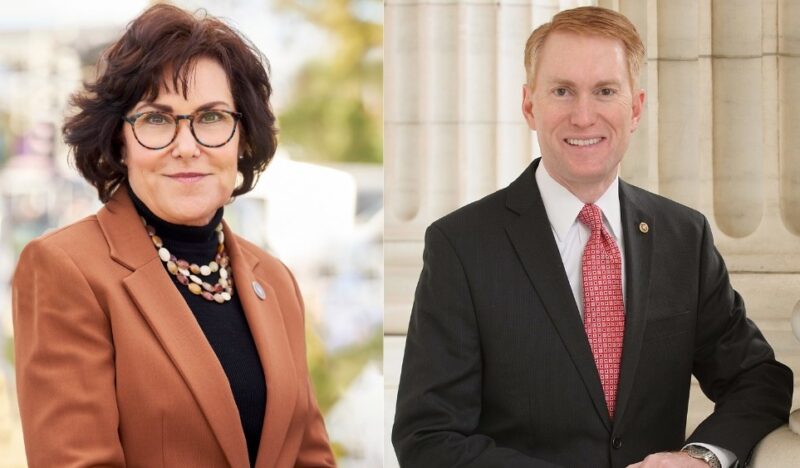
Sens. Jacky Rosen (D-NV) and James Lankford (R-OK) have also asked Sanders to hold a hearing on antisemitism on college campuses in his capacity as HELP chairman. Similar to Cassidy, they have also not heard back from the Vermont senator.
Separately, Sens. Rick Scott (R-FL) and Roger Marshall (R-KS) requested a Senate Homeland Security and Governmental Affairs Committee hearing on Washington, D.C., Mayor Muriel Bowser’s response to protests at The George Washington University’s campus this week.
The duo penned a letter on Thursday to Sen. Gary Peters (D-MI), who chairs the committee, requesting he bring in Bowser and D.C. Metropolitan Police Chief Pamela Smith to testify on their respective responses to university requests to bring DCMP onto campus to clear out an anti-Israel encampment, requests Bowser denied.
On the House side, where Republicans are in the majority, House Speaker Mike Johnson (R-LA) launched a chamber-wide effort to address all elements of the campus unrest.
Rep. Virginia Foxx (R-NC), who chairs the Education and Workforce Committee, revealed that in addition to her ongoing probes, she will have the presidents of three other schools testify next month on their responses to protests and instances of antisemitism on their campuses. The presidents of the University of California, Los Angeles; the University of Michigan; and Yale University will be brought in to testify before Foxx’s committee on May 23.
Rep. Cathy McMorris Rodgers (R-WA), chair of the Energy and Commerce Committee, noted that her panel “oversees agencies that dole out massive amounts of taxpayer funded research grants… We will be increasing our oversight of institutions that have received public funding and cracking down on those who are in violation of the Civil Rights Act.”
House Judiciary Committee Chairman Jim Jordan (R-OH) said that his panel was reaching out to the State Department and Homeland Security Department to find out “how many students on a visa have engaged in the radical activity we’ve seen now day after day on college campuses.”
Please log in if you already have a subscription, or subscribe to access the latest updates.
 Continue with Google
 Continue with Apple