




































The Connecticut senator also said he warned Saudi leaders that the proposed U.S.-Saudi nuclear deal would not survive into a Democratic presidency
(Finn Gomez/Getty Images)
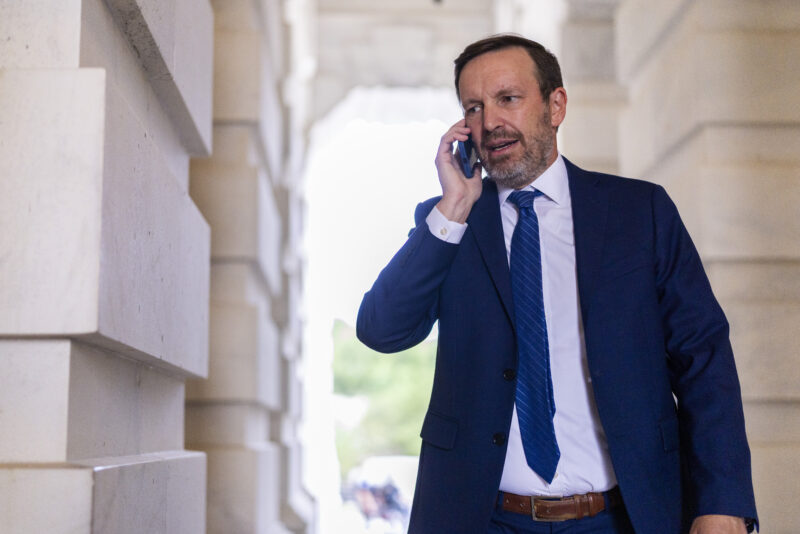
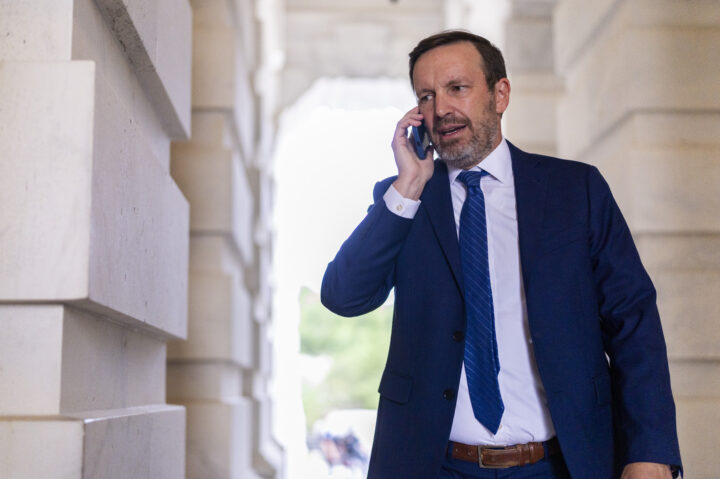
U.S. Sen. Chris Murphy (D-CT) enters the U.S. Capitol Building on August 07, 2026 in Washington, DC.


 Add JewishInsider on Google
Sen. Chris Murphy (D-CT) accused the Trump administration of an “active cover-up” of the costs of the war in Iran and vowed that Democrats would use funding and investigative authorities in the next Congress to force an end to the war.
He also said that he’d warned Saudi officials during his visit this week that the U.S.-Saudi nuclear deal, as currently constructed, would not survive under a Democratic president and urged them to renegotiate it.
The Connecticut senator told reporters on Thursday that Democrats next year should not appropriate funding for the Department of Defense or pass a National Defense Authorization Act without specific requirements to end the war.
He said Democrats will also conduct investigations of the administration and suggested that Democrats might break norms in the Senate requiring bipartisan agreement to schedule hearings and meetings in order to pursue investigations of “this mind-blowing corruption in our foreign policy.”
Murphy has said he was blocked from visiting military installations or receiving briefings from military leaders while in the region, which he described as unprecedented; he said that had not even occurred in Iraq and Afghanistan during the height of those conflicts while U.S. bases were under attack.
Murphy said he plans to draft legislation, and would be interested in using the appropriations and authorization process next year, to include language specifically requiring the Department of Defense to allow members of Congress to access military bases overseas.
Murphy said he saw “extensive damage” to the U.S. Embassy in Riyadh caused by Iranian drone strikes, and argued that the war should lead the U.S. to reassess and reduce its presence in the Middle East going forward.
“This is a moment for the United States to reconsider its footprint in the region,” Murphy said, calling U.S. bases “sitting ducks for the Iranians” that are “not protecting us” because the U.S. had to draw back from them as soon as the war with Iran began.
He said the U.S. may need to maintain some presence at its current bases, also noting Qatar’s strong desire to maintain al-Udeid, the largest U.S. air base in the region, but said it’s unclear whether the U.S. should rebuild its bases to the extent that they existed prior to the war.
In Riyadh, Murphy said he’d warned Saudi leaders that the recent nuclear deal, which would open the door to enrichment inside Saudi Arabia, may not last beyond the end of the Trump administration without the so-called “Gold Standard” provisions preventing enrichment and reprocessing of uranium and allowing at-will inspections of any site by the International Atomic Energy Agency.
Murphy himself has been seen as a potential Democratic presidential candidate in 2028.
“There is a risk that this could lead to the full nuclearization of the Middle East,” Murphy said. “The Emiratis will clearly come back and want the additional protocols dropped [from their agreement with the U.S.]. The Qataris and others are likely going to try to rush to the precipice of nuclear weapons power, and of course it is likely to be escalative, causing the Iranians to be less willing to do a nuclear deal with us.”
He said he told Saudi officials he might not even support the nuclear deal with those enhanced provisions, but that it would be more likely that the next Democratic president would uphold the deal if it meets those standards. He said Saudi Arabia’s objections to the enhanced inspection protocols “made no sense to me.”
He said that the visit to the region had shown him “how this war [in Iran] is spiraling downward very quickly” and that Saudi Arabia has the posture of a “country at war” as it resumes operations against the Houthis in Yemen alongside the Yemeni government.
He said that renewed conflict in Yemen will lead to the deaths and starvation of thousands and argued that Saudi Arabia should not be involved in the “Yemeni civil war” — despite repeated Houthi attacks on Saudi Arabia — and that the U.S. should stay out of the conflict as well.
Murphy acknowledged that the current phase of the war is “different” than the way the conflict was fought in the late 2010s, to significant criticism from Murphy and other U.S. lawmakers at the time. He argued that Saudi Arabia’s operations against the Houthis would not have restarted without the Iran war.
“It is true that this is now just one theater, and the Saudis, of course, have a right to try to protect themselves,” Murphy said. “In their mind, the only way to protect themselves is to run a ground operation inside Yemen.”
But he said he does not think that Saudi Arabia has a “clear set of objectives” in the conflict and instead plans to “push as far as they can,” and accused the Trump administration of entering the U.S. into the war by providing military advisors and aerial refueling to Saudi Arabia.
He warned that the war might provide an opportunity for al-Qaida to reform in the Arabian peninsula and that he believes congressional action will be necessary to prevent U.S. involvement in the war.
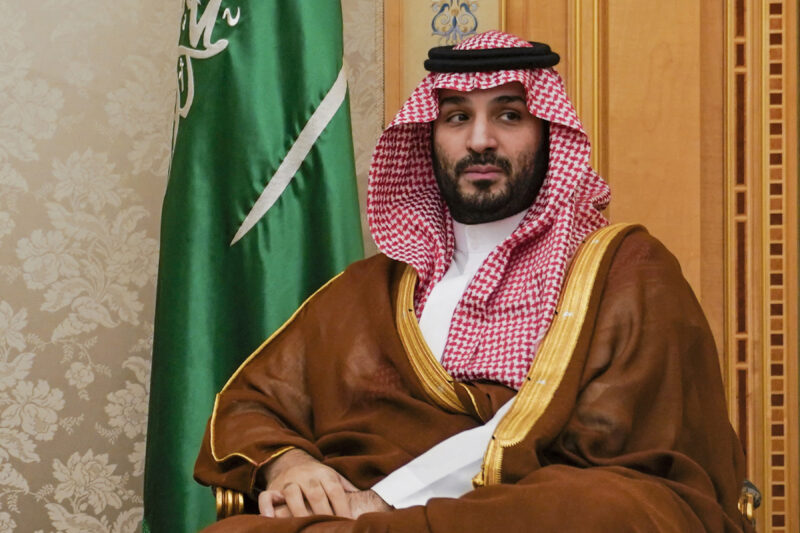
Murphy said he’d spoken to both Saudi Crown Prince Mohammed bin Salman and Qatari Emir Tamim bin Hamad Al Thani about “Trump’s foreign policy corruption.”
“I told the Qataris that no matter how much pressure they got from Donald Trump to gift that plane, they should have said no,” Murphy said. Public reporting has not indicated that Qatar was pressured to gift the jumbo jet now serving as Air Force One. “Knowing that this was a corrupt deal, the Qataris should have said no.”
He said that he also told MBS that his and Saudi Arabia’s investments in Jared Kushner’s private equity fund and his invitations to Trump and business affiliates to partner on projects in Saudi Arabia “was an enormous problem for the U.S.-Saudi relationship in the long run.”
“Both leaders told me that they believed this to be good business, and they claimed, of course, that they were doing nothing illegal on their end of the deal,” Murphy continued.
He said he saw a “legitimate social and cultural transformation happening in Saudi Arabia” but also said he spent a significant portion of his meeting with MBS pressing him over issues of free expression in the kingdom, which Murphy characterized as having backslid dramatically in the last decade.
“There is no room to dissent from the kingdom’s policies, and that’s unacceptable,” Murphy said. “MBS told me when I pressed him on this that he needed to eliminate the ability for political speech in order to get his social reforms done. … It seems to me just an excuse, a cover for what is a political campaign of repression designed to keep himself in power.”
He said that he had serious concerns about meeting with MBS at all, “given my criticism and given the legitimacy that sometimes comes with meetings with leaders in the United States,” but said that he’s concerned that Saudi leadership is “hearing only one view from the United States” and needs to hear more from Democrats about corruption concerns and political dissent.
Murphy also said, from his conversation with a Qatari official involved in negotiations between the U.S. and Iran, that negotiations over ending the war are far from complete, but would likely require the U.S. to give billions in sanctions relief and frozen funding in return for “relatively small commitments” from Iran on its nuclear program.
Murphy called Rep. Wesley Hunt (R-TX), the administration’s nominee for U.S. ambassador to Saudi Arabia, “a joke” who will cause more trouble in the U.S.-Saudi relationship.
A provision in draft versions of the 2027 NDAA mandating a department-wide hate symbols policy was prompted by a Coast Guard effort to reclassify swastikas as ‘potentially divisive’
Al Drago/Getty Images
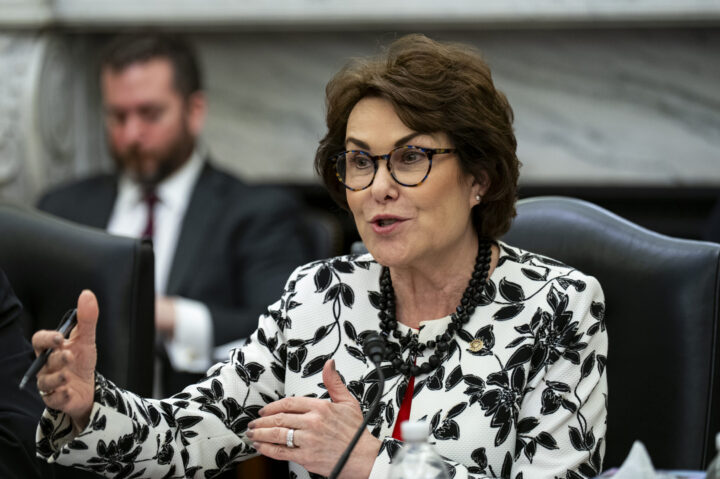
Sen. Jacky Rosen (D-NV), ranking member of the Senate Armed Services Subcomittee on Cybersecurity, speaks during a hearing on Artificial Intelligence cyber capabilities, on Capitol Hill on March 25, 2025 in Washington, DC.
Sens. Jacky Rosen (D-NV), Sen. James Lankford (R-OK) and Rep. Wesley Bell (D-MO) wrote to the leaders of the Senate and House Armed Services Committees on Thursday to urge them to ensure that a provision mandating the creation of a Department of Defense-wide policy on hate symbols remains in the final version of the 2027 National Defense Authorization Act.
Similar language was adopted in both the Senate and House versions of the bills, but the final NDAA remains under negotiation by lawmakers. The push comes largely in response to a back-and-forth last year in the Coast Guard over whether displays of swastikas and nooses would be considered banned hate symbols or only “potentially divisive.”
“Existing DoD hate symbol policies vary across our military service branches, creating inconsistent standards and potential enforcement gaps when it comes to addressing their display,” the three lawmakers said. “This lack of uniformity makes it harder to prevent, identify, and address symbols that promote hate, and can even allow displays to go unaddressed depending on branch-specific rules.”
They emphasized that such symbols in the military workplace “undermine unit cohesion, erode morale, and threaten … good order and discipline.” Bell’s amendment adding the hate symbols provision was adopted by a voice vote in the House Armed Services Committee’s NDAA markup.
The lawmakers emphasized that it was only sustained pushback from lawmakers that prompted the Coast Guard and Department of Homeland Security, which has oversight over the Coast Guard, to reverse course.
“The swastika is not potentially divisive,” the lawmakers continued. “It is one of the most universally recognized symbols of hatred in human history. It represents antisemitism, racial supremacy, violent extremism, and the systematic persecution and murder of millions.”
The lawmakers similarly said that the noose is a “symbol of racial terror,” representing the lynching and terror used to threaten and deny the rights of Black Americans.
Senators say the department of defense undersecretary for policy was evasive, unresponsive and even disrespectful at a classified briefing regarding the implementation of the National Defense Strategy
Graeme Sloan/Bloomberg via Getty Images
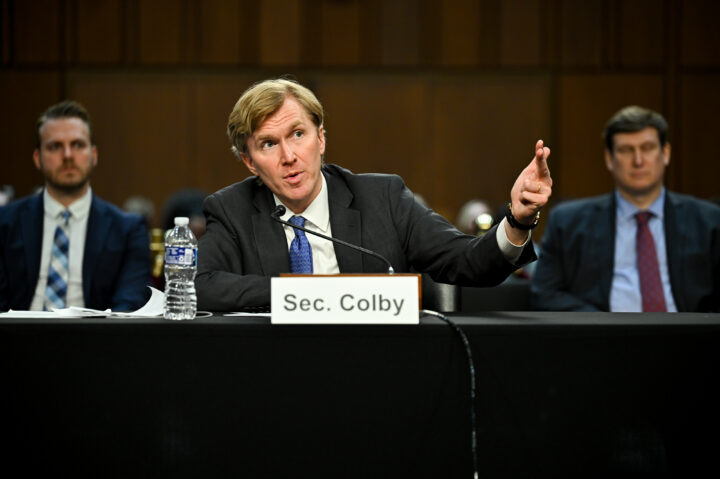
Elbridge Colby, under secretary of defense for policy, during a Senate Armed Services Committee hearing in Washington, DC, US, on Tuesday, March 3, 2026.
Elbridge Colby, the Pentagon’s under secretary for policy, is once again facing criticism from senators who said he was evasive, unresponsive and even disrespectful at a classified briefing on Thursday regarding the implementation of the National Defense Strategy.
Senators said that, among other issues, Colby had failed to provide clear answers regarding the war in Iran.
“The most telling thing I can tell you is that he didn’t have an opening statement, and he’s there to give us an update,” Sen. Kevin Cramer (R-ND) told reporters. “That seemed weird. You’re the policy undersecretary and you come before the Armed Services Committee and you don’t have an opening statement? That seemed contemptuous.”
In comments to The Hill, Cramer described the exchange with Colby as “very disrespectful to say the least” and as a “dodge and punt.”
Sen. Joni Ernst (R-IA) said Colby “was not giving any clear responses” and that she was “very disappointed” by the briefing.
“Right now, I don’t think any of us are happy with the amount of information being shared by the administration,” Sen. Mike Rounds (R-SD) said after Thursday’s briefing with Colby.
Sen. Roger Wicker (R-MS) attempted to avoid commenting on the subject to reporters on Thursday. “It was a confidential, classified meeting and I’m declining to comment,” Wicker told reporters, when asked if he was satisfied with the briefing.
Sen. Richard Blumenthal (D-CT) told Jewish Insider Colby had been “disastrously unresponsive and evasive, which prompted a lot of concern on both sides.”
“My impression [was] that he was lacking in candor and a lot less than forthcoming,” Blumental continued.
Sen. Tim Kaine (D-MD) told JI that Colby had been evasive on questions about his specific involvement in various discussions and decision-making, and that Colby had responded that he would have to follow up with senators in writing after the briefing.
“Those are easy to answer yes or no. So a lot of frustration,” Kaine said.
Sen. Jacky Rosen (D-NV) said that Colby “did not really address our concerns or issues” and “he was not forthcoming in how the National Defense Strategy should have been changed or updated since the illegal war in Iran.”
Sen. Mark Kelly (D-AZ), said, “Like a lot of these, with this administration, you walk out with more questions than you had when you went in. For me, that was the case today.”
Kelly said he pressed Colby on the planning for the war in Iran. “You always get answers — now is it the answer you would expect? Not always.”
Democrats, and some Republicans skeptical of the war effort, have indicated that they’re hesitant if not outright opposed to voting for additional funding for the war

ATTA KENARE / AFP via Getty Images
Explosions erupt following strikes at Tehran Oil Refinery in Tehran on March 7, 2026.
The Trump administration on Wednesday formally sent an $87.6 billion supplemental funding request to replenish stockpiles and otherwise cover the costs of the war with Iran to Congress.
The official notification came in a letter from Office of Management and Budget Director Russell Vought on behalf of President Donald Trump to House Speaker Mike Johnson (R-LA), which was subsequently forwarded to Senate GOP leadership offices.
The defense supplemental request includes $67 billion for the Department of Defense to resupply munitions stocks and prevent the cost of the U.S. troop deployment to the Middle East during Operation Epic Fury, the operation conducted last summer against Iran, from cutting into the Pentagon’s budget.
The bill also requests some additional funding for the State Department and Coast Guard related to the operations.
Administration estimates for the cost of the war have fluctuated significantly: initial reports indicated the Pentagon wanted to ask Congress for $200 billion for the war alone, while officials testified that the munitions costs of the war were between $20 billion and $30 billion. Reconstruction costs for the U.S. bases damaged or destroyed during the war have not yet been accounted for.
Democrats, and some Republicans skeptical of the war effort, have indicated that they’re hesitant if not outright opposed to voting for additional funding for the war, meaning that the legislation might struggle to clear the 60-vote threshold necessary for passage in the Senate.
In addition to the Iran war funding, the supplemental includes a variety of other requests relating to a smorgasbord of other subjects from the Ebola outbreak to supporting farmers, construction projects in Washington, D.C., and New York’s Penn Station and others.
Sen. Roger Wicker (R-MS), the chairman of the Senate Armed Services Committee, released a statement expressing his full support for the supplemental request.
“I fully support the defense supplemental request submitted to Congress today and look forward to working with my colleagues to move it forward legislatively as soon as possible. We must ensure our service members have everything they need to face an increasingly dangerous world,” Wicker said in a statement. “This supplemental funding is essential in the near term to maintain readiness through training and military pay.”
He added that the “request would also accelerate immediate production of key capabilities, from exquisite munitions to low-cost hypersonics, strike weapons, and drones.”
Sen. Kevin Cramer (R-ND) told reporters that he supports the supplemental.
“I think there should be a lot of support for it — you don’t have to agree with the president’s decisions in Iran to understand we need to modernize, we need more munitions, we have some catching up to do in terms of our weapons systems,” Cramer said. “I, frankly, thought it was pretty modest.”
Sen. Susan Collins (R-ME), the chair of the Senate Appropriations Committee, told Jewish Insider that she hasn’t had a chance to review the request yet, but that the committee plans to hold a public hearing about it.
Collins said “I have no idea, I really don’t” as to whether Republicans will be able to secure the Democratic support that will be necessary to pass the bill, but she was skeptical.
“I haven’t looked at it, and it also depends on whether they’re going to play politics,” Collins added. “I was also not encouraged by Vice Chair [Patty] Murray’s comments.”
Sen. Bill Cassidy (R-LA), who lost the Republican primary contest for his reelection bid to a Trump-backed challenger last month and has since become one of the Senate’s leading swing votes, told JI that he will need to review the supplemental before deciding whether to support it.
Sen. Chris Coons (D-DE), the top Democrat on the Senate Appropriations Defense subcommittee, told JI he was skeptical of the request.
“I’m still reviewing it. My initial reaction is I’m opposed to the supplemental as it is,” Coons said. “I’m open to finding ways to provide the resources that our war fighters need and that will defend our country, but I’m not open to billions of dollars for things like the Golden Fleet or the Golden Dome.”
Coons said that “it’s hard for me to get too excited about a supplemental when we don’t yet have clarity about if reconciliation 3.0 is the only supplemental and, frankly most importantly, what’s the status of the war. I’m not going to vote for a backdoor authorization for the war in Iran.”
The Delaware senator told JI that he has “pressed in every conversation” with the Trump administration “the importance of funding for Ukraine and securing cutting-edge drone interceptor capability to defend the United States.”
Sen. Patty Murray (D-WA), the top Democrat on the Appropriations Committee, released a statement late Wednesday criticizing the president for launching “a reckless and costly war with Iran — without authorization from Congress or the support of the American people — that he should never have started, and now, instead of doing anything to help families get by, he is asking taxpayers to pick up the tab and give him billions more to wage wars overseas.”
Murray noted that the president “is making this request for more funding as the Pentagon already has a historic annual budget and sits on over $100 billion in unspent funding Republicans provided in their Big Ugly Bill.”
She also argued that the Trump administration “has failed to answer basic questions about its aims and justification for the Iran war and failed to provide the most basic information about its costs.”
And the Washington senator said that the bill is “an attempt to secure tens of billions of additional dollars for unrelated Pentagon priorities that should rightly be considered through the annual appropriations process.”
Murray did not explicitly commit to voting against the supplemental request. She instead vowed to “closely review” it and said she would “ensure we take care of our servicemembers,” though she warned that, “I will not rubber-stamp tens of billions more for this disastrous war of choice.”
Secretary of Defense Pete Hegseth briefed some House Republicans in a classified setting on the supplemental, and the White House’s request for a $350 billion reconciliation bill to provide additional Pentagon funding, at the Capitol on Wednesday. Some Senate Republicans have said the reconciliation bill is a nonstarter.
The meeting took place a few hours before Vought’s letter to Johnson, which was sent earlier in the day, was made public and came ahead of an expected fight over the funding request to replenish stockpiles and otherwise pay for the war in Iran.
Rep. Don Bacon (R-NE) emphasized after the meeting that the supplemental is necessary to restock the munitions the U.S. needs to counter its adversaries, and to take care of servicemembers.
He also offered support for the larger $350 billion request, which he said is just a first step toward bringing the U.S.’ defense budget in line with where it needs to be to ensure the country’s global status and take care of troops.
He also praised Hegseth’s discussion of the U.S. memorandum of understanding with Iran. Bacon said he has not always been impressed by Hegseth, but found that he was “more prepared” and had a “good grasp” of the details.
Rep. August Pfluger (R-TX), the chair of the Republican Study Committee, the GOP caucus that organized the briefing, also made the case for the reconciliation bill, arguing that we “have a once in a lifetime opportunity to have a generational impact on our military,” and argued that it’s going to be up to Republicans “to make sure the future generations have the resources, have the weapons systems, are trained and are outfitted to make sure that they defend this country.”
Rep. Rich McCormick (R-GA) said that Hegseth argued to lawmakers that, before the Iran war, the Iranians were not negotiating in good faith, and “now they are,” which is a sign of progress.
“So you could say they accomplished that mission. I think it wasn’t good enough at all. I think we could have had an unconditional surrender,” McCormick said, arguing that the U.S. should have struck Iran’s oil facilities and set back Iran’s economy by decades, and could have ended the war by now on its own terms.
“I just don’t see how they had any negotiation power at all,” McCormick said. He said that if Iran doesn’t make a deal, he expects a return to war.
He also argued that, even prior to the supplemental, the U.S. has sufficient munitions to “obliterate all of Iran, easily, and then some.”
The request includes cuts of $1.3 billion to FEMA grant programs, a category which includes the Nonprofit Security Grant Program
Daniel SLIM / AFP via Getty Images
The White House is seen in Washington, DC, on December 17, 2025.
The Trump administration’s 2027 top-line budget request to Congress calls for significant funding increases for the Department of Defense, while pushing for cuts to certain programs at the Federal Emergency Management Agency and the Department of Justice.
The budget request affirms President Donald Trump’s previously stated desire for a $1.5 trillion defense budget in 2027 — a $441 billion increase over 2026 funding levels.
The request urges cuts of $1.3 billion to non-disaster grant programs at FEMA, a category which includes the Nonprofit Security Grant Program, which has been critical to protecting Jewish community institutions and for which both lawmakers and Jewish community groups have sought increased funding.
The request does not specifically spell out how NSGP funding would be impacted, but states broadly that the budget “reduces wasteful FEMA grant programs, refocusing the agency on sound emergency management while encouraging States and communities to build resilience and use their unique local knowledge and resources in disaster response.”
The budget document does specifically lambast FEMA’s “Targeted Violence and Terrorism Prevention” program, which has support from some groups in the Jewish community, as having been “weaponized to target Americans exercising their First Amendment rights.”
At the DOJ, the administration again aims to eliminate the Community Relations Service, which has received support from some Jewish community groups in the past, charged with helping to mediate communal conflicts based on various forms of hatred and discrimination. It describes the program as a “woke [enterprise] that fails to serve the core function of the Department to fight crime and protect American communities.”
Lawmakers ultimately rejected efforts to fully defund CRS last year, though they did cut $4 million from the office’s budget.
“CRS has a long track record of supporting fringe leftist organizations such as Black Lives Matter and legitimizing riotous behavior that puts America’s police in the crosshairs,” the budget request continues.
The budget request also continues to push for the elimination of the Department of Education, though it doesn’t include a specific line item for the Office for Civil Rights, which is responsible for addressing, among other issues, antisemitism on college campuses. The administration had sought significant cuts to that office in 2026.
The administration called for $2.7 billion in cuts to the U.S.’ funding for international organizations including the United Nations, particularly taking aim at the United Nations regular budget and U.N. peacekeeping missions.
It specifically criticizes anti-Israel bias at the U.N.: The budget document states that the U.N. Human Rights Council and its commission of inquiry on Israel “has failed to uphold any semblance of impartiality or conduct objective investigations.”
The administration requested $15.2 million in additional funding for the Treasury Department’s Office of Terrorism and Financial Intelligence, “making key investments in critical cyber capabilities, sanctions targeting, and combating illicit financial activity” — with a focus on countering cartels.
More specific line-item requests should be released in the coming days.
President threatens further attacks if Iran blocks Strait of Hormuz; teases nation-building effort
The White House via X Account/Anadolu via Getty Images
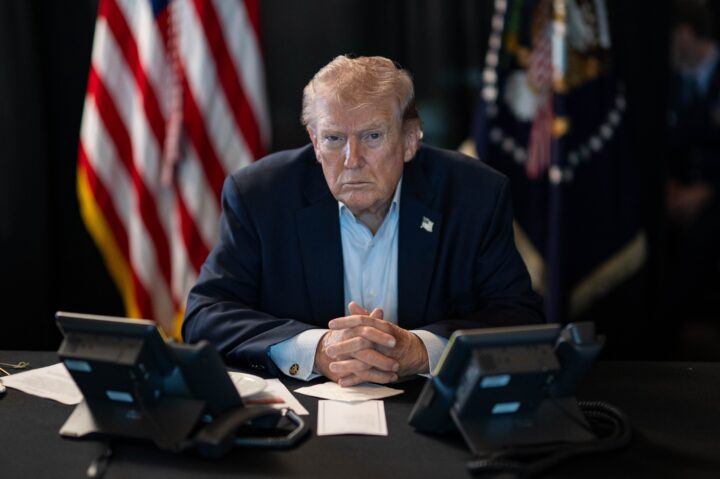
U.S. President Donald J. Trump sits at a table monitoring military operations during Operation Epic Fury against Iran, with U.S. flags visible behind him, in Washington, United States, on March 02, 2026.
President Donald Trump drew two contradictory timelines for the ongoing war in Iran in remarks on Monday, saying that the conflict was both drawing to a close and in its early stages.
In a call with CBS News, Trump said, “The war is very complete, pretty much. [Iran has] no navy, no communications; they’ve got no air force. Their missiles are down to a scatter. Their drones are being blown up all over the place, including the manufacturing of drones. … There’s nothing left in a military sense.”
The war has progressed faster than initially expected, the president added: “We’re very far ahead of schedule.”
Also Monday, the Department of Defense posted on X that “we have only just begun to fight, with a graphic of a missile interceptor and the text: “No Mercy.”
At a news conference after his CBS News interview, Trump was asked whether the war is “very complete” or “just beginning.”
“I think you could say both,” the president responded. “It’s the beginning of building a new country. We could call it a tremendous success right now, or we could go further.”
“And we’re going to go further,” Trump added.
In his interview with CBS, Trump considered further steps, saying that he is “thinking about taking … over” the Strait of Hormuz.
The president later posted on Truth Social: “If Iran does anything that stops the flow of Oil within the Strait of Hormuz, they will be hit by the United States of America TWENTY TIMES HARDER than they have been hit thus far.”
The Strait of Hormuz is the only passage by sea from the Gulf to the open ocean and a critical chokepoint in the global energy market.
Israeli Prime Minister Benjamin Netanyahu, meanwhile, said during a visit to Israel’s National Health Command Center on Monday that “our aspiration is to enable the Iranian people to cast off the yoke of tyranny; ultimately, it is up to them.”
“If we succeed together with the Iranian people, we will bring about a permanent end to the extent that such things exist in the lives of nations,” Netanyahu added. “We will bring about change, and we are already bringing about a massive shift in Israel’s international standing.”
The IDF Home Front Command reported only six missile launches from Iran to Israel in the past 24 hours, a significant slowdown from previous days of the war.
The IDF continued to strike targets in Iran, including a missile launcher, 10 minutes after it fired at Israel.
On Monday night, the IAF completed a wave of strikes against six major Iranian military airfields, destroying Islamic Revolutionary Guard Corps aircraft, including combat helicopters.
Lebanese President Joseph Aoun reached out to the U.S. to start direct talks with Israel on “permanent arrangements for security and stability on [its] borders.” He called for a “complete truce” ending Israeli military activity, and lamented that Hezbollah — which Beirut had agreed to disarm as one of the terms of its 2024 ceasefire with Israel — “wanted to achieve the fall of the State of Lebanon, under aggression and chaos.”
Israeli strikes on Hezbollah in Lebanon continued, with overnight attacks on command centers and the facilities of the Al-Quard Al-Hassan Association, which funds the Iran-backed terrorist group and works with cash, as well as a cell of Hezbollah terrorists approaching IDF soldiers and a structure in which commanders of the elite Radwan Force were said to be gathering.
Israeli Foreign Minister Gideon Sa’ar met with U.N. Special Coordinator for Lebanon Jeanine Hennis in Jerusalem on Monday. In his readout of the meeting, he noted that Hezbollah joined the war on Iran’s side “against the interest of Lebanon.”
“Over the past week there have been more attacks against Israel from Lebanese territory than from Iran,” Sa’ar said. “Weakening Hezbollah is a mutual interest of both Israel and Lebanon. I also said that Hezbollah initiated an attack against us and no member of the international community is acting to stop it besides us.”
Sa’ar and Hennis also discussed Israel’s decision not to evacuate residents from its northern border towns, in contrast with October 2023, and said that “the deployment of IDF troops in the border area is critical for preventing an invasion of Hezbollah’s ground forces and attacks against Israeli citizens and communities.”
The IDF estimated in recent days that over half a million Lebanese residents evacuated southern Lebanon.
Magen David Adom emergency services reported treating 76 people as a result of Monday’s missile attacks, two of whom were killed and 18 injured by missile debris.
Since the start of Operation Lion’s Roar, there have been 14 fatalities. MDA reported treating 667 people for injuries resulting from missile attacks, 511 of whom were injured making their way to shelter or in traffic accidents when stopping for a missile alert.
The lawmakers, led by Ossoff, said in a letter to Hegseth that they are troubled by the chatbot’s ‘track record promoting Holocaust denial, spreading racist ideologies, and generating deepfake pornography of children’

Cheng Xin/Getty Images
A person holds a smartphone showing the Grok 4 introduction page on the official website of xAI, the artificial intelligence company founded by Elon Musk, with the Grok logo visible in the background on July 16, 2025 in Chongqing, China.
In a letter sent to Secretary of Defense Pete Hegseth on Monday, a group of Senate Democrats raised concerns about the Pentagon’s decision to use xAI’s Grok chatbot in Department of Defense networks.
The senators said that Grok’s record of producing antisemitic content — pointing in particular to an antisemitic tirade by the chatbot in 2025 — as well as its more recent history of generating non-consensual pornographic images of people, including children, raises concerns about the Defense Department’s use of the model.
“We are particularly concerned by this development, given Grok’s reported recent track record promoting Holocaust denial, spreading racist ideologies, and generating deepfake pornography of children,” the lawmakers wrote. “Grok’s generation of such content has triggered various investigations of the platform and the potential use of this model by a federal agency is troubling.”
The lawmakers asked Hegseth to explain what rules and regulations are in place regarding the use of AI in the Defense Department, including safeguards against Grok promoting antisemitism, racist conspiracy theories and sexual content and what measures are being taken to ensure data privacy.
“While AI technology can facilitate innovation, it must be deployed, used, and regulated in a manner consistent with the national interest and standards of decency,” the letter continues.
The letter was led by Sen. Jon Ossoff (D-GA) and co-signed by Sens. Chris Van Hollen (D-MD), Adam Schiff (D-CA), Dick Durbin (D-IL), John Hickenlooper (D-CO) and Raphael Warnock (D-GA).
Groups of House members have pressed both the Pentagon and xAI CEO Elon Musk about the antisemitic content produced by Grok and the Pentagon’s plans to utilize the chatbot.
xAI told lawmakers that the antisemitic rants were a result of an “unintended update” to the chatbot’s code.
Sen. Roger Wicker (R-MS): ‘I’ve noticed an unsettling trend this year at times, that Pentagon officials have pursued policies that are not in accord with President Trump’s orders’

Nathan Posner/Anadolu via Getty Images
Elbridge Colby, nominee to be Under Secretary of Defense for Policy, is seen ahead of his confirmation hearing at the Senate Committee on Armed Services in Washington, DC on March 4, 2025.
Senate lawmakers from both parties on the Armed Services Committee excoriated the Department of Defense policy office run by Under Secretary of Defense for Policy Elbridge Colby at a Tuesday hearing. They criticized the office for a lack of communication with lawmakers as well as a series of controversial decisions seemingly at odds with White House policy.
Lawmakers expressed frustration that they had not received sufficient communication from the Pentagon’s policy office and criticized Colby and his team for making controversial decisions like pausing U.S. aid to Ukraine, opposing the deployment of additional U.S. forces to the Middle East during Israel’s war against Iran, withdrawing U.S. forces from Romania and re-assessing the AUKUS submarine agreement with the U.K. and Australia.
Democrats have publicly voiced frustration with Colby’s alleged rogue decision-making in the past, but the committee meeting — a confirmation hearing for several civilian Pentagon officials — constituted an unusual public airing of grievances from Republicans and Democrats alike about their concerns with Colby and his office.
“It just seems like there’s this pig-pen like mess coming out of the policy shop that you don’t see from [other departments of the Pentagon]. Why do you think it is that there’s so many controversies emanating out of the policy shop and not these other offices in the department?” Sen. Tom Cotton (R-AR) asked Austin Dahmer, the nominee to be assistant secretary of defense for strategy, plans and capabilities — a top position in Colby’s department — who is currently serving in an acting capacity as one of Colby’s chief deputies.
Cotton also serves as the chair of the Senate Intelligence Committee.
“I’ve noticed an unsettling trend this year at times, that Pentagon officials have pursued policies that are not in accord with President Trump’s orders, or seem uncoordinated within the administration,” Sen. Roger Wicker (R-MS), the chairman of the Armed Services Committee, said, adding that the members of the committee have found out about such moves from press reports rather than the Defense Department.
“There are strong foreign policy debates in my political party. We do not have consensus on every issue and I welcome healthy discussion on America’s role in the world. I think the president does too,” Wicker continued. “Amid these debates, I think everyone would expect the president’s national security strategy staff to follow his lead and implement his vision.”
He added that committee members “have struggled to receive information from the policy office and have not been able to consult in a meaningful way with [the policy office] either on the national defense strategy or the global posture review. … The situation needs to improve if we are to craft the best defense policy.”
A frustrated Sen. Dan Sullivan (R-AK) described Colby as “the hardest guy to get a hold of in the Trump administration.”
“He came to this committee and said, ‘Hey, I’m going to work with the Congress.’ He hasn’t, on big issues,” Sullivan continued. “I can’t even get a response and we’re on your team.”
Sullivan and other lawmakers expressed particular frustration with the lack of consultation from the administration on the forthcoming national defense strategy and global posture review, which news reports indicate will prioritize the Western hemisphere and domestic missions at the expense of other threats and theaters including China.
Dahmer, a former staffer for Sen. Josh Hawley (R-MO), pleaded ignorance about the controversial moves and lack of communication or claimed that such moves had not happened and that public reporting about them was false.
Regarding the recent drawdown of troops from Romania, Dahmer claimed that lawmakers had been briefed three times prior to the move — but Wicker said that neither the majority nor minority staff had been notified ahead of time about the plans.
“I think all of us would like to have more information on how the decision was made” and communicated to Romania, Sen. Rick Scott (R-FL) said, adding that he had more questions for Dahmer about “what the policy office has been doing as compared to the president’s and secretary’s directives and stated policy objectives” and “confusion between what the president and secretary called for versus what the policy office has been doing, from weapons sales and deliveries to troop draw-downs.”
Sen. Jack Reed (D-RI), the committee’s ranking member, said that Dahmer had “cloaked your testimony in a veil of ignorance, when in fact you were basically the stand in and the surrogate for [Under] Secretary Colby. … You’re clearly avoiding answers to questions that you should have been acutely aware of in your position.”
“I think you’ve essentially indicated to us that you won’t cooperate with us,” Reed continued.
Wicker also criticized the administration for providing notification to Congress on Sunday — days before the confirmation hearing — that it had renamed and changed the duties of the position for which Dahmer is nominated. Reed said that those changes were apparently made a month ago, without notifying Congress.
Alex Velez-Green, another former Hawley staffer nominated for a top Pentagon post under Colby, is scheduled to appear for his own confirmation hearing later this week.
Pentagon spokesperson Sean Parnell told JI: 'Senior Department of Defense officials will no longer be participating at the Aspen Security Forum because their values do not align with the values of the DoD.'
Kayla Bartkowski/Getty Images
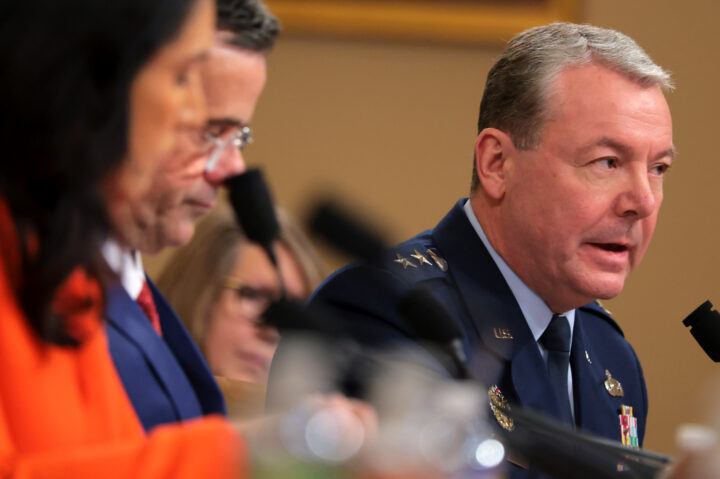
Defense Intelligence Agency Director Jeffrey Kruse testifies during an annual worldwide threats assessment hearing at the Longworth House Office Building on March 26, 2025 in Washington, DC.
The 2025 Aspen Security Forum kicks off today and finds itself unexpectedly thrust into the ideological fights gripping the administration.
The Defense Department announced Monday that it would be withdrawing numerous senior military and civilian officials who had been set to speak at the conference.
Pentagon spokesperson Sean Parnell told Jewish Insider: “Senior Department of Defense officials will no longer be participating at the Aspen Security Forum because their values do not align with the values of the DoD. The Department will remain strong in its focus to increase the lethality of our warfighters, revitalize the warrior ethos, and project ‘Peace Through Strength’ on the world stage. It is clear the ASF is not in alignment with these goals.” Spokesperson Kinglsey Wilson offered even more pointed criticism to right-leaning outlet Just the News, saying the conference “promotes the evil of globalism, disdain for our great country, and hatred for the President of the United States.”
It’s tough criticism of a forum that prides itself on bipartisanship and aims to foster cross-partisan dialogue and solution-making, even as those attributes are in short supply in today’s Washington. The forum said in a statement, “we will miss the participation of the Pentagon, but our invitations remain open. … The Aspen Security Forum remains committed to providing a platform for informed, non-partisan debate about the most important security challenges facing the world,” noting that voices across the political spectrum will be speaking this week.
Many had been hoping to hear Defense Intelligence Agency Director Lt. Gen. Jeffrey Kruse, who was originally scheduled for a panel discussing the evolution of warfare, speak about his agency’s leaked report suggesting the strikes on Iran’s nuclear facilities had minimal effects, but Kruse was among the speakers withdrawn by the Pentagon.
Among the administration speakers still scheduled to appear are hostage envoy Adam Boehler, speaking on Thursday, and Tom Barrack, the U.S. ambassador to Turkey and special envoy to Syria. Barrack will be speaking on a Friday panel about the Middle East alongside former CIA Director David Petraeus and former Deputy National Security Advisor Dina Powell McCormick.
Wednesday’s Israel-focused panel will feature former IDF Intelligence Chief Amos Yadlin, former Israeli Ambassador to the U.S. Michael Herzog, former Biden administration official Brett McGurk and author and “Call Me Back” podcast host Dan Senor.
An Iran-focused panel on Thursday will include former U.S. National Security Advisor Stephen Hadley, former CEO of the Bulletin of Atomic Scientists Rachel Bronson and Johns Hopkins professor Vali Nasr.
There’s likely to be plenty of discussion throughout the week about the ways the Trump administration’s strikes on Iran will shape policy in the Middle East — and throughout the world — going forward, and about the ongoing impacts of the war in Gaza.
Former National Security Advisor Jake Sullivan will be speaking on Friday on a panel with former Secretary of State Condoleezza Rice and former Defense Secretary Robert Gates.
Former Defense Secretary Mark Esper and former Homeland Security Secretary Jeh Johnson will also be speaking Friday, on AI and cybersecurity issues, respectively. Former Deputy Treasury Secretary Wally Adeyemo will speak on Thursday about international aid and trade.
Sens. Chris Coons (D-DE), John Cornyn (R-TX) and Mark Warner (D-VA) will lead the conference’s annual “View from the Senate” panel on Friday.
We’ll be keeping an ear out for discussion about the internal debates between hawks and isolationists taking place within the Trump administration over America’s role and engagement in key global arenas — from the Middle East to Ukraine and Asia. We’ll also be tracking proposed efforts to restructure the U.S. intelligence community.
Expect a significant focus throughout the week on the many ways that the Trump administration’s unpredictable foreign policy — from its recommitment to providing Ukraine military aid to the status of tariffs against key countries, along with the recent, sweeping cuts to the State Department and U.S. Agency for International Development — is shaking up global affairs, how the private sector and foreign countries are adapting and how leaders can attempt to maintain bipartisanship on foreign policy.
In social media posts, Wilson promoted antisemitic conspiracy theories, including one about the Anti-Defamation League’s founding

Screenshot/X
Kingsley Wilson
Kingsley Wilson, a deputy press secretary at the Department of Defense who has come under fire from Democratic and Republican lawmakers and Jewish communal organizations for promoting antisemitic conspiracy theories, has been promoted to serve as the department’s press secretary, the Pentagon announced on Friday.
“Kingsley’s leadership has been integral to the DoD’s success & we look forward to her continued service to President [Donald] Trump,” Sean Parnell, the chief Pentagon spokesman and a senior advisor to Defense Secretary Pete Hegseth, posted on X on Friday.
When Wilson was named deputy press secretary in March, she faced widespread condemnation for dozens of tweets viewed as antisemitic and racist. On two different occasions, she attacked the Anti-Defamation League for sharing its origin story — the organization was founded after the lynching of Leo Frank, an Atlanta Jew widely believed to have been wrongly convicted of raping and murdering a white child over a century ago.
“Leo Frank raped and murdered a 13-year-old girl,” Wilson wrote in 2023 in response to a post from the ADL, and repeated the claim a year later. “He also tried to frame a black man for his crime. The ADL is despicable.” (The tweet has not been deleted.)
Wilson has also called Confederate General Robert E. Lee “one of the greatest Americans to ever live” and regularly promoted the antisemitic “Great Replacement Theory.”
Her appointment in March drew bipartisan criticism. “Obviously I don’t agree with her comments. I trust the Pentagon will address this,” Sen. Rick Scott (R-FL) told Jewish Insider at the time. Senate Minority Leader Chuck Schumer (D-NY) called for her firing.
Spokespeople for the Pentagon and the White House did not immediately respond to requests for comment on Friday.
The jet will require significant upgrades before it can be used by the president

Win McNamee/Getty Images
Air Force One sits on the tarmac on May 12, 2025, at Joint Base Andrews, Maryland.
The Department of Defense formally accepted a luxury Boeing 747 jumbo jet from Qatar for President Donald Trump’s use as Air Force One, Pentagon spokesman Sean Parnell said in a statement on Wednesday.
Parnell said Secretary of Defense Pete Hegseth accepted the jet “in accordance with all federal rules and regulations” and that the Defense Department would “work to ensure proper security measures and functional-mission requirements are considered for an aircraft used to transport the President of the United States.”
The jet will require extensive modifications and security enhancements to be used as Air Force One, which must operate as a mobile command center for the president. Aviation experts estimate the upgrades could cost over $1 billion.
Air Force Secretary Troy Meink said in a Senate Armed Services Committee meeting on Tuesday that the Air Force has already begun exploring the extent of the upgrades required and that he would warn Trump and Hegseth should any concerns arise about the Air Force’s ability to ensure the plane is secure enough.
The Air Force said in a statement to Defense News that it currently has no information about its timeline for modifying the plane.
At a value of $400 million, the jet is one of the most expensive gifts given to a U.S. president. Experts and lawmakers have raised concerns of the transfer potentially violating the Constitution’s anti-bribery emoluments clause.
White House spokesperson John Kirby didn’t refute the documents’ authenticity in remarks to the press on Monday

Roberto Schmidt/Getty Images
John Kirby speaks during a press briefing at the White House on February 27, 2024 in Washington, DC. Earlier, the President met with the four Congressional leaders at the White House
The Department of Defense is investigating how U.S. intelligence documents detailing Israeli plans to attack Iran were leaked and published in an online forum, the White House said on Monday.
“We’re not exactly sure of how these documents found their way into the public domain,” said White House national security spokesperson John Kirby. “I know the Department of Defense is investigating this, and I’m sure that as they work through that, they’ll try to determine the manner in which they did become public.”
The White House does not yet know if the documents were purposely leaked by an official who had access to them or whether they were obtained as the result of a hack, according to Kirby.
President Joe Biden will be updated on the progress of the investigation and “any mitigation measures and recommendations that come as a result of the investigative efforts, [and] how to prevent it from happening again,” Kirby told reporters. “The president remains deeply concerned about any leakage of classified information into the public domain. That is not supposed to happen, and it’s unacceptable when it does.”
The reportedly top secret documents were published last week in a Telegram channel called “Middle East Spectator” that is believed to be affiliated with Iran, although it is operated anonymously. An account in the channel claimed the documents came from the National Geospatial-Intelligence Agency, headquartered at the Defense Department.
The authenticity of the documents has not been verified. Kirby did not refute their authenticity during his Monday remarks to the media.
Several U.S. lawmakers, including House Speaker Mike Johnson (R-LA), have called for investigations into the source of the leak.
Please log in if you already have a subscription, or subscribe to access the latest updates.
 Continue with Google
 Continue with Apple