








































The invitation comes amid a sharp rise in antisemitic and anti-Israel rhetoric from the Kingdom

Anna Moneymaker/Getty Images
Saudi Arabia Defense Minister Prince Khalid bin Salman ahead of a meeting with Secretary of State Marco Rubio in the State Department Building on February 25, 2025 in Washington, DC.


 Add JewishInsider on Google
Jewish and pro-Israel organizations were invited to a meeting with the Saudi defense minister in Washington on Friday afternoon, four sources familiar with the invitation confirmed to Jewish Insider.
Invited groups included the American Jewish Committee, Anti-Defamation League, Conference of Presidents of Major American Jewish Organizations and Republican Jewish Coalition, though as of Thursday morning it was not clear which invitees would be accepting the invitation.
Foundation for Defense of Democracies is meeting with the defense minister in a separate sit-down Friday morning, FDD CEO Mark Dubowitz confirmed to JI.
Saudi Defense Minister Khalid bin Salman, the brother of Crown Prince Mohammed bin Salman, is in Washington holding meetings with U.S. officials including Secretary of State Marco Rubio and White House Special Envoy Steve Witkoff on Thursday and Friday.
The invitation comes as some Jewish organizations have expressed concerns about the recent rise in antisemitic and Islamist rhetoric out of Saudi Arabia, but they’ve been relatively cautious in their language as they seek to maintain their support for the long-sought but elusive goal of bringing Riyadh into the Abraham Accords.
“This meeting will be complete window dressing,” one Middle East analyst familiar with the invitation and with the larger Saudi pivot in the region told JI. “The Saudis may try and rationalize their way out of their new alignment with Pakistan, Qatar and Turkey and say everything is fine with the UAE when evidence says otherwise.”
“They may also want to send a message to Jewish organizations with absolute clarity that they will not be joining the Abraham Accords until there’s a Palestinian state, especially ahead of a rumored visit by [Israeli Prime Minister Benjamin] Netanyahu to Washington in the next 30 days,” the analyst added.
“If these Jewish organizations do attend the meeting, they should give a stern message to Saudi leadership that their new strategic alliances and promoting antisemitism and being destructive in the region regarding Israel are not helpful.”
William Daroff, CEO of the Conference of Presidents, to Van Hollen: ‘Labeling American Jews as apologists when they challenge you is not discourse. It is a smear’

Joe Raedle/Getty Images
Rabbi Susan Shankman (L) hugs Ron Halber, the Executive Director of the Jewish Community Relations Council of Greater Washington, as they gather together at the Washington Hebrew Congregation during a vigil for Israel on October 09, 2023 in Washington, DC.
Several major Jewish organizations rallied around Ron Halber, the CEO of the Jewish Community Relations Council of Greater Washington, after a spokesperson for Sen. Chris Van Hollen (D-MD) attacked Halber as an “apologist for the Netanyahu government” and unrepresentative of his community.
The Van Hollen spokesperson’s comments came in response to remarks by Halber to reporters in which Halber said that many in the Maryland Jewish community feel “betrayed” by the senator and that he has failed to show empathy for Israel and the Jewish people.
The JCRC’s Board of Directors, in a statement late Thursday, offered Halber, who has led the group for nearly three decades, its full support, and applauded his work.
“Recent personal attacks leveled against [Ron] by Sen. Chris Van Hollen are undignified, unwarranted, and untrue. Ron and his leadership team have our full backing and support,” the board said in a statement. “In a time marked by division and discord, political leaders should model respectful behavior and discourse. We are deeply disappointed that Sen. Van Hollen chose instead to malign Ron and our organization, but we are heartened by the outpouring of support from so many partners and friends. They know what we know: Ron and the JCRC support not only Jewish families, but the millions of people who live in the DMV.”
William Daroff, the CEO of the Conference of Presidents of Major American Jewish Organizations, said he’s known, worked with and respected both Halber and Van Hollen for decades, and that Van Hollen has been his representative for much of that time.
“That is why I am stunned, offended, and frankly angry at Senator Van Hollen’s personal attack on Ron,” Daroff said on X. “Ron is a respected communal leader who has spent decades serving Maryland Jews, advocating for security, and giving voice to a community that is anxious and afraid in this moment of rising hostility.”
He said that Halber’s criticism was “not partisan” and was at its core a call for empathy for Israeli lives, Israel’s security dilemmas and the “vulnerability so many Maryland Jews feel today,” but was “met instead with derision.”
“We can disagree about Israeli policy. We can debate strategy and tone. But labeling American Jews as apologists when they challenge you is not discourse. It is a smear. It cheapens the conversation at a time when Jewish anxiety is real and rising, and when we need leaders who hear us rather than dismiss us,” Daroff said. “Our community deserves respect. We deserve empathy. We deserve partnership grounded in good faith. We will speak up for those expectations.”
The Jewish Federation of Greater Washington, another major D.C.-area Jewish umbrella organization, also offered support for “the vital role Ron Halber and the JCRC of Greater Washington play in advocating for Israel, Jewish safety, belonging, and connection across Greater Washington.”
“Ron has worked tirelessly for years to build a stronger Jewish community and Greater Washington region,” the organization continued. “At a time of extreme divisiveness in our society, our public officials should not be contributing to these divides through personal attacks.”
AIPAC said the statement by Van Hollen’s team was “shameful.”
“Disagreeing with you, Senator, doesn’t make American Jews apologists for a foreign leader,” the group said on X. “Resorting to this tired and toxic trope only reflects the shallowness of the Senator’s arguments.”
The Jewish Federations of North America, the umbrella group that represents hundreds of Jewish communities and groups around the country, said in a statement that it “stand[s] with our esteemed colleague Ron Halber … following the deeply troubling personal attack leveled against him.”
“Ron and [the JCRC of Greater Washington] understand and speak for their community, and their well-documented concerns should be listened to and addressed on the merits,” JFNA continued. “We are grateful to all the public officials in the Greater Washington DC area who are engaged in productive conversations and collaborations with the Jewish community.”
Yehuda Kurtzer, the president of the Shalom Hartman Institute, called the statement “unconscionable” and said Halber deserves an apology from Van Hollen.
“Politicians need to have thicker skins in responding to criticism, especially when it is directed at them by respected representatives of minority communities. That’s part of the job,” Kurtzer said on Facebook. “Van Hollen has the right to cut off contact with the organized Jewish community even though I think that’s a toxic political choice. But he should not respond publicly like this.”
He added that, “to characterize a pro-Israel view as an apologetic for a foreign government is to evoke unfounded suspicion of foreign interference and to cast the[m] as therefore ‘un-American.’ This is dangerous stuff and politicians shouldn’t do it.”
Halber’s counterparts in other parts of the country have also rallied to his defense. “The contempt with which [Sen. Van Hollen] showed for Ron, the DC JCRC, and the Jewish community is unacceptable. He needs to apologize,” Tyler Gregory, the CEO of the Bay Area JCRC, said.
Jeremy Burton, the CEO of the Boston JCRC said that “Labeling American Jews as ‘apologists’ just because you disagree with them & their (our) attachment to the Israeli people is unacceptable” and also called on Van Hollen to apologize.
Amy Spitalnick, who leads the Jewish Council for Public Affairs, lamented both Van Hollen’s attack on Halber as well as New York Jewish figures’ criticisms of Mayor-elect Zohran Mamdani.
“We can’t even engage without resorting to ad hominem attacks. A Senator’s office calls a respected Jewish community professional an ‘apologist for Netanyahu.’ Multiple leaders call the Mayor-elect an ‘enemy of the Jewish people,’” Spitalnick said. “Countering antisemitism and hate, protecting democracy, advancing peace and security for Israelis and Palestinians all require us to engage — not disparage and smear — even and especially when we disagree. This is all so dangerous.”
Rabbi Yaakov Menken, executive vice president of the Coalition for Jewish Values, said that “This was a display of bigotry unbecoming a US senator. [Van Hollen] owes the entire community, and especially [Halber], an apology.
Though he did not address the situation or the senator directly, Democratic Maryland Gov. Wes Moore — who addressed a JCRC legislative breakfast the same day as Halber and Van Hollen’s comments and offered praise and thanks to Halber — also reaffirmed his partnership with the D.C. JCRC in an X post on Thursday.
“There’s no higher goal for me than ensuring people feel safe where they live, work, and worship. That’s why our administration is fully committed to combating antisemitism in all its forms, and why I’m proud to announce that my upcoming budget proposal will preserve historic funding for hate crime protection grants,” Moore said, alongside a photograph from his speech in front of a JCRC banner. “Thank you to @JCRCgw for your partnership in this work.”
Eileen Filler-Corn, the Jewish and Democratic former speaker of the Virginia House, said on Facebook that she’s “offended by the personal attack directed at Ronald Halber,” describing him as a “respected leader in our Jewish community” and an “essential” advocate for the community.
“We can and should have healthy debates about the Israeli government and disagreement is part of a vibrant democracy, but labeling American Jews as ‘apologists’ for Netanyahu simply because they express support for the State of Israel is unacceptable, unproductive and entirely out of line,” Filler-Corn said. “Our community is hurting. We are being targeted and antisemitism is surging. At a moment like this, personal attacks on those who advocate for our safety and dignity do nothing but deepen the pain.”
Van Hollen does have some defenders in the Jewish community. Hadar Suskind, the CEO of the left-wing Israel advocacy group New Jewish Narrative, praised Van Hollen’s engagement since the Oct. 7, 2023, terror attacks and with the war in Gaza.
“Chris has always been there for his Jewish constituents and in support of the people of Israel,” Susskind said on X. “But you know what, like the majority of Marylanders, including Jewish Marylanders, he disagrees with many of the policies and actions of the Netanyahu government. And he is 100% right to do so and to say so.”
“As American Jews who care about Israel we should want all of our elected officials [to] do what Senator Van Hollen is doing, speak the difficult truths that need to be told and support a better future for Israelis and Palestinians,” he continued. “The days of demanding that elected officials ‘pick a side’ and show loyalty to ‘one team’ are over.”
To mark the second anniversary of the Oct. 7 attacks in Israel, the Jewish Insider team asked leading thinkers and practitioners to reflect on how that day has changed the world. Here, we look at how Oct. 7 changed Jewish advocacy
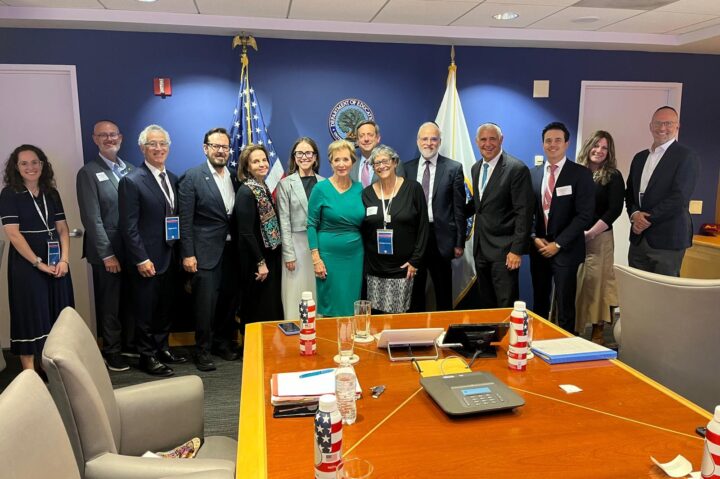
Courtesy Orthodox Union
Members of the Orthodox Union Advocacy Center met with Education Secretary Linda McMahon on Wednesday to discuss federal efforts to counter antisemitism and new legislation promoting school choice, Sept. 17th, 2025
The suggestions range from enforcing campus codes of conduct to holding faculty accountable for political coercion

Wesley Lapointe for The Washington Post via Getty Images
A row of tents line one side of a student encampment protesting the war in Gaza at the Johns Hopkins University Homewood Campus on Tuesday April 30, 2024, in Baltimore, MD.
As students return to school in the coming weeks, four leading Jewish organizations are encouraging university leaders to adopt a new set of recommendations, released on Monday, designed to curb the antisemitism that has overwhelmed many campuses since the Oct. 7, 2023, terrorist attacks in Israel, Jewish Insider has learned.
The guidelines — which call for increased safety measures as well as long-term structural reforms and build upon a four-page set of recommendations released last August — are a joint effort from the Anti-Defamation League, Conference of Presidents of Major American Jewish Organizations, Hillel International and Jewish Federations of North America.
The recommendations urge university leaders to “consistently enforce” codes of conduct around protests; appoint a coordinator to address Title VI discrimination complaints; reject academic boycotts of Israel; conduct annual student and faculty surveys in regard to campus antisemitism; crackdown on online harassment (in addition to physical safety concerns); and hold faculty accountable for political coercion and identity-based discrimination.
Some of the guidelines, such as the appointment of a Title VI coordinator, echo commitments that several university leaders have made in recent months amid battles with the Trump administration over federal funding. At Columbia University, some Jewish students expressed skepticism that the moves would have a significant impact on campus antisemitism.
“These recommendations aren’t just suggestions, they’re essential steps universities need to take to ensure Jewish students can learn without fear,” ADL CEO Jonathan Greenblatt said in a statement. “Jewish students are being forced to hide who they are, and that’s unacceptable — we need more administrators to step up.”
“We are encouraged by the universities that have taken prior recommendations seriously, implementing changes that have reduced the most severe types of incidents, creating safer and more welcoming environments as a result. But our work is far from complete,” Hillel International president and CEO Adam Lehman said in a statement. “These updated recommendations provide a roadmap for institutions to build on their progress and address the challenges Jewish students continue to face.”
The recommendations released last summer by the same groups, in addition to the American Jewish Committee, called for university leaders to “anticipate and mitigate disruptions” on the one-year anniversary of Oct. 7. Other suggestions included that universities clearly communicate campus rules, standards and policies, support Jewish students, ensure campus safety and reaffirm faculty responsibilities.
The union’s board of directors said the proposal ‘would not further NEA’s commitment to academic freedom’
Kristoffer Tripplaar/Sipa via AP Images
A logo sign outside of the headquarters of the National Education Association (NEA) labor union in Washington, D.C. on July 11, 2015.
The National Education Association, the largest teachers’ union in the country, announced on Friday that it would not cut ties with the Anti-Defamation League, declining to implement a contentious resolution approved by its governing body earlier this month that sought to target the Jewish civil rights organization.
“After consideration, it was determined that this proposal would not further NEA’s commitment to academic freedom, our membership or our goals,” the union’s board of directors said in a statement.
The decision came nearly two weeks after the measure was adopted by the NEA’s representative assembly, its annual leadership gathering that drew more than 6,000 union delegates.
“There is no doubt that antisemitism is on the rise. Without equivocation, NEA stands strongly against antisemitism. We always have and we always will,” the NEA’s board wrote. “In this time of division, fighting antisemitism, anti-Arab racism, and other forms of discrimination will take more resources, not fewer. We are ready.”
ADL CEO Jonathan Greenblatt cheered the union’s decision to distance itself from the “misguided” measure.
“We are committed to working with the NEA and all teachers’ unions to join the Jewish community in making clear these hateful campaigns cannot succeed. They must redouble efforts to ensure that Jewish educators are not isolated and subjected to antisemitism in their unions and that students are not subjected to it in the classroom,” Greenblatt said in a statement.
The measure faced fierce backlash from the Jewish world. A letter authored by the ADL expressing opposition to the proposal — which would have discouraged educators from using teaching materials from the ADL — garnered the support of roughly 400 Jewish organizations across the country, including the leadership of the Reform, Conservative and Orthodox movements.
Other outside Jewish groups, including the Conference of Presidents of Major American Jewish Organizations, the American Jewish Committee and Jewish Federations of North America, released a statement welcoming the NEA’s rejection of the anti-ADL resolution.
Sen. John Fetterman asked members of the left, ‘Why can’t you just call it [antisemitism] what it is?’
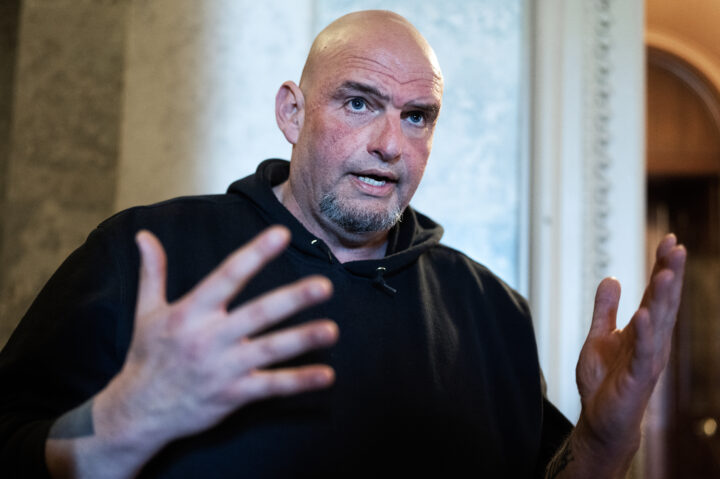
Tom Williams/CQ-Roll Call, Inc via Getty Images
Sen. John Fetterman (D-PA) talks with reporters after the Senate luncheons in the U.S. Capitol on Tuesday, March 11, 2025.
Pro-Israel leaders in the United States on Thursday connected the murder of two Israeli Embassy employees outside the Capital Jewish Museum in Washington to the anti-Israel advocacy seen on the political extremes throughout the country since the Oct. 7, 2023, attacks, characterizing it as a culmination of such rhetoric and, in some cases, the failure of some politicians to denounce it.
The suspected shooter, Elias Rodriguez, shouted “free, free Palestine” and “I did it for Gaza” following the shooting, according to an eyewitness and video from the arrest. He reportedly published a manifesto railing against Israel.
Sen. John Fetterman (D-PA) said that the attack should be a signal to the left that it needs to rethink its rhetoric on Israel and Zionism. He compared the anti-Israel movement in the United States to a “cult” that has been stoked online and is using inherently violent slogans while its members “try to hide behind this idea that it’s free speech to intimidate and terrorize members of the Jewish community.”
He said that too many on the left have failed to call out antisemitism in the anti-Israel movement.
“Why can’t you just call it what it is, and then address and assert the pressure on the aggressor,” which is Hamas,” Fetterman said. “I can’t even imagine having to live with that ever-present antisemitism and what? Why can’t people just acknowledge and call that what it is?”
Fetterman predicted that the same elements of the left that have supported Luigi Mangione, the alleged assassin of UnitedHealthcare CEO Brian Thompson, will also rally behind Rodriguez.
“What part of my party does this come from where it’s like, we try to defend or try to justify assassinating an executive in broad daylight or … somebody [who] guns down” two people at a Jewish event, Fetterman asked incredulously.
Israeli Ambassador Yechiel Leiter connected the shooting to the anti-Israel protests seen on college campuses and elsewhere in the country.
“The point of the matter is that on campuses around this country, where ideas — these are the temples of ideas — where smart ideas, intelligent ideas, moral ideas, truthful ideas, are supposed to be taught, we have useful idiots running around in support of the destruction of Israel,” Leiter said at a press conference.
“This is done in the name of a political agenda to eradicate the State of Israel,” Leiter added. “The State of Israel is now fighting a war on seven fronts. This is the eighth front, a war to demonize, delegitimize, to eradicate the right of the State of Israel to exist.”
He also connected rising global antisemitism to countries like France that have spoken out against Israel and are moving to recognize a Palestinian state.
A coalition of 42 Jewish organizations, in a statement, described the murders as “the direct consequence of rising antisemitic incitement in places such as college campuses, city council meetings, and social media that has normalized hate and emboldened those who wish to do harm.”
William Daroff, the CEO of the Conference of Presidents of Major American Jewish Organizations, said on X, “There is a direct line between demonizing Israel, tolerating antisemitic hate speech in the public square, and violent action.”
“We are now witnessing the deadly consequences of months of relentless antisemitic incitement — amplified by international organizations and political leaders across the globe — since the horrors of October 7,” Daroff said. “This is not a debate over policy; it is the mainstreaming of hatred, and its consequences are measured in blood.”
Rep. Josh Gottheimer (D-NJ) said on X the attack was “the deadly consequence of normalizing Jew-hatred.”
“Since October 7, antisemitic attacks have surged — fueled by violent chants to ‘globalize the intifada’ and slurs like ‘dirty Zionist,’” Gottheimer said.
Rep. Ritchie Torres (D-NY), highlighting a tweet from a local anti-Israel group that praised the attack, said that, “Violence is not a bug but a feature of virulent Anti-Zionism.”
Arizona state Rep. Alma Hernandez called out a series of progressive lawmakers, saying, “spare us the fake outrage.”
“Two Israeli diplomats were murdered in cold blood—and you dare act concerned? Y’all have spent years fueling the hate and antisemitism that’s now exploding across America. Don’t pretend to care,” Hernandez continued, in an X post. “You are constantly surrounded by keffiyehs and “Free Palestine” and have pushed rhetoric that’s radicalized Americans into thinking murdering Jews and harassing them in the streets will somehow “liberate” Palestine and end the so-called genocide. No thanks.”
“We don’t want prayers from politicians who support individuals and organizations that promote this hate and who are being actively supported by said individuals and organizations while they run for office,” Hernandez added.
“You can’t support chants of ‘Globalize the Intifada’ and then be ‘appalled’ when people act it out,” Georgia state Rep. Esther Panitch said on X in response to a statement on the attack from Rep. Ilhan Omar (D-MN) that did not acknowledge that the victims worked for the Israeli embassy and condemned “violence” broadly. Panitch also criticized other progressive Democrats who issued statements on the attack.
Panitch added, “Fascinating that those who campaigned against the Jewish community’s right to define their own experience of antisemitism are the ones who call ‘Globalizing the Intifada’ peaceful protests. The same ones who can’t say the word antisemitism in their posts.”
Jordan Acker, the University of Michigan regent who has been repeatedly targeted with antisemitic harassment and vandalism, drew a direct line between those incidents and demonstrations on the University of Michigan’s campus, and the Wednesday night murders.
“This isn’t protest. It’s a threat. This is what antisemitism looks like — and it’s escalating,” Acker said. “This is part of a terrifying trend: Jews in America being hunted, harassed, and attacked for being visibly Jewish — for existing in public. When we call it antisemitism, we’re told we’re overreacting. That our fear is political. That our pain is inconvenient. We’ve been gaslit for 18 months. Enough.”
He also called out progressives directly, saying “antisemitism isn’t any less dangerous when it comes wrapped in ‘progressive’ language.”
In response to the attack, some of the most prominent far-left critics of Israel on Capitol Hill have offered what many in the Jewish community have seen as half-hearted and inadequate responses.
“My heart breaks for the loved ones of the victims of last night’s attack in D.C. Nobody deserves such terrible violence. Everyone in our communities deserves to live in safety and in peace,” Rep. Rashida Tlaib (D-MI) said, linking to an article highlighting that the victims, Sarah Milgrim and Yaron Lischinsky, were Israeli Embassy workers, but not noting their backgrounds or the circumstances of the shooting in her own post.
Omar noted that the shooting took place at the Capital Jewish Museum but did not acknowledge the victims’ backgrounds and condemned violence broadly.
“I am appalled by the deadly shooting at the Capital Jewish Museum last night. Holding the victims, their families, and loved ones in my thoughts and prayers,” Omar said. “Violence should have no place in our country.”
Amid political divisions over funding for the office, Jewish groups called on Congress to ‘provide the highest possible funding’ in 2025

Jemal Countess/Getty Images for JDRF
Committee chair Sen. Patty Murray (D-WA) and Senator Susan Collins (R-ME) greet witnesses and delegates from the 2023 JDRF Children's Congress prior to the Senate Appropriations Committee hearing on July 11, 2023, in Washington, D.C.
In a letter sent to key members of the Senate and House Appropriations Committees on Friday, a coalition of 23 Jewish groups, spanning a range of political and denominational positions, urged Congress to “provide the highest possible funding” in 2025 for the Department of Education’s Office of Civil Rights.
The widespread support for funding for the office, known as OCR, is notable given political divisions over the issue on Capitol Hill. Democrats critical of Republicans’ approach to combating antisemitism on campuses have emphasized calls for increased funding for the office. Some Republicans, meanwhile, have downplayed the need for additional funding for the office, often arguing that it has the resources it needs but must better prioritize antisemitism cases.
But calls for increased funding span the political spectrum. In the 2024 funding process, a bipartisan group of 51 lawmakers urged Congress to provide funding in excess of the administration’s budget request for OCR.
House Republicans sought to cut funding to OCR, the office responsible for investigating complaints of antisemitism on campuses, for 2024. Education Secretary Miguel Cardona has said the office’s staff are severely overstretched, with each staffer working 50 cases in light of a post-Oct. 7 surge in complaints.
OCR received $140 million for 2024, the same funding it received in 2023, falling $37.6 million below the administration’s request. The administration requested $162 million for OCR for 2025.
“It is Congress’s responsibility to ensure that OCR has the resources it needs to conduct immediate and robust investigations into these complaints. OCR cannot protect the rights, safety and wellbeing of students if it does not have adequate resources to appropriately investigate and respond to its increased caseload,” the letter reads.
The signatories include the Anti-Defamation League, Alpha Epsilon Phi Sorority, Alpha Epsilon Pi, American Jewish Committee, B’nai B’rith International, Combat Antisemitism Movement, Conference of Presidents of Major American Jewish Organizations, Hadassah, Hillel International, Jewish Council for Public Affairs, Jewish Federations of North America, Jewish Grad Organization, Jewish on Campus, Olami, National Council of Jewish Women, Rabbinical Assembly, Sigma Alpha Mu Fraternity, Sigma Delta Tau, StandWithUs, Union for Reform Judaism, Orthodox Union, Zeta Beta Tau Fraternity and Zionist Organization of America.
They include liberal, nonpartisan and conservative-leaning Jewish groups, as well as groups representing the Reform, Conservative and Orthodox denominations.
The groups, the letter states, “reflect the depth and breadth of American Jewish life [and] are united in asking your urgent support to combat growing antisemitism on university campuses.”
The letter highlights data showing that cases of antisemitism on college campuses have “skyrocketed” since Oct. 7, and that OCR is facing “a surge in reported cases” alongside a reported 10% reduction in full-time staff.
The group’s national leadership refused to support a draft statement in response to anti-Israel protests that included a standalone condemnation of antisemitism

Grace Yoon/Anadolu via Getty Images
Pro-Palestinian students at UCLA campus set up encampment in support of Gaza and protest the Israeli attacks in Los Angeles, California, United States on May 01, 2024.
As anti-Israel encampments on college campuses sprung up at dozens of universities last week, the national leadership of the College Democrats of America (CDA) asked the group’s Jewish and Muslim caucuses to draft a statement condemning the antisemitism that was quickly appearing among some protesters.
The byzantine process that followed would lead the College Democrats’ top Jewish leader to accuse the influential organization of ignoring antisemitism at campus protests to further a one-sided, anti-Israel agenda, after the organization’s leadership nixed the inclusive statement that had been created by the top Jewish and Muslim activists in the group.
Allyson Bell, chair of the CDA’s national Jewish caucus and an MBA student at Meredith College in Raleigh, N.C., got to work writing a statement about antisemitism with Hasan Pyarali, the Muslim caucus chair and a senior at Wake Forest University. The two of them turned in a draft of a statement detailing antisemitism at Columbia University and stating that the College Democrats “absolutely and irrevocably denounce the antisemitism that has taken place at Columbia University and other college campuses over the past week,” according to a document shared with Jewish Insider.
But College Democrats’ national leaders weren’t pleased with this draft, Bell stated. “They wanted us to write a 50/50 approach, to both protect the peaceful side of the protesters and stand against antisemitism,” Bell told JI on Wednesday night. So she and Pyarali gave it another stab. (“It’s been really tough for people to work together on this issue, so I’m so glad that we’ve been able to work together,” Pyarali told JI.)
This time, the draft statement began with a denunciation of antisemitism and a statement of support for the “broad and interfaith coalitions of students who call for a ceasefire, release of the hostages, and a two-state solution where both Israelis and Palestinians can live side by side in peace.” This too, was voted down.
The statement that was ultimately released by the College Democrats on Tuesday ignored the middle path proposed by Bell and Pyarali. Instead, the statement described “heroic actions on the part of students around the country to protest and sit in for an end to the war in Palestine and the release of the hostages.” It called Israel’s war against Hamas “destructive, genocidal, and unjust” — language that Bell had never seen. An Instagram post with the statement touted the endorsement of Pyarali and the Muslim caucus, with no mention of the Jewish caucus — except a comment on the post from the Jewish caucus’ own Instagram account.
“This should not have ever been released without Jewish students’ support. Protect Jewish students, do better,” the College Democrats’ Jewish caucus commented.
“It’s a hurtful thing, not only to not feel heard, but also to know that the organization you’re in doesn’t believe that the antisemitism is happening and doesn’t care enough about it to even include the factual things that we’ve seen on video,” explained Bell.
For months, the Democratic Party has faced criticism from young activists for President Joe Biden’s support for Israel in its war against Hamas. In March, a cadre of influential progressive activist groups, including the Sunrise Movement and March for Our Lives, signed onto a “youth agenda” that focused on climate change, gun violence prevention, immigration reform and reaching a “permanent ceasefire” in Gaza. Debates over Israel and antisemitism have roiled progressive organizations since Oct. 7.
College Democrats touts itself as the official collegiate arm of the Democratic National Committee, the party’s campaign apparatus. The group endorsed Biden’s reelection campaign, and in the past it has served as a crucial tool for reaching young people in an election year, even as the organization has drifted far to the left of the national party in recent years. Spokespeople for the DNC and the Biden campaign declined to comment when asked if they support the message adopted by College Democrats.
The statement sharply diverged from the path charted by Biden, who has supported Israel in its war against Hamas after the Oct. 7 terror attacks that killed more than 1,200 people in Israel, while also seeking humanitarian protections for Palestinian civilians. College Democrats’ national communications chair, Sohali Vaddula, a New York University undergraduate, told JI on Wednesday that the group “has opposed President Biden’s support for Israel in terms of providing military aid, which would further the genocide that’s ongoing.”
On Tuesday morning, hours before CDA came out in favor of campus protests, a White House spokesperson slammed the violent tactics and antisemitism exhibited by some anti-Israel protesters at U.S. college campuses after activists at Columbia violently stormed a campus administrative building. Biden offered a similar message in a Thursday morning speech, the president’s first major remarks on the campus protests.
The College Democrats statement recognizes antisemitism halfway through, with a line that university administrations “need to protect students from all forms of hatred — antisemitism and Islamophobia — without impeding on the rights of students.” It refers to antisemitism having increased “in the weeks following October 7th” with no mention of what occurred that day. College Democrats did not issue a statement on the violence in the Middle East until December, two months after the Hamas attack, when they issued a call for a cease-fire and hostage deal. They refrained from doing so sooner because the issue was “controversial,” said Vaddula.
“This issue has always been controversial, even before Oct. 7, and especially after Oct. 7,” Vaddula said. (She was not an executive board member at the time and wasn’t involved in that decision.)
The College Democrats’ Tuesday statement says the group stands alongside protesters who are calling for an “immediate permanent ceasefire, releases of hostages, and a two-state solution where both Palestinians and Israelis can live side by side in peace.” But this is not what most of the protesters are demanding. Chants of “from the river to the sea, Palestine will be free” — widely seen as a call for the extermination of the Jewish state — are heard frequently from protesters, who also often chant about “intifada.” More than 1,000 Israelis were killed in the Second Intifada two decades ago. Other language and signage exhibited at encampments across the country state that Zionists are not welcome among the protesters.
“It’s hurtful to see so many progressive allies look at the situation as a black-and-white issue, where they can’t hold in themselves, in their hearts, empathy for the Israeli people, for hostages, for Jewish people who are victims of antisemitism,” said Stephanie Hausner, now the chief operating officer at the Conference of Presidents of Major American Jewish Organizations and a former senior leader with both CDA and the Young Democrats of America. “As someone who was deeply involved in the organization, both College Democrats and Young Democrats and the Democratic Party, it’s really hard to see what’s going on in those spaces.”
“I have not seen one student encampment talking about a two-state solution with both sides living side by side,” one former longtime Democratic Party staffer and White House aide observed.
Pyarali, the Muslim caucus chair, disagreed: “I think the majority of people are standing for a two-state solution, and at least we want them to know that at least the majority of College Democrats are,” he told JI on Thursday. “We do think it is possible to be supportive of Israel without being supportive of this genocidal campaign.”
Stephanie Hausner, now the chief operating officer at the Conference of Presidents of Major American Jewish Organizations and a former senior leader with both CDA and the Young Democrats of America, which serves young professionals, lamented the group’s approach to the protests and the war.
“It’s hurtful to see so many progressive allies look at the situation as a black-and-white issue, where they can’t hold in themselves, in their hearts, empathy for the Israeli people, for hostages, for Jewish people who are victims of antisemitism,” Hausner told JI. “As someone who was deeply involved in the organization, both College Democrats and Young Democrats and the Democratic Party, it’s really hard to see what’s going on in those spaces.”
Young Democrats’ Jewish caucus chair, Zach Shartiag, echoed that assessment. “Our organization has turned a blind eye, even in my mind pre-10/7, to issues of antisemitism,” he told JI.
“The Jewish caucus had not signed off on this particular statement because we felt like this one was more representative of what our organization wanted to support,” College Democrats’ national communications chair, Sohali Vaddula, a New York University undergraduate, told JI . “We just don’t want statements to focus entirely on antisemitism because that is a double standard. We should also be focusing on the rising Islamophobia on campuses. There are other students that feel unwelcome on these campuses, not just Jewish students. We wanted to highlight that and not make it one-sided. We felt that the Jewish caucus was making it one-sided.”
“Jewish Dems and the Democratic Party firmly stand with Israel and support its right to self-defense, especially in the aftermath of the horrific attacks perpetrated by Hamas,” Jewish Democratic Council of America CEO Halie Soifer told JI on Thursday. “President Biden, the head of the Democratic Party, has never wavered from his staunch commitment to Israel’s safety and security, while Republicans in Congress blocked emergency aid to Israel for more than six months. We stand with Israel and any statement to the contrary isn’t representative of the vast majority of Democrats and President Biden.”
Vaddula, the College Democrats board member, acknowledged that the Jewish caucus did not approve of the group’s final statement. But, she added, condemning only antisemitism would present a “double standard.” The statement was adopted by a vote of 8-2 among executive board members. She said the group didn’t need to specifically mention instances of antisemitism “because we didn’t feel that the existence of antisemitism at the protests was in question.”
“The Jewish caucus had not signed off on this particular statement because we felt like this one was more representative of what our organization wanted to support,” she said. “We just don’t want statements to focus entirely on antisemitism because that is a double standard. We should also be focusing on the rising Islamophobia on campuses. There are other students that feel unwelcome on these campuses, not just Jewish students. We wanted to highlight that and not make it one-sided. We felt that the Jewish caucus was making it one-sided.”
By ignoring Islamophobia, as the first drafts did, “certain students and identity groups [would] feel excluded from organization,” said Vaddula. When asked about Jewish Democrats who feel excluded, Vaddula said “there’s a seat at the table and the Democratic Party for everybody.”
Ultimately, she said the reason for not aligning with the Jewish caucus came down to the Jewish caucus’ difference of opinion on the war on Gaza. Vaddula said the Jewish caucus might not be “representative” of the Jewish community and cited groups like Jewish Voice for Peace, an anti-Zionist organization whose positions opposing the Jewish state represent a far-left fringe of the U.S. Jewish community.
“Unfortunately, the Jewish caucus just wasn’t willing to denounce genocide,” said Vaddula. “We felt like maybe that wasn’t the best representative sample of Jewish College Democrats or just Jewish young Democrats in general.” (In a follow-up conversation on Thursday, Vaddula clarified that “well-informed people of goodwill will continue to disagree when we use the word ‘genocide’ to describe the situation in Gaza, and of course, there is room for them in College Democrats.”)
“It does feel like the administration, or at least members of the executive board, believe that Jewish students are pro-genocide or anti-Palestine simply for being Jewish,” Allyson Bell, chair of the CDA’s national Jewish caucus and an MBA student at Meredith College in Raleigh, N.C., said. “That conversation hasn’t even been had, but it’s assumed. And like I said before, it’s isolating. It’s alienating. It’s disheartening, and it’s hurtful. I feel for my caucus members. I hate that we’re in this position where we’re trying to figure out like, How do we get heard? How do we share how we’re feeling without getting in trouble for it?”
“When I look at organizations like Jewish Voice for Peace and all these other organizations, some of whom actually are Jewish and are also calling out a genocide, I think it’s important to think about the larger messaging that we’re sending out,” Vaddula added. “I think that is in line with what most of the Jewish groups are saying.” (A March Pew poll found that 62% of U.S. Jews say the way Israel is carrying out its war in Gaza is acceptable, and 89% see Israel’s reasons for fighting Hamas as valid.)
Bell, the Jewish caucus leader, said that in conversations with other top College Democrats, someone implied that she supported genocide, even though no one had discussed the matter with her.
“The irony of saying that to a Jewish student — I honestly just can’t wrap my head around it at this point,” said Bell, who signed onto the December statement supporting a cease-fire. “It does feel like the administration, or at least members of the executive board, believe that Jewish students are pro-genocide or anti-Palestine simply for being Jewish. That conversation hasn’t even been had, but it’s assumed. And like I said before, it’s isolating. It’s alienating. It’s disheartening, and it’s hurtful. I feel for my caucus members. I hate that we’re in this position where we’re trying to figure out like, How do we get heard? How do we share how we’re feeling without getting in trouble for it?”
College Democrats’ turn away from Israel is striking against the backdrop of the organization’s long history of alignment with Israel and pro-Israel organizations such as AIPAC, which is now viewed as a target by many progressive activists. AIPAC used to bring the leaders of both College Democrats and College Republicans on bipartisan missions to Israel, a tradition it continued as recently as 2017. The leaders of both groups also used to travel to Washington each year for AIPAC’s annual policy conference.
“College Democrats owe it to their president and national party, not to mention the Israelis and Palestinians still committed to peace and coexistence, to avoid incendiary statements that will only exacerbate the already explosive situation on campus,” Jonathan Kessler, former leadership development director at AIPAC and founder of the peacebuilding NGO Heart of a Nation.
Despite the Gaza war and campus unrest, in an April Harvard Kennedy School poll, 18- to 29-year-olds ranked the Israeli-Palestinian conflict near the bottom of a list of most important topics; it ranked 15th out of 16 topics mentioned. But Vaddula and Pyarali both told JI they are struggling with College Democrats’ endorsement of Biden in light of his support for Israel.
“I’ve spoken to so many people who have seen his unfettered support as so soul-crushing, because we voted for Joe Biden with the thought that this is someone who’s gonna bring dignity back, someone who’s gonna bring compassion back to the White House,” said Pyarali, who called Biden “complicit in genocide.” Pyarali said Israel was “justified in their targeting of Hamas” after the “horrific” events of Oct. 7, but “it’s never been about targeting just Hamas.” He called the war genocidal from the beginning.
The College Democrats’ Jewish caucus chair said the experience over the past week has made her question her future with the organization.
“At this point, I’ve kind of just decided that it’s worth speaking out about, even if it means that I need to move away from College Democrats of America,” Bell said. “This is important enough that I think more people need to be speaking out in support of Jewish students and the rising antisemitism that is happening across college campuses, even though currently it’s not a popular stance.”
Obama privately lobbied on Harvard President Claudine Gay’s behalf as she faces growing scrutiny

Drew Angerer/Getty Images
Former U.S. Commerce Secretary Penny Pritzker speaks at the Semafor World Economic Summit on April 12, 2023, in Washington, D.C.
Even as Harvard continues to stand behind its embattled president, Claudine Gay, amid mounting backlash over her handling of campus antisemitism and new accusations of plagiarism, Penny Pritzker, who helms the university’s highest governing body, has so far remained conspicuously silent, drawing fresh scrutiny to her role atop the administration.
Pritzker, the billionaire Chicago hotel scion and former Obama administration official, was elected senior fellow of the Harvard Corporation last year, months after she had donated $100 million to the university. In her new position, she personally led the search committee that named Gay as president last December, praising her in an announcement at the time as “a remarkable leader who is profoundly devoted to sustaining and enhancing Harvard’s academic excellence.”
Notwithstanding her initial enthusiasm, Pritzker has in recent weeks avoided personally defending the newly installed president, who has faced calls to resign, instead joining a statement signed by the 11 members of Harvard’s top board, which has been criticized for a lack of transparency.
In their unanimous decision to back Gay last week, the board members affirmed their “confidence” in the university president, dismissing the plagiarism charges and accepting her apology for widely criticized comments at a congressional hearing on campus antisemitism earlier this month, where she equivocated on whether calls for the genocide of Jews would violate Harvard’s code of conduct.
Before the Harvard Corporation had released its statement, however, Pritzker had dodged repeated questions from a reporter for the school’s student newspaper on whether she would ask the president to step down, even as Gay had claimed to have her support.
A spokesperson for Harvard said in an email to Jewish Insider on Thursday afternoon that she “is not available for an interview at this time and we have no further comment to provide.” Pritzker did not respond to emails seeking comment.
Pritzker’s limited public engagement has fueled skepticism of whether she performed due diligence in the vetting process that led to Gay’s appointment, which detractors now see as flawed, citing a snowballing plagiarism scandal as well as top donors who have continued to join a growing revolt over the president’s response to rising antisemitism amid the Israel-Hamas war.
“This is a full-blown corporate governance crisis for Harvard University and the fellows of the Harvard Corporation,” Benjamin Badejo, an MBA candidate at Tel Aviv University who studied at Harvard Law School and is a vocal critic of Gay and Pritzker, said in a recent email to JI, “and raises questions about the fellows’ ability to carry out their professional responsibilities.”
Despite mounting pressure for Pritzker to address the controversy now embroiling Gay’s brief tenure, close watchers of the administration allege that she has continued to keep a low profile because she has nearly as much at stake in the ongoing ordeal as the president she herself recruited. “What I hear is she has no intention of going down with the ship,” one Harvard insider, speaking anonymously to discuss a sensitive topic, said of Pritzker’s motivations for remaining silent.
Behind the scenes, meanwhile, Pritzker, 64, had reportedly voiced misgivings over the university’s delay in responding to Hamas’ Oct. 7 attacks, which had fueled an outcry from leading donors who felt the university should firmly rebuke a letter signed by a coalition of student groups that blamed Israel for the massacre.
In a private phone call with the billionaire hedge fund manager Ken Griffin days after the attack, Pritzker expressed agreement with his demand that Harvard release a statement standing with Israel, according to an interview he gave to The New York Times two months ago. (A source familiar with the call told JI that the Times anecdote was “broadly accurate.”)
The university’s initial efforts to address the violence, however, were ultimately derided by donors, alumni and students who felt that Gay’s statements had equivocated over the attacks.

To some observers, Pritzker’s silence amid the fallout has been particularly glaring because she has long been regarded as a staunch supporter of Israel. The 64-year-old Jewish entrepreneur and philanthropist from Chicago, whose brother, J.B., is the governor of Illinois, was one of Barack Obama’s earliest and most important financial backers, and has been credited with persuading Jewish and pro-Israel donors to support his first presidential campaign, despite skepticism over his approach to Middle East policy.
According to a source familiar with the matter, Obama, a Harvard graduate, had privately lobbied on Gay’s behalf as she faced pressure to resign in the wake of her disastrous appearance before the congressional hearing on antisemitism. “It sounded like people were being asked to close ranks to keep the broader administration stable — including its composition,” the source, who was informed of Obama’s outreach and asked to speak anonymously to discuss a confidential matter, told JI on Tuesday.
Obama’s office did not respond to a request for comment from JI.
It is unclear if Pritzker, who served as Obama’s commerce secretary in his second term, spoke with the former president as the Harvard Corporation was deliberating over its decision to support Gay.
The former Obama official has been outspoken against Jewish persecution, recalling her family’s escape from Russian pogroms to the United States, where the Pritzkers eventually created the Hyatt hotel chain. In September, she was appointed by President Joe Biden to serve as the U.S. special representative for Ukraine’s economic recovery.
But as Gay has come under scrutiny in recent months, Pritzker has found herself in an increasingly uncomfortable position, albeit one familiar to many Jews in positions of power, said Rabbi Hirschy Zarchi, the founder and president of Harvard Chabad, who has been publicly critical of Gay’s remarks to the House committee.
While Zarchi clarified that he had not spoken with Pritzker, he speculated that she has been cautious in recent weeks because of what he described as a preemptively defensive posture he has observed among other Jewish leaders at Harvard. “Jews in power go to an extreme degree to show that they’re neutral, lest they be accused of showing favoritism,” he told JI last week. “It’s another reflection of the toxic culture in the academy that people can’t speak their conscience.”
Still, critics see other calculations at play. In his email to JI, Badejo, the Harvard Law School alumnus, claimed that Pritzker and her fellow board members on the Harvard Corporation “arguably have conflicts of interest regarding Gay’s continued tenure as president, as managing the public’s awareness of their potential failures to do proper diligence” could potentially “impact their own continued tenures.”
The Harvard Corporation has continued to back Gay, the school’s first Black president, even amid mounting accusations of plagiarism that have cast doubt on the integrity of her academic writings. The board on Wednesday acknowledged some indiscretions in Gay’s scholarship, but said the improper citations, for which she has requested corrections, fell short of research misconduct.
Meanwhile, in a letter to Pritzker on Wednesday, Rep. Virginia Foxx (R-NC), who chairs the House Education and Workforce Committee, said she was launching an investigation into Harvard’s handling of what she described as “credible allegations of plagiarism” against the university’s president.
Alan Solow, a former national co-chair of Obama’s reelection campaign, said he had not discussed the current controversy with Pritzker, whom he has known for years, but added that he had faith in her leadership at a particularly challenging moment.
“She is a person of great integrity. She is thoughtful; she studies, asks excellent and probing questions and listens,” Solow, the former chairman of the Conference of Presidents of Major American Jewish Organizations, said in a recent email to JI. “I hold her in the highest respect and have great confidence in her leadership and judgment based on my having worked on a variety of projects with her for more than 15 years.”
But a former high-profile fellow in the Harvard Institute of Politics, granted anonymity to speak candidly, questioned Pritzker’s decision to stand with Gay as misguided. “I wish I knew what motivated it because they will hemorrhage contributions,” the former fellow told JI. “She now needs to be fired and the board has to step down.”
On Thursday, Len Blavatnik, the billionaire investor whose family foundation has given at least $270 million to Harvard, reportedly became the latest major donor to pause contributions to the university over dissatisfaction with Gay’s recent handling of antisemitism.
“If Harvard has already lost a billion dollars in donations because of her testimony, her plagiarism and her unwillingness to truly back free speech,” the former fellow said, “the jury may still be out.”
Please log in if you already have a subscription, or subscribe to access the latest updates.
 Continue with Google
 Continue with Apple