
























The appointment of Deek, the country's first Christian ambassador, comes following several controversies in Israel relating to Christians
Courtesy
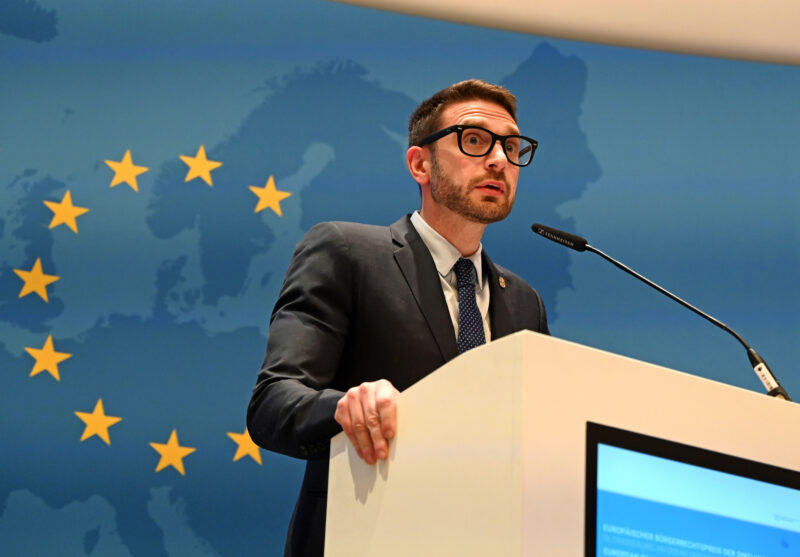
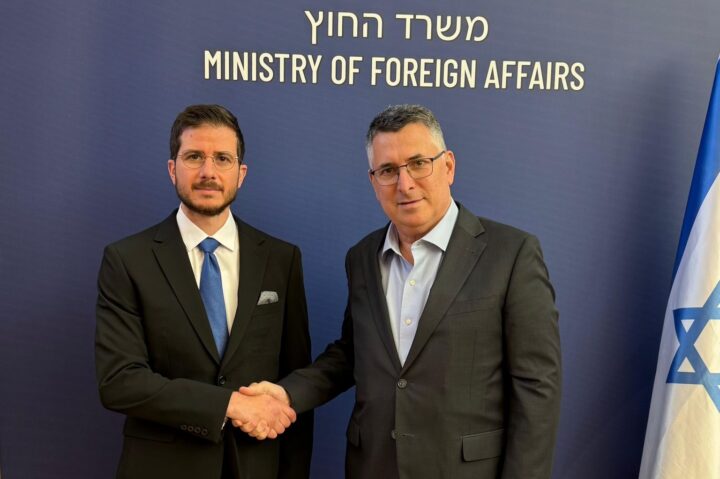
Former Israeli Ambassador to Azerbaijan George Deek (left) and Israeli Foreign Minister Gideon Sa'ar


 Add JewishInsider on Google
Israel’s first Christian ambassador, George Deek, has a new job after his return to Israel from his most recent posting as Israeli ambassador to Azerbaijan: special envoy to the Christian world.
Israeli Foreign Minister Gideon Sa’ar named Deek to the role on Thursday, with the ministry saying that the move was “intended to deepen Israel’s ties with Christian communities around the world.”
Deek, who joined the Foreign Ministry in 2008 and has been posted to Norway and Nigeria, received the Foreign Ministry Director General’s Award for Excellence in 2021. He is part of the Arab Orthodox Christian community in Jaffa, and his father, Youssef Deek, was chairman of the community for many years.
Deek came to international prominence as Israel’s chargé d’affaires in Oslo after giving a speech about his family’s background and his decision to represent Israel around the world. In the speech, video of which has gone viral, he spoke about his grandparents’ departure from Jaffa during Israel’s War of Independence and choice to return and build their lives in the fledgling Jewish state.
Sa’ar said that “the State of Israel attaches great importance to its relations with the Christian world and with its Christian friends around the world. I am confident that George, a respected and experienced diplomat, will greatly contribute to the friendship and strengthening of the ties between the State of Israel and the Christian world.”
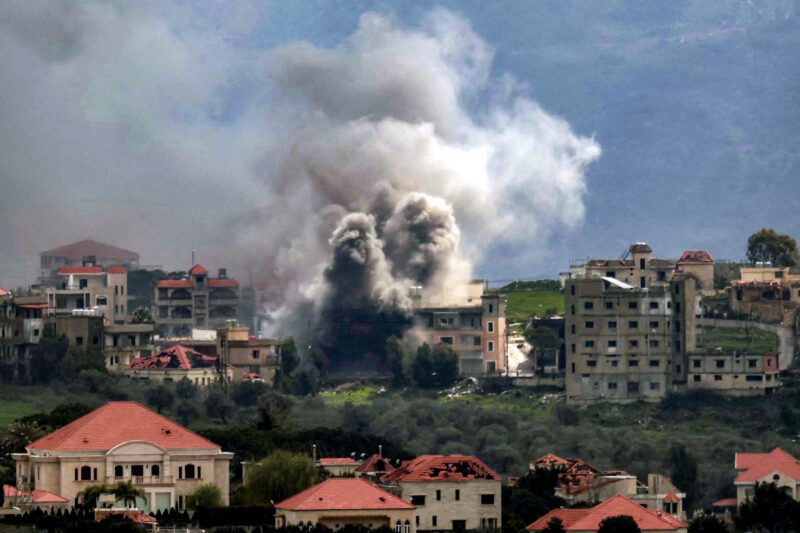
Deek’s appointment was announced soon after several controversies in Israel relating to Christians. Most recently, an IDF soldier who broke a statue of Jesus in a southern Lebanese Christian town was removed from combat duty and given 30 days in prison.
On Palm Sunday, with the war in Iran still raging, police officers barred Cardinal Pierbatista Pizzaballa from accessing the Church of the Holy Sepulcher because it did not have proper protection from missiles. After Prime Minister Benjamin Netanyahu intervened, Pizzaballa was given more access to the church.
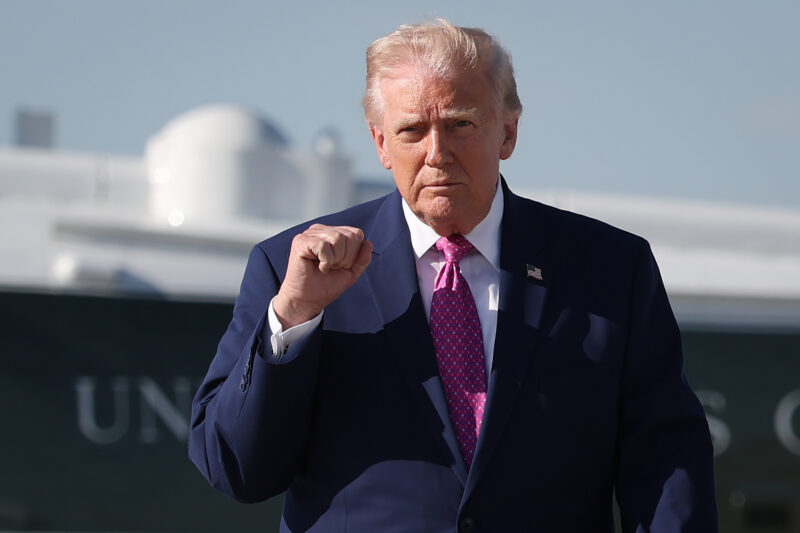
President Donald Trump, called by his Jewish supporters ‘the most pro-Israel president in history,’ won’t lead the party forever. So what will come next?
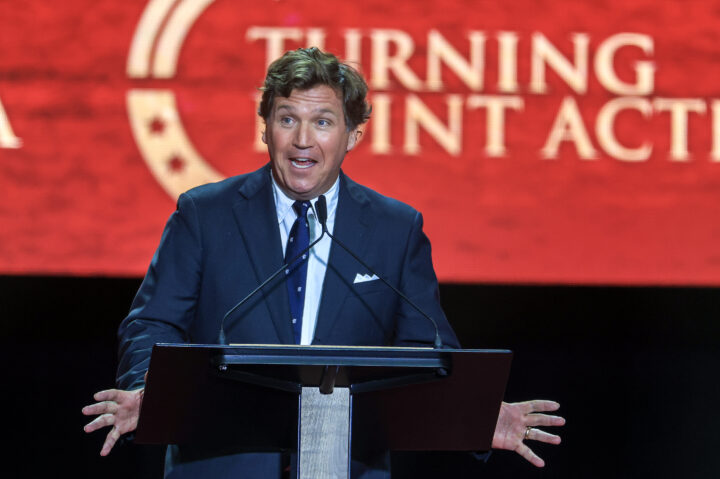
Joe Raedle/Getty Images
Tucker Carlson speaks during the memorial service for political activist Charlie Kirk at State Farm Stadium on September 21, 2025 in Glendale, Arizona.
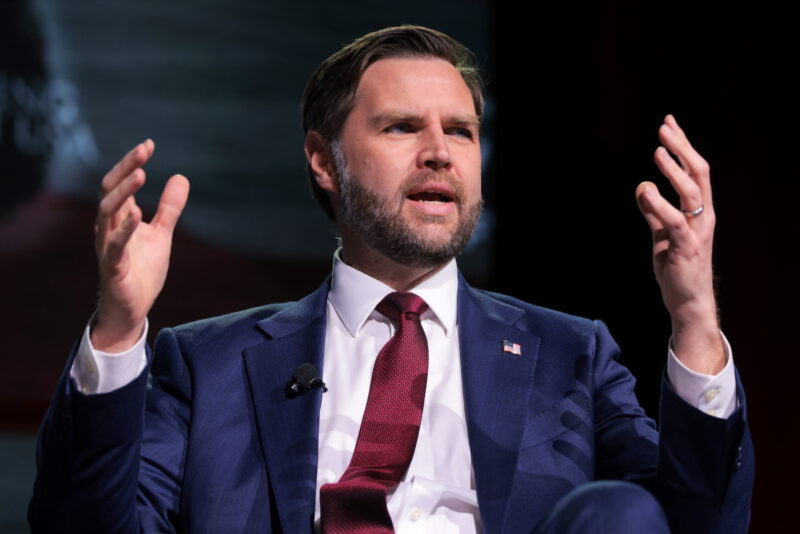
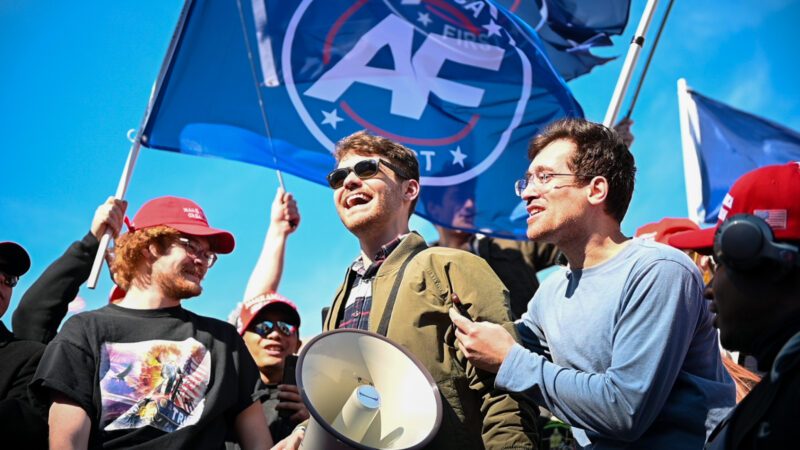
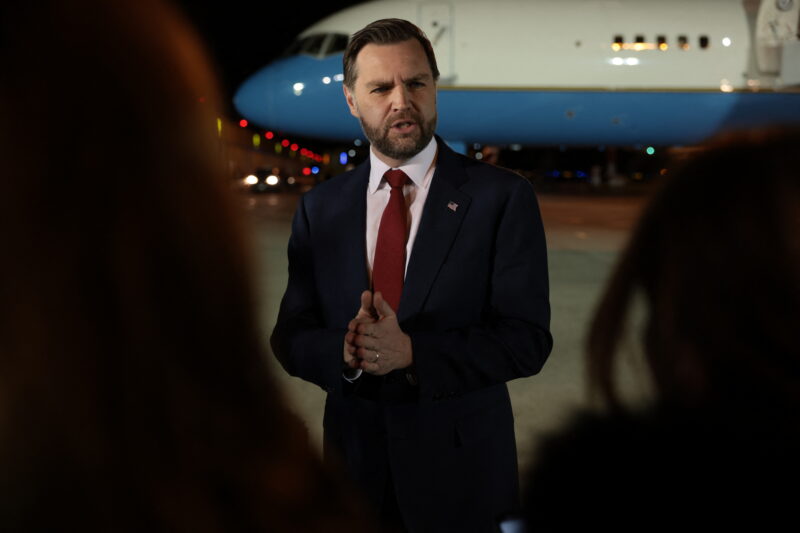
During a talk at a Turning Point USA event at the University of Mississippi last month, Vice President JD Vance listened carefully as a student took the microphone and asked him a question grounded in antisemitic tropes. Vance took the question at face value, declining to push back.
“I’m a Christian man, and I’m just confused why there’s this notion that we might have owed Israel something, or that they’re our greatest ally,” the questioner began. “I’m just confused why this idea has come around, considering the fact that not only does their religion not agree with ours, but also openly supports the prosecution [sic] of ours.”
The exchange came soon after right-wing podcaster Tucker Carlson hosted neo-Nazi provocateur Nick Fuentes for a decidedly friendly interview, a shocking but not altogether surprising cultural moment that catapulted an intra-party rift into the open: a shift among a small but growing contingent of young conservatives away from Israel and, increasingly, into a conspiratorial worldview that holds the Jewish state — and Jews — responsible for the world’s ills.
The question facing party leaders is just how deeply this perspective has rooted itself among the right and how to deal with it: whether to fight it, accept it or stay quiet and hope it disappears.
Vance’s response at the Turning Point event sparked concern among Jewish conservatives about how a potential future GOP presidential nominee plans to deal with a growing segment of the political right that is not just critical of Israel but of Jews — and why he has been willing to make excuses for the bigotry of some of his supporters. Last month, Vance called criticism of scores of racist and antisemitic messages in Young Republicans group chat “pearl clutching.” And earlier this month, after many conservatives spoke out against Carlson’s interview with Fuentes, Vance decried what he deemed “infighting” calling it “stupid.”
Until Sunday, President Donald Trump had avoided the maelstrom of the last several weeks, which saw the venerable Heritage Foundation devolve into chaos after its president, Kevin Roberts, defended Carlson following the Fuentes interview. But Trump entered the fray for the first time on Sunday when he was asked by a reporter what role Carlson should play in the conservative movement after hosting “antisemite Nick Fuentes” — and responded with praise for Carlson.
“I found him to be good. I mean, he said good things about me over the years. I think he’s good,” Trump said. “You can’t tell him who to interview. I mean, if he wants to interview Nick Fuentes, I don’t know much about him, but if he wants to do it, get the word out. People have to decide.” Trump dined with Fuentes and Kanye West, also an avowed antisemite, at his Mar-a-Lago resort in 2022, though Trump has insisted that he didn’t invite Fuentes, but rather that Fuentes tagged along with West.
Pro-Israel Republicans have generally been willing to dismiss Trump’s connection to Carlson — Trump appeared on Carlson’s podcast during the campaign last year soon after the former Fox News host platformed a well-known Holocaust denier — because of what they describe as Trump’s pro-Israel bona fides.
“It’s a ridiculous conversation to be having, because nobody should doubt where the president stands on this,” Republican Jewish Coalition CEO Matt Brooks told Jewish Insider on Monday. “Donald Trump has zero tolerance when it comes to antisemitism.” Brooks, who is highly critical of Carlson, categorized Trump’s comments as “an omission in his remarks on an airport tarmac.”
Earlier this month, at the RJC conference in Las Vegas, Republican fundraiser Eric Levine told JI that he has concerns about Vance, though he added that those concerns are balanced out by the fact that Trump remains “the most pro-Israel president in the history of the country.”
“I was disappointed in JD Vance’s response, particularly as part of the Trump administration, which is so pro-Israel, so pro-Jewish,” Levine said. “This notion of this outsized influence that Jews have is disturbing, and I would have thought that the vice president could have done a better job, could have been clearer on that point.”
Yet Vance’s rhetoric, coupled with his ties to the more isolationist wing of the Republican Party, has frustrated even some of his Jewish backers, who want to see him do more to disavow the fringe, conspiracist right.
“This [anti-Israel] sensibility has been gaining ground on the right for several years now, and I count myself as one of those who has been warning about it and is worried. But the antisemitic part of it is relatively new,” Peter Berkowitz, who served as a senior State Department official in Trump’s first term, told JI. “It’s high time for those great adepts of social media, President Trump and Vice President Vance, to take to social media and weigh in.”
“I admire and support JD Vance, but his response to that question was disappointing,” said David Brog, a conservative activist who leads the Maccabee Task Force, an organization focused on fighting the Boycott, Divestment and Sanctions movement targeting Israel. “He knows better. He is the vice president of the United States now. He doesn’t need to please the confused young groypers” — a term used by Fuentes’ acolytes to describe themselves. “He needs to step up, lead and teach them the right path forward.”
Andrew Day, an editor at The American Conservative, a magazine identified with more isolationist strains of the right, called Vance “the clear favorite of a growing faction on the right that favors realism and restraint in foreign policy, a faction generally hostile toward Israel,” while noting that his “pro-restraint views have long accommodated sympathy for the Jewish state,” so he won’t entirely alienate pro-Israel Republicans. Vance has written for the magazine, and Carlson sits on its advisory board.
“This [anti-Israel] sensibility has been gaining ground on the right for several years now, and I count myself as one of those who has been warning about it and is worried. But the antisemitic part of it is relatively new,” Peter Berkowitz, who served as a senior State Department official in Trump’s first term, told JI. “It’s high time for those great adepts of social media, President Trump and Vice President Vance, to take to social media and weigh in.”
The White House did not respond to a request for comment, and a spokesperson for Vance declined to comment for this article.
Vance’s sympathy toward a more transgressive younger generation of conservatives is an outgrowth of that contingent’s expansion in the party. How widely that worldview has percolated is not fully known: conservative writer Rod Dreher recently estimated that 30 to 40% of young Republican staffers in Washington “are fans of Nick Fuentes,” while journalist Emily Jashinsky wrote at the conservative website UnHerd that the “number is high, but not nearly as high as 30-40%.”
What is not disputed is that among Gen Z conservatives, old dogmas, like support for Israel, are no longer accepted at face value. In the weeks after TPUSA founder Charlie Kirk’s murder, several well-known figures on the right, particularly in the podcasting sphere where Carlson operates, have attempted to recast Kirk as critical of Israel. In a letter sent to Israeli Prime Minister Benjamin Netanyahu earlier this year, Kirk was clear about the trend lines: “Israel is losing support even in conservative circles. This should be a 5 alarm fire,” he wrote.
But Jewish Republicans see an issue bigger than just a shift away from Israel among some Republicans who are skeptical of American involvement overseas, particularly in the aftermath of the invasion of Iraq two decades ago. They also see an antisemitism problem, in addition to an apathy problem — or, perhaps more accurately, a fear factor — among leaders who are wary of taking on an increasingly radicalized young generation.
“It wouldn’t be accurate to say the right is inherently antisemitic, or that being anti-Israel is endemic on the right,” said Tamara Berens, a conservative writer in Washington who wrote an article in early 2023 outlining the growth of antisemitism on America’s far right. “I think what’s endemic is the platforming and the excusing of antisemitic figures.”
“You’re going to get debates about where America’s long-term interests truly lie and where they don’t, and that’s where I think you get a very hot debate,” said Rusty Reno, editor of First Things, a prominent Christian magazine. “Certainly because of the Gaza war, it became a very heated debate about whether or not the U.S. has an interest in a strong alliance with Israel.”
A June Quinnipiac poll found that 64% of Republicans sympathized more with Israelis than Palestinians — a far higher number than Democrats, but a decrease from November 2023, when 80% of Republicans were more sympathetic to Israel. And that drop in support has come alongside “flirt[ing] with antisemitism,” said Maccabee Task Force’s Brog.
“It’s a new era, certainly when it comes to the conversation about where the guardrails are, if there are any remaining on the broader right,” said Josh Hammer, a conservative activist and lawyer. “There are a lot of young folks on the right who have been infected with varying degrees of this mind virus.”
As the editor of First Things, a prominent Christian magazine, Rusty Reno is aware of the anti-establishment sentiment growing among young conservatives. He attributes much of that to an emerging “consensus that we need to revise and fundamentally rethink our global commitments,” Reno told JI.
“You’re going to get debates about where America’s long-term interests truly lie and where they don’t, and that’s where I think you get a very hot debate,” Reno explained. “Certainly because of the Gaza war, it became a very heated debate about whether or not the U.S. has an interest in a strong alliance with Israel.”
Reno said he believes some of the concern about rising antisemitism has brought about a “hysterical response,” although he acknowledged that it is not “just this internet nonsense.”
“It does exist, and I’ve heard people say things that shocked me in some circles on the right,” Reno said. “It’s difficult for me to interpret in young people the extent to which they say things performatively, to demonstrate to each other their bona fides as not captive to the baby boomer mentality, and how much of it is real, or something I should worry about.”
Even staunch backers of Trump’s agenda now acknowledge that they can no longer ignore the fact that something has begun to shift among some hardcore conservatives.
“I don’t think Republicans should make the same mistake that Democrats made and allow themselves to be eaten by a radical fringe, which inevitably means you start losing elections,” said the Foundation for Defense of Democracies’ Rich Goldberg, who until recently served as a senior advisor at the Department of Interior.
“I do not think that is reflective of the party as a whole, by any stretch of the imagination. I think that it is, with respect to the adults in the room, still fringe,” Sandra Hagee Parker, the chair of Christians United for Israel Action Fund, told JI. “But I think that the issue is that we have to be aware of what’s happening in this young generation and be prepared to respond to that.”
The party now finds itself at a crossroads as Republican leaders consider how to deal with a small but vocal antisemitic fringe.
“I don’t think Republicans should make the same mistake that Democrats made and allow themselves to be eaten by a radical fringe, which inevitably means you start losing elections,” said the Foundation for Defense of Democracies’ Rich Goldberg, who until recently served as a senior advisor at the Department of Interior.
It is certainly not a foregone conclusion that the party will fully cede to that perspective. Sen. Ted Cruz (R-TX) has spoken out sharply against Carlson recently, including in a recent speech calling on his Republican colleagues to criticize the popular podcaster. By going after Carlson, Cruz may be positioning himself for a 2028 presidential run, Axios reported this week.
Trump is in his second term, and the Republican Party — which has been shaped almost exclusively by Trump for the last decade — will eventually have a new figurehead. Whether that is Vance or someone else remains to be seen, with two years before presidential primary season begins. But the fight that is playing out now is not one that Trump will be able to contain forever.
“What these guys are fighting for is not MAGA. It’s fighting for the next thing,” said David Reaboi, who operates a national security communications firm. “They don’t care if he’s MAGA or not. They’re very happy to hand over MAGA at this point.”
The Syrian minority representatives urged the United States to maintain pressure on the new Syrian government, including conditioning the repeal of sanctions
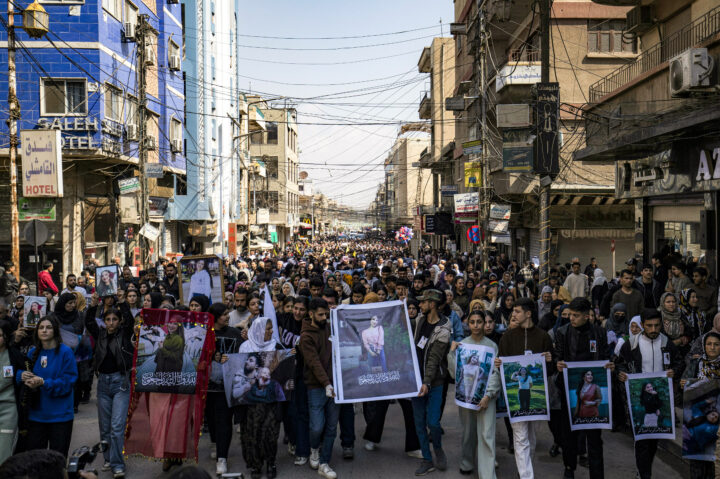
DELIL SOULEIMAN/AFP via Getty Images
People march with pictures of victims of a recent wave of sectarian violence targeting Syria's Alawite minority on March 11, 2025.
Representatives of Syria’s Druze, Christian and Alawite communities warned members of the U.S. Commission on International Religious Freedom on Thursday about the systematic targeting, persecution and atrocities their communities have endured under the new Syrian government led by President Ahmad al-Sharaa.
They urged the U.S. to condition the removal of remaining sanctions on Syria and its evolving partnership with the Syrian government on the government’s efforts to protect religious minorities and prevent further atrocities. Members of the commission, an independent body created by Congress, likewise expressed alarm about the pattern of violations against Syria’s minorities.
The Trump administration is currently urging Congress to fully repeal the remaining sanctions on Syria under the Caesar Civilian Protection Act, but some key players on Capitol Hill remain reticent given the human rights situation for minorities and other concerns inside Syria. The Senate passed legislation repealing the sanctions in its version of the 2026 National Defense Authorization Act, and the provision could be included in the final bill.
Rita Khairbek, a Syrian Alawite therapist and activist, said that the Alawite community has faced discrimination in various aspects of public life, as well as disappearances, abductions, beatings, murder, rape and executions and frequent incitement to violence against them.
During an attack on Alawite communities earlier this year, Khairbek said that more than 5,000 people were killed in two days, including 300 children, a figure that could not be independently verified by Jewish Insider and is higher than other documented estimates that place the toll at around 1,500.
She described the attacks as a “genocide,” going on to describe a range of other violations — “dehumanization, discrimination. … [We are] isolated … massacres, the long destruction of our community life. Women abducted, children orphaned and shrines destroyed.”
“As a therapist, I see the after image: chronic fear, sleepless children, maps where our presence is rubbed out,” she continued. “Genocide is not only by body, it’s by symbol and by the slow destruction of our name.”
Khairbek urged the United States to condition its future work with the Syrian government on its protection of minorities, support an independent investigation of the attack on the Alawite community, protect survivors and work to support Alawite civil society.
Nuri Kino, a Syriac Orthodox Christian investigative journalist, emphasized that the Syrian Christian community has shrunk dramatically since the start of the country’s civil war, a situation faced by other minority groups in Syria as well, and that the shrinking of minority communities has not stopped since the fall of the Assad regime.
Kino said that churches have been attacked and burned, families kidnapped, their homes destroyed and grave sites desecrated. And he said that the international community has responded with sympathy but no action.
“What is happening now is ethno-religious cleansing, a slow, systematic removal of indigenous minorities through fear, violence and dispossession,” Kino said. “Yet the international community has largely responded with silence. Sanctions were eased without guarantees for minority protection.”
He said that the U.S. must put pressure on the Syrian government, including conditioning aid and sanctions relief, on “clear measurable religious freedom benchmarks” to be verified by an independent international monitor, secure guarantees that the government will protect religious sites, fund Syrian aid and human rights groups led by minorities and establish a U.S. special envoy for religious freedom in Syria reporting directly to the secretary of state.
Jamil Ammar, a Druze activist, said that the campaign of violence against the Druze community in the southern Syrian city of Suweida was deliberate, planned and even rehearsed in a smaller Druze community.
The attacks began, Ammar said, with a disinformation campaign to incite hatred against the Druze community, followed quickly by an assault by armed forces from both the government and Bedouin tribes. The massacres, he added, have come immediately after disarmament operations by state forces. And he accused al-Sharaa of publicly thanking and supporting those responsible for the massacres.
Ammar said that the attacks have included an ISIS-style campaign of psychological warfare, where fighters have raped and killed victims and left their bodies in public places to intimidate the Druze and attempt to chase them off the land.
He characterized the current U.S. approach to the Syrian government as “wishful thinking” that was ultimately “transactional” and would create a “security risk.”
He urged the U.S. to monitor the new school curricula in Syria — through which he accused the government of attempting to indoctrinate a new generation of extremists — to consult with the entire array of the Druze community and to work to empower moderate Syrian Sunnis at the expense of the Sunni extremists he said currently control the Syrian government.
The witnesses differed in their recommendations to the commission on whether the U.S. should support a program of decentralization in Syria, in which local sectarian groups would be empowered at the expense of the central government and would be armed to maintain their own security.
Some argued that would be the only way to ensure the safety and protection of the minority communities, while others said that decentralization is not a viable solution and might only further exacerbate the existing problems and create more conflict.
Commissioners Meir Soloveichik and Steven Schneck also expressed concerns about the situation for religious minorities in Syria.
Soloveichick said he was “alarmed” by the Syrian government’s “lack of will or ability” to stop the attacks against a range of religious minorities, and noted that reports indicate that the Syrian government authorities were involved in and exacerbated the violence.
He also highlighted that HTS, the rebel group which al-Sharaa formerly led, has long been a cause for concern for the commission given its violations of religious freedom in the territory it controlled.
Schneck said he was also concerned about the “pronounced deterioration” of conditions for religious minorities in Syria. He further noted that, as of 2024, the commission found that nonstate actors like HTS had been, prior to the Assad regime’s fall, worse violators of religious liberties than the regime itself.
Aaron Zelin, a senior fellow at the Washington Institute for Near East Policy who also testified before the commission, painted a more complex picture of the situation, arguing that some incidents should be seen as political or acts of vigilantism targeting those involved with the Assad regime rather than sectarian violence, though he also acknowledged there have been real and serious massacres and other incidents.
“This goes to a fundamental issue related to Syria’s transition thus far, the incomplete and slow transitional justice process,” Zelin said. “The biggest issue today now in Syria is a lack of trust amongst many communities, and therefore a lack of transparency is undermining all of this. It’s worth noting, because there is no process to deal with bringing people involved in war crimes during the war to justice.”
Zelin also said that al-Sharaa has expressed a commitment to the rule of law and its equal application to all groups and that the Syrian government has attempted to engage at some levels with minority communities. But he acknowledged al-Sharaa himself has not met with the Alawite community.
Zelin said the the U.S. should urge the Syrian government to limit access to weapons and decommission nonstate forces, be more transparent about transitional justice processes and implement a long-term national and local dialogue project among majority and minority communities — rather than the brief, one-time dialogue convened by the new government.
Over 1 million congregants at Hindu temples and Christian churches are expected to take part in ‘Stand Up Sunday’ on Sept. 7

Chris Unger/Getty Images
New England Patriots owner Robert Kraft
Congregants of a Hindu temple on Long Island that was vandalized last year and worshippers of a Methodist Church in Oklahoma City, who last year put on a musical production of “Fiddler on the Roof” to learn about Jewish culture, may not appear to have much in common.
But this Sunday, both houses of worship — together with an expected crowd of nearly 1 million congregants around the country — will join forces for the inaugural “Stand Up Sunday,” a show of force in the fight against antisemitism and all faith-based violence.
As part of the effort, spearheaded by Robert Kraft’s Foundation to Combat Antisemitism and the Appeal of Conscience Foundation, founded by Rabbi Arthur Schneier, organizers said each congregation “will dedicate their services to raising awareness about the sharp increase of antisemitism and all forms of hate against religious communities in the United States by standing together on September 7.”
FCAS’ Blue Square pins will be distributed to attendees “as a visible display of solidarity across faiths,” the group said. Congregational leaders will deliver remarks on antisemitism and faith-based hate in their sermons and houses of worship will place signs and posters throughout their buildings.
The solidarity project comes less than two weeks after a mass shooting at the Annunciation Catholic Church and School in Minneapolis, in which two students were killed and 21 others injured. Since 2021, the number of religious-based hate crimes has doubled, according to the FBI. The FBI’s 2024 crime statistics show a record number of hate crimes against Jews in particular, accounting for nearly 70% of all religious-based hate crimes.
Bawa Jain, an Indian advocate for interfaith dialogue, told Jewish Insider that the participation of 11 Hindu temples around the country was a “no-brainer.”
“People [aren’t aware] that Hindu temples are also vandalized. The media doesn’t cover it to the extent that other acts of violence are covered,” said Jain, secretary-general for the World Council of Religious Leaders and the founder and president of the Centre for Responsible Leadership.
As Hindu temples across the U.S. have seen a surge of vandal attacks over the past year, Jain said that “the Hindu and Jewish communities share a similar past. We are constantly targeted. Any crime against one of us is a crime against all of us,” adding that in his 35 years as a religious leader, he has “never seen a time where Hindu communities were targeted in such a way. We must stand together.”
“One of the things I hope comes out of this is that people realize other communities are being targeted too, even if you don’t hear about it,” said Jain. “When I was approached to get the Hindu community behind this, it was a no-brainer. [Sunday’s] program will focus on incidents of hate, supporting each other and how we must educate our communities. Our hope is that through this first launch, next year more than 120 temples across the country will participate in Stand Up Sunday.”
Participants in the day-long event include the Churches of the Catholic Archdiocese of New York, New Jersey and the Diocese of Brooklyn, the Greek Orthodox Archdiocese of America, Armenian Diocese of America, National Council of Churches of Christ, and numerous Christian, African Methodist Episcopal, Episcopal, Presbyterian Churches as well as the Akshardham BAPS Swaminarayan Hindu Temple USA. Synagogues are not taking part.
For Pastor Bob Long, head of St. Luke’s Methodist Church in Oklahoma City, speaking out against antisemitism goes back to the immediate aftermath of the 2018 Tree of Life synagogue shooting in Pittsburgh, where 11 congregants were shot dead during Shabbat morning services.
Following a visit to the synagogue with other pastors, Long reflected that he “became aware of a Catholic church in the area that put up a sign that said ‘Love your neighbor, no exception.’”
“That became a theme for us in 2020 and 2021 when we gave away thousands of shirts” with the phrase, he told JI.
Last year, the church dedicated its annual “St. Luke’s on Broadway” musical production to learning about Jewish heritage by putting on “Fiddler on the Roof.” St. Luke’s also hosted a pilot version of Stand Up Sunday last year.
“Every Sunday, we have banners at our welcome center that say ‘St. Luke’s stands up to Jewish hate’ and ‘St. Luke stands up to all hate.’ For us, this is something we keep in the forefront all year long,” Long said.
But he called this Sunday “a special lift” for learning about hate and antisemitism in particular.
“We will be talking about [antisemitism] in our worship service,” said Long. “The sermon will be dealing with how we chose to participate and reminding people of what happened at Tree of Life but also what happens all across the country [today] and around the world. We will have multiple banners all around the church about standing up to Jewish hate.”
“Stand Up Sunday is about raising awareness, inspiring action and standing together against hate,” Robert Kraft, founder of the Foundation to Combat Antisemitism, said in a statement. “By uniting behind the Blue Square, faith leaders are sending a powerful message, that antisemitism and all forms of hate have no place in our communities. At a time when division and intolerance threaten to pull us apart, this initiative shows what is possible when we unite across backgrounds and beliefs, and that our shared values are greater than what divides us.”
“Sept. 7 is the moment for us to stand shoulder to shoulder as people of faith to say enough is enough. We are all God’s Children and together we can silence the voices of hate and the perpetrators of violence,” Karen Dresbach, executive vice president of Appeal of Conscience Foundation, said in a statement. “In this concerning time of rising antisemitism and faith-based hate, ‘Stand Up Sunday’ underscores our core mission to ‘Respect the Other,’ a call that is more urgent than ever.”
Please log in if you already have a subscription, or subscribe to access the latest updates.
 Continue with Google
 Continue with Apple