






























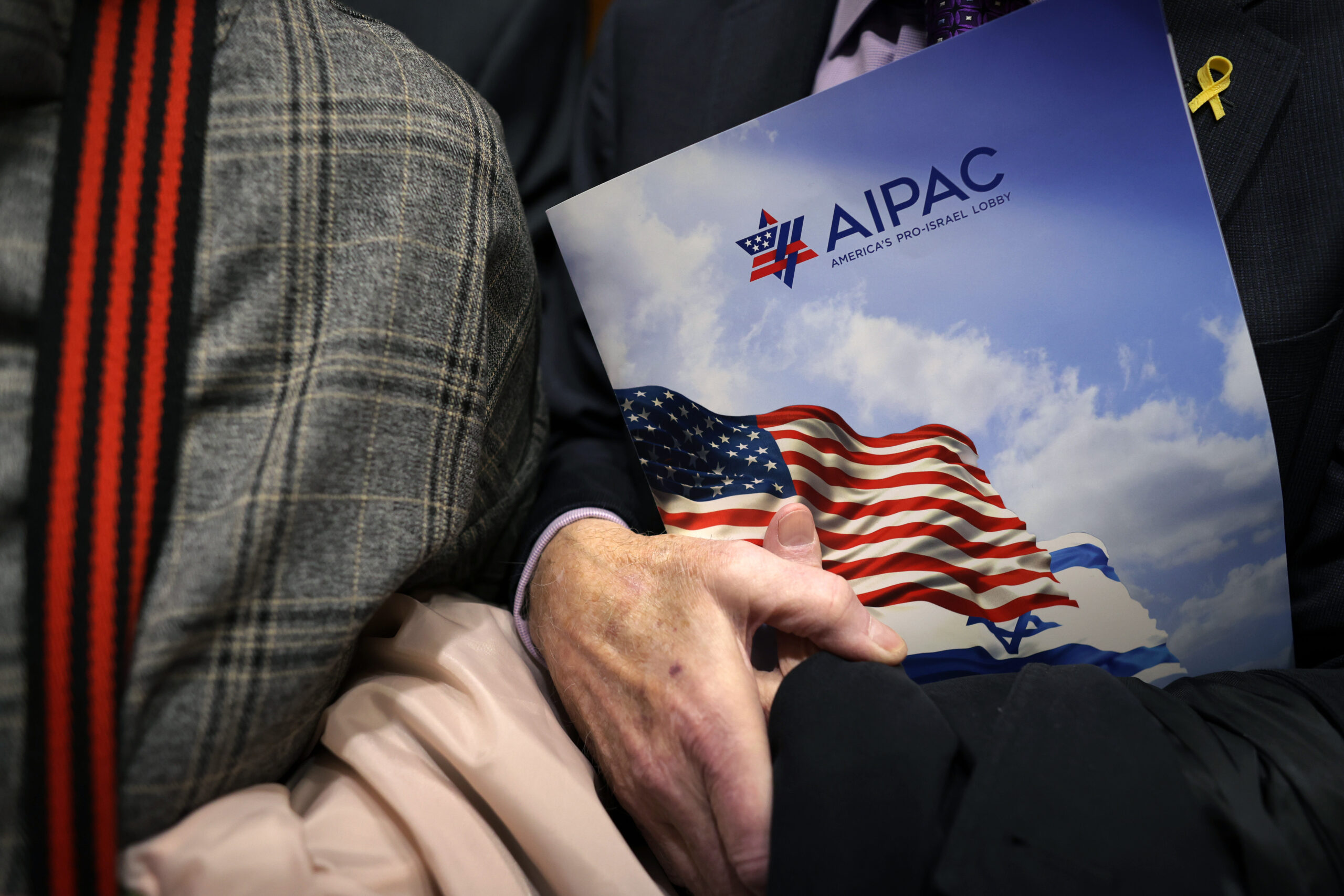













After 104 members of the House voted last week in favor of an amendment to eliminate military aid to Israel, pro-Israel activists who have spent years building ties with lawmakers are now wondering how to approach those relationships
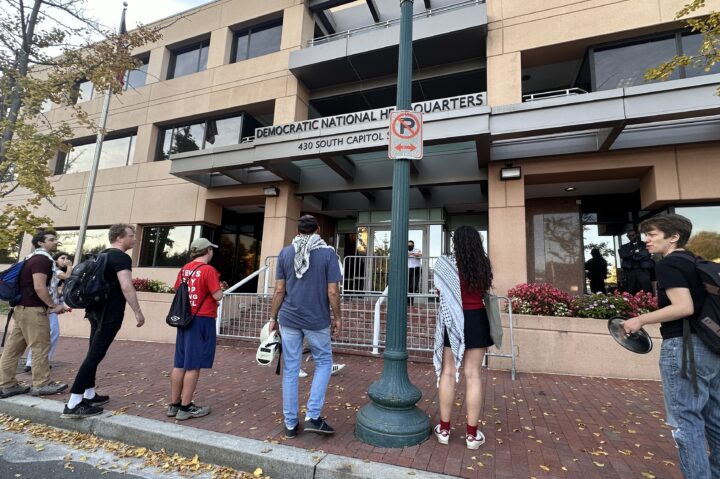
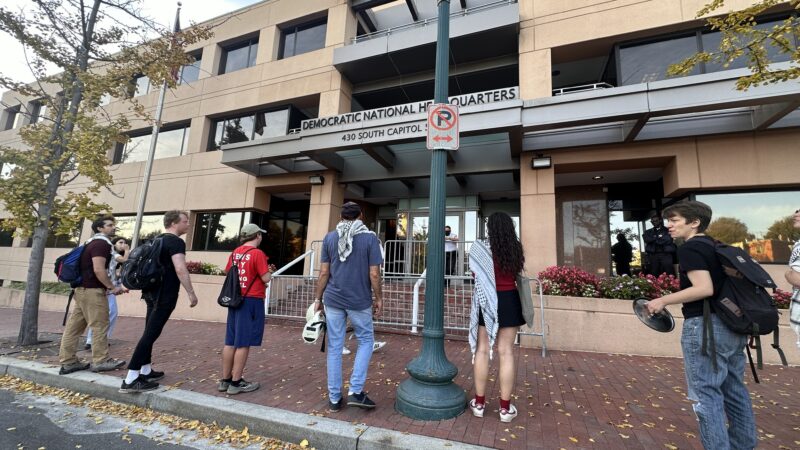
(Yasin Ozturk/Anadolu via Getty Images)
A group of demonstrators hold a noise protest outside the Democratic National Committee Headquarters in Washington D.C., United States on October 31, 2024.


 Add JewishInsider on Google
Before AIPAC began spending tens of millions of dollars per election cycle on campaigns, back when it was purely an advocacy organization that touted its relationships with many of the 535 members of Congress, the pro-Israel group used to describe its approach to Capitol Hill with a cheeky, upbeat motto: “You have friends, and you have potential friends.”
But when former Bay Area AIPAC leader Naomi Lauter used to invoke the slogan, she added a third category: “Friends who have a little less potential than others.” Lauter died in 2017, but the saying still resonates with her son, Sam, who is a major Democratic donor and pro-Israel activist in his own right — and who is now wondering whether that third category might be growing even larger.
After 104 members of the House voted last week in favor of an amendment to eliminate all $3.3 billion in annual military aid to Israel, pro-Israel activists across the country who have spent years building ties with lawmakers are now wondering how to approach those relationships following a vote that some see as a betrayal. Even many longtime Israel supporters — including Reps. Jack Auchincloss (D-MA), Glenn Ivey (D-MD), Laura Friedman (D-CA), Nancy Pelosi (D-CA) and Pat Ryan (D-NY) — voted for the amendment, which did not pass. Pro-Israel activists who spent years building trust and gaining access to these lawmakers are now grappling with whether whether those relationships are still worth their continued investment.
To borrow from AIPAC’s old slogan: Are the lawmakers who voted for the amendment still considered friends — or potential friends — of the U.S.-Israel relationship? Or was their vote against the annual aid package to Israel, and against a bill that was opposed by a wide swath of nonpartisan and Democratic Jewish groups, a crossing-the-Rubicon moment that cannot be undone?
Friends and backers of the members of Congress who voted for the amendment are struggling to answer those questions. Several who spoke to Jewish Insider said that a single vote on a measure that was sure to fail should not spell the end of years of friendship. But even as they acknowledged the seismic reverberations of the vote, many also spoke of the need to tread carefully at a politically uncertain moment.
“Our issues are too important to not hold onto the ability to have a conversation with the person, because the votes are not going to end. It’s not going to all of a sudden stop,” Sam Lauter said. He talked to several members of Congress in the days before the vote, including Pelosi, urging them to vote no.
“It’s not a good trend line, but also this idea that we’ve lost the Democrats — let’s not create self-fulfilling prophecies here. There’s an opportunity for us to turn some of this around,” Tyler Gregory, CEO of the Bay Area Jewish Community Relations Council, said. “I am optimistic that several of them could be flipped if the vote had actual consequences, and I think that’s the job ahead of us.”
“Now, if someone said to me, ‘You know what, I voted yes, and my reasoning was because actually I don’t think we should be allies with Israel anymore, and I have no interest in the friendship with the community or the country, I’m done.’ Well, OK, that friendship’s done,” said Lauter.
This vote was destined to fail, but Tyler Gregory, CEO of the Bay Area Jewish Community Relations Council, called it “a dress rehearsal.” It will not be the last time U.S. aid to Israel comes up for a vote, and Gregory said he will need to lean on those lawmaker relationships in the future when the vote is more consequential.
“It’s not a good trend line, but also this idea that we’ve lost the Democrats — let’s not create self-fulfilling prophecies here. There’s an opportunity for us to turn some of this around,” Gregory said. “I am optimistic that several of them could be flipped if the vote had actual consequences, and I think that’s the job ahead of us.”
Halie Soifer, who served as an advisor to then-Sen. Kamala Harris (D-CA), now leads the Jewish Democratic Council of America, which urged members to vote against the amendment — as did Democratic Majority for Israel and the more liberal J Street. She called the vote “an inflection point,” but said the group is not considering removing its endorsements of lawmakers who supported the amendment.
“We’ve maintained a very consistent, principled position with regard to aid for Israel, and it’s not us that shifted,” Soifer said. “There is clearly a fast-moving shift within the Democratic Party itself, and we’re considering what that means.”
When asked whether she had ever seen so many candidates shift their positions on an issue within a single two-year election cycle, Soifer answered directly: “Absolutely not.”
AIPAC responded to the vote by no longer allowing donations, through its political action committee, to the 18 lawmakers it endorsed who voted for the measure.
“AIPAC members across the country watched this vote closely and are making sure their representatives in Congress who stood on principle hear that they’re appreciated,” AIPAC spokesperson Deryn Sousa told JI.
“The reality is these are our representatives. There is a relationship that we have with most of them, and they continue to be our representatives today, tomorrow, next week,” said Jeremy Burton, the CEO of the Greater Boston Jewish Community Relations Council. “The ones who say, ‘No, I’m still committed to Israel’s security and the Jewish community,’ things like that — and I’m not going to quote any one of them — but the ones who are saying that in these private conversations, it’s incumbent upon them now to show what that means.”
Many activists who have relationships with lawmakers are taking the long view, arguing that cutting ties now will not help in future battles. For a lot of them, Israel is not the only issue about which they are concerned.
Jeremy Burton, the CEO of the Greater Boston Jewish Community Relations Council, said he knows that some Jewish Bostonians have told Massachusetts’ congressional representatives, all of whom voted for the amendment, that this moment represents a “break point.” But as the leader of a nonpartisan organization, he cannot end relationships over a disagreement on one vote. He has other issues — such as nonprofit security funding and cooperation on fighting antisemitism — to consider.
“The reality is these are our representatives. There is a relationship that we have with most of them, and they continue to be our representatives today, tomorrow, next week,” said Burton. “The ones who say, ‘No, I’m still committed to Israel’s security and the Jewish community,’ things like that — and I’m not going to quote any one of them — but the ones who are saying that in these private conversations, it’s incumbent upon them now to show what that means.”
For one Jewish former Biden administration staffer, voting to cut off security aid to Israel must be the red line.
“They’re like, ‘Don’t worry about it. It’s just symbolic.’ Well, no, you’re telling us not to care about it, but clearly other people care about it, and that’s why you’re voting in that way,” said the staffer, who requested anonymity to speak about communal organizations they support. “I don’t think the Jewish community should be giving these people a pass right now, and I believe that’s actually creating an incentive for them to actually take these votes against us and against our interests, because there’s no political consequence or repercussions for them.”
House Minority Leader Hakeem Jeffries (D-NY) said on Thursday that Democrats will adopt a new approach to Israel if the party regains control of the House in November. “The current status quo is unsustainable,” said Jeffries, who voted no on the amendment.
“On one hand, I am really disappointed to see some true friends of mine and Israel vote for the [amendment] or vote ‘present,’” said Jennifer Laszlo Mizrahi, a Jewish philanthropist and disability rights advocate in Maryland. “On the other hand, as an American and as a Jew, I am horrified by how Netanyahu and his administration treat Palestinians in the West Bank, give Haredim the ability to be draft-dodgers and don’t show empathy when legitimate security operations accidentally kill an innocent child.”
Many of the 103 Democrats who voted “yes” released statements saying that they still support America’s relationship with Israel, but that they viewed the amendment as a symbolic way to tell Israeli Prime Minister Benjamin Netanyahu that they disagreed with his handling of the wars in Gaza and Iran.
In doing so, they tapped into a difficult reality for many of the Jewish activists who wanted to see the measure defeated. Many of those activists also wish Netanyahu would do more to take the concerns of Democrats and liberal Jews into account, even as they think Washington should continue supporting Jerusalem’s security needs.
“On one hand, I am really disappointed to see some true friends of mine and Israel vote for the [amendment] or vote ‘present,’” said Jennifer Laszlo Mizrahi, a Jewish philanthropist and disability rights advocate in Maryland. “On the other hand, as an American and as a Jew, I am horrified by how Netanyahu and his administration treat Palestinians in the West Bank, give Haredim the ability to be draft-dodgers and don’t show empathy when legitimate security operations accidentally kill an innocent child.”
In Los Angeles, Democratic donor and pro-Israel activist Howard Welinsky said many of the “yes” votes were a result of political “noise” — namely, concerns about current or future primary challengers from the left. “It’s the volume of the noise, and some members of Congress have more intellectual capacity to withstand it, and others have less,” said Welinsky.
So he is holding out hope that a change in Israel’s political leadership might help rectify Israel’s plummeting support among Democrats. “I just pray that Oct. 27” — the day Israel goes to elections — “gives Israel a new prime minister, and we can turn a page,” said Welinsky.
‘Israel is capable of paying for its own military equipment, including supplies for its missile defense systems,’ a spokesperson said, a position which is at odds with J Street PAC’s own stated endorsement criteria

Michael Brochstein/Sipa via AP Images
J Street President Jeremy Ben-Ami speak at the 2022 J Street National Conference held at the Omni Shoreham Hotel in Washington, D.C.
J Street, the progressive Israel advocacy organization which describes itself as a “pro-Israel, pro-peace” group, offered backing for the growing calls among far-left lawmakers to end U.S. support for Israel’s missile-defense systems, such as Iron Dome, which until recently had been largely spared even by strident critics of the Jewish state.
“What progressives are saying is not radical, and in fact, [Israeli Prime Minister] Benjamin Netanyahu and [Sen.] Lindsey Graham (R-SC) are arguing the same thing. Israel is capable of paying for its own military equipment, including supplies for its missile defense systems,” a J Street spokesperson told Jewish Insider.
Notably, that stance is at odds with J Street PAC’s own top endorsement criteria on its website as of Friday afternoon. The site states that J Street PAC requires endorsees to support “US security assistance to Israel that adheres to US law,” specifically citing support for Iron Dome.
“The United States plays an indispensable role in ensuring Israel’s future as a secure, democratic homeland for the Jewish people. J Street PAC only supports candidates who affirm this responsibility and who commit to supporting US security assistance to Israel as outlined in the 10-year Memorandum of Understanding (MOU) negotiated by President Obama — including sustained support for vital systems like Iron Dome,” the J Street website says.
The group, however, is currently supporting candidates who back policies like the Block the Bombs Act that run counter to the MOU.
In its statement, the group was referring to comments by the Israeli prime minister in which he did not call for an immediate end for U.S. aid to Israel, but said that he believed Israel would no longer need to rely on U.S. aid in a decade.
Though Graham initially responded to Netanyahu’s calls by suggesting he would immediately work to wind down U.S. aid, the South Carolina senator softened that position after a meeting with Netanyahu.
Calls to cut off missile defense aid to Israel have been growing in recent weeks from prominent far-left lawmakers like Reps. Alexandria Ocasio-Cortez (D-NY) and Ro Khanna (D-CA), joined recently by Brad Lander, a Jewish challenger to Rep. Dan Goldman (D-NY).
J Street’s backing of that stance could give cover to a host of rank-and-file Democrats to take a similar position.
Systems like Iron Dome are also co-produced by the U.S. and Israel, and similar arrangements would likely continue even if direct U.S. financial aid to Israel were ended in the short term.
In a Substack post on Sunday, J Street President Jeremy Ben Ami said that the U.S. should continue to cooperatively develop defensive technologies and to sell such systems to Israel, subject to Israel’s compliance with U.S. arms sales law, but that it should no longer provide any financial aid or subsidies to Israel for military systems.
“The United States should continue to supply what Israel needs for the defense of its people from Iranian, Hezbollah, Hamas and Houthi missiles – but the time is coming for Israel to pay for what it needs, as other prosperous countries do,” Ben Ami wrote.
He also reiterated J Street’s support for new legislation conditioning U.S. arms sales to Israel and for upcoming legislation to block specific arms sales.
“The exact timetable for phasing out taxpayer subsidies should be worked out carefully. The United States should honor existing commitments, including those in the 2016 memorandum of understanding, through their conclusion in the next two years,” Ben Ami said. “But after that, a responsible yet rapid phase-out is needed – a step that would move the U.S. and Israel toward a more mature, balanced, and ultimately more resilient partnership – one grounded not only in shared interests, but in shared standards and accountability.”
The meeting took place as the White House distances itself from the Muslim advocacy organization over its leader’s defense of the Oct. 7 terror attacks in Israel

California Gov. Gavin Newsom speaks to union workers and volunteers on election day at the IBEW Local 6 union hall on September 14, 2021 in San Francisco, California. (Credit: Justin Sullivan/Getty Images)
California Gov. Gavin Newsom met in December with representatives from the Council on American-Islamic Relations, an advocacy organization that has faced scrutiny in recent months for its executive director’s controversial statements celebrating the Oct. 7 terrorist attacks in Israel.
The Dec. 16 hour-long Zoom meeting, which was organized by CAIR’s California chapter and included roughly 15 Muslim leaders from across the state, was meant to address the humanitarian situation in Gaza, according to a CAIR press release. The participants also urged Newsom to call for a cease-fire in the Israel-Hamas war, now entering its fourth month.
On Oct. 7, CAIR-LA Executive Director Hussam Ayloush tweeted a prayer for Allah to “grant relief, freedom, and victory to the people of Gaza.” Three days later, he called the attack “our Warsaw Uprising moment” and linked to an Al Jazeera article praising the attack.
Newsom’s office declined to comment.
“The administration is actively engaging with Muslim and Jewish community leaders across the state to support the safety and security of California’s diverse communities,” a spokesperson for Newsom told the publication CalMatters in December after the meeting.
CAIR’s executive director, Nihad Awad, said in November that he was “happy to see” the Oct. 7 attack, which he described as “self-defense.” The White House condemned “these shocking, antisemitic statements in the strongest terms,” a spokesperson told Jewish Insider in December.
The White House pledged not to include CAIR in discussions around the White House national Islamophobia strategy, which is underway.
In 2021, CAIR San Francisco executive director Zahra Billoo came under fire from Jewish leaders after delivering a speech in which she called Jewish organizations that support Israel, including synagogues, Hillels and Jewish federations, “enemies.”
Newsom traveled to Israel in October less than two weeks after the attacks, which killed more than 1,200 people. Since then, he has directed the shipment of humanitarian aid to both Israel and Gaza.
This story was updated at 9:48 p.m. on 1/4/2024.
Please log in if you already have a subscription, or subscribe to access the latest updates.
 Continue with Google
 Continue with Apple