





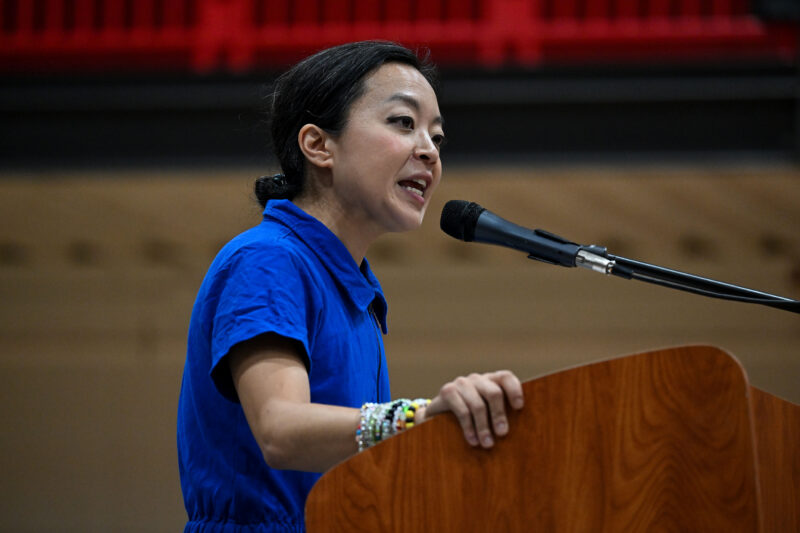











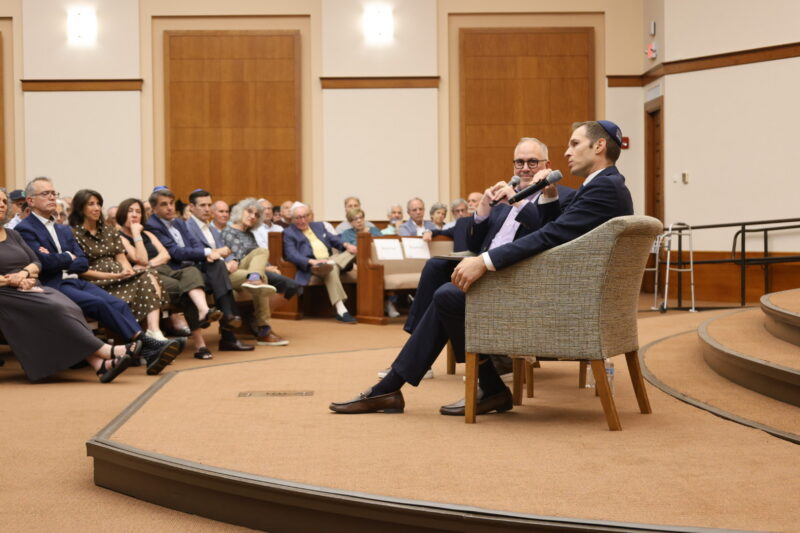

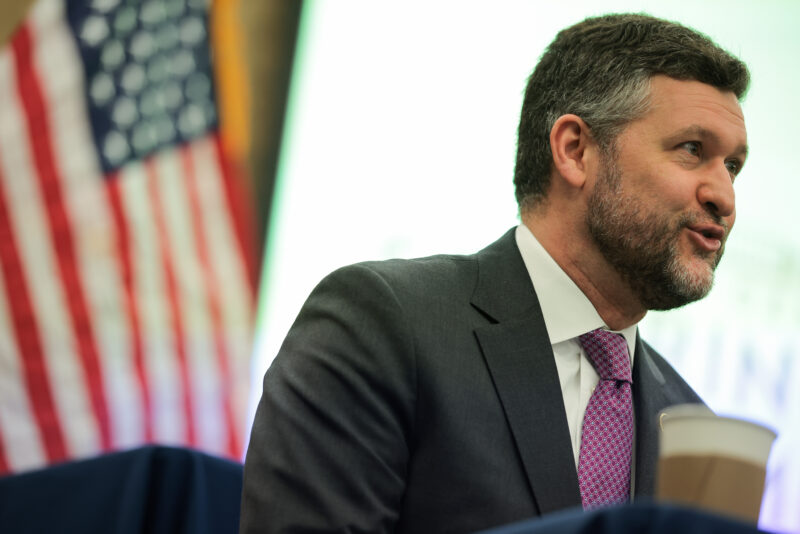














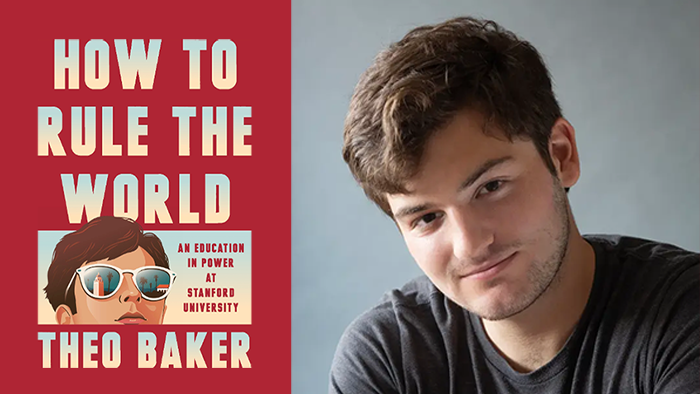
Discussing his new book 'How to Rule the World: An Education in Power at Stanford University,' Baker revealed to JI details about his turbulent and impactful college years


 Add JewishInsider on Google
Theo Baker describes himself as “an accidental journalist.” But at just 21, his writing has already sent shockwaves through the academic world.
As a freshman at Stanford University in 2022, he exposed then-President Marc Tessier-Lavigne’s decades-long pattern of manipulated data and research in scientific papers he co-authored or supervised, ultimately leading to his resignation. Baker, the son of New York Times reporter Peter Baker and New Yorker columnist Susan Glasser, became the youngest recipient of the George Polk Award for his reporting on Tessier-Lavigne.
During his sophomore year, Baker published a much-discussed essay in The Atlantic called “The War at Stanford,” exploring campus culture following the Oct. 7, 2023, terrorist attacks in Israel. He called college “a factory of unreason” and argued that anti-Israel demonstrations and rhetoric had created a pervasive climate of fear, accusing Stanford of failing to adequately condemn the attacks or protect Jewish students, all while training the next generation of tech and industry leaders.
Baker reflects on his turbulent college years in his new memoir and exposé, How to Rule the World: An Education in Power at Stanford University, published earlier this month. The book lays bare an elite university corrupted by Silicon Valley’s pursuit of power, all while Stanford saw a historic rise of antisemitism.
Whether it was navigating the release of ChatGPT or grappling with the impact of the Oct. 7 attacks, Baker said every year of his experience at the elite Palo Alto, Calif., university presented a unique challenge. Weeks away from graduation, Baker spoke with Jewish Insider about his past four years on campus, the role that technology plays in rising antisemitism — and what the future might hold for universities.
Jewish Insider: You’ve described yourself as coming from a home with “just a tiny bit of cultural Judaism.” How has covering antisemitism changed your Jewish identity? What about your relationship with Israel?
Theo Baker: In fall 2022, I went home for Thanksgiving and said, “There’s so much antisemitism at Stanford.” I was shocked by that. It’s not something I really countered growing up. As soon as I arrived at Stanford — even in the first week — someone asked me, “why are all Jews so rich?”
By the end of that year — and this is before Oct. 7 —- someone in my dorm, a kid who was Jewish, talked about being Jewish for the first time and someone put a bunch of swastikas and an image of Hitler on his door later that day.
So Jewishness is an identity and not one I would have placed much investment in prior to coming to college. It was something that I knew about myself but was not particularly salient. Certainly, I, like many college students in the last few years, have been made to feel more Jewish just by the circumstances around us. It was certainly interesting to be here on campus as a reporter when the biggest story happening was something that also intersected with my own background.
I have not taken trips to Israel [in college] but I lived in Israel briefly when my dad was the Jerusalem correspondent for The New York Times. I’ve tried to center my reporting on the things I have expertise on. Stanford is 7,000 miles away from Israel. It’s so fascinating that it became such an important issue for people, and then disappeared seemingly so quickly from the public conversation.
JI: You wrote that extremism had made it “normal for students to be harassed and intimidated for their faith, heritage, or appearance.” You described a campus environment where to get into a party you had to say things like “f**k Israel” at the door. Do you think campus culture has improved since then? Do you expect other issues to eventually overshadow the fixation with Israel on campuses? How come the Iran war didn’t spark as many protests?
TB: Certainly the focus has shifted dramatically. Stanford has not been a real hub of activism. It’s been a place where people have been more focused on their dorm-based startups. For one year, things were very different. Pretty quickly that [anti-Israel protests] dissipated come fall 2024. The tensions are still there, yet they’ve become far less visible. This all-consuming fixation with Israel is still certainly a thing for some quadrants of campus but is no longer the dominant narrative.
Many of the protests were fashionable because you could join them as a pregame to a party — literally. The vast majority of students didn’t come into 2023 with the Middle East being their focus and at this point I don’t think it is either for most of them.
Higher ed and academia perceives itself as under attacks from the federal government at the moment. A lot of attention has been focused on that, obviously a closer-to-home thing than Israel. But I also think people became less interested.
JI: Do you think elite universities can fix this problem and what would it take? Has the threat of losing federal funding has actually changed anything?
TB: Universities have become so sprawling that they’ve lost a sense of cohesive identity.
Yes [the threats made an impact but] it’s a mixture of things.
JI: Your Atlantic piece on Stanford antisemitism made you a target — you’ve described receiving death threats and messages saying you should be “cooked alive.” Are you expecting similar backlash from this book or do you think the current moment is less tense?
TB: There are a range of reactions, as you might expect. I’m grateful that both with that piece and this book there are people who care about these conversations and reasonable people can have differing interpretations.
Sophomore year I had events canceled because of “security threats.” I did an event at Stanford for the book [last week] and no one shouted at me. So that’s a little different. I haven’t gotten as many death threats. Higher ed right now, though, is a very charged landscape so people have different reactions to things they perceive as a critique.
JI: What reaction have you gotten from the Jewish community to the book? Who is the target audience? What should Jewish students reading this book take away from it?
TB: I hope different people can find different things of value in this book. The Jewish community on campus is very engaged. A lot of organizers belong to the Jewish community and some of them have opened up to me about their own experiences in relation to the book.
What I’m describing at Stanford is an inner world that is necessarily exclusive, necessarily kept obfuscated from the rest. That matters because these are the future masters of the universe who are going to assume their rightful place among the tech masters of the world. So understanding how they are being trained — all too frequently trained to cut corners to get ahead — that has a real salience for all our lives given the sheer dominance of technology.
JI: Your reporting on President Tessier-Lavigne, which led to his resignation, demonstrated the power of students holding institutions accountable. Do you believe student journalists have generally succeeded in covering campus antisemitism fairly and making a meaningful impact since Oct. 7, or have they fallen short?
TB: The student journalism community is a wonderful one. The past few years have been really tough for student journalists, the same we’ve seen for professionals doing this work in the “real world.” Sometimes that’s magnified on campus because you’re reporting on your peers. The number of threats and doxxing that has been targeted at journalists just doing their jobs is horrifying.
Institutions have arrested journalists just for covering college protests. A lot of student journalists have done important work in the last few years to document this important cultural story from the ground, from the campuses where these fights are breaking out.
JI: Your book describes Stanford as a place training kids to “rule the world.” What does it mean for American Jewish life — and American values in general — that so many future tech and political leaders are being educated in environments where antisemitism is largely unchecked?
TB: In addition to antisemitism, one of the major trends we’ve seen on college campuses in the last few years is a lack of engagement with high-quality information. This is a huge problem. The way students have come to grapple with the world is often filtered with unreliable sources that are intentionally distorting the facts and events of the world. One of the results of that is the rising surge of antisemitism, clearly prevalent among my generation. The overt antisemitism, expressed explicitly in polls, is significantly higher among people my age than even 10 years older. A big part of that technology and social media.
The people building those echo chambers are the same ones who are being trained on this campus to learn that getting ahead at any cost means putting yourself first.
JI: Do you think this is a Gen Z problem specifically, or is it more about the ideological framework that’s taken hold on elite campuses that your generation inherited?
TB: Our [Gen Z’s] manifestation of antisemitism is unique. So much of antisemitism is the denial of antisemitism, like Holocaust reductionalism and the anti-victim narrative refusing to allow Jews to be victims of a hate crime because they are somehow seen as a category you’re punching up at. That’s a big thing on college campuses. Part of that is how people grew up on the internet.
JI: A 2024 report from a Stanford committee focused on addressing antisemitism stated that although antisemitism manifested itself in classrooms, campus protests and among friend groups, “no venue has provided a wider and more uninhibited berth for the expression of hostility toward Jews and Israelis than social media.” How have you seen social media and AI exacerbate antisemitism — especially at Stanford which is a leader in technology?
TB: ChatGPT arrived two months after [my freshman year class arrived]. Already there’s a huge gap between what the freshmen coming in now who had ChatGPT throughout high school are like versus the kids who were seniors when we were freshmen.
Stanford is a vanguard of a lot of trends we see sweeping higher education — the same way Silicon Valley trends tend to filter out into broader society, the same thing is true for Stanford. It was true of the patent licensing program and corporate partnership programs. One of the biggest trends we’ve seen here in the last few years — and certainly we’ve seen filter out into the rest of higher ed — is this corporatization of the university, where students are no longer just people or teenagers, but they’re commodities that have to be both protected and buttered up. Something you can make your riches off of.
JI: The book examines how power operates at elite universities, particularly regarding who receives institutional protection and who is left vulnerable. Based on your reporting, did you find a direct link between the donor and venture capital influence you document and how these schools manage concerns raised by Jewish students?
TB: The most important thing to understand is that the attitudes of these institutions are shaped by their relationship to money and power. Stanford likes to think of itself as an underdog institution, a place where renegade outsiders build for the sake of it and that is what has created all the innovation and fortune that has followed. Stanford is very far from an underdog right now. It’s annual budget is higher than [more than 100] countries. The result of that is governance by corporate structure — this is a place with more administrators than undergraduate students.
You see that reflected in all facets of student life [including how] the administration is going to respond to antisemitism. Everything is filtered through the lens of donors and protecting the ability to fundraise at the level of billions of dollars Stanford has historically been at. Everything is filtered not as seeing students as going through a formative experience, but as commodities that have to be protected and preserved just as products of any business are seen.
JI: Jewish Insider spoke with you in 2024. Now that you’re about to graduate and have the perspective of all four years — what has changed for you? Do you think what happened at Stanford after Oct. 7 was unique in any ways or just part of a broader and systemic trend across elite institutions?
TB: Certainly very few of the things that happened at Stanford after Oct. 7 are unique to Stanford. Individual circumstances and behaviors may be, but the broader trends are all completely reflective of what we saw at basically every major institution.
Now with a couple of years of perspective, it’s still a hard thing to explain to some degree.
Everything was intense and quickly faded to the background. Universities got themselves into trouble by setting a standard for themselves that they weren’t equipped to hold onto when it came to the Middle East. They adopted the path of least resistance. In that sense, nothing has changed even if the words being uttered are different ones. The primary motivation isn’t an ideological one for why these universities were making statements on political causes routinely that aligned with the liberal perspective in the past, or why they are making statements now that appear to be in favor of academic freedom. For the most part, all of that is still guided by political expediency regardless of what the actual politics are.
JI: What would you advise a Jewish student considering attending Stanford or another elite university today?
TB: Universities for the most part are about finding your people. It’s still very much possible to do that. It’s important to keep your eyes open and observe the things happening around you because so much of what we’re seeing on college campuses right now is a representation of these broader national trends in terms of our politics, culture and technology that are important to understand and reckon with. I don’t think we properly understand the implications of having such a rancorous political climate, what it looks like to have these new technologies like ChatGPT taking on such an important role in our lives.
Every person going to college right now is well positioned to observe things that are important for our society going forward, and the lessons we draw from that have a huge impact and influence on everything.
I hope Stanford is a hyperconcentrated version of the modern university. It takes everything and turns the dial up to 11. It’s an interesting sociological experiment to look at what is happening here and see how that is reflected in what is happening in the rest of higher ed.
Emmanuel Nahshon, the coordinator for combatting academic boycotts on behalf of the Israeli Association of Universities, speaks to JI about the challenges Israeli academia is facing in the shadow of the Gaza war
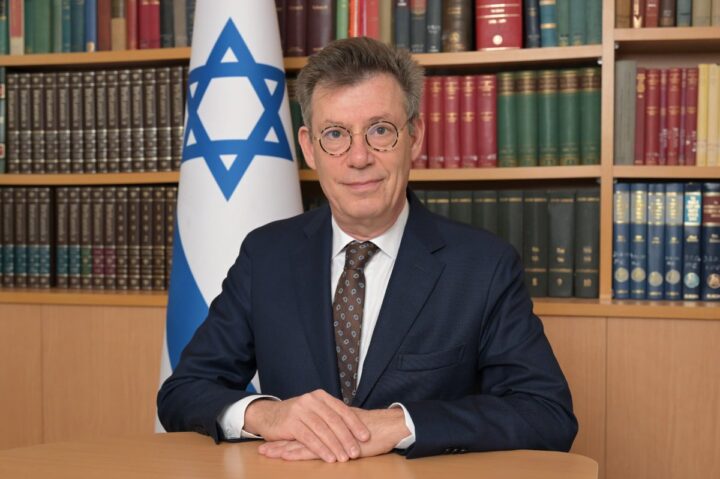
Shlomi Amsalem/GPO
Emmanuel Nahshon
As nearly a dozen countries announced plans to recognize a Palestinian state in the last week, the European Union debated exerting an additional form of leverage on Israel, in the form of suspending its participation in Brussels’ flagship scientific research and innovation program.
Earlier last week, the European Commission proposed a partial suspension of Israel’s participation in Horizon Europe — a 95.5 billion Euro ($109.2 billion) program that covers all areas of science and technology and has contributed significantly to Israeli academia and its tech sector — in response to what Brussels called a “severe” humanitarian situation in Gaza, which it views as having been insufficiently addressed by the daily humanitarian pauses this week.
The commission proposed to no longer allow Israeli entities to work with the European Innovation Council’s accelerator, which an Israeli diplomatic source estimated would lead to damages of about 10 million Euros ($11.4 mn.) to Israeli startups in the program, but none to research projects.
The motion did not receive the qualified majority in the European Union Council, and therefore Israel remains a full partner in Horizon Europe. Germany and Italy reportedly blocked the suspension, and Tuesday’s meeting on the matter ended without a decision. The European Council presidency said after the meeting that it plans to continue talks about the matter. The Israeli diplomatic source said some countries wanted to continue monitoring the humanitarian situation in Gaza before reaching a decision.
The scare from Brussels came at a difficult time for Israeli academia, which has been facing overt and more subtle forms of boycotts, Emmanuel Nahshon, the coordinator for combatting academic boycotts on behalf of the Israeli Association of Universities, told Jewish Insider in an interview on Wednesday.
Nahshon, a former ambassador and deputy director of Israel’s Foreign Ministry, who resigned last year in protest against the government, spoke about the challenges Israeli academia is facing in the shadow of the war in Gaza.
The interview has been condensed and edited for clarity.
Jewish Insider: What did you think about the outcome of the European Council’s discussion on partially suspending Israel from Horizon Europe?
Emmanuel Nahshon: They decided not to decide at the EU level, because we still have Germany and Italy blocking a possible majority against Israel, but even the Germans are telling us that this cannot go on. It’s an expression of the increasing isolation of Israel, given the unending war in Gaza, which has become more and more difficult to explain … It creates a bleak picture.
I’m very happy that sanctions on Israel in Horizon Europe did not work out this time, but unfortunately, it will happen next time.
JI: Can you explain why Horizon Europe is so important?
EN: It’s a fund budgeted by the EU and its member states, a multi-year fund for six to seven years, and its purpose is to fund joint research and development projects. Israel is one of the few non-EU countries that have been invited to participate … starting in the mid-1990s. It has been extremely successful.
European funds are extremely important because they create partnerships and networks and this is part of what has made Israel the innovation hub that it is.
Israel has one of the highest rates of return on investment and are welcome partners in top-level projects of the EU. By cutting us out of those projects, it will really punish Israeli innovation and the Israeli economy.
It’s not only about academic cooperation — it goes way beyond that. These are projects that are translated into concrete innovations for the welfare of humanity.
JI: What kinds of challenges is Israeli academia facing from anti-Israel elements abroad?
EN: Immediately after Oct. 7 [2023 Hamas attacks on Israel], there were mostly student protests, encampments, violent protests – those are almost non-existent now. It has shifted in the last year to something else, institutional boycotts.
Universities have decided to cut ties with Israel, as have professional associations – medical, psychology, historians, mathematicians. It’s much more dangerous. We now have countries in which the majority of universities have no contact with Israel. In Belgium and the Netherlands over 80% of universities have severed all contacts with Israeli universities, as have most in Spain and Italy. It’s beginning in Switzerland, in Geneva and Lausanne.
It’s a slippery slope. The more it happens, the more it is bound to happen. Universities copy one another.
On top of that, we have the silent, covert boycott. It’s like Voldemort [from Harry Potter], no one is saying its name, but it is there and we feel it all the bloody time. Israeli lecturers are not invited to international events anymore; articles are rejected; Israelis are not invited to take part in science and research consortia, etc.
If it continues for a year or two, we may face dire consequences.
JI: What would those consequences be?
EN: It’s the slow strangling of the Israeli academic world. We cannot function without contact with the outside world. Israel is too small a country to be able to have its own, internal academic world. We need contact with …the Ivy League and Western European universities.
On top of it, there is a phenomenon that began before the war, because of the so-called judicial reform, and that is Israeli academics leaving Israel. This is a brain drain that is noticeable and catastrophic. We are talking about tens of thousands of Israeli academics choosing to make their lives elsewhere. It began in early 2023 and the war made it worse.
JI: The Israeli Association of Universities (known in Israel by the Hebrew acronym VERA) hired you about a year ago to combat the academic boycott. What have you been doing?
EN: We have been working very hard on two levels. The first was to create internal coordination between different Israeli universities so we can speak the same language in the fight together. We did one thing that has been extremely useful, which is to create a common database. Now, on a regular basis, we have information coming from all the Israeli universities regarding boycott attempts and events. This is super useful, because now we know how many took place.
JI: How many?
EN: By last count there were over 800 boycott events since last summer. Some are smaller, some are bigger.
[Nahshon provided JI with a presentation given by VERA to the Knesset Education Committee in May, which said that this year they received an average of 50 boycott reports per month — double that of the previous year. Broken down by country, the number of reports about the U.S., Canada and Holland more than doubled, Spain went up 125% and England increased by 55%. A third of the complaints from North America were about the suspension of individual collaborations between Israeli scientists and their colleagues, while 18% were about difficulty in publishing, and 18% were about not being invited to lecture or participate in conferences. In Europe, nearly a third of the complaints were about institutions ending their cooperation with Israelis.]
Boycotts are complex. It’s a bit like sexual harassment. People do not always want to say they’ve been the victim, so we have to encourage people. Now, more and more [academics] are reporting and we have a fuller picture of the situation.
JI: What do you do after receiving the reports?
EN: We do work all over the world on the legal, political and public relations fronts. We emply the services of a law firm in Brussels that is helping us tremendously, because a lot of institutional boycott cases violate European laws.
For example, if universities want to kick Israeli researchers out of Horizon Europe [grantee] projects, that is against European law … We have had many successes in which they immediately stop the boycott.
Politically, we want to encourage our friends to pass legislation against boycotts, like the ones that exist in the U.S.
There are so many lies directed at Israeli universities that have nothing to do with reality, such as calling them apartheid or saying that Israeli academia teaches the military how to occupy or how to kill.
This effort is very new, very young. We need more budgets to function; it’s challenging. I have addressed the government without much success. We are looking for partners and funds, and we do the best we can with the limited means we have.
JI: The Weizmann Institute, one of Israel’s leading scientific institutions, was hit by an Iranian missile last month, which destroyed 45 labs. Are they going to have a hard time recovering because of international boycotts?
EN: I don’t think it will be a problem [raising funds for the recovery] because so many have expressed solidarity with the Weizmann Institute. They have so many friends around the world.
The problem is that the government is not fulfilling its mission. It should be the role of the Israeli government to commit to financing it, instead of fundraising … Israeli academia is not a priority for this government because it is identified with the more liberal wing of Israeli politics.
Weizmann will be fine, but the problem is of a more general nature. I quote the head of VERA Daniel Chamovitz, who said that “you can see that the Iranians put higher education and Israeli research at the center of their launch map” — apparently the Iranians understand better than the Israeli government that academia is a top priority. They aimed at Weizmann and the Soroka Hospital [in Beersheba, a teaching hospital] for exactly that reason.
The leaders of Georgetown, CUNY and UC Berkeley condemned antisemitism generally at a Capitol Hill hearing, but struggled to criticize antisemitic professors

Win McNamee/Getty Images
Dr. Robert Groves, Interim President of Georgetown University, Dr. Félix Matos Rodríguez, Chancellor of The City University of New York, and Dr. Rich Lyons, Chancellor of the University of California, Berkeley, testify during a House Committee on Education and Workforce hearing in the Rayburn House Office Building on July 15, 2025 in Washington, DC.
When the leaders of Georgetown University, the City University of New York and the University of California, Berkeley sat down on Tuesday morning to testify at a congressional hearing about antisemitism, they clearly came prepared, having learned the lessons of the now-infamous December 2023 hearing with the presidents of Harvard, the University of Pennsylvania and MIT, each of whom refused to outright say that calls for genocide violated their schools’ codes of conduct.
Georgetown interim President Robert Groves, CUNY Chancellor Felix Matos Rodriguez and UC Berkeley Chancellor Rich Lyons were all quick to denounce antisemitism and even anti-Zionism at Tuesday’s House Education and Workforce Committee hearing examining the role of faculty, funding and ideology in campus antisemitism.
But while the university administrators readily criticized antisemitism broadly, they struggled to apply that commitment directly to their field of academia.
Lyons in particular offered a revealing look at the gulf between a university’s stated values and its difficulty in carrying them out.
He was asked to account for the promotion of Ussama Makdisi, a Berkeley history professor who described the Oct. 7, 2023, Hamas terror attacks as “resistance” and later wrote on X that he “could have been one of those who broke the siege on October 7.” Why, Lyons was asked by Reps. Randy Fine (R-FL) and Lisa McClain (R-MI), did Berkeley announce last September that Makdisi had been named the university’s inaugural chair of Palestinian and Arab studies?
Lyons first defended Makdisi: “Ussama Makdisi, Professor Makdisi, is a fine scholar. He was awarded that position from his colleagues based on academic standards,” Lyons said.
Later, when McClain followed Fine’s line of questioning, Lyons went to great lengths to avoid criticizing Makdisi.
“I want to separate the phrase from the person. If I heard some other person —” he said, before McClain cut him off. What, McClain asked, did Lyons think Makdisi meant with his tweet?
For five seconds, Lyons sat in silence.
“I believe it was a celebration of the terrorist attack on Oct. 7,” he replied slowly.
He shared that he had spoken to Makdisi about the social media post. Pressed to share what the conversation was like, Lyons returned to an earlier line: “He’s a fine scholar,” Lyons said.
Lyons, like Matos Rodriguez and Groves, acknowledged that antisemitism exists at his campus. But they all struggled to reckon with what Republican lawmakers alleged was an explosion in antisemitism at each of the three schools after Oct. 7.
“I believe that most Jewish students feel safe on our campus,” Lyons said, though he also said that he knows some do not feel safe. When asked why they may not feel safe, he demurred.
“Well, I think there are Jewish people that don’t feel safe in lots of parts —” he said, cut off again by McClain, who asked him to speak specifically about UC Berkeley.
“I think there is antisemitism in society,” Lyons said, before he was cut off again.
Lyons repeatedly attempted to make the same point: “I do believe that public universities are reflections of society, and I believe the antisemitism in society is present on our campus,” Lyons said. Asked whether the actions that he takes or that his faculty take can influence the campus environment, he said yes. McClain accused him of “avoiding the question,” and asked: Would he commit to act to make sure all Jewish students and all students feel safe?
“I’m committing to striving to reach that goal,” said Lyons.
Each of the university leaders was asked, at different occasions, to account for faculty members who had shared antisemitic or pro-Hamas rhetoric. Matos Rodriguez, the CUNY chancellor, did not deny that the New York City university system employs antisemitic faculty, though he did not specify whether any action would be taken against them.
“We have faculty that might conduct themselves in antisemitic behavior, and we have no tolerance for it, and we’re clear about the expectations to follow all our rules and policies,” Matos Rodriguez said. “If any individual breaks those rules, they will be investigated, and the appropriate disciplinary action will be taken if warranted.”
Presented with the cases of two faculty members who had shared pro-Hamas content on social media, Matos Rodriguez condemned Hamas, but did not say specifically if their rhetoric violated codes of conduct or led to any consequences.
“I have been very clear that Hamas is a horrible terrorist organization, and we have no tolerance at the City University of New York for anyone who would embrace that support of Hamas,” said Matos Rodriguez. “I clearly condemn the statements, and it’s been my testimony here, and our practice, that if any member of the City University community violates our policies and our code of conduct, we will conduct an investigation, and if discipline is warranted, we will take it, and we will not hesitate to do that, and we have done so.”
Groves, Georgetown’s president, shared early in the hearing that the university had taken action against Jonathan Brown, a tenured professor who faced criticism last month for a tweet calling for Iran to conduct a “symbolic strike” on a U.S. military base after Washington struck Iranian nuclear sites. Brown is no longer the chair of the university’s Arabic and Islamic studies program, Groves said, and he has been placed on leave pending an investigation.
Groves, who faced several questions about Georgetown’s ties to Qatar, pledged to commit to disclosing every dollar that Georgetown receives from foreign sources.
At the same time, he stood by Georgetown’s decision to award Sheikha Moza bint Nasser, the mother of the Qatari emir, with the university’s president’s medal in April. Sheikha Moza has a history of incendiary anti-Israel commentary on social media, including several posts praising the Oct. 7 attacks and Hamas leader Yahya Sinwar, who orchestrated the violence. Rep. Mark Harris (R-NC) asked Groves why Georgetown gave her a medal, given those posts.
The medal was awarded because of her “decades-long work for educating, getting access to education, to the poorest children around the world,” Groves said.
“I don’t support that tweet,” he added, when asked if Georgetown’s values include calls for the destruction of Israel. “That tweet is not consistent with Georgetown policy. We honored her for her decades of work in access to education to the poorest children of the world.” Georgetown would not consider revoking the award, he added.
Groves’ stated commitment to transparency about its sources of foreign funding — the university’s 20-year relationship with Qatar is well-documented and oft-criticized — stood in contrast to Lyons’ response to questions about whether he would disclose all foreign funding to Berkeley.
“As a public university, I am not ready to commit to that on the fly. There are different donors to the university who request anonymity,” Lyons said. “What I’d be very, very happy to be very transparent about is exactly what is our process for vetting those things. We say no to a lot of foreign money. I promise you that.”
He would not give an example of foreign money he had rejected.
Democrats at the hearing mostly used their time to criticize President Donald Trump’s approach to higher education, and his funding cuts that are affecting scientific and medical research at top universities. They highlighted his administration’s massive cuts to the Education Department, including at the Office for Civil Rights, the division tasked with investigating civil rights violations — including antisemitism — at American schools and universities.

Webbi1987 / Wikimedia Commons
Malcolm X Plaza at San Francisco State University
Zoom has denied its services to San Francisco State University for a university-sponsored event scheduled for Wednesday featuring Palestinian terrorist Leila Khaled.
The event, titled “Whose Narratives? Gender, Justice & Resistance,” was cosponsored by the university’s Arab and Muslim Ethnicities and Diasporas Studies Program and the Women and Gender Studies Department. The webinar listed SFSU professors Rabab Abdulhadi and Tomomi Kinukawa as the moderators.
Khaled was involved in two plane hijackings in 1969 and 1970 as a member of the Popular Front for the Liberation of Palestine (PFLP), which is designated by the U.S. and several other Western counties, as well as the European Union, as a terrorist organization. She was arrested in London after the second hijacking, but was released by U.K. officials in exchange for hostages taken in a similar plane hijacking.
A statement provided by Zoom to the Lawfare Project, which had warned the technology company and the university that by hosting Khaled they may violate a federal law prohibiting assisting foreign terrorist organizations, read:
“Zoom is committed to supporting the open exchange of ideas and conversations, subject to certain limitations contained in our Terms of Service, including those related to user compliance with applicable U.S. export control, sanctions, and anti-terrorism laws. In light of the speaker’s reported affiliation or membership in a U.S. designated foreign terrorist organization, and SFSU’s inability to confirm otherwise, we determined the meeting is in violation of Zoom’s Terms of Service and told SFSU they may not use Zoom for this particular event.”
The announcement comes 18 months after SFSU settled a claim filed by the Lawfare Project alleging discrimination against two students.
Benjamin Ryberg, COO and director of research at The Lawfare Project, told JI that Zoom deserves some credit for its decision. “We applaud Zoom for enforcing its own terms of service and complying with U.S. law, which clearly prohibits the provision of technological services to members of designated Foreign Terrorist Organizations.”
Please log in if you already have a subscription, or subscribe to access the latest updates.
 Continue with Google
 Continue with Apple