


Leonardo MUNOZ / AFP via Getty Images
U.N. secretary-general race puts candidates’ Israel records in focus
Costa Rican Jewish economist Rebeca Grynspan has emerged as a leading contender, but faces competition from Carolyn Rodrigues-Birkett, the anti-Israel Guyana U.N. ambassador


 Add JewishInsider on Google
The race to succeed U.N. Secretary-General António Guterres is still wide open, with seven candidates vying to lead an organization whose approach toward Israel has become a central concern for the United States and pro-Israel advocates.
But even as the candidates stake out different records on Israel, diplomats and experts caution that the next secretary-general will have limited power to alter the U.N.’s broader posture toward the Jewish state — and could inherit an institution in which those policies are deeply embedded.
Guterres, whose tenure has been riddled with accusations of antisemitism and anti-Israel bias, will leave office on Dec. 31 after serving two five-year terms. His successor is expected to be selected in the coming months, though one source familiar with the situation told Jewish Insider the process may not be completed by the time Guterres leaves office, and it’s not clear what — if any — consequences there will be if the post remains empty for a period of time.
Seven candidates are currently seeking the position, including four women, raising the possibility that the U.N. could select its first female secretary-general. Under the organization’s informal regional rotation, there is also a strong possibility that the next secretary-general will come from Latin America or the Caribbean.
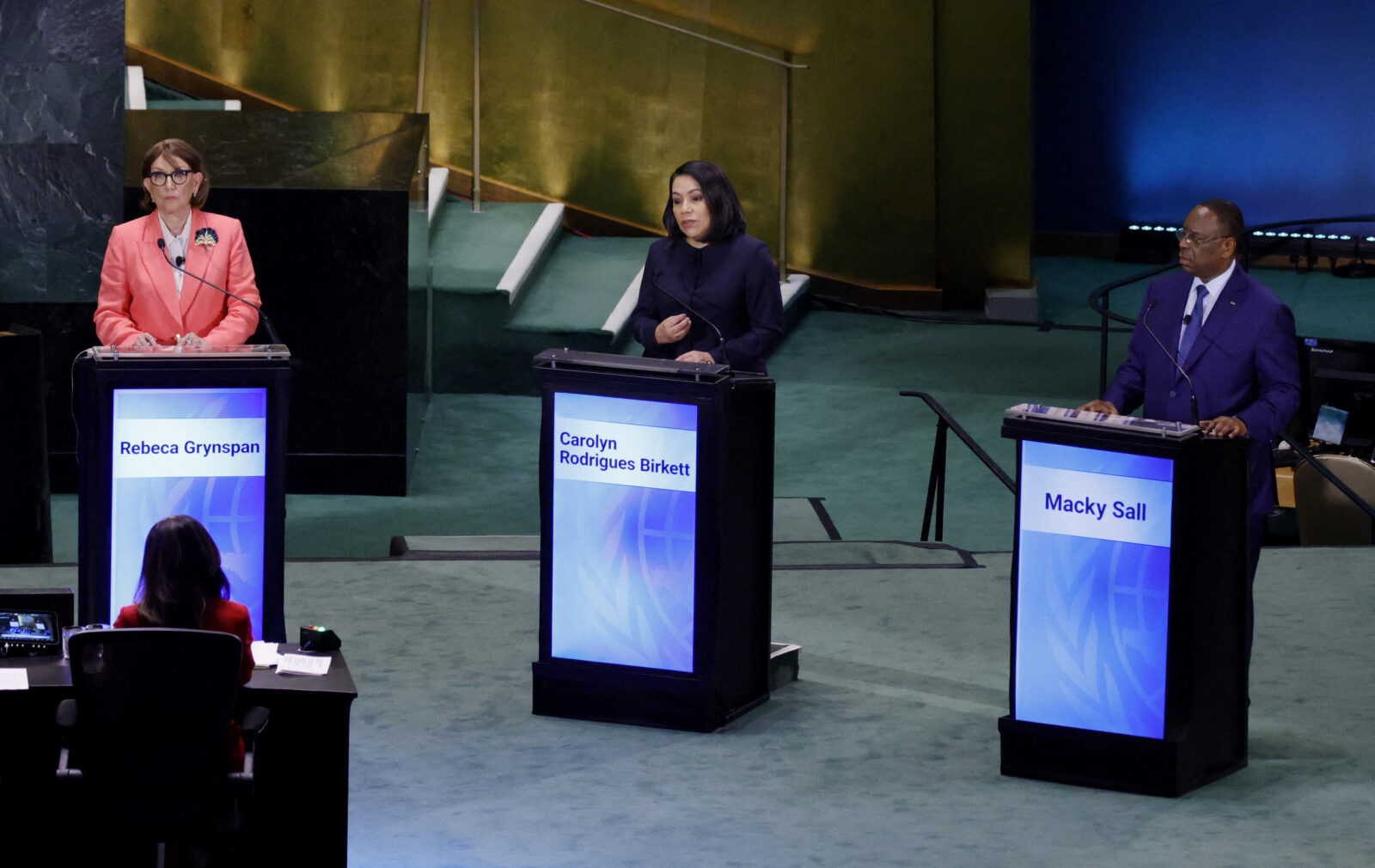
Costa Rican economist Rebeca Grynspan and Guyana’s U.N. ambassador, Carolyn Rodrigues-Birkett, have emerged as the leading contenders. The field also includes Rafael Grossi of Argentina, the director general of the International Atomic Energy Agency; María Fernanda Espinosa Garcés and Ivonne A-Baki of Ecuador; Olara Otunnu of Uganda; and former Senegalese President Macky Sall.
The source, who requested anonymity to speak candidly about private deliberations, said that U.S. Ambassador to the U.N. Mike Waltz has tasked Jennifer Locetta, the alternate representative of the United States for special political affairs at the U.N., as well as Ambassador Jeff Bartos, the U.S. representative for U.N. management and reform, with interviewing the candidates “and being front and center in the process. They have had multiple meetings with every candidate.”
A Sept. 18 straw poll, one of three conducted by the 15-member U.N. Security Council since July, offered the clearest indication yet of where the race stands. In the anonymous poll, in which members indicate whether they encourage, discourage or have no opinion about each candidate, Grynspan received nine “encourage” votes, the most of any candidate, while Rodrigues-Birkett received eight. Otunnu and Grossi each received five.
The informal, nonbinding straw poll votes are intended to gauge support but do not determine the winner. The UNSC will ultimately hold a formal vote to determine its final recommendation, which requires at least nine votes and no veto from any of the five permanent members — the U.S., U.K., France, Russia and China. The recommended candidate then goes to the General Assembly for approval. If the General Assembly does not accept the recommendation, the UNSC must return to the process and put forward another candidate.
Ben Cohen, a research fellow and senior editor at the Foundation for Defense of Democracies, said the contest remains inconclusive as compared to past secretary-general races, leaving open the possibility that another candidate could emerge late in the process.
“We’re at a juncture three months from Guterres leaving office, and we still don’t have a clear front-runner,” Cohen said. “Going by history, you would expect to have a clear front-runner at this point, and you really don’t. So I wouldn’t rule out the possibility that you could have a candidate entering very late, who would be palatable to all five of the permanent members, who could win over most of the other 10 nonpermanent members.”
He noted that despite the strong showings for Grynspan and Rodrigues-Birkett in the straw polls, both leading candidates could run into trouble given signs of opposition among the UNSC’s permanent members.
“We have no idea how the Security Council members are voting, and particularly whether the five permanent members are going to veto any of them,” Cohen said. “In that sense, I’d say both Grynspan and Rodrigues-Birkett are in a bit of trouble because there are rumors that the Russians or the Chinese — or indeed both — are not happy with Grynspan and don’t want her as secretary-general, so there’s a potential veto there. And as far as Rodriguez Burkett is concerned, I would eat my hat if the U.S. doesn’t veto her.”
David May, a senior fellow at FDD, described Grynspan and Rodrigues-Birkett as currently “neck and neck for the top spot.”
He acknowledged that the U.N. Conference on Trade and Development, currently led by Grynspan, “has been harshly critical of Israel.” Under her leadership, the agency has issued reports sharply critical of the impact of Israeli policies on the Palestinian economy.
Cohen similarly noted her record at UNCTAD, which he argued has amplified the Human Rights Council’s blacklist of companies operating in the West Bank, will leave Israel wary.
“In terms of economic warfare against Israel, it’s something that she knows about, and something that she has not rejected outright,” Cohen said. “I think she’s willing to engage in it, where she believes at least it could make a difference.”
Cohen described Grynspan as a U.N. insider candidate who has been close to Guterres and knows the U.N. system well. He argued she would likely “be in the mold of Guterres.”
Jonathan Ruhe, a fellow at the Jewish Institute for National Security of America, similarly contended that Grynspan “is a U.N. insider who seems unlikely to depart from Guterres’ record.”
However, given Grynspan’s background as the daughter of Holocaust survivors with family members residing in Israel, she could be viewed as friendlier to the Jewish state. One source familiar with the deliberations remarked that there is some concern in the Jewish community about whether it would “be a plus or a minus for there to be a Jewish secretary-general,” given the hostile views toward Israel among U.N. members generally.
Rodrigues-Birkett, meanwhile, has drawn criticism from experts over statements that they view as disproportionately critical of Israel. She has previously described the Jewish state’s actions against Palestinians as “brutality that would make some of history’s most cruel oppressors blush,” and praised former Cuban dictator Fidel Castro as a “visionary” in a June 2013 speech.
She has also “echoed a Hamas narrative falsely accusing Israel of genocide and framing the Oct. 7 massacre as a response to Israeli wrongdoing,” May said. “The already pervasive anti-Israel hostility at the United Nations would only increase under her leadership.”
Elliott Abrams, a senior fellow at the Council on Foreign Relations and former U.S. special envoy for Iran during the first Trump administration, also criticized Rodrigues-Birkett’s track record, calling her “unbalanced in her criticisms of Israel” and saying he “would hope the U.S. will make it clear that we won’t accept her either,” Abrams said.
Beyond Israel, Cohen pointed to Rodrigues-Birkett’s ties to Beijing as a potential sticking point for Washington. He noted that she was one of about five candidates who visited China’s Foreign Ministry over the summer.
“She was the only one who explicitly endorsed a General Assembly resolution from 1971 that states that the PRC, the People’s Republic, is the only legitimate representative of China at the U.N., basically freezing out Taiwan,” Cohen said. “And she’s also been very supportive of Chinese initiatives on artificial intelligence, which will absolutely worry this administration.”
Meanwhile, Grossi is also viewed favorably by some pro-Israel analysts. However, despite leading the race earlier in the process, his candidacy has now “faltered,” according to May.
“The early front-runner, [he] is seen by the Israelis as even-handed and admired for his commitment to preventing Iranian nuclear ambitions,” May said. “However, his campaign has faltered of late.”
Ruhe similarly described Grossi as a “more hopeful alternative” because he is “a serious diplomat who’s been dogged about holding actual violators of international law like Iran and Russia to account.”
Cohen attributed Grossi’s decline to a growing push for a female secretary-general and to fierce Russian opposition, including recent attacks against him by Russian Foreign Ministry spokeswoman Maria Zakharova. She has accused Grossi of tacitly encouraging Ukrainian military activity around the Zaporizhzhia nuclear plant.
“The Russians absolutely hate him,” Cohen said. “It’s not beyond the bounds of possibility that at the eleventh hour something could be arranged with the Russians where they drop their veto. But I don’t know that the Russians are really in the mood to compromise right now, and Zakharova in particular has been so hostile towards Grossi that it would be a climb-down that they’re unwilling to make at this point. So if I was Grossi, I wouldn’t be planning to move my family to New York City just yet.”
Still, several experts cautioned against overstating how much the political identity of the next secretary-general could change the U.N.’s overall approach toward Israel.
Aaron David Miller, a former State Department negotiator and senior fellow at the Carnegie Endowment for International Peace, argued that the secretary-general has limited ability to overcome divisions within the organization and that Israel’s own policies will likely play a greater role in determining its relationship with the next U.N. leader.
“Since the days of Dag Hammarskjold, the most consequential UNSYG, in the UN’s history, it matters very little to either the US, Israel or the world [who the next secretary general is],” Miller said in a statement to JI. “The UNSC is so divided that the UN can’t serve as an effective instrument to resolve conflict.”
Miller said that while Israel’s relationship with the U.N. “has always been fraught,” he argued that it was “better when [Israel] had [prime ministers] who were interested in serious peacemaking.”
“It’s Israeli policies that are likely to determine how the next UNSYG relates to Israel,” Miller added. “The ‘what’ is more important than the ‘who.’”
Abrams similarly noted that a new secretary-general on its own is unlikely to be enough to sway the U.N.’s posture toward Israel.
“The secretary general does not control the General Assembly or UN agencies like the Human Rights Council or UNESCO, so Israel will still face a hostile organization even if the Secretary General is neutral,” Abrams said.
Ruhe argued that the structural constraints run even deeper and that candidates have little incentive to campaign against the institution’s anti-Israel bias because doing so could make it harder to build the consensus necessary to win.
“No candidate is going to become the next secretary-general by campaigning on reforming the U.N.’s institutional hostility to Israel,” Ruhe said. “Nor will they build consensus for their own initiatives by meaningfully softening the organization’s anti-Israel bias, even if they privately disagree with it.”
Still, experts said that does not make the choice irrelevant. They argued that a secretary-general who reinforces existing hostility toward Israel could worsen an already difficult environment, while a leader who attempts to apply a more even-handed standard could affect the organization’s credibility and priorities.
Andrew Weinstein, who served as a public delegate to the U.N. General Assembly during the Biden administration, said the U.N. “has built a structural bias against Israel into its machinery,” and that the next secretary-general must be prepared to inherit what he described as a “credibility crisis.”
“Whoever’s chosen is going to face a simple test, which is, can they speak both honestly about the humanitarian catastrophe in Gaza and the rights of Palestinians, and at the same time reject the politicization of antisemitism, condemn U.N. actors who traffic in antisemitic tropes, and insist that Jewish fears and Israeli security are treated as seriously as that of any other people,” Weinstein said.
Asked whether a secretary-general who continued the U.N.’s existing hostility toward Israel could make the problem worse, Weinstein said, “Certainly that’s true,” pointing to Guterres’ remark after the Oct. 7 attacks that they “didn’t happen in a vacuum” and what he described as a delay by U.N. Women in explicitly condemning sexual violence against Israeli women.
“If the U.N. wants to be taken seriously on human rights, the next secretary-general really needs to move away from performative, one-sided condemnations and toward a fair standard that protects Palestinians, Israelis, and Jews worldwide without using any of them as props in someone else’s politics,” Weinstein said.
Featured Stories
Please log in if you already have a subscription, or subscribe to access the latest updates.
 Continue with Google
 Continue with Apple