









































































El-Sayed defends harsher criticism of Israel than Saudi Arabia in ‘60 Minutes’ interview
The Michigan Senate nominee questioned whether any Saudi entity is 'as strong as AIPAC is on behalf of the Israeli government’
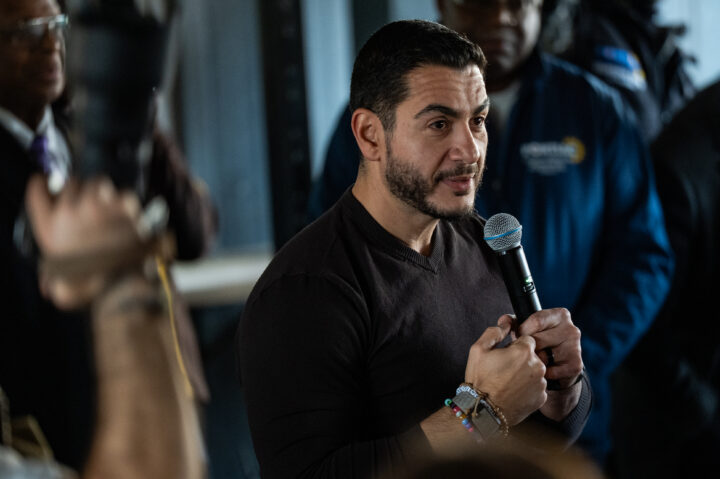
Salwan Georges/Getty Images
Michigan Democratic Senate candidate Abdul El-Sayed speaks to supporters at "Get Out The Vote Cookout" on October 31, 2026 in Pontiac, Michigan.


 Add JewishInsider on Google
Michigan Democratic Senate nominee Abdul El-Sayed defended his sharp criticism of Israel over other Middle Eastern countries, including Saudi Arabia, in an extended “60 Minutes” interview released on Sunday.
The remarks came amid growing tensions over El-Sayed’s position on Israel ahead of Tuesday’s election, with Rep. Haley Stevens (D-MI), whom El-Sayed defeated in the Democratic primary, endorsing his Republican opponent, Mike Rogers, on Sunday.
When pressed by CBS News’ Ross Douthat on why Israel attracts more intense criticism from American progressives than other Middle Eastern countries, El-Sayed cited “the scale of U.S. spending, the scale of those war crimes, and the impact on our politics.”
He pointed to AIPAC’s spending against him in the Democratic primary, arguing that pro-Israel political organizations have an outsized influence on American elections.
“Do you really think that there is any entity on behalf of the Saudi government that is as strong as AIPAC is on behalf of the Israeli government?” he asked.
Saudi Arabia routinely outspends pro-Israel groups in total registered lobbying expenditures. According to OpenSecrets’ Foreign Lobby Watch, Saudi-linked foreign principals sent approximately $421.9 million on activities disclosed under the Foreign Agents Registration Act between 2016 and 2025, the fourth-most of any country, compared with approximately $214.6 million by Israel-linked foreign principals, the tenth-most, during the same period.
Such expenditures are distinct from campaign spending by AIPAC and similar political organizations, which are funded by American donors and do not work on behalf of the Israeli government. In the 2026 campaign cycle, the United Democracy Project, AIPAC’s affiliated super PAC, spent roughly $104 million across the country, including over $30 million in the Michigan Democratic Senate primary.
“I’m not going to defend Saudi Arabia. I’m not going to defend Egypt,” El-Sayed continued. “I am principled in my opposition, but when one organization spends $33 million in one election on behalf of the interests of the foreign policy of a foreign government, yeah, there’s going to be a big response there.”
On the issue of a two-state solution, El-Sayed pushed back on the notion that a future Palestinian state should be established based on Israel’s existing borders.
“Too often, when this question is asked, we start with the currently existing state of Israel that is existing in contraposition to the possibility of a state of Palestine,” he said. “We have to start on that premise, and then from there we say, OK, where do we carve out a Palestinian state? That’s not equal rights to peace, dignity and self-determination.”
“‘We’re going to just take as fixed the idea of the state as it is’ implies that you are just taking whatever’s carved left, and there is no actual real opportunity for self-determination for the Palestinian people,” he said. “It’s like, ‘Hey, listen, after I eat, then you can have my seconds.’ I just don’t think that’s fair.”
When pressed on why he would not affirm that Israelis want a Jewish state alongside a Palestinian state, El-Sayed questioned the question’s premise, saying he did not know whether it was true.
“I think the question right now is, how do you empower two communities with equal rights to peace, dignity and self-determination to have the conversation amongst themselves to see where that plays out?” El-Sayed said. “But the problem is that process has never been dignified.”
Asked whether his responses were sufficient to reassure Jewish Democrats seeking a commitment to the continued existence of a Jewish homeland in the Middle East, El-Sayed emphasized shared domestic priorities and his commitment to protecting Jewish Americans.
“Wherever our disagreements are when it comes to Israel, there are a lot more things that we agree on here: the right to pray as you choose to pray, safety for religious minorities, the right to choose,” he said. “When it comes to standing up for Jewish Americans, I will be right there. I understand what it’s like to fear what happens at my place of worship.”
El-Sayed also delivered a sweeping criticism of Washington’s relationship with Israel, reiterating his argument that American military assistance takes away from domestic programs.
“We have been told that we are pursuing a two-state solution, only to aid, arm and abet the very people [who] are trying to foreclose on the possibility of a second state,” he said. “So it’s incoherent on its own terms.”
“I don’t know about you, but I don’t pay my taxes to buy another country a bomb or a tank,” El-Sayed continued, citing Israel, Egypt, Saudi Arabia and Pakistan. “My interest is making sure that our kids get good schools, that we have functional roads, that we’re paying for things like healthcare and childcare, and we’re spending billions to do the worst things.”
El-Sayed also reiterated his accusation that Israel committed genocide in Gaza, saying, “I don’t think that’s disagreeable.” He called the use of American tax dollars for that purpose “deeply problematic.”
The Democratic nominee again questioned whether Israel should be considered an American ally, accusing Israeli Prime Minister Benjamin Netanyahu of pushing the United States toward war with Iran.
“We’re told that Israel is our ally,” El-Sayed said. “But, I’m just so sorry, but like, if you’re walking with a friend and you see a bear, and you’re like, ‘Maybe we should just steer clear of the bear,’ and your friend’s like, ‘No, we ought to poke the bear,’ I don’t know if that person is really your friend.”
“I just think that we’ve got to really rethink the nature of this relationship,” he added.
El-Sayed called for ending the Iran war and returning to negotiations with Tehran, arguing that the United States has diplomatic and economic tools beyond military force. When asked how he would respond if Iran refused to end the war and asserted control over the Strait of Hormuz, El-Sayed advocated renewed negotiations but did not outline a specific response to that scenario.
“We pretend like the only thing we have is our sabers, and we rattle them or we use them,” he said. “We got to the [2015 Iran nuclear deal] because there are other needs that Iran has. Iran does not want to be a pariah. There is a lot of power that we can inflict that is not just war.”
More Stories
RESOURCE DENIED
Lawsuit alleges discrimination against Jewish employee org at NYC agency
CHRIS CROSSED
Philadelphia Jewish federation blasts Chris Rabb’s silence on bike protest
MR. (VAN) HOLLEN'S OPUS
Van Hollen leads push to remove U.S.-Israel cooperation provisions from defense funding bill
DEM DIVIDES
Van Hollen’s possible bid to oust Schumer spotlights Democratic rift over Israel
SANCTIONS STRATEGY
Rubio: Military operations in Iran unnecessary — for now
SCOOP
El-Sayed significantly underperformed among Jewish Michigan voters, poll finds
Please log in if you already have a subscription, or subscribe to access the latest updates.
 Continue with Google

 Continue with Apple