













































Saudi-UAE rift is bad for U.S. regional interests, former ambassador to Egypt warns
‘It is in our interest to strengthen the GCC as much as possible,’ Herro Mustafa Garg said on a panel at the Aspen Security Forum
(KHALED DESOUKI/AFP via Getty Images)
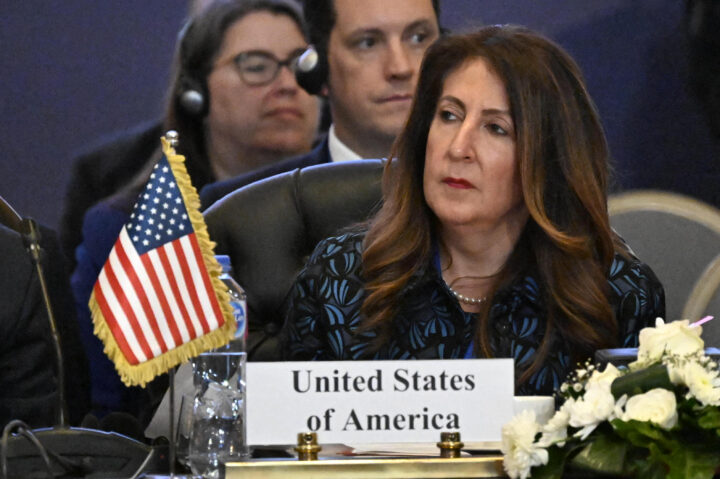
U.S. ambassador to Egypt Herro Mustafa Garg attends a humanitarian conference for Gaza in Cairo on December 2, 2024.


 Add JewishInsider on Google
ASPEN, Colo. — The rift growing rift between Saudi Arabia and the United Arab Emirates hurts U.S. interests in the region and Washington should work to bring the countries and other Gulf Cooperation Council states back together, Herro Mustafa Garg, a former U.S. ambassador to Egypt, argued on a panel at the Aspen Security Forum on Thursday.
“This conflict, this current war with Iran, made the animosity between these two countries — and some of the other Gulf countries — at a point that is not in the U.S. national interest,” Garg said. “Also, I don’t think it helps us when we think about what we do with Iran, what we do with Iraq. We need a united GCC in order to tackle these important strategic questions.”
She said that with a divided Gulf, the U.S. will see unilateral backchannelling to Iran by various partners, internal suspicion and more. And, she noted, the conflict between the UAE and Saudi Arabia is also playing out in other arenas — including Sudan, Libya and the Horn of Africa — fomenting instability that does not serve the U.S.
“It is in our interest to strengthen the GCC as much as possible,” Garg said.
Garg, who represented the U.S. in Cairo from 2023 until earlier this year, also praised comments by Iraqi President Ali al-Zaidi during a visit to Washington, D.C., this week, in which he committed to efforts to demilitarize Iranian-backed militias in the country, though Garg warned that such a task is easier said than done, given the political and structural constraints in the country and the Iranian regime’s continued resilience.
“This is an area that will be very very important for us to give our support, sustain support, and here again I would say, bring in the GCC because we need this to be not Iran versus U.S., but a coalition supporting Iraq,” Garg continued.
On the same panel, former Palestinian Authority Prime Minister Salam Fayyad highlighted the delays in implementing what he described as a laudable peace agreement to end the war in Gaza, including the failure of the proposed governance committee to actually enter Gaza.
He argued that the best path forward would be to establish a technocratic interim government, with the promise of elections at the end of a set period, for a government to manage both the West Bank and Gaza.
He added that the PA has long been stunted by basic failures of governance to provide for basic needs of the Palestinian people and because it lacks broad acceptance and legitimacy. He described the discussions of reform in the PA over the past few years as an exercise in “kicking the can down the road” — and said that the prospect of true reform is difficult to envision at this stage.
“In the way it’s constituted right now, it’s difficult for me to see how the Palestinian Authority can be fundamentally reformed,” Fayyad said. “Part of the reason goes to the fact that actually our own basic law … is not being respected in the way it should be. That is something that was promulgated by our administration going back to 2003. It created a position of prime minister and a purview for a government that has, over the past years, become completely usurped by the president and his office.”
But he emphasized that he believes the PA remains critical and that it must be politically reconfigured such that it becomes a product of popular consensus with true legitimacy.
Kim Ghattas, a Lebanese journalist who writes for The Atlantic, argued on the panel that the focus in Lebanon should move away from disarming Hezbollah, arguing that it’s unrealistic for Israel to expect the Lebanese Armed Forces to expect to go into neighborhoods and villages and forcibly disarm Hezbollah — something the LAF is obligated to do under various international agreements.
Ghattas said that a more realistic path is for the Lebanese government to work on interdicting weapons shipments and going after Hezbollah through legal, judicial and financial restrictions, as well as empowering the Lebanese state to deliver for all its citizens.
Jordan’s foreign minister offered a similar readout during a separate panel earlier in the day.
More Stories

Daily Kickoff
Barack to 1948
ACCUSATION AFTERMATH
El-Sayed denies Muslim Brotherhood ties after Rogers debate claim
analysis
Could these two small parties be Israel’s kingmakers?

SEEKING ANSWERS
After State Department memorial, families of Oct. 7’s American victims call for U.S.-led probe
PROBLEMATIC POST
Paxton senior advisor endorsed antisemitic slur on social media

Daily Overtime
Dublin hotel dumps antisemitism conference
Please log in if you already have a subscription, or subscribe to access the latest updates.
 Continue with Google
 Continue with Apple