






























The organizations collectively called the mayor’s decision to block bill that would standardize NYPD policy around schools during protests ‘a profound failure’
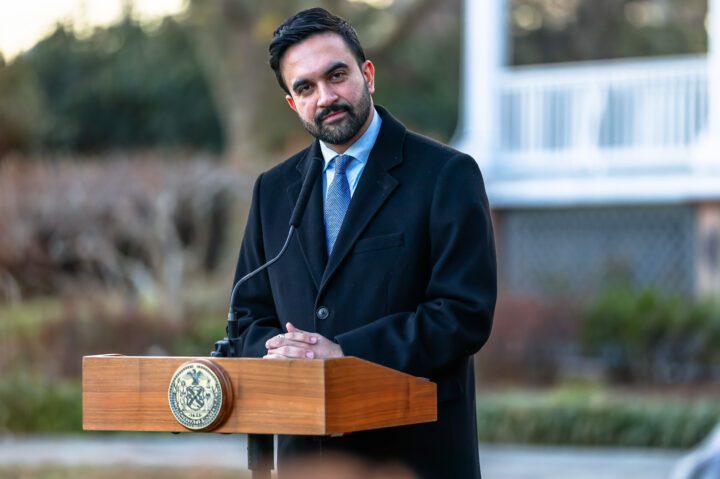
Michael M. Santiago/Getty Images
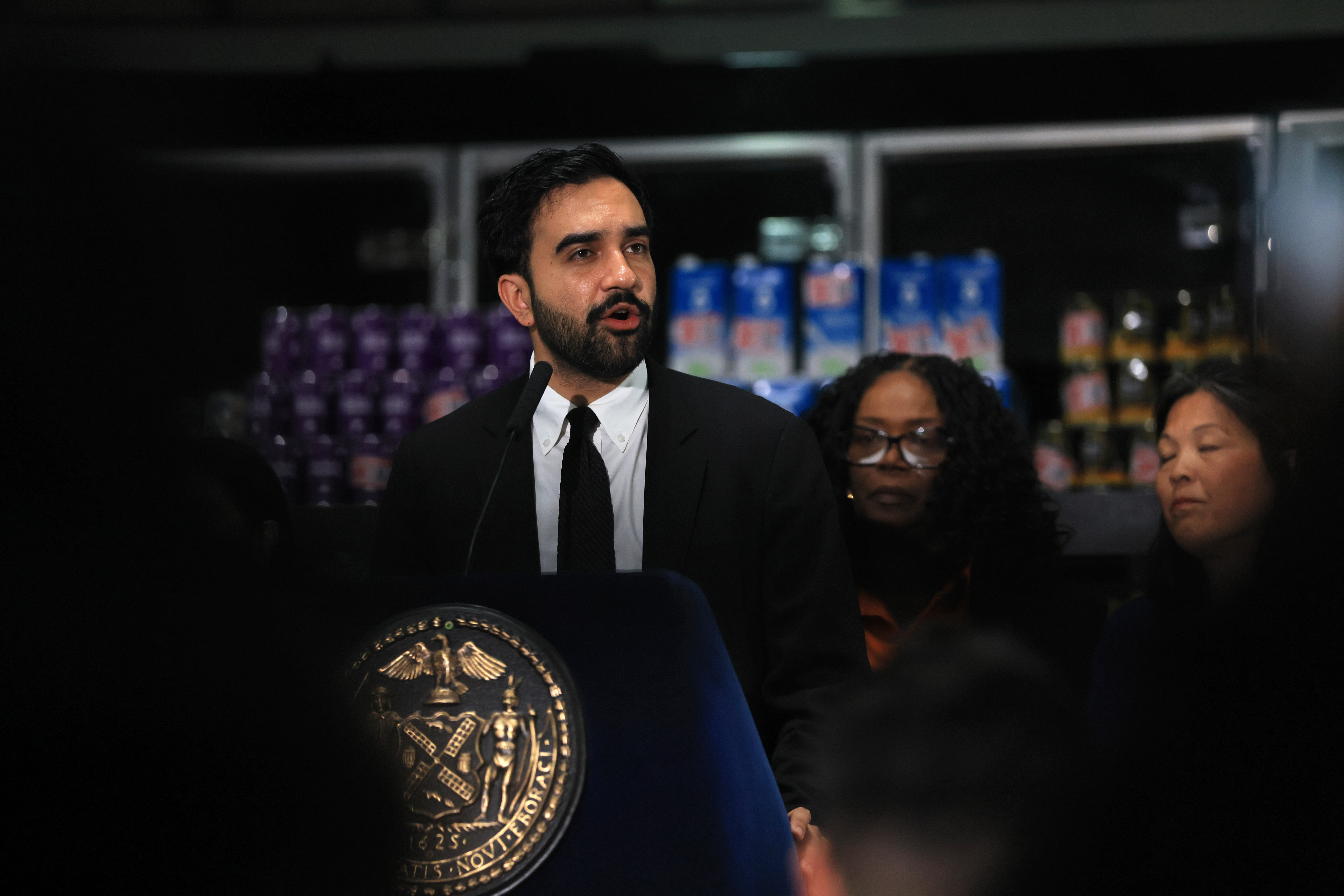
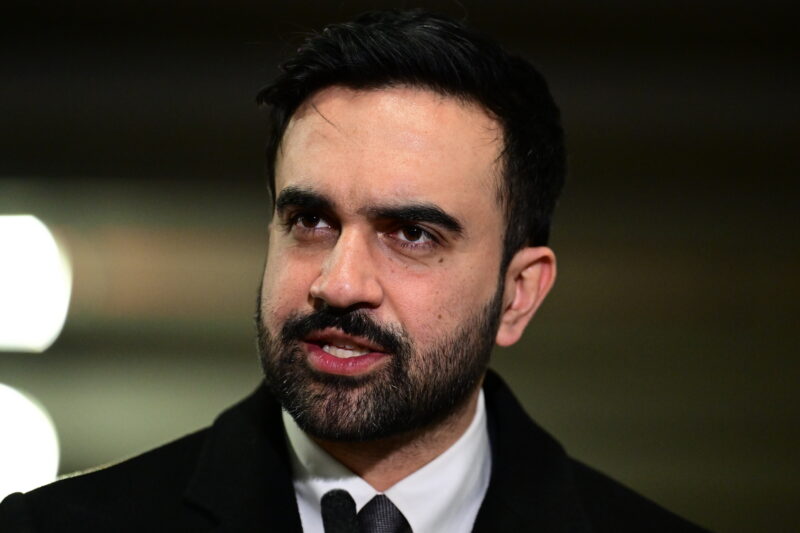
Mayor Zohran Mamdani speaks at a press conference during moving day at Gracie Mansion on January 12, 2026 in New York City.


 Add JewishInsider on Google
New York City Mayor Zohran Mamdani exercised his veto power for the first time since entering office on Friday to block a bill that would standardize NYPD policy around protests at educational institutions.
Mamdani had just one day left to block the two “buffer zone bills” that the City Council passed last month: the other measure, backed by Council Speaker Julie Menin and passed with a veto-proof majority, compels the police commissioner to develop formal protocol for security perimeters that ensure access and egress from religious buildings during demonstrations. That proposal went untouched and passed into law automatically — but the schools bill, which contains similar language but did not pass with a veto-proof majority, was struck down.
Speaking to reporters after an unrelated event Friday morning, the mayor cited what he described as “constitutional concerns” and union objections to possible infringement on their right to picket — even though the measure contained a carveout for labor action.
“It carries [these concerns] because unlike in the first piece of legislation, which is balancing the right to protest and the right to prayer — both of which are not just sacrosanct in our city but also constitutionally — the second does not have a counterbalance to the right to protest,” he said, suggesting that this exposed the proposal to legal challenge. “It also defines educational institutions in such a broad manner that it includes museums, libraries, teaching hospitals, things of that nature.”
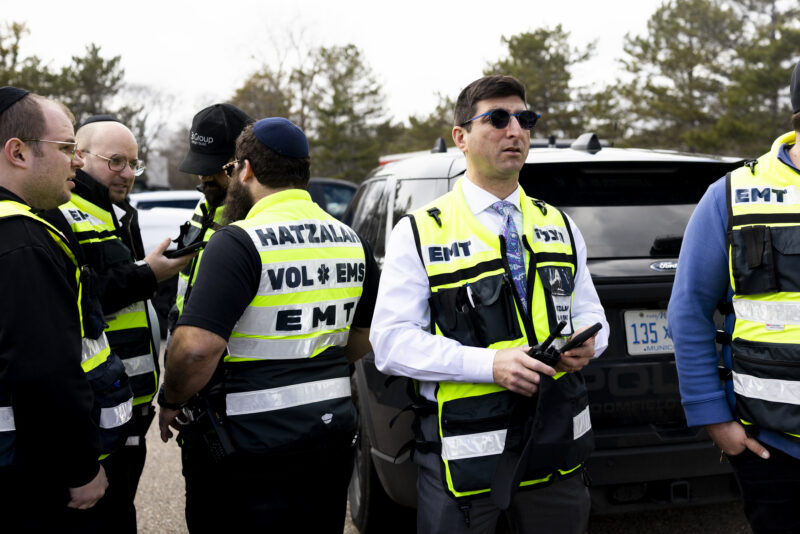
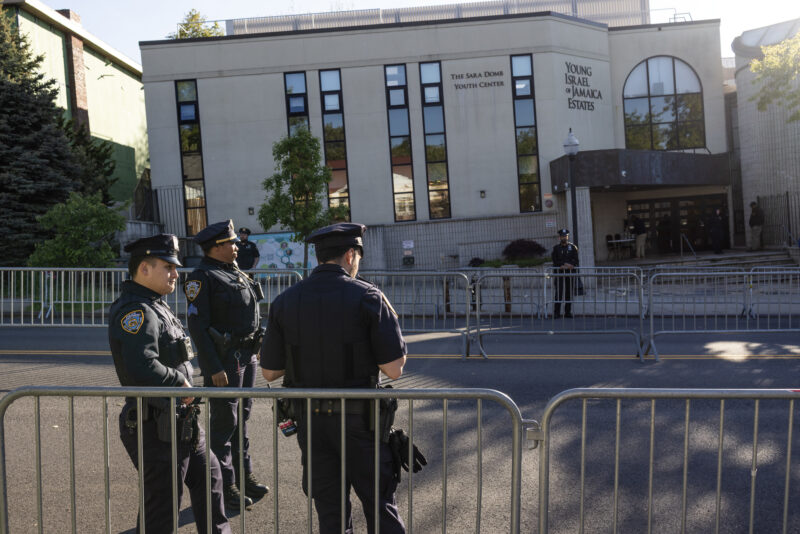
The city’s leading Jewish groups issued a rare united response, highlighting the protests that have targeted yeshivas and gathering places for Jewish student groups in recent years.
“We are deeply disappointed by Mayor Mamdani’s decision,” said the UJA-Federation of New York, the Anti-Defamation League of New York/New Jersey, Jewish Community Relations Council of New York, American Jewish Committee New York, the Conference of Presidents of Major American Jewish Organizations, the New York Board of Rabbis, Orthodox Union, The Rabbinical Assembly, Union for Reform Judaism, StandWithUs and Teach NYS. “This veto is a profound failure of City Hall to demonstrate to all New Yorkers that our safety is a priority.”
Bronx Councilman Eric Dinowitz, the lead sponsor of the bill, highlighted that it would merely obligate the NYPD to create a uniform policy for security perimeters, already frequently enforced during protests. He pushed back on claims that it would infringe on First Amendment rights.
“Students deserve safety as they enter and exit their school buildings, and New Yorkers deserve transparency from the NYPD,” Dinowitz said in a statement. “The mayor promised to keep New Yorkers safe and increase police transparency. By vetoing this bill, he is breaking yet another campaign promise.”
Sources indicated to Jewish Insider that they would try to whip votes to secure the necessary support from the City Council to override the mayor’s decision. The city bills are distinct from state-level proposals Gov. Kathy Hochul has endorsed that would establish a felony penalty for protesters who come within 25 feet of the doorways and driveways of religious institutions and abortion clinics.
Menin, Mark Levine and Brad Hoylman-Sigal — the most senior Jewish elected officials in NYC — beseeched the Jewish community not to flee the city despite tensions with the mayor
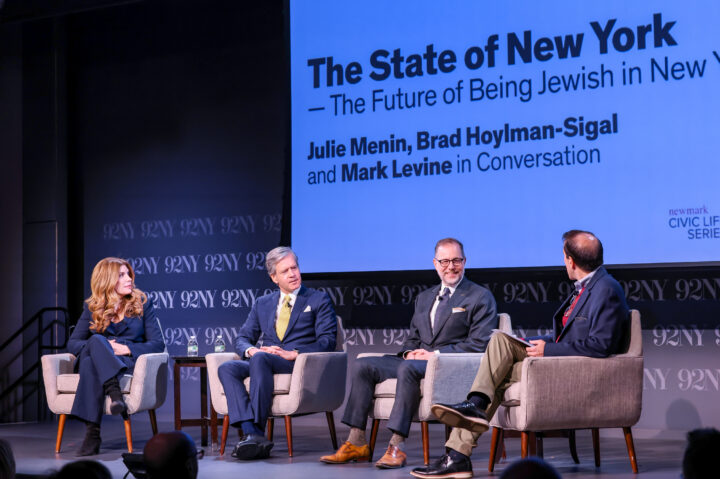
Vladimir Kolesnikov/Michael Priest Photography
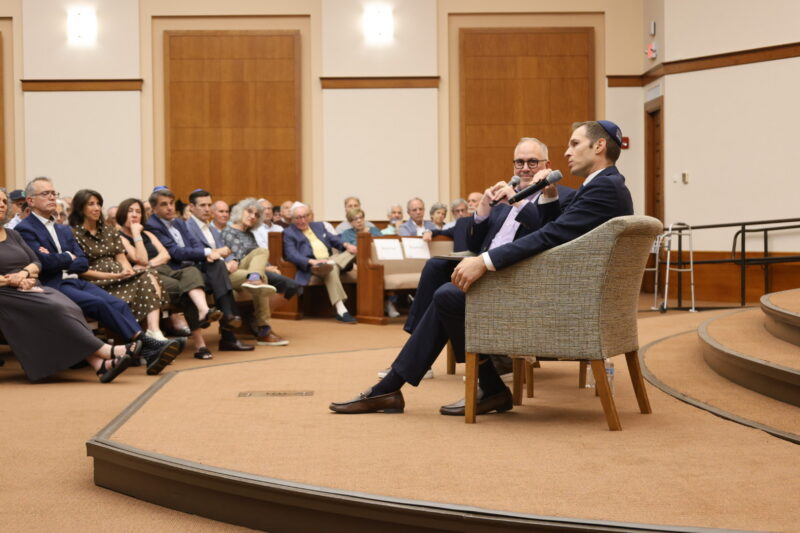
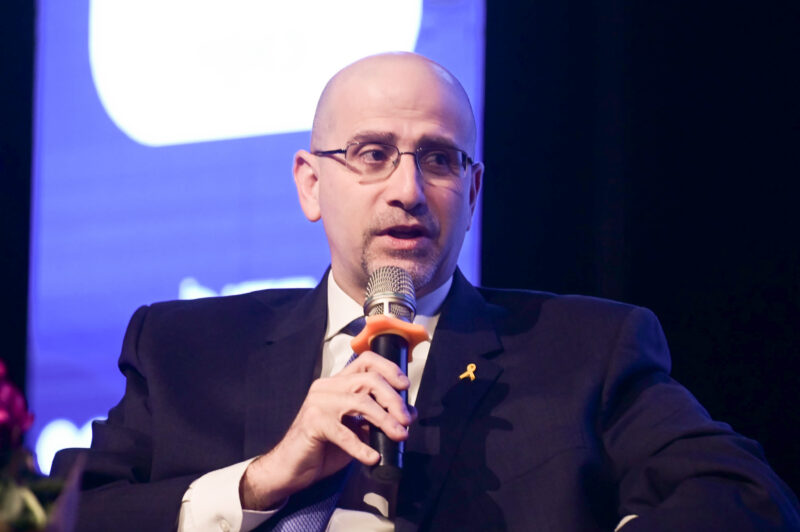
New York City Council Speaker Julie Menin, Comptroller Mark Levine and Manhattan Borough President Brad Hoylman-Sigal speak at 92NY on April 22, 2026.
New York City Council Speaker Julie Menin warned Wednesday morning that if Mayor Zohran Mamdani vetoes the council’s legislation intended to regulate protests at religious and educational sites, the city will face “more divisiveness,” calling the decision a critical test for the mayor.
The bills, which include measures to create standard NYPD policy for deploying buffer zones during protests at educational and religious facilities, face a potential veto as Mamdani has repeatedly declined to take a stand on the issue. He has acknowledged concerns against the legislation from left-wing activists and civil rights groups who have targeted synagogues and yeshivas with anti-Israel demonstrations, and has until the end of this week to veto the bills or they become law automatically.
“We need less divisiveness. I really hope — and I’ve said this to the mayor — that there is not a veto of the package of bills. That’s necessary. It will create much more division,” Menin said during a panel discussion at 92NY on “the future of being Jewish in New York,” featuring the city’s most senior Jewish elected officials: Menin, who is the first Jewish council speaker, Comptroller Mark Levine and Manhattan Borough President Brad Hoylman-Sigal.
The panel, moderated by 92NY CEO Seth Pinsky, comes as the city has experienced historic levels of antisemitism in the wake of the Oct. 7, 2023, terrorist attacks — and as Jews navigate a tense relationship with a mayor who has held hostile views towards several key communal issues. New York City has the largest population of Jews outside of Israel.
Asked by Pinsky what advice each would give to Mamdani to try to reassure the roughly 70% of the Jewish New York City electorate that did not vote for him, Hoylman-Sigal called on Mamdani to “follow the tradition of every mayor preceding him [since 1951] and visit Israel.”
He added that Mamdani already has some “really good Jewish advisors,” including Phylisa Wisdom, a progressive Jewish leader Mamdani tapped in February to run the Mayor’s Office to Combat Antisemitism. A range of Jewish Democratic politicians and advocates had lauded Wisdom’s selection, though she has alienated some Orthodox and Hasidic Jewish leaders over her work criticizing the secular education taught at yeshivas in the past.
Hoylman-Sigal’s assertion that the mayor’s heart “is in the right place” when it comes to the Jewish community was met with a chorus of “boos” from the audience.
Addressing the city’s long-standing Israel bonds investments, which Mamdani has called to end in a key source of tension for him and Levine, Levine said the investments “are not political [and] shouldn’t be political.”
“Israel bonds have never missed a payment in 70 years,” said Levine. “And by the way, we’ve had no protests about our investments in Saudi Arabia, our investments in Pakistan or China.”
All three Jewish leaders echoed the sentiment that despite a turbulent past few years, the New York City Jewish community remains resilient, and urged New Yorkers not give into the rising calls to decamp to Florida.
“Absolutely stay in New York,” said Menin. “This is not a time to lose hope. Hopefully the three of us here can embody the future of the commitment to fighting antisemitism, the commitment to supporting the Jewish community. This is a time to lean into it as opposed to shy away from it. New York is a city that has been a beacon of inclusion and tolerance; we need to make sure that it stays that way.”
“I believe the Jewish community in New York City is stronger than it’s ever been,” said Levine, who praised Mamdani’s decision to retain former Mayor Eric Adams’ NYPD commissioner, Jessica Tisch, who is Jewish and openly identifies as Zionist.
“In many synagogues, attendance is way up. Jewish New Yorkers are active in ways they haven’t been. We’ve seen new coalitions come together … This engagement gives me real hope for the future,” continued Levine.
“My wish looking forward to the next 25 years is that we see a community that fought — that didn’t move to Miami with its bad bagels — and that we kept this story going of what is really one of the most glorious Jewish communities.”
The move, which experts told JI is unlikely to be implemented, would enable the body to further target Israel by preventing the U.S. from vetoing anti-Israel resolutions
ANGELA WEISS/AFP via Getty Images
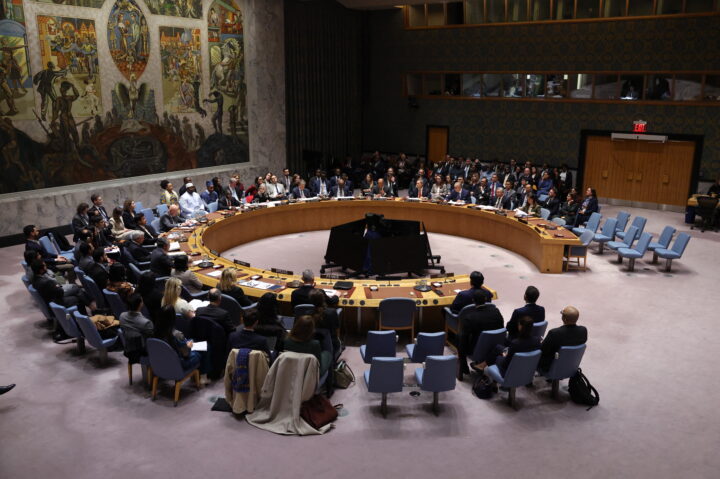
Ambassadors and representatives to the United Nations meet at the U.N. Security Council to vote on a U.S. resolution on the Gaza peace plan at the U.N. Headquarters in New York City, Nov. 17, 2025.
Members of the United Nations General Assembly are renewing their push to curb or eliminate the Security Council veto, intensifying concern over whether such a reform would make it easier for the international body to target Israel.
The “veto initiative,” adopted in 2022, requires the General Assembly to convene a debate any time a permanent member of the Security Council — the United States, United Kingdom, France, China or Russia — blocks a resolution. Since then, 17 vetoes have triggered General Assembly meetings.
During the war between Israel and Hamas, the Security Council attempted multiple times to pass resolutions calling for an “immediate” and “unconditional” ceasefire in Gaza. The United States often cast the lone veto, arguing the measures were one-sided and would ultimately benefit Hamas.
Delegates from several countries have argued that U.S. vetoes have prevented the 15-member body from taking meaningful action and that the debates prompted by the initiative have produced “little tangible impact.”
“The veto, once envisioned as a safeguard for peace, has too often become a barrier to collective action,” said Latvia’s representative during a Nov. 20 General Assembly meeting, speaking on behalf of the Baltic and Nordic states. “Time and again, we have seen the veto used or threatened to block [Security] Council action to protect civilians in Sudan and Gaza.”
This has led member states to call for abolishing the veto entirely, arguing that a single vote enables permanent members to endorse “the worst levels of cruelty and barbarity,” according to Colombia’s representative.
But many in the pro-Israel community warn that eliminating the veto would dramatically accelerate what they see as entrenched anti-Israel bias at the U.N. The General Assembly has adopted 173 resolutions against Israel and 80 against all other countries combined between 2015 and 2024. In 2025 alone, the GA is projected to pass 16 resolutions on Israel and 10 on the entire rest of the world, according to the pro-Israel watchdog group UN Watch.
If the veto were removed, the United States would no longer be able to block resolutions viewed as hostile or disproportionately focused on Israel, a shift experts said would allow such measures to advance far more easily.
“Anti-Israel bias at the United Nations is pervasive, and the U.S. veto is the only thing standing in the way of the body passing binding resolutions that would pose a danger to the Jewish state,” said David May, a senior research analyst at the Foundation for Defense of Democracies. “A U.N. Security Council without a U.S. veto would be indistinguishable from Students for Justice in Palestine or a pro-Hamas rally.”
Elliott Abrams, who served as Iran envoy in the first Trump administration, told Jewish Insider that efforts to restrict or eliminate the veto are not new and that doing so would pose serious risks for Israel.
“Any restriction accepted by the United States would endanger Israel, because the U.S. has so often been Israel’s only defender in the Security Council,” said Abrams. “With an automatic anti-Israel majority in the General Assembly, the U.S. veto is critical.”
“President Trump should adopt a very simple policy,” said Abrams. “Just say no.”
Both the U.S. and Russia defended the use of the veto and rejected any effort to alter it. Julie Rayman, the American Jewish Committee’s senior vice president for policy and political affairs, told JI that this opposition and structural realities make changes to the veto unlikely to occur.
“The veto power can only be changed through an amendment to the U.N. Charter, which requires unanimous agreement of all five permanent members,” said Rayman. “There’s no realistic chance this will happen, so the system isn’t currently at risk of being changed to allow even greater disproportionate targeting of Israel at the U.N.”
May echoed those sentiments, calling efforts to eliminate the veto “aspirational,” and adding that “the five permanent Security Council members who hold a veto are not inclined to relinquish their power.”
However, May said there are mechanisms countries could employ to “circumvent” the veto.
“For example, the Palestinian Authority’s effort to expel Israel from the United Nations came up against the U.S. veto at the Security Council,” said May. “Instead, there was talk of having the credentials of the Israeli delegation revoked, something within the remit of the General Assembly, effectively achieving an expulsion without Security Council support.”
Please log in if you already have a subscription, or subscribe to access the latest updates.
 Continue with Google
 Continue with Apple