













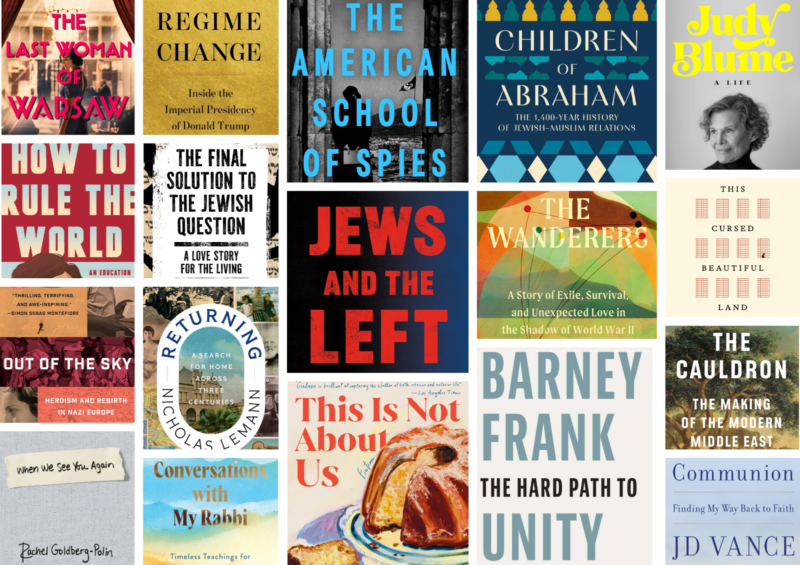










































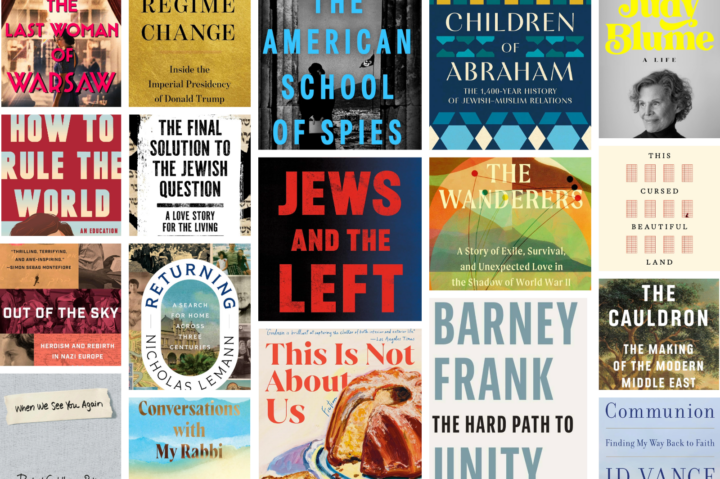
Take a look at the banner new releases we’re recommending from this spring, as well as books we’re looking forward to in the coming months


 Add JewishInsider on Google
Memorial Day Weekend marks the unofficial summer kickoff, and for observant Jews, the long weekend is made even longer with the two-day holiday of Shavuot, starting Thursday evening, which commemorates the day the Jews received the Torah at Mount Sinai.
Jews mark the day by studying at all-night learning sessions at synagogues and JCCs around the country. We know that many will also use the occasion to jump-start summer reading goals, so the Jewish Insider team has compiled our summer reading list — beginning with some banner new releases from this spring, and looking towards books coming out this summer.
RECENT RELEASES:
Allegra Goodman, This Is Not About Us (February)
The author of several novels with heavily Jewish themes, Goodman returns to Jewish characters in this novel about a decades-long feud between two Jewish sisters that started with a misunderstanding about apple cake.
Mark Oppenheimer, Judy Blume: A Life (March)
The journalist published the definitive biography of beloved YA author Judy Blume, based on more than 100 interviews with Blume and her inner circle — though she disapproved of the finished product.
Nicholas Lemann, Returning: A Search for Home Across Three Centuries (March)
The longtime New Yorker staff writer traces his family’s history from Germany to New Orleans, recounting the ways they reckoned with religion, race and belonging.
Matti Friedman, Out of the Sky: Heroism and Rebirth in Nazi Europe (March)
One of Israel’s most celebrated English-language writers tells the story of the young Jews who had made it to Mandate Palestine but chose to parachute into Nazi Europe to try to rescue their Jewish brethren — ultimately failing in their mission — and examines what motivated them.
Daniela Gerson, The Wanderers: A Story of Exile, Survival, and Unexpected Love in the Shadow of World War II (March)
The journalist recounts the story of how she and her wife discovered that decades before the two of them met, their grandparents had escaped the Nazis through Soviet Russia on the same route.
Judy Batalion, The Last Woman of Warsaw: A Novel (April)
Better known for her nonfiction work, including a 2021 bestseller about Jewish female resistance fighters in the ghettos of Poland, Judy Batalion released her debut novel about the intersecting lives of Jewish women in Warsaw in the late 1930s.
Rachel Goldberg-Polin, When We See You Again (April)
The world got to know Goldberg-Polin when she became a tireless advocate on the global stage for her son, Hersh, who was kidnapped by Hamas on Oct. 7, and killed almost a year later. Her book chronicling her grief, which was published last month, soared to the top of the best-seller list.
Theo Baker, How to Rule the World: An Education in Power at Stanford University (May)
The Stanford student, who chronicled the campus chaos of 2023-2024 with a crucial article in The Atlantic, investigates the ways that Stanford undergrads, located just miles from the tech billionaires of Silicon Valley, are seeking out power, influence and money in place of an education.
UPCOMING RELEASES:
Rabbi Eli Schlanger and Nikki Goldstein, Conversations With My Rabbi: Timeless Teachings for a Fractured World (May 26)
Three years before the rabbi was murdered in the Hanukkah terror attack at Bondi Beach in Australia last year, he got to know Goldstein after praying by her bedside as she recovered from a near-death experience that brought her to the ICU three years earlier. Goldstein, a secular Jew, and Schlanger, a Chabad rabbi, recorded their conversations about faith in the hope of writing a book together. She finished the project after Schlanger’s death.
Batya Ungar-Sargon, The Jews and the Left (June 2)
The conservative journalist examines American Jews’ historic ties to liberal politics and argues that their alliance has been fundamentally broken in the aftermath of the Oct. 7 attacks and the war in Gaza.
Marc David Baer, Children of Abraham: The 1,400-Year History of Jewish–Muslim Relations (June 9)
The professor of history at the London School of Economics and Political Science looks at the centuries of cooperation and coexistence between Jews and Muslims in the Middle East that predated the current regional conflicts.
Stephan Talty, The American School of Spies: The Archaeologists Who Fought the Nazis and Saved the Treasures of Ancient Greece (June 9)
The journalist and novelist recounts the true story of a group of American archaeologists who trained as spies during World War II in order to go undercover and protect Greek artifacts that were at risk during the war.
JD Vance, Communion: Finding My Way Back to Faith (June 16)
The vice president’s forthcoming book — his second memoir, to be published nine years and a political lifetime after the release of Hillbilly Elegy, about his childhood growing up poor in Appalachia — will discuss his connection to Christianity and his decision to convert to Catholicism.
Maggie Haberman and Jonathan Swan, Regime Change: Inside the Imperial Presidency of Donald Trump (June 23)
Two of America’s top White House reporters tell the story of the first year of President Donald Trump’s second term, and how he learned to use political power more effectively than in his first term.
Dara Horn, The Final Solution to the Jewish Question: A Love Story for the Living (Sept. 1)
Her 2021 book of essays reckoning with the curiosities of modern antisemitism, People Love Dead Jews, went about as viral as a book possibly could. She published a children’s book in 2025, but this will be her first book for adults in years. Aside from announcing its scheduled release, her publisher has not shared any information about the project.
Simon Sebag Montefiore, The Cauldron: The Making of the Modern Middle East (Sept. 8)
The British historian presents a history of the last 125 years of the modern Middle Eastern, surveying the key events and narratives — both accurate and misguided — that led to the current state of the region.
Barney Frank, The Hard Path to Unity: Why We Must Reform the Left to Rescue Democracy (Sept. 15)
The trailblazing politician served in Congress for 32 years, representing suburban Boston. The Jewish Democratic lawmaker, who was also the first openly gay member of Congress, died this week at 86. His upcoming book argues that the political left must reform itself so it does not cater to its most extreme adherents.
Evan Gershkovich, This Cursed Beautiful Land: A Russian-American Story (Sept. 29)
The Wall Street Journal journalist who spent over a year wrongly imprisoned in Russia details his harrowing experience in the Russian carceral system against the backdrop of the country’s history and culture.
An anti-Israel tech founder and far-right online subcultures are unexpectedly embracing Rabbi Shalom Landau’s Torah videos

Rabbi Shalom Landau
Facebook/Rabbi Shalom Landau
Rabbi Shalom Landau, a Satmar Hasidic leader who posts online videos offering practical, Torah-based advice, has found unlikely supporters in a prominent Jordanian-American tech founder who is outspokenly critical of Israel and within white nationalist online subcultures.
“Rabbi putting out the best self-help content on the internet rn,” tweeted Amjad Masad, the Dubai-based founder and CEO of Replit, an AI-powered platform for building, coding and deploying web applications. Masad shared one of Landau’s latest videos on Tuesday, which offers advice for dealing with abuse by quoting the Book of Jeremiah: “Cursed is a man who puts his trust in people.”
Masad has frequently smeared Israel in online posts. On Jerusalem Day last year, he accused Israelis celebrating as “go[ing] around Jerusalem hunting Palestinians to torture and abuse. Think Spanish ‘running the bull’ with all its cruelty but directed at humans. This event is supported by their government and police (and of course US taxpayer).” After Israel carried out strikes on Iran’s nuclear facilities in June, Masad called the Jewish state “the single most destabilizing force in the world.”
Landau’s approach of providing Jewish wisdom without mentioning Israel has elicited praise from male-dominated, right-wing Internet subcultures as well, where white nationalist ideology and antisemitism are typically rampant. Comments from anonymous accounts on his posts state, “say what you want about them [Jews], but they have a good track record with marriages lasting” and “Why are Christian pastors unwilling to speak this way?”
Some comments are supportive but still carry antisemitic undertones, “When a guy called rabbi shalom gives you money advice, you just listen.” Others have scrutinized Landau’s videos for sexist ideology, such as one about marriage that states, “No woman wants to speak to a husband who gets as weak as she is when she speaks to him… sure she wants empathy but the one that comes from you[r] logic not you[r] feelings.”
Landau, whose videos on marriage, responsibility and financial stability are widely circulated on X and TikTok (where he has 34 thousand followers), was condemned by some Jewish communities when — just weeks before the New York City mayoral election — he hosted then-candidate Zohran Mamdani in his Williamsburg sukkah.
The meeting was part of the mayor-elect’s bid to win over Orthodox Jewish support amid his frequent criticism of Israel. At the time, Landau defended his ties to Mamdani by saying, “We think our voices decide who wins. That’s wrong. God does. We have a mission in exile to live among the nations. Our strength in exile isn’t protest. It’s the Torah.”
The Satmar sect of Judaism, to which Landau belongs, is typically anti-Zionist, believing only the Messiah is supposed to bring about a Jewish state.
Still, Landau’s Torah videos have also inspired a prominent pro-Israel and modern Orthodox rabbi, Mark Wildes, the founder and director of Manhattan Jewish Experience.
Wildes wrote in a Dec. 2 post, “Every so often, something unexpected happens online that reveals a larger truth about who we are meant to be. Recently, a rabbi named Shalom Landau has become an unlikely voice within corners of the internet that are anything but friendly to Jews.”
“His Torah videos have received widespread praise among young men from the ‘groyper’ and ‘manosphere’ movements — subcultures laced with grievance and overt antisemitism. People who have spent years resenting Jews are suddenly listening to a Jew, a rabbi no less, teach Torah because they sense wisdom there,” continued Wildes.
“They are responding not to the endless Hasbara that Israel is ‘just like every Western democracy,’ but to Torah messages about building a life of meaning and responsibility. If we want to be a ‘light unto the nations,’ we must first reclaim our own light and resist becoming defined by whatever the algorithm rewards. We must speak from our Torah tradition, not from insecurity. When we share a message grounded in confidence rather than defensiveness, even the most unlikely audiences notice.”
“With Chanukah on the horizon, maybe that’s the beginning of understanding what it truly means to be a nation that carries light.”
OU Executive VP Rabbi Hauer unexpectedly passed of a heart attack earlier this week
Screenshot/Youtube
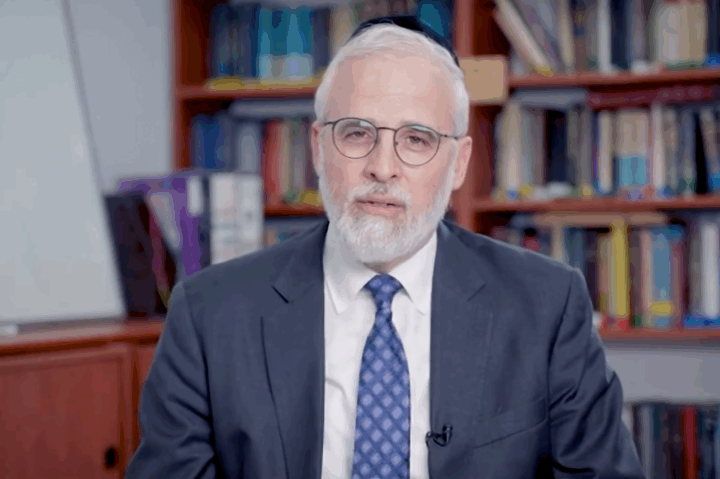
Rabbi Moshe Hauer
Rabbi Moshe Hauer, the executive vice president of the Orthodox Union, died suddenly on Monday evening after suffering a heart attack, his organization said. He was 60.
Jewish communal leaders remembered Hauer as a friend, a bridge-builder, a faithful and committed leader and a source of wise counsel.
Hauer had served in his role at the OU since May 2020, acting as the organization’s professional and rabbinic leader and primary spokesperson, as well as helping to lead the organization’s outreach to U.S. administration officials and lawmakers.
“Rabbi Hauer was a true talmid chacham, a master teacher and communicator, the voice of Torah to the Orthodox community and the voice of Orthodoxy to the world. He personified what it means to be a Torah Jew and took nothing more seriously than his role of sharing the joy of Jewish life with our community and beyond,” OU President Mitchel Aeder and Chief Operating Officer Rabbi Josh Joseph said in a joint statement.
“Rabbi Hauer’s leadership was marked by unwavering dedication, deep compassion, and a vision rooted in faith in Hashem, integrity, and love for Klal Yisrael,” Aeder and Joseph continued. “Whether through his inspiring words, thoughtful counsel, powerful advocacy, or quiet acts of kindness, Rabbi Hauer uplifted those around him and made an impact on every person he encountered.”
Prior to his role at the OU, Hauer served for more than 26 years as the lead rabbi at Bnai Jacob Shaarei Zion Congregation in Baltimore.
William Daroff, the CEO of the Conference of Presidents of Major American Jewish Organizations, told Jewish Insider he was “shattered by the sudden passing of my dear friend and partner, Rabbi Moshe Hauer.”
“We just spoke this past Friday and texted on Monday, when he was overflowing with joy at the miracle of the hostages’ freedom and the unmistakable hand of Hashem in it. Rabbi Hauer was a trusted advisor, cherished colleague, and wise counselor to me, a bridge-builder whose faith, humility, and moral clarity inspired all who knew him. His loss leaves a deep void for all who loved and learned from him,” Daroff continued.
“He was a wise and thoughtful leader for so many dimensions of the OU’s activities — That included his partnership with me in advocacy,” Nathan Diament, the OU’s executive director of public policy, told JI. “Rabbi Hauer deeply believed in the imperative for the Orthodox community to be fully and proactively engaged with the world at large — not isolated from it. And for us to work to better society by advancing Torah values. In fact, the last time I was with him in person was just a couple of weeks ago — we met with senators and senior White House officials to discuss key issues and values.”
Israeli President Isaac Herzog mourned Hauer as “a true leader and teacher in the Jewish world,” in a post on X.
“Each and every conversation I was privileged to have with him was so very meangiful [sic] and showed his warmth and kindness, and his unwavering love for Torah, Israel, Zionism, and the Jewish people,” Herzog wrote.
Despite ideological and theological differences, Hauer maintained friendships and partnerships with Jewish leaders across the ideological spectrum and rejected claims that progressive and liberal Jews were “self-hating,” telling eJewishPhilanthropy last year that he “bristle[s] and object[s]” to the canard.
Sheila Katz, the CEO of the National Council of Jewish Women, said in a Facebook post, “Some leaders shape institutions. Others shape hearts. Rabbi Moshe Hauer did both.”
“After October 7, we found ourselves advocating side by side at the Department of Education and Department of Justice, in Congress, in the White House, and in the Knesset, determined to show what Jewish unity could look like,” Katz said. “It wasn’t unity for its own sake, but unity in service of the Jewish people, to advocate together for Jewish women, for the Orthodox community, and for all of us. Him, an Orthodox male rabbi. Me, a Reform Jewish progressive woman. Together, we were an unlikely duo that came together to advocate against antisemitism, to promote safety in Israel, and for the return of the hostages.”
“I’m grateful he lived to see all the living hostages come home. But I’m heartbroken that we won’t get to be with him for all that’s next, for the rebuilding, the hope, and the unity he modeled so powerfully,” Katz continued. “All we can do is continue to build a better world with love, and with Jewish life and wisdom, to honor the memory of our dear friend, Rabbi Hauer.”
Hauer was ordained at Ner Israel in Maryland and received a graduate degree from Johns Hopkins University.
According to the OU, during his time at Bnai Jacob Shaarei Zion he “was active in local communal leadership in many areas, with an emphasis on education, children-at-risk, and social service organizations serving the Jewish community… led a leadership training program for rabbis and communal leaders, and was a founding editor of the online journal Klal Perspectives.”
eJewishPhilanthropy‘s Judah Ari Gross contributed to this report.
English translation, commentary by former U.K. chief rabbi seeks to ‘make Torah relevant to us today’
Blake Ezra Photography Ltd.
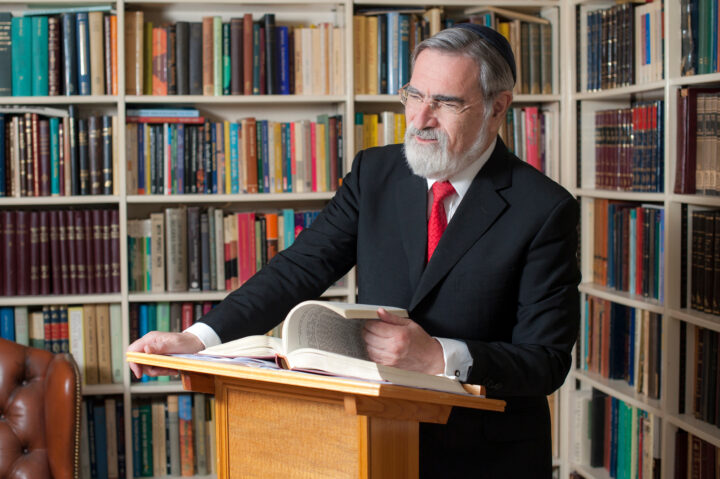
Former British Chief Rabbi Lord Jonathan Sacks
Former British Chief Rabbi Lord Jonathan Sacks was a towering figure in Jewish life whose unique blend of Torah and Western wisdom attracted adherents around the world for many years before his death in 2020.
Now, with Rosh Hashanah, the Jewish new year, approaching later this month, and the restarting of the cycle of reading the weekly Torah portion a few weeks later, Rabbi Sacks’ longtime Jerusalem-based publisher, Koren, is releasing a posthumously completed Koren Shalem Humash, with a new translation and insights to encourage deeper understanding of the Five Books of Moses.
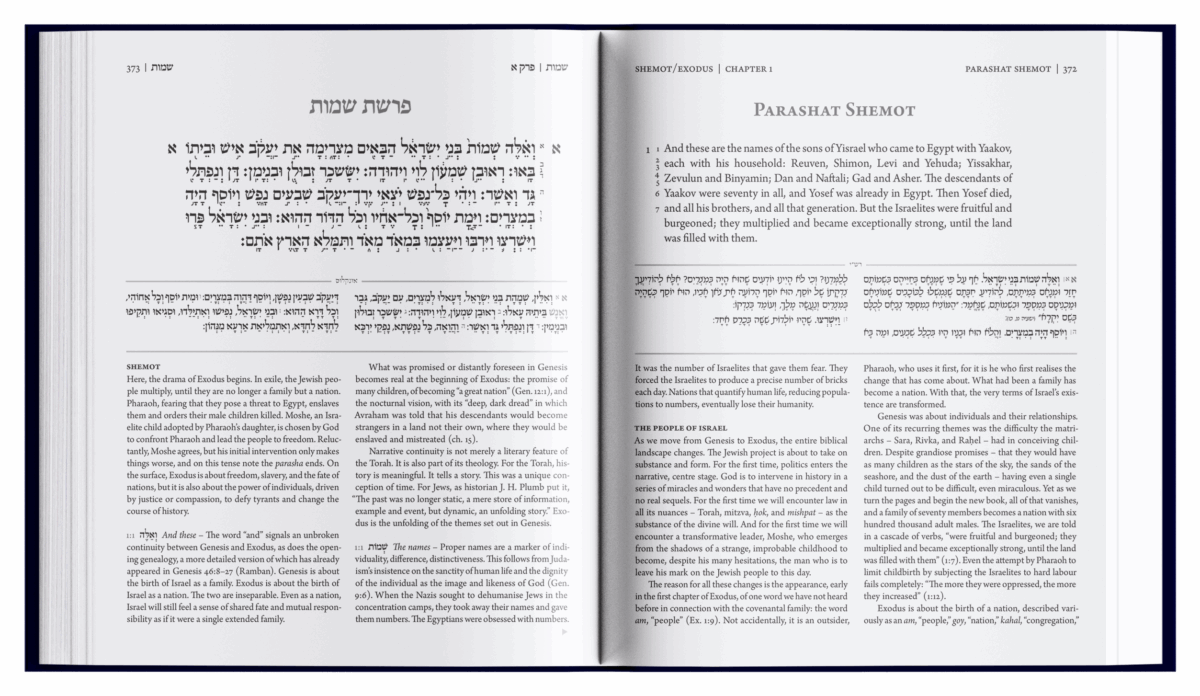
Each spread features the words of the Humash in Hebrew — written in the clear Koren font, recognizable to users of the publisher’s popular prayer books — on one side. On the other side there is a new, modern English translation that Sacks completed in 2018. Below there are two of the standard commentaries: from the 11th-century French rabbi Rashi and second-century sage Onkelos, who translated the Torah into Aramaic.
On the bottom half of the pages is Sacks’ own commentary, which he began writing before his death, after which The Rabbi Sacks Legacy continued his work based on his writings and speeches.
The story of the Koren Shalem Humash begins in 2006, Joanna Benarroch, president of The Rabbi Sacks Legacy, told Jewish Insider last week. At that time, Sacks began working on his popular series of books about the weekly Torah portion, Covenant and Conversation.
“He started writing it online every week,” Benarroch recalled. “He was the chief rabbi of the United Kingdom and the Commonwealth, based in London, but he started to build a global audience.”
Sacks’ goals for Covenant and Conversation were “to make Torah relevant to us today, so it’s not just wisdom from 2,000-3,000 years ago today, but wisdom we can also take with us. It was very important to him for us to be proud, knowledgeable Jews and to share that with the next generation … to create new leaders who were proud, knowledgeable Jews. These were the things permeating his mind when he was writing,” Benarroch said.
After Rabbi Sacks’ death, Koren brought scholars, including the rabbi’s niece, Jessica Sacks, to compile elements of Covenant and Conversation, his many other books, his BBC Radio “Thought for the Day” segments and other essays and speeches to complete Sacks’ commentary on the Humash.
“The scholars beautifully weaved his ideas from each parasha [Torah portion] into detailed commentary,” Benarroch said. “It’s his words, very carefully crafted to give a whole picture of each parasha. The ideas are woven together in a way they had never before been [presented]. You have 15 years of writing and speaking on Bereishit [Genesis] crafted in this way.”
In his Passover Haggadah, quoted in the editor’s note of the Humash, Sacks wrote that “traditional commentaries are usually close readings of individual words and phrases rather than reflections on the meaning of the whole. That is a classic Jewish response and I have not hesitated to do likewise … But it is the great themes, the overarching principles, that are often neglected or taken for granted.”
Sacks’ commentary combines both, in some places referring to specific words and phrases, and in others sharing insights on broader stories and ideas, which gives, Benarroch said, “an overview of what you can learn from the parasha. You’re coming out with a clear understanding of what it is about, with relevant ideas for today.”
Benarroch recounted recently being in synagogue and sitting near a non-Jewish visitor who was reading along to the Torah portion in English.
“I was mortified, because it was a parasha that was quite difficult, with a lot of blood and gore,” Benarroch said. “I wished at that point that the Rabbi Sacks Humash was available, because he would have given her a sense of what is going on and an understanding of the battles in the time of the Humash … He wanted people to understand the whole picture, to read it as a narrative.”
She paid tribute to Sacks’ ability to “make very complicated things accessible.”
In addition, the Humash features detailed references, such that if there is an idea a reader seeks to explore further, he or she can find the full essay, book or radio program it came from.
Benarroch worked for Sacks for 24 years, as executive director of the Office of the Chief Rabbi and then of his private office, and was key to establishing The Rabbi Sacks Legacy after his death. She said that the greatest lesson she’s taken from him is the importance of listening to and learning from one another.
“He felt active listening was absolutely imperative for all of us. We talk a lot, but we don’t listen enough,” she said. “When he was writing his Humash, he felt he was connecting to God through it, and that for us to listen to the words and the messages, we must also listen closely to one another. Judaism is a religion of listening … in terms of unity, community, being part of the Jewish people.”
The Jewish text-sharing platform has developed a prototype for applying its model globally

Homepage for Sefaria 'Democracy' Project
The Mishnah meets the American Revolution?
Sefaria, a non-profit that provides public domain access to Jewish texts and commentary, has developed a prototype of its highly praised model to bring its technology to other bodies of work — starting with the U.S. Constitution.
In addition to providing primary source material, Sefaria, founded in 2013 by Google developer Brett Lockspeiser and author Joshua Foer, maintains a user-friendly interface and software to highlight interlinking references and citations throughout Jewish scripture.
“I think we were really inspired by the shape of Torah itself. The Torah tradition has this texture and shape that the printed ‘Vilna Shas,’ the printed Talmud, really has this visual sense of,” Lockspeiser, who serves as the organization’s chief technology officer, explained to Jewish Insider.
“All along, we’ve had in the back of our heads that the software that we’re building isn’t necessarily specifically about Jewish content,” he continued. “It’s something that applies to any body of text where you have lots of voices kind of in communication and dialogue with one another.”
Sefaria, working with a grant from the Lippman Kanfer Foundation, developed a prototype of its model with texts related to the birth of American democracy. The group chose the United States Constitution as an example, partly for its robust links to other noted texts but also because the Constitution and related texts already existed in the public domain. Lockspeiser emphasized this was only an initial example, mentioning the works of Shakespeare, Greek and Roman literature, medical texts, and texts of other religions as potential future projects.
Just as with its original platform, the goal of Sefaria will remain the same: to promote learning by providing free access to primary and secondary sources. Lockspeiser said he and others on the team have already spoken to experts about the unlimited future potential.
Tamara Mann Tweel, a professor in Columbia University’s American Studies Program, spoke glowingly of Sefaria’s new direction.
“The project will benefit teachers and students across the country by allowing them to access their rich democratic inheritance and converse with the great political and literary minds who have helped build that inheritance,” Tweel told JI. ”Sefaria took the infrastructure built for our Jewish textual tradition and gave it to our democratic one.”
Currently, the prototype website — which also lists works including the Declaration of Independence, Madison’s notes from the Federal Convention, the Magna Carta and important Supreme Court decisions — appears bare-bones, especially in comparison to the complexity of its mother site.
Still, the possibilities for future development are immediately apparent. While Lockspeiser admits there remain “a million steps,” before the site is ready for mass use, the Google alum is enthusiastic about the progress.
“I think we’re being really successful right now at the initial demo moment,” he said. “You look at it and you’re just like, ‘This is interesting. This is cool. There’s something here.’ And that’s the seed of a project being successful.”
Please log in if you already have a subscription, or subscribe to access the latest updates.
 Continue with Google
 Continue with Apple