

































Ingrassia pulled himself from consideration to be head of the Office of Special Counsel after three Republican senators vowed to oppose his embattled nomination
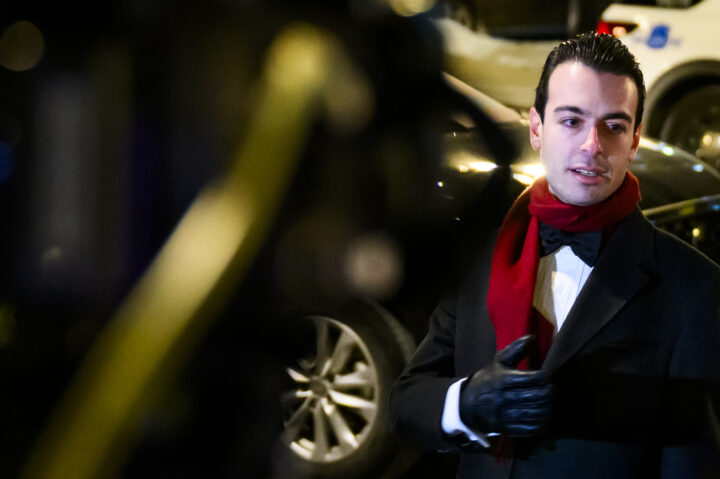
Pete Kiehart for The Washington Post via Getty Images
Paul Ingrassia, forer White House liaison to the Justice Department, left, announces the release of brothers Andrew and Matthew Valentin outside of the DC Central Detention Facility on January 20, 2025 in Washington, DC.


 Add JewishInsider on Google
Paul Ingrassia announced on Tuesday he was withdrawing his embattled nomination to lead the Office of Special Counsel amid growing GOP opposition to his recently unearthed antisemitic and racist text messages.
Ingrassia, 30, currently serves as the White House liaison for the Department of Homeland Security. Prior to that role, he briefly served as the liaison to the Department of Justice at the beginning of President Donald Trump’s second term, but was reassigned after clashing with the DOJ’s chief of staff.
“I will be withdrawing myself from Thursday’s HSGAC [Senate Homeland Security & Governmental Affairs Committee] hearing to lead the Office of Special Counsel because unfortunately I do not have enough Republican votes at this time,” Ingrassia wrote in a post on Truth Social. “I appreciate the overwhelming support that I have received throughout this process and will continue to serve President Trump and this administration to Make America Great Again!”
Trump nominated Ingrassia in late May to lead the Office of Special Counsel, which is tasked with investigating and prosecuting whistleblower claims and accusations of corruption within the federal government. He was scheduled to receive a confirmation hearing in committee on Thursday.
The nomination was initially poorly received by some Republicans on the committee due to his past incendiary comments, including antisemitic conspiracy theories posted to social media. Two GOP committee members had privately expressed concerns to the White House about Ingrassia’s candidacy in recent months, those senators told Jewish Insider on condition of anonymity.
Ingrassia’s standing plummeted further after Politico reported on Monday that he had sent text messages in a group chat of Republican operatives stating that Martin Luther King Jr. Day should be “tossed into the seventh circle of hell” and described himself as having a “Nazi streak … from time to time.”
Ingrassia wrote in the text chain that he would “never trust a chinaman or Indian,” a comment made in reference to former Republican presidential candidate Vivek Ramaswamy. Another message stated that “We need competent white men in positions of leadership … The founding fathers were wrong that all men are created equal.”
The revelation prompted immediate outcry on Capitol Hill, with Democrats reiterating their prior calls to pull Ingrassia’s nomination and Republicans publicly and privately urging the White House to do the same. Three Republicans on the Homeland Security Committee — Sens. Ron Johnson (R-WI), Rick Scott (R-FL) and James Lankford (R-OK) — told reporters that they would vote against Ingrassia’s nomination at his confirmation hearing.
Johnson said that Ingrassia’s nomination “never should’ve gotten this far” and that the White House “ought to withdraw” his name from consideration.
“I don’t plan on voting for him. I can’t imagine how anybody can be antisemitic in this country,” Scott said, later adding that he had informed the White House of his decision after the most recent text messages were published.
Asked by reporters at the Capitol on Tuesday if the White House should pull Ingrassia’s nomination, Senate Majority Leader John Thune (R-SD) replied, “I hope so. He’s not going to pass.” He responded, “Yeah,” when asked if it’d be a mistake for Ingrassia to appear before the Homeland Security Committee on Thursday.
Ingrassia also lost the backing of the Zionist Organization of America, the sole Jewish group that was supporting Ingrassia’s nomination, over the texts. The group announced on Tuesday that they were pulling their endorsement as a result of the messages.
“In this age of Jew hatred, even a hint of antisemitism can’t be tolerated,” Mort Klein, the group’s president, told the Washington Post of the decision.
At a luncheon hosted by the White House on Tuesday for GOP senators, several Republicans took part in a discussion about Ingrassia’s nomination being “dead,” according to one senator who participated in the conversation.
“He’s going to be pulled,” the senator said of Ingrassia, citing several conversations this week with the White House.
Sen. Richard Blumenthal (D-CT), who also serves on the panel, similarly predicted the White House would withdraw his nomination, saying there was no reason to force the confirmation hearing to proceed on Thursday when he had no chance of being confirmed.
“I expect it because there’s no way he’ll be confirmed. I don’t know why anyone would put him through the gauntlet of questions that I would be asking him, along with others,” Blumenthal told JI. “They should mercifully spare him the ignominy of being overwhelmingly disapproved.”
Ingrassia’s nomination was already considered controversial prior to the leak of his text messages, the result of his ties to avowed white nationalists and antisemites like Kanye West and Nick Fuentes, his record of public statements embracing conspiracy theories and his already rocky tenure in the second Trump administration, which had seen him depart from two roles due to friction with colleagues in less than a year.
Ingrassia was also the subject of an internal investigation at the Department of Homeland Security this month after a sexual harassment complaint was filed against him, though the complaint was later withdrawn and no wrongdoing was found.
Ingrassia has also been consistently critical of the U.S.-Israel relationship and has repeatedly asserted since Hamas’ Oct. 7, 2023, attacks on Israel that the United States should not provide any aid to the Jewish state.
As the Hamas attacks were still underway, Ingrassia posted on X calling illegal immigration to the U.S. “comparable to the attack on Israel.” Days later, Ingrassia wrote in a since-deleted post on the platform that the Israel-Palestine conflict was a “psyop.”
The acting Columbia University president said the comments ‘do not reflect how I feel’

JEENAH MOON/POOL/AFP via Getty Images
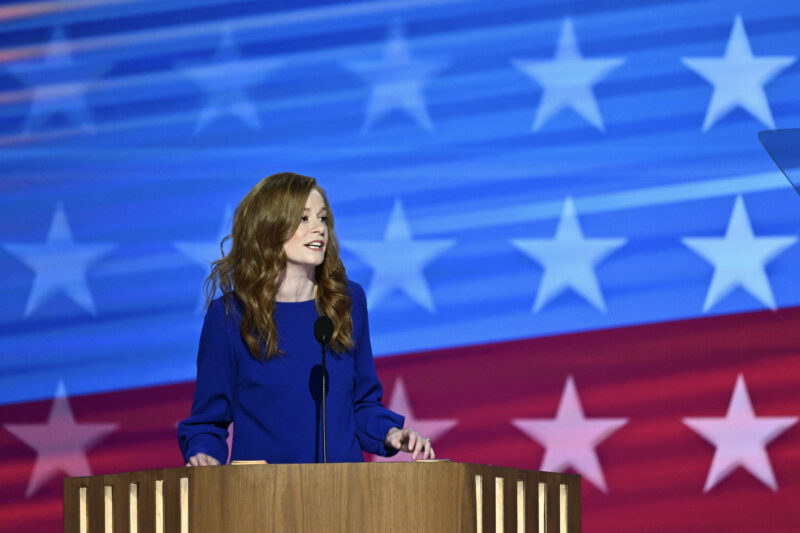
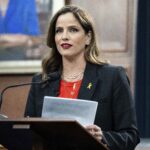
Columbia University acting President Claire Shipman speaks during the Commencement Ceremony at Columbia University in New York on May 21, 2025.
Claire Shipman, acting president of Columbia University, issued an apology to several members of the campus community for leaked text messages where she suggested that a Jewish trustee should be removed from the university’s board over her pro-Israel advocacy.
“The things I said in a moment of frustration and stress were wrong. They do not reflect how I feel,” Shipman wrote on Wednesday in a private email obtained by Jewish Insider, noting that she was addressing “some trusted groups of friends and colleagues, with whom I’ve talked regularly over the last few months.”
The text messages, from 2023 and 2024, were obtained by the House Committee on Education and Workforce and published in a letter from the committee’s chairman, Tim Walberg (R-MI), and Rep. Elise Stefanik (R-NY) to the university on Tuesday as part of the committee’s ongoing investigation into whether the school is violating Title VI of the Civil Rights Act of 1964 by allowing harassment of Jewish students.
Shipman, then co-chair of Columbia’s board of trustees, also wrote in a separate message to the board’s vice chair on Jan. 17, 2024, “We need to get somebody from the middle east [sic] or who is Arab on our board.”
Shipman said in a follow-up message days later that Shoshana Shendelman, a Jewish board member who frequently condemned campus antisemitism, had been “extraordinarily unhelpful” and said, “I just don’t think she should be on the board.” In another communication on April 22, 2024, she expressed belief that Shendelman was a “mole”.
“I have apologized directly to the person named in my texts, and I am apologizing now to you,” Shipman wrote in Wednesday’s email. “I have tremendous respect and appreciation for that board member, whose voice on behalf of Columbia’s Jewish community is critically important. I should not have written those things, and I am sorry. It was a moment of immense pressure, over a year and a half ago, as we navigated some deeply turbulent times. But that doesn’t change the fact that I made a mistake. I promise to do better.”
Shipman continued, “One thing I hope salacious headlines will not obscure—my deep commitment to fighting antisemitism and protecting our Jewish students and faculty. Board members who have worked with me for more than a decade know that antisemitism, and the culture on our campus, was a priority well before October 7th, as do colleagues at the university, and personal friends.”
She included a link to steps the university pledged to take to combat antisemitism. Shipman added that she continues to commit to “restoring our critical partnership with the federal government as quickly as possible, so that thousands of our faculty and researchers and students can get back to the essential work they do on behalf of humanity.” The Trump administration canceled approximately $400 million in grants and contracts with Columbia in March. The university has since entered into negotiations with the federal government.
The texts from Claire Shipman, published in a letter by the House Education Committee, call a Jewish board member a ‘mole’ and ‘extremely unhelpful’

Alex Wong/Getty Images
Acting Columbia University President Claire Shipman testifies before the House Committee on Education & the Workforce at Rayburn House Office Building on April 17, 2024 in Washington, DC.
Text messages obtained by the House Committee on Education and Workforce published in a letter on Tuesday revealed that Claire Shipman, acting president of Columbia University, suggested that a Jewish trustee should be removed over her pro-Israel advocacy and called for an “Arab on our board,” amid antisemitic unrest that roiled the university’s campus last year.
“We need to get somebody from the middle east [sic] or who is Arab on our board,” Shipman, then the co-chair of Columbia’s Board of Trustees, wrote in a message to the board’s vice chair on Jan. 17, 2024. “Quickly I think. Somehow.”
Shipman said in a follow-up message days later that Shoshana Shendelman, a Jewish board member who frequently condemned campus antisemitism, had been “extraordinarily unhelpful” and said, “I just don’t think she should be on the board.”
In another communication on April 22, 2024, according to the texts obtained by the committee, Wanda Greene, vice chair of the board of trustees, asked Shipman — referring to Shendelman — “do you believe that she is a mole? A fox in the henhouse?” Shipman agreed, stating, “I do.” Greene added, “I am tired of her.” Shipman agreed, “so, so tired.”
The messages were referenced in the letter, first obtained by Free Beacon, sent to Columbia on Tuesday by the committee’s chairman, Tim Walberg (R-MI), and Rep. Elise Stefanik (R-NY) as part of the committee’s ongoing investigation into whether the school is violating Title VI of the Civil Rights Act of 1964 by allowing harassment of Jewish students.
The lawmakers wrote in the letter, which was addressed to Shipman, “These exchanges raise the question of why you appeared to be in favor of removing one of the board’s most outspoken Jewish advocates at a time when Columbia students were facing a shocking level of fear and hostility.”
Columbia responded to the letter, in a statement to Free Beacon, claiming that the text messages were taken out of context.
“These communications were provided to the Committee in the fall of 2024 and reflect communications from more than a year ago,” the university said. “They are now being published out of context and reflect a particularly difficult moment in time for the University when leaders across Columbia were intensely focused on addressing significant challenges.”
Shipman, a former ABC News reporter, stepped into the role in March after interim President Katrina Armstrong’s abrupt resignation. At the time, Stefanik called the choice of Shipman “untenable.” On campus, the news of Shipman’s hiring was met with cautious optimism from pro-Israel student leaders.
Last April, Shipman testified at a congressional hearing regarding antisemitism at Columbia alongside then-Columbia President Minouche Shafik, who resigned from her post in August, and board co-chair David Greenwald. Shipman told members of the House Committee at the time that she knew Columbia had “significant and important work to do to address antisemitism and to ensure that our Jewish community is safe and welcome.”
Please log in if you already have a subscription, or subscribe to access the latest updates.
 Continue with Google
 Continue with Apple