


























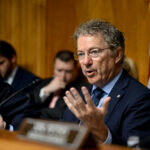
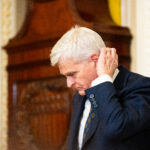
Rabbi Yosef Hamra is the brother of the last chief rabbi of Syria
X/Jewish Heritage in Syria Foundation
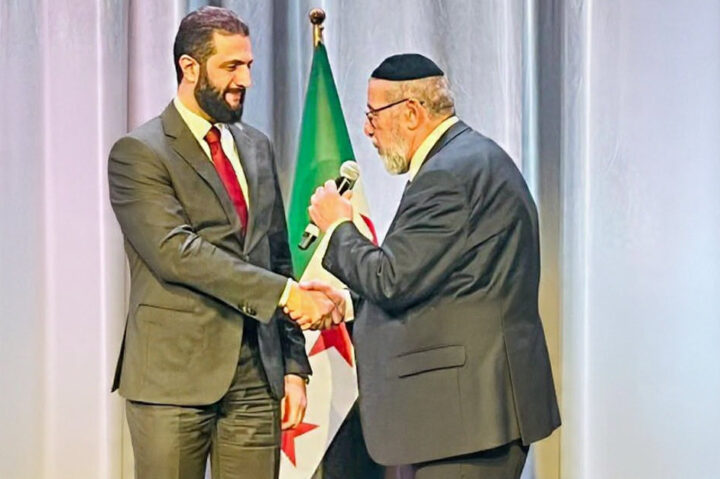
Rabbi Yosef Hamra, the brother of the last chief rabbi of Syria, shakes hands with Syrian President Ahmad al-Sharaa during a meeting between al-Sharaa and a variety of Syrian diaspora activists on Sunday, Nov. 9th, 2025.


 Add JewishInsider on Google
Rabbi Yosef Hamra, the brother of the last chief rabbi of Syria, who now lives in Brooklyn, was invited to offer a blessing to Syrian President Ahmad al-Sharaa during a meeting between al-Sharaa and a variety of Syrian diaspora activists in Washington on Sunday.
The moment produced a striking visual — a handshake between a kippah-wearing rabbi and the new president of Syria, a former Islamist terrorist affiliated with Al-Qaida and ISIS.
“Syrian Jews coming up and sitting down with the president — this is really history,” Henry Hamra, who leads the Jewish Heritage in Syria Foundation with his father, told Jewish Insider. “A lot of people from over here, from our community, were very, very emotional about it. It’s a beautiful thing, and my father was so touched and it was a great moment.”
Hamra said that al-Sharaa had thanked his father for the blessing and said that he would “love to see you again in Syria. And I think it’s happening very soon.”
He said that al-Sharaa had also, during the meeting, expressed a commitment to religious inclusion and pluralism.
“The Jewish community in Syria is exactly the same thing as every community,” Hamra said. “That’s what the president said — there’s no difference between the Syrian Jewish and the Syrian Christian and the Syrian Muslim. We’re all in this together … that’s what he was emphasizing also. And he spoke about all the religions — that everything is the same, the Kurds, the Alawites, everybody is the same.”
Forces aligned with al-Sharaa’s government have carried out massacres targeting the Alawite, Druze and other minority communities.
“We should get ourselves together and try to rebuild again [in] Syria,” Hamra said.
He said the members of Jewish Heritage in Syria also had the opportunity to discuss with both Syrian leaders and U.S. Syria envoy Tom Barrack the work they are doing to support sanctions relief and restore Jewish antiquities and religious sites in Syria. The Jewish group was invited to the meeting by the Syrian Foreign Ministry.
Hamra said that he had invited Barrack to tour Jewish sites in Syria, and Barrack expressed an interest, sharing his personal phone number with Hamra.
“I think the government [is] very, very open for us to start the process of building up, and that’s a great thing,” Hamra said.
Mouaz Moustafa, a Syrian-American activist who leads the Syrian Emergency Task Force, which has been working with JHS in advocating for the repeal of sanctions on Syria under the Caesar Act, said it was “inspirational” and moving to see the meeting between al-Sharaa and Rabbi Hamra.
Henry Hamra, who fled Syria in 1992 at age 15, also recently ran for the Syrian parliament on a platform focused on advocating for sanctions relief, though he was not successful.
Hamra reiterated to JI his desire to see the repeal of the Caesar Act sanctions.
“My goal is to help the Syrian people who suffered a lot, and I think they should have another chance to live in freedom again,” he said. Moustafa, Hamra and Hamra’s father have argued that any restoration work on Syria’s ancient synagogues will be impossible until all sanctions are lifted.
Opponents of the sanctions relief effort say that keeping the sanctions in place is necessary to maintain U.S. leverage and ensure accountability on American priorities like protecting minority groups from further attacks.
Mast, who had already expressed concerns about lifting the sanctions, met with Syrian President Ahmad al-Sharaa earlier this week, alongside other lawmakers

Kent Nishimura/Getty Images
Rep. Brian Mast (R-FL) speaks during a news conference at the U.S. Capitol on September 9, 2024 in Washington, DC.
House Foreign Affairs Committee Chair Rep. Brian Mast (R-FL) told Jewish Insider that, after his meeting with Syrian President Ahmad al-Sharaa earlier this week, he’s going to “think about” his skeptical stance on the repeal of sanctions on Syria under the Caesar Civilian Protection Act.
Mast has previously expressed concerns about lifting the sanctions, a move which the Trump administration supports.
The Senate approved the repeal of the Caesar Act as part of its draft of the 2026 National Defense Authorization Act, but the House has not yet approved similar legislation. Mast would need to approve the Senate proposal for it to be included in the final defense bill. He told The Hill last week that “discussions on Caesar Repeal are ongoing but my concerns should be obvious to anyone following the situation in Syria.”
The House Financial Services Committee voted on a bipartisan basis in July for legislation conditioning the lifting of the sanctions on Syria meeting a series of human rights, anti-corruption and counterterrorism standards.
Asked if the meeting had changed his views on the issue, Mast said that he had read at length about al-Sharaa and his background — al-Sharaa is a former terrorist commander affiliated with ISIS and Al-Qaida — prior to the meeting. Mast is a military veteran who lost his legs to a terrorist bombing in Afghanistan.
“We had a lot of conversation, good conversation,” Mast said. “I asked him very pointedly [to] explain why we’re no longer his enemy. He gave a pretty good answer. Said he was hoping for a noble future for his people, one free of radicalism, fundamentalism … and ISIS. So it was a good answer.”
Opponents of the full repeal effort argue that sanctions should remain on the books to ensure Syrian compliance with U.S. priorities and human rights, particularly in light of the massacres of religious minority groups.
A bipartisan group of lawmakers that attended the Sunday dinner called the discussion ‘open,’ ‘moving’ and ‘constructive’
Francis Chung/POLITICO via AP Images
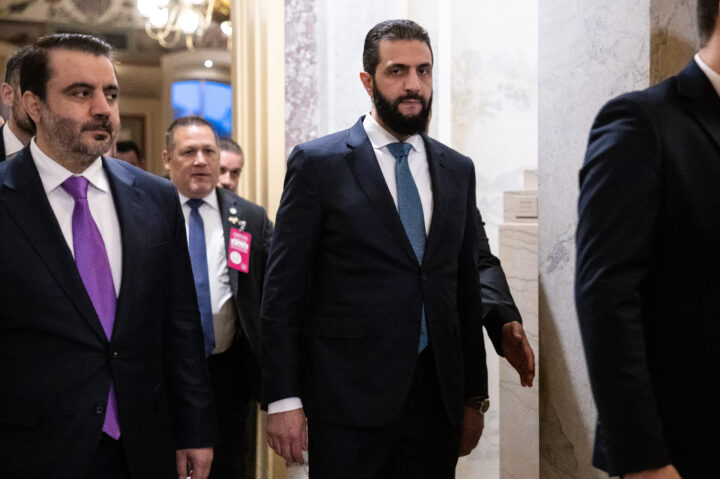
Syrian President Ahmed al-Sharaa departs a meeting in the Senate Foreign Relations Committee hearing room at the U.S. Capitol, Nov. 10, 2025.
Senators offered a positive readout from a dinner meeting with Syrian President Ahmad al-Sharaa on Sunday evening prior to al-Sharaa’s Monday summit at the White House with President Donald Trump.
Sen. Markwayne Mullin (R-OK) told Jewish Insider that al-Sharaa was “very charismatic” and “had a very open conversation” about his “checkered past” with senators. “I found it to be straightforward. I thought his answers were what we needed to hear, but I think he honestly believed it too,” Mullin said of the dinner.
“I was with him in Damascus in August. I led the first delegation there with [Rep.] Jason Smith (R-MO), [Rep.] Jimmy Panetta (D-CA) and [Sen.] Joni Ernst (R-IA). This was kind of more of the same, just building on that,” Mullin told JI. “When we talked in August, there were some issues that he brought up with sanctions towards the Assad regime that we need to work on. I’ve already been working on that, so we wanted to give him an update on it.”
The Oklahoma Republican said progress was being made on lifting the sanctions, something he attributed to the fact that the U.S. wants the al-Sharaa regime to “be successful.”
“He may not fit the mold of what you’d want as a leader in Syria. Actually, if you look at it, he’s probably what needs to be in Syria right now, because they’ve been at war for so long,” Mullin said. “As I told him, it’s trust — but verify. And so far, he’s making all the right moves. He’s trying to actually formalize relationships with Israel, that’s huge for that region. So, as he continues to move down this path, we want to continue to help him be successful.”
Sen. Elissa Slotkin (D-MI) told JI that, as a longtime Middle East and counterterrorism official, “it was quite a change to be sitting across the table from someone a decade ago I may have looked at in a very different light. But he was very impressive.”
She said that Michigan has a large Syrian-American community that supports efforts to lift sanctions and reopen Syria to the world, “so it was actually in some parts, even quite moving.” Slotkin said she also supports lifting sanctions to “do what I can to give them a shot,” and added that she wants to visit Syria.
“There were a number of people at the dinner, Democrats and Republicans, who have former service in the global war on terror,” Slotkin continued. “There was something really almost emotional about sitting across the table from someone who years ago would have been an adversary who now seems like he’s trying to really make Syria work. It was quite moving.”
Sen. Chris Coons (D-DE) echoed his colleagues’ comments about wanting to see al-Sharaa be successful in ushering Syria into a peaceful era.
“We need Syria to succeed. We want Syria to succeed. Peace between Syria and Israel is absolutely essential. Respect and support for the Syrian Democratic Forces is essential,” Coons told JI, referring to the Kurdish-led group that has been a key U.S. ally inside Syria.
The Delaware senator said that the Sunday evening discussion “was broadly a constructive conversation. For some of the members who were present, it was their first time meeting him. For most of us, it was our second or third conversation with him.”
“Having a pathway towards repealing the state sponsor of terrorism designation and repealing or downgrading the Caesar sanctions were key asks of his, and I believe the NDAA has a Risch-Shaheen provision that repeals the Caesar sanctions,” Coons added.
Sen. Richard Blumenthal (D-CT) called the meeting “encouraging and positive.”
“I think that the relationship with Israel is still challenging,” Blumenthal told JI. “I asked him very specifically about it, but on the whole, I think it’s a new chapter for the region that could be extremely promising.”
Ernst, who also attended the dinner, described it in a statement as “frank and constructive,” praising Trump for engaging with al-Sharaa.
“Today’s visit is an important step toward building trust, fostering dialogue, and uniting Syria’s diverse ethnic and religious communities,” Ernst said. “Under President Trump’s leadership, there is a real opportunity to advance peace in the Middle East and make the vision of a more stable and prosperous world a reality.”
Other lawmakers who attended the dinner were Reps. Brian Mast (R-FL), Marlin Stutzman (R-TN), Joe Wilson (R-SC) and Abe Hamadeh (R-AZ). Mast, according to Politico, was not planning to attend the meeting but happened to be at the same hotel where the meeting was occurring and was asked to join.
He offered a more tepid readout than many of the other attendees.
Mast did not issue any support for sanctions relief for Syria; the congressman is seen as a key holdout for the move
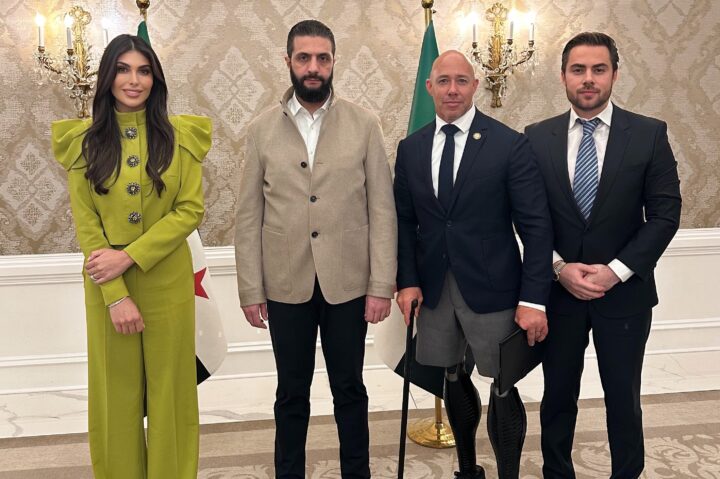
Jasmine Naamou and Tarek Naemo with Syrian President Ahmad al-Sharaa and Rep. Brian Mast (R-FL) (courtesy)
Rep. Brian Mast (R-FL) met on Sunday with Syrian President Ahmed al-Sharaa, who is in Washington for a meeting with President Donald Trump. Mast said he confronted al-Sharaa over his terrorist past.
“We had a long and serious conversation about how to build a future for the people of Syria free of war, ISIS, and extremism,” Mast said in a statement.
Mast is an Army veteran who lost both legs while serving as an explosive ordinance disposal technician in Afghanistan in 2010. Al-Sharaa is a former commander in ISIS and Al-Qaida and later in a Syrian splinter group.
“He and I are two former soldiers and two former enemies. I asked him directly ‘Why we are no longer enemies?’” Mast continued. “His response was that he wishes to ‘liberate from the past and have a noble pursuit for his people and his country and to be a great ally to the United States of America.’”
Mast, a Trump ally, concluded, “Today, he will meet with President Trump and officially join the Global Coalition to Defeat ISIS.”
Notably, Mast’s statement is absent any direct praise for al-Sharaa or his efforts, or any commitment to supporting sanctions relief for the Syrian regime, which Trump has encouraged Congress to enact.
Some Syrian diaspora activists have targeted Mast, who chairs the House Foreign Affairs Committee, in recent days, describing him as the largest obstacle to the repeal of human rights sanctions on Syria under the Caesar Act.
Meanwhile, Mast is facing criticism from some conservatives for sitting down with al-Sharaa.
Far-right influencer Laura Loomer, who has a long history of anti-Muslim activism and is an ally of Trump as well, said she was “really stunned” by the two meeting.
“Imagine getting your legs blown off by Muslim terrorists and then posing for a photo with an Islamic terrorist,” Loomer said on X. “How many of @RepBrianMast’s fellow brothers and sisters in uniform were killed by Islamic terrorists like Julani?”
Loomer has also criticized the Trump administration for welcoming al-Sharaa to the White House.
Please log in if you already have a subscription, or subscribe to access the latest updates.
 Continue with Google
 Continue with Apple