


























While Israel did not have intelligence pointing specifically to Sunday’s attack, it had provided information to Canberra about threats to the Australian Jewish community
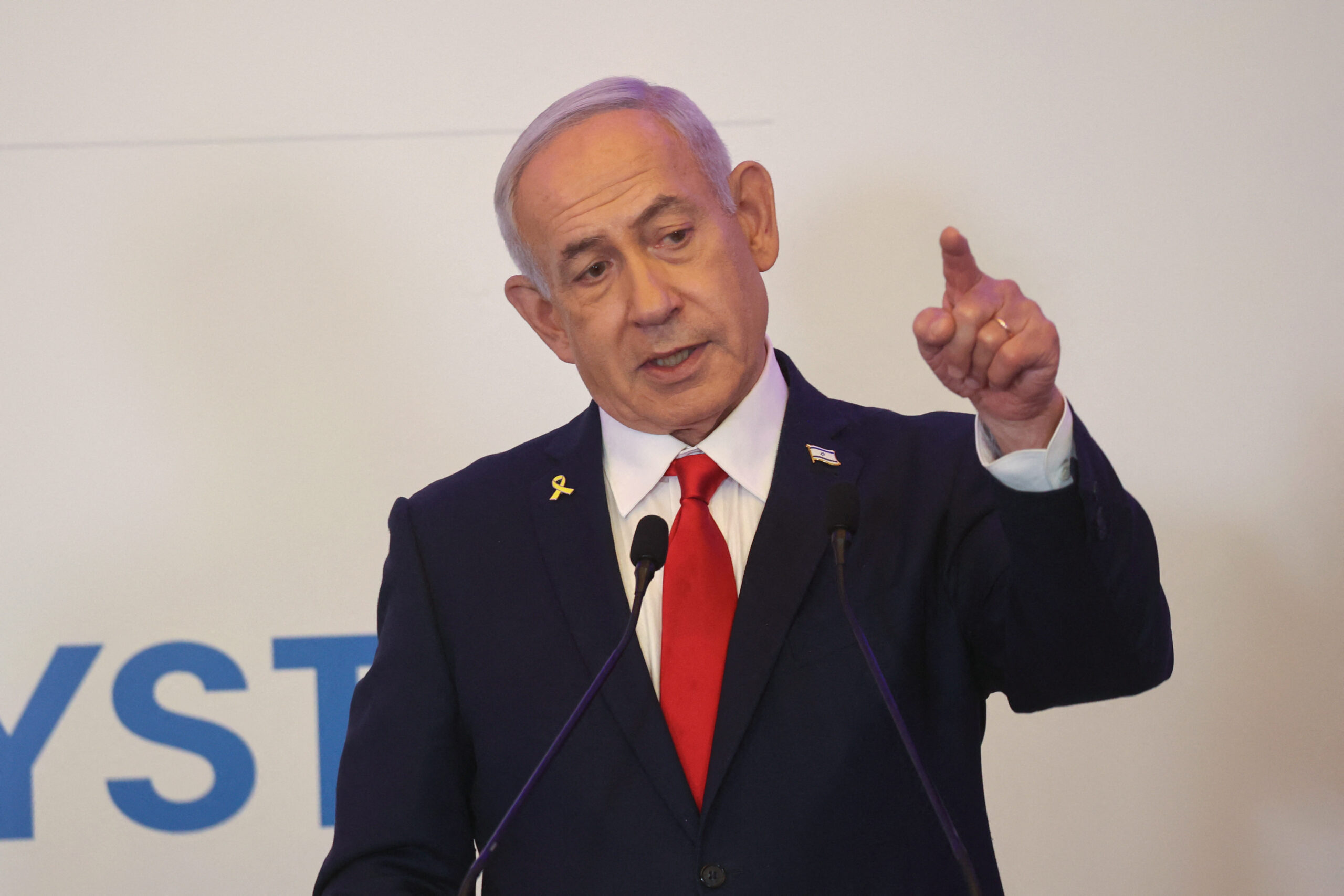
GIL COHEN-MAGEN/AFP via Getty Images
Israel's Prime Minister Benjamin Netanyahu speaks during an event at the Waldorf Astoria Hotel in Jerusalem on July 27, 2025.


 Add JewishInsider on Google
In the wake of the deadly terrorist attack in Sydney, Australia, on Sunday in which 15 people were killed, Israel is imploring Western governments to heed its warnings about the potential for violent acts of antisemitism.
In a video statement on Tuesday, Israeli Prime Minister Benjamin Netanyahu said, “I demand that Western governments do what is necessary to fight antisemitism and provide the required safety and security for Jewish communities worldwide. They would be well-advised to heed our warnings. I demand action from them now.”
One of the recurring themes in Israeli officials’ statements after the attack on Bondi Beach, following condolences to the community, was “we told you so.” While Israel did not have intelligence pointing specifically to Sunday’s attack, it had provided information to Canberra about threats to the Australian Jewish community.
In his initial public statement following the attack, Netanyahu said, “Four months ago, I wrote a letter to the prime minister of Australia. I told him: ‘Your policy encourages terrorism. It encourages antisemitism. You call for a Palestinian state, and you are essentially giving a prize to Hamas for the terrible massacre they carried out on Oct. 7. You are legitimizing all these rioters and you are not lifting a finger to eliminate these terror hotspots. This will lead to more murders.’ [Prime Minister Anthony Albanese] did nothing.”
Israeli Foreign Minister Gideon Sa’ar said that “the Australian government, which received countless warning signs, must come to its senses.” President Isaac Herzog recalled that Israel “repeat[ed] our alerts time and again to the Australian government to seek action and fight against the enormous wave of antisemitism which is plaguing Australian society.”
American lawmakers and Jewish leaders also emphasized that Canberra had been repeatedly warned about a rise in violent threats to the local Jewish community.
In August, Netanyahu said that “history will remember Albanese for what he is: A weak politician who betrayed Israel and abandoned Australia’s Jews.”
At the time, the post seemed to be a response to Australia’s plan to recognize a Palestinian state. However, it was harsher and more personal than Netanyahu’s statements about the 10 other countries that did the same.
Days later, Australia expelled Iran’s ambassador, saying that intelligence services found Tehran was linked to arson attacks on a kosher cafe in Sydney and a synagogue in Melbourne in 2024. That intelligence reportedly came from Israel and included warnings that Iran was plotting more attacks.
Mark Regev, chair of the Abba Eban Institute for Diplomacy and Foreign Relations at Reichman University and former diplomatic advisor to Netanyahu, who was born and grew up in Australia, told Jewish Insider that “it’s clear that despite the bad political working relationship between the two governments, at least the channel between security services was working well. As a result of the information received in Australia, that they verified themselves, they took a stand against the Iranians.”
Michal Cotler-Wunsh, CEO of the International Legal Forum and Israel’s former special envoy for combating antisemitism, told JI that she has met with former and current chiefs of police in Canberra, and found them to be “well aware” that, quoting former British Chief Rabbi Jonathan Sacks, “antisemitism is the world’s most reliable early warning sign of a major threat to freedom, humanity and the dignity of difference.”
Regev said that usually, when Israel has reason to believe a Jewish community is in danger, it “expresses concern and talks to the relevant government.”
“Israel sees itself as the homeland of all Jewish people, so when Jews are under threat, it raises its voice,” he said.
Generally, “it is accepted that Israel has a say. Everyone understands it,” Regev said. “It’s not an accident that [Australian Foreign Minister] Penny Wong so quickly [after the attack] had a phone call with Sa’ar. That Israel has standing with Jews who are not Israeli citizens is commonly accepted in many parts of the world.”
There is little Israel can do beyond relaying warnings and intelligence, Regev said: “The Mossad can talk to local intelligence and give them information, and we can informally advise the Jewish community on how to protect synagogues, Jewish day schools and public events.”
“Ultimately, the job of protecting the Jewish community is the government” of the country in which the community lives, he added. “Israel is not in charge of law and order in Australia; that’s the Australian government.”
“Aside from saying ‘you have to do a better job,’ I’m not sure what else we can do,” Regev said.
Cotler-Wunsh argued on this week’s episode of the Misgav Mideast Horizons Podcast that Israel can be doing much more to combat antisemitism around the world. She resigned from her position as special envoy earlier this year in part because it remained voluntary and with little to no funding or ability to set policy. (JI’s Lahav Harkov cohosts the Misgav Mideast Horizons Podcast.)
“There needs to be some sort of authority, because it seems that there is no collaboration. … As Israel’s special envoy for combating antisemitism, different from many of my counterparts in the rest of the world, in the U.S., in Canada … I was not privy to the conversations that the security [establishment] was having, and I would say that is another testament to the lack of understanding of how severe an existential threat antisemitism is as both a symptom and a weapon in this eighth front of a raging war,” Cotler-Wunsh said.
“In no other war front would we say we have no strategy. We are just reacting,” Cotler-Wunsh lamented.
Jeremy Leibler, president of the Zionist Federation of Australia, told JI that the way Israeli leadership responded to the deadly terrorist attack did not take into consideration the particular concerns of Diaspora Jewry, and that their statements “go to the heart of Diaspora Jewry’s relationship with Israel and historic allegations of loyalties.”
Netanyahu and Sa’ar’s “immediate reaction is to attack the Australian government after this horrific terrorist attack for failing the Jewish community in relation to antisemitism … and I don’t disagree, but their first reaction should have been to convey condolences to the Australian government and the people of Australia,” he said.
“This is the greatest mass-casualty event [in Australia] since [1996] … This is an attack on Australia,” Leibler said. “It’s important to keep in mind, because the message you send otherwise is that the Jewish community is a fifth column. We’re not. We are passionately Zionist and that is completely consistent with being passionate Australians.”
“I don’t think people thought deeply about that, and it’s an important point,” Leibler added, saying that it may be a result of “politics in Israel [being] globally tough” and lacking “the same level of decency in the way people interact that perhaps there once was, and that does come out in the way some of the reactions were communicated.”
Regev recalled that when he was Israeli ambassador to the U.K. from 2016 to 2020, “the British Jewish community had nothing but praise for the seriousness with which [the government] took the safety of the Jewish community, and there were serious threats.”
This week, the police forces of London and Manchester said they would arrest people who chanted “globalize the intifada” in light of the Sydney attack.
“The Australian Jewish community is not in the same place in the way they look at the Australian government. … Jews were seen as whingers, overstating the threat, but obviously they weren’t,” he said.
“The general message [from Israel] is that Australia is not taking these things seriously enough,” Regev added. “What will [Canberra] do following this event? They say all of the right things, but are they taking steps?”
Leibler said that Albanese’s government has “absolutely, there is no doubt, failed since Oct. 7 to thwart the antisemitism that has exploded. They bear responsibility for an environment that has allowed antisemitism to thrive.”
He emphasized that “from a basic moral perspective, it is important to acknowledge the people responsible are the perpetrators and those who inspired, educated and financed them.”
“Had this government known about this attack, they would have tried to prevent it, but they are clearly not equipped to deal with it, and the response so far has been inadequate,” he said.
Leibler called on Australia to adopt its antisemitism envoy’s recommendations, made in July, and to acknowledge that the weekly anti-Israel protests on the streets have “crossed the line from criticism of Israel to full-blown antisemitism. … Ninety percent of the Jewish community has been demonized.” At the same time, he acknowledged that the government has increased funding for security Jewish sites and introduced hate speech laws.
“What they have not done is come to the defense of Israel’s legitimacy and model how one can criticize Israel’s policies of the day but vehemently come to its defense,” he said. “The Jewish community maybe would have disagreed with policy shifts, like recognition [of a Palestinian state] and changing [U.N.] voting patterns, but it wouldn’t have resulted in the same sense of isolation and demonization.”
Netanyahu said on Sunday that Jerusalem had previously warned Australia’s PM that Palestinian statehood recognition endangered Jews in the country

Kevin Dietsch/Getty Images
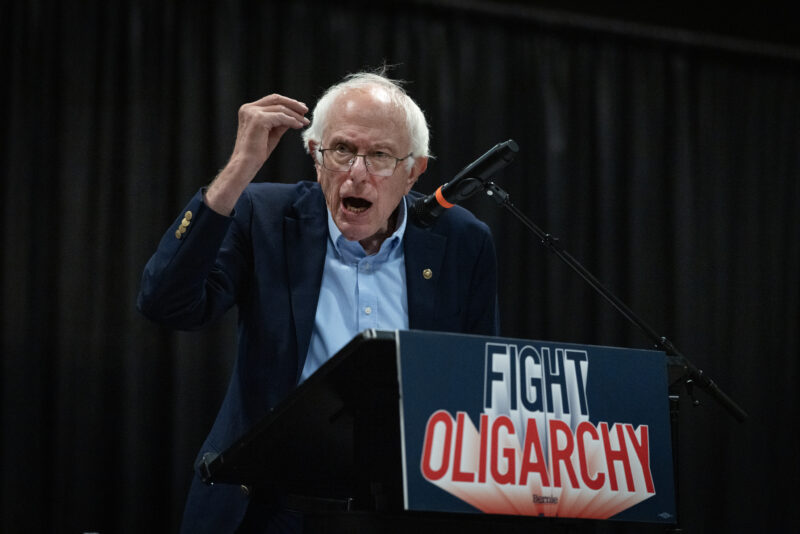
Sen. Bernie Sanders (I-VT), joined by fellow senator Sen. Jeff Merkley (D-OR) (R), speaks at a news conference on restricting arms sales to Israel at the U.S. Capitol on November 19, 2024 in Washington, DC.
Sen. Bernie Sanders (I-VT) criticized Israeli Prime Minister Benjamin Netanyahu on Tuesday, after Netanyahu linked the terror attack in which 15 people were killed at a Hanukkah celebration in Sydney, Australia, to Canberra’s support for a Palestinian state.
Netanyahu highlighted in a speech on Sunday that he had warned Australian Prime Minister Anthony Albanese that Canberra’s recognition of a Palestinian state was fueling antisemitism and endangering Australian Jews. Netanyahu further accused Albanese of failing to take action against antisemitism.
Sanders issued a statement in response on Tuesday: “No, Mr. Netanyahu. Speaking out on behalf of the Palestinian people is not antisemitic. Opposing the disgraceful policies of your extremist government is not antisemitic. Condemning your genocidal war, which has killed more than 70,000 people — mostly women and children — is not antisemitic. Demanding that your government stop bombing hospitals and starving children is not antisemitic.”
He said that “we must continue to oppose antisemitism and all forms of racism and bigotry. At the same time, we must demand a world in which international law and human rights are respected by all governments, without exception.”
Sanders opted against signing onto a joint statement issued Monday by Jewish Senate Democrats condemning the Sydney attack. Asked about his decision not to join the collective statement from Jewish Senate Democrats, a Sanders spokesperson pointed JI to Sanders’ comment on Sunday mourning the attack, in which the Vermont senator called antisemitism “a disgusting and cowardly ideology” that is “growing worldwide” and added, “we must be equally committed to fighting all forms of” bigotry.
For the American Jewish community, the prospects for much-needed help from the federal government in the form of additional Nonprofit Security Grant Program funding remain unclear
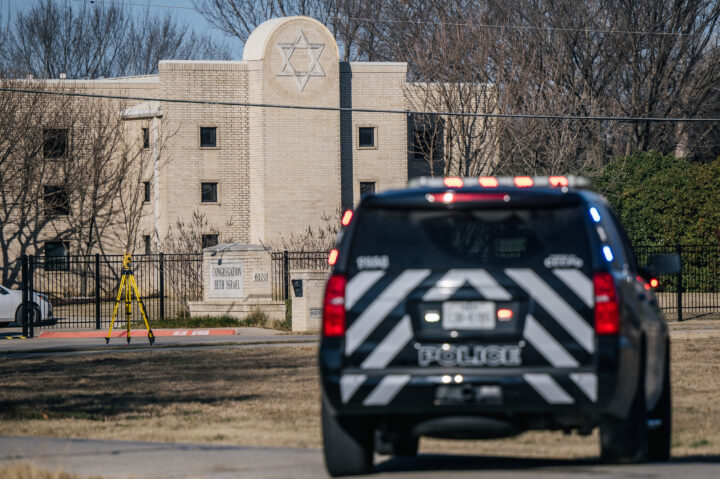
Brandon Bell/Getty Images
A law enforcement vehicle sits near the Congregation Beth Israel synagogue on January 16, 2022 in Colleyville, Texas.
The massacre in which 15 people were killed at a Hanukkah celebration at Bondi Beach in Sydney, Australia, on Sunday has once again brought the Jewish community’s security vulnerabilities into stark focus.
But for the American Jewish community, the prospects for much-needed help from the federal government in the form of additional Nonprofit Security Grant Program funding remain unclear.
The Senate Appropriations Committee’s homeland security subcommittee still hasn’t released a draft bill for 2026, greatly increasing the chances of a full-year continuing resolution that would keep funding for the program flat, at $274.5 million, a level that advocates and proponents on the Hill and Jewish groups say is severely insufficient. The House has passed its own version of the bill with $335 million in funding for the program.
Eric Fingerhut, the CEO of the Jewish Federations of North America, told JI, “The events in Australia and California these past days are terrible reminders of the violent antisemitism Jewish communities face. We’ve worked to ensure that every Federation community has a professional security program and director, but at the end of the day it is the government’s responsibility to keep its citizens safe from terrorism, and that’s why it is critical to both ensure that the Nonprofit Security Grant Program is fully funded and not allowed to lapse.”
Multiple lawmakers on the committee and those who follow the NSGP funding process closely said they have little clarity on the state of play on the funding bill, including subcommittee ranking member Sen. Chris Murphy (D-CT) and Sen. James Lankford (R-OK), a co-chair of the Senate antisemitism task force.
Sen. John Kennedy (R-LA), who serves on the homeland security subcommittee, told JI that a full-year continuing resolution is “a real possibility” at present, noting that the legislation “is always tough to put together.”
But Kennedy said there are other ways to boost funding for the grant program. “There’s no reason we can’t do that [add more money for NSGP] if we end up with an omnibus for the remainder of the bills that don’t pass. But every day that goes by that we don’t do something on [Appropriations], an omnibus or CR looks more and more likely,” Kennedy told JI.
Government funding runs out again at the end of January, so lawmakers will need to put together a plan quickly on how they plan to proceed when they return from the holidays.
Grant funding allocations for this year also remain pending — the administration announced applications months ago, but lawmakers have repeatedly raised concerns about unclear timelines and a failure by the Department of Homeland Security to conduct statutorily required outreach programs.
Lankford told JI, “I’ve been calling all year” for the funding to be disbursed, but indicated he hasn’t heard any updates.
Looking into next year, the agenda for combating antisemitism on Capitol Hill also remains unclear. The momentum from Jewish communal institutions and lawmakers that in 2024 drove a push for the Antisemitism Awareness Act has largely died down. It’s been months since the last hearing on antisemitism — once a regular occurrence after Oct. 7, 2023. The volume of legislation introduced and congressional letters on the issue has also seemed to flag.
It’s still early, but there’s little sign that the events of this weekend are fundamentally altering the inertia that seems to have set in on antisemitism policy. Which raises the question: what can?
Please log in if you already have a subscription, or subscribe to access the latest updates.
 Continue with Google
 Continue with Apple