





















The move marks the latest crackdown from the White House against Muslim Brotherhood affiliates
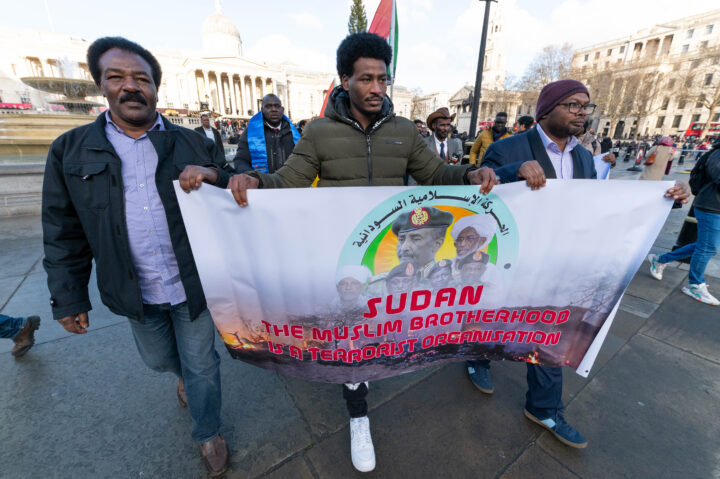
Andrea Domeniconi/SOPA Images/LightRocket via Getty Images
Man hold a banner reading "The Muslim Brotherhood is a terrorist organization" during a Sudanese rally in Trafalgar Square on Dec. 20, 2025.


 Add JewishInsider on Google
On Monday, the Trump administration moved to designate the Sudanese Muslim Brotherhood (SMB) as a Specially Designated Global Terrorist (SDGT) entity and announced plans to impose a Foreign Terrorist Organization (FTO) designation on March 16.
“The Sudanese Muslim Brotherhood uses unrestrained violence against civilians to undermine efforts to resolve the conflict in Sudan and advance its violent Islamist ideology,” Secretary of State Marco Rubio said in a press release. “The United States will use all available tools to deprive the Iranian regime and Muslim Brotherhood chapters of the resources to engage in or support terrorism.”
The SMB is composed of the Sudanese Islamic Movement and its armed wing, the al-Baraa Bin Malik Brigade (BBMB). The Muslim Brotherhood has maintained a significant presence in Sudan since the 1940s and has played a role in the country’s ongoing civil war between the Sudanese Armed Forces (SAF) — backed by Iran, Russia, Egypt and Turkey — and the Rapid Support Forces, which have reportedly received support from the United Arab Emirates.
Experts have previously told Jewish Insider that the SAF is heavily influenced by the SMB, working alongside several Islamist militias and receiving attack drones from Iran’s Islamic Revolutionary Guard Corps (IRGC), which has been designated as a terrorist organization by both the U.S. and the European Union. The SMB has contributed roughly 20,000 fighters to the conflict, with many receiving “training and other support” from the IRGC, according to the State Department.
An alleged Muslim Brotherhood leader in the Sudanese Armed Forces was also caught on video last week asserting that the group is ready to defend Iran amid the ongoing conflict between Tehran and the U.S. and Israel. The leader suggested that the group would send battalions to fight alongside Iran, according to Sky News Arabia.
“As the world’s leading state sponsor of terrorism, the Iranian regime has financed and directed malign activities globally through its IRGC,” Rubio said in the statement, adding that the SMB has also “conducted mass executions of civilians.”
The designation marks the Trump administration’s latest crackdown on Muslim Brotherhood affiliates and represents a notable policy step into the Sudan conflict. In January, the administration designated three Muslim Brotherhood branches in Egypt, Lebanon and Jordan as SDGT entities, with the State Department citing their provision of “material support to Hamas.”
During an appearance on the ‘On The Record’ podcast, Sen. Lindsey Graham urges Gulf nations to prioritize regional stability and make tough choices on Iran
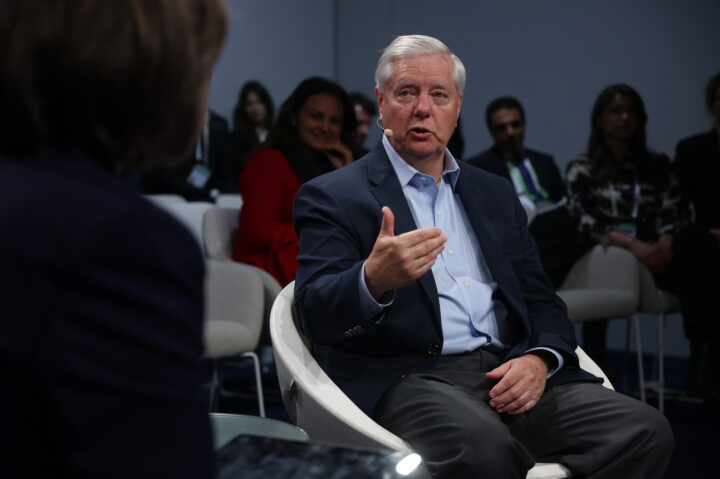
Sean Gallup/Getty Images
Sen. Lindsey Graham (R-SC) speaks at the 62nd Munich Security Conference on February 13, 2026 in Munich, Germany.
Sen. Lindsey Graham (R-SC) on Thursday rejected the suggestion from some in the Arab world that the deaths of civilians in Gaza does not align with Christian values. Graham made the comments during an appearance on an episode of the “On The Record” podcast with Hadley Gamble, while discussing how Israel’s war in Gaza had impacted regional stability in the Mideast and delayed normalization efforts with the Saudis.
“I just don’t buy that at all, because what did we do in World War II? Did we think for one minute about starving the Germans? Did we bomb every city into smitherreens?” Asked if that meant he was comparing Israel’s response to Hamas’ Oct. 7, 2023, attacks on the Jewish state to how the U.S. responded in World War II, Graham responded affirmatively.
“This is an absolute, existential threat to the Jewish people. What happened on October the 7th was 1,200 people were slaughtered, raped and murdered, and filmed by radical Islamists who would kill every Jew if they could.”
Gamble then pressed Graham on Israel “flattening Gaza,” which the South Carolina senator said he took no issue with.
“Just flatten it. We flattened Berlin. We flattened Tokyo,” Graham said. “Were we wrong to drop an atomic bomb to end the Japanese reign of terror? Were we? In my view, if I were Israel, I would have probably done it the same way. Without military victory, there is no hope of breaking radicalism. We flattened Germany. We flattened Japan.”
“It’s a TV war. We didn’t have TV in World War II. The behavior of the United States was to pursue total destruction of the enemy. That was our behavior. Take Tokyo and Berlin,” he added. “Those people who are trying to say this is just another conflict, it’s not another conflict. It’s existential to the Jewish state.”
Graham, who is in the Middle East for meetings with Israeli, Emirati and Saudi officials, also criticized Saudi Arabia for “attacking the United Arab Emirates pretty viciously for being in the Abraham Accords” and questioned assertions that the kingdom’s ongoing dispute with the Emiratis was solely based on differences in Sudan and Yemen.
“Saudi Arabia is now moving backward. They’re attacking the United Arab Emirates pretty viciously for being in the Abraham Accords,” Graham said. “There is no good reason for this. You can have disputes about Sudan and Yemen, but they’re basically declaring war.”
Asked if he believed the dispute “is all about Israel,” Graham replied: “I don’t know what this is about. I know the consequences. [Mohammed bin Zayed], the president of the United Arab Emirates, I’m going to meet him, you could not ask for a better partner. You could not ask for a better partner than the United Arab Emirates. They’ve stuck with the Abraham Accords through Gaza.”
In a post on X after his meeting on Thursday with Saudi Crown Prince Mohammed bin Salman, Graham praised the kingdom while acknowledging his concerns about achieving normalization with Israel.
“The Crown Prince is dealing with the aftereffects of October 7 like all leaders in the region, particularly with the tremendous loss of life in Gaza,” Graham wrote. “Having said that, his vision for the region is for conservative Islam to coexist — with tremendous economic opportunity — for the people of Saudi Arabia, the Middle East, and the entire world. He is the first Arab leader in modern history that’s expressed a vision not only for the faith, but for economic empowerment that is simply stunning when absorbed, and will set the tone for the region for generations to come.”
Graham criticized Gulf state opposition to regime change in Iran over fears about potential fallout as politically weak.
“That is a short-sighted view of the problems you face over here,” he said. “You’ve got domestic problems, so do I. I’ve got domestic problems. It’s probably better for me to be at home than it is here, so I don’t have a lot of tolerance anymore for people having to make uncomfortable decisions, because I have to make them all the time.”
Pressed on Saudi concerns about oil prices and regional instability, Graham said all of the Gulf states needed to “suck it up.”
“I’m telling everybody over here to suck it up. You’ve got to suck it up to bring about real change. Real change doesn’t come without sacrifice. Now, this region is going to change one way or the other,” Graham said. “There are two scenarios. … The inflection point is weeks away, not months away. That’s why I’m here. That’s why I haven’t slept, because it’s either going to go really good or really bad.”
Later Thursday, Graham warned in a post on X that the U.K. should not deny the U.S. the ability to use British military bases to attack Iran.
“If it turns out to be true that Britain is denying the United States the ability to use British bases against Iran if there is a necessity for an attack – it would be beyond surprising,” Graham tweeted. “I’ve been a military lawyer most of my adult life. What they’re saying about the status of Diego Garcia, the joint US-UK military base, is a huge question.”
“To my friends in Britain, sitting this one out puts you on the wrong side of history and is yet another example of how much our alliances throughout Europe have degraded,” the tweet concluded.
The lawmakers downplayed reports of a serious Gulf rift, with Rep. Brad Sherman calling the increasing disputes between neighbors ‘tactical, not ideological’
BRENDAN SMIALOWSKI/AFP via Getty Images
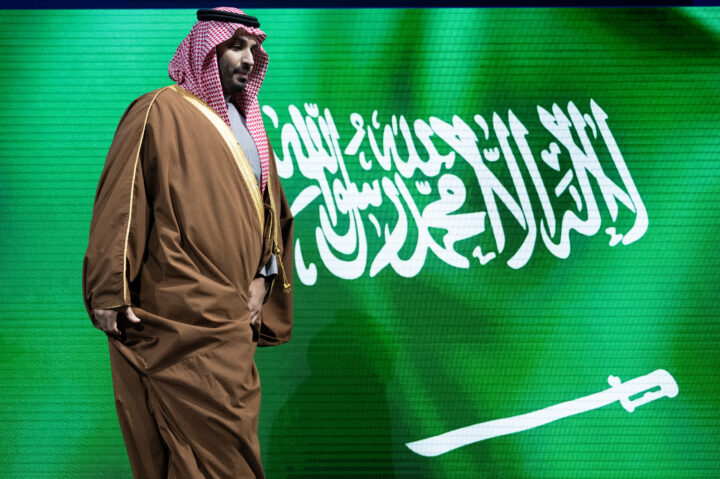
Saudi Arabia Crown Prince Mohammad bin Salman Al Saud walks to his seat after speaking during the US-Saudi Investment Forum at the Kennedy Center November 19, 2025, in Washington, DC.
Lawmakers in Washington are largely downplaying recent developments suggesting that Saudi Arabia is pivoting away from moderation and entertaining more hardline Islamism.
Saudi Arabia and the United Arab Emirates have been at loggerheads in Sudan, Somalia and Yemen — including a recent Saudi airstrike on an Emirati shipment in southern Yemen — prompting questions about Riyadh’s continued interest in acting as a moderating force in the region.
Saudi Arabia has also sided with Muslim Brotherhood-aligned forces in other regional conflicts, is increasing its business ties with Qatar and softening its stance toward other Islamist powers hostile to Israel, among other steps, some analysts say.
Saudi Foreign Minister Prince Faisal bin Farhan Al Saud met with lawmakers on Capitol Hill on Wednesday, who came away from the meeting indicating that potential disputes or shifts in the kingdom had been overstated.
Rep. Brad Sherman (D-CA) — who has been critical of Saudi Arabia in the past — told Jewish Insider that Prince Faisal, in the meeting, sought to directly rebut claims that Saudi Arabia was pivoting away from a position of moderation.
The overall message from Prince Faisal, Sherman said, was “the Saudis claim that they are anti-Brotherhood and that the disputes with the UAE are tactical, not ideological.”
“Just because the Saudis are not Shiite does not mean they’re Zionists. No one should get too carried away. And I’m sure there are elements of the Saudi government that are not nearly anti-[Muslim] Brotherhood as much as they should be,” Sherman said. “That being said, I see a foreign minister who is not Qatar or Turkey.”
“If you’re worried about Israel, you should never put any of the countries we’re talking about here in the ‘don’t worry about it’ category — you’ve got to worry,” he continued. “But the foreign minister went out of his way to say that when it comes to the Brotherhood or Iran, that there’s less reason to worry about Saudi Arabia.”
He said that he expects Saudi Arabia and the UAE to come to an agreement on the anti-Houthi campaign to deconflict the situation — likely one which would see the UAE take a decreased role in Yemen.
Sherman also said he did not see evidence that Saudi Arabia has significantly accelerated or expanded its relationship with Qatar — though he also noted that Saudi-Qatari tensions have gradually eased over the past few years and particularly since the Arab League blockade of Qatar. Saudi Arabia signed a major deal earlier this month to link Riyadh and Doha with a high-speed rail line.
Even so, Sherman said he has other pre-existing concerns about Saudi Arabia, such as its pursuit of a nuclear program and bid to purchase F-35 fighter jets, neither of which was discussed at Wednesday’s meeting.
Rep. Brian Mast (R-FL), the chairman of the House Foreign Affairs Committee, also met with Prince Faisal. He said it was “great” to see the foreign minister and that the group had discussed various issues including Yemen, Sudan and Gaza.
“Saudi Arabia and UAE are very close, right? I mean, that’s an understatement,” Rep. Brian Mast (R-FL), the chairman of the House Foreign Affairs Committee, told JI. “What I’m saying — everybody can have disagreements, spats, misunderstandings about different things, and that relationship is no different, but those two are two very, very close allies.”
“The U.S.-Saudi relationship remains a pillar of U.S. policy in the region,” Mast said in a statement. “I look forward to continuing to build upon our decades-old alliance to help resolve some of the region’s most pressing and complex challenges.”
He dismissed concerns about a potential Saudi repositioning or clash with the UAE.
“Saudi Arabia and UAE are very close, right? I mean, that’s an understatement,” Mast told JI in a brief interview. “What I’m saying — everybody can have disagreements, spats, misunderstandings about different things, and that relationship is no different, but those two are two very, very close allies.”
A congressional source deeply involved in Middle East issues argued that ties between the Sudanese Armed Forces — the faction Saudi Arabia is backing in Sudan — and the Muslim Brotherhood have been overstated and that the Saudi decision to back the SAF is a tactical one rather than an ideological signal of alignment with the Brotherhood. The source said that the Saudis have indicated that they are working to push the Brotherhood elements out of the SAF faction.
And, the source emphasized, both sides in Sudan have committed significant atrocities, further noting that the Trump administration sanctioned the Rapid Support Forces — which successive U.S. governments have found is committing genocide. The source said that Saudi Arabian officials have been clear they do not want the U.S. to sanction the UAE over its alleged support for the RSF, as some in Abu Dhabi heard after Saudi Crown Prince Mohammed bin Salman’s visit.
Regarding the Saudi strike in Yemen, the source said that Saudi Arabia was concerned about anti-Saudi forces approaching its territory and that the shipment the UAE convoy was transporting was being provided to those forces.
Sen. Markwayne Mullin (R-OK) said that there “a lot of concerns” about a Saudi dispute with the UAE in Yemen but that he is not “worried about [the Saudis] repositioning to an extreme point.”
“I don’t think we see that yet. There’s still a lot of conversations going on,” Mullin said. “I think that was just one of those regional things that sometimes we have a lack of understanding — or maybe understand it, but don’t understand it.”
Another lawmaker who has had conversations with individuals in the region said on condition of anonymity that — despite recent headlines — they did not believe that Saudi Arabia was making a fundamental pivot in its posture away from moderation or toward a more extremist Islamist stance.
The lawmaker added that the tensions between the two U.S. partners have been “surprising” but also noted there is a long and complex history between the two countries.
Addressing the Saudi-Emirati tensions, Sen. Pete Ricketts (R-NE), the No. 2 Republican on the Senate Foreign Relations Committee, acknowledged that the two countries had conveyed “different interests,” but did not appear concerned that their differences would alter the Saudis’ view of Iran as the top threat in the region.
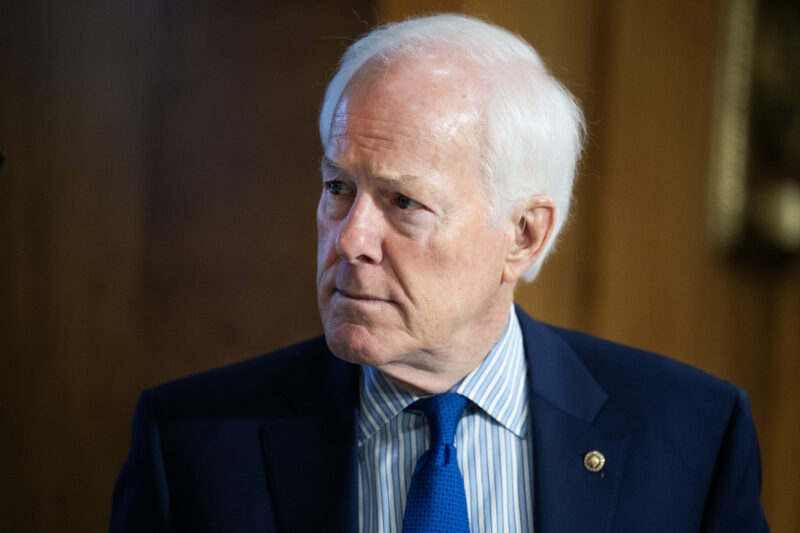
“The UAE seems like they’re trying to diversify their sources of support in the region, and that’s a point of some disagreement between the Saudi leadership and UAE leadership,” Sen. John Cornyn (R-TX) told JI.
“I have no insight into what’s going on there, but clearly they’ve got different interests,” Ricketts told JI. “Saudi Arabia’s long-term interest is in a peaceful Middle East where they have allies to offset Iran. Saudi Arabia knows that in the region their worst enemy is Iran, and so they’re going to want allies to push back.”
Sen. John Cornyn (R-TX), who sits on the Senate Intelligence Committee as well as on Foreign Relations, said his primary concern was the UAE’s deepening ties with Russia.
“I mean, the UAE seems like they’re trying to diversify their sources of support in the region, and that’s a point of some disagreement between the Saudi leadership and UAE leadership,” Cornyn told JI.
“What worries me a little bit is UAE talking about allowing the Russians to build a military base there,” he continued. “They seem to be less convinced that they can rely on support from the United States and so they are looking for other friends. That concerns me.”
Sen. John Kennedy (R-LA) attributed the fissures to the situation in Sudan and instability in Yemen that neither country could independently solve, but said he had been informed that the Saudis and Emiratis had addressed their differences.
“Well, Yemen is a mess,” Kennedy said. “The UAE and the Saudis have been allies. Now, they recently got crossways, but I understand they got it worked out. I don’t know what else to say. I mean, Yemen is just, … it’s not a stable country.”
Pressed on the Gulf states having “worked out” their issues, the Louisiana senator responded, “Well, I think that got a lot of it worked out. The Saudis and UAE … they’re crossways in Sudan. They’re not always joined at the hip, so I wasn’t particularly shocked about it, but my understanding is they got it worked out.”
Sen. Mark Warner (D-VA), the ranking member of the Senate Intelligence Committee, said he hadn’t been following all of the developments with Saudi Arabia’s regional posture but had been tracking the conflict in Sudan, where Saudi Arabia and the UAE have been backing opposing sides in the civil war. Warner emphasized that “neither one of them are the good guys,” referring to the UAE-aligned RSF and Saudi-aligned SAF.
“It does bother me, not just where [the Saudis] may be moving, but also just … in terms of bombing [in] Yemen,” Warner added, referring to the Saudi strike.
Warner, who led Intelligence Committee members on a visit to Saudi Arabia to meet with Crown Prince Mohammed bin Salman in 2024, said that the Saudis were, at the time, “anxious to get normalization with Israel,” but the Gaza war interrupted that progress.
And Sen. Richard Blumenthal (D-CT) said the “instability” in the region — including the Saudi-UAE tensions — demonstrates the need for strong congressional oversight of “any agreement that’s reached with any of our potential partners there.
President Donald Trump recently announced a series of deals with Saudi Arabia, including selling the kingdom F-35 fighter jets and naming Riyadh a major non-NATO ally, without making public strides toward Saudi-Israeli normalization.
“And very bluntly, it reemphasizes that our one truly reliable ally in the Middle East is Israel,” Blumenthal continued.
Recent Saudi moves across Yemen, Sudan and the Horn of Africa — including a widening rift with the UAE and closer alignment with Qatar — are challenging long-held assumptions about Riyadh's regional posture
BRENDAN SMIALOWSKI/AFP via Getty Images
Saudi Arabia Crown Prince Mohammad bin Salman Al Saud walks to his seat after speaking during the US-Saudi Investment Forum at the Kennedy Center November 19, 2025, in Washington, DC.
Saudi Arabia is recalibrating its regional posture in ways that are challenging long-held assumptions about Riyadh’s role as a moderating force in the Middle East, as recent moves across Yemen, Sudan and the Horn of Africa expose the country’s widening rift with the United Arab Emirates and a growing alignment with Qatar and Turkey — two countries with openly hostile positions toward Israel.
The realignment has been most stark on the issue of Yemen, where Saudi Arabia led an airstrike on an Emirati shipment of vehicles on Tuesday which Riyadh claimed was intended for the UAE-backed Southern Transitional Council (STC), which has consolidated power in the country’s south as Saudi-backed efforts to stabilize the war-torn nation have stalled. Hours after the strike, the Emirati government announced it would withdraw its remaining troops from the country.
The Saudis’ decision to embrace Islamist-aligned factions in Sudan, where the UAE is aligned with rival forces, has caused additional fissures with the Emiratis, putting the two U.S. allies and Gulf power players at odds.
The Gulf states have also taken opposite sides on Somalia, with the UAE quietly supportive of Somaliland, while Saudi Arabia condemned Israel for recognizing its independence and Israel’s Channel 12 reported that the move threatened the chances of Riyadh and Jerusalem establishing diplomatic relations.
These actions, taken together, have raised questions about Riyadh’s role as a moderating force in the region and potential partner for normalization with Israel.
“Yes, Saudi Arabia is moving away from its position of recent years,” Hussain Abdul-Hussain, a research fellow at the Foundation for Defense of Democracies, told Jewish Insider on Tuesday. “Since [Crown Prince Mohammed bin Salman] came to power, he promised drastic change under the banner of ‘Saudi First.’”
Abdul-Hussain said that Saudi Arabia is “abandoning its past policy and distancing itself from the UAE and the moderate capitals and getting closer to Islamist Qatar and Turkey. … How far on the scale of Islamism the Saudis decide to go remains to be seen.”
“There have been two alliances competing in the region: A radical Islamist one led by Turkey and Qatar and allied with Iran and Pakistan and a moderate one led by Israel and UAE and allied with India, Greece and Cyprus,” Abdul-Hussain said. “While America has friends on both sides, it is clear that American national interests are served by taking the side of Israel, the UAE, India and Greece coalition against the rival axis.”
Nervana Mahmoud, a political commentator based in the U.K., told JI that while “it’s very difficult to read the strategic decisions within the kingdom because they don’t announce plans … I noticed a shift in the Saudi [posture] from mid-2024.”
Mahmoud said that the Saudi-UAE divergence has also expanded because of the Saudi’s softened stance on Qatar, something she argued reflects the kingdom’s acknowledgement of Doha’s growing influence both in the region and globally, specifically pointing to Qatar’s positive standing with the Trump administration.
“I see the Saudis saying, ‘We cannot defeat the Islamists, but we can influence [them], using them for strategic influence,’” Nervana Mahmoud, a political commentator based in the U.K., told JI. “They think they can influence Islamists rather than be fooled by them. Before Islamists were infiltrating Saudi, now Saudi thinks [they’re] powerful enough to influence and tame them to serve strategic interests. I see that as wishful thinking.”
Saudi Arabia has improved ties with Qatar, ending a blockade on Doha in 2021 and signing a deal earlier this month to link Riyadh and Doha with a high-speed rail.
The UAE, meanwhile, has expressed concerns over Doha’s influence in Trump’s Gaza peace plan, including its potential role in post-war Gaza, as well as Qatar’s Islamist ties.
“I see the Saudis saying, ‘We cannot defeat the Islamists, but we can influence [them], using them for strategic influence,’” Mahmoud told JI. “They think they can influence Islamists rather than be fooled by them. Before Islamists were infiltrating Saudi, now Saudi thinks [they’re] powerful enough to influence and tame them to serve strategic interests. I see that as wishful thinking.”
Mahmoud pointed to Saudi Arabia’s engagement in Syria where Riyadh has supported efforts to rehabilitate Syrian President Ahmad al-Sharaa and encourage engagement with the Trump administration, despite Al-Sharaa’s Islamist background. Israel, meanwhile, has taken a more suspicious view of al-Sharaa and has thus far failed to secure a security agreement with Damascus.
Another cause for concern has been the Saudis’ reticence to engage on joining the Abraham Accords, despite publicly expressing willingness to normalize relations with Israel on condition of the establishment of a pathway to Palestinian statehood and a ceasefire in Gaza.
“Since 9/11, and especially since MBS came to power in 2015, Saudi Arabia made enormous effort to distance itself away from Muslim Brotherhood and Islamism,” Hussain Abdul-Hussain, a research fellow at the Foundation for Defense of Democracies said. Now, “Saudi is getting closer to all Islamist, anti-Israel, anti-West governments, whether it’s Iran and Pakistan or Qatar and Turkey.”
Mahmoud accused Riyadh of “playing the game” on the normalization issue, saying that the kingdom had continued to signal interest in joining the Abraham Accords while “always [having] an excuse not to.”
“The excuses will never end,” Mahmoud told JI of the Saudis, adding that the kingdom was “trying to be on the good side of [President Donald] Trump.”
Riyadh’s shift away from moderate Gulf states has also been marked by diverging views on how to approach the Muslim Brotherhood. While Qatar has long sponsored the Islamist movement’s actions, Saudi Arabia and the UAE have historically taken a harsher stance against the group, proscribing it as a terrorist organization, aligned with the Trump administration’s recent moves to do the same.
“There was a period from 2017 to 2021 where the Saudis, Emiratis and Bahrainis completely isolated Qatar because they considered the Qataris as sponsoring the Muslim Brotherhood, and the Muslim Brotherhood meant harm to the political systems in Saudi and UAE and Bahrain,” Edmun Fitton-Brown, a senior fellow at the Foundation for Defense of Democracies and a former British diplomat who served in Kuwait, told JI.
Abdul-Hussain argued that there has been “some reversal” on Saudi Arabia’s reputation as a moderate actor on the brotherhood, creating a potentially concerning landscape for Israel and dampening efforts toward normalization.
“Since 9/11, and especially since MBS came to power in 2015, Saudi Arabia made enormous effort to distance itself away from Muslim Brotherhood and Islamism,” Abdul-Hussain said. Now, “Saudi is getting closer to all Islamist, anti-Israel, anti-West governments, whether it’s Iran and Pakistan or Qatar and Turkey.”
As they denounce the UAE’s alleged backing of Sudan’s Rapid Support Forces, far-left lawmakers have passed over the Muslim Brotherhood affiliations and foreign backing of the rival Sudanese Armed Forces
Tariq Mohamed/Xinhua via Getty Images
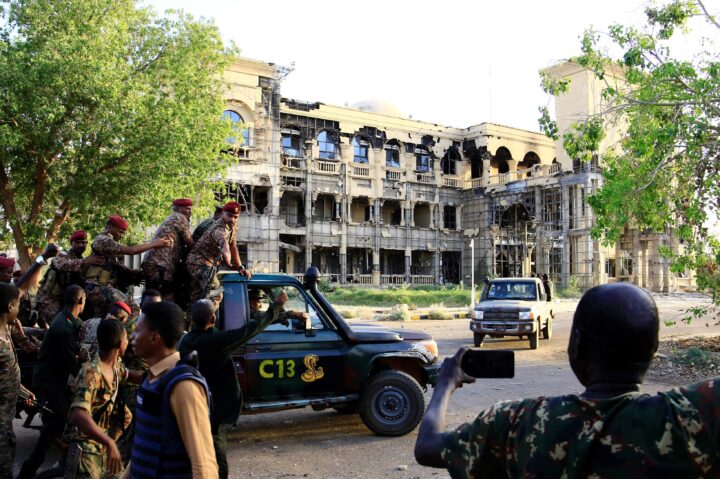
Abdel Fattah Al-Burhan in the vehicle, chairman of Sudan's Transitional Sovereign Council and commander of the Sudanese Armed Forces SAF, departs from the Presidential Palace in Khartoum, Sudan, on March 26, 2025.
In recent days, a chorus of left-wing lawmakers in Congress have ramped up their ire towards the United Arab Emirates, accusing the Gulf country of helping fuel the yearslong civil war in Sudan by reportedly backing the Rapid Support Forces (RSF), the non-Islamist Arab force fighting the Muslim Brotherhood-aligned Sudanese Armed Forces (SAF).
The UAE has long denied allegations of involvement in the war. The Wall Street Journal reported this week that, according to sources, recent assessments by the Defense Intelligence Agency and the State Department’s intelligence bureau purport to show the UAE sending Chinese drones to the RSF.
On the other side, Iran, Russia, Egypt and Turkey have provided support to the SAF, according to conflict monitors and reporting by Bloomberg and The Washington Post.
The war in Sudan has wrought havoc upon the eastern African nation, with both warring factions committing crimes against humanity. The conflict has killed as many as 150,000 people and has displaced around 12 million.
Over the more than two-year long conflict, both militias have been accused of widespread sexual assault, mass killings of civilians, torture and deliberate attacks on civilian infrastructure. On Monday, the RSF captured the city of El Fasher after an 18-month blockade which saw the group effectively devastate the city, with reports of mass killings, sexual violence and the destruction of hospitals and displacement camps.
The U.S. government, under former President Joe Biden, determined the RSF was committing genocide and found both the RSF and SAF guilty of committing war crimes.
Meanwhile, the Muslim Brotherhood’s growing influence with the Sudanese Armed Forces has alarmed experts, who warn that the SAF’s deepening ties to Islamist networks threaten regional stability and could pose a risk far beyond the eastern African nation.
“The Muslim Brotherhood has had a strong presence in Sudan since the 1940s and that presence has evolved over the years,” Norman Roule, a former senior U.S. intelligence official, told Jewish Insider. “It’s important to note that this presence is also why Iran is such a strong supporter of the Burhan [head of SAF] government.”
Liam Karr, an analyst at the American Enterprise Institute, who has condemned actions on both sides of the conflict, says the ties date back to former Islamist dictator Omar al-Bashir, who ruled Sudan for several decades before the SAF overthrew him in 2019.
“The SAF is working with several Islamist brigades that consist of former Bashir-era army, police and intelligence personnel,” Karr told JI. “This includes the al Baraa Ibn Malik Brigade, which is widely associated with the Sudanese Muslim Brotherhood and Bashir and has an estimated 20,000 fighters.”
In recent months, the SAF has received explosive attack drones from Iran’s Revolutionary Guard Corps to aid in the conflict, while Egypt, one of their key backers, arrested a key Islamist militia leader aligned with the group — signaling that even staunch regional supporters of the group are “growing wary of its Islamist factions,” according to Foundation for Defense of Democracies Research Fellow Hussain Adbul-Hussain.
Roule said Iran has a vested interest in providing the SAF with weaponry in order to reestablish a presence in the region and revitalize their “broken proxies,” following Israel’s degrading of its military capabilities and of its proxy Hezbollah, as well as the fall of the Assad regime in Syria.
“This is of extreme importance to the U.S. and its partners in the region, because if the Quds Force [IRGC] is able to establish a presence it lost in Syria, it would be able to reestablish training camps it operated a decade ago for Hamas smugglers, routes for weapons that it could send back into Gaza and revitalize Lebanese Hezbollah, as well as provide a transshipment location of weapons to the Houthis,” said Roule. “The Muslim Brotherhood presence in Khartoum is of serious concern for the United States and deserves much greater attention. It is a significant threat to the United States, Israel and the region.”
Anti-Israel lawmakers, including some of the Jewish state’s most vocal critics in the House, have sounded the alarm on the RSF, but have notably glossed over the SAF and its increasingly Islamist alignment.
“Sudan is facing the world’s worst humanitarian crisis and a genocide,” said Rep. Ilhan Omar (D-MN) in a post on social media on Tuesday. “The UAE and other arms dealers to the RSF and RSF-aligned militias must be held accountable.”
Rep. Rashida Tlaib (D-MI) echoed the same sentiment, saying she is “horrified” by the RSF’s “mass killings of civilians.”
“We must do everything in our power to stop this genocide, including cutting off all weapons sales to the United Arab Emirates who are arming and funding this ethnic cleansing,” said Tlaib on social media on Wednesday.
Rep. Joaquin Castro (D-TX) followed suit and similarly directed his criticism at the Emirates.
“I am incredibly concerned about the deepening humanitarian crisis in Sudan, and the atrocities committed by the Rapid Support Forces,” Castro wrote on social media on Wednesday. “The United States must put pressure on the RSF and those who back it — including the United Arab Emirates — to end these atrocities.”
A number of far-left activists online have also singled out the RSF and its reported Emirati ties for condemnation.
Kenneth Roth, a virulent critic of Israel and former head of Human Rights Watch, posted on Tuesday, “British arms sold to the United Arab Emirates are being found in Sudan, where the UAE is arming the paramilitary Rapid Support Forces as they commit genocide.”
“Both the Biden and Trump administrations refused to hold the UAE accountable as it armed Sudan’s RSF, despite massacre after massacre, atrocity after atrocity,” wrote New York Times columnist Nicholas Kristof, adding, “Members of Congress are showing more responsibility and initiative.”
House Democrats, led by Reps. Gregory Meeks and Sara Jacobs, released a statement in April marking the two year anniversary of the conflict. “External actors like the UAE must immediately stop fueling the conflict by arming the warring parties,” the statement said notably only listing the UAE and omitting any mention of Turkey, Iran, Russia, and other countries who have sent arms to factions in Sudan.
A bi-partisan group of senators, including Ranking Member Jeanne Shaheen (D-N.H.) of the Senate Foreign Relations committee, released a statement on Thursday breaking in tone from the other lawmakers – condemning both sides and making mention of all nations reportedly backing the war.
“Both the RSF and the Sudanese Armed Forces (SAF) have committed atrocities against civilians and pursued a zero-sum war at any cost,” the lawmakers said in a statement. “Foreign backers of the RSF and SAF-including the United Arab Emirates (UAE), Russia, Iran, China and governments in the immediate region-have fueled and profited from the conflict and legitimized the monsters destroying Sudan,” the senators continued.
Secular forces in Sudan have called for the country’s Islamist movement to be classified as a terrorist group, according to Hussain. Sudan’s Civil Democratic Alliance of Revolutionary Forces (Sumud) has stated that the “Islamist movement sees no pathway for ending the fighting other than the complete submission of the Sudanese people to its terrorist regime, an arrangement that has never achieved peace.”
Karr says the Trump administration and the SAF’s own partners have put “heavy pressure” on the group to “distance itself politically from the Islamist groups.” Karr also believes pressure should be applied to the RSF.
In his second term, President Donald Trump voiced support for designating the Muslim Brotherhood as a terrorist organization. Various members of congress have introduced legislation that would require the secretary of state to use this designation, though Congress has yet to move forward with the legislation.
Please log in if you already have a subscription, or subscribe to access the latest updates.
 Continue with Google
 Continue with Apple