













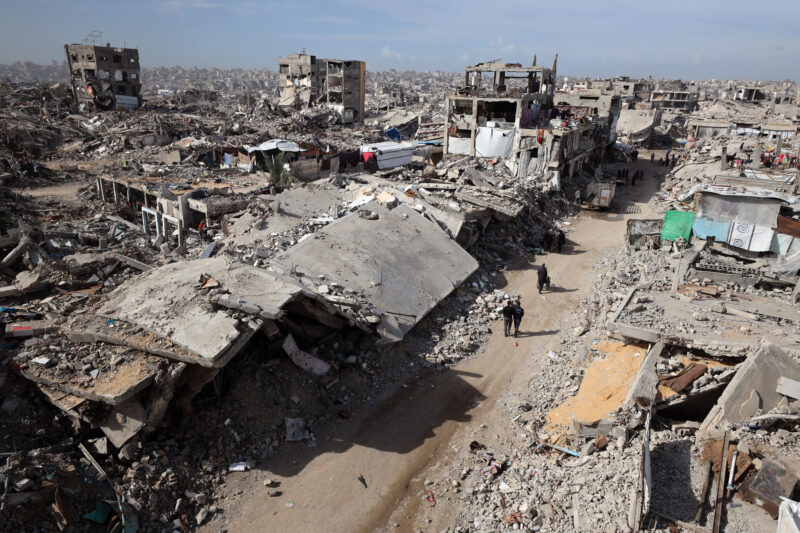
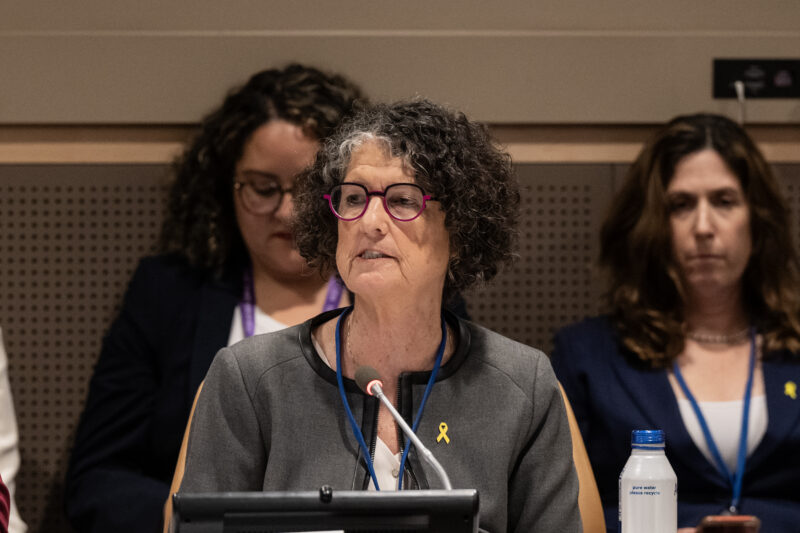
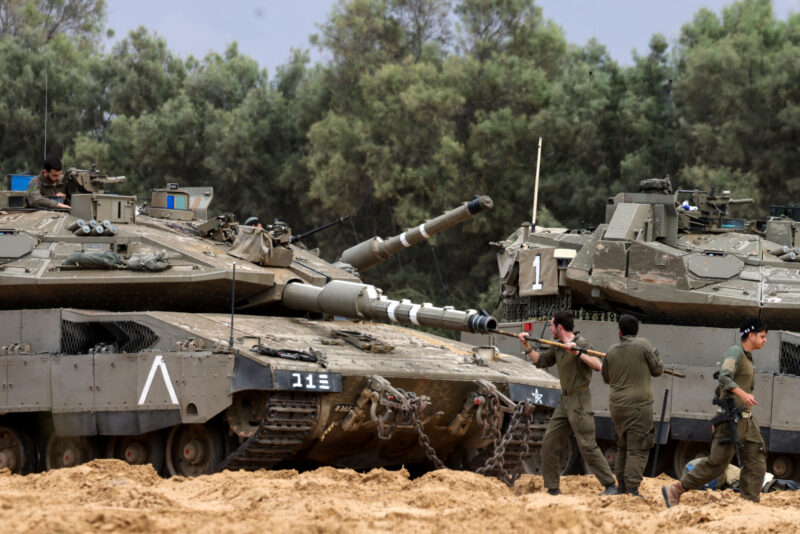

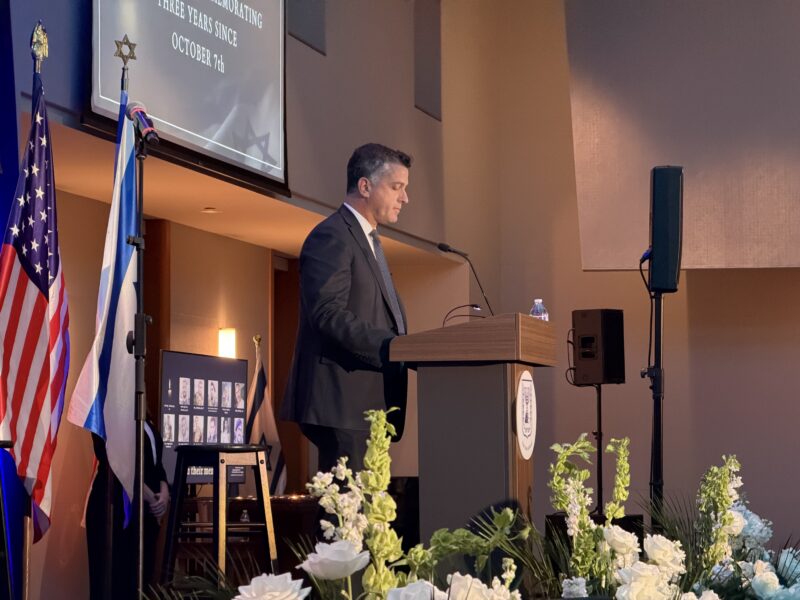









Izz al-Din al-Haddad was the leader of Hamas’ military wing and an architect of the Oct. 7 attacks, according to Israeli leaders
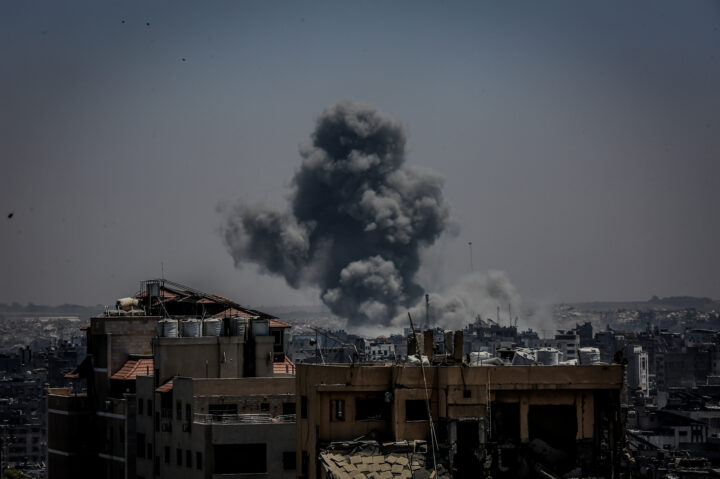
Saeed M. M. T. Jaras/Anadolu via Getty Images
Smoke rises after an Israeli strike in the eastern part of Gaza Strip on July 3, 2025.


 Add JewishInsider on Google
The Israeli military killed Izz al-Din al-Haddad, the most senior remaining Hamas commander in the enclave, in a strike on Friday, according to a joint statement from Prime Minister Benjamin Netanyahu and Defense Minister Israel Katz.
Al-Haddad was the leader of Hamas’ military wing and was “one of the architects of the October 7 massacre,” according to the statement.
The strike, carried out by the Israeli Air Force, had been approved about a week and a half earlier, during which time Israeli forces kept Al-Haddad under constant surveillance, an Israeli official told reporters. The official said the operation was carried out after an “operational opportunity” emerged.
Al-Haddad “held our hostages in brutal captivity, directed terrorist operations against our forces, and refused to implement the agreement led by U.S. President Donald Trump aimed at dismantling Hamas and demilitarizing the Gaza Strip,” Netanyahu and Katz’s statement said. “The IDF and the Shin Bet are effectively implementing the government’s policy of not tolerating threats and preemptively thwarting our enemies.”
The strike comes amid a fragile ceasefire between Israel and Hamas that was first implemented in October 2025, under which Israeli forces withdrew to a “yellow line” encompassing roughly 53% of the Gaza Strip. Hamas has yet to comply with the next phase of Trump’s plan, which calls for the group’s disarmament.
Nickolay Mladenov, the Board of Peace’s lead envoy for Gaza, wrote in a recent letter obtained by The Times of Israel to the technocratic committee governing Gaza that the board would not expect Israel to abide by the terms of the ceasefire if Hamas continues to refuse to disarm.
Less than 24 hours before the expiration of his previous delay, Trump said he would pause the strikes ‘per Iranian government request’
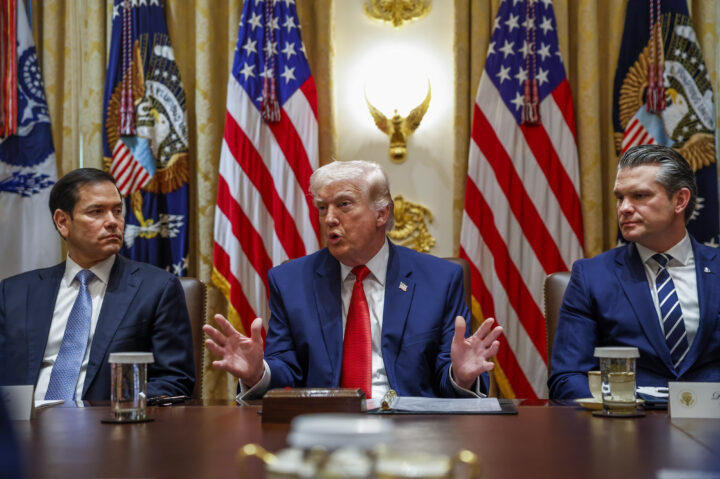
Will Oliver/EPA/Bloomberg via Getty Images
Secretary of State Marco Rubio, President Donald Trump and Defense Secretary Pete Hegseth during a Cabinet meeting at the White House in Washington, DC, US, on Thursday, March 26, 2026.
President Donald Trump announced on Thursday afternoon that he would extend his pause on plans to strike Iran’s energy infrastructure, “per Iranian government request,” for an additional 10 days amid ongoing diplomatic negotiations to end the war.
Trump wrote in a post on his Truth Social platform that he is “pausing the period of Energy Plant destruction by 10 Days to Monday, April 6, 2026, at 8 P.M., Eastern Time.”
“Talks are ongoing and, despite erroneous statements to the contrary by the Fake News Media, and others, they are going very well,” Trump added.
The post comes a few hours after the president said that he wasn’t sure if he would follow through with his five-day delay, set to expire Friday, for strikes on Iran’s energy infrastructure, which he had pushed back at the start of diplomatic negotiations on Monday.
“I don’t know yet,” Trump said when asked by reporters if the strikes would still take place Friday. “It’s a day. In Trump time, a day, you know what it is? That’s an eternity.”
Trump made the comments while speaking to reporters at the opening of his first Cabinet meeting since launching the war in Iran.
He alleged that Iranian leaders “are begging to make a deal” to end the war while criticizing press reports alleging that he was looking for a diplomatic off-ramp to the conflict, saying he has not decided whether he’ll agree to a diplomatic settlement if one were reached.
“They are begging to make a deal. Not me,” Trump said of current Iranian leadership. “They’re not fools, they’re very smart actually in a certain way and they’re great negotiators. I say they’re lousy fighters, but they are great negotiators. They are begging to work out a deal. I don’t know if we will be able to do that. I don’t know if we’re willing to do that. They should’ve done that four weeks ago. They should’ve done it two years ago.”
“The reason they want to make a deal is they have been just beat to sh*t,” he said later on, touting the U.S. military operation as a success.
During the meeting, White House Special Envoy Steve Witkoff confirmed reports that the U.S. had presented Iran with a “15-point action list” as a starting offer in peace talks between the two countries. He also confirmed that Pakistan had been acting as a mediator for the U.S. and Iran.
“We will see where things lead, and if we can convince Iran that this is the inflection point with no good alternatives for them other than more death and destruction,” Witkoff said. “We have strong signs that this is a possibility.”
Witkoff said to Trump, “You’ve instructed us that your preference is always peace and that we should make that our priority. We have delivered that message, sir, along with the 15 points for peace. Finally, we have told Iran one last thing: don’t miscalculate again.”
Trump later revealed that the “present” Iran gifted the U.S. was allowing eight oil tankers through the Strait of Hormuz, which he said proved the U.S. was speaking with the “right people” in Iran with the authority to make such decisions.
“They said to show you the fact that we’re real, and solid and we’re there, we’re going to let you have eight boats of oil, eight boats, eight big boats of oil,” Trump said of the Iranians. “And I said, ‘Well, I guess they were right,’ and they were and they were real.”
Trump then said that Iran later allowed two additional vessels to travel through the strait, which he described as an overture from the Iranians to “apologize for something they said.”
Turning to Witkoff, the president then expressed hope that he hadn’t “screwed up” their diplomatic efforts by revealing the “gift.”
Trump made the remarks in a Truth Social post, in which he threatened that the U.S. would bomb the South Pars gas field if Iran does not stop attacking Qatar
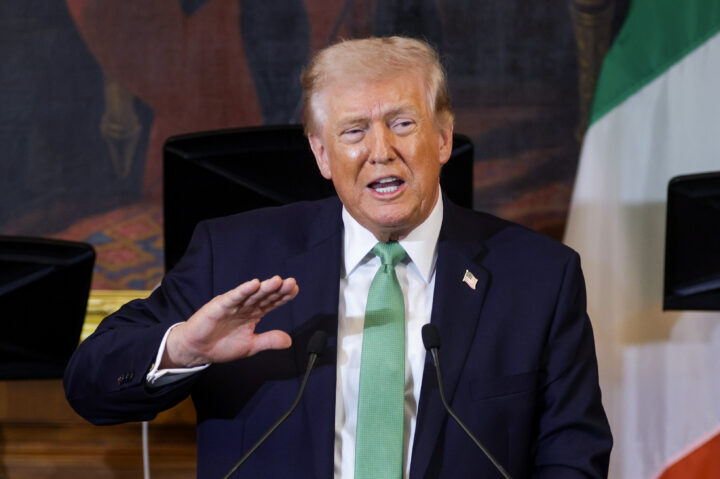
Alex Wong/Getty Images
President Donald Trump speaks during the annual Friends of Ireland Luncheon at the U.S. Capitol on March 17, 2026 in Washington, DC.
Current and former Israeli and U.S. officials suggested that an Israeli strike on an Iranian gas field on Wednesday that prompted the Islamic Republic to strike Qatar was coordinated with the White House, despite President Donald Trump’s claim that the U.S. “knew nothing about this particular attack.”
Trump made the remarks in a Truth Social post, in which he threatened that the U.S. would bomb the South Pars gas field, the Iranian portion of the larger field shared with Qatar, if Iran does not stop attacking Qatar.
“The United States knew nothing about this particular attack, and the country of Qatar was in no way, shape or form involved with it, nor did it have any idea that it was going to happen. Unfortunately, Iran did not know this … and unjustifiably and unfairly attacked a portion of Qatar’s [liquid natural gas] facility,” the president wrote.
If “Iran unwisely decides to attack a very innocent, in this case, Qatar,” he added, the U.S., “with or without the help or consent of Israel, will massively blow up the entirety of the South Pars Gas Field at an amount of strength and power that Iran has never seen or witnessed before.”
An Israeli official told Kan News, Israel’s public broadcaster, that the attack on the South Pars gas field was coordinated with the U.S.
Dan Shapiro, the former U.S. ambassador to Israel and Pentagon official in the Biden administration, wrote on X, “Trump can post whatever he likes. But there is zero, I mean zero, chance the IDF would conduct a strike in that location without giving CENTCOM full visibility.”
“Trump knew (and approved),” Shapiro added. “Now he realizes it caused a major escalation with Iran’s (entirely unjustified) attacks on Gulf energy targets.”
Shapiro later clarified that the Israeli strike “could not have been carried [out] without U.S. knowledge and explicit or implicit approval.”
“It was predictable that strikes on Iranian energy facilities (by US or Israel) would lead to Iranian strikes on Gulf energy facilities,” he wrote. “There is a narrow window following the Israeli and Iranian strikes, and Trump’s Truth Social Post (untrue, but possibly useful in this context), to de-escalate away from further strikes on energy industry targets in either direction. That will still leave a very challenging situation to unwind, but [it] would be the best near-term development.”
Gilad Erdan, a former Israeli ambassador to Washington and a former member of Israel’s Security Cabinet, told Jewish Insider that it was highly likely the U.S. knew about the strike, saying that Trump did not criticize Israel in his post, and “in the same breath” as saying the U.S. was unaware, “[Trump] himself threatened to erase the [gas] field.”
Erdan noted that the South Pars gas field is “used for Iran’s domestic energy needs [and] doesn’t harm the international energy market.”
“Israel took upon itself to be at the front [of the situation] in my estimation because the field is also Qatari,” Erdan, who is also a senior fellow at the Misgav Institute for National Security, said. “Someone had to send the deterrent message about the energy field to the Iranians, that if they continue, then all options are open against them and they will be hurt badly.” (The writer is a senior fellow at the Misgav Institute and cohosts its podcast.)
Yaakov Katz, an Israeli military expert and author of While Israel Slept: How Hamas Surprised the Most Powerful Military in the Middle East, told JI that he agreed with Shapiro’s assessment. “There is no way Israel would attack such a strategic facility [without coordination] because they know it would draw the Iranians to attack the Gulf states,” he said.
Katz pointed to Israeli Prime Minister Benjamin Netanyahu’s behavior since the war with Iran began late last month as further indication that Israel was unlikely to make such a move without coordinating with the U.S.: “Why would Netanyahu who behaved so carefully all throughout the war, coordinating with Trump to not upset him so he keeps the war going … do something that would anger Trump and potentially lead him to do something brash and declare the war is over?”
“It was coordinated, and now Trump is saying what he’s saying to distance himself, but it was done to send a message to the Iranians,” Katz added.
Also Thursday, Saudi Arabia released a statement with the foreign ministers from Azerbaijan, Jordan, the UAE, Bahrain, Pakistan, Turkey, Syria, Qatar, Kuwait, Lebanon and Egypt urging Iran to stop its attacks.
“The participants held Iran fully responsible for the losses and called on Iran to immediately and unconditionally cease its aggression and to comply with UN Security Council resolutions. The meeting also emphasized the dangers of supporting militias and destabilizing security, stressing that Iran must seriously reconsider its miscalculations,” the statement read.
If Iran continues, the foreign ministers stated, there will be “serious consequences for Iran and the security of the region, and will exact a heavy price, casting a shadow over its relations with the countries and peoples of the region, who will not stand idly by in the face of threats to their capabilities.”
Experts tell JI that despite the constant flow of reports that Trump favors a military response as talks with Iran falter, an American strike and Iranian retaliation against Israel are likely not imminent

Tomer Neuberg/AP
Israeli Iron Dome air defense system launches to intercept missiles fired from Iran, in central Israel, Sunday, April 14, 2024.
Tensions in Israel continued to rise over possible missile strikes from Iran, as signals increased that President Donald Trump is ready to order a strike on the Islamic Republic, possibly within days.
Yet experts told Jewish Insider on Thursday that, despite the constant flow of reports that Trump favors a military response as negotiations with Iran falter, an American strike and Iranian retaliation against Israel are likely not imminent.
Nearly every major Israeli news website and broadcast led with Iran news on Wednesday evening and Thursday morning, referencing reports in CBS News that the U.S. military could be prepared to strike in the coming days and and the Wall Street Journal headline that the U.S. has amassed the greatest air power in the Middle East since the Iraq war in 2003.
In a moment that went viral in Israel and sparked hundreds of phone calls to the IDF Home Front Command, former IDF intelligence chief Amos Yadlin told Israel’s Channel 12 on Wednesday that while he went to the Munich Security Conference last week, “I would think twice about flying [abroad] on the coming weekend.”
Every Israeli “asks himself several times a day when there will be a campaign against Iran,” Knesset Foreign Affairs and Defense Committee chairman Boaz Bismuth (Likud) said on Wednesday. “The entire population and homefront are preparing.”
However, IDF Spokesperson Effie Defrin said that “there is no change in the situational assessment, and if there will be, we will update [the public]. There is no need to panic.”
Defrin also noted that “there are negotiations, and the IDF has long been prepared for maximum defense. If we are attacked, we will respond forcefully.”
However, while Israel’s leadership and the IDF’s assessment is that the U.S. will warn them before a strike, they plan to prepare quietly and not alert the public in advance, in order to increase the chances of success, Israel’s Kann News reported on Wednesday.
Raz Zimmt, director of the Iran Program at Tel Aviv University’s Institute for National Security Studies, quipped to JI in reference to Yadlin’s remarks: “Don’t change your weekend plans.”
Zimmt noted that the USS Gerald Ford aircraft carrier is still on the way to the region, and argued that “the Americans will want to be maximally prepared when they make their decision” whether to strike Iran.
“I think it’s a matter of days, not weeks, but it could also be 14 days,” he said.
Oded Ailam, former head of the Mossad Counterterrorism Division and a researcher at the Jerusalem Center for Security and Foreign Affairs, said that he “doesn’t see a scenario of an immediate strike in the coming days or the coming week, despite the fearmongering in the media.”
Ailam argued that Trump will try to exhaust the current negotiations to be certain if Iran will accept a deal.
“He won’t attack until it is totally clear that this is a dead end, but he will gather forces” in the region, Ailam said. “It won’t happen for the next week or two, and after that, it depends mostly on the Iranians and the extent of their concessions.”
In Zimmt’s assessment, an Iranian surprise attack, rather than a retaliation following an American strike, is unlikely.
“Iran understands the chance of an American attack is higher than the chance of an agreement, but why should they drag themselves into a war that they have a chance of avoiding?” he said.
In addition, he said, the Iranian leadership “knows very well that Israel is ready and won’t be surprised, so it’s not worth it.”
Still, Zimmt said, Iran’s likely first reaction to an American strike will likely be to attack U.S. bases in the Gulf and Israeli targets: “For them, the U.S. and Israel are the same thing.”
Ailam said that Israel has greatly improved its air defenses since the 12-day war with Iran last June. At the time, Israel intercepted 85% of the missiles coming from Iran, and Ailam said the interception rate would likely be higher next time. Israel’s Iron Beam laser-defense system has also become operative in the interim, adding a new element of defense against drones.
In addition, he noted that the amassing of American naval vessels in the region means that the U.S. will likely contribute more to Israel’s defense than during the last war.
At the same time, Ailam said, “the Iranians have not managed to rebuild their ballistic missile systems. They only have 240 launchers, which is not much. When you strike launchers, you neutralize their ability to shoot many missiles simultaneously and disrupt Israel’s defense systems.”
As such, Ailam’s assessment was that “Iran is on the defensive and Israel has a clear advantage.”
“If two ballistic missiles penetrate Israel’s defensive envelope, it can cause great damage — as it did at Soroka [Medical Center in Beersheba] and Weizmann [Institute of Science] last year — but it is not a threat that Israel can’t handle. I don’t see it as an existential or very significant threat,” he said.
Right-wing Israelis support a strike even if Iran does not attack, while other political camps prefer to wait and see if Iran strikes Israel first, IDI poll finds
Stringer/Getty Images
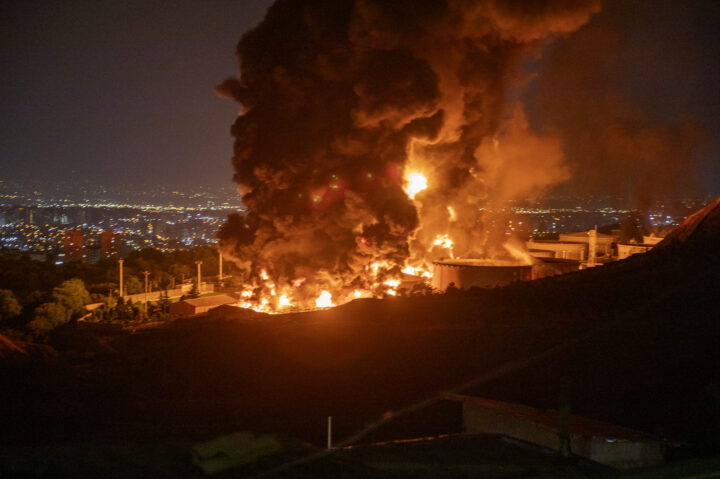
Fire and smoke rise into the sky after an Israeli attack on the Shahran oil depot on June 15, 2025 in Tehran, Iran.
Less than half of Israelis support joining an American strike on Iran if Israel is not directly attacked, a poll from the Israel Democracy Institute found this week.
Half of the Israelis polled supported a military response only if Israel is directly attacked by Iran, while 44% backed joining an American strike on Iran even before a potential attack on Israel.
Among Israeli Jews, 46% support intervening only if Iran attacks first, while 48% support involvement regardless.
If those results are further divided between political affiliations, only among Israel’s right does a majority (62%) support joining a preemptive American strike on Iran. On the center-right, 41% support such a scenario, while that number decreases to 35% among centrists, 36% of those polled on the center-left and 31% of respondents who identified as left.
Among Israeli Arabs, 67% would only support an Israeli strike if Iran attacks first.
Israelis are also split over Israeli Prime Minister Benjamin Netanyahu’s announcement that U.S. military aid would be phased out in the coming years. About half (49%) think the change would make Israel less secure, while 39.5% think otherwise.
The Israeli right is less likely to think that bringing U.S. military aid down to zero will be harmful to Israel’s security, with only 30% holding that view, while most on the center-right (56%), center (64%), center-left (72%) and left (72%) hold that view.
Most Israeli Jews (54%) believe that President Donald Trump’s Board of Peace will not “help solve the problems in Gaza while maintaining Israel’s security,” while 37% believe it will. When the results are analyzed by political affiliation, a slight majority of those on the left, center and right all agree the Board of Peace will not help.
Among Israeli Arabs, 42% believe the Board of Peace will help and 34% say it will not; 24% did not know.
IDI conducted the poll on January 25-29 among a sample size of 604 with a margin of error of 3.57%.
Analysts still think it’s possible that Trump will take action against Iran, but worry his backtracking on providing help to Iranian protesters could hurt American deterrence
Daniel Torok/The White House via Getty Images
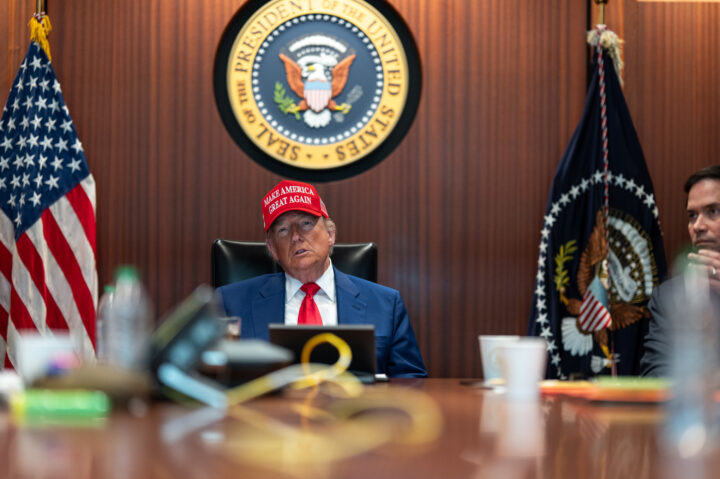
President Donald Trump and Secretary of State Marco Rubio (R) sit in the Situation Room as they monitor the mission that took out three Iranian nuclear enrichment sites, at the White House on June 21, 2025 in Washington, DC.
Even as President Donald Trump backed away from taking immediate military action against Iran, several leading foreign policy analysts believe a U.S. strike against the Islamic Republic remains a possibility, arguing that the administration may be deliberately keeping Tehran off balance and preserving its military options.
Trump appeared to ease off on striking Iran after being advised by administration officials that a large-scale attack is unlikely to bring about regime change and could instead trigger a broader regional conflict, and hearing concerns from allies — including Israel, Turkey, Qatar and Saudi Arabia — who have urged him not to carry out military action. U.S. officials said Washington is now monitoring to see whether Tehran is backing down from its violent crackdowns against protesters before determining whether to act.
“Even though Trump did not direct strikes on Wednesday, he is keeping options open,” said Dana Stroul, the research director at The Washington Institute for Near East Policy, pointing to the administration’s decision to reposition the USS Abraham Lincoln aircraft carrier from the Indo-Pacific to the Middle East. “The buildup of military posture in the region over the coming weeks keeps plenty of military options on the table and maintains pressure on the Iranian regime.”
Stroul said the president appears to be taking additional time to ensure the U.S. is prepared not only to act against Iran, but also to defend regional partners in the event Iran attacks U.S. allies or military bases in the region, in retaliation.
Analysts cautioned that the delay should not be interpreted as a decision against military action altogether. Aaron David Miller, a senior fellow at the Carnegie Endowment for International Peace, told Jewish Insider that he believes a strike is still on the table, putting the odds at “60–40 [percent]” in favor of a strike.
“There’s still a very real possibility of a strike,” Miller said. “I don’t see how the president gets out of the box he put himself in,” referring to Trump’s public calls for Iranians to continue protesting and his promise of U.S. assistance. “When an American president emboldens demonstrators and then says ‘We will help you’ without the capacity to really protect them, you have to wonder whether that’s morally conscious.”
Andrea Stricker, a research fellow at the Foundation for Defense of Democracies, also noted that Trump’s rhetoric has made the administration’s hesitation striking.
“It’s puzzling and upsetting that President Trump would call on the Iranian people to continue protesting in the midst of gunfire and then wait so long to act,” Stricker said. She suggested the delay could reflect a deliberate effort to gain military or intelligence advantages before a strike.
“I lean more toward a possible deception campaign designed to expose IRGC [Islamic Revolutionary Guard Corps] movements and preparations before an actual U.S. attack,” Stricker said, adding that the administration may prefer to wait until additional U.S. naval assets arrive in the region, which she said would “happen in the coming days.”
Other analysts were more skeptical that Trump’s hesitance is a cover for an impending operation. Elliott Abrams, a senior fellow at the Council on Foreign Relations and a former Iran envoy in the first Trump administration, said it’s possible the president won’t act at all.
“As of noon today, it seems Trump will not do anything, which is extraordinary after he urged Iranians to protest and seize institutions at the risk of their lives,” Abrams said on Thursday. “It is unconscionable to say ‘Help is on the way’ and then do nothing. I hope the president will change his mind.”
While the Iranian regime has faced unprecedented pressure at home and abroad, Stroul warned that Iranian retaliation could be significant in the event of a strike — potentially another factor in Trump’s hesitation.
“The regime still has substantial missile and cyber capabilities,” she said. In the event of a strike, “the U.S. and Israel would need to prepare for the possibility of a sustained, destructive conflict that could be extremely costly in human life, military platforms and infrastructure.”
Concerns over retaliation have fueled lobbying by Arab states, including Saudi Arabia and Qatar, urging Trump to avoid military action, and Israeli Prime Minister Benjamin Netanyahu reportedly conveyed a similar message to the president on Wednesday
“Arab governments recognize that the regime in Tehran is destabilized but still dangerous,” Stroul said. “Desperate leaders often take unpredictable, aggressive actions. For a region trying to turn the page after years of conflict, leaders are wary of another escalation that could jeopardize economic and security priorities.”
Even among experts who believe military action remains possible, there is broad agreement that it’s not clear what the consequences of a strike would be or that sustained military engagement would lead to the collapse of the regime.
“Any military strike has to answer the question of how it actually changes the balance between a repressive regime and protesters who have very limited means to push back,” Miller said. “There’s no guarantee that even massive strikes would lead to regime change.”
Miller and Stricker both noted that the administration has also not articulated a clear plan for alternative political leadership in Iran should the regime fall — an issue that complicates any decision to intervene.
“Penalizing the regime enough to support the Iranian people could produce unclear outcomes in terms of who provides order and security afterward,” Stricker said. “At the same time, if Trump ultimately does not act, it will be seen by many Iranians as a historic betrayal — and by U.S. adversaries as weakness.”
Trump was reportedly briefed in recent days on options for sites to strike in Iran as the regime cracks down on protesters
Morteza Nikoubazl/NurPhoto via Getty Images
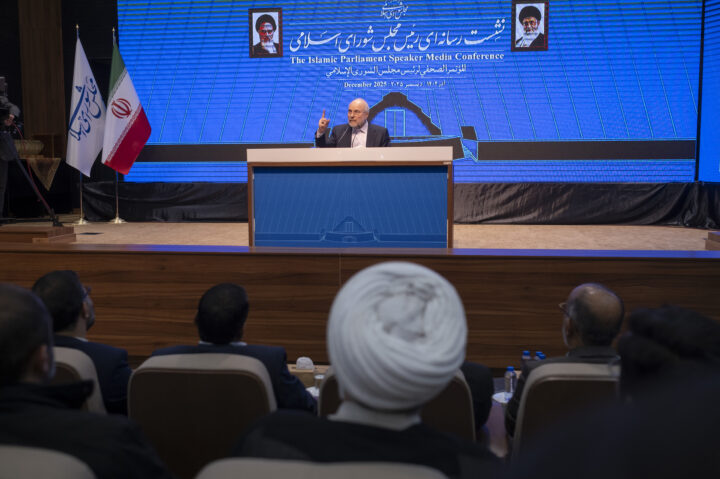
Iranian Parliament Speaker, Mohammad Bagher Ghalibaf, speaks with the media in a media conference at a conference hall in the Iranian Parliament building in Tehran, Iran, on December 2, 2025.
Tensions between the U.S. and Iran escalated on Sunday as President Donald Trump weighed options for striking Iran amid the regime’s crackdown on protesters, and Tehran threatened to strike U.S. bases in response.
Trump was briefed in recent days on options for sites to strike in Iran, The New York Times reported, after he issued several threats warning that the U.S. could get involved if the Iranian regime attempted to violently suppress the nationwide demonstrations that have racked the country for several weeks.
The options include nonmilitary sites in Tehran, the Times wrote, as well as a large-scale aerial strike on military targets, The Wall Street Journal reported. Trump has not yet made a decision whether to proceed and no U.S. military action has been taken in preparation thus far, U.S. officials told the Times and the Journal.
In response to the reports, Mohammad-Bagher Ghalibaf, the speaker of Iran’s parliament, said on Sunday that the country would attack American military bases in the region if the U.S. follows through, and even raised the possibility of a preemptive strike. Ghalibaf also threatened to attack regional shipping lanes and Israel.
Over the last week, Trump has made repeated threats against the Iranian regime that the U.S. was “locked and loaded” and would “rescue” demonstrators if security forces began killing them. Human rights groups say the death toll has reached over 200 as the protests, sparked by a severe economic crisis in the country, have spread, with protesters explicitly calling for regime change.
The president wrote on Truth Social on Saturday that “Iran is looking at FREEDOM, perhaps like never before” and that the “USA stands ready to help!!!”
Trump has floated the possibility of regime change in Iran before. During the country’s June war with Israel, when the U.S. struck nuclear sites inside Iran, Trump wrote on social media that the U.S. knows “exactly where the so-called ‘Supreme Leader’ [Ayatollah Ali Khamenei] is hiding. He is an easy target, but is safe there — We are not going to take him out (kill!), at least not for now.” Later, he wrote, “It’s not politically correct to use the term, ‘Regime Change,’ but if the current Iranian Regime is unable to MAKE IRAN GREAT AGAIN, why wouldn’t there be a Regime change??? MIGA!!!”
GOP lawmakers have voiced their support for renewed U.S. strikes on Iran, with Sen. Lindsey Graham (R-SC) sharing a message to Khamenei on Fox News last week: “You need to understand, if you keep killing your people who are demanding a better life, Donald J. Trump is gonna kill you.”
The Trump advisors said the president felt the Israelis were ‘out of control' and it was 'time to be very strong' with them
Alexi Rosenfeld/Getty Images
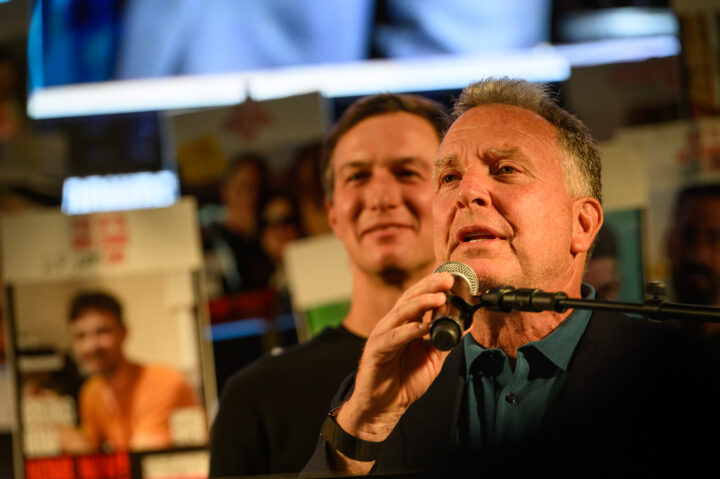
U.S. Middle East envoy Steve Witkoff (C), flanked by Jared Kushner (L), speaks at the weekly 'Bring Them Home' rally in Hostage Square Hostages Square on October 11, 2025 in Tel Aviv, Israel.
Two clashing narratives have emerged about Israel’s strike on a meeting of senior Hamas terrorists in Doha, Qatar, in September, following the release of a preview of an interview with U.S. Middle East envoy Steve Witkoff and Jared Kushner on CBS’ “60 Minutes” program that aired on Sunday evening.
Both narratives posit that the strike hastened the arrival of President Donald Trump’s 20-point plan to free the hostages and end the war. Figures close to Israeli Prime Minister Benjamin Netanyahu said that the attack pushed an anxious Qatar, Hamas’ patron and host of its senior officials, to do more to get the terrorist organization across the finish line.
Trump’s negotiators, however, presented a scenario in which the president, unhappy about the strike, pressured Israel to end the war.
Of the Israeli strike on Doha, Witkoff said that he and Kushner, who in recent months has also played a key role in the administration’s Middle East efforts, “felt a little bit betrayed.”
Kushner added, “I think [Trump] felt like the Israelis were getting a little bit out of control in what they were doing, and it was time to be very strong and stop them from doing things he thought were not in their long-term interest.”
Witkoff said that Qatar, which served as a key mediator between Hamas and Israel for much of the negotiations, said that, following the strike, “we had lost the confidence of the Qataris, so Hamas went underground. It was very difficult to get to them … and it became very, very evident as to how important, how critical [Qatar’s] role was.”
Jerusalem, however, had a different version of the events, as told by Israeli Strategic Affairs Minister Ron Dermer, Netanyahu’s closest confidante, in an Israel Hayom column by journalist Amit Segal.
Israelis involved in the negotiations viewed Qatar as a “spoiler,” such as when they talked Hamas out of accepting a deal proposed by Egypt earlier in the year, according to Segal.
Dermer, Segal wrote, “links the strike to the agreement … The Qataris, it turns out, were convinced that by agreeing to host the negotiations, they had obtained immunity from Israeli strikes on their soil. From their perspective, the strike was a blatant, offensive breach of the commitment. … The Americans’ genius was to convert that negative energy into fuel to propel negotiations to their goal. ‘You want Israel to stop? Then let’s end the war.'”
Netanyahu’s office and the White House closely coordinated throughout subsequent talks to end the war, Segal reported. Then came an agreement backed by several Arab states calling for Hamas to disarm and without the immediate involvement of the Palestinian Authority.
Reactions in Israel to the “60 minutes” preview fell on predictable lines. Netanyahu’s critics said that the U.S. officials’ comments demonstrated that the prime minister did not want to enter the agreement, but instead was pushed into it by Trump.
Israeli Opposition Leader Yair Lapid argued that Witkoff and Kushner’s comments made clear that “after the failed attack on Doha, Trump thought that Netanyahu lost control and forced an agreement on Netanyahu that he didn’t want. … An American administration has never described an Israeli government like this.”
Ha’aretz journalist Amir Tibon, who lived in one of the kibbutzim attacked by Hamas on Oct. 7, 2023, posted on X: “Witkoff and Kushner say in their own voices: Trump understood that Netanyahu was not on the right track and acted aggressively against him to reach a ceasefire and free the hostages.”
Nava Rozolyo, a prominent figure in the protests against Netanyahu years before the Gaza war began, wrote: “Thank you … for forcing Hamas and Netanyahu to reach an agreement on the return of all hostages and ending the war. Thank you for saving us from our own government and for saving lives.”
On the Israeli right, many took issue with Witkoff and Kushner’s retelling of events.
Jerusalem Center for Security and Foreign Affairs President Dan Diker posted on X that “the Israelis ‘getting out of control’ is what helped bring the hostage deal to the table, scaring the Qataris out of their minds.”
Some highlighted Kushner and Witkoff’s business dealings in Qatar. Kushner’s investment company, Affinity Partners, manages billions of dollars in investments from Qatar’s sovereign wealth fund. Witkoff’s son sought Qatari investments in commercial real estate projects earlier this year, and in 2023, Qatar bought the Park Lane Hotel in Manhattan from Witkoff and his partners.
Yishai Fleisher, spokesman for the Jewish community in Hebron and an informal advisor to Israeli National Security Minister Itamar Ben-Gvir, who opposes the ceasefire deal, posted on X in response to the video: “Two American Jews, with no blood on the line in Israel (their wife and kids don’t drive on the roads with Jihadis), but lots of money on the line and business with Qatar, wag their finger at the Jewish State as they cut an awful deal that is certain to bring war.”
Other moments in the interview courted further controversy in Israel, such as when Witkoff described an Israeli cabinet meeting that he attended, in which Ben-Gvir talked about “all the death and all the carnage” from the Oct. 7, 2023, Hamas attacks and was “emotional.” In response, Witkoff described his son Andrew’s death from an overdose and told the Israeli cabinet minister to “let it go, you just can’t play the victim all the time.”
Witkoff also brought up his son’s death in the interview in relation to his meeting with Hamas lead negotiator Khalil al-Haya, whose son was killed in the Doha strike.
“We expressed our condolences to him for the loss of his son, and I told him that I had lost my son and we are both members of a really bad club, parents who had buried children,” he said.
Kushner said of Witkoff and the senior Hamas terrorist: “When Steve and him talked about their sons, it turned from a negotiation with a terrorist group to seeing two human beings kind of showing a vulnerability with each other.”
Kushner also said that he sought to relay a message to Israel’s leadership that “now that the war is over, if you want to integrate Israel with the broader Middle East, you have to find a way to help the Palestinian people thrive and do better.”
“How are you doing with that message?” Leslie Stahl asked.
Kushner smiled and replied: “We’re just getting started.”
This report was updated on Oct. 20, 2025, after the CBS “60 Minutes” interview aired in full.
White House readout: ‘Prime Minister Netanyahu expressed his deep regret that Israel’s missile strike against Hamas targets in Qatar unintentionally killed a Qatari serviceman’
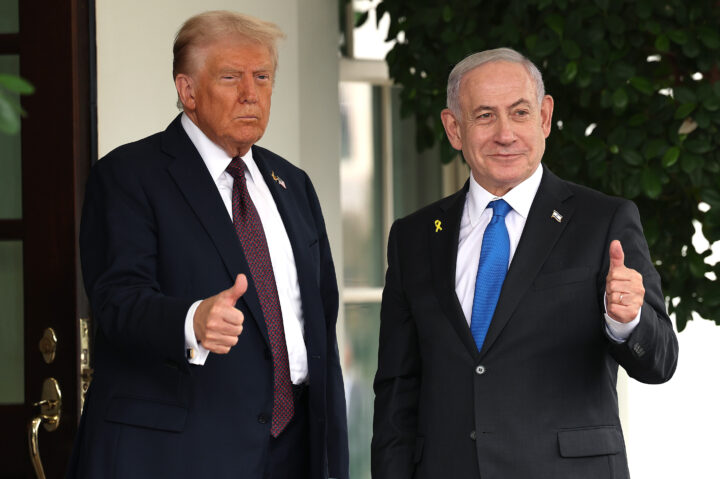
Win McNamee/Getty Images
President Donald Trump (L) greets Israeli Prime Minister Benjamin Netanyahu as he arrives at the White House on September 29, 2025 in Washington, DC.
During a meeting between Israeli Prime Minister Benjamin Netanyahu and President Donald Trump at the White House on Monday, Netanyahu apologized to Qatar’s prime minister, Sheikh Mohammed bin Abdulrahman al-Thani, for killing a Qatari serviceman in an attempted strike on Hamas leadership in Doha and promised not to violate Qatari sovereignty again.
The strike, which reportedly failed to eliminate any members of Hamas’ top political leadership, caused a public rift between the U.S. and Israel. The Trump administration attempted to warn Qatar about the strike before it happened and Trump said he promised Qatar that such attacks would not be repeated in the future.
According to a readout from the White House, “Prime Minister Netanyahu expressed his deep regret that Israel’s missile strike against Hamas targets in Qatar unintentionally killed a Qatari serviceman” and that “in targeting Hamas leadership during hostage negotiations, Israel violated Qatari sovereignty and affirmed that Israel will not conduct such an attack again in the future.”
According to remarks released by the Israeli government, Netanyahu told Al Thani, “I want you to know that Israel regrets that one of your citizens was killed in our strike. I want to assure you that Israel was targeting Hamas, not Qataris. I also want to assure you that Israel has no plan to violate your sovereignty again in the future, and I have made that commitment to the president.”
Netanyahu also acknowledged Qatar’s “grievances against Israel” as well as Israel’s own issues with Qatar “from support for the Muslim Brotherhood to how Israel is portrayed on Al Jazeera to support for anti-Israel sentiment on college campuses.”
Trump, during the call, “expressed his desire to put Israeli-Qatar relations on a positive track after years of mutual grievances and miscommunications,” and the three leaders agreed to establish a trilateral mechanism “to enhance coordination, improve communication, resolve mutual grievances, and strengthen collective efforts to prevent threats,” per the White House release.
According to his remarks, Netanyahu said that the mechanism is intended to “address both our countries outstanding grievances.”
Netanyahu and Al Thani “underscored their shared commitment to working together constructively and clearing away misperceptions, while building on the longstanding ties both have with the United States,” according to the White House readout.
The three leaders discussed efforts to end the war in Gaza as well as “the need for greater understanding between their countries.”
Al Thani “emphasiz[ed] Qatar’s readiness to continue contributing meaningfully to regional security and stability.”
Israel and Qatar do not have formal relations and public high-level diplomatic engagements between their leaders are rare.
From the Israeli side, news of the apology has been met with frustration and scorn from Netanyahu’s political allies and opponents.
Finance Minister Bezalel Smotrich compared the apology to U.K. Prime Minister Neville Chamberlain’s appeasement of Adolf Hitler during WWII. Netanyahu’s “groveling apology to a state that supports and funds terror is a disgrace,” Smotrich said on X.
National Security Minister Itamar Ben-Gvir expressed continued support for the Qatar strike, calling it “important, just, and supremely moral.”
Orit Strock, a member of the Israeli Cabinet, asked, “Did the Emir of Qatar apologize to PM Netanyahu for Oct. 7?”
Yair Golan, chairman of opposition party The Democrats, called the apology “a humiliation” and said that, “In order to beat Hamas, we need to replace Bibi and Qatar.”
Israeli political analyst and author Amit Segal said, “The Qatari scum have not condemned the October 7 massacre to this day. Even if there is a diplomatic need for this, it is repulsive and disgusting.”
Haaretz reporter Amir Tibon and others expressed anger that Netanyahu had apologized to the Qataris before he apologized to Israeli victims of Oct. 7.
Nadav Pollack, a lecturer at Israel’s Reichman University, said that the apology and promise show that Qatar holds stronger influence in the White House than Israel.
Foundation for Defense of Democracies CEO Mark Dubowitz downplayed the significance of the apology.
“Apology or not, Qatar is on notice that Israel will eliminate Hamas terrorists where and when it chooses,” Dubowitz told Jewish Insider. “The overarching message is more important: Get your Muslim Brotherhood cousins to agree to a deal, and release the hostages, or next time we won’t miss.”
Rich Goldberg, a senior advisor at FDD and a former Trump administration official, responded similarly.
“If that’s the worst thing Israel has to do to save face while Qatar acquiesces to U.S. pressure to secure the release of all hostages, let it be the last insult endured,” Goldberg told JI. “There is a cold dark place in hell awaiting all Hamas sponsors, and I expect the Mossad will help them find that place at the right time in the future.”
Both Dubowitz and Goldberg have publicly maintained that the U.S. was likely aware of and approved of the Israeli strikes in Qatar, in spite of Trump’s own public condemnations and denials.
Former U.S. Ambassador to Israel Dan Shapiro, a senior fellow at the Atlantic Council and former top Pentagon official in the Biden administration, told JI that the apology “was a useful diplomatic maneuver, likely pre-scripted, to ensure Qatar would do its part to deliver a yes from Hamas on release of all hostages and disarmament. Trump pressuring Netanyahu was necessary, but no less needed was his pressure on Qatar. The apology gave him that leverage.”
Michael Makovsky, the CEO of the Jewish Institute for National Security of America said that “Based on what we know, it’s understandable that Netanyahu felt compelled to apologize to the Qatari PM. Pres Trump asked him to do it, and Trump has collaborated with Israel in the 12-Day War, and backed Israel on Gaza.”
“But it’s unfortunate, because Israel doesn’t owe Qatar an apology—Qatar owes Israel an apology for supporting Hamas for so many years, by hosting its leaders, funding its operations, offering verbal support, etc.,” Makovsky continued. “Qatar should also apologize for spreading anti-Israel (and anti-American) hate on its al-Jazeera news organization. The bigger question is why Pres. Trump is so favorable to Qatar.”
Dana Stroul, the research director for the Washington Institute for Near East Policy and Shapiro’s predecessor at the Defense Department in the Biden administration, said that the statement echoes past engagements.
“It’s almost reverting to traditional US diplomacy of facilitating rapprochement between long-standing US partners,” Stroul said. “Recall then-President Obama brokering a phone call and an Israeli apology to Turkey in 2013 for its role in a 2010 Gaza flotilla incident. It also is a critical step in coalescing Arab support for providing meaningful support and resources to post war Gaza.”
She added that the administration “definitely believes it needs Qatar on its side.”
“When you read all of the various statements from the Trump administration about the peace and de-escalation agreements they are brokering, Qatar is very frequently thanked in these statements for its mediation role,” she explained.
At a press conference with Israeli PM Netanyahu, Rubio said an agreement with Hamas to end war ‘probably won’t happen’ because ‘savage terrorists don’t often agree to disarm’
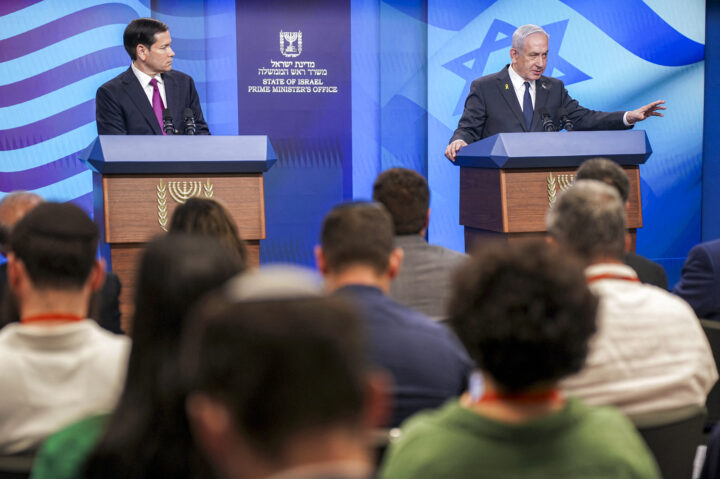
NATHAN HOWARD/POOL/AFP via Getty Images
Secretary of State Marco Rubio and Israeli Prime Minister Benjamin Netanyahu give a joint press conference at the Prime Minister's Office in Jerusalem on September 15, 2025.
Secretary of State Marco Rubio said the U.S. is focused on moving forward from Israel’s strike on Qatar last week, refraining from doubling down on criticism during a joint press conference with Israeli Prime Minister Benjamin Netanyahu in Jerusalem on Monday.
“We are just focused on what happens next,” Rubio said, when asked about Tuesday’s strike aiming at Hamas’ leadership in Doha, Qatar’s capital. On Saturday, Rubio had echoed comments by President Donald Trump that the U.S. “is not happy” about the strike.
“Some fundamentals still remain that have to be addressed, regardless of what has occurred,” Rubio said at the press conference on Monday. “We still have 48 hostages. Hamas is holding not only 48 hostages but all of Gaza hostage … As long as they still exist, are still around, there will be no peace in this region.”
Rubio said the end of the war in Gaza, disarmament of Hamas and freeing the hostages are “pillars of what we hope will happen in the region.”
The secretary of state said that the U.S. not only wants Qatar to continue to play a role in those matters “but also in a better future for the people of Gaza, which cannot happen with Hamas intact. We are going to continue to encourage Qatar to play a constructive role in that regard.” Rubio is scheduled to visit Qatar on Tuesday after concluding his trip in Israel.
As to the chance of a negotiated deal to end the war, Rubio said that “the problem is Hamas is a terrorist group, a barbaric group, committed to destroying the Jewish state, so it probably won’t happen.”
“I don’t think there’s anyone who wouldn’t prefer a negotiated settlement,” he added. “That would be the ideal outcome we can see, one we worked on, but we need to be prepared for the reality that savage terrorists don’t often agree to disarm.”
Netanyahu reiterated that “Israel’s decision to act against Hamas’ terrorist leadership was a wholly independent decision by Israel … It was conducted by us and we assume full responsibility for it, because we believe terrorists should not be given a haven.”
As to those saying Israel violated Qatari sovereignty, Netanyahu said that the U.S. took similar action against the Taliban in Afghanistan and Osama bin Laden in Pakistan.
“You don’t have such sovereignty when you are effectively giving a base to terrorists, a place where they can ply their gruesome trade,” he said.
Netanyahu also took issue with a claim made by a reporter during the press conference that the Doha strike was a failure, because it remains unclear if any of Hamas’ leaders were killed. The prime minister said Israel is waiting for further reports on the matter.
“I’ll tell you the results,” he added. “We sent a message to the terrorists. You can run, you can hide, but we’ll get you. … I don’t accept the premise that the raid failed, because it had one central message. … If the terrorists think they enjoy immunity they’ll do it again and again, and if you deny that immunity, they’ll think twice.”
Netanyahu opened the press conference by paying tribute to the “powerful bond” between Israel and the U.S. and thanking Trump for helping target Iran’s nuclear facilities in June, as well as his efforts to free the hostages remaining in Gaza, 20 of whom are believed to still be alive.
Rubio said that Iran is a threat not only because of its pursuit of nuclear weapons, but because of its development of short and midrange missiles that can reach across the Middle East and into Europe.
“This is an unacceptable risk not just for Israel but for the U.S. and the world, which is why the president has continued with his campaign of maximum pressure on Iran until they change course,” Rubio said. “We are encouraged by our partners in Europe beginning the process of snapping back [sanctions] on Iran, who are clearly out of compliance [with the 2015 nuclear deal]. We 100% support that; that’s what needs to happen.”
The secretary of state criticized countries that recently announced they would recognize a Palestinian state.
“The things these nations are doing in the U.N. are largely because of domestic politics. They’re largely symbolic. The only impact they have is to make Hamas feel emboldened … You know, there’s a negotiation going on and maybe you think you made some progress on getting hostages released and ending the war, and then these things come out and Hamas walks away … They see international support, they believe they’re getting what they want, and they walk away,” Rubio said.
Rubio also spoke about his plan to attend the inauguration of the Pilgrims Road on Monday evening. The site features the path on which Jewish pilgrims walked to the Second Temple in Jerusalem, which Rubio described as “perhaps one of the most important archeological sites on the planet, important to many in the U.S.”
The secretary of state arrived in Israel on Sunday, beginning his visit with prayers at the Western Wall with Netanyahu. He also met with Israeli Foreign Minister Gideon Sa’ar and Strategic Affairs Minister Ron Dermer on Monday.
Although most at the conference were decidedly pro-Israel, Netanyahu’s risky mission faced significant skepticism, particularly as reports emerged that the attack may not have killed the high-level Hamas leaders that Israel hoped to target

(Photo by JACQUELINE PENNEY/AFPTV/AFP via Getty Images)
This frame grab taken from an AFPTV footage shows smoke billowing after explosions in Qatar's capital Doha on September 9, 2025.
When 200 top policymakers, analysts and government officials from the U.S. and the Middle East gathered on Wednesday for the second day of the high-profile MEAD conference, one topic was top of mind for everyone at the ritzy Washington confab: Israel’s strike on Doha a day earlier that targeted senior Hamas officials who were gathered in the Qatari capital.
Although many at the conference were decidedly pro-Israel, Israeli Prime Minister Benjamin Netanyahu’s risky mission — Israel’s first-ever airstrikes on Qatar, a major non-NATO ally of the United States — faced significant skepticism, particularly as reports emerged that the attack may not have killed the high-level Hamas leaders that Israel hoped to target.
In a rare on-the-record session, former Israeli Prime Minister Yair Lapid, Israel’s opposition leader, questioned whether the strike fit within Israel’s broader war aims.
“If you take the operation itself, per se, and you single it out from anything else, of course these are a bunch of bad people that we should have killed a long time ago, and whenever you have a chance to kill them, you should kill them,” Lapid said. “Having said that, as the hours go by, we understand two things. A is that it might not be as successful as we thought in the beginning, and B [is] that this has nothing to do with strategy. It’s just an operation.”
That language marked a shift from Lapid’s initial reaction to the Qatar strike, which he described on Tuesday afternoon in a Hebrew-language tweet as “an exceptional operation to thwart our enemies.”
A lot changed in the interim: President Donald Trump said he was “very unhappy” with the attack, and that it “does not advance Israel or America’s goals.” Arab nations rallied around Qatar, with the leaders of the United Arab Emirates, Jordan and Saudi Arabia all visiting Doha this week. That led some MEAD attendees to argue that Israel’s strike could jeopardize regional integration efforts led by Washington.
There was little sympathy among MEAD attendees for the Hamas leaders who live in Qatar, which has faced criticism for providing them a safe harbor. But Israel’s apparent failure to reach its targets prompted frustration even from many who were sympathetic to the operation, because it’s unlikely the U.S. will permit Israel to try again.
The biggest problem, according to Lapid, was this divergence with the U.S., which Trump administration officials stood by on Wednesday.
“Part of Israel’s strength in the region and elsewhere is the fact that everybody seemed to think that we are stepping in lockstep with the administration,” said Lapid. “When the region sees us as somebody who is not that coordinated with the administration, with the United States, it has a bad effect on our ability to influence the region.”
Leiter compared Israel’s campaign against Hamas to the U.S. pursuing the perpetrators of 9/11
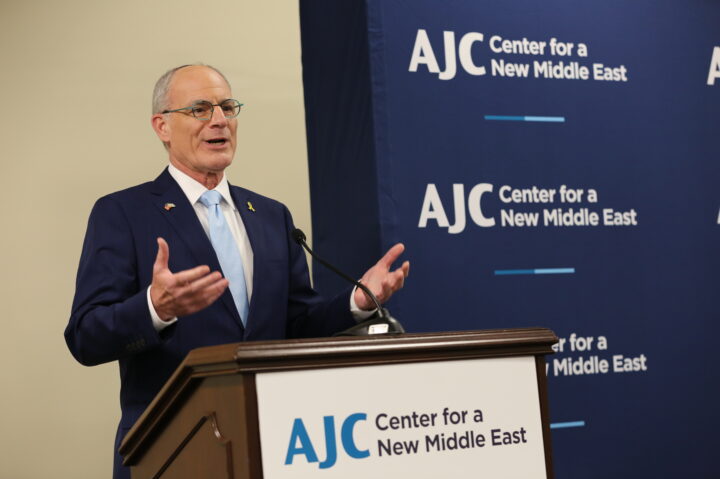
Martin H. Simon/AJC
Israeli Ambassador to the U.S. Yechiel Leiter speaks at AJC's Abraham Accords 5th Anniversary Commemoration on Capitol Hill in Washington on Sept. 10, 2025.
Israeli Ambassador to the U.S. Yechiel Leiter offered a strong defense of Israel’s strike on Hamas leaders in Doha, Qatar, as the Israeli government doubled down on the strategy in the face of strong pushback from the Trump administration.
Speaking at an American Jewish Committee event on Capitol Hill, Leiter argued that, in carrying out the strike, Israel was only doing what it and other countries have always done in the past: hunting down terrorists who perpetrate attacks on them wherever they may be.
He made repeated reference to Jordan’s King Hussein’s Black September campaign against Palestinian terrorists in Jordan, Israeli Prime Minister Golda Meir pursuing those responsible for the 1972 Munich Olympics attack and the U.S. launching wars to hunt down those responsible for the 9/11 attacks.
“Israel acted in the context of what any normal country does, it pursues terrorists and eliminates them, like King Hussein, like Golda Meir, like the United States of America,” Leiter said.
Leiter also highlighted U.N. Security Council Resolution 1373, presented by the U.S. and passed weeks after the 9/11 attacks, which “obligates states to prevent and suppress the financing and support of terrorism, including the harboring of terrorists.”
“Now what is Qatar doing if not financing and supporting terrorism by playing host to Hamas, the very people who sent the terrorists who murdered six people sitting at a bus stop in Jerusalem, waiting to go about their business?” Leiter said, referencing a Hamas-linked attack days before the Israeli strike in Doha.
“Who sent them? The terrorists we targeted in Doha. They celebrated the murder of these six innocents the same way they celebrated, on camera, the slaughter of 1,200 innocents on Oct. 7,” Leiter added.
Leiter said that, in striking Hamas leaders in Doha, “We are acting in the context of the U.N. charter, of international law, in the cause of sanity and morality.”
He noted that the campaigns by both Jordan against Palestinian terrorists and the United States against terrorist groups in Iraq could also have been considered “disproportionate,” a criticism that some in the international community have leveled over Israel’s operations in Gaza.
Leiter also argued that Israel’s ongoing military operations in the Middle East increase, rather than hurt, the prospects for expanded normalization, “because we are empowering the moderate elements within Islam.” The AJC event was a celebration of the fifth anniversary of the Abraham Accords.
Addressing criticisms that Israel has failed to properly plan for the day after the war in Gaza, Leiter insisted that those plans are in place — but can’t be safely discussed in public.
“We’re preparing for the day after. The day after is going to be brilliant and for it to succeed, we can’t talk too much about it, and it certainly can’t be an Israel-sponsored day after to enjoy success,” Leiter said.
President Donald Trump doubled down Tuesday evening on his criticism of the Israeli strike while Senate Republicans remain strongly supportive of the attack
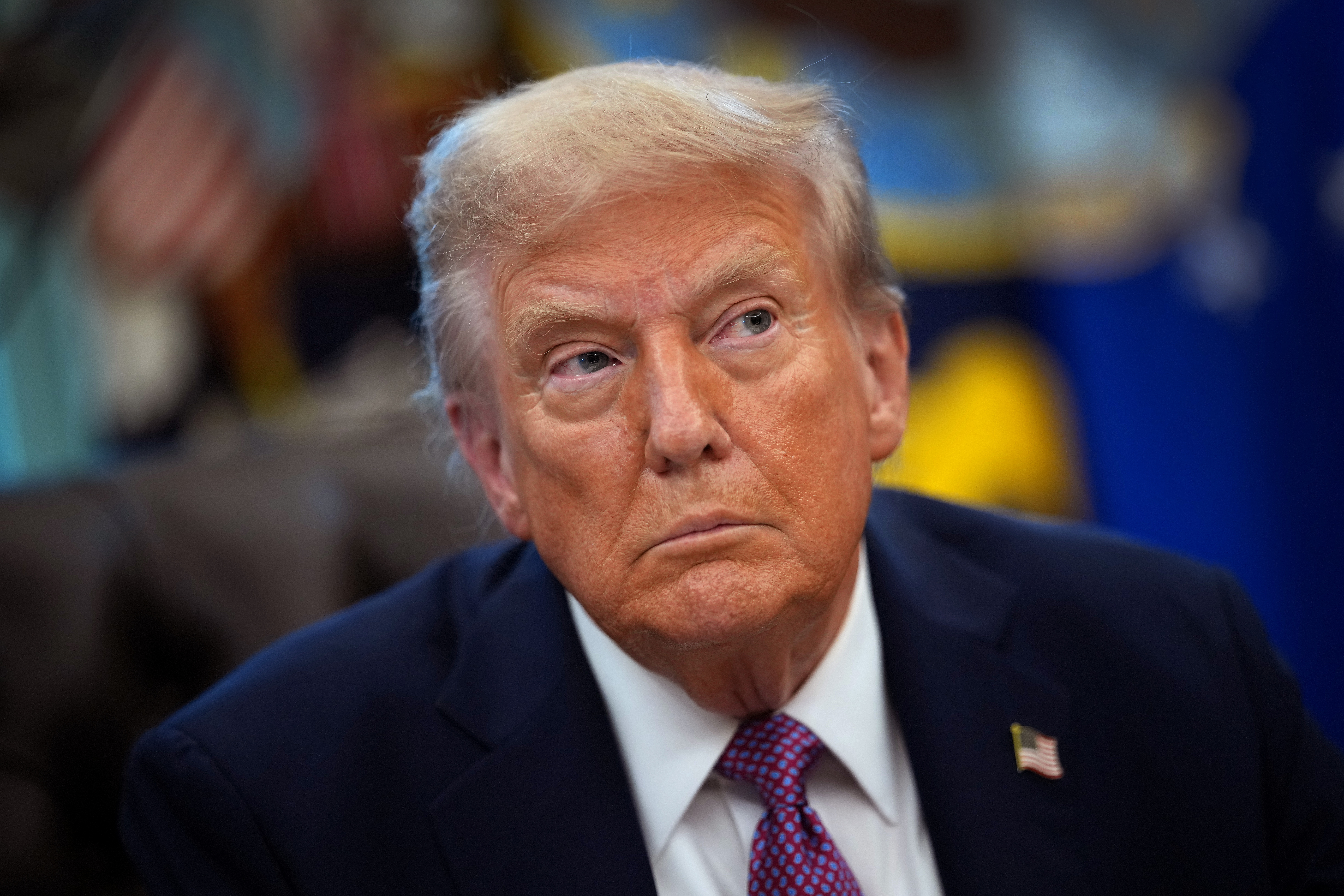
Kevin Dietsch/Getty Images
President Donald Trump in the Oval Office of the White House on Sept. 5, 2025 in Washington, DC.
The Israeli strike targeting Hamas leaders in Qatar is dividing the White House, which strongly criticized Israel for attacking Qatari territory, and Senate Republicans, who have been overwhelmingly supportive of the Israeli action.
President Donald Trump told reporters on Tuesday evening he was “not thrilled about the way that went down” and “very unhappy with every aspect,” his first direct public comments on the Israeli strike, after White House Press Secretary Karoline Leavitt made comments to the same effect earlier in the day.
Sen. Lindsey Graham (R-SC), asked about the White House statement on the attack, told Jewish Insider, “I understand we have troops there, but my focus is Israel. Hamas has had every chance. … Lay down your weapons, release the hostages — you live. If you don’t — it keeps going.”
Sen. Markwayne Mullin (R-OK) told JI, “Israel has made this very clear, and the same as we’ve made it very clear, we’re going to go after terrorist organizations, no matter where you’re at. We have a good relationship with the Qataris. They didn’t target the Qataris. They were targeting Hamas, and they had the right to do that.”
Asked about the administration’s comments, he said, “I understand where they’re at. My opinion is the Qataris knew good and well that they were there and they were doing nothing about it.”
He said that he does not know the full context of the strike at this point, but that if Israel had asked Qatar to take action against the Hamas leaders sheltering inside the country and Qatar had refused, “then I don’t blame Israel for doing that. Now if they didn’t have a conversation beforehand, maybe it is a different story.”
When asked about the White House’s statement, which described the Israeli strike as “unfortunate,” Sen. Rick Scott (R-FL) responded, “I think it’s unfortunate that Qatar kept the Hamas leaders in their country, that was the unfortunate part.”
He said that he was surprised that the strike didn’t come sooner.
“Why did it take them so long? As soon as Oct. 7 happened, I met with the Qatari ambassador and I said, ‘Why are you hosting these people?’ He said, ‘Well, Obama asked.’ I said, ‘He gave you a bad job. Stop doing it,’” Scott continued. “I’m glad [Israel] did it. I’m impressed with what [Israeli Prime Minister Benjamin] Netanyahu’s done, the political leaders, the military leaders, the IDF, whether destroying Hamas, or Hezbollah or Iran — you have to really admire what they’re doing.”
Sen. Roger Marshall (R-KS), the most outspoken supporter of Qatar among Senate Republicans, stood alone in offering a full-throated criticism of the Israeli strike and fully backing Trump’s position.
“I fully agree with President [Trump]. At the request of the U.S. and Israel, Qatar is mediating a peace agreement. The Israeli attack on allied soil, where approximately 10,000 American troops are stationed, is highly ill-advised,” Marshall said on X. “Grateful that [Secretary of State Marco Rubio] is finalizing a Defense Coordination Agreement with Qatar to prevent Israel from repeating this action.”
The IDF said it targeted Hamas’ senior leadership amid explosions in Doha
Screenshot/X
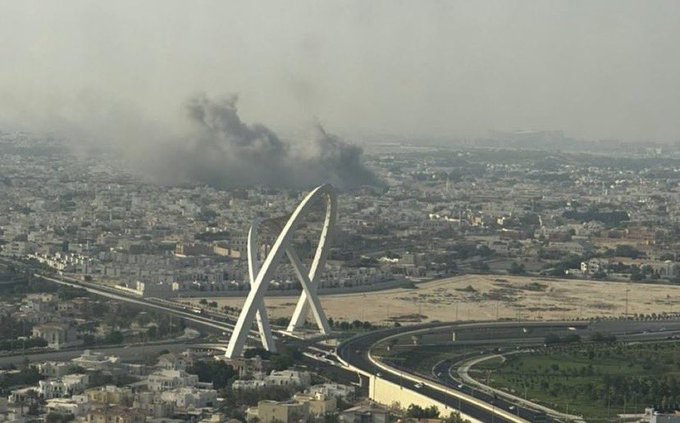
Israel strikes Hamas leadership in Doha, Qatar on Sept. 9, 2025.
Israel conducted a strike against senior Hamas leaders, the IDF said on Tuesday, following reports of explosions in Doha, Qatar.
The operation, whose Hebrew name translates to “Judgment Day,” reportedly targeted Khalil al-Hayya, Hamas’ chief negotiator in hostage and ceasefire talks, and longtime senior Hamas official Khalid Mashaal, as well as Hamas officials Zaher Jabarin and Nizar Awadallah, though reports conflict as to the success of the strike.
Israeli Prime Minister Benjamin Netanyahu and Defense Minister Israel Katz said in a joint statement that the Israeli defense establishment unanimously supported the strike.
“The action is totally justified in light of the fact that Hamas leadership initiated and organized the Oct. 7 massacre and did not stop launching murderous actions against Israel and its citizens since then, including taking responsibility for the murder of our civilians in the terrorist attack in Jerusalem yesterday,” they stated.
President Donald Trump was informed of the strike in advance and supported it, Israel’s Channel 12 reported. Netanyahu’s office said that “today’s action against the top terrorist chieftains of Hamas was a wholly independent Israeli operation. Israel initiated it, Israel conducted it, and Israel takes full responsibility.”
“The IDF and [Israel Security Agency (Shin Bet)] conducted a precise strike targeting the senior leadership of the Hamas terrorist organization,” the IDF Spokesperson’s Office stated. “For years, these members of the Hamas leadership have led the terrorist organization’s operations, are directly responsible for the brutal October 7th massacre, and have been orchestrating and managing the war against the State of Israel.”
The IDF said that it used precision munitions and intelligence to reduce harm to civilians.
Hamas leadership is based in the Al-Qatar neighborhood of Doha, where the explosions took place, according to videos posted on social media.
Qatar said it “strongly condemns” the strike in a statement posted to X by Majed Al-Ansari, spokesman for the Qatari Ministry of Foreign Affairs, which described the operation as “a cowardly Israeli attack that targeted residential buildings housing several members of the Political Bureau of Hamas in the Qatari capital, Doha.”
“This criminal assault constitutes a blatant violation of all international laws and norms, and poses a serious threat to the security and safety of Qataris and residents in Qatar,” he added, and said that Qatar “will not tolerate this reckless Israeli behavior and the ongoing disruption of regional security, nor any act that targets its security and sovereignty.”
The strike took place days after the Trump administration sent a Gaza ceasefire and hostage deal proposal via intermediaries, which Israel accepted and a senior Hamas official based in Istanbul rejected.
Earlier Tuesday, Netanyahu left a hearing in his ongoing corruption trial early due to “an exceptional security matter,” Israeli public broadcaster Kan reported.
In 1997, Israel attempted to assassinate Mashaal, the head of Hamas’ political bureau at the time, in Jordan, but gave Amman the antidote for the poison after then-King Hussein threatened to cancel the peace treaty between the countries.
The Israeli prime minister’s statement came after President Donald Trump said he’s ‘not happy’ about the attack
Abed Rahim Khatib/picture alliance via Getty Images
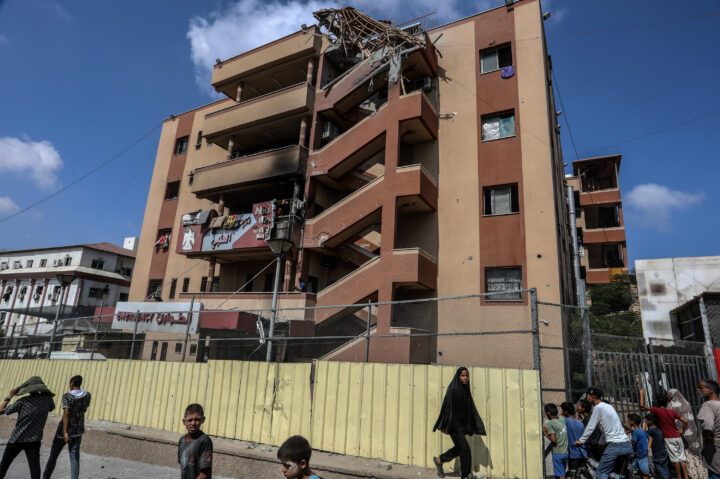
A view of Nasser hospital in Gaza, that was damaged by an Israeli strike on August 25, 2025.
An Israeli strike on a Gaza hospital that reportedly killed 20 people, including four journalists, was a “tragic mishap,” Israeli Prime Minister Benjamin Netanyahu said on Monday, not long after President Donald Trump criticized the attack.
“Israel deeply regrets the tragic mishap that occurred today at the Nasser Hospital in Gaza. Israel values the work of journalists, medical staff and all civilians,” the Prime Minister’s Office said in a statement. “The military authorities are conducting a thorough investigation. Our war is with Hamas terrorists. Our just goals are defeating Hamas and bringing our hostages home.”
Trump told reporters in the Oval Office that he is “not happy” about Israel’s strike on the Nasser Hospital, in the southern Gaza Strip.
“I’m not happy about it. I don’t want to see it,” Trump said, while noting that he did not know the details of the strike.
The president added that he is also committed to getting the remaining hostages out of Gaza, though he expressed doubt that a deal would come through.
“At the same time,” he said, “we have to end that whole nightmare. I’m the one that got the hostages out. I got them out, all of them. [Middle East envoy] Steve Witkoff has been amazing.”
Israel has said that 20 living hostages are still being held in Gaza, but Trump on Monday repeated a claim that the true number is “probably a little bit less than 20, because I think one or two are gone.” Israeli officials have not said that any of the 20 hostages believed to be alive have died recently.
Hamas, Trump said, is unlikely to release the hostages.
“I said a long time ago I’m going to get them out, but when we get down to that final 10 or 20, these people aren’t going to release them, because [Hamas is] dead after they release them,” Trump said. “It’s a nasty situation, very nasty. Horrible thing.”
The Israeli Defense Forces announced that it would conduct an inquiry into the attack. “The IDF regrets any harm to uninvolved individuals and does not target journalists as such. The IDF acts to mitigate harm to uninvolved individuals as much as possible while maintaining the safety of IDF troops,” IDF international spokesperson Lt. Col. Nadav Shoshani said.
A nationwide strike led by hostage families draws hundreds of thousands into the streets, revealing the depth of Israel’s internal divide as the military prepares for its next move in Gaza

Yair Palti
Protestors hold up phone flashlights in Tel Aviv's Hostages Square and the surrounding streets during mass demonstration for the hostages, August 18th, 2025
The unrest could be felt everywhere — in traffic jams, on the airwaves, in WhatsApp groups, even in the waiting room of a dental clinic.
Across Israel yesterday, hundreds of thousands joined a nationwide unofficial strike, led by hostage families and bereaved families, demanding an end to the war in Gaza and the immediate release of the hostages still held there. According to the Hostages Families Forum, over 1 million people participated in protests throughout the day. As the government plans to escalate its military campaign against Hamas, emotions ran high across towns, cities and online spaces, deepening a national rift.
Police clashed with demonstrators blocking roads. In Ra’anana, a truck driver was arrested after allegedly attacking a protester. In a Tel Aviv neighborhood mothers’ WhatsApp group, several members condemned local cafés for staying open, while another defended them for “not strengthening Hamas.” At a dental clinic, a man berated staff for opening their doors, shouting, “What about the hostages!?”
At the heart of the tensions is a painful divide: protesters — including the majority of the hostage families — argue that rescuing the captives must come before all else. Meanwhile, the government and its supporters, and even several hostage families, claim such demonstrations weaken Israel’s negotiating hand and embolden Hamas. Israeli President Issac Herzog, speaking at Hostages Square, said “There’s no Israeli who doesn’t want them back home. We can argue about philosophies, but truly, the people of Israel want our brothers and sisters back home.”
Israeli Prime Minister Benjamin Netanyahu doubled down on his government’s stance in a public statement, warning: “Those who are calling for an end to the war today without defeating Hamas, are not only hardening Hamas’s stance and pushing off the release of our hostages, they are also ensuring that the horrors of October 7 will recur again and again … to advance the release of our hostages and to ensure that Gaza will never again constitute a threat to Israel, we must complete the work and defeat Hamas.”
Yet recent polls show that a majority of Israelis support prioritizing the hostages’ release and bringing an end to the war.
Israeli journalist and commentator Ben Caspit wrote on social media: “To join the protest strike, you don’t have to be a leftist. Nor a centrist. Nor a rightist… You need a heart. There on the left side, between the ribs and the lungs. A beating heart that feels the need to express solidarity with our kidnapped brothers, with their families, with the terrible suffering.”
“And no, don’t believe the spin that it ‘helps Hamas.’ It doesn’t. Hamas doesn’t need strike X or demonstration Y to get to know Israeli society. Hamas knows us very well, just as we know them. They are death eaters. We seek life. That’s the whole difference.”
Meanwhile, Amit Segal — a reporter and political commentator often seen opposite Caspit on Channel 12 — offered a more sober take in his newsletter on Sunday: “While the strike will help many Israelis express their frustration and desperation to bring the hostages home, it won’t bring Israel closer to achieving the very thing they’re protesting for.”
Even if that may be, the protests reach further than home: former hostages have recounted the strength they gained from witnessing the demonstrations on the news while in captivity in Gaza. In Tel Aviv, as night fell, thousands of protesters raised their phone flashlights in Hostages Square and the surrounding streets, creating a moment of visual unity. The sea of lights stretched across the plaza and beyond — a simple gesture that carried a message of solidarity for the hostages still held in Gaza.
At the same time, the wheels of war are already turning. While Israelis grappled with grief, anger and hope in the streets, the military was preparing for its next incursion. Lt. Gen. Eyal Zamir, the IDF’s chief of staff, declared yesterday from the Gaza Strip: “Today we are approving the plan for the next phase of the war.”
“We will maintain the momentum of Operation ‘Gideon’s Chariots’ while focusing on Gaza City. We will continue to strike until the decisive defeat of Hamas, with the hostages always at the forefront of our minds,” Zamir said, adding, “Soon we will move on to the next phase” of the operation.
Obama’s former national security advisor disagreed with David Petraeus, John Bolton over the effectiveness of the strikes

Win McNamee/Getty Images
Former National Security Advisor Susan Rice speaks at the J Street 2018 National Conference April 16, 2018 in Washington, D.C.
Susan Rice, who served as national security advisor during the Obama administration’s nuclear deal with Iran, sharply criticized President Donald Trump’s decision to strike Tehran’s nuclear program while defending the 2015 agreement during a panel discussion on Monday at the Aspen Institute’s Ideas Festival.
Rice, who was on stage with former Trump administration National Security Advisor John Bolton and former CIA director David Petraeus, disagreed with her two colleagues that Trump’s Iran strikes were largely a success.
“I think the resort to military action when diplomacy had not been exhausted was a strategic mistake,” Rice said. “And the reality is, and we’re back to this point today, only diplomacy and a negotiated settlement can ensure the sustainable and verifiable dismantling of Iran’s nuclear program. You need inspectors on the ground. You need verifiable constraints that are very significant, and you don’t achieve that by ripping up the 2015 nuclear agreement and replacing it with nothing.”
Rice joins a chorus of former Obama and Biden administration officials who have criticized Trump’s decision to strike Iran’s nuclear facilities, despite many experts concluding the damage to the program was significant. IDF Chief of Staff Eyal Zamir, for instance, said that “based on the assessments of senior officers in IDF Intelligence, the damage to [Iran’s] nuclear program is … systemic … severe, broad and deep, and pushed back by years.”
Last week, former Secretary of State Tony Blinken wrote an op-ed in The New York Times: “The strike on three of Iran’s nuclear facilities by the United States was unwise and unnecessary. Now that it’s done, I very much hope it succeeded.”
At the Aspen Ideas Festival last week, former Biden administration National Security Advisor Jake Sullivan told moderator Fareed Zakaria: “We still need a deal because Iran still has, it appears, stockpiles of enriched uranium, still has centrifuge capacity, even if the installed centrifuge capacity has been destroyed or damaged or who knows what, and still has know-how and therefore still has the possibility of reconstituting its program.”
Bolton, on the same panel as Rice, argued that the time was ripe for military action against Iran.
“I think the regime is weaker than at any point since the 1979 revolution,” Bolton said. “But I think we will never have an opportunity this good to remove not just the nuclear program but the Iranian support for terrorism, which dates back to 1979 when they seized our embassy employees and it went downhill from there.”
Bolton outlined several ways in which Iranians are dissatisfied with the regime, including economic stagnation and state of women’s rights in the country.
“The answer is regime change. But in the meantime, we want to make sure that there aren’t any even possible successful efforts by Iran to do something with what they have,” Bolton said.
Turning to Israel’s war in Gaza, all members of the panel argued that Israel needed to shift its strategy to successfully eliminate Hamas. Bolton said that, despite successfully degrading the terror group’s organizational structure, Israel had not successfully fulfilled all of its war goals, which include eliminating Hamas and securing the release of all the hostages.
Bolton argued that an additional objective of the war should be to “provide a better future for the Palestinians without Hamas in their lives. The only way you can achieve all four of these is … by going in and conducting a comprehensive civil military counterinsurgency campaign. You clear every building floor room and block all the tunnel entrances, let the people that belong there back in with biometric ID cards, and then you have an entry control point to the rest of Gaza. With security, anything is possible.”
Iran unlikely to escalate attacks against the U.S. after strike on nuclear sites, but the war with Israel will continue, experts say
Morteza Nikoubazl/NurPhoto via Getty Images
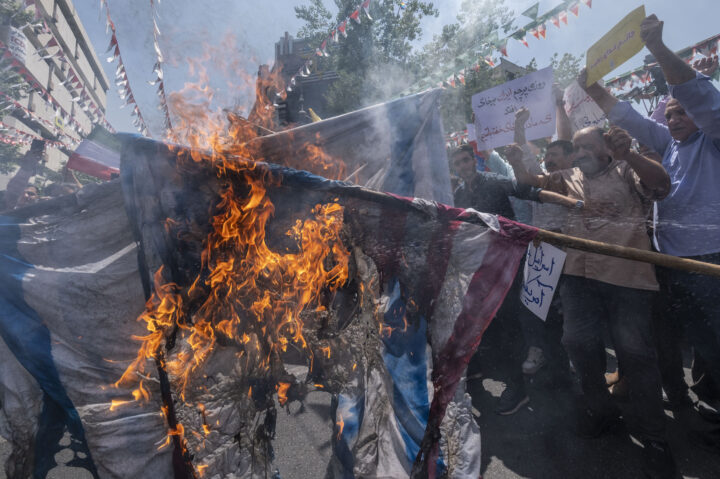
Iranian worshippers burn the flags of the U.S. and Israel during an anti-Israeli rally to condemn Israeli attacks on Iran, after Tehran's Friday prayers in Tehran, Iran, on June 20, 2025.
Iran is unlikely to initiate attacks against the U.S. after the American strike on Islamic Republic nuclear sites, but it will continue to launch missiles at Israel, experts told Jewish Insider on Sunday.
Hours after the U.S. bombed nuclear facilities in Fordow, Natanz and Isfahan in Iran, Raz Zimmt, director of the Iran program at the Institute for National Security Studies at Tel Aviv University, told JI that he doesn’t “identify a great desire — to say the least — of the Iranians to escalate with the U.S. … If they have a sharp reaction, it could drag in the Americans, who said that the matter is finished for them after they strike Iran. The U.S. has capabilities that could threaten the survival of the regime.”
Zimmt said it was likely that the Iranians would have a “symbolic reaction,” possibly targeting a U.S. military base in the region but with advance warning, similar to their response to the killing of Quds Force commander Qassem Soleimani in 2020.
“We shouldn’t underestimate Iran’s capabilities — their missiles are a big concern — but those who think we’re on the verge of World War III and that all the American bases will burn need to understand that the central goal of the Iranian regime is to survive, so I don’t think they’ll do that in the foreseeable future,” Zimmt added.
However, he said, hours after Iran shot 25 missiles at Israel on Sunday morning, causing damage in central Israel and Haifa, “Israel is another story. I think [Iran will] continue what they’re doing in Israel.”
Oded Ailam, a former senior official in Israel’s defense establishment and a researcher at the Jerusalem Center for Security and Foreign Affairs, told JI that Iran may choose not to escalate with the U.S. and instead “take out their anger on Israel with an increase in ballistic missiles,” but he said an Iranian attack on U.S. military targets in the region was still possible.
“The Iranians probably have not decided yet. It can go either way,” he said.
Iranian Foreign Minister Abbas Araghchi posted on X that “we were in negotiations with the U.S. when Israel decided to blow up that diplomacy. This week, we held talks with the E3/EU when the U.S. decided to blow up that diplomacy. What conclusion would you draw?”
Ailam said that while, in the short term, Iran was unlikely to return to the negotiating table “as a matter of national pride, it would look like a total defeat,” they would probably reenter talks farther down the line.
“I don’t know when it will happen, but I think the Iranians will very cautiously try to reach out to the Americans to negotiate and say they want to try to salvage some uranium enrichment for civilian needs,” he said.
Zimmt, however, said it was “clear that they won’t go back to negotiations.”
“The more significant thing in the weeks and days ahead is what they do in the nuclear arena,” he said. “Do they announce that they’re quitting the [Non-Proliferation Treaty]? In the end, I think their decision is connected to the question to which we don’t have an answer: what capabilities they still have.”
The lesson that Iran likely learned from the past week and a half, Zimmt posited, is that “being on the verge of having a nuclear weapon is not enough. They need to have a nuclear weapon. I’m not sure they can do it, though.”
“If, theoretically, they can use a few hundred centrifuges that remain and a few hundred kilos of uranium and try to break out [to weapons-grade enrichment] in a hidden place, they may consider it. I doubt they’ll do it now, when Israeli planes are flying over their heads, but I assume they would wait some time and reconsider their nuclear strategy,” Zimmt explained.
Initial satellite photos published by the Associated Press showed damage to the entrances of the nuclear facility in Fordow, which is under a mountain, as well as damage to the mountain itself. David Albright, president and founder of the Institute for Science and International Security, wrote on X that the photos appear to show that the bombs were dropped on a ventilation shaft into Fordow’s underground halls.
Ailam said that “the damage is very extensive.” According to his analysis, the attacks “neutralized” Iran’s ability to use its 400-kg stockpile of uranium enriched to 60% purity and turn it into weapons-grade (90% enriched) uranium.
“They don’t have the capability because they don’t have the centrifuges anymore,” he said. “It’s not terminal; if we want to ensure the nuclear weapons program is totally destroyed, we need to strike the 400 kg or reach an agreement in which it is removed from Iran, but this has significantly damaged the Iranians’ ability to rapidly reach military-grade enrichment.”
U.S. intelligence agencies said that the stockpile, held at the Isfahan facility, was harmed, but Israel has not yet released a similar assessment, Ailam said.
However, Zimmt said that it is harder to know the extent of the damage to the nuclear program without more extensive satellite photos of the nuclear sites.
“The Iranians are trying to present a picture that it was not significantly damaged, but there really is not much to rely on yet other than IDF reports,” he said.
IDF Spokesperson Effie Defrin said on Sunday that the Israeli army “has more targets. We are prepared for the campaign to continue and must prepare for any developments.”
Ailam said that Israel “did not entirely meet [its] goals. It was mostly Israel, but with the help of the U.S., we partially removed the immediate threat from the nuclear program and the massive ballistic system and [Iran’s] ability to manufacture 300 ballistic missiles a day. That was an existential threat to Israel.”
“But we are not at the point where we can say we removed all the threats and finished the whole bank of targets. It’s a huge country,” he added.
Zimmt said that the U.S. strike on Fordow was “the cherry on top” of Israel’s war against Iran, and that it’s time to wind down.
“Of course we can continue. We can always try to further degrade the nuclear program, but … as long as the goal was, foremost, to severely damage the nuclear program, the goal was — if not already achieved — it’s very close … I think the time has come to think of how to end this, even if it’s unilateral. If they attack, we can react, but we need to aim to finish in the coming days,” Zimmt said.
As for talk about regime change, Zimmt said it would be “impossible” through airstrikes.
Ailam said that every major attack on Iran creates “cracks in the regime’s wall and stability, and reveals this regime to be an empty vessel.” However, he said that there are not powerful enough forces within Iran that have risen up against the regime yet. “When it will happen is hard to say, but the more [the regime] suffers blows, the closer it gets.”
The Israeli prime minister, in video address: ‘History will record that President Trump acted to deny the world's most dangerous regime, the world's most dangerous weapons’

JACQUELYN MARTIN/POOL/AFP via Getty Images
Israeli Prime Minister Benjamin Netanyahu gives statements to the media inside The Kirya, which houses the Israeli Defence Ministry, after their meeting in Tel Aviv on October 12, 2023.
Israeli Prime Minister Benjamin Netanyahu praised President Donald Trump for his “bold decision” to strike three Iranian nuclear facilities located deep underground on Saturday.
Netanyahu made the comments in a video address posted shortly after Trump announced the completion of the operation targeting Fordow, Natanz and Esfahan, three nuclear sites that are deeply entrenched underground.
“Your bold decision to target Iran’s nuclear facilities with the awesome and righteous might of the United States will change history. In Operation Rising Lion, Israel has done truly amazing things, but in tonight’s action against Iran’s nuclear facilities, America has been truly unsurpassed. It has done what no other country on Earth could do. History will record that President Trump acted to deny the world’s most dangerous regime, the world’s most dangerous weapons,” Netanyahu said.
The Israeli prime minister argued that Trump’s “leadership today has created a pivot of history that can help lead the Middle East and beyond to a future of prosperity and peace.”
“President Trump and I often say ‘peace through strength.’ First comes strength, then comes peace. And tonight, President Trump and the United States acted with a lot of strength. President Trump, I thank you, the people of Israel thank you, the forces of civilization thank you,” Netanyahu added.
Trump’s decision to carry out the strikes came just over a week after Israel began its military operation to destroy Iran’s nuclear program and before the end of the two-week period that the Trump administration had provided for a decision on potential strikes. The decision also came as analysts and lawmakers on Capitol Hill warned that Israel lacked the capacity to destroy deeply entrenched nuclear facilities and would need the U.S. to get involved.
The president said on Saturday that the U.S. dropped six bunker-busting bombs on Fordow and launched a total of 30 Tomahawk cruise missiles from U.S. submarines at Natanz and Esfahan. He said that all three facilities were destroyed completely.
Ron Dermer and David Barnea will meet Steve Witkoff on Friday ahead of the sixth round of talks with Iran in Oman on Sunday 'in an additional attempt to clarify Israel's stance.'

ATTA KENARE/AFP via Getty Images
A picture taken on November 10, 2019, shows an Iranian flag in Iran's Bushehr nuclear power plant, during an official ceremony to kick-start works on a second reactor at the facility.
Since the Israeli strike on Iran’s air defenses in October, Jerusalem has sought a green light, or something close to it, from Washington to strike the Islamic Republic’s nuclear sites. President Donald Trump, however, repeatedly told Israel to hold off as he pursued a diplomatic agreement with Tehran to stop its enrichment program.
Now, after the Iranian nuclear program has continued apace and Trump has voiced frustration over Tehran’s intransigence, it seems that Jerusalem’s patience for diplomacy is running out.
Israeli Strategic Affairs Minister Ron Dermer and Mossad chief David Barnea will be meeting Trump’s top negotiator Steve Witkoff on Friday ahead of the sixth round of talks with Iran in Oman on Sunday “in an additional attempt to clarify Israel’s stance,” an official in Jerusalem said, amid persistent reports and strong indications that Israel is prepared to strike Iran.
After a call with Israeli Prime Minister Netanyahu last week, Trump said that if Tehran does not agree to give up uranium enrichment, the situation will get “very, very dire.” On Wednesday, Secretary of Defense Pete Hegseth said that “there have been plenty of indications” that Iran is moving towards weaponization of its nuclear program, and Gen. Michael “Erik” Kurilla, the chief of CENTCOM, said that he presented Trump and Hegseth with numerous options to attack Iran if nuclear talks break down.
Hours later, the State Department began to move some personnel out of Iraq and the military suggested that servicemembers’ families depart the Middle East, while the U.K. warned about a potential “escalation of military activity” in the region. Such evacuations are often the first step to reduce risk ahead of a large-scale military operation.
Trump told reporters that the evacuations are happening because the Middle East “could be a dangerous place, and we’ll see what happens.” More on this from Jewish Insider’s Marc Rod here.
Kurilla postponed his testimony before the Senate planned for Thursday. Staff at U.S. embassies and consulates throughout the Middle East were told to take safety precautions, and those stationed in Israel were told not to leave the Tel Aviv metropolitan area, Jerusalem or Beersheva.
Multiple news outlets published reports citing anonymous American officials that Israel is ready to strike Iran without help from the U.S. One possible reason for the timing — moving forward even as Washington and Tehran are set to enter a sixth round of talks on Sunday — is that Iran has reportedly begun to rebuild the air defenses that Israel destroyed last year. Iranian Armed Forces Chief of Staff Mohammad Bagheri reportedly said last month: “We are witnessing a remarkable improvement in the capability and readiness of the country’s air defense.”
Ynet’s well-sourced military analyst Yoav Zitun reported early Wednesday that Israel’s threat to attack Iran’s nuclear program is serious, and the most likely scenario is that Israel would strike Iran on its own but coordinate with the U.S. to receive air defense support. That scenario appears consistent with both Trump’s stated reticence to launch an attack, and the events that took place later that day.
In light of the negotiations set to continue on Sunday, some American analysts told JI that Washington could be acting as though it’s preparing for a possible attack to pressure Iran into concessions.
If the latest moves successfully pressure Iran, Shira Efron, Israel Policy Forum’s director of policy research, told JI that she hoped it would be “an opportunity to get to a bigger, better deal.”
However, in Israel, it looks like the moves towards a strike on Iran are serious.
The fact that Netanyahu is expected to go on a two-day vacation in northern Israel this weekend and his son is getting married next week have been counterintuitively pointed to as indications that a strike is imminent — after all, the Hezbollah pager operation happened when the prime minister was in New York, and the strike on Syria’s nuclear facilities in 2007 took place when then-Prime Minister Ehud Olmert was set to go on vacation in Europe.
“Yesterday, I thought there was no way something is going to happen,” Efron said, but now, “I think we’re at the money time. It’s more serious than we had thought.”
“Israel clearly no longer thinks an agreement can work, so it all depends on whether Trump told Israel it can do something before” negotiations between Iran and the U.S. break down, Efron said.
Sinwar has taken over as de facto leader of Hamas in Gaza since his older brother’s death

Mahmoud Issa/Anadolu via Getty Images
Smoke rises after Israeli airstrikes in Gaza City, Gaza, on April 29, 2025.
The IDF targeted Hamas leader Mohammad Sinwar in a strike on the European Hospital in southern Gaza, according to a report in The Times of Israel.
The IDF said it conducted a “precise strike on Hamas terrorists in a command and control center, located in an underground terrorist infrastructure site beneath the European hospital” on Monday evening local time, though did not name the targets.
Sources, including a senior Israeli official, told TOI and CNN that the intended target was Sinwar, the younger brother of former Hamas leader Yahya Sinwar who was assassinated by the IDF in October 2024. The younger Sinwar has become the de facto leader of Hamas in Gaza since his brother’s death.
Initial Palestinian media reports indicated at least four killed, though none named Sinwar.
Please log in if you already have a subscription, or subscribe to access the latest updates.
 Continue with Google
 Continue with Apple