



























































The resolutions are similar to that which failed in the Senate last week, but some narrow the scope of permitted intelligence sharing and military cooperation
Tom Williams/CQ Roll Call
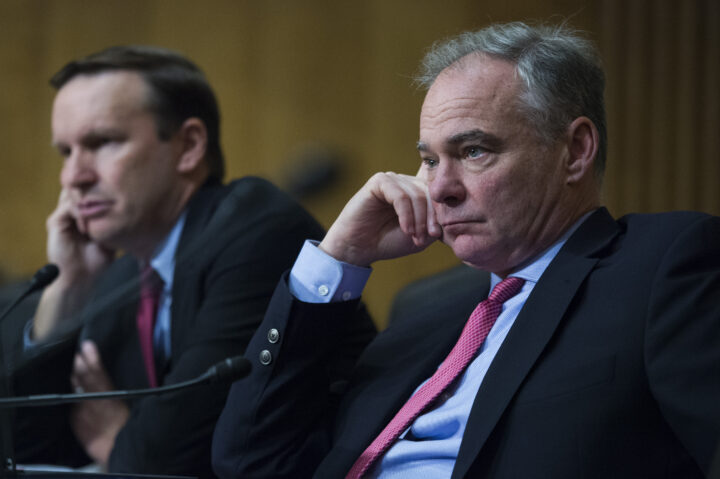
Sens. Chris Murphy (D-CT), left, and Tim Kaine (D-VA) attend a Senate Foreign Relations Committee nominations hearing in Dirksen Building on August 1, 2018.


 Add JewishInsider on Google
Senate Democrats introduced five new war powers resolutions seeking to block military action in Iran on Thursday, a day after the Senate voted along mostly partisan lines to block an effort to immediately halt the operation.
One of the resolutions was introduced by Sen. Tammy Baldwin (D-WI), with the other four being introduced by the same group of senators: Sens. Tim Kaine (D-VA), Chris Murphy (D-CT), Cory Booker (D-NJ) and Adam Schiff (D-CA). Murphy, who has also been pushing for the Senate to vote on an authorization for use of military force in Iran, is leading two of the resolutions, and Schiff and Booker are leading the other two, respectively.
Having a series of war powers resolutions already introduced could allow Democrats to continue teeing up votes on the war, or allow them to have several resolutions in reserve to vote on as the situation in Iran evolves.
War powers resolutions are subject to a 10-day waiting period between their introduction and when senators can force votes on them.
Kaine suggested last week after the initial war powers resolution failed that he would plan to force further war powers votes, as well as look for opportunities in other legislation to tee up votes on the war effort, which Democrats see as politically unpopular for the administration and for Republicans.
Kaine, Murphy, Booker and Schiff did not provide comment.
The text of one of the five resolutions was not yet available as of Sunday evening, but the other four are largely similar. As compared to the resolution led by Kaine, Schiff and Sen. Rand Paul (R-KY) that the Senate voted on last week, each includes updated details about the U.S. campaign in Iran, which had not yet begun when the previous resolution was introduced.
Several of the resolutions also appear to narrow the scope of U.S. intelligence sharing and military cooperation with Israel and other allies that would remain explicitly exempt from the legislation’s mandate for an immediate end to military operations against Iran.
One of the Murphy-led resolutions allows for intelligence sharing with allies attacked by Iran “related to defense from threats from Iran or its proxies,” whereas the Kaine-Paul resolution did not include that specific reference to defense.
It also allows for the U.S. to assist partners in “intercepting retaliatory attacks upon their territory,” where the previous version allowed for assisting with “defensive measures to protect their territory from retaliatory attacks by Iran or its proxies” more broadly — without the reference to interception of active attacks alone.
The Baldwin-led resolution includes the same language as the Murphy-led resolution on interceptions of retaliatory attacks, but does not include the new language on intelligence sharing.
The Schiff-led resolution includes similar specifications around intelligence sharing as the Murphy resolution, but does not impose the same limitations allowing the U.S. to only intercept attacks on allies. It includes additional language allowing for continued evacuations of U.S. citizens.
The Booker-led resolution does not include any additional restrictions on intelligence sharing, but it restricts assistance to Israel and other allies to “directly defending against retaliatory attacks upon their territories by Iran or its proxies.” It also includes the carveout regarding evacuations of U.S. citizens.
Separately, in the House, Rep. Josh Gottheimer (D-NJ) said Thursday that he plans to force a vote later this month on his war powers resolution that offers a 30-day wind-down period for the war effort in Iran, which Gottheimer is leading with several other moderate Democrats.
All the committee’s Republicans and two Democrats — Sens. Jeanne Shaheen and Jacky Rosen — voted in favor
Screenshot
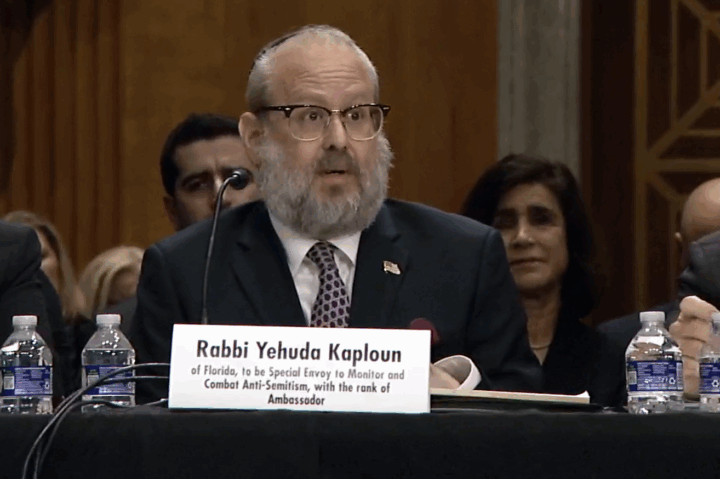
Rabbi Yehuda Kaploun, the Trump administration's nominee to be special envoy to monitor and combat antisemitism
The Senate Foreign Relations Committee voted on Wednesday to advance Rabbi Yehuda Kaploun’s nomination to be the Trump administration’s antisemitism envoy, clearing the way for a full Senate vote on his confirmation.
All 12 Republicans on the committee voted in favor, while eight of the 10 Democrats on the panel were opposed. The two Democrats who voted to support Kaploun were the committee’s ranking Democrat, Sen. Jeanne Shaheen (D-NH), and Sen. Jacky Rosen (D-NV), a close ally of the Jewish community.
Kaploun, an Orthodox Jewish businessman and Chabad rabbi, was a campaign surrogate for President Donald Trump’s 2024 bid and has, since he was first nominated for the post in April, become a fixture at D.C.-area events focused on combating antisemitism.
The leaders of various mainstream Jewish organizations — including the Jewish Federations of North America, the Conference of Presidents of Major American Jewish Organizations, the Anti-Defamation League and the American Jewish Committee — have urged Senate leaders to move ahead with the confirmation process and act swiftly to fill the post.
The 14-8 vote, which came two weeks after Kaploun’s confirmation hearing, offers a preview of how senators on both sides of the aisle could land on his nomination when it comes before the full Senate. Sen. Rand Paul’s (R-KY) decision to vote to advance Kaploun’s nomination, given his record of bucking the president’s choice of Cabinet nominees and legislative matters, suggests Republicans are likely to be unified in supporting Kaploun on the floor.
Shaheen and Rosen’s support for Kaploun’s nomination indicates that he could secure a handful of Democratic votes as well. Sen. John Fetterman (D-PA), who has not said where he stands on Kaploun’s nomination, has crossed party lines to support several of Trump’s Cabinet picks, including U.S. Ambassador to Israel Mike Huckabee.
Shaheen said during Wednesday’s vote that she had reservations about prior comments Kaploun had made about lawmakers, including statements she described as “very partisan.” Still, she planned to support his confirmation and said she hoped Kaploun would approach the role in a nonpartisan way.
“I’m going to vote for Mr. Kaploun, but I continue to be concerned about his past statements that he’s made, particularly about members of Congress. They have been very partisan. I think partisanship weakens the collective effort to combat antisemitism,” Shaheen said. “I agree with the past special envoy [Deborah Lipstadt], who has been supporting Mr. Kaploun, that this position should be above partisanship.”
“I hope that he will recognize that once he assumes this position, that he should be above partisanship and focus on combating antisemitism,” she added.
Please log in if you already have a subscription, or subscribe to access the latest updates.
 Continue with Google
 Continue with Apple