











































































Trump told Axios that he would be pressuring Israeli Prime Minister Benjamin Netanyahu not to strike back

Mostafa Alkharouf/Anadolu via Getty Images
Missiles fired by Iran to Israel are seen in the skies over Jerusalem on June 07, 2026.


 Add JewishInsider on Google
Iran launched a number of ballistic missiles at Israel on Sunday night for the first time since the U.S. and Iran reached a tenuous ceasefire in early April.
The IDF said it had intercepted all of the missiles “thus far,” and no injuries were reported. Israel’s Home Front Command canceled schools nationwide on Monday.
Ebrahim Rezaei, spokesperson for the Iranian parliament’s foreign policy and national security committee, had warned several hours prior to the attacks that Iran would deliver “a decisive and painful response” to the IDF’s strikes in the suburbs of Beirut earlier in the day. “These rabid dogs must be disciplined and put back in their place. Watch the sky over [Israel] tonight,” he wrote on X.
Earlier Sunday, the IDF struck the Beirut suburb of Dahiyeh, where it said it was targeting a Hezbollah headquarters, in response to the terror group’s missile attacks on northern Israel on Sunday morning.
President Donald Trump announced he had brokered a ceasefire between Israel and Hezbollah last week, though the terror group quickly rejected the deal.
Shortly after Iran’s attacks, Trump told Fox News that the incident was “certainly not going to help” the ongoing negotiations between the U.S. and Iran. He continued, “What I would suggest to Iran: You’ve shot your missiles, that’s enough, get back to the table and make a deal.”
About Israel’s strikes in Beirut, Trump said, “I’m not happy about it.”
Trump also told Axios, “I am going to call [Israeli Prime Minister Benjamin] Netanyahu right now and tell him not to strike back. … Each of them had their fun. Israel had its strike and Iran had its strike. We don’t need another one.” Israeli sources, however, told several news outlets that the IDF planned to deliver a “powerful” response to Iran.
Trump also said Netanyahu “won’t have any choice” but to accept any deal the U.S. reaches with Iran, in an interview with the Financial Times shortly after the Iranian attacks. “I call the shots. I call all the shots. He [Netanyahu] doesn’t call the shots,” the president said.
In a wide-ranging interview with JI, the U.S. ambassador to Israel also spoke out against far-right commentators spreading antisemitism
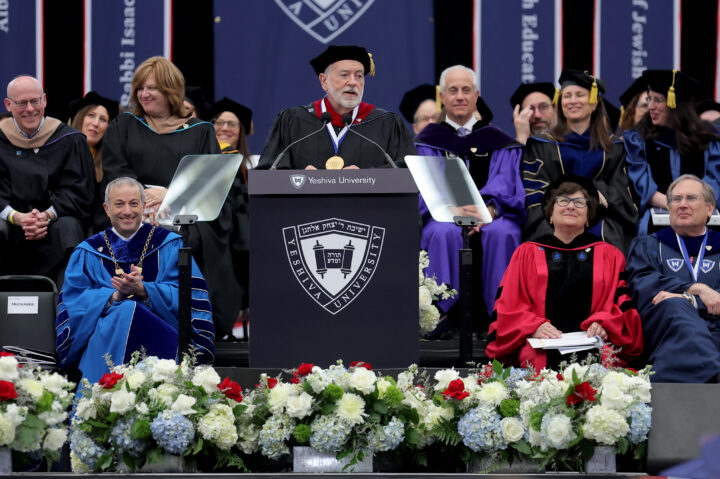
Yeshiva University
U.S. Ambassador to Israel Mike Huckabee delivers the commencement address at Yeshiva University’s graduation ceremony at Louis Armstrong Stadium in Queens, May 28, 2026
U.S. Ambassador to Israel Mike Huckabee urged America to “be doing more” to combat foreign influence in schools, which he identified as a key factor in the declining support for Israel among younger evangelical Americans.
While evangelicals have historically been some of Israel’s strongest allies, support among the youngest Americans is becoming “more divided” than in previous generations, Huckabee, who is an evangelical Christian, told Jewish Insider in a wide-ranging interview on Thursday.
“A lot of it is driven by social media and Middle Eastern studies programs that are heavily financed by Gulf state countries pouring billions of dollars into universities in the U.S. and giving people a very false understanding of what the realities in the Middle East are,” Huckabee said.
His comments came shortly before he delivered the commencement address at Yeshiva University’s graduation ceremony at Louis Armstrong Stadium in Queens — and a surprise musical performance. The theme of this year’s ceremony was “America 250.”
“Maybe the U.S. should be doing more because it’s still a problem. Truth is a great antiseptic as a healing power and we need more of it. I’m not one for restricting the rights of people to express the First Amendment. I want there to be more voices in the mainstream and for more people to engage in social media because that’s where a lot of the poison comes from and to counteract it,” he said.
Huckabee added that the U.S. should “block funding by anybody funding things that are fundamentally opposed, not only to American policy, but to truth. I’d like to think American policy and truth are hand in hand but especially when there is propaganda being inflicted on young minds, that should be unacceptable to us.”
According to a new report from the Institute for the Study of Global Antisemitism and Policy, Qatar has spent more than $65 million to influence U.S. education over the past 17 years through Qatar Foundation International.
The interview came as the U.S. and Iran reportedly await final approval from President Donald Trump to extend a ceasefire in the war and launch negotiations on Iran’s nuclear program.
“It’s an incredible time to weaken Iran,” said Huckabee. “We don’t know where the next step is. I would leave any questions about that to the White House and secretary of state. President Trump has made it very clear what his goals are — he will keep them and I trust him.”
Addressing Israeli settler violence in the West Bank, which has increased amid the Iran war, Huckabee suggested that the attacks have often been carried out by “people that don’t even live in Judea and Samaria,” a claim that security and human rights organizations dispute.
“The trouble that is caused by those who engage in attacks on Palestinian families is devastating to the reputation of Israel for no good purpose,” he continued. “I would say they are not settlers, they’re un-settlers. It’s a very tiny minority of people who engage in things like stealing livestock, vandalizing homes and cars and committing acts of violence, but it’s too many. Just as outraged as we are when there’s a Palestinian crime against an Israeli, we can be equally concerned about a crime an Israeli might commit against a Palestinian.”
Huckabee also expressed concern over declining support for Israel among both young Americans using social media and certain fringes of the Republican Party.
“The No. 1 [way to get young Americans engaged with Israel] is to bring them to Israel, let them see it firsthand,” he said. “It’s the best antidote there possibly could be. Anyone who comes to Israel will never leave saying it’s an apartheid state or that it’s genocidal. You cannot come to any of those ridiculously false conclusions. It’s a free, wonderful, vibrant society in which people with all kinds of viewpoints are able to live and thrive. People need to see that and understand most of what they hear, particularly on social media, is an outright lie.”
Beyond coming to Israel, “people who know the truth need to be bold in speaking the truth,” he added.
“Americans don’t realize that the return on investment that Americans get from Israel is many times over anything they ever have as Americans have invested into Israel,” the ambassador said. “What we give we get right back, not only in terms of direct military sales where thousands of Americans’ jobs are created solely because Israel is buying defense mechanisms, but a lot of other things too, like cellphones and car navigation.”
He said the GOP will only remain pro-Israel if Republicans “understand the big picture” — “If they understand not only world history but the realities of the geopolitical world and especially that of the Middle East.”
Huckabee distanced his party from several right-wing commentators who have used their large platforms to spread antisemitism.
“I’m finding the anti-Israel voices are leaving the Republican Party, they are no longer a part of it,” continued Huckabee. “Tucker Carlson, Megyn Kelly, Candace Owens are not Republicans. They’ve gone in a direction that is independent of any particular ideology other than making a lot of money and getting provocative statements in the marketplace. But you don’t hear an ideology expressed. I hope people will pay less and less attention to the voices of division.”
“I don’t want to say [those voices] must be funded from outside sources,” said Huckabee. “I think some of it is driven by the fact that social media makes money because people click, [even] if they click in disagreement.”
During his commencement address, Huckabee said he is “a Zionist — an unapologetic one — because I believe the Bible and because I recognize that Jews around the world … have created an outsized impact on the world.”
On the sidelines of YU’s commencement, Rabbi Ari Berman, president of the university, told JI that even as campus antisemitism appears quieter than in the immediate years following the Oct. 7, 2023, terrorist attacks, the institution “continues to see an incredible rise in interest.”
“Our honors applications are up 70% the past two years,” said Berman. “Students who would have otherwise gone to elite universities are recognizing that the elite Jewish university actually does not only give them academic excellence but nourishes their soul.”
But it’s not just students seeking refuge in a Jewish university, said Berman. “Faculty are coming to us also. After Oct. 7, faculty with values realized campuses are without compassion.” He pointed to the university’s new engineering program, which was founded and chaired by a professor who left his position at Cooper Union amid increased campus antisemitism.
Following a “donor revolt” after Oct. 7 — a wave of financial pushback where prominent alumni and philanthropists leveraged their donations to various universities to force administrative changes in addressing antisemitism — Berman said he is “not concerned” about donors who switched their gifts to YU returning to other universities.
Still, Berman warned that “people foolishly are returning to a pre Oct. 7 mindset, and should not forget what was revealed” on American campuses following the attacks.
Bruce Pearl, former head coach of Auburn University, made a surprise appearance to address the crowd, praising YU’s basketball team and student athletes. Faculty, graduates and honorees all donned the blue square pin, a symbol associated with the fight against antisemitism as part of a campaign spearheaded by New England Patriots owner Robert Kraft’s Blue Square Alliance Against Hate.
‘Too many Jewish students and educators at too many MCPS schools continue to face too many threats,’ said COO Guila Franklin Siegel
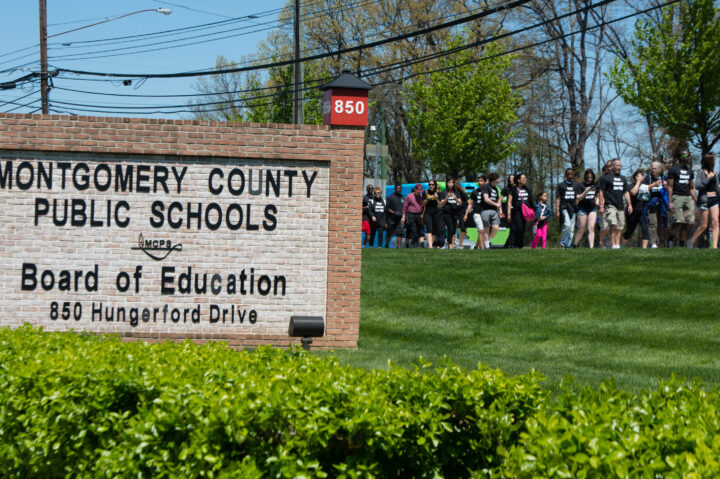
Sarah L. Voisin/The Washington Post via Getty Images
Montgomery County Public Schools building on April 27, 2014.
The leading Jewish advocacy group representing the Washington, D.C., area is raising the alarm on a uniquely high rate of antisemitic incidents in Maryland’s Montgomery County public school system.
Guila Franklin Siegel, chief operating officer at the Jewish Community Relations Council of Greater Washington, said Tuesday that the JCRC is receiving “significantly higher” reports of antisemitism out of MCPS, located just outside of Washington, than others in the region.
Montgomery County’s public school system is the largest school district in the state and hosts a sizable Jewish student population.
The statement comes amid a new report from the Anti-Defamation League showing that Maryland ranked ninth in total antisemitic incidents nationwide in 2025, two-thirds of which occurred in Montgomery County. Among the top ten states with total incidents, Maryland ranked first in the percentage of incidents occurring at K-12 schools, at 34%.
“While the details vary, these incidents reveal a harsh truth: too many Jewish students and educators at too many MCPS schools continue to face too many threats,” said Franklin Siegel, whose statement came the day after JCRC leadership met with MCPS Superintendent Thomas Taylor and his senior management team.
Incidents in recent months include anti-Jewish and anti-Israel graffiti on school walls, most recently at Greenwood Elementary School last weekend; inflammatory anti-Israel messaging at Olney Elementary School’s recent cultural night; “Heil Hitler” gestures and speech occurring at middle school events; and, according to JCRC, “physical threats and harassment directed toward Jewish students at multiple schools.”
Franklin Siegel said MCPS and JCRC leadership discussed “progress on the steps MCPS needs to take to protect Jewish students, educators, and staff.”
“Our messages were simple: MCPS must establish a zero-tolerance policy on antisemitism and other forms of hatred and bias; train and empower administrators and teachers to correctly identify and respond to antisemitism; and rigorously enforce disciplinary codes, making it clear that anyone who engages in antisemitic or other hateful behavior will face meaningful consequences,” Franklin Siegel said.
MCPS said it “will be in compliance with recently adopted state law requiring anti-bias training for school educators and staff” starting in August, according to Franklin Siegel.
The school district also committed “to improv[ing] school participation rates in JCRC’s gold-standard Student to Student and Holocaust speakers’ programs” and to “drafting specific guidelines for culture and international nights. The district must ensure these events are safe and educational for all students and families, not political battlefields,” she added.
But Franklin Siegel called on the school district to go further in protecting Jewish students.
“MCPS should follow the lead of other schools in our area by incorporating specific antisemitism training as well,” she said. “More lessons about Jewish history beyond antisemitism and the Holocaust should be included in its curricula. And given that bias incidents are so often connected to the proliferation of hate speech online, MCPS also needs to discipline students who harass and bully Jewish students on social media accounts, even when those accounts are not formally affiliated with schools. The district has that authority, and principals must enforce it.”
MCPS, which serves over 156,000 students, did not respond to a request for comment from Jewish Insider.

Chip Somodevilla/Getty Images
U.S. Census Bureau Director Robert Groves holds a news conference at the National Press Club August 25, 2011, in Washington, D.C.
School may be out of session for the summer, but officials from Georgetown University, the University of California, Berkeley and the City University of New York will be in the hot seat this week when they testify on Tuesday before the House Education and Workforce Committee.
This is not the first time that university officials have appeared in front of Congress to account for the situations on their campuses, but this week’s hearing aims to focus on more than just the anti-Israel activism that has permeated many campuses since the Oct. 7, 2023, Hamas terror attacks on Israel and the ensuing war in Gaza to focus on root issues, including foreign funding in higher education as well as faculty anti-Israel organizing efforts.
With that as the backdrop, Georgetown’s interim president, Robert Groves, is likely to face hard-hitting questioning about the school’s donations from authoritarian regimes.
Nearly a decade ago, Georgetown took a $10 million donation from an organization connected to Beijing’s ruling Chinese Communist Party — more specifically, according to The Washington Post, to “the specific CCP organizations that manage overseas influence operations” — to establish the Initiative for U.S.-China Dialogue on Global Issues.
But that $10 million is a drop in the bucket compared to the amount of money Qatar is alleged to have sent to Georgetown. According to a study by the research institute ISGAP — which primarily focuses on progressive and Islamist antisemitism — Qatar has donated more than $1 billion dollars to the Jesuit school in recent decades. In addition, Qatar has long had a partnership with Georgetown that includes an outpost of the school in Doha. Earlier this year, the school extended its contract with Doha for another decade.
UC Berkeley’s own handling of foreign funding will be under the microscope during Tuesday’s hearing. Earlier this year, the Department Education launched an investigation into the school’s alleged failure to report hundreds of million dollars in foreign funding — including $220 million from China for the creation of a Berkeley-linked campus in the city of Shenzhen.
The CUNY system doesn’t receive foreign funding. But it is likely to face scrutiny for its handling of campus antisemitism issues, which date back long before the Oct. 7 attacks. A decade ago, CUNY’s graduate student union was one of the first to push an anti-Israel vote on Shabbat.
In the years since, the school has seen a number of issues across its campuses and disciplines. CUNY Law School’s 2022 commencement speaker, Nerdeen Kiswani, said from the lectern that she had been targeted by “well-funded organizations with ties to the Israeli government.”
Kiswani, one of the founders of the far-left anti-Israel Within Our Lifetime organization, was a national leader of Students for Justice in Palestine when she was an undergraduate attending both Hunter College and the College of Staten Island.
We also expect a number of committee members to grill Georgetown and Berkeley leaders on their handling of campus incidents, such as the Georgetown’s support for a professor earlier this year who was alleged to have ties to Hamas, as well as the more recent call last month by the chair of the school’s Islamic studies department to call for “symbolic” Iranian strikes on American bases in the Middle East.
Past hearings have proven to be significant moments for some of those testifying, as well as members of Congress. Rep. Elise Stefanik’s (R-NY) profile was elevated following her grilling of University of Pennsylvania, Massachusetts Institute of Technology and Harvard leaders — two of whom resigned shortly after appearing before the committee.
But they are perhaps most consequential for the Jewish students on those campuses — many of whom matriculated amid the COVID-19 pandemic after having lost out on key adolescent and teenage experiences. For some of these students, their desire to have a “normal” college experience was taken from them by the protests and anti-Israel activity that swept across campuses nearly two years ago. But still, many continue to apply to these schools, hopeful that the worst is in the past.
There’s a saying that has floated around many a conference, Jewish organizational board meeting and Shabbat dinner table in recent years: Jews endow buildings, their enemies endow what happens inside of them. Tomorrow’s hearing will see just how deeply those efforts have permeated.
Please log in if you already have a subscription, or subscribe to access the latest updates.
 Continue with Google

 Continue with Apple