












































































Can the Israeli electorate overlook the fact that Netanyahu was in charge during the Oct. 7 massacre and was responsible for some of the mistakes leading up to it? That is precisely what Likud is betting on
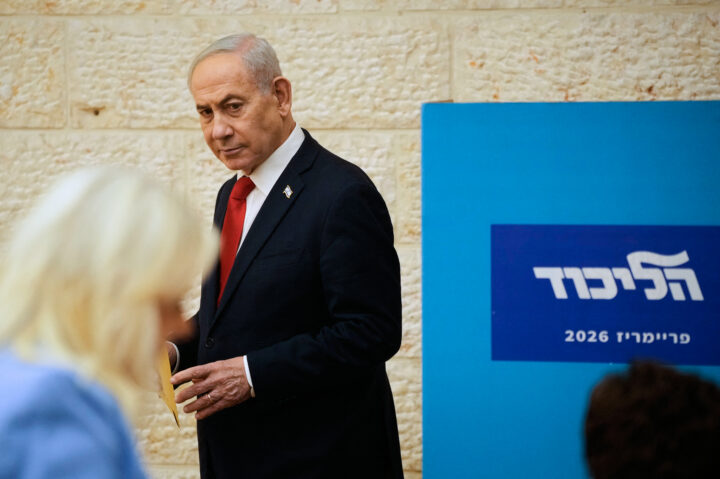
(Ohad Zwigenberg / POOL / AFP via Getty Images)
Israeli Prime Minister Benjamin Netanyahu casts his ballot at his party Likud's main polling station during primary elections ahead of Israel's general election in October in Jerusalem on August 17, 2026.


 Add JewishInsider on Google
The countdown to Israel’s October elections has begun, bringing with it a central question: Will Prime Minister Benjamin Netanyahu — who, against all odds, remains in office three years after the Oct. 7, 2023, Hamas attacks took place under his tenure — remain Israel’s leader?
Israeli governments have often faced political upheaval after major wars or security crises, but Netanyahu’s current government completed a full term — the first time a government has done so in nearly four decades. But Netanyahu is not out of the woods yet.
“Oct. 7 serves primarily as a reminder that the stakes are genuinely high. Israel is a country where elections are fought over matters of life and death in the most literal sense,” Shmuel Rosner, a pollster and analyst for Israel’s Channel 13, told Jewish Insider.
The leading candidates of the major parties all have defense bona fides: Netanyahu, who has been out of power for only a single year in the last 15 years, has overseen wars in Gaza, Lebanon and Iran; Gadi Eisenkot, who is projected to lead the largest party according to most polls, served as IDF chief of staff from 2015 to 2019 and lost his son, Gal, in Gaza combat; and former Prime Minister Naftali Bennett, who served as a cabinet minister for nearly a decade.
So how is it that the average Israeli voter — with plenty of experience at the ballot box, having endured six election cycles in a decade — is largely maintaining the same voting pattern?
“The discussion is always framed in terms of alternatives. People used to say: ‘What, rockets are being fired at Sderot again and again, and people still vote for Likud?’ It seems crazy, but the answer is yes, indeed,” a political strategist who has worked for Likud and several other parties told JI. “Ultimately, right-wing voters tend to be pragmatic. As a result, they assess the available alternatives. When the alternative is perceived as worse, they will go with the option that feels more natural to them, despite their anger.”
Many Israelis view the upcoming election in this frame of tradeoffs: What is more concerning — another term under a Netanyahu-led government that includes the ultra-Orthodox parties as they continue to push for draft exemptions for their constituents, or a new government that might rely on Arab parties to reach the magic number of 61 members of Knesset needed to form a coalition?
“First, there’s the question of whether a potential voter wants the current coalition to return in an identical or similar composition. Next is whether they want the prime minister to continue in his role. And as usual, there’s the element of fear: How much do they fear the ‘other side’, meaning the possibility of an alternative coalition forming?” Rosner explained. “‘A coalition with Arab parties is the demon of the right; a coalition of ‘extremists’ is the demon of the smaller centrist parties; a ‘coalition with the Haredim’ is the demon of many voters, particularly in the anti-Netanyahu camp, and so on.”
If there is one thing both the Israeli right and left agree on, it is that security issues will dominate this election. In a poll conducted last July and published by Kan 11, voters were asked what key issue would determine their vote in the October elections: One-quarter of respondents cited security issues, while an almost equal share (24%) cited the Oct. 7 failures and the establishment of a commission of inquiry into the terror attacks.
Economic matters trailed in third place at 22%, while judicial reform — an issue that dominated Israeli politics just a few years ago — stood at just 12%.
“Economics isn’t playing a major role in these elections. Security definitely is,” Rosner noted. “Netanyahu faces a challenge partly because he made far-reaching promises that even his supporters realize were not delivered on. If he could show Hamas raising a white flag, or Iran doing the same, or boast a stable peace agreement with Lebanon without Hezbollah on the horizon, he would have something to sell.”
Yossi Tatika, a pollster and strategic consultant at Tatika Consulting and Research, also believes that defense issues remain “the top priority for the Israeli voter, but their meaning has shifted. In my view, the Israeli voter is prioritizing security figures who are not directly tied to Oct. 7. There is a strong appetite for figures perceived as ‘fresh faces.'”
One new candidate on the scene is Ofer Winter, a former high-ranking IDF officer who historically maintained ties with Netanyahu, Avigdor Liberman and Bennett (though some of those relationships have cooled) and has a strong animosity towards Eisenkot, who refused to promote him to a general when he was the IDF chief of staff. Winter announced the launch of his new right-wing party, People of Israel, last week, and some polls project the new contender winning between four and six seats. In an election campaign that feels increasingly unpredictable, he could emerge as the wild card.
Meanwhile, Netanyahu has publicly urged his far-right Cabinet ministers, Finance Minister Bezalel Smotrich and National Security Minister Itamar Ben-Gvir, to merge their parties to hopefully gain more seats in the election, but they have remained defiant.
Still, Netanyahu remains a powerful brand among large segments of the Israeli public, and his entire campaign rests on what he markets as Israel’s achievements over nearly three years of war, including, the assassinations of Hezbollah leader Hassan Nasrallah, Iranian Supreme Leader Ayatollah Ali Khamenei and Hamas head Yahya Sinwar, while touting deterrence this has brought Israel in the region.
Can the Israeli electorate overlook the fact that Netanyahu was in charge during the Oct. 7 massacre and was responsible for some of the mistakes leading up to it? That is precisely what Likud is betting on. The answer will begin to come clear at 10 p.m. on Oct. 27, when the exit polls are released.
Longtime observers of the U.S.-Israel relationship expressed concern that Jerusalem has not developed a strategic long-term approach to deal with the emerging political realities in the U.S.

Andrew Harnik/Getty Images
President Donald Trump, seated next to Secretary of Defense Pete Hegseth, hosts Israeli Prime Minister Benjamin Netanyahu for a dinner in the Blue Room of the White House on July 7, 2025, in Washington, DC.
After a tumultuous decade in American politics, both major parties are undergoing ideological and generational shifts that are likely to redefine America’s standing in the world — and its relationship with Israel.
On the left, a new generation of lawmakers from the progressive wing of the Democratic Party, many with more critical views of Israel than those who came before them, is making gains in major cities, state capitals and on Capitol Hill. On the right, the ascendance of the isolationist MAGA movement and the decline in support for Israel among younger evangelical Christians, traditionally a bastion of support for the Jewish state, is challenging what has long been traditional, unequivocal GOP support for Israel.
Longtime observers of the U.S.-Israel relationship with whom JI spoke over the weekend expressed concern that Jerusalem has not developed a strategic long-term approach to deal with the emerging political realities in the U.S.
When asked if he believed there’s a serious effort in Jerusalem to address the longterm political challenges in the U.S., former Israeli Ambassador to the U.S. Michael Oren was succinct: “I do not.”
The U.S.-Israel relationship, Yossi Klein Halevi, a senior fellow at the Shalom Hartman Institute, told JI on Sunday, “has never been in bigger trouble.” What’s so significant about this moment, he said, is that “the erosion is happening in both parties.”
In the past, Halevi explained, “we could always rely on one party or the other to bail us out. And of course, in the past, it was usually the Democrats, and the fact that the erosion is now beginning in the Republican Party should be sending major, major alarms in Jerusalem, but I don’t see any indication of that.”
Former Knesset member Einat Wilf told JI that the warning signs had been evident for years, and that she had pushed for conversations on the future of the U.S.-Israel relationship when Rep. Ilhan Omar (D-MN) began to criticize Israel. “I remember at the time I started talking with people,” Wilf recalled, “And I told them, ‘Look, if I’m Israel, then I’m putting [together] a team now. Doesn’t have to be overt, but I’m putting [together] a team now that begins to plan for a world where we don’t have such strong support.’”
Wilf said that the idea of Rep.Alexandria Ocasio-Cortez as a future president, which would have been “a fringe scenario not long a time ago,” is no longer such a long shot. “Now, it’s almost the mainstream scenario. So we need to take that into consideration. We need to look at it as at least a serious or likely scenario.”
The problem, Halevi said, is that Israel’s government is not thinking long term. “It’s all day-to-day, and it’s all tactical, and it’s not strategic. What happens after Trump and Netanyahu? Scorched earth, as far as [Netanyahu is] concerned. So there’s no one in the government thinking seriously about the relationship with Washington, because he didn’t allow that. It all has to go through him. It goes through him and [Strategic Affairs Minister Ron] Dermer.”
America’s shifting political winds “are not existential issues for Israel, but they’re very, very serious strategic issues for Israel,” Oren said.
Much of the concern from the activist wings of both parties in recent months has been about U.S. military support for Israel amid the IDF’s campaign in Gaza. Lawmakers on the far left and far right have advocated for rolling back military support for Israel. But that sentiment is being to percolate into the mainstream — note former Transportation Secretary Pete Buttigieg’s opposition earlier this month to a new Memorandum of Understanding between the U.S. and Israel, ahead of the current MOU’s expiration in 2028.
Oren had suggested in 2021 a rethinking of U.S. military aid to Israel, from a traditional “donor-to-recipient” model to “a collaborative relationship based on both countries’ interests and strengths.” That sort of cooperation, he suggested at the time, “would bring immediate benefits to American and Israeli security and strengthen their abilities to counter common threats.”
Such a redefined military relationship with the U.S. would likely serve to combat concerns from the isolationist branch of the GOP over entrenchment in foreign conflicts at a time when such engagement is unpopular among the MAGA wing of the party. And it would address, to some degree, concerns from progressive Democrats, some of whom are pushing the “Block the Bombs” bill to end the U.S.’ sale of offensive weapons to Israel.
But ultimately, Israel is at its best strategically and militarily when it gives itself time and runway to prepare for future challenges and threats. Its wars against Hamas and Hezbollah have underscored the results of Israel’s long-term planning: Hezbollah’s dismantlement as a serious threat came swiftly and as the result of years of preparation, while, nearly two years after the start of the Israel’s war in Gaza, Hamas remains in power, holding both Israelis and the entire enclave hostage as Israel fights an elusive threat on the ground and a losing battle for public opinion around the world.
Those with whom JI spoke agreed that taking on an evolvingU.S. political reality now will help future Israeli governments address the long-term challenges facing the U.S.-Israel relationship.
“We’re a crisis-oriented society. That’s partly our strength, that helps us cope, because we don’t think too far in advance,” Halevi said. “It helps us. It keeps us from getting too depressed. But the downside is that you don’t have the kind of serious, strategic conversations that we desperately need, and certainly we should be having those conversations now about what happens after Trump, what happens if we find ourselves stranded without any major party to rely on.”
Please log in if you already have a subscription, or subscribe to access the latest updates.
 Continue with Google

 Continue with Apple