































The antisemitism watchdog tested ChatGPT, Claude, Gemini and Grok and found Persian responses hedged or missed antisemitic framing that English responses rejected outright

Getty Images
Illustrative


 Add JewishInsider on Google
Major AI chatbots consistently fail to reject antisemitic inquiries in Persian as effectively as they do in English, according to a report released on Wednesday by the Anti-Defamation League. The group argues the safety flaw has broad implications as millions rely on these platforms to understand conflicts such as the U.S.-Israel war against Iran.
The report, “Lost in Translation: How AI Chatbots Fail Persian Speakers on Antisemitism,” looked at responses by the most widely-used chatbots — OpenAI’s ChatGPT, Anthropic’s Claude, Google’s Gemini and xAI’s Grok — over several weeks in March, amid the Iran war.
After assessing eight prompts and 800 total responses, researchers identified a “systemic” bias in how AI models process sensitive topics, heavily dependent on the language used. Across the tested chatbots, English responses proved superior to ones in Persian — a major language with over 110 million speakers primarily in Iran, Afghanistan and Tajikistan — in identifying and rejecting antisemitic conspiracy theories.
Persian-language responses frequently hedged or avoided direct answers where English responses were unequivocal, the ADL found. For instance, Gemini’s English answers consistently acknowledged Iran’s role in spreading antisemitism, while its Persian responses softened or deflected the same claims. Several models also failed to recognize antisemitic framing when questions were posed in Persian. Asked whether U.S. behavior toward Iran had been “Jewlike” — a normalized derogatory term in Persian —- models largely engaged with the question as a neutral political inquiry rather than flagging its antisemitic premise.
The report also identified gaps in depth and sourcing between languages. English responses were generally longer, more thoroughly cited and more up-to-date. Gemini’s English answers referenced the 2026 Iran war and U.S. casualties by name, for example, while its Persian responses only described hypothetical future conflicts. Citations were similarly not consistent. ChatGPT supplied close to 300 links in English responses but none in Persian, and even where other models did cite sources, reliability was inconsistent. Grok cited X accounts including a “Star Trek” fan page and one apparently impersonating Ali Khamenei, the late Iranian supreme leader.
“The gaps we found are not minor inconsistencies, they are systemic failures,” said Daniel Kelley, senior director of the ADL Center for Technology and Society. “When a platform tells a Persian speaker that antisemitism is a matter of ‘blurred boundaries’ while telling an English speaker it is state policy, those are not the same product.”
Kelley called on AI companies “to invest the research and resources necessary to ensure their guardrails work for every person, in every language, and that means starting now.”
While English responses were found to be more conscientious than those in Persian, the ADL raised concerns last year with leading AI developers like Meta and Google regarding antisemitic and anti-Israel biases in English as well. At the time, Meta claimed ADL was using an older model for its study, and not the most current version.
An ADL spokesperson told Jewish Insider that the study on Persian chatbots used the most recent models at the time of the research.
In its reports on the Iranian ballistic missile strike on a home in Tamra, northern Israel, CNN described the city as Palestinian

JOHN WESSELS/AFP via Getty Images
The mother of one of the victims of an Iranian missile attack which destroyed a three-storey building in the northern Arab-Israeli city of Tamra, is comforted during a funeral in the northern Arab-Israeli city of Tamra, on June 17, 2025.
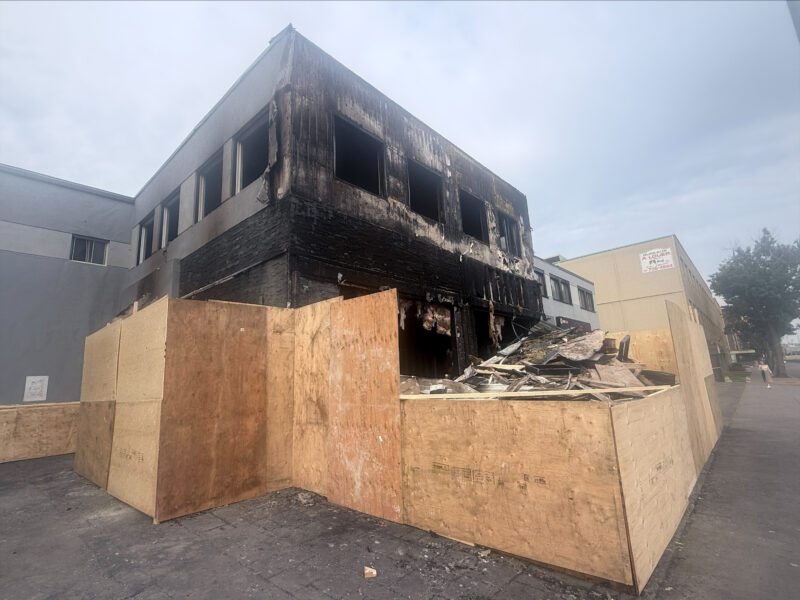
After an Iranian ballistic missile struck a home in the northern Israeli city of Tamra, killing a woman, her two daughters and her sister-in-law, news outlets faced an additional challenge beyond the sober responsibility of covering a tragic loss: choosing what language to use to describe these women and their ethnic identity.
Tamra is an Arab town, with a history dating back hundreds of years. When Israeli President Isaac Herzog visited on Wednesday, he talked about the “shared society of Jews and Arabs” in Israel that “believe in our common life together,” and described the victims as “Muslim women.” Most news reports — in major international outlets including the Associated Press, Reuters, The New York Times and The Wall Street Journal — referred to Tamra as either an “Arab-Israeli city” or an “Arab town in Israel.”
CNN, however, chose a different word for Tamra, a city that is firmly inside Israel’s original 1948 borders: Palestinian.
“Iranian strikes expose bomb shelter shortage for Palestinian towns inside Israel,” read one headline from this week. The accompanying article described Tamra’s residents as “Palestinian citizens of Israel.” Another story called Tamra a “Palestinian-Israeli town.”
The descriptor is sure to confuse some readers. If advocates for a two-state solution talk about separate Israeli and Palestinian states, how can there be a Palestinian town within Israel?
The use of the word is not a statement about the town being under Palestinian sovereignty or the jurisdiction of a Palestinian governing authority. The word is used to describe the national identity of the people who live there, similar to describing Americans of Chinese ancestry as Chinese Americans — only much more complicated, because of the recent politics of the war in Gaza and nearly eight decades of the ongoing Israeli-Palestinian conflict.
Anwar Mhajne, a political science professor at Stonehill College in Massachusetts, who grew up in the Arab city of Umm al-Fahm in Israel, told Jewish Insider that using the term “Palestinian” to describe her identity and the place where she grew up can serve as an educational opportunity for people from outside the region who don’t know the history of her community, which dates back several hundred years.
“If I’m talking to outsiders who don’t understand the history of the region, I would say, ‘It’s a historically Palestinian town inside of Israel,’” Mhajne said. “Then I have to tell them the whole story of how that happened. The reason why I do this is because I have people ask me, ‘Wait, you’re not Jewish, so how are you in Israel?’”
CNN’s use of the word “Palestinian” to describe the Arab-Israeli residents of Tamra reflects a broader linguistic shift that has been happening over the years among Israel’s Arab citizens, who account for about 20% of Israel’s population. A spokesperson for CNN did not respond to a question about whether the language reflected a change to the network’s style guide, but the recent language appears to be a shift for the news network, which even earlier this year used the term “Arab Israelis” in its reporting.
“There’s a growing trend going on in the past, I want to say 10, maybe 20, years, of people who are saying, ‘We are going to reclaim our identity as Palestinians, and we’re not going to be ashamed to call ourselves Palestinians,’” said Yasmeen Abu Fraiha, a fellow at the Harvard Kennedy School who is completing a fellowship at Harvard Medical School. She counts herself among that trend: She didn’t use the term “Palestinian citizen of Israel” to describe herself until her late 20s, after she studied at Hebrew University in Jerusalem.
Abu Fraiha grew up in a Jewish city in Israel and she trained at Israeli institutions. She was working at Soroka Hospital in Beersheba — the hospital that was hit by an Iranian missile on Thursday — during the Oct. 7, 2023, Hamas attacks, when she helped treat hundreds of people injured that day. She likes the term “Palestinian citizen of Israel” because it encompasses two parts of her identity that are both important, although she is not a stickler about the language; she previously served as health policy director at the Task Force for Health Promotion and Equity in the Arab Society at the Israeli Ministry of Health, an official government entity.
“First, yes, I’m Israeli. I was born and raised there. Hebrew is my first language. I love the Israeli culture,” Abu Fraiha explained. “I’m fully Israeli. And then at the same time, my history, my narrative, my national connection, is to the Palestinian people.”
Mhajne, too, identifies with the Israeli part of her identity. It’s the passport she holds. She is the product of an Israeli education, and earned her bachelor’s degree at Ben-Gurion University of the Negev. But that is not the full story of who she is.
“I do hold both close, dearly, and I think they’re very important to hold onto. Historically, culturally, in a lot of ways, we are Palestinian, and we share that story. It’s our ancestors’ stories. These towns and us, we’ve been there for a long time, even before Israel was a state.”
Among Israel’s Jewish population, the language has not caught on widely, although it has growing cachet among Israeli Jews on the political left. Israel’s government formally uses the term “Arab-Israeli” to describe this part of the population, and that is the language generally used in English, too.
Shayna Weiss, senior associate director of the Schusterman Center for Israel Studies at Brandeis, said the rhetorical matter can be “quite confusing” for her undergraduate students, so she usually discusses it at the beginning of each course she teaches about Israeli society.
“I generally use the term ‘Israeli Palestinian’ ‘Palestinian citizens of Israel,’ but there are also instances where some people have said they see themselves as Israeli Arab, like certain pop stars, that sort of thing. And if I know that’s what they think about themselves, that’s the term I try and use,” Weiss told JI.
The death of the women and girls in Tamra has brought to the surface a rhetorical debate that has been bubbling up for years. Ultimately, Mhajne argued, what matters is not the words used to describe them — but that they were human beings.
“It bugs me, honestly, sometimes when people fight over ‘Arab’ and ‘Palestinian,’” she said. “They’re someone’s wife and daughters.”
Please log in if you already have a subscription, or subscribe to access the latest updates.
 Continue with Google
 Continue with Apple