










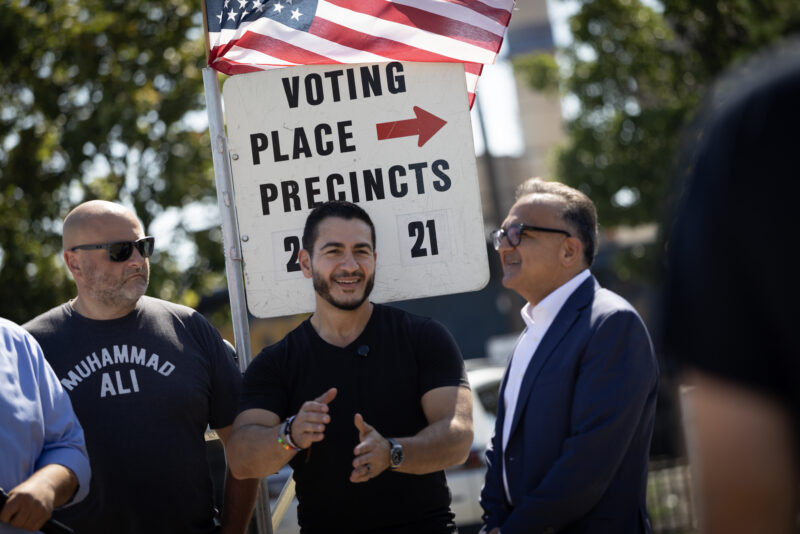
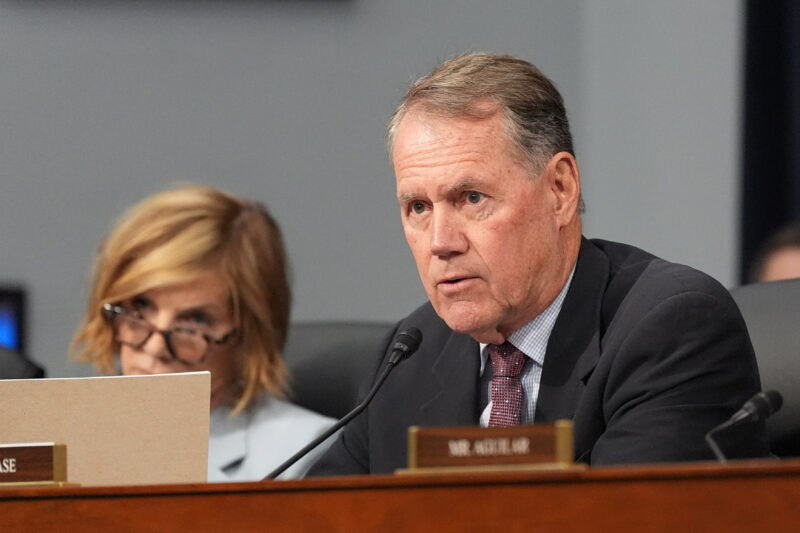
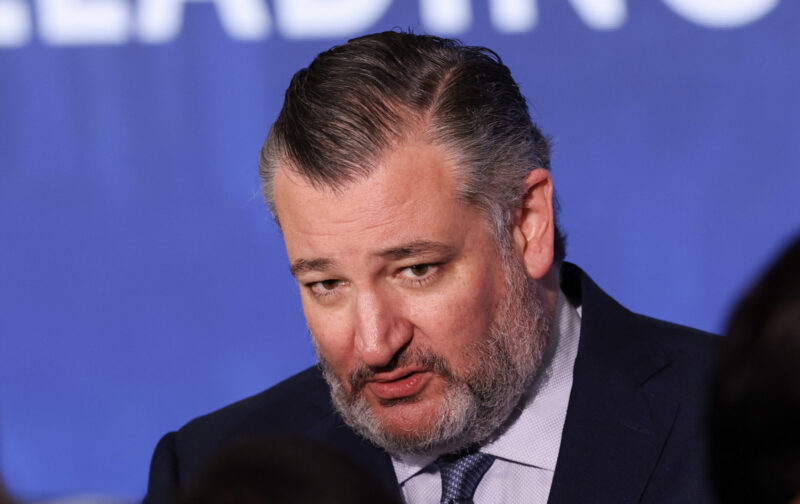
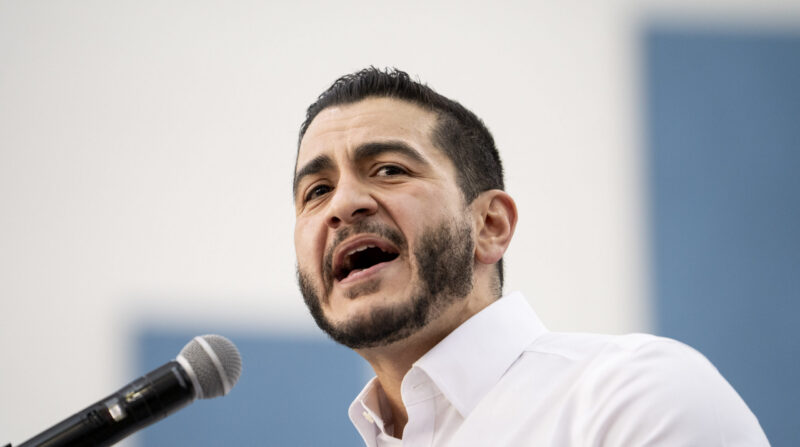











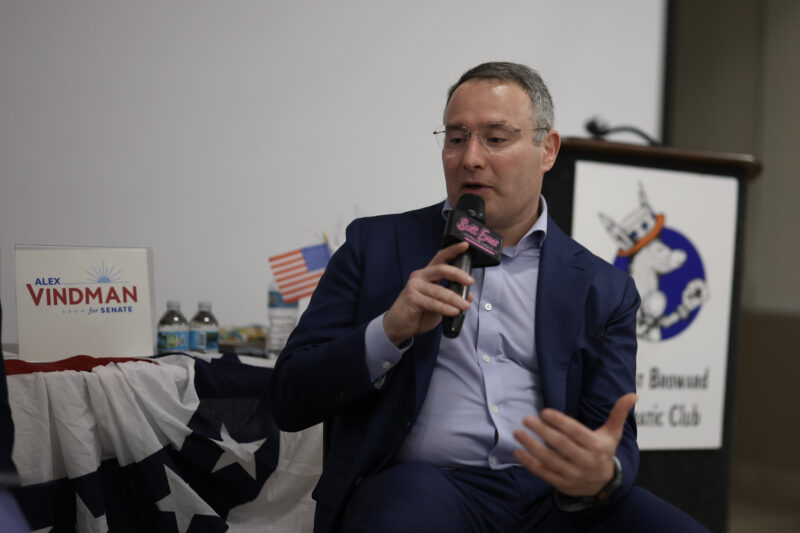













The leading candidate, former state Sen. Matt Little, is calling for a full arms embargo on Israel

(Carlos Gonzalez/The Minnesota Star Tribune via Getty Images)
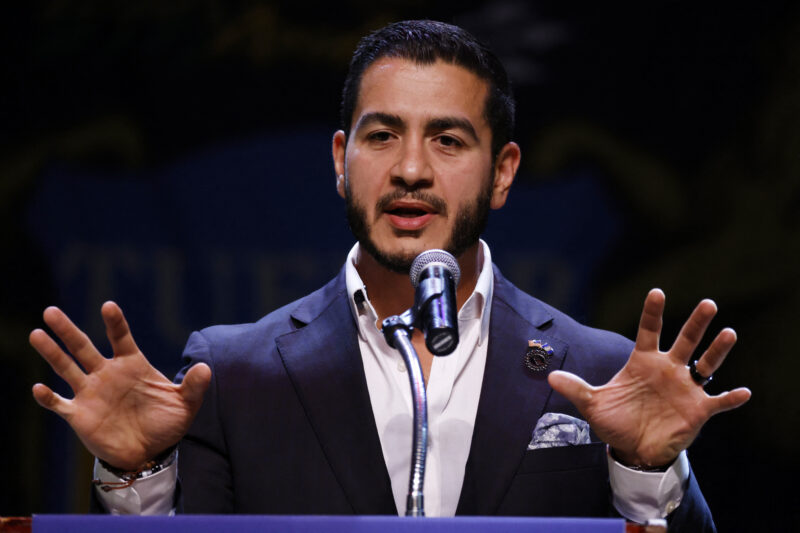
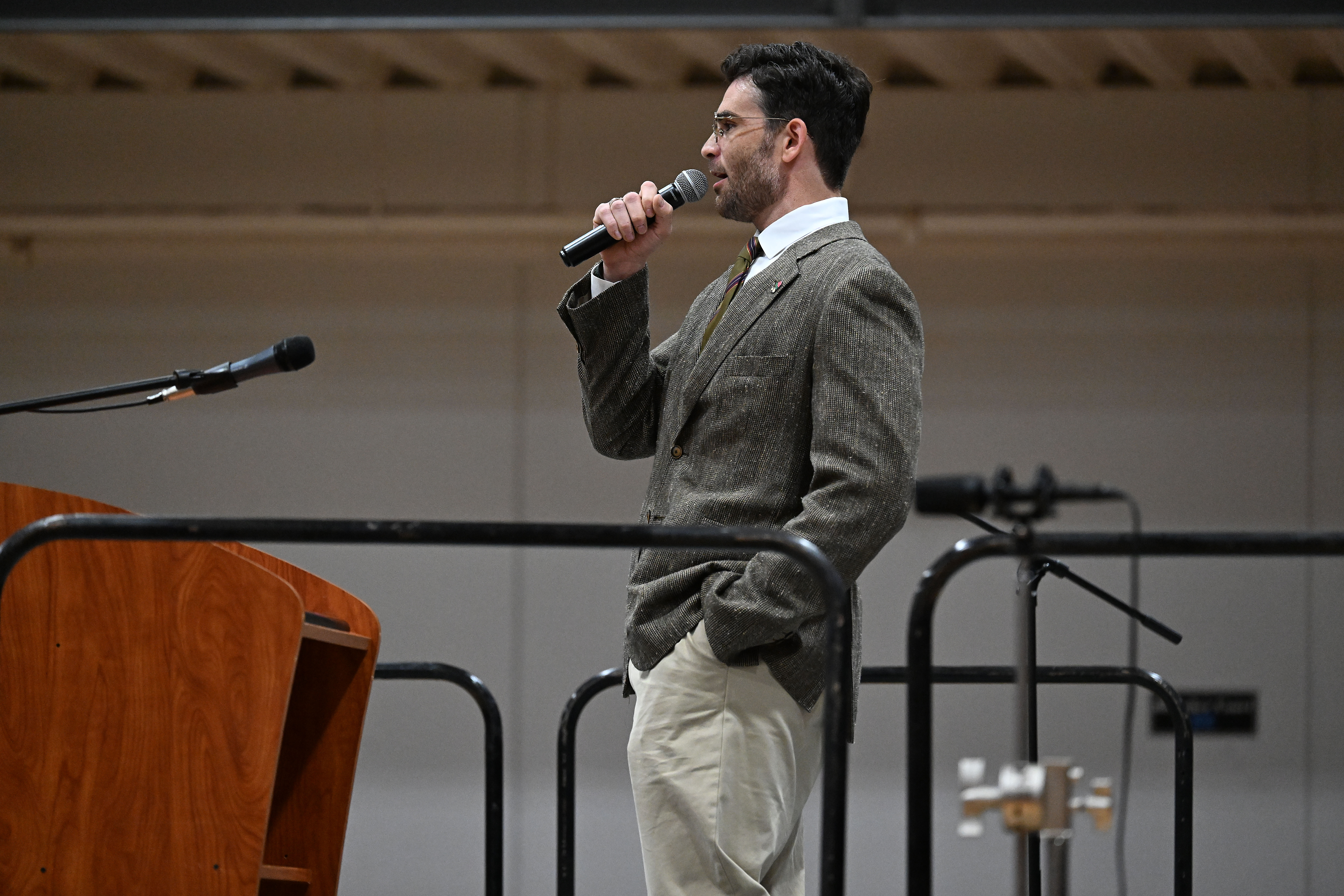
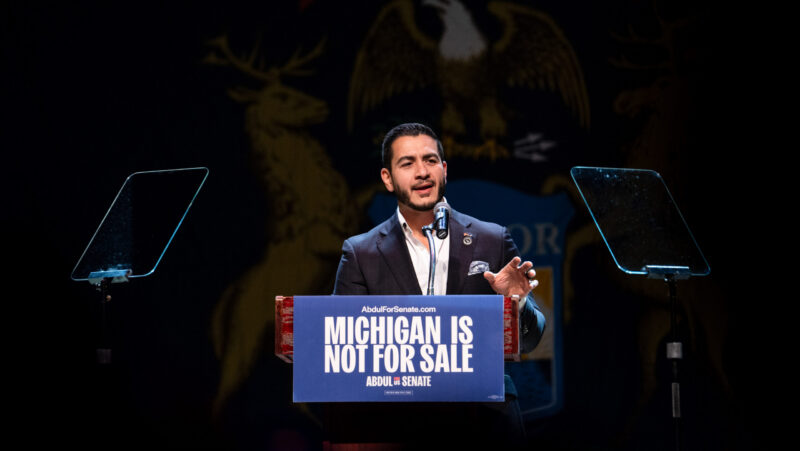
Matt Little answers a question during a Congressional Candidate Forum at Minnesota Farmfest in Morgan, Minn., on Tuesday, August 4, 2026.


 Add JewishInsider on Google
The three major Democratic candidates vying to replace Rep. Angie Craig (D-MN) are charting distinct lanes on Israel policy but only one of them, at a recent debate, offered support for Israel. The front-runner, former state Sen. Matt Little, is the Democrat positioning himself as most hostile to Israel in the race.
Little’s views are at odds with Craig, who was one of 98 House Democrats who declined to support an amendment by Rep. Thomas Massie (R-KY) that would have cut off $3.3 billion in military aid to Israel in 2027. (Craig is running for the Senate in a closely contested primary against a left-wing challenger.)
At a July 19 debate, Little called not only for the U.S. to stop sending military aid to Israel but also to impose an arms embargo “on the sale of all weapons to Israel,” preventing Israel from buying U.S. military systems — its primary source of armaments — with its own funds.
He said he would have voted for the Massie amendment and would have offered it himself if he had the opportunity.
“This is an issue I’ve been speaking out about for over a year, ever since we started the campaign. I think that is a big difference in this race,” Little said. “I’m the first person in this race to call it a genocide because that is exactly what it is.”
State Sen. Matt Klein, running as a moderate and seen as most closely aligned with Craig’s own record, was the only one of the three candidates who did not express support for the Massie amendment at the debate. Klein additionally did not name the war in Gaza as a genocide and described Israel as an ally and friend of the United States.
“As a father and as a physician, I know that what is occurring in Gaza is a humanitarian disaster, and it is our obligation as an ally and a friend of the State of Israel to try to end that and come to a peaceful solution, a two-state solution that provides dignity and safety for peoples of that entire region,” Klein said.
“I am a supporter of our alliance with the State of Israel, just as I am a patriotic American who has deep difficulties with Donald Trump’s leadership,” Klein continued. “I am a supporter of our friendship with Israel, who deeply objects to the way [Prime Minister] Netanyahu has prosecuted this war.”
State Rep. Kaela Berg charted out something of a middle position, but she is still calling for a complete halt to U.S. taxpayer funding to Israel.
“That was an ill-written piece of legislation. It was political gamesmanship from the Republicans meant to divide, and it did,” Berg said of the Massie amendment. “We shouldn’t send one more tax dollar to Israel. We cannot be responsible for funding the genocide in Gaza. … Benjamin Netanyahu’s government should not be funded by the United States.”
She also described Netanyahu as “largely responsible” for the U.S. war in Iran.
Little repeatedly accused both Klein and Berg during the debate of being funded or supported by AIPAC, which both candidates denied. The group has not been involved in the race.
Little has been endorsed by the anti-Israel group A New Policy, and the anti-Israel super PAC American Priorities has spent $64,000 supporting him. Berg has been “primary approved” by J Street, and Klein is supported by Democratic Majority for Israel.
The little publicly available polling in the race has shown Little in the lead. A mid-May poll by Little’s campaign showed him with a wide lead at 41%, followed by Berg at 13% and Klein at 11%. A late May poll by Klein’s campaign showed Little with a narrower lead at 26%, followed by Klein at 19% and Berg at 16%.
Little also won the state party endorsement at a convention in May and is supported by state Attorney General Keith Ellison and former Congressional Progressive Caucus Chair Rep. Pramila Jayapal (D-WA).
Little and Berg have both been leaning into appealing to the progressive party base, while Klein has argued that he’s more electable in a potentially competitive general election against GOP state Sen. Eric Pratt. The district was competitive in the past and was long held by Republicans prior to Craig, but is rated by the Cook Political Report as likely Democratic.
Klein’s campaign holds the lead in fundraising at $1.2 million, followed by Little at $923,000, with Berg trailing well behind at $391,000. The super PAC 314 Action Fund, which supports Democratic doctors and scientists running for office, has intervened aggressively to support Klein, spending nearly $2.5 million in the district.
Berg has been backed by EMILYs List and Our Revolution, a progressive campaign group founded by alumni of Sen. Bernie Sanders’ (I-VT) presidential campaign.
Klein’s campaign has come under scrutiny, and he was required to pay a $540 fine, after having been found to have bet on the outcome of the primary election on the prediction market Kalshi. Klein said he’d bet $50 that he would win the race.
The leading House Democrat said U.S. policy in the Middle East ‘has to change’ and is ‘unsustainable’ but would be ‘broadly inclusive’ in its new iteration
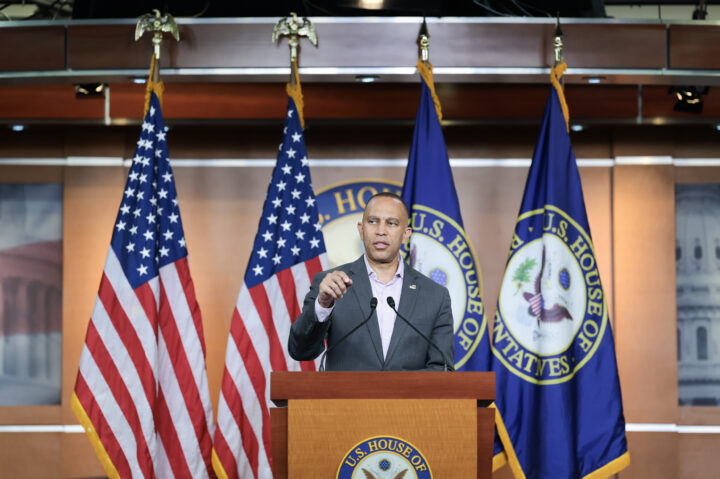
Anna Moneymaker/Getty Images
House Minority Leader Hakeem Jeffries (D-NY) speaks during a news conference at the U.S. Capitol Building on July 13, 2026 in Washington, DC.
House Minority Leader Hakeem Jeffries (D-NY) said on Thursday that should Democrats regain control of the House in the upcoming midterm elections, the party will adopt a “broadly inclusive” but fundamentally new approach to policy on Israel.
Jeffries’ comments follow a historic, highly divisive floor vote on Wednesday where nearly half of House Democrats broke with him to support an amendment cutting off $3.3 billion in U.S. foreign military aid to Israel. The amendment to the 2027 State Department appropriations bill, introduced by Rep. Thomas Massie (R-KY), ultimately failed, but laid bare a continuing erosion of support for Israel within the Democratic caucus.
“The situation relative to the United States’ relationship with Israel, the Palestinian people and policy in the Middle East has to change because the current status quo is unsustainable,” Jeffries said at a press conference. “Our approach will be one that is broadly inclusive … [and will include] dialogue across the entire spectrum of the House Democratic Caucus and then be able to land on the highest common denominator, but being guided by the effort to actually create a just and lasting peace between Israel and the Palestinian people.”
House Minority Leader Hakeem Jeffries said that should Democrats retake the House, the party will adopt a “broadly inclusive” but fundamentally new approach to policy on Israel.
— Jewish Insider (@jewishinsider) July 16, 2026
"The situation relative to the United States' relationship with Israel, the Palestinian people and… pic.twitter.com/AELh50as7i
Jeffries outlined that the future Democratic approach will be “anchored in several different principles,” including a renewed commitment to a two-state solution.
“[It will include] Israel’s right to exist as a Jewish and democratic state and homeland for the Jewish people, and at the same time, pressing the urgent need to establish an independent Palestinian state that allows the Palestinian people to live with dignity, respect, and self-determination — and that needs to be dealt with urgently.”
Jeffries also noted that the Democratic Party under his leadership will support all necessary measures to allow for the “prosperity” of the Palestinian people and the alleviation of “suffering,” including calling for a surge of humanitarian assistance into Gaza.
“It means not just the reconstruction of Gaza, but the modernization of Gaza and investing, along with our partners in the Gulf states and moderate Arab nations, in a path toward prosperity for the Palestinian people,” Jeffries said. “Hamas needs to be disarmed and completely removed from power, and we need to deal with the out-of-control settler violence that the Netanyahu administration has allowed to take place in the West Bank, and perpetrators of that violence should be sanctioned and criminally prosecuted.”
Still, Jeffries noted that Israel remains a valuable ally.
“[The Democratic policy approach also includes] recognizing that Israel is an ally of the United States of America in the fight against terrorism, whether that’s Iranian-backed proxies, Hezbollah, Hamas or the Houthis,” Jeffries said.
The state party platform now recognizes the right of return for Palestinian refugees and supports Palestine becoming a U.N. member state
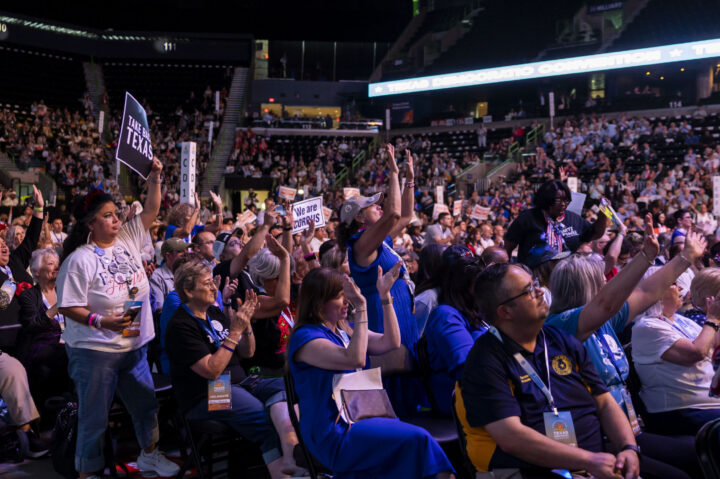
Katina Zentz/San Antonio Express-News via Getty Images
People cheer at the Texas Democratic Convention at the Hilliard Center in Corpus Christi on June 26, 2026.
Texas Democrats adopted several anti-Israel amendments into their party platform at a state party convention last weekend — a significant move to the left on Israel policy in a generally conservative state with marquee Senate and gubernatorial races this November.
That said, much of the anti-Israel language was toned down from the original amendments as introduced — and the party also adopted some pro-Israel language in the platform.
The platform also supports the right of Israel to “exist in safe and secure borders” and condemns the “genocidal actions and goals of Hamas” and supports its removal from leadership in the Gaza Strip and the terror group’s disarmament.
At the same time, it offers support for the right of return for Palestinian refugees as well as for Palestine becoming a U.N. member state “when qualified under the U.N. Charter” and the International Court of Justice’s interim judgement in the genocide case against Israel — though it acknowledges that the ICJ has not ruled that Israel committed genocide — and recognizes the Palestinian “Nakba.”
“Israelis and Palestinians alike have the inalienable right to pursue self-determination, be it a unified political structure or separate sovereign states,” the platform reads.
The platform urges Texas Democratic members of Congress to support the Block the Bombs Act and the end of U.S. offensive weapons sales to Israel, as well as legislation calling for a war crimes investigation into certain Israeli actions in the West Bank.
It states that Texas Democrats support the repeal of Texas’ anti-Boycott, Divestment and Sanctions law and “greater accountability in campaign finance and eliminate and reject the influence and contributions of foreign-interest PACs and lobbying organizations, including AIPAC, on campaigns.”
The wording of several of the anti-Israel resolutions is slightly toned down from some proposed resolutions, including language describing pro-Israel groups as “foreign interference” in American elections and as compromising U.S. institutions.
One proposed resolution also specifically condemned Democratic Majority for Israel in addition to AIPAC, and called for investigations of the groups as unregistered foreign agents, but that language does not appear in the final platform.
Other proposed resolutions also explicitly accused Israel of apartheid and genocide, and called for a complete arms embargo on Israel and a cessation of all U.S. logistical support to Israel.
Still other proposed resolutions called for a statewide adoption of BDS policies, and stated that the repeal of anti-BDS legislation should be a “top legislative priority,” language that was also softened in the final platform.
The platform also calls for dismantling illegal settlements in the West Bank and east Jerusalem “while recognizing historical origins of multiple cultures in the area” and for displaced civilians from Gaza to have a right to return to the territory.
In addition to the anti-Israel language in the platform, the convention’s exhibit hall also included a display that downplayed and attempted to justify the Oct. 7, 2023 Hamas attacks on Israel, including denying allegations of mass rape and pointing blame for the attacks toward Israel and its settlement policies.
Sens. Chris Van Hollen (D-MD) and Chris Murphy (D-CT), as well as Rep. Ro Khanna (D-CA), have been among the party’s most prominent critics of Israel on Capitol Hill amid a marked decline in Democratic support for the Jewish state
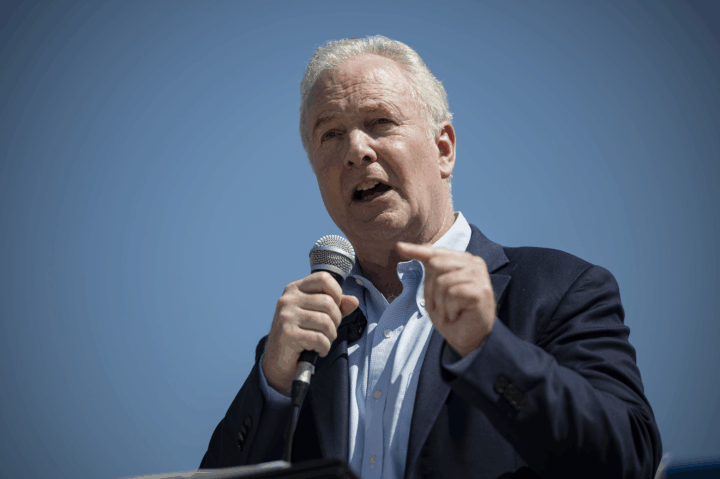
Celal Gunes/Anadolu via Getty Images
Sen. Chris Van Hollen (D-MD) speaks during a rally around the National Mall in Washington, D.C., on September 19, 2025.
As the 2028 presidential campaign season nears, a handful of prospective candidates from the Democratic Party’s left flank are raising their profiles with efforts to shape a more critical approach to U.S. policy toward Israel.
Sens. Chris Van Hollen (D-MD) and Chris Murphy (D-CT), as well as Rep. Ro Khanna (D-CA), all of whom are seen as potential presidential prospects, have been among the party’s most prominent critics of Israel on Capitol Hill amid a marked decline in Democratic support for the Jewish state.
Recent moves suggest they are each testing voter appetite for a possible White House campaign. Even as they are not considered top-tier contenders in what is likely to be a crowded primary field, history has shown they could be positioning themselves for a Cabinet role — particularly if they prove successful in driving the national conversation on the debate stage and other forums.
Murphy, for instance, released a book last month, Crisis of the Common Good: The Fight for Meaning and Connection in a Broken America, of the sort that typically presages a bid for higher office. The senator has otherwise continued to promote what he terms a “forward-looking foreign policy,” which has included an increasingly antagonistic assessment of Israel and its relationship with the United States.
Van Hollen, meanwhile, published a deeply disputed op-ed in The New York Times last week that argued for wholly jettisoning the Democratic Party’s “unconditional support to Israeli governments” that, he warned, has “increasingly undermined American interests and values.” He also proposed several steps that the next Democratic president should take with respect to Israel — such as recognizing a Palestinian state “subject to clear benchmarks” and ending U.S. “taxpayer-funded support to Israel,” which has also recently been championed by more moderate voices such as former Chicago Mayor Rahm Emanuel.
In a noteworthy aside at the end of his essay, Van Hollen, who, like Murphy, sits on the Senate Foreign Relations Committee, stated that voters “won’t trust any Democratic presidential candidate who does not have a record of moral and strategic clarity on these issues” — a possible advertisement for his own 2028 ambitions.
The senator also insisted that voters will not be open to a presidential “candidate who plans to re-enlist the senior Democratic decision makers who whitewashed the truth during the Biden administration and refuse to acknowledge their complicity.”
Left unmentioned was that Van Hollen’s dictates could reasonably be seen as planting the seeds for a possible post in a future administration, including secretary of state or another top foreign policy role.
Khanna, long seen as harboring presidential ambitions, has for his part moved swiftly to the far left on Israel policy in recent years, while giving his endorsement to a range of Israel critics running for House and Senate this cycle that have helped him to build a progressive imprint throughout the country.
None of the three lawmakers, however media-savvy, possesses the name recognition or national profile of other prominent Democrats who are more frequently cited as presidential prospects, such as Pennsylvania Gov. Josh Shapiro from the moderate wing of the Democratic Party and Rep. Alexandria Ocasio-Cortez (D-NY) on the left.
But if they do choose to mount what would likely be long-shot presidential bids, each has the potential to become a more significant player in national politics, as previous presidential contests have demonstrated.
During the 2020 primary, for instance, Andrew Yang rose to prominence as a Democratic outsider thanks in part to his calls for unconventional policies such as universal basic income. And Pete Buttigieg channeled his short-lived primary surge from small-town mayor in Indiana to leading the Transportation Department under former President Joe Biden.
With intraparty conflict over Israel poised to inflect the 2028 presidential race, it would not be surprising if Khanna, Murphy or Van Hollen seized the national spotlight while championing Middle East policy positions that had once been considered off-limits for a viable campaign.
Kenneth Baer, a former Obama administration official who now leads a communications firm, voiced concerns about the possibility, albeit hypothetical, of a lawmaker like Van Hollen helming the State Department, say, in a future administration.
“The only thing more menacing to a strong U.S.-Israel relationship than Van Hollen as SFRC chair is him as secretary of state,” Baer, a constituent of the senator, told Jewish Insider. “It’s a sad commentary about the state of our party that more than a few presidential hopefuls would seriously consider him for that role.”
The progressive lawmaker rejected calls for the left to ally with the far-right former lawmaker on anti-Israel activism
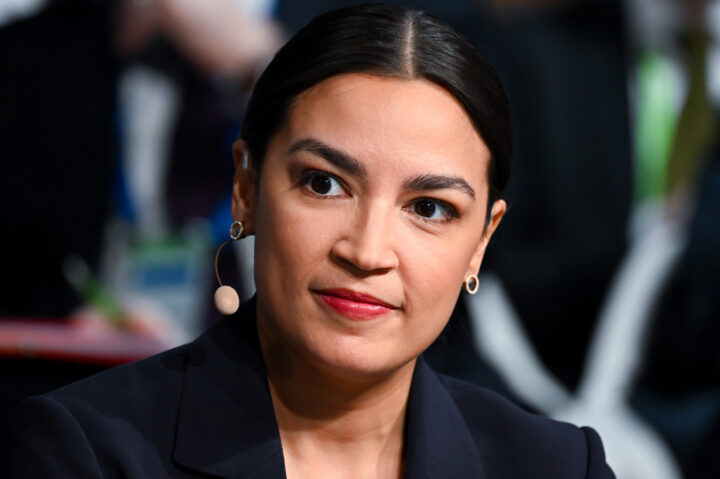
Sven Hoppe/picture alliance via Getty Images
Rep. Alexandria Ocasio-Cortez (D-NY) takes part in the Munich Security Conference.
Rep. Alexandria Ocasio-Cortez (D-NY) expressed skepticism of allying with former Rep. Marjorie Taylor Greene (R-GA) on issues like Israel policy, calling Greene a “proven bigot and antisemite.”
The comments have, notably, earned her the opprobrium of others on the far left, and also mark a break with some more mainstream Democrats who have urged their party to join forces with the disgruntled GOP ex-lawmaker.
“There are certain places, certain areas where I don’t think that we should ignore some folks’ record on some of these issues. It’s about where we trust intent, where we trust where those outcomes are going,” Ocasio-Cortez said at an event last week at the University of Chicago Institute of Politics.
“I personally do not trust someone like Marjorie Taylor Greene, a proven bigot and antisemite, on the issues of what is good for Gazans and Israelis.”
“I don’t think that it benefits our movement, in that instance, to align the left with white nationalists,” she continued. “I don’t think it serves us.”
The comments run counter to calls from both the far-left and certain more mainstream Democrats to praise and align with Greene and other Republicans with histories of antisemitism and other controversies who have broken with President Donald Trump over Middle East policy and other issues.
Some on the far left have reacted with outrage.
Peter Daou, a former Democratic strategist who later served as a campaign strategist for presidential candidates Marianne Williamson and Cornel West, asserted that Greene has “far more intellectual honesty … and far more courage on the defining moral issue of our time” than Ocasio-Cortez.
Ryan Grim, a founder of the Hamas-sympathetic news site Drop Site News, said that Greene “sacrificed her political career to stand against genocide, against Trump, against the Epstein Class, and to defend the survivors of Epstein’s trafficking. If that doesn’t earn credibility I don’t know what possibly could.”
Susan Abdulhawa, a prominent Palestinian writer and activist, said, “as a leftie, I’d say [Greene] has more credibility and honor than [Ocasio-Cortez] on this matter.
Greene herself responded, “AOC refused to vote for my amendment to strip funding for Israel. She can run her mouth all she wants but votes are the only thing that matters, not a bunch of words and nasty name calling.”
At the same time, Ocasio-Cortez said that there are areas where cross-partisan alliances are needed because certain issues are “anti-establishment” and will “require a massive bipartisan consensus of people willing to come together across those differences,” like outlawing stock trading by members of Congress.
Ocasio-Cortez is seen as having ambitions for higher office, either running for Senate against Sen. Chuck Schumer (D-NY) or for president in 2028.
Backed by prominent donors and polling at the top of the Democratic primary field for NY-12, Schlossberg says he supports Iron Dome but is open to restricting U.S. aid to Israel
Edna Leshowitz/Getty Images
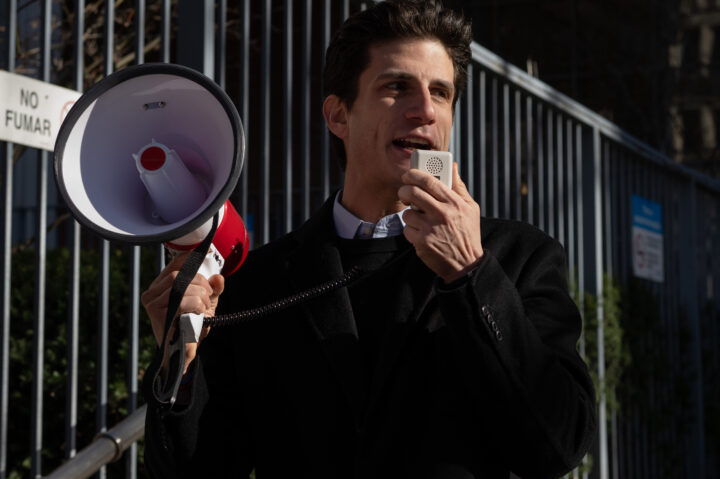
Jack Schlossberg, grandson of former President John. F Kennedy who is currently running for Congress, on Jan. 12, 2026 in New York City.
As Jack Schlossberg gains a foothold in his primary campaign for a coveted open House seat in the heart of Manhattan, his views on Israel policy are drawing closer scrutiny, as he begins to stake out a stance on the increasingly heated subject of Democratic debate.
His decision to skip at least two upcoming Jewish community candidate forums occurring next month, meanwhile, is also raising some eyebrows among a key constituency in a district that has the largest Jewish voting population in the country.
On Middle East policy, the 33-year-old Kennedy scion has embraced positions that place him to the left of the field on Israel, a potentially consequential issue in the 12th Congressional District, which favored former New York Gov. Andrew Cuomo over New York City Mayor Zohran Mamdani in the November mayoral election.
Schlossberg, like his some of his Democratic rivals, had backed Mamdani, despite disagreeing with the now-mayor’s controversial campaign vow to arrest Israeli Prime Minister Benjamin Netanyahu and declining to call Israel’s war in Gaza a genocide, among other notable differences.
But as the fallout over Gaza and the war with Iran has stoked Democratic skepticism of the U.S. relationship with Israel, Schlossberg is now joining growing calls to oppose U.S. weapons sales to the Jewish state, though he has yet to clearly articulate his plans to enact such policies if elected to serve in the House.
During a candidate forum at 92NY last week, for example, Schlossberg, the grandson of former President John F. Kennedy, rejected continued U.S. funding for offensive weapons to Israel amid the war in Iran — even as he emphasized support for boosting the Iron Dome missile-defense system, which he described as a “critical” technology.
“I do not think the United States should back away from its ally completely and leave them hanging out to dry without any defenses,” he told the crowd, while saying Congress should hold a vote on funding for the war in Iran, including offensive weapons to Israel.
Schlossberg made no mention of Senate votes taking place that evening in which most Democrats favored resolutions led by Sen. Bernie Sanders (I-VT) seeking to block arms sales to Israel — which were ultimately rejected.
Meanwhile, in a questionnaire recently solicited by the Working Families Party, Schlossberg confirmed that he would co-sponsor legislation introduced by Rep. Betty McCollum (D-MN) “that would end U.S. military aid to Israel for any uses connected to the occupation of the West Bank and East Jerusalem.”
“Yes, I oppose the use of U.S. taxpayer dollars for abuse, illegal seizure and destruction of property and any violations of international humanitarian law anywhere,” he wrote.
For their part, two of his rivals in the race to succeed Rep. Jerry Nadler (D-NY), state Assemblymen Micah Lasher and Alex Bores, both declined to back the legislation. Another top primary opponent, George Conway, a former Republican lawyer and activist who has become a vocal critic of President Donald Trump, did not submit a questionnaire to the party.
Previously, Schlossberg had said at a candidate forum in January that he “would want to have a full intelligence briefing before supporting any specific legislation” related to Israel.
Schlossberg, who identifies as Jewish on his father’s side despite being raised Catholic, has taken steps to court the district’s sizable Jewish constituency. In the first policy proposal of his campaign, for instance, he pledged to fast-track legislation that would nearly double security funding for synagogues and other Jewish institutions amid an uptick in antisemitic violence.
It is unclear whether his views will shape pro-Israel spending in the race. Democratic Majority for Israel did not respond to requests for comment, though one person familiar with internal discussions told Jewish Insider late last year it was unlikely to engage in the primary, barring any major developments.
A spokesperson for AIPAC likewise declined to comment on the primary when reached by JI.
J Street, the progressive Israel advocacy group that has recently begun calling for ending U.S. funding to bolster Iron Dome, told JI it has “primary approved” Bores, Lasher and Schlossberg, meaning its members are able to contribute to all three candidates through its online political portal.
Tali deGroot, J Street’s vice president of political and digital strategy, told JI in a statement that all three of the candidates “are aligned with J Street’s pro-Israel, pro-peace, pro-democracy positions.”
“Ultimately, it is up to the district to determine who they want to represent them in Congress, and we are glad to see three J Street-aligned voices in this race,” she added.
Some Jewish leaders say that they are interested in hearing more from Schlossberg as he emerges as a leading candidate in the race. He attended Shabbat services in March at the Conservative Park Avenue Synagogue on the Upper East Side, a day after the terrorist attack against Temple Israel in suburban Detroit.
But he is otherwise expected to be absent from two Jewish community forums next month in the district at The Jewish Center and West Side Institutional Synagogue, the latter of which will be moderated by JI’s editor-in-chief.
Daniel Sherman, the rabbi of West Side Institutional Synagogue, said Schlossberg had been invited to the May 4 candidate forum “but his campaign responded that they had a scheduling conflict.” The event will be attended by Lasher, Bores and Conway, according to a flyer.
“As our goal is to engage with all of the candidates we would welcome his presence if the scheduling conflict can be resolved,” Sherman told JI.
Mordechai Schwarz, a longtime Jewish Center member who organized its upcoming forum, told JI that Schlossberg’s team had declined to join due to a busy schedule, even when asked if an alternative date would work better, while Conway’s campaign had not responded to repeated email invitations.
In an email to The Jewish Center shared with JI by its rabbi, Yosie Levine, Schlossberg’s team gave its “sincerest apologies” for skipping the forum, adding that “May is a busy, everchanging month for us, so we do not have alternative times to offer right now.”
In a statement to JI on Monday, a spokesperson for Schlossberg said, “Jack Schlossberg knows that Israel is a critical democratic ally for America and does not believe we should abandon Israel. That includes funding for the Iron Dome — which he would support should he be elected to Congress, so that Israel can protect itself from the myriad of threats facing it from all directions — as well as his local plan to boost protections at Jewish places of worship, given the increase in antisemitism and hate crimes.”
“With that said, Mr. Schlossberg is also the only NY-12 candidate fully opposed to the no-plan Iran war,” the spokesperson added. “That includes weapons to foreign countries, Donald Trump’s massive $200b supplemental request, and his record-breaking, bloated $1.5 trillion defense budget demands. No war means no funding for any part of the war. Schlossberg would vote accordingly.”
A spokesperson for Conway told JI on Friday he was unable to attend the forum because of a “scheduling conflict,” and said the campaign would be following up with The Jewish Center “to close the loop” on the pending matter.
Lasher and Bores are listed as attending The Jewish Center’s forum in a flyer.
The Stephen Wise Free Synagogue, a Reform congregation on the Upper West Side, is hosting a Democratic candidate forum scheduled for May 6, a representative confirmed to JI, but participants have not yet been finalized. Schlossberg’s team confirmed to JI after this story was published that he will be joining the Stephen Wise forum.
Most of the limited available polling conducted earlier this year shows Schlossberg narrowly leading the crowded primary field with a small plurality of the vote in the district that spans the Upper East and West Sides and stretches south to Union Square.
More recent private polling has indicated that Schlossberg continues to maintain a leading position in the race. According to a source briefed on an internal survey conducted for Schlossberg’s campaign in early April, who broadly described the results to JI on condition of anonymity, the Kennedy scion held a seven-point lead in the 20s — with his opponents all clustered in the high teens. The poll’s margin of error was three percentage points.
Jake Dilemani, a Democratic consultant who is not involved in the primary, suggested that Schlossberg’s favorable position most likely is “a function of name recognition,” saying that voters “are interested in his campaign because there’s a sexiness to a Kennedy running.”
Like other political observers, though, Dilemani told JI he expects the polling to shift as outside spending and other advertising influences the primary.
A star-studded list of campaign donors reflects Schlossberg’s celebrity status in the race, featuring prominent names from politics, fashion, music and entertainment such as Tory Burch, John Goodman, Bette Midler, Paul Simon, Lorne Michaels, Richard Plepler, Damon Lindelof, Bryan Lourd, Peggy Siegal, Chrissy Teigen, Jay Carney and Jon Corzine — all of whom have shown up in recent campaign filings to the Federal Election Commission.
Schlossberg, who had built a sizable online following as a social media influencer before launching his bid in November, pulled in nearly $1.2 million in the first quarter of 2026, according to his latest filing released last week, with most of that money on hand, less than his rivals have banked in their accounts.
Credibly or not, Schlossberg’s fresh perspective as a relative newcomer has provided him some license — despite his well-known family name — to call himself an “outsider” in a field populated by more established opponents with extensive records in both politics and government.
“President Kennedy was the first Catholic and the youngest president. He challenged the status quo, and he was an outsider. And that’s what I am in this race, so I’m proud to continue that legacy here,” he recently told a local news outlet, saying he will bring “new energy” to Washington.
But some critics point to Schlossberg’s otherwise thin resume, lack of reported income last year and history of bizarre and performative social media stunts, such as imitating a Nazi salute in a controversial video that surfaced at the start of his campaign, as evidence that his recent political makeover remains unconvincing.
While many of the district’s older constituents may still be unaware of Schlossberg’s unbalanced online record, Dilemani predicted that the other campaigns “will do their best to make it known” before the June primary.
High campaign staff turnover since he entered the primary has also drawn scrutiny to his operation. And he has faced some recent scrutiny for pulling out of other upcoming candidate forums.
Chris Coffey, a Democratic strategist who is not involved in the race, expressed strong doubts over Schlossberg’s bid to represent what he described as a “really important seat” in “one of the most educated and affluent districts in the country,” airing concerns about his “erratic background” and “online persona.”
“I have no doubt he is a great guy to go and have a Diet Coke with,” Coffey explained of Schlossberg. “But in an era where Democrats will hopefully be in an oversight position and needing to use all the tools they can to hopefully go after the president, he’ll be the guy making videos and doing press conferences.”
He also questioned the sincerity of Schlossberg’s comments on Israel as the party has shifted to the left, claiming he had not yet seen him “take a tough position” on any issue in the race.
“I honestly think Jack would say and do anything to get elected,” he told JI, citing Schlossberg’s recent opposition to a redevelopment project in Chelsea that some of his rivals have backed. “If he thinks today that it’s better to say, ‘I’m never going to give Israel a weapon again,’ he’ll say that,” Coffey added.
In Coffey’s assessment, “this race will test whether we’re in a moment where resumes don’t matter and nothing actually matters.”
Still, Schlossberg has managed to win some notable mainstream support, claiming a major endorsement in February from retiring Rep. Nancy Pelosi (D-CA), who said in a statement that he “represents the best of his generation” and “possesses a unique ability to navigate the digital and the classical political worlds in a way that can get things done for people.”
He has also garnered praise from Al Sharpton, joining the Democratic commentator for a “power breakfast” reported in Page Six this month and days later taking the stage at his National Action Network convention in New York, a closely watched annual political event.
Former ADL chief Abe Foxman: 'This is a calamity for the Democratic Party, if it will not be contained and stopped'

Andrew Harnik/Getty Images
(L-R) Senate Democratic leadership, Sens. Brian Schatz (D-HI), Bernie Sanders (I-VT), Elizabeth Warren (D-MA), Amy Klobuchar (D-MN), Senate Majority Leader Chuck Schumer (D-NY), Senate Majority Whip Richard Durbin (D-IL), Tammy Baldwin (D-WI), Cory Booker (D-NJ), Mark Warner (D-VA), Catherine Cortez Masto (D-NV), and Chris Murphy (D-CT), pose for a group photo in the U.S. Capitol on December 3, 2024 in Washington, DC.
The Democratic shift on Israel policy was on full, dramatic display on the Senate floor on Wednesday night as 40 of 47 Senate Democrats voted for at least one of two resolutions to block U.S. shipments of bulldozers and bombs to Israel.
The votes left many pro-Israel Democrats shocked and disillusioned — exemplified in the muted statements, if any, on the vote from key pro-Israel groups — and is being seen by some as the marker of a new era of Democratic policy on Israel, in which critics of Israel are firmly in the party mainstream.
“It’s yet another data point that the bipartisan consensus [in support of Israel] is, at least at the moment, no longer,” a former Biden administration official told Jewish Insider on Thursday. “Democrats think it’s politically advantageous to take these votes that would have been completely out-of-bounds just two-and-a-half years ago. … It’s deeply concerning if you care about the relationship, if you care about the security of [Israel]. But that’s the state of play at the moment, I think until or unless there’s an event that changes the trajectory.”
Abe Foxman, the former head of the Anti-Defamation League, said the vote highlights the “progressive socialist wing” of the Democratic Party’s increasing takeover. “This is a calamity for the Democratic Party, if it will not be contained and stopped,” Foxman told JI. “What’s also disturbing to me is that this litmus test is being first administered to every Jewish candidate.”
He added that the votes send a terrible message to U.S. allies beyond Israel that the U.S. can’t be relied upon.
Pro-Israel Democrats who spoke to JI said the votes came about as a combination of several factors: They served as a proxy for the war in Iran that nearly all Democrats oppose, but also were a signal of opposition to Israel’s operations in Lebanon, settler attacks and settlement expansion in the West Bank, the war in Gaza and — to a substantial degree — the Democratic enmity that has been growing for years toward Israeli Prime Minister Benjamin Netanyahu, his government and his alignment with President Donald Trump and Republicans.
And lawmakers are also responding to the growing progressive pressure, fueled by two years of imagery from the war in Gaza, amplified by social media platforms that boosted antisemitic content, that has changed the politics around Israel in a “really dramatic way” in the Democratic Party, the former Biden administration official said.
“Those [resolutions], at this moment in time, were just a proxy for real discomfort with the direction of the Trump-Netanyahu relationship in this war, which is not the right reason to vote for these,” another former Biden administration official told JI. “I understand the [vote to block] bulldozers at this moment in time. [Withholding] the munitions — I think it’s really, really troubling.”
Sen. Tim Kaine (D-VA), an early supporter of efforts to block weapons sales to Israel, said that the growing opposition can’t be blamed solely on Netanyahu. “I also think it’s watching how the weapons are used,” Kaine told reporters. “I think the observation of how the weapons are used is probably a little bit more the reason that the vote total is going up than a feeling about the domestic politics of Israel.”
Some pro-Israel Democrats say that the impact and meaning of the votes shouldn’t be overstated, and that there remains a sizable pro-Israel Democratic contingent, even including some of the lawmakers who voted for the resolutions on Wednesday.
“There were pro-Israel senators, and senators who are close partners and allies of the Jewish community, on both sides of this vote last night,” Halie Soifer, the CEO of the Jewish Democratic Council of America, said. “This didn’t occur in a vacuum, and it’s not necessarily driven by anti-Israel, and certainly not antisemitic, views. It also doesn’t necessarily represent a wholesale shift in the Democratic Party. It’s a snapshot of where we are in this moment as it relates to these particular arms sales and this particular Israeli government and its policies. But I have no doubt that there’s the chance that that will change in the future.”
Soifer said that she and JDCA didn’t support the resolutions, but emphasized that some of the Democrats who voted for the resolutions said in their statements that they remain strong supporters of Israel. And she said JDCA doesn’t view the votes as “inherently anti-Israel” or necessarily an expression of alignment with the far left.
She called the vote on the bulldozers, which received 40 supporters, a particularly potent “symbolic message” — many Democrats associate the machines with the destruction of Palestinian homes and expansion of settlements in the West Bank. But she said it was something of an “anomaly” as compared to previous efforts to block systems such as bomb guidance kits.
“It’s a challenging time where both things are true at once: You do have an increased number of Democrats who are supporting these [resolutions], and you also still continue to have a majority of Democrats who support the U.S.-Israel security relationship,” Soifer said.
A common refrain in conversations with those in the Democratic pro-Israel world after the votes — and even before then — was that the end of Netanyahu’s premiership would provide a critical opening and opportunity to start rebuilding support for Israel among Democrats.
Kaine said that a change in the Israeli government would lead lawmakers to step back and analyze the potential implications, but said it wouldn’t necessarily bring sweeping changes. “I don’t think the 40 [Democrats voting for the resolutions] is baked in, I also don’t think it will immediately change.”
But a Netanyahu defeat in this year’s Israeli elections is far from a sure thing. So what happens if Netanyahu wins again? “I think it will be very difficult for Democrats to hold any center on support for Israel,” one former Biden administration official said.
The other former Biden administration official said that the intense anti-Israel pressure on Democrats would likely fade if Middle East policy issues are out of the headlines on a day-to-day basis. They further argued that the 2028 primaries will be an “inflection point,” on both sides of the aisle.
And they said that the Jewish community, particularly the non-Orthodox community, needs to be more organized and active locally and on a grassroots level in advocating for their representatives to be supportive of the U.S.-Israel relationship.
Foxman said he hopes to see more Democratic lawmakers — naming Sen. Jacky Rosen (D-NV) specifically — standing up directly to the anti-Israel wing of the party, just as Sen. Ted Cruz (R-TX) has spoken out against antisemitism on the right.
With opposition to weapons systems for Israel apparently firmly within the mainstream, we wrote earlier this week about the emerging progressive push to cut off U.S. support for Israel’s missile-defense systems as well.
Asked whether he takes a similar view, Sen. Bernie Sanders (I-VT), the lead driver of the Senate votes, did not directly respond. “Let’s take one thing at a time. Right now, I think we made progress yesterday,” he told JI.
Kaine took a firmer stance in support of missile-defense aid, calling those who want to cut it off “a tiny minority,” especially in the Senate. He noted that no Democrats have offered similar resolutions to block defensive systems, and that other weapons sales to Israel have gone entirely unchallenged — though he acknowledged that the distinction between offensive and defensive weapons can be fuzzy at times.
One of the former Biden administration officials warned that opposing missile-defense support is a “totally unproductive, terrible” policy — not just for Israel, but also sending a message to allies around the world that the U.S. can’t be relied upon to follow through for its partners.
Democrats will be choosing whether to nominate moderate-minded lawmakers, or elevate potential future members of the far-left Squad
Scott Olson/Getty Images
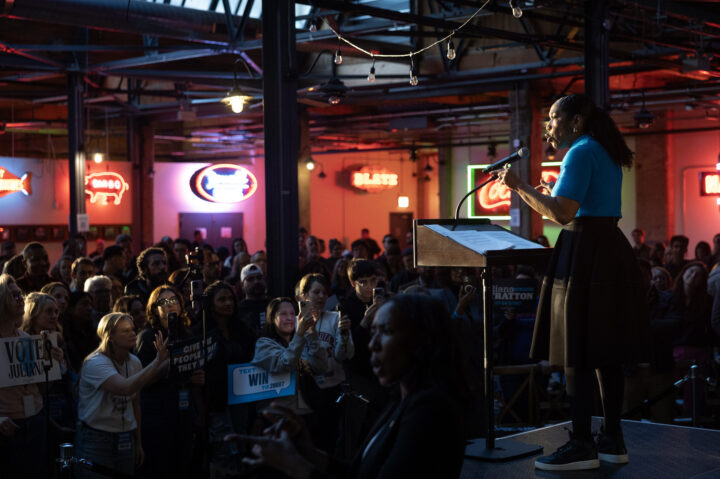
Illinois Democratic Senate candidate Lt. Governor Juliana Stratton speaks to voters during a campaign stop on March 13, 2026 in Chicago, Illinois.
After months of an increasingly bitter campaign characterized by tens of millions in outside spending and increasingly heated debate over Israel policy, Democrats in the Chicagoland area head to the polls on Tuesday, with the outcome of the primaries potentially reshaping the political landscape in Chicago, one of the most Jewish cities in the country.
The races are also set to be a test of AIPAC and the pro-Israel community’s political strategy and heft. There are four House races that pro-Israel groups are reportedly engaged in, and their success rate in those primaries will be an early indicator of whether resources can overcome the shifting winds in a party that is becoming increasingly hostile to the Jewish state.
Broadly, a source close to AIPAC said, the group’s main goal in the primaries is to prevent six candidates — state Sen. Robert Peters in the 2nd District, activist Kina Collins in the 7th, activist Junaid Ahmed and Hanover Park Trustee Yasmeen Bankole in the 8th and influencer Kat Abughazaleh and Skokie School Board member Bushra Amiwala in the 9th — from being elected, as it believes those candidates would be aligned with the far-left ‘Squad’ on Israel policy issues if elected to Congress.
That’s an apparent change in strategy from the recent special election in New Jersey’s 11th Congressional District, where spending by the AIPAC-affiliated United Democracy Project against a relative moderate who had expressed an openness to conditioning aid to Israel helped elect a far-left candidate with more hostile views.
Here’s what we’re watching, and where the races stand.
Illinois Senate
This race appears to be effectively a two-way contest between Rep. Raja Krishnamoorthi (D-IL) and Lt. Gov. Juliana Stratton. Rep. Robin Kelly (D-IL), who has been carving out the left-most lane (including on Israel policy), has been trailing further behind in most polling and will have the hardest climb to victory, despite backing from the Congressional Black Caucus.
Krishnamoorthi, who has taken the most moderate and most pro-Israel posture, would likely benefit most from Stratton and Kelly splitting the Black and progressive Democratic vote in the state. A super PAC backing Krishnamoorthi has taken to promoting both him and Kelly while attacking Stratton.
Some recent polling has shown Stratton, who has been trying to balance criticism of Israel while also maintaining support within the Jewish community, closing in on Krishnamoorthi in the final stretch of the race.
Though Krishnamoorthi has been the most prolific fundraiser in the race, Stratton has benefited from more than $13 million in spending by the Illinois Future PAC, backed by Illinois Gov. J.B. Pritzker and his family, Stratton’s main political backer.
Stratton has hit Krishnamoorthi as overly supportive of Immigration and Customs Enforcement, in part by pointing to his vote in support of a resolution condemning the attack on an Israeli hostage awareness march in Boulder, Colo., last year, which also included language thanking ICE.
Krishnamoorthi also took a hit last week with a story that described him as mistreating employees as he amassed his war chest for this Senate run. Meanwhile, Stratton’s campaign is touting what it says is a deathbed endorsement by Rev. Jesse Jackson, who died last month.
2nd Congressional District
Despite poor fundraising as compared to others in the field and a term in prison for a corruption scandal, former Rep. Jesse Jackson Jr. (D-IL) has long been the favorite to win the 2nd Congressional District seat, an effort likely aided by national attention over his father’s death.
Affordable Chicago Now, a new super PAC reported to be supported by pro-Israel backers, has been boosting Cook County Commissioner Donna Miller, putting $4.3 million behind her campaign.
An AI industry-linked super PAC has stepped in to help boost Jackson’s chances. Miller has also faced attacks from the Working Families Party for receiving pro-Israel support.
Peters has been trying to carve out the far-left lane in the district, including by taking a strongly critical line toward Israel and AIPAC, though Jewish Insider reported that he had previously reached out to the group early in his campaign, offering a very different set of policy priorities.
7th Congressional District
The AIPAC-linked United Democracy Project and a cryptocurrency industry group have been supporting Chicago Treasurer Melissa Conyears-Ervin in the race, helping push her toward the top of the field. UDP has spent more than $5 million in the race. Conyears-Ervin has also received support from the Chicago Teachers’ Union, which has been hostile toward Israel.
Other notable candidates include state Rep. LaShawn Ford, who is Rep. Danny Davis’ (D-IL) preferred successor, and has taken significant heat from the crypto-backed Fairshake.
The progressive Collins, who has long held hostile stances toward Israel, is making her third run at the seat, but attention from progressive and anti-Israel interests has also turned toward Anthony Driver Jr., a union organizer who has seen support from outside spending by an SEIU-linked group, among other progressive candidates. That group has spent more than $550,000 hitting Conyears-Ervin, in part for receiving pro-Israel support.
Jason Friedman, a Jewish real estate developer and longtime Jewish federation leader who has taken a largely pro-Israel stance, has led the field in fundraising, but it’s unclear how he might fare in a historically Black district. UDP’s ads have also directly responded to Friedman’s criticism of Conyears-Ervin’s past corruption issues, attacking Friedman.
8th Congressional District
Former Rep. Melissa Bean (D-IL) is seen as the strong front-runner in the race, and is the most likely victory for pro-Israel voters in the Chicagoland House primaries.
By contrast, Ahmed has consolidated support among the progressive left and has staked out an anti-Israel stance on the trail. A poll released Sunday showed Bean in the lead, but Ahmed closing in, just five points behind.
Bean has been backed by pro-Israel groups, the AI industry and cryptocurrency advocates. Meanwhile, Justice Democrats and the anti-Israel IMEU Policy Project have been spending in the district in an attempt to undercut Bean and boost Ahmed.
Chicago Progressive Partnership, a group rumored to be linked to AIPAC, has recently been hitting Ahmed from the left, putting $664,000 behind that effort.
Other candidates in the race include Bankole, Cook County Commissioner Kevin Morrison and entrepreneur Neil Khot. Khot has led the field in fundraising with around $2 million, though a majority of that has been self-funded.
9th Congressional District
The 9th District seat has become the most watched and most bitter of the four House primaries in the Chicago area — with Middle East policy and pro-Israel funding becoming one of the most contentious issues, to the extent that those issues dominated a recent televised debate.
The top tier of candidates includes Evanston Mayor Daniel Biss, far-left activist and influencer Abughazaleh and state Sen. Laura Fine. Fine has charted out the most moderate and pro-Israel stance of the three, while Biss has leaned toward a progressive posture critical of Israel and Abughazaleh has taken an even harder anti-Israel line.
Though Biss and Fine at one point appeared to be the top candidates, recent polling has shown Fine falling behind and Abughazaleh closing the gap with Biss, who has consistently led in polling.
Abughazaleh finished out the race as the top fundraiser, pulling in $3.4 million, followed by Fine and Biss neck-and-neck at $2.6 and $2.5 million, respectively.
Elect Chicago Women, reportedly backed by pro-Israel donors, has put $5.8 million into supporting Fine and attacking Biss, but pro-Israel groups appear to have shifted their strategy in the final weeks of the campaign amid Abughazaleh’s surge.
Attacks on Biss have tapered off, while Chicago Progressive Partnership has been hammering Abughazaleh with more than $1.2 million in spending in just a few weeks. Most recently, the group has also been boosting Skokie School Board member Bushra Amiwala, in an apparent attempt to siphon off some of Abughazaleh’s base.
Meanwhile, Rep. Rashida Tlaib (D-MI) and actor and anti-Israel activist Mark Ruffalo offered endorsements for Abughazaleh over the weekend.
Though the pro-Israel community’s strategy in this race has been different than the one it took in New Jersey’s 11th Congressional District, where attacks on a liberal candidate helped elect another candidate from the far-left, there’s been longstanding fear among some in the local Jewish community that outside groups’ concerted anti-Biss attacks could end up electing the far-left Abughazaleh.
JI found that Biss reached out to AIPAC before formally announcing his campaign, and that his stances on Israel policy have also evolved significantly since he entered the race, including supporting efforts to cut off weapons transfers to the Jewish state.
Biss also faced grilling from the House Education Committee over his decision to withhold police support when Northwestern University sought to clear an anti-Israel encampment on campus in 2024.
J Street has spent around $150,000 boosting Biss.
The New Jersey Democrat asked, ‘Is it really worth throwing Jews under the bus to advance your political ambitions?’
Tom Williams/CQ-Roll Call, Inc via Getty Images/PATRICK T. FALLON/AFP via Getty Images
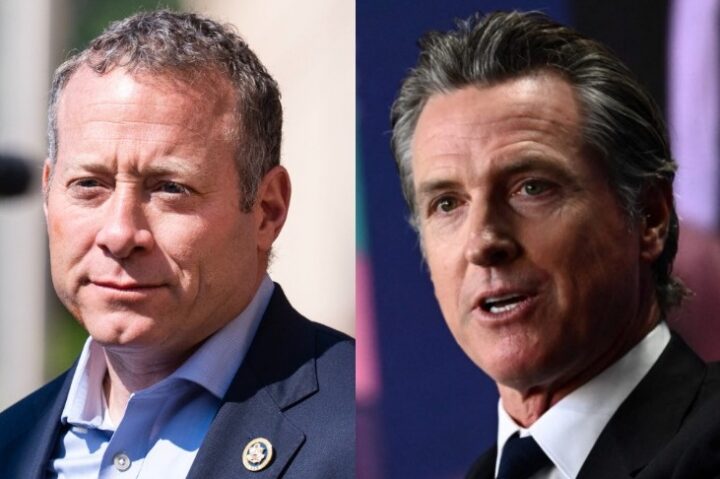
Rep. Josh Gottheimer (D-NJ) and California Gov. Gavin Newsom
As the Democratic Party’s internal schism over Israel policy continues to deepen, Rep. Josh Gottheimer (D-NJ) called out California Gov. Gavin Newsom, a leading 2028 presidential contender, for recent comments characterizing Israel as an apartheid state and questioning future military aid.
“These comments are not only wrong, but they are dangerous and will feed more antisemitism in our country,” Gottheimer said on X this weekend. “Is it really worth throwing Jews under the bus to advance your political ambitions?”
Newsom and other 2028 contenders, including some who have strong pro-Israel voting records and close ties with the Jewish community, have increasingly shifted left on the U.S.-Israel relationship amid pressure and scrutiny from the progressive wing of the party.
Newsom, whose staff met with Jewish leaders in California after he made the comments, said subsequently that he was speaking about a potential Israeli annexation of the West Bank in reference to a February column by The New York Times’ Thomas Friedman that used the term “apartheid.”
Lt. Gov. Juliana Stratton seems to be running to the congressman’s left on Israel, even as Rep. Robin Kelly is the most outspoken critic of Israel in the race
Tom Williams/CQ Roll Call/Bloomberg via Getty Images
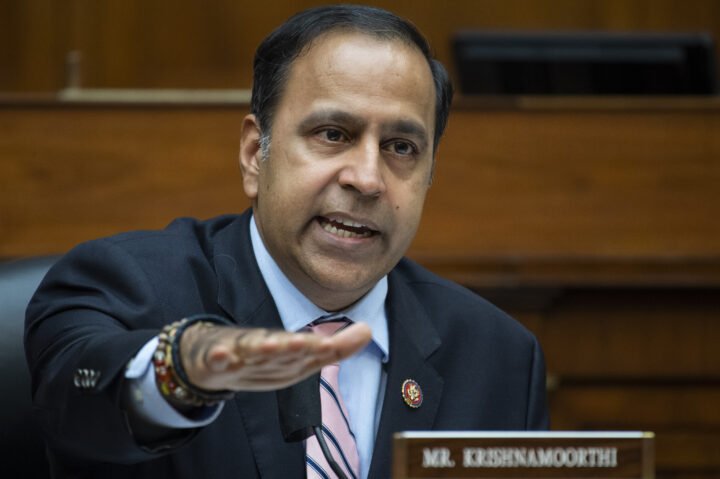
Representative Raja Krishnamoorthi, a Democrat from Illinois
Democrats running for the open Senate seat in Illinois are increasingly trying to differentiate themselves on Israel policy ahead of next month’s primary. In the final weeks of the campaign, Illinois Lt. Gov. Juliana Stratton appears to be trying to straddle a line on Israel policy between Rep. Raja Krishnamoorthi (D-IL), who has a largely pro-Israel record, and Rep. Robin Kelly (D-IL), who has been increasingly critical of Israel.
Stratton, of the three, has the least established record on Middle East policy issues, and her approach was on display at a debate last week with fellow candidates, where she did not offer direct answers to questions on whether additional conditions should be applied to U.S. aid to Israel or whether the war in Gaza constituted a genocide.
Asked about conditions on aid to Israel, Stratton said that the “devastation” both on Oct. 7, 2023, and during the ensuing war in Gaza has been “horrifying” and she wants to “see the suffering end.”
“I can tell you that as our democratic ally in the Middle East, I believe that Israel has a right to safety and security, but at the very same time, I totally disagree with the way that [Israeli Prime Minister Benjamin] Netanyahu has responded to those attacks, and I believe that he should be removed from power, or he should step down, and there should be elections, as the people have been calling for,” Stratton said.
Israel is set to go to elections in October.
Stratton also called for aid to Gaza and for Palestinian leadership that can push toward a two-state solution.
Asked whether she would vote for a resolution led by Rep. Rashida Tlaib (D-MI) describing the war in Gaza as a genocide, Stratton said the war was “devastating and it was horrific” and that “we must do everything we can to make sure that we can be on a real, sustained path to peace,” but avoiding directly answering the question.
Krishnamoorthi emphasized that U.S. aid to Israel and all other allies is already subject to various conditions, which he said should be enforced. He “strongly condemned” both Hamas for the Oct. 7 attacks and Netanyahu for Israel’s conduct during the war.
“We need to take the next step,” Krishnamoorthi said. “That means Israel needs to withdraw from the Gaza Strip. Hamas needs to be demilitarized. An international stabilization force has to arrive, and then massive construction aid has to come in, to the point where we have a chance at a road to a two-state solution of Palestinian and Israeli states living side by side.”
When asked about classifying the war as a genocide, he said that the parties in the region “don’t agree on a credible assessment of what exactly happened” and suggested that debate over or the use of the term would be an obstacle to progress in the ceasefire agreement first implemented in October 2025.
“I want to see the language [of the Tlaib resolution], but I need to be comforted right now that this type of resolution doesn’t get in the way of progress right now for Gazans, because right now they’re going through hell as it is, and we got to get to a better place,” he responded, when pressed on whether he would vote for the Michigan congresswoman’s resolution.
Kelly touted her support for the Block the Bombs Act that would place sweeping restrictions on U.S. arms sales to Israel, and joined Stratton in calling for Netanyahu to resign, calling his leadership a “reign of terror.”
“A lot of people would say what happened on Oct. 7 was horrible, but there were a lot of things that happened before Oct. 7 also,” Kelly said. “I’m the only one on this stage that supported something like Block the Bombs and I’m the only one on the stage that said, it may not have started off like this but … genocide was the result.”
All three candidates said that a preemptive U.S. strike on Iran without congressional authorization would be illegal.
Krishnamoorthi emphasized that Iran cannot obtain a nuclear weapon, but argued that the U.S. must find a diplomatic solution to address the Islamic Republic’s nuclear and ballistic missile programs.
He added that any military action must be authorized by Congress and that he plans to support an upcoming war powers resolution to block military action against Iran without such authorization.
Stratton said that “we certainly don’t want to see a nuclear Iran … but what we also can’t have is a president who just decides whenever he gets a whim … and threatens to strike or commit some act of war. We need Congress to rein him in.”
Kelly accused Trump of seeking out war as a “distraction” from alleged failures on the home front, and demanded a diplomatic path using any tools and partners available.
Stratton is supported in the Senate race by Gov. JB Pritzer, who last week condemned AIPAC as a “pro-Trump organization.”
A Democratic strategist in the state said that it’s hard to tell where the race stands, but that public polling has put Krishnamoorthi in the lead. He noted that Krishnamoorthi is running an ad contrasting him with Stratton, indicating his campaign thinks Stratton may be making up some ground.
Pritzker’s super PAC recently began spending big backing Stratton and attacking Krishnamoorthi.
The strategist said that Kelly hasn’t been keeping up with the other two candidates in television advertising, but there are still opportunities to make up ground and increase her vote share. Kelly has largely been trying to court the most progressive voters and carve out the left-most lane for herself, but otherwise, the strategist said, there’s been little ideological difference among the candidates overall.
Please log in if you already have a subscription, or subscribe to access the latest updates.
 Continue with Google
 Continue with Apple