


































The suspension ends a key commercial lifeline, though analysts said Iran's sanctions-evasion networks and enforcement uncertainty limit how decisive a blow it will be
Stringer/Anadolu via Getty Images
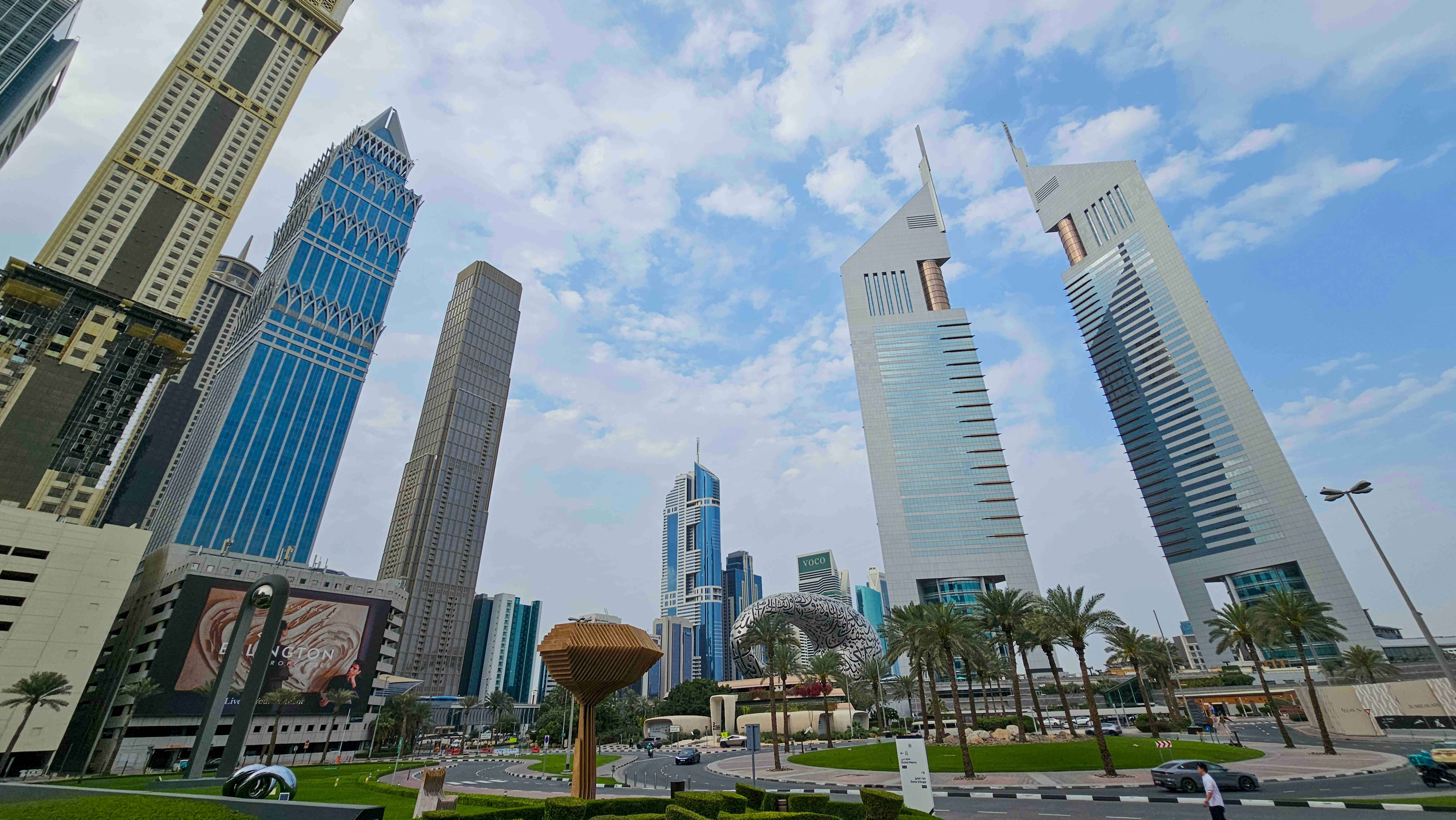
A view from the Dubai International Financial Centre (DIFC) on March 03, 2026 in Dubai, United Arab Emirates.


 Add JewishInsider on Google
The United Arab Emirates’ decision to sever trade and financial ties with Iran could deliver a major blow to Tehran’s economy, regional analysts said, disrupting a commercial lifeline that Iran has relied on for years. But experts cautioned that Tehran is likely to turn to existing workarounds to keep money flowing and that the UAE’s full implementation of the move is not completed.
In a statement released on Tuesday, Afra Al-Hameli, a spokesperson for the UAE Ministry of Foreign Affairs, announced that Abu Dhabi had suspended all trade activity, commercial exchanges and financial transactions with Iran “until further notice.” The UAE — which serves as Tehran’s second-largest commercial partner — issued the declaration after its Defense Ministry reported detecting two Iranian ballistic missiles that were “targeting maritime navigation” before falling into the sea. Iran’s Foreign Ministry denied launching the missiles.
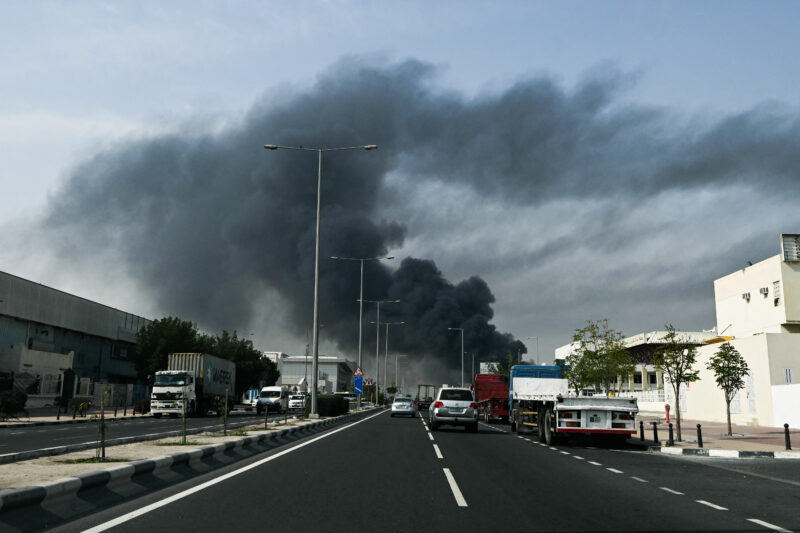
Since the Iran war began in late February, the UAE has been the country most heavily targeted by Tehran’s missile and drone attacks, with strikes damaging airports, ports, energy facilities, financial centers and other critical infrastructure.
Regional experts told Jewish Insider that given the UAE’s history as a vital commercial conduit and financial hub for Iran, cutting those links would deal a heavy blow to Tehran’s already fragile economy.
“Dubai in particular has been a key hub for Iranian finance, and if that role ends, Iran’s economy will be hurt,” Elliott Abrams, who served as special envoy for Iran during the first Trump administration, told JI. “And while Iran will scramble to find alternatives, that will be difficult and take time — and meanwhile their weak economy will suffer even more.”
Abrams added that ensuring the UAE acts as “a full ally” rather than a neutral observer is essential to President Donald Trump’s strategy of exerting maximum economic pressure against Tehran.
Anne Dreazen, vice president of the American Jewish Committee’s Center for a New Middle East, similarly described the UAE’s declaration as “significant,” emphasizing that sustained enforcement would restrict Iran’s commercial access and financial liquidity.
“This move by the UAE sends an important message to Iran that it can’t continue to attack Gulf commerce with impunity while continuing to rely on the Gulf as one of its principal economic lifelines,” Dreazen said. “If this suspension is sustained and enforced, it will make it more difficult for Iran to conduct commerce and move money.”
However, Dreazen pointed out that Tehran’s economic resilience and pre-existing sanctions evasion networks mean the move will not act as a “silver bullet.”
“Iran is resilient, and a lot of Iran-UAE trade has already been disrupted due to the war. I therefore don’t expect this move to be a silver bullet — Iran will devise workarounds and can probably withstand this move,” Dreazen continued. “However, it will cause significant additional economic pain for Iran at a time when Iran cannot really afford more economic pressure.”
Jason Greenblatt, who served as White House Middle East envoy during the first Trump administration, voiced strong support for the decision, framing it as a necessary measure against Iranian aggression.
“It also strengthens President Trump’s effort to choke the Iranian regime economically and stop its threats to the region and the United States,” Greenblatt told JI. “The more nations that join, the greater the pressure on Tehran and the better the chance of changing its behavior.”
Conversely, Kristin Diwan, a senior resident scholar at the Arab Gulf States Institute in Washington, expressed skepticism over whether Abu Dhabi will follow through with full execution or that neighboring Gulf nations will replicate the move.
“Dubai is the safety valve for the Iranian economy. Losing that outlet would unquestionably be punishing, but it will hurt Dubai as well,” Diwan said. “I’m skeptical that this will be fully executed or that other Gulf states will follow the UAE on this path. While the U.S. is now focusing on punishing Iran economically, many Gulf partners are looking for ways to deescalate, and those tools may also be economic.”
‘Without oil, they're nothing,’ the former national security adviser said at the Aspen Security Forum, adding that by cutting it off, the U.S. could ‘turn them into a ‘stan, turn them into a nonentity’
(David Paul Morris/Bloomberg via Getty Images)
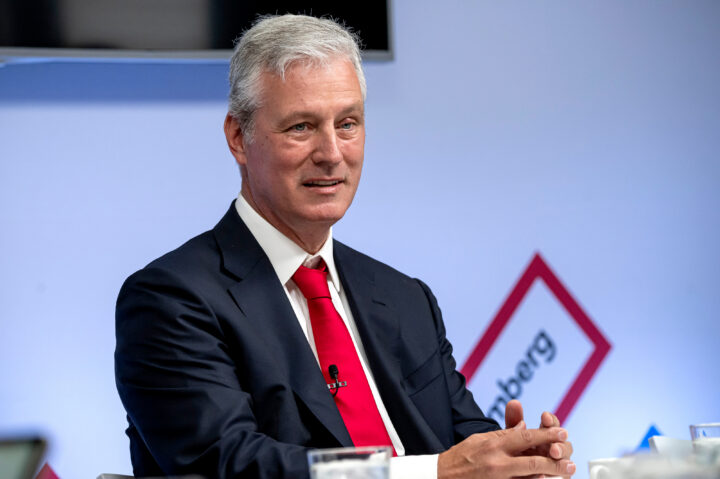
Robert O'Brien, former national security adviser, at an interview during the Republican National Convention (RNC) near the Fiserv Forum in Milwaukee, Wisconsin, US, on Wednesday, July 17, 2024.
ASPEN, Colo. — Robert O’Brien, who served as national security advisor during President Donald Trump’s first term, said on Wednesday that the U.S. should target Iran’s oil infrastructure with the goal of choking off its economy — and predicted that the president is moving in that direction.
The former national security advisor said on a panel at the Aspen Security Forum that Trump had been “very, very generous” with Iran but he believes that Trump’s “patience” with Iran is running thin. The next steps, he predicted, would be for the U.S. to “hit them hard” and “finish the job” by targeting sites connected with Iran’s oil infrastructure, including the facilities at Kharg Island, in order to deprive Iran of its ability to produce and export oil.
“Without oil, they’re nothing. With oil, the regime thinks if they can survive, they can just buy more kit,” O’Brien said. “I think President Trump will finish the job. The Iranians are using the old playbook of extend, pretend and snowball. … They’re dealing with a whole new administration with Donald Trump. They don’t understand it, and I think that they’ll pay a heavy penalty for their lack of understanding.”
The first Trump administration’s strategy of maximum pressure through economic sanctions is “not enough” without strikes on Iran’s oil production, he continued.
O’Brien said that cutting short Iran’s oil exports would be the skeleton key to deafening the regime — cutting off its ability to build missiles, support terrorism or rebuild its nuclear program, and said that the U.S. could “turn them into a ‘stan, turn them into a nonentity” and prevent it from ever rebuilding.
The former national security advisor acknowledged that targeting Iranian oil production would hurt the world economy, but made the case that there are other oil producers that would be able to fill the gap with the right support, including Venezuela, Guyana and Mozambique, along with increased production in the U.S.
Asked after the panel by Jewish Insider about how he views the future of Israel policy among conservatives — and about comments by Vice President JD Vance accusing Israel of running a cover influence campaign to undermine the Iran deal and of having ties to sex offender Jeffrey Epstein — O’Brien insisted that support for Israel among conservatives, including Vance, remains strong.
O’Brien said he hadn’t heard Vance’s comments but called him a “supporter” and “friend of Israel.” He added that Trump is “a very good friend of Israel. President Trump has Jewish grandkids, I mean, so he cares deeply about it. He got the Abraham Accords for us and sent me to Jerusalem many times. And I can tell you, after Oct. 7, he was very concerned about Israel and has remained so ever since. No better friend to Israel than President Trump.”
He argued that recent polling indicates that support for Israel remains strong among Republicans in general, even among young people, and predicted that issues among “some conservatives — or people who claim to be conservatives” will not “hold.”
“Those of us who value the partnership, love our Jewish friends, our Israeli colleagues, just need to be forthright and stand up for Israel,” O’Brien said. “Israel, I’ve always said throughout my career, is a canary in the coal mine. If people are attacking Israel, the next country they’re going to attack is America, and so we need to stand strong with our allies in Israel, stand strong with Jerusalem, and I think it’s going to be a relationship that lasts long into the future.“
Stephen Hadley, who served as national security advisor in the Bush administration, said on the panel that the U.S. “can do better in terms of an outcome” with Iran, urging the administration to “stop chasing after the Iranians for an agreement on the nuclear issue,” adding that the U.S.’ operations have done significant damage to Iran’s nuclear program and can hit Iran again if it attempts to reconstitute the program.
It’s a similar strategy to that outlined by former Secretary of State Condoleezza Rice, also a Bush administration alumnus, a day prior at the Aspen conference.
Hadley said the U.S. should be open to nuclear talks if Iran seeks them out — but with the preconditions of no enrichment and no financial paydays for Iran.
He said that with continued sanctions, facilitation of trade along the Omani side of the Strait of Hormuz, strikes on Iranian capabilities threatening trade in the strait and assistance to countries in the region to diversify their export channels in the longer term, the U.S. could erode Iran’s ability to hold the global economy hostage and reach a stable situation.
“Hopefully, someday an Iranian regime will come forward and decide that their pursuit of nuclear weapons and support for Hezbollah and the like has been a dead end, and they will join the countries in the region to try to build a more prosperous and secure Iran for their people,” Hadley said. “If that happens, great. If it does not happen, the kind of arrangement I think I’ve described will protect our interests, protect the interests of our allies. “
At the same time, he emphasized that regime change through air power alone is likely off the table.
“[Trump] has to be clear that his objectives are consistent with the tools and means he has at his disposal,” Hadley said. “I think that’s a mistake he made in Iran initially when he was talking about regime change.”
Former Undersecretary of Defense Michèle Flournoy, who served under President Barack Obama, praised the U.S.’ Operation Midnight Hammer last June as “very targeted, very specific and very effective” — something few Democrats said at the time.
She contrasted her praise of that operation to the war this year, which she said started with unclear objectives, priorities and strategy, a lack of appreciation of the risks and a failure to appreciate the Iranian regime’s durability.
“I don’t know how this is going to conclude,” Flournoy said. “But the most likely outcome is we’re going to have a new normal. Even if the Strait opens, Iran is still going to have a few drones, a few mines to jerk the chain of the international economy when it’s unhappy.”
She said that, even if one agrees with the objectives of the war, “the way it’s been done has not paid enough attention to managing the risks, having a clear strategy, and ensuring you want to translate the military campaign into political outcomes.”
Former Secretary of Defense Mark Esper, joining Rice at the Aspen Security Forum, said the U.S. was right to launch the war but may have overestimated or overstated its own capabilities
(Roberto Schmidt/Getty Images)
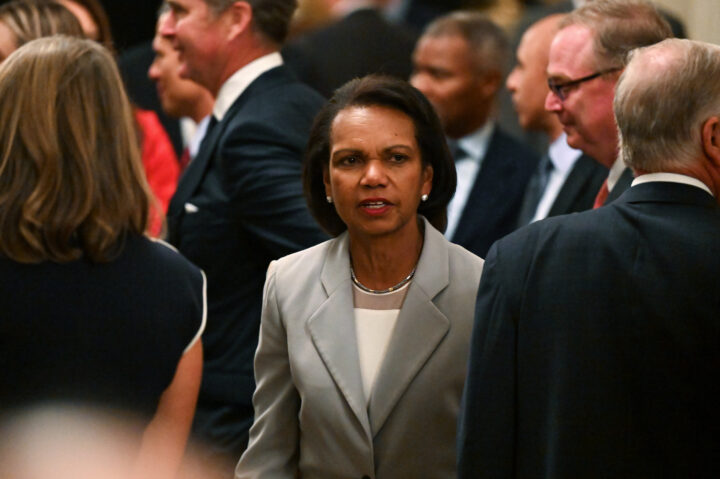
Former U.S. Secretary of State Condoleezza Rice attends the swearing-in ceremony for Chairman of the Federal Reserve Kevin Warsh in the East Room of the White House on May 22, 2026 in Washington, DC.
ASPEN, Colo. — Former Secretary of State Condoleezza Rice on Tuesday opposed any nuclear deal with Iran, arguing at the Aspen Security Forum that the U.S. should continue pressure on Iran’s economy and “see what happens.”
Meanwhile, former Secretary of Defense Mark Esper speaking alongside Rice on a panel, suggested that the U.S. had potentially overestimated its capabilities in the war, agreeing that continued economic pressure and a renewed blockade would be the best strategies going forward.
The two, speaking at the Aspen Security Forum, also offered strong criticisms of U.S. allies for not joining with and at times attempting to obstruct the U.S. campaign against Iran.
“I would not buy a nuclear agreement [with Iran] under any circumstances. I’d let them sit there and stew in their lousy economy, where most of their A-level nuclear scientists have been killed, where I believe there are deep splits in the Iranian government … and let’s just see what happens,” Rice said. “I wouldn’t give them a penny back, and let’s just see what happens to that economy over time.”
Rice said that she believes the U.S. did do significant damage to Iran’s nuclear program and that she’s “quite confident” that the country is not in a position to produce a nuclear weapon in the near future.
Mark Esper, who served during President Donald Trump’s first term, said that the U.S. war on Iran was a “a good thing to do to show the seriousness of of how we felt about this and our willingness to commit force to do that” but added, “we can discuss whether our reach exceeded our grasp, and some of the language used about unconditional surrender, et cetera, pushed them into a corner”
He said that a success in the war would require a return to the status quo in the Strait of Hormuz and a deal on Iran’s nuclear program superior to the 2015 Joint Comprehensive Plan of Action.
Esper argued that there would be no way to bring such a result solely through airstrikes, and that the primary path forward should be renewed economic pressure on Iran, including a renewed blockade targeting Iran’s ports and land and air routes. He said the U.S. should continue to respond to Iranian attacks with strikes on its missile and drone capabilities.
Esper said that strategy will take time, patience, discipline and the support of allies and come at the cost of higher gas prices. He said the end goal should not be to collapse the Iranian regime but to bring Iran back to the negotiating table.
“That approach, barring — I’m open to any better one — gives you the highest return with the lowest risk to where we don’t want to go,” Esper said.
Former Secretary of Commerce Penny Pritzker, who also spoke on the panel, emphasized that economic pressure is a useful tool, which can be effective but takes time, will and coordination, without which there are ways to evade sanctions.
“I’m hopeful that with all this pressure, that something rational can come of this, because we’re not in a good place right now, obviously,” Pritzker said.
Rice and Esper both expressed frustration with U.S. allies’ refusal to cooperate with the U.S. operations and, particularly, European allies’ decisions to block the U.S. from using their bases in their countries in the course of those operations — a move Esper called “really stupid.”
Rice said it was “really not a very smart thing” for allies to dismiss the conflict as not “our war.”
She said would have “preferred” if the U.S. had worked more closely with its allies before the operation, but acknowledged that actually getting them onboard would have been questionable, pointing to her own experience trying to bring allies onboard with the Iraq invasion during the Bush administration.
Sometimes, she said, “the United States has to do something really hard, like really deal with a bad guy who’s been a bad guy for a long time,” she said, emphasizing that the sophistication and range of Iran’s missile program was increasing and it was preparing to make a major agreement with Russia on missiles. “When the time comes, if it’s your ally and your friend, even if you’re not going to join, you don’t try to harm the effort,” she said.
“When I hear, ‘Well, it wasn’t imminent,’ I think, ‘Do you really want to wait until it’s imminent, or do you want to try to degrade it earlier?’” she continued.
Both Esper and Rice warned that, through their actions around the Iran war and comments denigrating the U.S.’ reliability as an ally, or declaring that they will handle their own defense without American assistance, allies are only playing into the hands of those who want to see those alliances collapse.
“You may speak into existence exactly what you need to avoid, because there are some people inside the American political system, on both sides of the aisle, who would be perfectly happy to withdraw from the world, and you don’t want to help empower those people,” Rice warned.
‘I’m not an investment advisor, but you can see that if you were not in Israel in the past two years, you probably missed out, if Israel was not part of your portfolio,’ Seffy Zinger, chair of the Israel Securities Authority, told JI

Patrick T. Fallon / AFP via Getty Images
Laurence D. Fink (R), co-founder, chairman and CEO of BlackRock, speaks next to Milken Institute chairman Michael Milken during the 29th annual Milken Institute Global Conference at the Beverly Hilton in Beverly Hills, California on May 5, 2026.
LOS ANGELES — The Israeli financiers, investors and entrepreneurs who attended last week’s Milken Institute Global Conference in Beverly Hills almost couldn’t make it. Just weeks earlier, after all, the country’s airspace had been largely closed as war raged with Iran.
But aside from their slight fear that the fragile ceasefire would fall apart and leave them stranded in the United States, the Israelis who participated in the marquee conference of global finance brought an upbeat attitude about Israel’s economy, even two-and-a-half years into near-constant war that began with Hamas’ Oct. 7, 2023, attacks.
“When the war began, I think none of us — none of the regulators in Israel, and almost none of the players or the investors in Israel — thought or believed that after two-and-a-half years of war, Israel would show such growth, such resilience,” Seffy Zinger, chair of the Israel Securities Authority, told Jewish Insider in an interview. (The ISA is Israel’s equivalent of the U.S. Securities and Exchange Commission.)
Zinger was at Milken to spread the message that global financiers should consider investing in the Israeli economy, and in particular the Tel Aviv Stock Exchange, despite the doom-and-gloom headlines about the Middle East.
“I’m not an investment advisor, but you can see that if you were not in Israel in the past two years, you probably missed out, if Israel was not part of your portfolio. So I think Israel is becoming a very interesting place economically,” he said.
The shift away from Israel in American politics did not appear to be reflected at this gathering of global business elites: Natti Ginor, a managing director at Jefferies and the bank’s head of Israel investment banking, pitched Israel at the conference as a financial capital in the Middle East. Blackstone’s Tel Aviv-based senior managing director, Yifat Oron, was also there talking about her work leading the firm’s investments in Israel.
“When we are talking to investors and the big players, what I see is a lot of interest in Israel, and I think the economy and the numbers speak for themselves,” said Zinger.
Dror Barak traveled to Los Angeles from Israel to meet developers and investors from across the Middle East, including Saudi Arabia, the United Arab Emirates and the Palestinian territories. He is the founder of Align Capital, an infrastructure-focused private equity firm that is working on projects related to IMEC, the India-Middle East-Europe Economic Corridor — a planned project meant to further economic cooperation across wide swathes of the world. Its development has stalled since the Oct. 7 terror attacks and the ensuing war, but behind the scenes, progress is being made.
“The war, I don’t like to say it, but with all the bad things it also pushed us toward a new era of cooperation,” Barak told JI last week. “The war made us on the same side. It’s the first time in history that we, the UAE [and] Saudi are on the same side. We are all against, publicly or less publicly, Iran. With the United States, of course. So this is a very, very, very dramatic thing, and it’s changed dramatically the nature of our relationship.” IMEC has been floated as an alternative for global shipping amid turbulence in the Strait of Hormuz.
Barak acknowledges that Israel’s reputation has suffered: “Yes, it’s an issue,” he said. But he argued that the work of investing in cross-regional infrastructure must happen, even if the geopolitical situation remains unresolved.
“I’m not waiting for the American public to dedicate my direction, and I’m not waiting for [Israeli Prime Minister Benjamin Netanyahu] or [President Donald Trump] to do some peace,” said Barak. “We promote Arabs and Jews working together. So everywhere that you are looking, I think that we are doing the right thing — the right thing for Israel, the right thing for the region and the right thing for the global politics that want to support the right forces.”
Last year was a banner one for Israeli startups, and the country’s GDP rebounded last year after slowing in 2023 and 2024. But challenges remain. Bentzion Levinson, founder and CEO of Heven AeroTech, an American company with a large Israeli workforce, said there were times that more than one-third of his employees were out of the office doing reserve duty in the Israeli military.
“To this day, we have an average of 10 to 20% of our employees in reserves, around the clock. So I think it’s a challenge. But challenges build strength,” Levinson told JI in Los Angeles. His company’s creation of pioneering long-range stealth drones has driven contracts with the U.S. military and earned a unicorn valuation.
“A lot of things are taking a toll on families [and the] personal, but I think people are strong and they realize that there’s no other choice,” said Levinson. “I think it’s gonna be a decade of significant growth in Israel, especially in the defense tech world … it’s a challenge, but I think the Israeli people can overcome it.”
Zinger, the ISA chair, was attending Milken with his chief of staff, who spent nearly 400 days serving in the reserves after Oct. 7. Responsibilities got juggled; some days the staffer would work three days and do reserve duty for two days. There was no choice but to adapt. And that flexibility, Zinger argued, is part of why Israel’s economy has performed better than anyone expected during the war.
“I think this is part of the strength of the Israeli community and society, exactly these kinds of things, and of course, without that strength, the performance that we see could not have happened,” said Zinger. “It’s something that I think we learn how to live with.”
Mohamed Hagi: ‘Somaliland is deliberately cultivating relationships with partners that value stability, innovation or responsible governance’
Shlomi Amsalem, GPO
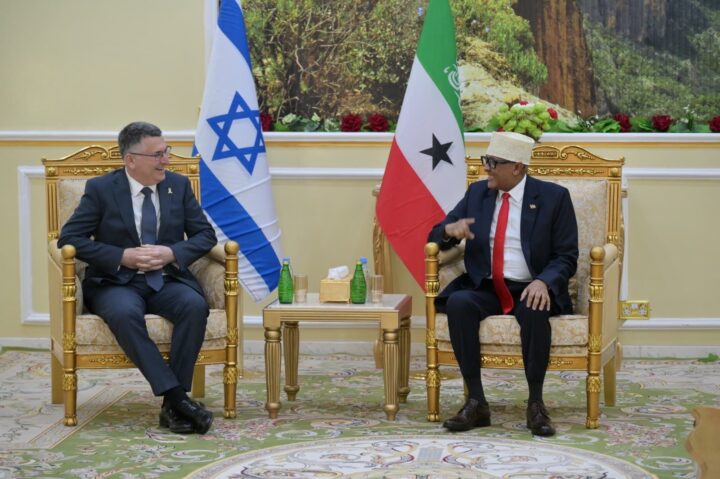
Israeli Foreign Minister Gideon Sa’ar meets with Somaliland President Abdirahman Mohamed Abdullahi in Hargeisa, Somaliland, Jan 6, 2026
Mohamed Hagi, Somaliland’s newly appointed envoy to Israel, spoke on Wednesday about the country’s “special relationship” with the Jewish state, saying that the ties are built on mutually beneficial economic and security interests.
“Our relationship with Israel should be understood as part of a purely strategic orientation,” Hagi said on the podcast “Ask Haviv Anything,” hosted by Israeli journalist Haviv Rettig Gur. “Somaliland is deliberately cultivating relationships with partners that value stability, innovation or responsible governance.”
Hagi said that the relationship will be “based on economic development,” noting that the two countries could benefit from “practical cooperation” in areas such as technology, water management, agriculture and security.
“We have natural resources in Somaliland, we have rare earth minerals in Somaliland, we have oil and gas. We have a lot to offer to our partner Israel,” Hagi said. “And Israel is a manufacturing industry.”
“They [Israel] have the know-how, we [Somaliland] have the natural resources, so in that way we benefit economically and we look at one of the most strategic areas in the world when it comes to security and when it comes to the economy and trade,” he added. “We are benefitting Israel for many, many areas.”
In addition to economic cooperation, Hagi noted that the two countries share “common enemies.” He said that Israel and Somaliland are “working together” to combat “terrorists and piracy.”
“These are our common enemies for Israelis and also for Somalilanders,” he said. “What we are going to build with the Israelis is a strategic partnership that can last forever.”
He also said the relationship being built between Israel and Somaliland is based on “interests” and is “not about religion.”
“It’s about engagement, it’s not about religion,” Hagi said. “Countries engage always on interests. Our people are not ignorant. They understand that the relationship between Israel and Somaliland has nothing to do with religion.”
He added that Israel’s decision to recognize Somaliland carries significant weight in the relationship.
“We see Israel as a very important country for us. It is the first country that recognized Somaliland,” Hagi said. “Our hearts and minds are always with Israel because of recognition.”
Israel became the first nation to formally recognize Somaliland’s independence from Somalia in December 2025 in a move that has since drawn waves of sharp condemnation from several Arab and Muslim countries. As part of the agreement, both nations agreed to open embassies and appoint ambassadors.
Following the announcement, Israeli Foreign Minister Gideon Sa’ar made a historic diplomatic visit to the Somaliland’s capital city of Hargeisa, in which he met with Somaliland President Abdirahman Mohamed Abdullahi.
Israel appointed Michael Lotem, who currently serves as an economic ambassador to Africa, to be its first ambassador to Somaliland earlier this month. The move also received criticism from Arab and Muslim countries.
“We need to build a relationship that is mutually beneficial — for the Israeli people, for the Israeli government, for our people and our government as well,” Hagi said. “We want to build this relationship and you will witness that this relationship will be one of the best special relationships in the world. We want to strengthen and deepen the relationship in a way that no one can imagine.”
Prime Minister Netanyahu said he told President Trump that Israel has ‘come of age’ and ‘developed incredible capacity’

Joshua Sukoff/Medill News Service
President Donald J. Trump holds a joint news conference at the White House with Israeli Prime Minister Benjamin Netanyahu on February 4, 2025.
Israeli Prime Minister Benjamin Netanyahu announced that Israel is seeking to end the military assistance it receives from the U.S. in the next 10 years, a move that he said is “in the works.”
In an interview with The Economist released Friday, Netanyahu said that during his December visit to President Donald Trump’s Mar-a-Lago resort in Palm Beach, Fla., he told Trump that Israel “very deeply appreciate[s] the military aid that America has given us over the years.”
But, he said, “we’ve come of age and we’ve developed incredible capacity. And our economy, which will reach, certainly within a decade, will reach about a trillion dollars — it’s not a huge economy, but it’s not a small economy. So I want to taper off military aid within the next 10 years.”
“And that’s not saying that I don’t want to fight for the allegiance and support of the American people — I do, you would have to be crazy not to,” Netanyahu continued.
“You want to taper it off to zero?” Zanny Minton Beddoes, editor-in-chief of The Economist, asked.
“Yes,” Netanyahu said.
“That would be a very dramatic shift,” Beddoes responded.
“Well, it’s in the works,” the prime minister replied.
Israel and the U.S. currently have a 10-year memorandum of understanding that provides Israel with $3.8 billion of security assistance annually, through 2028. Negotiations to establish the next MOU are underway.
Experts say what is unfolding now could be more significant than protests of the past, expressing to JI that recent developments could pose an unprecedented challenge to a regime already under strain
Kamran / Middle East Images / AFP via Getty Images
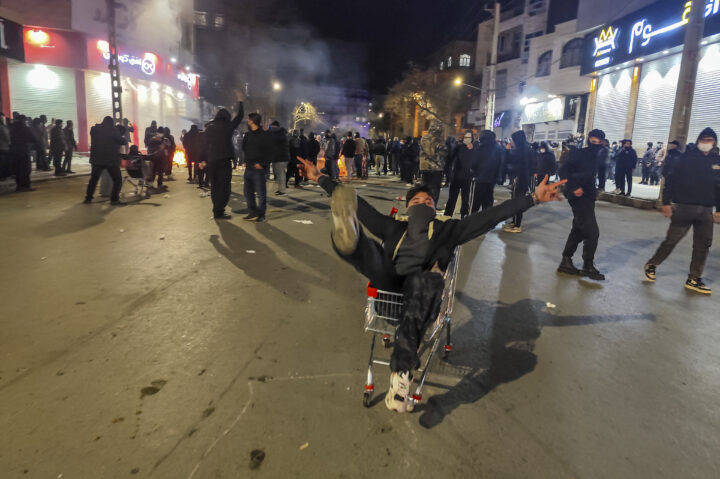
Iranians gather while blocking a street during a protest in Kermanshah, Iran on January 8, 2026.
The United States, Israel and their regional allies are watching closely as sustained unrest in Iran puts renewed pressure on the regime at a moment of economic strain, international isolation and lingering fallout from the 12-day war with Israel last June.
Recent demonstrations have spread across all 31 of Iran’s provinces, fueled by public anger over a collapsing economy, inflation exceeding 40% and aggressive crackdowns by security forces. Economic pressure — intensified by costly proxy wars and United Nations sanctions — have sent Iran’s currency into a sharp decline.
Jonathan Ruhe, a fellow at the Jewish Institute for National Security of America, said the regime’s “unwillingness to be responsive to its people’s basic demands and rights,” is also a factor. Adding that Tehran has a “clear preference to spend the country’s resources on military projects like its proxies, missiles and nuclear program instead of its citizens’ well-being.”
More than 400 demonstrations took place this week alone, with at least 743 recorded over the past month, according to a tracker from the Foundation for Defense of Democracies. The death toll has reached at least 38, with more than 2,200 arrests reported. The demonstrations are the largest since April 2025 and among the most sustained since late 2022 as videos continue to circulate online of Iranians flooding the streets, burning regime flags and lighting fire to statues of Supreme Leader Ayatollah Ali Khamenei.
Ruhe said that uprisings by the Iranian people against the regime are not uncommon. “In 2009 it was political corruption, when the regime clearly stole the presidential election to get [former President Mahmoud] Ahmadinejad reelected,” he said. “In 2017-18 it was economic and foreign policy issues, for instance Iranians being killed in the Syrian civil war and the regime’s lavish spending on its proxies instead of at home. In 2022 it was social and cultural issues, namely hijab enforcement.”
But experts say what is unfolding now could be more significant than protests of the past, expressing to Jewish Insider that recent developments could pose an unprecedented challenge to a regime already under strain.
Behnam Ben Taleblu, the senior director of FDD’s Iran program, called the protests a “nationwide anti-regime uprising,” telling JI that they are reaching a “crescendo” with a “greater demographic and geographic group of Iranians protesting.”
“Protests have rapidly spread due to the shared consensus that the Islamic Republic of Iran is behind the demise of Iran,” said Taleblu, who called the demonstrators “historic and different” given how the Iranian people have “not given up” in the face of crackdowns. “This matters for a regime that is battered and bruised.”
Ruhe also said the protests are “different from past waves,” explaining that the regime is less capable of solving the issues of the Iranian people in the current moment.
“The economic grievances that triggered the current protests are much more clearly beyond the regime’s ability to fix than they might have been years ago, before the effects of the regime’s corruption and mismanagement had reached the point where the country is running out of electricity and water and its money is absolutely worthless,” said Ruhe.
The ayatollah’s fears are also likely heightened by the recent U.S. operation in Venezuela that ousted President Nicolás Maduro. The U.S. pursuing similar actions in Iran is unlikely, however, Iranian officials have expressed concerns that their regime in Tehran could be next. President Donald Trump has warned that the U.S. is watching the protests “very closely.”
In response, the Iranian regime has vowed to crack down against protesters, with Khamenei stating last week that they must be “put in their place.” The regime also appeared to cut off internet access on Thursday. But none of these methods have seemed to quell the unrest, with recent reports suggesting Khamenei could flee Tehran for Moscow if security forces become overwhelmed by protests.
Nadav Eyal wrote that the continued protests could indicate that “fear has shifted sides” from the people of Iran to the regime itself.
“The oppressors are no longer as certain as they once were in using force. They cannot compete with sheer numbers, with masses filling the streets,” Eyal wrote on X. “The Islamic Republic still possesses formidable repressive capacity. Yet the signals — hesitation, mixed messaging, demonstration of fear by cutting internet — suggest a leadership aware that it may no longer be able to rely on obedience.”
In an interview with JI, Ambassador Gilad Cohen discusses his push to persuade Japan not to recognize a Palestinian state at the UNGA
Courtesy Gilad Cohen
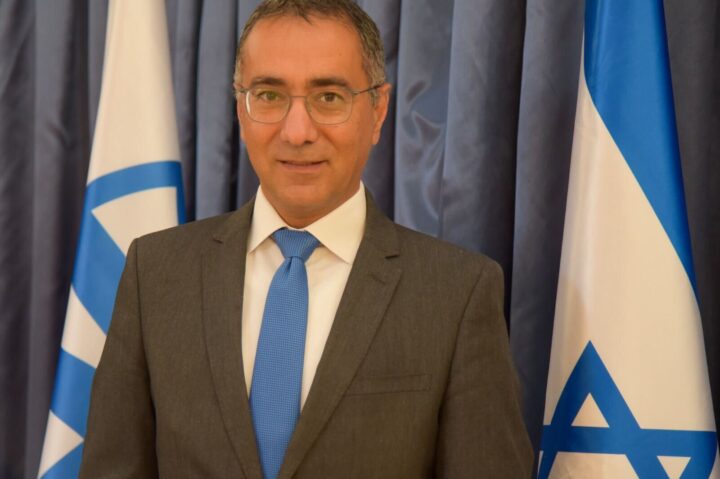
Israeli Ambassador to Japan Gilad Cohen
TOKYO — As Japan decided against recognizing a Palestinian state at the United Nations General Assembly on Friday, Israeli Ambassador to Japan Gilad Cohen told Jewish Insider in a wide-ranging interview in Tokyo that he is appreciative of Japan, “an important factor of the international community.”
On Friday evening, Japanese Foreign Minister Takeshi Iwaya called his Israeli counterpart, Gideon Sa’ar, to update him that after weeks of deliberation, Japan decided it will not recognize a Palestinian state at the UNGA.
“Sa’ar appreciated [the] decision and briefed [Iwaya] about Israel’s actions against Hamas chiefs in Qatar and IDF operations in Gaza,” Cohen told JI. “I join my foreign minister in appreciating Japan, a member of the G7, and an important factor of the international community, and for the deep friendship of our nations.”
“A recognition of a Palestinian state would be a reward to Hamas after the Oct. 7 terrorist attacks, would not contribute to peace and would not build on the trust of Israelis in the future,” he said. In recent weeks, Cohen relayed that message to Japanese ministers as the country weighed recognizing a Palestinian state as several governments, including those in Britain, France, Australia and Canada, have announced plans to do at the UNGA.
“This recognition is null and void because when you acknowledge a state there have to be conditions — what are the boundaries? Do you have effective control of the population? Nothing about that works with the Palestinians,” Cohen told JI. “Are they going to dismantle Hamas? Are they going to continue paying salaries for families of suicide bombers? Are they going to continue to have pacts with Iran against Israel? Is there going to be a repetition of Oct. 7 because they have a state? We are the Jewish people, we always have to be concerned and worried.”
For Cohen, who assumed office as ambassador of Israel to Japan in October 2021 following a stint as deputy director general for Asia and Pacific division in the Israel Ministry of Foreign Affairs, Japan’s consideration of recognizing a Palestinian state has been one of only a few disagreements he’s held with local politicians since arriving in Tokyo. In the immediate aftermath of the Oct. 7 attacks, “the Japanese government stood by Israel, called for an immediate and unconditional release of our hostages and said publicly that Hamas should be dismantled,” Cohen said.
“I thank the Japanese for acknowledging that Hamas is a terrorist organization and for saying that Iran is the number one destabilizer of the region. I want to thank the Japanese government for standing on the right side of history.”
When war broke out between Israel and Hamas soon after the Oct. 7, 2023, Hamas attacks on Israel, Japan, as a member of the U.N. Security Council, “was trying to influence the release of the hostages and not to [attack] Israel. They were not mediating, but there were messages Japan was trying to deliver for both sides in order to bring our hostages back,” Cohen recalled.
Looking ahead to the postwar period, Cohen suggested that Japan will contribute to rebuilding the Palestinian economy. “We will welcome any kind of investment in the Palestinian economy to revive it,” he said. “Economy is a major part of the vision of Palestinians living side by side with Israelis in peace and security.”
While tourism from Japan to Israel has seen a decline amid the war, Cohen said that joint business ventures between the two countries have increased over the past two years, as Israeli tech companies engage with Japan’s industrial giants and venture capital networks.
“Investments from Japanese companies in Israel were much higher in 2024 than 2023, including in AI and technology,” he said. “There is a saying that Israel can do things from zero to one and Japanese can take them from one to 10. Israeli innovation and startups can be combined with Japanese wisdom, experience and production ability that Israel doesn’t have.”
When it comes to creating cars, for example, an area that Japan is a global leader in, “Israel should focus on the brain of the car, systems that prevent accidents such as Waze and Mobileye,” said Cohen. “The synergy that we can learn from Japan — and we can share our experience with them — I see a lot of potential in economic relations. Japanese companies are looking at Israeli startups with great interest. In the last two and a half years, there have been direct flights from Israel to Japan, which is important because businessmen and investors do not have time to waste. This is an engine for connecting the people of Israel and Japan.”
Israel is among the handful of countries that Japan has a free trade deal with, an agreement signed by Cohen in March 2023. It allows 200 Israelis to come to Japan annually on a visa for one year of work, study and travel. At the same time, 200 Japanese citizens can come to Israel for one year to do the same.
Cohen sees himself not only as an ambassador of Israel “but also as representing the Jewish people in Japan,” he said, describing a small but vibrant community. Tokyo is home to two Chabad houses and a Jewish community center, which runs a pluralistic synagogue. The cities of Kyoto and Kobe also each have a Chabad. All five centers primarily cater to tourists.
It can be a challenge to navigate Holocaust education and antisemitism awareness in a country with limited historical exposure to those issues, Cohen said, recommending that all Japanese visit the Holocaust Education Center in Fukuyama City, near Hiroshima.
“The Japanese government comes to commemorate our Holocaust memorial days,” Cohen told JI. “They give thanks to [Chiune] Sugihara,” he said, referring to the Japanese diplomat who, while posted in Lithuania, saved thousands of Jews during the Holocaust. “We are participating in ceremonies to commemorate him. In Japan, he became a hero.”
“I see a lot of potential in the future when things calm down in the region,” continued Cohen. “I would like to have future agreements signed with Japan to boost the economy on both sides. I have many things on my agenda, but this will be after Rosh Hashanah.”
Trump, Netanyahu to meet in White House in two weeks after Israeli prime minister’s U.N. speech
Screenshot
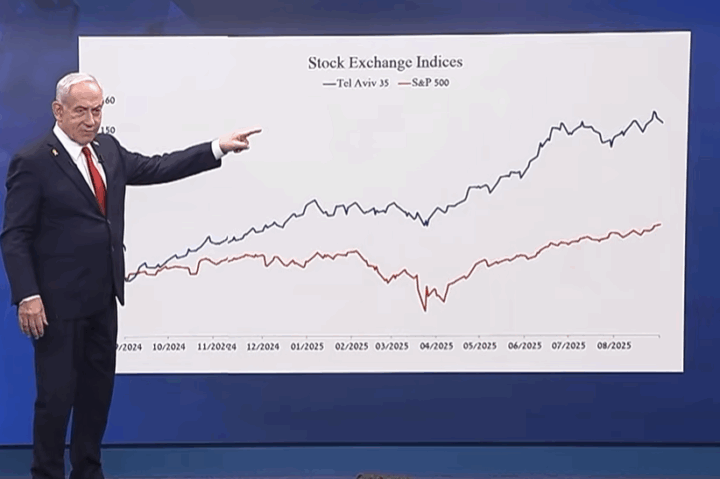
Israeli Prime Minister Benjamin Netanyahu holds a press conference on the Israeli economy on Sept. 16, 2025.
Israeli Prime Minister Benjamin Netanyahu clarified his remarks that Israel’s economy may “need to adapt to … autarkic characteristics” on Tuesday, after a dip in the Tel Aviv Stock Exchange.
Netanyahu made his original comments at a conference held by the Israeli Finance Ministry on Monday, where he said that “Israel is in a sort of isolation,” and that he hates the idea that Israel will have to behave like an autarky, or self-reliant economy.
“I believe in the free market, but we may find ourselves in a situation where our arms industries are blocked. We will need to develop arms industries here — not only research and development, but also the ability to produce what we need … There’s no choice,” he said, adding that Israel will need to be “Athens and super-Sparta.”
Israeli markets dropped in response, and business and industry leaders came out against Netanyahu’s remarks, saying that “an autarkic economy will be a disaster for Israel,” and “this vision … will make it hard for us to survive in a developing globalized world.”
A day later, Netanyahu called a press conference to do damage control amid the widespread concern in Israel, clarifying that his comments were specific to the Israeli defense industry.
In the defense industry, he said “there are limitations that are not economic, but political.”
“If there’s one lesson from this war, it is that we want to be in a situation where we are not limited. We want to defend ourselves by ourselves and with our own weapons,” Netanyahu stated. “We are going to produce an independent arms industry that is very strong that can withstand any political constraints.”
Israel will “build a defense industry that will match the best in the world,” he added. “You saw some — not even all — of it in the 12-day war with Iran.”
The prime minister also talked about Israel working on technology for underground warfare.
Netanyahu said western European countries implementing arms embargoes against Israel are “pressured by minorities in which some are very extreme,” as well as “advanced propaganda against us.”
Netanyahu said that his intention in the speech at the Finance Ministry was to tell its workers that “we are aiming for security independence and I asked them to cut bureaucracy.”
“Within that [speech], there was a misunderstanding,” he said.
“A concentrated, closed market is not what I usually like,” he said. “I turn to the markets. But we are using all of the means needed to create a strong defense industry.”
Netanyahu expressed “full faith in Israel’s economy.”
“Israel’s economy is very strong,” he said. “It has amazed the whole world in recent decades and more than amazed the world in the last two years, in which we are fighting a war. … Against all predictions, the shekel is stronger than it was before the war … Unemployment is at a historic low. In recent months, there is a large flow of investors in the Israeli economy.”
Netanyahu presented graphs showing the Tel Aviv Stock Exchange rising at a higher rate than the S&P, that the shekel is strong against the dollar and GDP per capita is rising, that Israel’s debt to GDP rate is lower than that of the U.S. and the average for advanced economies, and that Israel is second in the world — after the U.S. — in receiving foreign investments for research and development.
“I don’t underestimate the attempts to economically isolate us, but the world wants the products that Israel makes,” he added, mentioning artificial intelligence and cybersecurity. “This is the health, the vibrancy of Israel’s economy. This is a very powerful economy, an economy of 10 million people, but very gifted people.”
In the press conference, Netanyahu also said he had spoken on the phone with President Donald Trump several times since Israel’s strike aimed at Hamas leaders in Qatar last week, including one in which the president invited him to the White House.
Netanyahu said he will be meeting with Trump in Washington on Sept. 29.
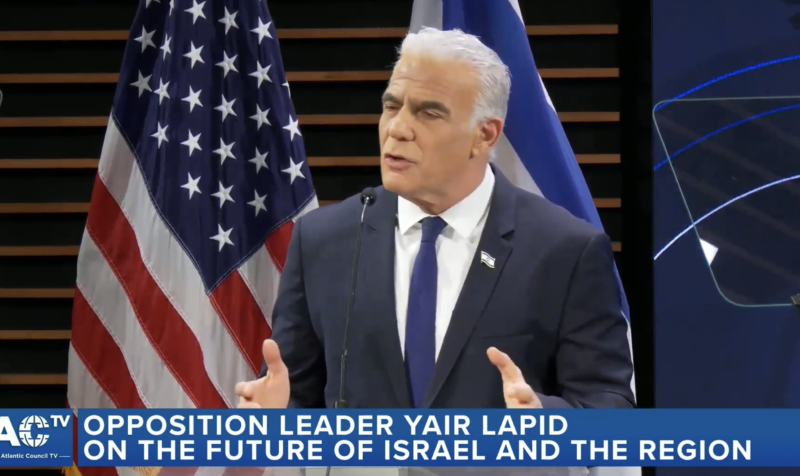
Following the press conference, Yair Lapid, Israel’s opposition leader, said that Netanyahu “lost contact with reality.”
“You cannot run a market when there is no trust in the government and no trust in the prime minister,” Lapid said. “On Netanyahu’s watch and that of the current government, Israel’s credit rating was lowered for the first time in history, and then it happened again. There is a sharp reduction in Israeli exports. There is a sharp decrease in investment from abroad. High-tech, the engine of the market, is in an unprecedented crisis.”
Please log in if you already have a subscription, or subscribe to access the latest updates.
 Continue with Google
 Continue with Apple