



























AJC report calls out systemic antisemitism in far-right German AfD party
The group typically masks its antisemitic views by using coded rhetoric and promoting conspiracy theories, said the report’s author, Lars Rensmann
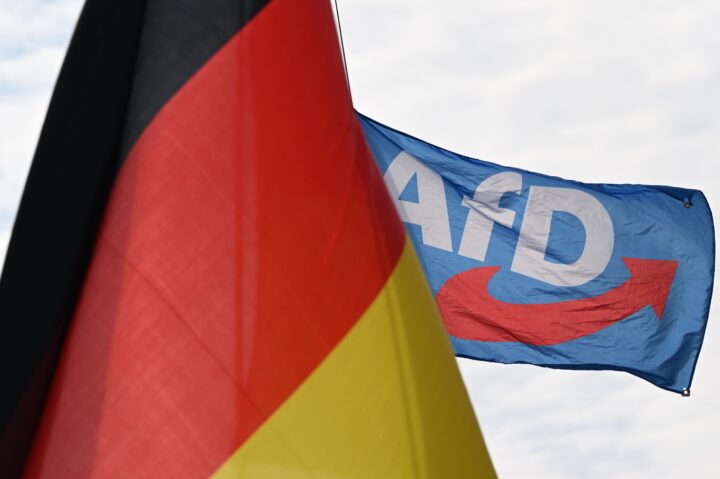
Hendrik Schmidt/picture alliance via Getty Images
An AfD flag flies in the market square in Zeitz.


 Add JewishInsider on Google
Germany’s far-right Alternative for Germany party has embedded antisemitism into its core ideology, using coded rhetoric, conspiracy myths and historical revisionism to mobilize voters and undermine German democracy, according to a new report released by the American Jewish Committee.
The AJC report details how the party rarely uses explicit anti-Jewish rhetoric in official statements, instead relying on coded verbiage — such as attacks on so-called “globalist elites” — to mask its hostility while maintaining plausible deniability.
“Antisemitism is very much part and parcel of the authoritarian nationalist worldview of the AfD,” said Lars Rensmann, the author of the report and a professor of political science and comparative government at Germany’s University of Passau. During a briefing on the report on Wednesday, he explained that the group “frames politics through stark friend and enemy logics,” pitting a supposedly “virtuous people” against corrupt “domestic elites, hostile external forces and migrants.”
Rensmann said a key pillar of that rhetoric is the Great Replacement conspiracy theory, which claims that white Western populations are being systematically, “replaced by migrants, particularly migrants from the Muslim world,” in a process orchestrated by Jews, Rensmann said.
He noted that AfD and its allies frequently personify this narrative through attacks on financier George Soros as the “string‑pulling Jew that personifies this kind of orchestration of a replacement of domestic populations.”
While open Jew-hatred sometimes surfaces among rank-and-file activists, Rensmann stressed that the AfD typically relies on “encoded language.” Its antisemitism, he argued, is embedded “in historical revisionism, in positive references to the Nazi past, in downplaying Nazi crimes,” as well as in “targeted campaigns against Jewish individuals,” such as [journalist] Anetta Kahane and [former vice president of the Central Council of Jews in Germany] Michel Friedmann.”
Rensmann noted that the party’s hostility extends to what scholars describe as “secondary antisemitism” — resentment of Germany’s postwar culture of Holocaust remembrance. AfD figures, he said, have repeatedly attacked Holocaust memory as a “cult of guilt” and have engaged in “Nazi crime relativization.”
“Far from being an isolated problem,” Rensmann said, “political antisemitism functions as a key mobilizing resource within the AfD’s broader challenge to liberal democracy.”
“We see a very large support of antisemitism among AfD voters, to which, of course, the party also appeals,” Rensmann continued, noting that AfD voters are “disproportionately antisemitic.”
Rensmann said the AfD is recognized in Europe broadly as too radical for even other far-right parties. Because of its extremism, he noted that the AfD was excluded from the main right-wing populist family in the European Parliament in 2024.
“They are isolated because of their positive references to the Nazi past, the downplaying of the SS as a criminal organization and their antisemitism and extremism,” Rensmann said. As a result, the AfD has had to form a group in the European Parliament with “tiny homophobic and antisemitic and right‑wing extremist neo‑fascist parties in Europe.”
From an American vantage point, he suggested, the AfD represents “the Tucker Carlson wing of the MAGA movement” within German politics.
The AfD also frequently attempts to shield itself from criticism of antisemitism by adopting a “superficial” pro-Israel stance, according to Rensmann, particularly by framing Israel as a frontline state against Muslim immigration. Rensmann said that while some AfD actors have used pro-Israel rhetoric as a “counter element” to political antisemitism, this support is performative and “constantly undermined” by anti‑Israel memes and the growing strength of an “overtly anti‑Israel wing” inside the party.
For the German Jewish community, he said the most immediate concerns center on what AfD gains in upcoming state elections could mean for policy.
“According to the Constitution, education is primarily a state matter,” Rensmann said. “They have ample opportunity to basically set curricular guidelines,” including on how the Nazi past and the Holocaust are taught.
Rensmann warned that an AfD‑led state government could also “draw potential civil servants to the state … with an extremist party neo‑Nazi background, who were rejected as teachers, as educators in other states,” but would then have “a good chance to join and become lifetime civil servants.”
Remko Leemhuis, director of AJC’s Berlin Lawrence and Lee Ramer Institute for German‑Jewish Relations, pointed to domestic intelligence agencies and the police as another potential flashpoint.
Every German state has its own domestic security service and helps finance the memorialization of former concentration camp sites and other institutions. If the AfD takes power in a state, “this means the AfD then has political power to … direct security services where to look, where not to look,” Leemhuis said.
He added that party leaders could “immediately appoint a new president” to the state intelligence agency, shift focus away from right‑wing extremism and move quickly to cut funding for memorial sites “to a level where a lot of these memorial sites are no longer able to operate in a way that they used to.”
“This would increase the risk for Jewish institutions and Jews in that state dramatically,” Leemhuis warned, adding that the concern is “not an overstatement” given the profiles of AfD candidates in eastern regions.
Leemhuis also underscored that the Jewish community’s stance toward the AfD remains unequivocal. “No Jewish institution has any contacts with the AfD — not the Central Council, not any Jewish organization, not the embassy of the State of Israel,” he said, noting there is “unity among the community and Jewish organizations in Germany to have no contacts with them.”
From Washington’s perspective, AJC officials argued that AfD’s antisemitism poses not only a European challenge but a test of the U.S. commitment to combat antisemitism globally.
Historically, mainstream German parties built a “firewall” around the AfD by pledging to block it out of coalition partnerships — a boundary past U.S. administrations have typically respected, according to Julie Rayman, AJC’s senior director of policy and political affairs. Under the Trump administration, however, she said that approach has appeared to change.
At the 2025 Munich Security Conference, Vice President JD Vance “talked about this firewall” and “publicly … criticized European governments for excluding populist parties,” Rayman said. Vance then “went pretty much directly from his speech to meet with AfD leader Alice Weidel,” signaling “a senior U.S. official publicly questioning the legitimacy of Germany’s efforts to isolate the AfD.”
Secretary of State Marco Rubio subsequently “publicly criticized the designation in 2025 of … AfD as an extremist organization,” calling it a “farce” and suggesting the label was meant to limit the party’s political influence, she said.
While lower‑level State Department engagement with the AfD has continued to reflect earlier practice, Rayman warned that senior‑level outreach risks normalizing a movement whose antisemitic record is often downplayed or misunderstood in Washington.
“I am not saying that the United States shouldn’t talk to the AfD,” Rayman said, acknowledging that the party is “too electorally significant to simply ignore.”
“The objective should be engagement without endorsement,” Rayman stressed, cautioning that U.S. officials might make decisions about the AfD “without recognizing the extremist antisemitism within AfD” in ways that “could jeopardize both German Jews and American Jews.”
More Stories
EMPIRE STATE FEUD
Mamdani rips Blakeman’s claims he wouldn’t protect Jews as ‘directly racist’
ON DEFENSE
El-Sayed dismisses half-sister’s comments about family’s Muslim Brotherhood ties as ‘hearsay’
FOLLOW THE MONEY
Brandeis Center, FDD urge federal court to allow disclosure of campus foreign funding data
Daily Overtime
Jewish leaders press Miliband on U.K. antisemitism
booking bias
Irish Jewish leader says Dublin hotel canceled guest rooms for conference on fighting antisemitism
PROBLEMATIC POST
Paxton senior advisor endorsed antisemitic slur on social media
Please log in if you already have a subscription, or subscribe to access the latest updates.
 Continue with Google
 Continue with Apple