































































This is the second constituent of Moskowitz’s to be arrested for threatening his life since 2024
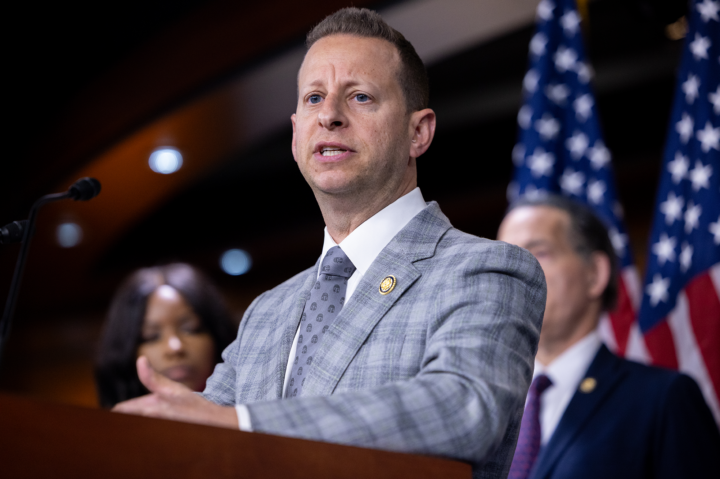
Nathan Posner/Anadolu via Getty Images
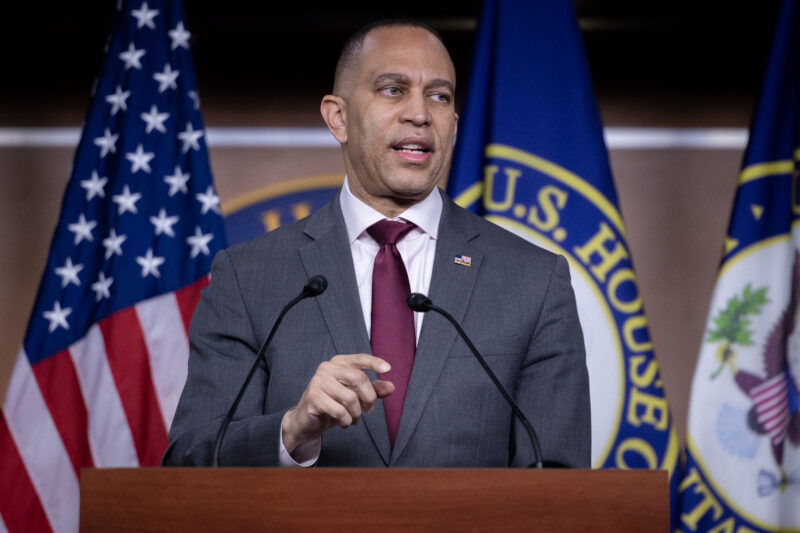
Rep. Jared Moskowitz (D-FL) speaks at a press conference on Capitol Hill on Sept. 8, 2025.


 Add JewishInsider on Google
Rep. Jared Moskowitz (D-FL) said on Thursday that a constituent had been arrested in Boca Raton for making a death threat directed at the Florida congressman, the second such arrest since 2024.
“A constituent of mine has just been arrested in Boca Raton, just a few miles from my house, for threatening my life,” Moskowitz said. “He is currently in the Palm Beach County Jail. I’m grateful to the Florida Department of Law Enforcement (FDLE) and local law enforcement for acting quickly to keep my family and me safe.”
The FDLE and U.S. Capitol Police did not immediately respond to requests for comment. The nature and motive of the threat are not yet clear, as is the identity of the man in custody. The Boca Raton Police Department said it is not the arresting agency and does not have any information to provide.
Moskowitz has spoken publicly about facing heightened security threats as a result of his Jewish identity and outspoken support for the Jewish community and Israel, requiring armed security while in his district. Standing up for Israel, at this point, puts members’ families at risk, he told Jewish Insider earlier this year.
Another man is currently serving a 25-year prison sentence for planning an assassination attempt targeting Moskowitz, after being arrested in 2024. That attacker had a manifesto containing antisemitic rhetoric and a target list that included Jewish institutions.
Other Jewish lawmakers, including Moskowitz’s Florida colleague Rep. Randy Fine (R-FL), have also faced death threats and other security incidents.
A slew of Democratic lawmakers in recent days have received envelopes containing white powder at their district offices across the country, but each incident thus far has been found to be a hoax.
Rep. John Larson, a Democrat, supports continued U.S. aid to Israel, while former Hartford Mayor Luke Bronin has said he would not back further offensive aid but does support Iron Dome
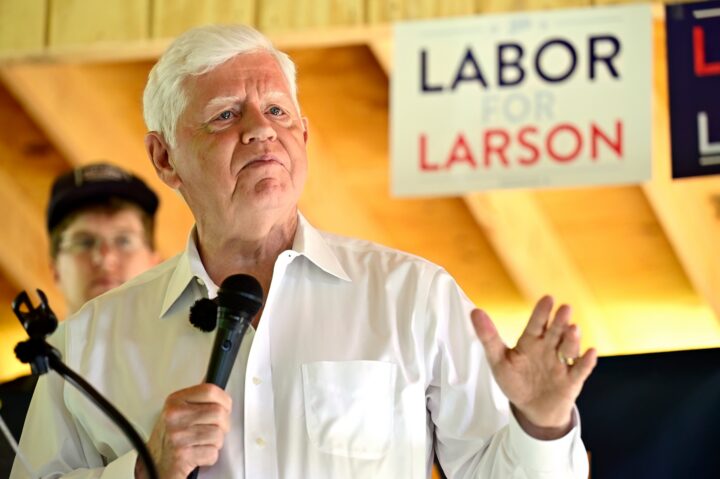
Jessica Hill/AP
U.S. Rep. John Larson D-Conn., attends a campaign event, Saturday, July 25, 2026, in Bristol, Conn.
Longtime Rep. John Larson (D-CT) is facing a serious challenge to his political survival from former Hartford, Conn., Mayor Luke Bronin, the latest in a wave of challengers to make the argument for generational change in the House of Representatives. Larson, 78, has held his House seat since 1999.
Despite their age gap — Bronin is 47 — the two are generally ideologically aligned and were once allies, though Larson has been trying to outflank Bronin from his left, pointing to support the former Hartford mayor has received from wealthy backers. The race has also split local Democrats: Sen. Chris Murphy (D-CT) is defending and recorded an advertisement for Larson, but Bronin won the Connecticut Democratic Party’s endorsement in a party convention, a major upset.
Bronin has argued that the current political environment requires more active and energetic representation. Larson has emphasized his record and experience in office and has had to campaign more aggressively than in decades, according to local reporters.
Larson was among the House Democrats who voted last month against an amendment to cut off all U.S. aid to Israel, and is endorsed by AIPAC. At the same time, he’s been critical of the human rights situation in Gaza and opposed the Iran war. The district is home to the largest concentration of Jews in the state, largely in the Hartford area.
“Yes, I voted in favor of making sure that Israel, our ally, is going to get the aid from the United States that it needs. But the Palestinians need humanitarian aid, and [President] Donald Trump has got to enforce the law,” Larson said of the amendment vote in a recent debate. He urged the administration to enforce the terms of the ceasefire deal between Israel and Hamas, including to ensure that Israel is providing sufficient humanitarian aid to the Palestinians.
Bronin criticized Larson for his vote, adding that if elected, he would not support any further offensive aid to Israel, though he said he supports defensive systems that protect civilians such as the Iron Dome.
“Trusting Donald Trump to do the right thing is a mind-blowing example of putting hope over all of the evidence in front of us,” Bronin said during the debate. “We have a president who is empowering an extremist Netanyahu regime that sees war as the answer to everything — most of all Netanyahu’s political interests.”
Bronin led Larson by eight points in a May poll that was sponsored by a group backing Bronin. The challenger has also received a boost from outside spending. VoteVets has spent $1 million boosting Bronin, with other groups also intervening in support of him, allowing him to dominate the airways, according to the Cook Political Report. Other groups have come in to support Larson, but are spending less on the race.
Bronin also holds an edge in fundraising — atypical for a challenger against a veteran incumbent — bringing in $3 million during the campaign cycle to Larson’s $2.7 million as of late July.
Both Democrats described the war in Iran as illegal and said they opposed it during the debate.
Bronin also emphasized his work in the Obama administration as assistant secretary of the treasury for terrorist financing and financial crimes. He said he had traveled globally to rally support for Iran sanctions that ultimately yielded the Obama-era Iran nuclear deal “that would have kept us safer if Donald Trump had not ripped it up.”
‘Barney Frank changed the country through the barriers he broke and through the seriousness, clarity, and effectiveness he brought to public life,’ said Jeremy Burton of the Boston JCRC
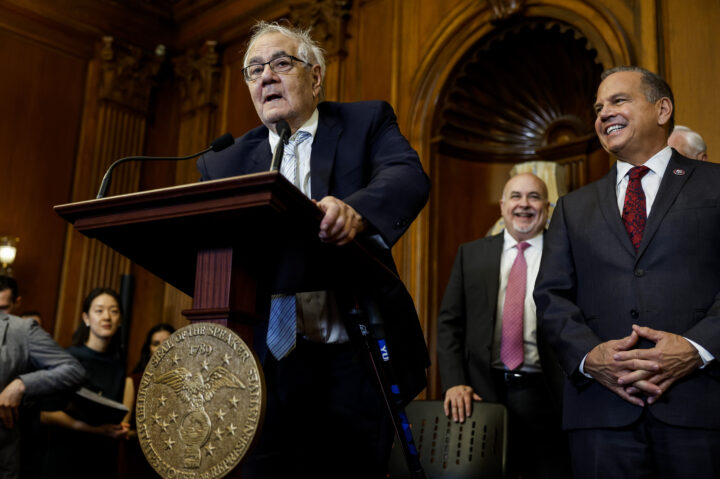
Anna Moneymaker/Getty Images
Former Rep. Barney Frank (D-MA) speaks during a bill enrollment ceremony for the Respect For Marriage Act as Rep. David Cicilline (D-RI) looks on at the U.S. Capitol Building on December 08, 2022 in Washington, DC.
Former Rep. Barney Frank (D-MA), who represented the Boston area in Congress for more than three decades and was the first openly gay member of Congress, died on Tuesday. He was 86.
Known as a liberal firebrand, Frank’s most high-profile act in politics was drafting the legislation that tightened financial regulations in response to the 2008 financial crisis, a bill known as the Dodd-Frank Wall Street Reform and Consumer Protection Act. He also was widely considered a pioneer for the LGBTQ community after coming out publicly as gay in 1987.
Frank grew up in a working-class Jewish family in Bayonne, N.J. His sister, Ann Lewis, also worked in politics, holding senior roles in the Clinton administration and later on Hillary Clinton’s presidential campaign.
Frank said he was drawn to public service early, feeling in some way that he was an outsider who could challenge how things were done.
“I’m a left-handed gay Jew,” Frank said. “I’ve never felt, automatically, a member of any majority.”
He knew from the time he was a teenager that he was gay, but figured that being Jewish would be a bigger barrier to holding public office.
“I knew I was a homosexual growing up in the 1950s, but figured no one had to know I was one,” Frank told a group of Yale students in 2013. “And it was already out [that] I was Jewish. I had been bar mitzvahed.”
A graduate of Harvard Law School, Frank spent nearly his entire career in elected office after a short stint working in Boston politics. He was elected to the Massachusetts State House in 1972, a position he held for eight years until his election to Congress in 1980.
For 32 years, until he retired in 2013, he represented a district that included the Boston suburbs of Newton, Needham, Brookline, Foxborough and Sharon. One of Frank’s final acts in office was marrying his husband, James Ready, in 2012, becoming the first sitting member of Congress to marry a same-sex partner.
“Massachusetts and the Jewish community are mourning one of the defining public leaders of his generation,” Jeremy Burton, CEO of the Jewish Community Relations Council of Greater Boston, said in a statement. “Barney Frank changed the country through the barriers he broke and through the seriousness, clarity, and effectiveness he brought to public life.”
In the final weeks of his life, Frank did a series of interviews to promote his new book, The Hard Path to Unity: Why We Must Reform the Left to Rescue Democracy, which will be released in September. He entered hospice a few weeks ago and knew he would not make it to the book’s release date.
Frank explained in a May 8 interview with the Jewish Telegraphic Agency that he believed Democrats should get rid of far-left litmus tests that he said limited the party’s electoral prospects and turned away voters — but added that he thought Israel should be treated differently.
“I’ve been talking about the importance of repudiating positions from the left and from the far left, but the Israel one is almost 180 degrees” different, he told JTA. “It’s the one area where we are not doing enough in terms of making our position clear.”
Frank, who considered himself a Zionist and supporter of Israel, said Democrats need to be much clearer about their opposition to Israeli Prime Minister Benjamin Netanyahu and his treatment of the Palestinians in Gaza and the West Bank. He said Netanyahu is the “enabler” of rising anti-Israel Democrats, such as New York City Mayor Zohran Mamdani.
“It’s what the Democrats should be doing, it’s what America should be doing, and it should be what the Democrats are advocating, is giving an ultimatum that [Netanyahu] either changes things substantially in Gaza and the West Bank, or we cut off any aid,” Frank said in the interview. “We’ve now gone to the point where supporting Israel has become unpopular, and that’s all Netanyahu’s doing.”
But, Frank added, opposition to Netanyahu should not be seen as opposing Israel’s very existence.
“We should make it clear that the right position here is to support Israel’s right to exist, but to be unwilling to facilitate what they’re doing militarily and to give them an ultimatum,” said Frank.
The embattled Kentucky congressman called his Trump-endorsed challenger a ‘puppet’ of the Republican Jewish Coalition

DANIEL HEUER/AFP via Getty Images
Rep. Thomas Massie (R-KY) speaks to reporters at the US Capitol on Washington, DC on November 18, 2025.
In the closing days of his House reelection campaign against Trump-endorsed Navy veteran Ed Gallrein — which will conclude with Tuesday’s primary — Rep. Thomas Massie (R-KY) has focused his ire on pro-Israel and Jewish advocacy groups, claiming that his opponent is a “puppet” of such interests.
At a rally on Saturday, the congressman joked that Gallrein’s phone number had a Tel Aviv area code, part of a narrative by Massie that Gallrein is working on behalf of Israeli interests.
“After months of beating around the bush, one reporter finally writes the true story of my race and when asked, the lobbyists brag about it,” Massie said on X on Sunday, referring to a story in Politico about pro-Israel groups’ spending to defeat him. “A coalition of Israel’s lobbyists and donors is spending tens of millions of dollars in a blatant attempt to buy a KY congressional seat.”
The congressman also asserted that Gallrein is a “puppet” of the Republican Jewish Coalition and that “they are running his race.”
The RJC’s national political director, Sam Markstein, responded, “I am speaking for ALL Republicans who want to see you lose tomorrow — including President Donald Trump.”
On Friday, Massie called his primary, which has become the most expensive intraparty congressional contest in U.S. history, “a referendum on whether Israel gets to buy seats in Congress.”
“I’ve never seen Great Britain, Australia or even Germany play in our elections here in the United States. But Israel gets so much from the United States. It’s a one-sided relationship,” Massie said. “They get us to be their proxies in wars they want against their enemies. They get our military assistance. They get our technology. They get our bombs. They get our tax dollars. And I think it’s a very one-sided relationship. At least with NATO, we pretend that they would come to our aid someday if we needed it — and even that’s a ruse.”
Massie also reportedly hosted at least two antisemitic social media figures at his home for an event over the weekend. Some of the attendees said online that Massie brought a group of several dozen influencers into his home for the event. His campaign did not respond to a request for comment on the event or on the individuals invited.
One of the individuals pictured at the event was Ryan Matta, a Holocaust denier who was pictured with Massie at a separate event wearing an “American Reich” sweatshirt. Another was David Reilly, a self-described antisemite who also has a history of racist and otherwise offensive comments.
Various figures with records of antisemitism including Tucker Carlson, former Rep. Marjorie Taylor Greene (R-GA), former Rep. Ron Paul (R-TX), Carrie Prejean Boller, who was booted from the White House Religious Liberty Commission over her antisemitic views, Alex Jones, Nick Fuentes and Ian Carroll have all declared their support for Massie, framing his race as a battle between him and Israel and its supporters.
He’s also picked up support from a variety of anti-Israel and Israel-critical figures on the left.
In the final days of the campaign last week, Massie also introduced the “AIPAC Act,” demanding that the pro-Israel group, and other interest groups supporting other countries, register as foreign agents — a longtime talking point by the congressman that leans into antisemitic dual loyalty tropes.
Rep. Christian Menefee is the favorite against Rep. Al Green in next month’s primary; Green has consistently voted against Israel since Oct. 7
Jason Fochtman/Houston Chronicle via Getty Images
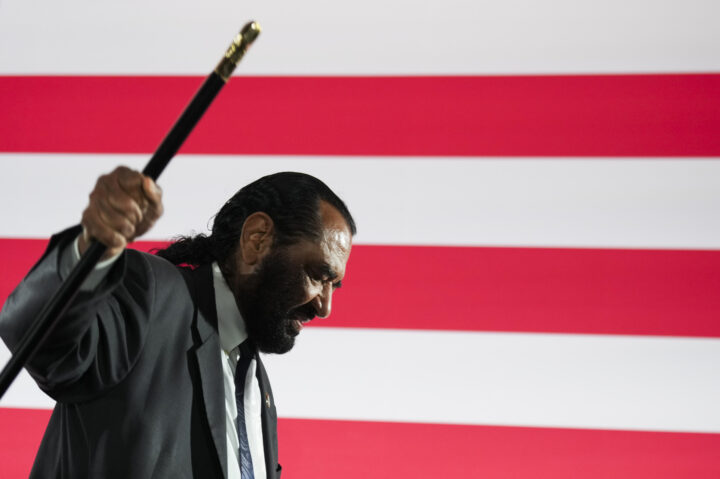
Texas Rep. Al Green leaves the stage after speaking during a rally featuring California Governor Gavin Newsom in Houston, Saturday, Nov. 8, 2025.
Jewish leaders in the Houston area see a chance for a fresh start this year with a new congressman, after an increasingly strained relationship with their longtime representative, Rep. Al Green (D-TX), who has taken a strong anti-Israel turn in recent years.
Green, 78, is struggling to hold onto his seat in a primary against newly elected Rep. Christian Menefee (D-TX), the former Harris County attorney, who won a commanding victory in a special election runoff last month to replace former Rep. Sylvester Turner (D-TX). Turner died months after taking office to replace former Rep. Sheila Jackson Lee (D-TX), who died less than a year earlier of pancreatic cancer after serving for over 30 years in the House.
Due to Texas’ redistricting process, Menefee now faces Green, as well as other longshot candidates, for a full term in the House beginning in 2027.
Since the Oct. 7, 2023, Hamas attacks, Green has consistently taken anti-Israel stances, even on legislation that has received widespread support on a bipartisan basis. Weeks after the attacks, Green was one of just 10 House lawmakers who voted against legislation expressing support for Israel and condemning Hamas.
The veteran congressman was an early backer of efforts to unilaterally recognize Palestinian statehood, of legislation describing the war in Gaza as a genocide and of the Block the Bombs Act.
Siding with six other members of the House, he voted to cut off missile-defense funding to Israel last July. Green also voted against supplemental aid to Israel in 2024 and has supported legislation to block specific arms transfers to Israel.
Green was one of 11 lawmakers to vote against an amendment condemning Hamas’ use of human shields and demanding its unconditional surrender and disarmament.
He voted against declaring the phrase “From the river to the sea, Palestine will be free” to be antisemitic. And he was one of just four House members who voted to require universities to disclose investments in countries whose leaders are facing International Criminal Court arrest warrants, indirectly targeting Israel.
In 2024, he introduced a resolution affirming the Palestinian right to statehood, to which two Jewish members were added as cosponsors without their knowledge or consent. He led an effort, opposed by a majority of House Democrats, to impeach President Donald Trump for striking Iran last June without congressional authorization.
At the same time, Green has also continued to back certain measures to combat antisemitism.
Green told the Texas Tribune that he expects AIPAC to spend “inordinate amounts of money to get me out of office,” and has been railing against the group on the campaign trail, though AIPAC has not endorsed anyone in the race.
Menefee has said little publicly about Middle East politics, though in a January candidate forum for the special election, he described Israel’s operations in Gaza as excessive while also condemning the Oct. 7 Hamas attacks, according to The Daily Cougar, the University of Houston’s student newspaper.
“Look, what I want is peace, now,” Menefee said. “I want a lasting ceasefire so that not a single baby in either Israel or Gaza has to worry about being bombed.”
Leaders in the local Jewish community said their once-strong relationship with Green — who had been a frequent presence at community events and maintained strong relationships with members of the community — turned sour following Green’s vote on the post-Oct. 7 resolution, which surprised and hurt many in the community.
“Everybody — particularly in a large section of the Jewish community — carries this wound from that vote. They’ve not forgotten it. They’re unforgiving about it. It’s been very painful because there was a relationship,” Art Pronin, who is Jewish and leads the Meyerland Area Democrats Club, told Jewish Insider. “It felt like we lost a congressman. … it was just shocking.”
Pronin says he now hears concerns from others in the community about Green on a weekly basis at his synagogue.
“It’s really sad, because we used to have a very strong relationship with him,” Norri Leder, a founder of Houston Jewish Women Vote and a board member of the local federation, told JI. “It’s been incredibly disappointing, and especially because the way his district was newly drawn, he represents a very large chunk of the Jewish community. … It almost feels like he’s hostile towards us, not just disagrees. It doesn’t feel like respectful disagreement.”
Leder added that Green’s positions on Israel policy had appeared to begin to shift prior to Oct. 7, but the change became more pronounced after the attacks.
She said that she has heard from other members of the community for whom Green’s stance on Israel issues is factoring “very heavily” into their plans for their primary votes. “We’re looking for somebody that understands us and wants to represent us, and Al Green gets a poor grade on that front.”
The longtime congressman was the chair of the local NAACP before entering public office, building strong relationships with the local Jewish community that he maintained for years, according to Pronin.
Since Oct. 7, Pronin and Leder said that Green has not attended community events to which he’s been invited and has been inaccessible to Jewish constituents who have requested meetings or expressed concerns about his posture.
Leder said that lack of accessibility and engagement from Green and his office, in addition to the shock of his vote against the resolution condemning Hamas, has contributed to the sense of hostility she feels from him.
Pronin said he had multiple conversations with Green about his vote on the resolution condemning Hamas, seeking an explanation, but has never received a “solid explanation,” and Green has not softened his stance.
Leder joined a group meeting with Green recently, where he was pressed on his lack of engagement with Jewish constituents, and said Green vowed he would try to engage on some issues of mutual concern, but also “did launch off on Israel” during the conversation.
“The challenge is you can have very strong feelings about Israel, but if you’re representing the Jewish community that lives here, you still have to represent that community, and that’s where I think he’s really fallen down,” Leder continued. “He wasn’t present at any [Oct. 7 memorial] events in the community. He hasn’t attended … community seders, things like that a lot of elected officials attend, and he just has been completely absent.”
“It feels like his anger at [Israeli Prime Minister] Benjamin Netanyahu and whatever he’s feeling towards the Israeli government is spilling over into his treatment of Jewish constituents,” she added.
Leder said that Menefee, on the other hand, has interacted on numerous occasions with the Jewish community and attended events like the community Passover seder. He “understands our concerns,” Leder said, though she said she couldn’t speak specifically about his views on the current Israeli government.
“I know him personally. I think he has a lot of respect for the Jewish community and is available and that’s what the Jewish community is looking for: somebody that understands our concerns and is there for us as constituents, and when it comes to Israel, is somebody that is open and reasonable,” she continued.
Pronin said he has known Menefee for a long time and never heard him say anything about Israel policy that has concerned him, describing the newly elected lawmaker as “balanced” on the issue, though he hasn’t spoken about it extensively.
“I think he’s got a balancing act to play on this issue, and we’ll have to really kind of thread the needle in conversations with these communities, and maybe help bring people together to talk about this, so he can listen and hear out the perspectives on this as a congressman over time,” Pronin said.
Green’s campaign did not respond to a request for comment.
Mark Jones, a Texas pollster and fellow at Rice University’s Baker Institute for Public Policy, recently conducted a poll of the district showing Menefee with a commanding 52%-28% lead.
“Menefee’s crushing him,” Jones told Jewish Insider, noting that an internal poll by Menefee’s campaign conducted by the well-regarded Lake Research Partners shows similar results. Jones predicted that Menefee should be able to win the race cleanly in the primary, without advancing to a runoff.
Around two-thirds of the voters from the new district come from Green’s old district, but they are roughly evenly split — with a slight advantage toward Menefee — between the two leading candidates, Jones said. The quarter of the district that comes from the current 18th District “overwhelmingly prefer[s] Menefee,” Jones added. “And that’s also the case with some of the other northern parts of the district that used to be in other districts.”
“The only reason Green is even in this race remotely is that he still is popular among … his current constituents, but he’s doing very poorly among the roughly little more than a third of constituents who he currently doesn’t represent,” he said.
And though voters report positive views on both candidates, Jones noted, when forced to choose, “a significant majority — effectively almost two-to-one — prefer Menefee.”
Jones said that, for many Democrats, Menefee is a “perfect candidate,” with a reputation for being pragmatic progressive and a record opposing Trump. Green’s age is also a stumbling block for him, particularly for voters who saw two of their representatives die in office over the course of about a year.
“People like what he’s done over the past 20 years, but they believe it’s time to pass the baton,” Jones said.
Green has argued that he will be more effective given his greater seniority in the House, which is particularly valuable in the Democratic Caucus. At the same time, the veteran lawmaker has been a bomb-thrower who has sometimes found himself out of step with Democratic leadership.
The controversial Iowa congressman is facing a formidable opponent in State Senator Randy Feenstra

In 2018, Rep. Steve King (R-IA) narrowly defeated his Democratic rival, J.D. Scholten, by roughly 10,000 votes. Two years later, bruised by a series of controversies and repudiated by his party’s leadership, King is limping towards his ninth re-election bid. Four candidates are challenging the embattled congressman in Tuesday’s GOP primary to represent Iowa’s 4th congressional district — and one, State Senator Randy Feenstra, may be within striking range of ending King’s tenure in Washington.
King has not run a single television ad over the course of his latest campaign, and entered the final phase of the primary with a little over $30,000 cash on hand. He has been outraised 2-1 by Feenstra, according to the most recent FEC filings. Two recent polls have shown mixed results: A poll conducted by The Iowa Standard shows King with a 13-point lead over Feenstra, while a poll sponsored by the American Future Fund organization showed Feenstra with a two-point lead. Others in the race include businessmen Bret Richards and Steve Reeder and Woodbury County Supervisor Jeremy Taylor.
Feenstra, 51, has represented Iowa’s 2nd district in the State Senate since 2009, where he serves as assistant majority leader in the GOP-controlled legislature. Previously, he worked in local government for nearly a decade. Feenstra graduated from Dort College and got his master’s degree at Iowa State University. In the private sector, he was head of the sales department at Foreign Candy Company, a large candy manufacturer best known for its Black Forest-flavored gummy bears.
King has a history of making bigoted comments against a variety of minority groups, and has faced criticism for his association with far-right political parties in Europe. In 2006, the nine-term congressman called the deaths of Americans at the hands of undocumented immigrants “a slow-motion Holocaust.” Last year, House Republican leaders voted to remove King from the Judiciary and Agriculture Committees following comments that appeared to defend white nationalists and white supremacists. Earlier this month, King claimed he had reached an agreement with House Minority Leader Kevin McCarthy (R-CA) to return to his committee slots. The statement was immediately denied by the GOP leader.
King’s original journey to Washington was not a smooth one. In 2002, he ran for the open seat in the 5th congressional district after Rep. Tom Latham (R-IA), who had previously represented the district, ran in the newly redrawn 4th district. King received 30% of the vote in a four-way Republican primary, sending the race to a convention, where he narrowly edged out State House Speaker Brent Siegrist. King went on to win the general election with 62% of the vote. In 2013, his district was combined with the 4th.
But King may still come out on top next Tuesday. “Four people in the race always helps the incumbent,” Rick Bertrand, who challenged King in the 2016 primary, told The New York Times. During a TV debate on Tuesday, King was asked by his main opponent if he would commit to supporting the GOP nominee in the district in November. “I am going to be the nominee, and that’s my answer,” he replied.

Iowa State Senator Randy Feenstra (Feenstra for Congress)
Feenstra launched his campaign in January 2019 after King was stripped of his committee assignments. He immediately received the backing of former Iowa Gov. Terry Branstad. In a recent interview with Jewish Insider, Feenstra maintained that King being deprived of his committee responsibilities, in particular the agriculture committee, is a good enough reason for him to be replaced. “We have a big agricultural area in our 4th district, and we have lost the seat at the table,” he noted.
The case against King, Feenstra said, is simple: As an ineffective lawmaker sidelined by his colleagues, the congressman would not be able to advocate for quality-of-life issues that matter to constituents. A primary victory for King “puts the seat at risk, and we don’t need anybody else to help [House Speaker] Nancy Pelosi, that’s for sure,” Feenstra stressed. The winner of the primary will face Scholten in the fall.
Iowa conservative Christian leader Bob Vander Plaat, who served with King as co-chair of Sen. Ted Cruz’s (R-TX) 2016 presidential campaign, is backing Feenstra, as is the U.S. Chamber of Commerce, which aired more than $200,000 in advertising on broadcast and cable television in the Des Moines and Ames media market, according to Advertising Analytics.
The Republican Jewish Coalition also offered its support to Feenstra. Rep. Steve Stivers (R-OH), a member of the Steering Committee and former chairman of the National Republican Congressional Committee, didn’t endorse any candidate, but told JTA that the RJC deserves praise for taking the rare step of supporting a challenger to an incumbent.
“Steve King’s comments put him clearly outside of the mainstream of the Republican Party and they certainly don’t reflect or represent what we feel to be the values of the Republican Jewish Coalition,” RJC executive director Matt Brooks told JI. “And given that we think we have a strong candidate who can win in Randy Feenstra, we felt it important to take a stand and to make a clear statement that we will do everything in our power to defeat King in the primary and to elect somebody who is better representative of our values.”

Feenstra has never been to Israel, but says that as a deeply religious person, he’s committed to supporting the Jewish state. “I’ve read the Old Testament many, many times,” he told JI, noting that “actually, right now” he’s reading the book of Exodus. “It’s just very intriguing to me. I just love what Israel stands for. Israel is so important for us as a nation to have as a great ally in the Middle East, and we have to be their protectors,” he added.
As a supporter of the president, Feenstra praised Trump for moving the U.S. Embassy to Jerusalem and withdrawing from the 2015 nuclear deal with Iran. He also backs the president’s Mideast peace plan, but stated, “I don’t believe Israel has to give up ground. We have to create a demarcation line and say, ‘This is Israel’s land and let’s be done with it.’” Feenstra took pride in being part of the effort to pass anti-BDS legislation in Iowa in 2016 that prevents state pension funds from directly investing in companies that boycott Israel.
In Congress, King has been a hawkish supporter of Israel. In 2017, he introduced a resolution “rejecting” the two-state solution. During a debate on an AIPAC-backed bipartisan House resolution (H. R 11) that rebuked the United Nations Security Council (UNSC) resolution condemning Israel, King said, “I would like to have a debate on the one-state solution versus the two-state solution because I believe that the two-state solution has run its course and we need to pack up our tools and ship those off to the side and start all over again with a new look.”
RJC’s Brooks pushed back against criticism that his organization has abandoned a strong supporter of Israel. “Because somebody stands with us on Israel, which we appreciate, that does not give them a pass to support white nationalism and embrace white nationalist candidates,” Brooks said. “Our endorsement and our support transcends that — Randy Feenstra is going to be a great friend and outspoken supporter of Israel.”
Brooks noted that the action taken against King by the House Republican Caucus “stands in stark contrast to the lack of action by any of the leaders on the Democratic side with regard to the blatant antisemitism of [Rep.] Ilhan Omar and the offensive and troubling comments by Omar and [Rep.] Rashida Tlaib.” He added, “Republicans have shown that there are clear red lines and act when people within our party cross those lines.”
If successful in his mission to oust the controversial incumbent, Feenstra wants the national newspapers to move on from its focus on his district. “I’m going to Washington to be an effective conservative leader,” he said. “Voters want an effective leader who can stand up and push the conservative agenda of reducing taxes, protecting lives and protecting our constitutional freedoms. That’s the bottom line.”
Please log in if you already have a subscription, or subscribe to access the latest updates.
 Continue with Google

 Continue with Apple