





































Costa Rica’s Rebeca Grynspan expands support in latest U.N. secretary-general straw poll
The entry of the UAE’s Lana Nusseibeh into the race appears to have done little to dislodge the three established leading contenders
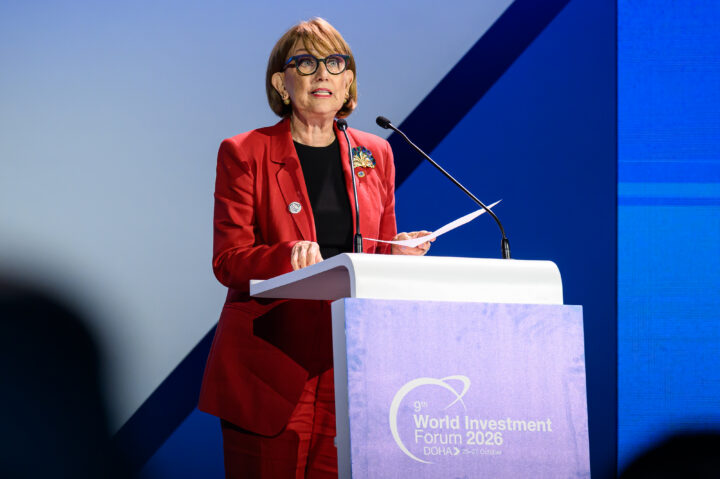
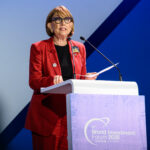
(Noushad Thekkayil/NurPhoto via Getty Images)
Rebeca Grynspan, Secretary-General of the United Nations Trade and Development, UNCTAD, speaks during the opening ceremony of the 9th World Investment Forum (WIF 2026) in Doha, Qatar, on October 25, 2026.


 Add JewishInsider on Google
Costa Rica’s Rebeca Grynspan had her strongest showing yet on Friday in the race to become the next U.N. secretary-general in the latest Security Council straw poll, while the United Arab Emirates’ newly nominated candidate, Lana Nusseibeh, failed to disrupt the established frontrunners.
The race remains far from settled, though, with questions surrounding potential vetoes from permanent Security Council members — the U.S., U.K., France, Russia and China — and the possibility of additional candidates entering the contest. In addition, unlike the previous round on Oct. 16, Friday’s straw poll did not use color-coded ballots distinguishing the votes of permanent members from those of the council’s 10 elected members, leaving unclear whether the candidates face opposition from veto-wielding countries.
The contest could also be further complicated by the entrance of Feridun Sinirlioğlu, a former Turkish foreign minister and U.N. ambassador, whom Ankara nominated for the position on Friday evening following the straw poll results. His candidacy could potentially present a diplomatic complication for Washington, as President Donald Trump has sought to maintain close relations with Turkish President Recep Tayyip Erdoğan, while his administration has prioritized defending Israel at the United Nations.
Grynspan, a former vice president of Costa Rica who would become the first woman and first Jewish person to serve as U.N. secretary-general if selected, received 11 votes of support and four votes against, according to reported results of the confidential ballot.
The daughter of Polish Jewish refugees who fled Europe before World War II, Grynspan maintains close family ties to Israel. Her sister, Frida Grynspan, immigrated to the country as a teenager and resides in Mevaseret Zion, near Jerusalem, while her niece and nephew have both served as officers in the Israel Defense Forces.
But under Grynspan’s leadership of the U.N. Conference on Trade and Development, the organization has been critical of Israel, issuing reports condemning the impact of Israeli policies on the Palestinian economy.
Meanwhile, Rafael Grossi, the Argentine head of the International Atomic Energy Agency, moved into second place with nine encouragement votes, four discouragement votes and two members expressing no opinion. Carolyn Rodrigues-Birkett of Guyana, another leading contender, remained at eight encouragement votes, six discouragement votes and one vote of no opinion.
Nusseibeh, who entered the race last week amid a prolonged deadlock among Security Council members, received seven encouragement votes and six discouragement votes, with two members expressing no opinion. Her initial showing fell short of expectations and appears to have done little at the moment to alter the competition among the three established leading contenders.
Analysts previously told Jewish Insider that the UAE’s alleged support for the Rapid Support Forces, a paramilitary group accused of committing atrocities in Sudan’s civil war, could raise difficult questions for Nusseibeh’s candidacy. The UAE has denied providing military support to the group, and Nusseibeh has distanced herself from Abu Dhabi’s policies when asked about the issue, saying that she resigned as minister of state and questions should be directed to the Emirati government. It remains unclear whether those concerns influenced Friday’s voting.
The previous color-coded round revealed that Grynspan, Grossi and Rodrigues-Birkett had each received two discouragement votes from permanent members, indicating that each faced potential vetoes. Friday’s undifferentiated ballots did not reveal whether that opposition has changed or if Nusseibeh faces similar resistance from veto-wielding countries.
Although Grynspan’s 11 encouragement votes represent a significant improvement, her four discouragement votes could still include opposition from permanent members. In the formal vote, a candidate must receive at least nine votes of support in the 15-member council without a veto from any permanent member to move forward to a broader vote in the General Assembly.
The straw polls are informal, nonbinding votes intended to assess candidates’ support before the Security Council makes its formal recommendation. Their results are not officially released by the United Nations but have been reported following each round.
The next color-coded straw poll, expected in the coming weeks, could provide a clearer indication of whether the leading candidates have overcome opposition from permanent members or whether the council remains divided.
The selection process is becoming increasingly urgent as Secretary-General António Guterres prepares to conclude his second five-year term on Dec. 31. Analysts previously told JI that if the position remains unfilled, Guterres could remain in office temporarily as a “caretaker” secretary-general while the Security Council seeks agreement on a successor.
More Stories
REPORTED RIFT
‘Israel had no plan to attack Iran before election,’ defense minister says
TIES THAT BIND
Jewish Federations survey finds deepening ties between U.S., Israeli Jewish communities
SCOOP
Former Haley Stevens campaign chair and prominent Democratic fundraiser says he plans to vote for Rogers
HAWKEYE HANGUP
Top Democratic recruit in Iowa balances support of Israel with criticism of war in Gaza
FLORIDA FACTOR
David Jolly looks to translate moderate, pro-Israel record in Congress to upset in Florida governor’s race
QATAR-ING FAVOR
KIND founder Daniel Lubetzky calls Semafor’s Qatar ties ‘downright unethical’
Please log in if you already have a subscription, or subscribe to access the latest updates.
 Continue with Google

 Continue with Apple