





















































The Bot Mitzvah moment
Plus, Platner’s prickly past persists


 Add JewishInsider on Google
Good Friday morning.
In today’s Daily Kickoff, we look at how the latest allegations against Graham Platner may affect the Senate candidate’s campaign ahead of next week’s Maine Democratic primary, and talk to Jewish thought leaders about the use of AI in Jewish study and education. We report on the House’s rejection of a Lebanon war powers resolution put forward by Rep. Rashida Tlaib, and look at how President Donald Trump’s plans to ink a civilian nuclear deal with Saudi Arabia are being received on Capitol Hill. Also in today’s Daily Kickoff: Brig.-Gen. Guy Markizeno, Julie Menin and Rep. Dina Titus.
Today’s Daily Kickoff was curated by JI Executive Editor Melissa Weiss and Israel Editor Tamara Zieve, with assists from Danielle Cohen-Kanik and Marc Rod. Have a tip? Email us here.
What We’re Watching
- We’re keeping an eye on the tenuous situation along the Israel-Lebanon border, after Hezbollah on Thursday rejected the ceasefire deal that had been reached between Israeli and Lebanese officials in Washington a day prior. Hezbollah head Naim Qassem on Thursday called the deal a “farce” and said that the Iran-backed terror group had “given no commitment to anyone” regarding a cessation of hostilities.
- Stateside, Rep. Ro Khanna (D-CA) is set to participate in a rally today in Maine with embattled Senate candidate Graham Platner. The rally comes a day after an in-depth New York Times report on Platner’s past volatile romantic relationships, including with several women who detailed the Maine Democrat’s “unsettling” behaviors.
- Speaking to Fox News earlier Thursday, prior to the latest allegations, Khanna said, “Where I draw the line is if there are any credible allegations of abuse or assault or domestic violence.” In a statement after the Times report was published, Khanna called the “behavior described in the New York Times story … wrong and toxic,” but said, “The people of Maine deserve a senator who is going to stand up to the billionaire class, against genocide, and for the working class.”
- A California jury is expected to begin deliberations today in a case involving seven anti-Israel activists whose demonstration halted traffic on San Francisco’s Bay Bridge for hours in April 2024. If convicted, the activists face up to 15 years in prison.
What You Should Know
A QUICK WORD WITH JI’S JOSH KRAUSHAAR
TheNew York Times’ detailed exposé about Maine Senate candidate Graham Platner’s history of toxic, alcohol-laden and occasionally physically threatening relationships with three former girlfriends landed Thursday afternoon — with Platner’s campaign hoping to limit the fallout amid signs his campaign is losing support.
In an interview with MS NOW’s Chris Hayes Thursday evening, Platner denied the most serious allegations of physical abuse leveled by Lyndsey Fifield, who dated him from 2013-2015. Fifield recounted one incident where Platner “twisted her arm behind her back, shoved her into a bedroom and held the door closed from the other side so she couldn’t get out.”
She also said he knew about the Nazi origin of his Totenkopf tattoo — first reported by Jewish Insider in October — saying he taught her the word for it when they were dating.
“There are some allegations in this piece that I want to be unequivocal about — they’re not true. Anything alleging physicality, anything alleging I knew what my tattoo was, these are the statements of someone politically motivated,” Platner told Hayes.
The one-two punch of allegations this week of sexually explicit text messages to women while he was married now combined with reports of abuse in past relationships are merely the latest hits against the scandal-plagued candidate who, under normal political circumstances, would be a political nonstarter.
PROMISES AND PERILS

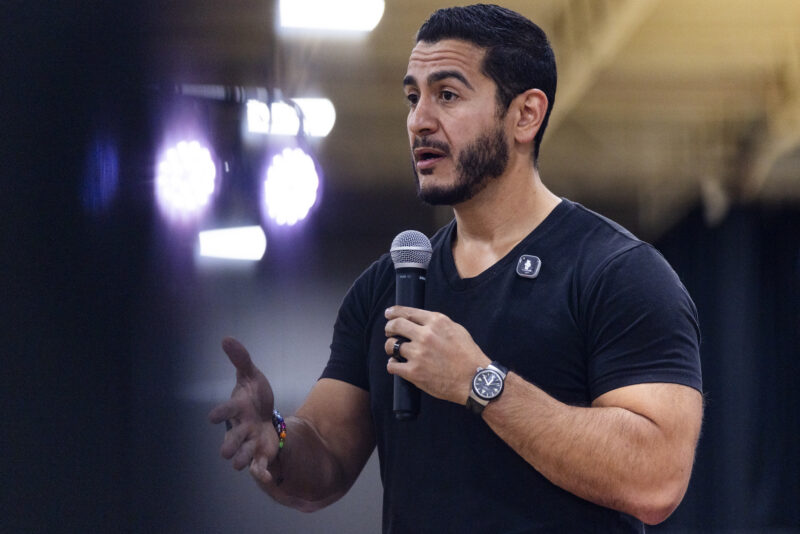
A group of rabbis, educators and thinkers in the Jewish world is deeply engaged in examining questions related to Judaism’s approach to artificial intelligence, Jewish Insider’s Gabby Deutch reports. Some of them are theological, almost halachic: Should rabbis be allowed to use AI to write sermons? Can an AI chatbot be considered a havruta, or study partner, in place of an actual human? Should AI even be used for serious Jewish study?
Keeping it human: David Zvi Kalman, a research fellow at the Shalom Hartman Institute who studies Judaism and technology, argued strongly against AI being used to write sermons. “I think people in religious communities would like to know that there’s at least one space in their lives when they are able to be free of machines, when they can actually just be humans interacting with other humans,” he said. The Orthodox Union faced criticism from within its ranks after releasing a new app in March that uses AI to help people study Torah.
PROVISION PROTECTED

The House Armed Services Committee blocked an amendment that sought to strip a relatively routine provision on U.S.-Israel cooperation out of the 2027 National Defense Authorization Act by a bipartisan voice vote, Jewish Insider’s Marc Rod reports.
Pushing back: Leaders of the committee on both sides of the aisle spoke out against the amendment, led by Rep. Ro Khanna (D-CA), saying that critics of the provision — who have claimed it would fuse the U.S. and Israeli militaries or subvert U.S. sovereignty — were misrepresenting the legislation. Rep. Adam Smith (D-WA), the Armed Services Committee ranking member, said he is “very sympathetic” to Khanna’s “frustration … with Netanyahu’s leadership in Israel” but said that “the way this amendment was described is simply not accurate.”
SAUDI SIGHTS

As the Trump administration prepares to submit a proposed civil nuclear pact with Saudi Arabia to Congress, U.S. lawmakers are raising concerns about the potential agreement while nonproliferation experts and former Trump administration officials are sounding the alarm, warning that the pact abandons traditional safeguards and could ignite a nuclear arms race in the Middle East, Jewish Insider’s Matthew Shea reports.
Left out: Experts told JI that the agreement in its current form would not require Riyadh to adhere to the nonproliferation “gold standard” – a commitment to forgo domestic uranium enrichment and fuel reprocessing. Other regional partners, such as the United Arab Emirates, accepted this stringent safeguard in past U.S. deals specifically to prevent military or illicit nuclear activity. Democrats across the ideological spectrum have previously indicated concern over the potential civil nuclear pact, reflecting a historical trend in which Congress has typically supported a stringent nonproliferation policy toward Saudi Arabia that includes robust safeguards.
Read the full story here with comments from Reps. Brad Sherman (D-CA), Jared Moskowitz (D-FL), Tim Burchett (R-TN) and Sen. James Lankford (R-OK).
VOTED DOWN

The House rejected a war powers resolution by Rep. Rashida Tlaib (D-MI) on Thursday that aimed to block U.S. support for Israeli operations against Hezbollah in Lebanon, after House Democratic leaders publicly came out against the effort, Jewish Insider’s Marc Rod reports. The resolution failed by a vote of 324-92, with most votes in favor of the resolution coming from progressive House Democrats, though several more moderate lawmakers also voted in favor. Rep. Thomas Massie (R-KY) was the only Republican to support the effort.
Looking ahead: But the Democratic leaders said they would support a future effort by Tlaib along similar lines that will include carveouts for other U.S. operations inside Lebanon, indicating that Tlaib’s next effort is likely to pick up greater Democratic support. Democratic critics said that the current legislation, which directed the administration to “remove the United States Armed Forces from Lebanon” within seven days, would have also required the U.S. to remove military guards from its diplomatic facilities and U.S. servicemembers that train and advise the Lebanese Armed Forces.
SPENDING DISPUTE

Sen. Chris Van Hollen (D-MD) on Thursday called out recent AIPAC and crypto-linked spending in the crowded Democratic House primary in Maryland to replace retiring Rep. Steny Hoyer (D-MD), accusing “outside groups” backing state Del. Adrian Boafo of “trying to buy this congressional seat.” Speaking at a press conference he said, “I think voters need to be aware that these outside groups do not have the voters’ interests at heart,” Jewish Insider’s Matthew Kassel reports.
Reaction: In a statement to JI, Patrick Dorton, a spokesperson for UDP, shot back at the senator, an outspoken critic of Israel who in March called AIPAC anti-American in an address to the progressive Israel advocacy group J Street. “Once again, Chris Van Hollen is deliberately misrepresenting our views and discriminating against millions of pro-Israel Democrats who are members of AIPAC,” Dorton said.
GOLDEN MEMORIES

Four friends gather around a table as a waiter serves a tray of pastrami sandwiches; a Torah scroll is passed from grandfather to father and son, marking a bar mitzvah; three grandmothers sit on lawn chairs outside of a brownstone, watching passersby on a summer night. These candid glimpses of ordinary American Jewish life, part of a new art exhibition, “Golden Age: Nostalgia for the American Jewish Century” — currently on display at the Altneu, an Upper East Side Orthodox synagogue — evoke a bygone era, before today’s historic rise in antisemitism,Jewish Insider’s Haley Cohen reports.
Reminiscing: “I grew up in the golden age [of North American Jewry], the ’70s, ’80s and ’90s. It was an easy time,” Jacqueline Kott-Wolle, one of the seven artists whose work is highlighted in the exhibit, told JI on Wednesday at an event to mark the gallery’s opening. “My memories of growing up Jewish [in Toronto] were very positive. Everybody was Jewish — even the people at my high school who weren’t Jewish were Jewish. It was a good time to be alive. [Today,] antisemitism slammed into us so hard. It shocked us.”
Worthy Reads
Army Upgrade: In The Washington Post, former Army Secretary Ryan McCarthy calls for additional resources to help the military modernize to address current and future threats. “But with the past decade’s budget cuts, the Army has had to innovate as it adapts to today’s warfare. In its weapons development and training exercises, the service has embraced unmanned systems that can replace personnel at the tactical edge. Learning from the Ukraine war and its so-called kamikaze drones, the Army is working to deploy such loitering munitions and reconnaissance tools to even its smallest units. … Without the Army’s capacity for theater-wide logistics, long-range fires, and command and control for distributed forces, the U.S. military cannot sustain a major combat operation, let alone win one. ” [WashPost]
Covering Our Bases: In The Wall Street Journal, Reuel Marc Gerecht and Ray Takeyh argue in favor of maintaining U.S. military bases in the Middle East, positing that they act as a critical check on Iran’s power and influence in the region. “Whatever credibility Washington still has in the Middle East depends on its willingness to maintain bases in the Gulf and in Iraq — and that places U.S. forces in harm’s way. Given our failure so far to fight the Battle of Hormuz and our inability to defend our allies adequately, this lever has lost some of the deterrence that once scared the Islamic Republic’s rulers. But it’s all we have now in an otherwise deteriorating situation.” [WSJ]
Maine Drag: New York magazine’s David Freedlander looks at the debate around campaign strategist Morris Katz’s recent threat to Graham Platner’s former chief of staff regarding the release of damaging information about the Maine Democrat. “In the hothouse world of New York City Democratic political consultants, which Katz came out of, the reaction was mixed: There was fear, of course, about dreams of a Democratic majority in the U.S. Senate slipping away but also something that, if not quite glee, has a suitable German equivalent. ‘Schadenfreude,’ said one local operative describing the mood in her group chats. ‘Everyone is delighting in this and is guns blazing for Morris Katz.’” [NYMag]
Graham Cracking: The Atlantic’s Elizabeth Bruening reflects on Platner’s recent controversies as the embattled Maine Senate candidate argues he has changed and learned from past missteps. “The trouble with hiding damning information is that when it ultimately comes out, it demonstrates a willingness to readily lie, and invites reasonable suspicion that there may be yet more to the story. … Platner and his wife have characterized public concern about his past behavior and statements as mere gossip and trashy headlines, but there’s good reason to see in this mess both evidence of poor personal judgement and a harbinger of things to come.” [TheAtlantic]
Food Fight: In The New York Times, Rabbi Rachel Timoner explains why she resigned from the Park Slope Food Coop following the institution’s member vote to boycott Israeli products. “BDS weakens and undermines the fragile Israeli left, made up of people working for equality and justice for all in Israel and Palestine. And in addition to being ineffective and, in my opinion, counterproductive, the global BDS movement divides local communities like ours in Park Slope. … In the case of the Park Slope Food Co-op, a member was able to use the rules to block all discussion of the boycott proposal, so that no argument could be made during last week’s meeting — not one word could be spoken — against the boycott before the vote.” [NYTimes]
Word on the Street
President Donald Trump said that Bill Pulte, whom he named as acting director of national intelligence, will not be nominated as the administration’s “permanent” pick for the role, as some Senate Republicans, including Majority Leader John Thune (R-SD), expressed concerns about Pulte, the head of the Federal Housing Finance Agency…
Former National Security Advisor John Bolton reached a plea deal with federal prosecutors and will plead guilty to one felony count of illegal retention of sensitive national security information; Bolton, who will avoid jail time, will also pay a fine of more than $2 million…
Rep. Dina Titus (D-NV) accused U.S. Ambassador to Turkey Tom Barrack of “clientitis” over his advocacy for Ankara to be brought back into the F-35 program…
Republicans on the House Appropriations Committee proposed providing $315 million for the Nonprofit Security Grant Program in 2027, a slight increase from 2026 funding levels but far below the $1 billion that supporters of the program in the House and Jewish and other faith communities have called for, Jewish Insider’s Marc Rod reports…
City & State NY reports that far-left congressional candidate Darializa Avila Chevalier, who is challenging Rep. Adriano Espaillat (D-NY) with the backing of New York City Mayor Zohran Mamdani, participated in a Democratic Socialists of America-organized rally in the city the day after Hamas’ Oct. 7, 2023, terror attacks that was criticized by numerous officials and Jewish leaders for demonstrators’ apparent support for the attacks…
Founders Fund released the first episode of its “Mafia” card gameshow, which featured, among others, OpenAI CEO Sam Altman, Signal creator Moxie Marlinspike, Figma CEO Dylan Field, Anduril co-founder Trae Stephens and Oculus founder Palmer Luckey…
Universal Music Group stock dropped as much as 7.6% following Pershing Square’s sale of its $1.5 billion stake in the company, as the firm, led by Bill Ackman, unloaded its holdings following a failed takeover bid…
Yeah That’s Kosher spotlights Kosher Square Pizza, the Oakhurst, N.J., outpost of Brooklyn Square Pizza, which kosher restaurateur David Mizrahi opened in partnership with Brooklyn Square owner Peter Grippo…
The Jewish Federation of Greater Harrisburg (Pa.) listed the Alexander Grass Campus for Jewish Life less than two years after it moved into the complex, amid mounting financial challenges that have also resulted in the closure of its fitness and early learning centers in the last several months…
The Financial Times spotlights efforts by Iran and Russia to recruit European teenagers as proxies to assist and carry out attacks on targets on the continent…
CNN reports that Israel deployed units to Azerbaijan and Somaliland during the Iran war…
Haredi protesters on Wednesday demonstrated outside the home of Israeli Supreme Court Judge Noam Sohlberg, damaging property on the premises…
Israeli Prime Minister Benjamin Netanyahu appointed Brig.-Gen. Guy Markizeno as his military secretary, following Roman Gofman’s promotion to head the Mossad…
Israeli Foreign Minister Gideon Sa’ar announced plans to open its first embassy in Slovenia following the formation of a new center-right government in the country under new Prime Minister Janez Janša…
The IDF said that the head of Hezbollah’s engineering unit was killed in a strike last week…
Petroleum Development Oman said Mina Al Fahal port was operating as usual, following reports that oil loading had been suspended after an explosion near its mooring berths…
Anne Neuberger, who served as deputy national security advisor for cyber and emerging technology in the Biden administration, is joining Andreessen Horowitz as a general partner and head of global affairs…
Asaf Elia-Shalev was named editor-in-chief of J. The Jewish News of Northern California, after five years as an investigative reporter at the Jewish Telegraphic Agency…
Virologist Bernard Roizman, whose work focused on the herpes virus, died at 96…
Wine of the Week

JI’s wine columnist Yitz Applbaum reviews the Aegerter Nuits-Saint-Georges 1er Cru 2020:
Drinking great kosher French wine has always been a passion. Drinking great kosher Burgundy has always been a dream. Benjamin Uzan, who has all but built the market for fine kosher French wine, has finally brought us a Burgundy masterpiece. He poured it for me in Paris yesterday, and I am hooked.
The Aegerter Nuits-Saint-Georges 1er Cru 2020 is elegant and subtle, beautifully composed, with flavors that arrive in layers. It opens on mint, settles into rose petals at the mid-palate and finishes on ripe plum with a touch of sweetness. The perfume has stayed with me, and I have no wish to forget it. Drink it on its own. It will keep for at least 15 years.
Pic of the Day

New York City Council Speaker Julie Menin on Thursday addressed Holocaust survivors at a “Coffee House” social event organized by Selfhelp and UJA-Federation of New York at the federation’s Manhattan headquarters.
Birthdays

Owner of the NFL’s New England Patriots, Robert Kraft turns 85 on Friday…
FRIDAY: Lithuanian-born Holocaust survivor, co-founder of the Virginia Holocaust Museum in Richmond, Va., known for his ever-present cowboy hat, Jay M. Ipson turns 91… Sales associate of the Santa Monica, Calif., Berkshire Hathaway Home Services branch, Saul Bubis… The first woman to serve as international president of the United Synagogue of Conservative Judaism, Judy Yudof turns 81… Senior project manager in tech product development, Dan Yurman… Israeli politician, diplomat and businessperson, he served as consul general of Israel in Philadelphia from 1988 to 1992, Israel Peleg turns 77… VP of new business development at Maresco & Partners, Linda Greenfield… Author of several personal finance books, financial advisor, motivational speaker and television host, Susan Lynn “Suze” Orman turns 75… Staff member at Burbank Temple Emanu El, Audrey Freedman-Habush… Portrait photographer and visual anthropologist, she is the author of The Jews of Wyoming: Fringe of the Diaspora, Penny Diane Wolin turns 73… Former commissioner on the U.S. International Trade Commission, now a consultant, Dean A. Pinkert turns 70… Best-selling instrumental musician, the saxophonist “Kenny G,” Kenneth Bruce Gorelick turns 70… Columnist for the New York Post, Andrea Peyser turns 67… Senior associate general counsel at Compass real estate, Sam Kraemer… EVP and managing director at D.C.’s Burson, Michael Heimowitz… Member of the Ontario Provincial Parliament for eight years until 2022, Gila Deborah Martow turns 65… President of Weprin Public Affairs, Mark S. Weprin turns 65… First-ever Jewish speaker of the Virginia House of Delegates, she served from 2020 until 2022, Eileen R. Filler-Corn turns 62… Manager of the Jeff Astor Legacy Fund, Beth Astor Freeman… Member of Congress (D-PA), her father is a Jewish Holocaust survivor from Poland, Christina Jampoler Houlahan turns 59… Member of the British House of Commons for 15 years, now a member of the House of Lords, Baron Ed Vaizey turns 58… Entrepreneur, venture capitalist and author, he holds approximately 100 granted and pending patents, Nova Spivack turns 57… Professor of Israel studies at UCLA, Dov Morris Waxman turns 52… Film and television actor, Liza Rebecca Weil turns 49… Actor, voice actor, comedian, writer and producer, Nicholas Kroll turns 48… Co-founder of BlueLabs and director of analytics for the campaigns of both Hillary Clinton in 2016 and Barack Obama in 2012, his father and grandfather were both rabbis, Elan Alter Kriegel… Senior research fellow at the Heritage Foundation, he was previously a member of the New Hampshire state legislature, Jason Bedrick turns 43… Humorist, novelist and screenwriter, Simon Rich turns 42… Partner relationship manager at Voyant, Arielle Levy Marschark… VP on the corporate PR team at M Booth, Maya Bronstein… Clara Moskowitz… Susan Stein… State and federal political fundraiser in New Jersey and Pennsylvania, Ashley Barth…
SATURDAY: One-half of the husband-and-wife screenwriting and television production team, Esther June Shapiro turns 98… Senior judge of the U.S. District Court for the Eastern District of New York, Frederic Block turns 92… Real estate entrepreneur, member of the Pritzker family and former executive chairman of the Hyatt Hotels Corporation, Thomas Pritzker turns 76… U.S. Sen. Marsha Blackburn (R-TN) turns 74… Diplomat who has served as Israel’s ambassador to South Sudan and then Egypt, Haim Koren turns 73… Five-time Tony Award winner, he is an actor, playwright and screenwriter, Harvey Fierstein turns 72… Comedian, political critic, musician and author, Sandra Bernhard turns 71… Radio news personality known as “Lisa G,” Lisa Glasberg turns 70… Former chair of the board of Prizmah: Center for Jewish Day Schools and president at Micah Philanthropies, Ann Baidack Pava… CEO of the NBA’s Atlanta Hawks and the State Farm Arena in Atlanta, Steve Koonin turns 69… Israeli conductor and musician, Nir Brand turns 65… Former majority leader in the U.S. House of Representatives and now vice chairman of investment bank Moelis & Company, Eric Cantor turns 63… Partner in the strategic communications division of FGS Global, Jonathan Kopp turns 60… Israeli American behavioral economics professor at UCSD, Uri Hezkia Gneezy turns 59… Best-selling author, journalist and television personality, she has focused on addiction and recovery as well as relationships, Anna Benjamin David turns 56… Chairman of Israeli fintech entrio (formerly The Floor), he is the only child of Holocaust survivor and Nobel laureate Elie Wiesel, Elisha Wiesel turns 54… Hedge fund manager and founder of Saba Capital Management, he is also a skilled chess player, Boaz Weinstein turns 53… Producer of 11 network television programs, Jennie Snyder Urman turns 51… 2019 Trump impeachment witness, now Democratic candidate for the U.S. Senate seat in Florida, Lt. Col. (ret.) Alexander Semyon Vindman… and his twin brother, Lt. Col. (ret.) Yevgeny Vindman, a member of Congress from Virginia’s 7th District, both turn 51… Pundit, political activist and lobbyist, founder and chairman of The Washington Free Beacon, Michael L. Goldfarb turns 46… Washington managing editor at ABC News, Katherine B. Faulders… Director at FGS Global, Anna Epstein… White House staffer during the Biden administration, Jordan G. Finkelstein… Communications manager at the American Association of State Highway and Transportation Officials, Allie Freedman…
SUNDAY: Chicago- and Aspen-based businessman, he owns large stakes in Hilton Hotels, the New York Yankees and the Chicago Bulls, Lester Crown turns 101… Rehoboth Beach, Del., resident, Dennis B. Berlin… Former five-term Democratic congressman from California, he now serves as counsel in the Century City office of Gibson Dunn, Mel Levine turns 83… Professor of linguistics at Georgetown University, and author of 13 books, Deborah Tannen turns 81… Epidemiologist, toxicologist and author of three books about environmental hazards, Devra Davis turns 80… Deputy secretary of state of the U.S. during the first half of the Biden administration, Wendy Ruth Sherman turns 77… Retired senior advisor at the State Department’s Office of the Inspector General, Hillel Weinberg… President of Shenkar College of Engineering, Design and Art in Israel, he is a grandson of former Israeli PM Levi Eshkol, Sheizaf Rafaeli turns 71… Member of the U.S. House of Representatives (D-PA) until 2025, Susan Ellis Wild turns 69… Former vice president of the United States, Mike Pence turns 67… Jerusalem resident, Deborah Lee Renert… Founder chairman and CEO of the Naftali Group, Miki Naftali turns 64… U.S. district judge for the Southern District of New York, Jesse Matthew Furman turns 54… U.S. Sen. Ben Ray Luján (D-NM) turns 54… Brooklyn rapper better known by his stage name Necro, Ron Raphael Braunstein turns 50… One-half of the Arab-Jewish electronic music duo Chromeo, David “Dave 1” Macklovitch turns 48… Israeli actor, singer and pianist, she performs in Hebrew, Russian, French and English, Ania Bukstein turns 44… Senior director of strategic initiatives at the Nathan Cummings Foundation, he was an early J Street activist, born Isaac Goldstein, Isaac Luria… Editor of The New York Review of Books, Emily S. Greenhouse… Actor and model, Emily Ratajkowski turns 35… Chinese-Canadian ice hockey forward, he played for China in the 2022 Winter Olympics, now a free agent, Ethan Werek turns 35… Andrea Gonzales…
Recent Daily Kickoff Newsletters





Please log in if you already have a subscription, or subscribe to access the latest updates.
 Continue with Google
 Continue with Apple