

































































Foreign policy experts wary of Trump administration’s Gaza diplomacy
Former Trump special envoy Elliott Abrams: ‘Kushner’s meeting with Hamas was a terrible mistake that helps to legitimize them’

Ali Jadallah/Anadolu via Getty Images
Weapons on display as the Al-Qassam Brigades, the military wing of Hamas, hand over on Saturday two Israeli hostages in Rafah on February 22, 2025.


 Add JewishInsider on Google
A diplomatic push by Jared Kushner to revive the stalled Gaza peace plan was met with widespread skepticism from Middle East analysts, who warned that the envoy’s timeline for Hamas disarmament is unrealistic as the group continues to hide behind a smokescreen of diplomacy rather than follow through on its commitments.
Following a series of meetings in Cairo and Jerusalem this week with Hamas and Israeli officials, Kushner expressed optimism that initial progress on Hamas surrendering its weapons could begin “in as little as 30 days,” and filling in Hamas’ terror tunnels within “60 to 90 days.” Additionally, Israel and the Board of Peace established two working groups to address key issues in the plan.
However, regional experts told Jewish Insider that Hamas is unlikely to fully disarm, warning that Kushner’s timeline faces significant operational and political hurdles.
“It may feign disarming and may turn in some guns, but full disarmament means they will lose power in Gaza,” said Elliott Abrams, who served as special envoy for Iran during the first Trump administration. “What Hamas wants is what Hezbollah has had in Lebanon: someone else runs schools and collects garbage, while they remain in charge behind the scenes. In my view, Kushner’s meeting with Hamas was a terrible mistake that helps to legitimize them.”
Daniel Shapiro, former U.S. ambassador to Israel under President Barack Obama and deputy assistant secretary of defense for the Middle East under President Joe Biden, similarly questioned whether Hamas would genuinely comply with the roadmap, characterizing the talks as “a lot of misdirection, spinning, time-buying, and politics by all parties involved.”
“[Hamas’] ideology has not dimmed, and they have a long history of seeming to reach agreements, and then asserting caveats to wriggle out of them,” Shapiro said.
Shapiro also argued that Israeli Prime Minister Benjamin Netanyahu has incentives of his own to present the negotiations as making progress, describing the Israeli prime minister as performing a “familiar two-step” — reassuring the Israeli public on a sensitive issue ahead of an upcoming election while attempting to keep Washington appeased with the progress of the plan.
Beyond the political dynamics, Shapiro pointed to significant operational obstacles. The technocratic Palestinian government has yet to deploy to Gaza, its 5,000-member police force remains untrained and international stabilization forces are not prepared to seize Hamas’ weapons.
“Kushner is trying to bridge these unbridgeable gaps,” Shapiro said. “The result is different, and at times contradictory, statements and understandings by all parties on timing and sequence… In the best case, it will take many months to make even modest progress, and U.S. officials will need to stay engaged daily to keep the road map from collapsing.”
Hamas has an incentive to remain at the negotiating table even without having intent to fully comply, analysts said.
“Observers should evaluate Hamas’ commitments in the context of their total war against Israel,” said Steven Cook, a senior fellow at the Council on Foreign Relations. “They can position themselves as the reasonable party and Israelis as rejectionists if it advances Hamas’ goal to delegitimize Israel. They don’t have to fire a shot. In this case, lying is politically profitable.”
Kushner warned following his meetings in Israel on Monday that if Hamas fails to fulfill its disarmament pledge, Washington would allow Israel to “finish the job” militarily.
Matthew Levitt, a senior fellow at the Washington Institute for Near East Policy, said the threat is “intended to press Hamas to follow through.” But he cautioned that it “must have teeth” to prevent Hamas from using the negotiations to gain international legitimacy without surrendering its weapons.
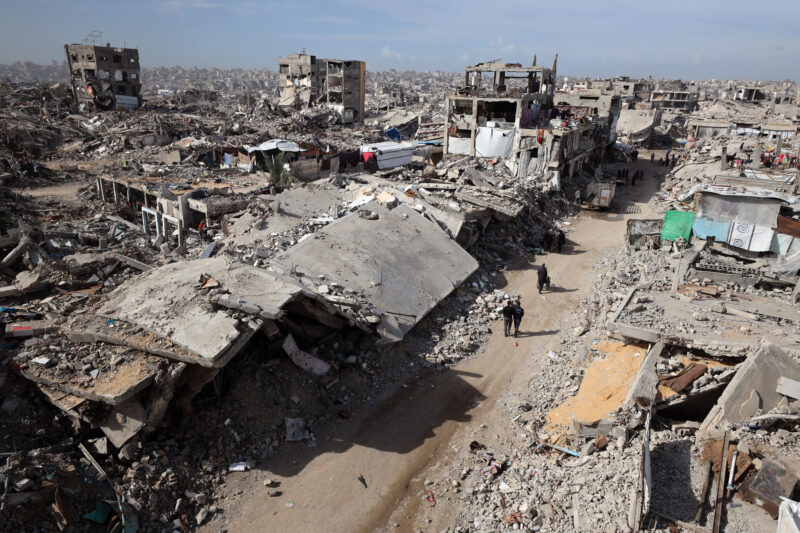
“At the end of the day, Hamas cannot be allowed to prioritize holding on to its weapons at the expense of Gaza’s reconstruction,” Levitt said. He described the newly established working groups as a “significant” step toward “holding Hamas to full disarmament” and “addressing the very real sanitation crisis in Gaza.”
Jonathan Ruhe, a fellow at the Jewish Institute for National Security of America, said the timeline will have little meaning without a credible force on the ground capable of disarming Hamas if the group refuses to surrender its weapons voluntarily.
“By saying all the right things, Hamas hopes to aggravate existing tensions between Washington and Jerusalem,” Ruhe said, arguing that the group is playing for time as U.S. and Israeli attention is pulled toward upcoming elections in both countries and other regional flashpoints.
“It’s almost impossible to foresee real progress on the Gaza peace plan until there’s a viable and ready option to forcibly disarm Hamas, since Hamas is not going to voluntarily surrender control over its part of the Strip,” Ruhe said. “The agreed timeline doesn’t mean much in the absence of any viable disarmament option.”
Ruhe added that Hamas could “play for time” and “hope Gaza continues to fall down the list of U.S. and Israeli priorities as tensions flare in [the Strait of] Hormuz, the West Bank and Syria, and as Trump and Netanyahu focus on upcoming elections.”
“Israel may have the U.S. blessing to finish the job, and ultimately it is willing to do so, but that doesn’t mean it’s ready or eager to resume intensive and draining ground operations in the near future,” he said.
Jason Greenblatt, former Middle East envoy in the first Trump administration, struck a more supportive tone toward the administration’s effort while expressing continued distrust of Hamas.
“I remain deeply skeptical of anything Hamas says. Hamas’ defining objective remains the destruction of Israel, and I am aware of no evidence that this has changed,” Greenblatt said. “Yet President Trump and his team secured the release of hostages held by Hamas in brutal conditions when almost no one thought it could be done.”
“President Trump, Jared and others on the team also created the Abraham Accords, which most experts believed could never happen, and they are uniquely qualified to take on this extraordinarily difficult task,” he continued. “The administration is right to pursue every possible path while making clear that, if Hamas refuses to comply, Israel will have America’s support to finish the job.”
More Stories
SUNSHINE STATE RETREAT
House GOP leadership super PAC pulls ad spending against Jared Moskowitz

VATICAN VISIT
Pope Leo affirms commitment to fighting antisemitism in meeting with AJC leaders

UNHOLY ALLIANCE
New El-Sayed ad features Tucker Carlson, far-right podcaster’s attack on Mike Rogers
TEXTBOOK TEST
Syrian textbooks under al-Sharaa deny Israel’s right to exist and promote antisemitism, report finds

AID ARGUMENTS
Michael Oren, Jonathan Schanzer split over when Israel should move past U.S. aid

analysis
Playing to the cameras in the West Bank
Please log in if you already have a subscription, or subscribe to access the latest updates.
 Continue with Google
 Continue with Apple