





























ADL research documents faculty networks shielding anti-Israel student groups from discipline and instructors presenting one-sided narratives on Israel as fact
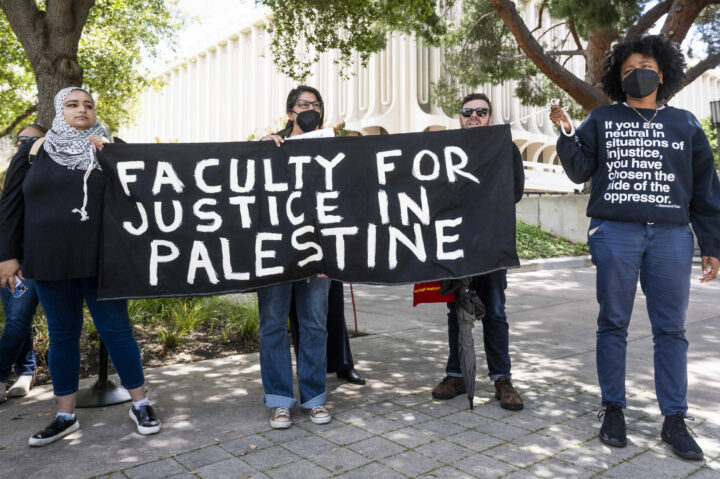
(Paul Bersebach/MediaNews Group/Orange County Register via Getty Images)
Several hundred people demonstrate at the University of California, Irvine in Irvine, CA on Thursday, April 25, 2024.


 Add JewishInsider on Google
Even as student-driven protests against Israel and the war in Gaza have quieted down on college campuses, two new Anti-Defamation League reports reveal rising levels of antisemitism and anti-Zionism in university classrooms nationwide driven by faculty, noting that some instructors are still presenting one-sided views on Israel as fact, assigning readings by terrorist groups and offering extra credit for attending anti-Israel protests.
“The Faculty Factor: Inside the Networks Driving Anti-Israel and Anti-Zionist Activism on Campus,” published on Wednesday, documents how faculty groups, unions and networks drive anti-Israel and anti-Zionist actions at universities. The report claims that faculty networks such as Faculty & Staff for Justice in Palestine and the American Association of University Professors have shielded anti-Israel student groups from discipline since the 2024 campus anti-Israel encampments, detailing methods used by influential organizations to provide institutional cover.
The report follows a 2025 ADL and Academic Engagement Network survey that found that 73% of the 209 Jewish faculty members polled from universities around the U.S. reported observing antisemitic activities or statements from faculty, administrators or staff on campuses, including calls to boycott Israel and doxxing campaigns. Forty-four percent said they were aware of an organized Faculty for Justice in Palestine chapter on their campus.
A second report, “Antisemitism Among Faculty and in the Classroom: Trends, Patterns and Institutional Dynamics,” highlights anti-Israel narratives presented to students through regular course study since the Oct. 7, 2023, Hamas terror attacks and the ensuing Gaza war.
The report cites incidents of professors presenting one-sided narratives, framing lectures around a single political view and treating contested claims as settled fact. In some cases, courses feature extensive criticism of Israel without engaging substantively with counterarguments or historical complexities, according to the ADL.
For instance, at Stanford University, the course “Palestine Across Disciplines: An Introduction” asked in its description, “How do we talk about Palestine and Palestinian life in the midst of devastation and genocide?” At Yale, a seminar description referred to Israel as a “settler-colonial structure of occupation and violence.” And at Princeton, a course titled “Gender, Reproduction and Genocide” focused on Gaza and featured readings that described “Israel’s genocidal project” as unfolding since the “1948 Nakba.”
In 2024, University of California, Berkeley students in a history course were reportedly assigned to read Men in the Sun by Ghassan Kanafani, a former spokesperson for the Popular Front for the Liberation of Palestine, a U.S.-designated terrorist organization, alongside materials on Kanafani’s fellow PFLP member and plane hijacker Leila Khaled that explored armed struggle and Palestinian resistance.
At the University of Missouri, a journalism student reported that a professor used a film about a former mayor of the West Bank city of Ramallah in a required course to push a personal anti-Israel view, as he called Israel an occupying force that aims to kill all Palestinians.
In extreme cases, professors use their platforms to direct students to oppose protections against antisemitism, according to the report. It pointed to an incident where a California State University, Los Angeles professor allegedly urged his class to petition Gov. Gavin Newsom to veto bill AB 715, California’s landmark K-12 antisemitism prevention law.
In response to these reports, the ADL announced it will launch the Campus Classroom Reporting tool to provide a confidential channel for the public to report classroom antisemitism, aiming to improve upon what it says are low reporting rates. Alongside this, ADL released best practice guides and model policies to assist institutions in addressing discrimination, tenure and academic freedom issues.
Jewish leaders in the area had raised concerns that messaging from Hernandez’s opponent, including calling her an enabler of genocide, was not addressed by Democratic Party leaders
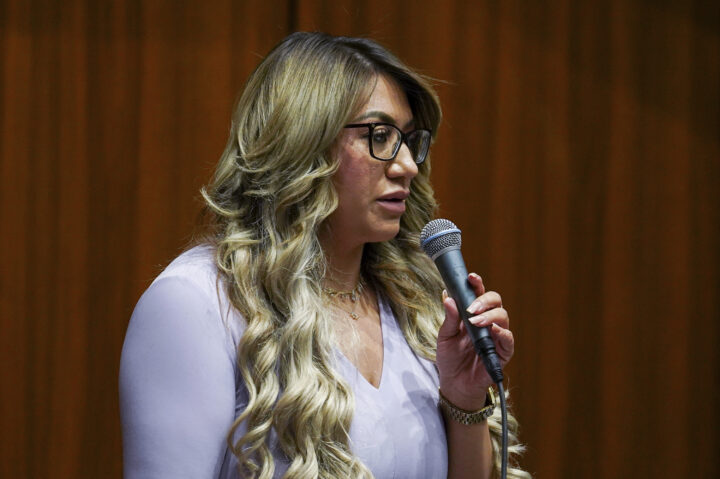
Samantha Chow/AP
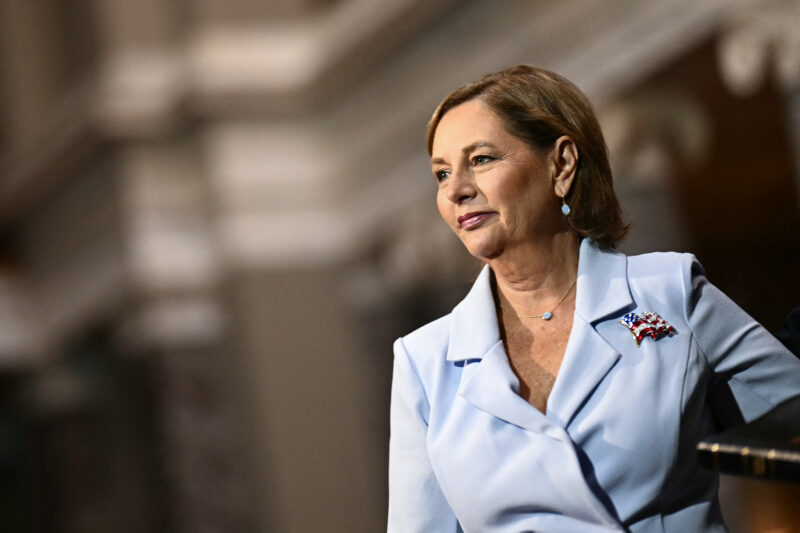
State Rep. Alma Hernandez, D-Tucson, speaks during a House session, Wednesday, April 23, 2025, at the state Capitol in Phoenix.
Alma Hernandez, a Jewish Democratic legislator in Arizona who is known as an outspoken supporter of Israel, claimed victory on Wednesday in a bitterly contested primary for an open state Senate seat in Tucson, hailing the win as a repudiation of the far left.
Hernandez, who is 33 and identifies as a “proud Zionist,” faced off against Rocque Perez, a former Tucson City Council member, whom she accused of using rhetoric that crossed a line into antisemitism with no pushback from the range of elected officials supporting his campaign.
With all votes counted in Arizona’s 20th Legislative District, Hernandez pulled in 54% of the vote share, defeating Perez by 8 points, according to unofficial results on the secretary of state’s website. The election results have yet to be officially certified.
“The voters in my district rejected antisemitism and rejected the DSA’s agenda, and clearly rejected what the mayor, the congresswoman and the county attorney wanted,” Hernandez, a term-limited House member, said in a statement to Jewish Insider, referring to the Democratic Socialists of America. “We proved that elections are won by knocking on doors and talking to voters, not by social media or online outrage and your friends’ endorsements.”
Throughout the campaign, Perez, who had been endorsed by Tucson Mayor Regina Romero, Rep. Adelita Grijalva (D-AZ) and Pima County Attorney Gabriella Cázares-Kelly, among others, had fixated on Hernandez’s pro-Israel views, casting her as having been influenced by “foreign” and “overseas interests” and labeling her an enabler of “genocide” and “bankrolled” by AIPAC, which does not engage in state-level races.
In one fundraising message, Perez asked his supporters to contribute $5 to “unseat a Zionist!”
Jewish leaders in Arizona had raised concerns about Perez’s messaging, saying that his attacks were an example of how rising anti-Zionism on the far left has intersected with antisemitism and is met with silence from Democratic Party leaders.
Before Tuesday’s primary, the Center for Jewish Resilience at Jewish Philanthropies of Southern Arizona, which monitors incidents of antisemitism in the area, distributed a letter to city council members backing Perez that highlighted what the group called his “repeated pattern of public rhetoric” espousing “longstanding antisemitic tropes and narratives.” It did not receive responses.
“It was our hope that these concerns would be taken seriously,” Carina Bien-Willner, the center’s director of public affairs, said in a statement to JI last month.
Perez, who has not yet conceded, did not return a request for comment on Thursday.
Hernandez, whose pro-Israel sentiments and votes with Republicans in the state legislature have fueled tensions with Democrats, said her victory had made “clear that running a campaign centered on attacking a Jewish elected official and making ‘genocide’ the defining issue is not a winning message in Arizona.”
“Despite not being the establishment candidate, we won by staying authentic, working hard and focusing on delivering results,” she told JI.
Hernandez is all but certain to prevail in November in the safe blue seat.
The outcome of Hernandez’s race also represented a counternarrative to broader national voting trends that have seen left-wing populists make inroads in recent congressional primaries across the country, including in Colorado this month and New York last month.
Rep. Greg Stanton (D-AZ) likewise fended off a left-wing challenger in Arizona’s primaries this week, winning a decisive 62% of the vote over Kai Newkirk, who lost by 25 points with most of the results tallied.
“I’ll continue to be unapologetically myself, and I look forward to serving the people of LD20 in the Arizona Senate,” Hernandez said in her statement.
JCRC CEO Ron Halber said he hopes to work with the DSA member, despite his strident criticism of the group, while remaining vigilant
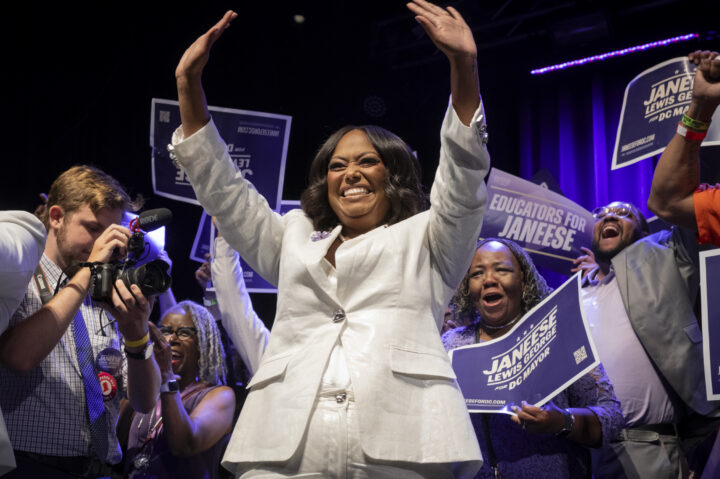
Maxine Wallace/The Washington Post via Getty Images
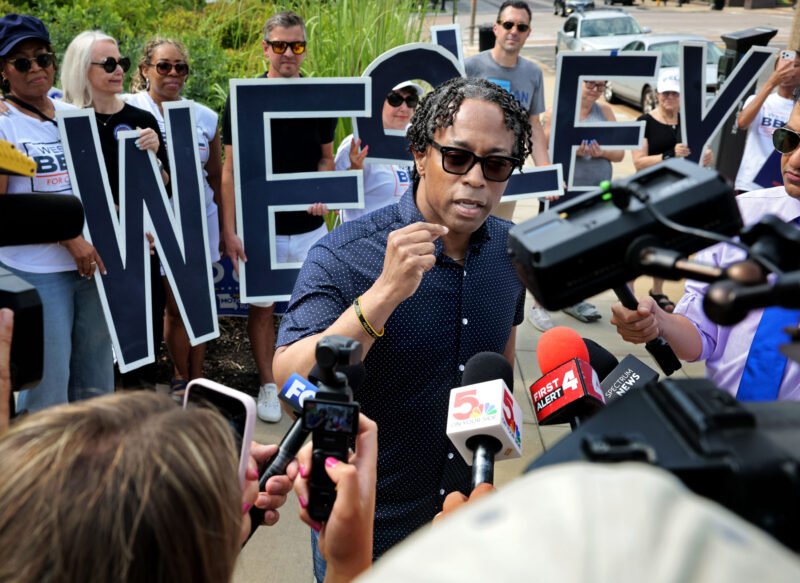
Mayoral candidate Janeese Lewis George celebrates her early lead at her election night party at the Howard Theatre on June 16, 2026 in Washington, DC.
With Janeese Lewis George’s victory in last week’s Democratic primary, Washington, D.C., is expected to become the third major city in the country, after Seattle and New York, with a democratic socialist serving as mayor.
Now, Jewish Washingtonians who were unsettled by Lewis George’s stance on Zionism, as articulated in a Democratic Socialists of America endorsement questionnaire in which she said she would reject the “Zionist lobby,” are grappling with how to approach her tenure as mayor.
Mainstream Jewish organizations tasked with local lobbying and advocacy efforts appear to be taking a wait-and-see approach, while cautioning Lewis George that they will be monitoring her tenure in office to make sure she does not assume positions that exclude segments of the city — including Jewish supporters of Israel.
“We hope to work with her, and we will work with her,” Ron Halber, CEO of the Jewish Community Relations Council of Greater Washington, told Jewish Insider on Friday. “But at the same time we’re also going to be watching to make sure that she lives up to her promises to make this an inclusive city, where all feel they can participate equally, and that all people, regardless of their backgrounds, are welcomed — Zionists as well.” (In February, Halber called DSA’s requirements for backing local candidates “an antisemitic manifesto.”)
Anti-Defamation League Washington regional director Tali Cohen expressed a similar sentiment.
“We look forward to continuing our work with local leaders,” Cohen said in a post on X, “while also holding them accountable to combat antisemitism and ensure Jewish voices are included in our nation’s capital.”
Lewis George, who has served on the D.C. Council since 2020, defeated Kenyan McDuffie by a double-digit margin, 54%-36%, in last week’s primary. During the campaign, she presented a proudly progressive vision for the city, leaning into an affordability message and offering proposals for universal childcare and housing construction that were described as unrealistic by her opponent.
Lewis George’s campaign was powered largely by labor unions, but also by activists with DSA, of which Lewis George has been a member for years. The group’s endorsement questionnaire included a lengthy section on Israel. “I will refrain from going on any political junkets to Israel. I will also not attend events focused on obfuscating the realities of occupation or promoting Zionism and apartheid,” Lewis George wrote. In a candidate forum hosted by the JCRC in May, she declined to answer when asked to clarify her views on Zionism.
McDuffie’s strategy included campaigning within the Jewish community and contrasting himself to Lewis George by saying he would have shunned an endorsement from DSA and that he would be a mayor “for all D.C.” The issue of Israel never rose to a major focus for the campaign, and instead the candidates’ approaches to the city’s economic challenges — and its complicated relationship with President Donald Trump and federal oversight — proved to be driving factors in the race.
Rabbi Shmuel Herzfeld served for nearly 20 years as the rabbi at Ohev Sholom Congregation, an Orthodox synagogue in Lewis George’s ward. He now runs a small yeshiva in the area, and told JI he is concerned about her election as mayor.
“We need to be on guard. We need to be ready to challenge her, and [these are] concerning times,” said Herzfeld, who told JI he never heard back from her office when he reached out after she was elected to the D.C. Council in 2020. “She’s clearly surrounded herself with people who are anti-Zionists.”
After the Associated Press called the race for her on Thursday, Lewis George hosted a press conference at Busboys and Poets, a Washington bookstore and restaurant that regularly hosts speakers with an anti-Israel bent. (Its 14th Street location, where Lewis George spoke, has a mural painted on the wall showing a group of left-wing leaders and activists sitting at a table together; one of the legs of the table has the words “Long Live the Intifada” painted on top of it, and another says “From the River to the Sea, free Palestine.”)
Lewis George touted “the broad coalition I was able to build,” and specifically mentioned Jews United for Justice, a left-wing Jewish group that supported her campaign.
“So many different people came into the JUFJ campaign fund because they were excited about Janeese, and I think that really speaks to something special about this election,” JUFJ’s D.C. director, Yael Shafritz, told JI. Shafritz said JUFJ does not take foreign policy issues such as the Israeli-Palestinian conflict into account when supporting candidates, but that its members felt Lewis George had taken a strong position on antisemitism.
“All the candidates we endorsed actually gave incredible answers about how they would support the Jewish community around fighting antisemitism,” Shafritz said. After Lewis George met with Washington rabbis in March following the release of the DSA endorsement questionnaire, she released a statement saying it is not a conflict to support “Palestinian human rights” and to “stand firm in my commitment against antisemitism.”
Lewis George represents Ward Four, which encompasses several neighborhoods in the northernmost part of Washington, including Petworth, Brightwood, Fort Totten, Sixteenth Street Heights and Shepherd Park. The district includes two synagogues — the Orthodox Ohev Sholom and the Conservative Tifereth Israel Congregation — and Milton Gottesman Jewish Day school, a pluralistic pre-K-8 school.
“There’s a lot of very progressive Jews in Ward Four, and they seem to support her and not have antisemitism as a central campaign issue,” said one of Lewis George’s Ward Four constituents, who requested anonymity because her job does not allow her to speak to the media. “I think there’s an equal amount of Jews like me who want to support her on social policies because we think they’ll make D.C. better, but antisemitism was my number one campaign issue, and how you handle antisemitism. I don’t feel confident that she’ll do much to battle it.”
Leiter: ‘The tent, as we call it, should be wide and as inclusive as possible, but it cannot be inclusive to those who are contributing to the efforts of those seeking to collapse the tent’
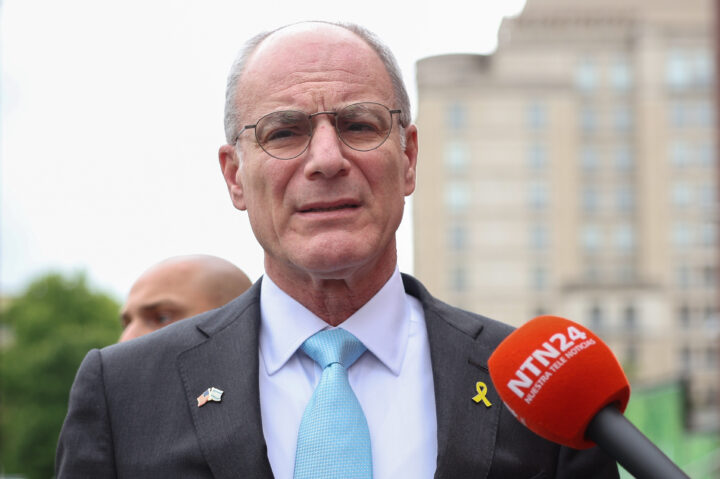
Tasos Katopodis/Getty Images
Israeli Ambassador to the United States Yechiel Leiter
A week after describing J Street as “a cancer within the Jewish community” for calling for the United States to restrict aid to Israel, Yechiel Leiter, Israel’s envoy to Washington, doubled down on his critique of the organization, stating that the liberal advocacy group’s recent actions are “decidedly not pro-Israel.”
The remarks came during Leiter’s broader address on Thursday at the Re-Charging Reform Judaism conference on Manhattan’s Upper West Side, during which he argued to the audience of over 300 Reform rabbis, lay leaders and teachers that American Jews need to respond to rising anti-Zionism and post-Oct. 7 hostility toward Israel with a stronger, more unapologetic form of Zionism and Jewish solidarity.
“J Street does incalculable amount of damage to the interests of Israel,” Israeli Amb. Yechiel Leiter said at the Re-Charging Reform Judaism conference, expanding on his previous critique of the liberal advocacy group.”
— Jewish Insider (@jewishinsider) May 27, 2026
Watch more of what he said below or read our full story: https://ji.news/55×33
While Leiter expanded on his critique of J Street, receiving applause and a standing ovation at the end of his speech, his remarks were more measured than in previous appearances, focusing on what he described as the group’s role in supporting arms embargoes and amplifying accusations against Israel, rather than attacking the organization wholesale. His past comments — including describing J Street as “duplicitous” and “two-faced” — drew ire from many progressive Jews.
“I believe the tent, as we call it, should be wide and as inclusive as possible, but it cannot be inclusive to those who are contributing to the efforts of those seeking to collapse the tent. J Street does incalculable amount of damage to the interests of Israel,” he said.
He continued, arguing that support for arms embargoes against Israel “endanger Israel” and that “supporting such embargoes is not pro-Israel,” He also denounced the organization’s call for Leiter to investigate the allegations of sexual abuse of Palestinians outlined in a controversial opinion piece by New York Times columnist Nicholas Kristof earlier this month.
“It is certainly not pro-Israel to push the canards peddled by Nick Kristof in The New York Times. Jewish dogs don’t commit rape. That was the last straw for me….It’s perfectly fine to have a different vision than the majority of Israelis as to what that peace should look like… but it’s unethical to undermine Israel’s democratically elected government. Friends, please understand, I did not call out J Street because I disagree with their vision of Israel. I call them out because their actions are endangering Israel,” he said.
Leiter also said that senators he meets with on Capitol Hill have accused Israel of “genocide and starvation” and said lawmakers cite J Street as a source for those claims.
“Ask anyone in the know in Washington who is lobbying alongside [Sen.] Bernie Sanders [I-VT], who is responsible for 40 of 47 Democratic senators voting in favor of the arms embargo in Israel,” Leiter said. “They will tell you J Street.”
JCRC CEO Ron Halber: ‘They're a fringe, radical, antisemitic organization’
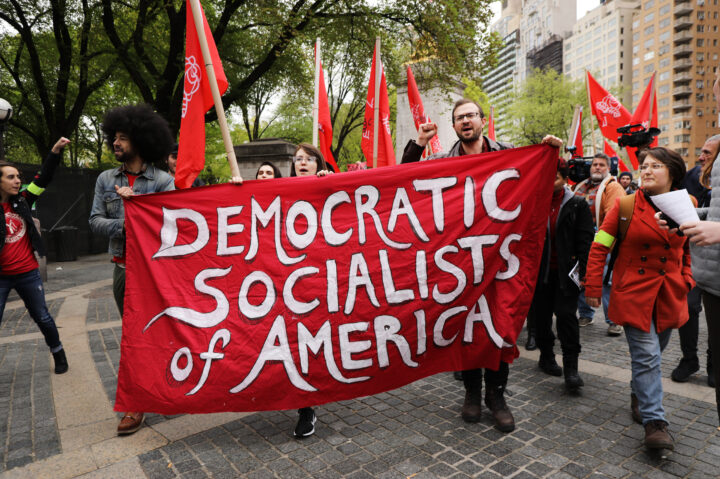
Spencer Platt/Getty Images
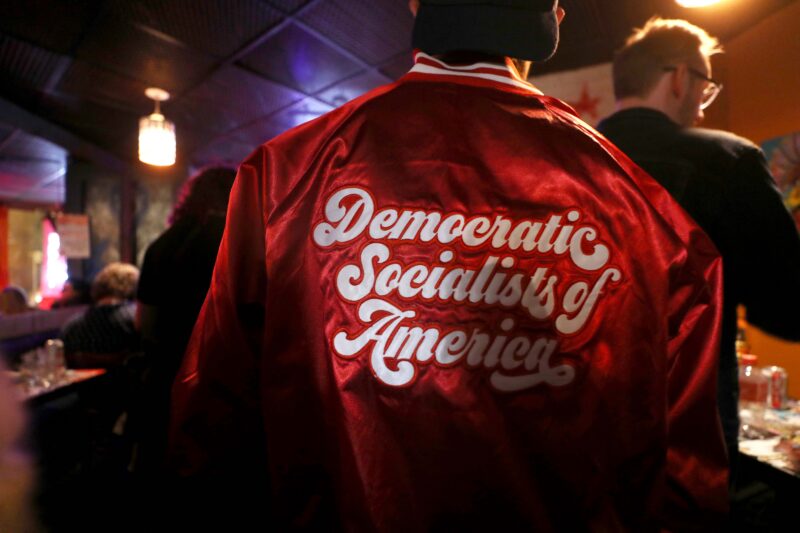
Members of the Democratic Socialists of America May 01, 2019 in New York City.
Amid the rise of a DSA-aligned mayoral candidate in the city, a senior Jewish community leader in Washington, D.C., excoriated the Democratic Socialists of America as an “evil” organization committed to driving Jews out of society.
Speaking on a webinar with other Washington-area Jewish leaders on Tuesday, Ron Halber, the CEO of the Jewish Community Relations Council of Greater Washington, stridently criticized the far-left group.
“I think they’re a fringe, radical, antisemitic organization, and I happen to even think they’re evil,” Halber said. “They are trying to do in America what [the Boycott, Divestment and Sanctions movement] seems to do internationally, which is to make being Jewish unacceptable in polite society.”
He said that the group wants to make Jews feel “isolated” and force them to “renounce Zionism” and their connection to Israel in order to participate in the political process. Antisemitism is “core to their belief,” he continued.
Halber described the activist group as emboldened and energized during the second Trump administration — as numerous DSA-aligned candidates make gains in local and national elections — and said that the Jewish community “should view DSA with alarm, because they are having a radical impact.”
And, he added, the Jewish community should be “very, very wary of political candidates who go out and seek their endorsement and who wish to affiliate.”
The Metro DC DSA did not immediately respond to a request for comment.
Halber said it’s the responsibility of Jewish organizations to come together with allies to expose the DSA as “the fringe of American society that most people in America would be repulsed by.”
Tali Cohen, the Anti-Defamation League’s Washington regional director, said on the webinar that she has been “astonished by the rhetoric coming out of the D.C. DSA chapter.”
Cohen said the group is attempting to “isolat[e] the Jewish community through exclusionary policies” — requiring endorsees to cut ties with “the overwhelming majority of organized Jewish community institutions” — and has “embrace[d] antisemitism as an organizational orthodoxy” through its embrace of anti-Zionism.
“If you read DSA’s platform, they have disproportionately and overwhelmingly chosen to focus on the world’s only Jewish state,” she continued. “The selective focus can suggest that something else is at work beyond just policy concerns.”
Cohen also raised concerns about the group’s opposition to the International Holocaust Remembrance Alliance’s working definition of antisemitism and its efforts to defund the D.C. police, a project she said endangers the Jewish community.
The event comes following a high-profile clash between Jewish communal groups and the Washington DSA chapter over its endorsement questionnaire for the city’s mayoral race that required candidates to pledge to refrain from engaging with “Zionist lobby groups.”
Mayoral candidate Janeese Lewis George, a DSA member endorsed by the group, said in response to the questionnaire that she would not attend events “promoting Zionism and apartheid.”
Alan Ronkin, the regional director of the American Jewish Committee in Washington, and ADL experts also spoke on the webinar.
The Michigan senator acknowledged it ‘used to be easier’ to identify as pro-Israel while denouncing ‘collective punishment’ of Jews at a Politico conference
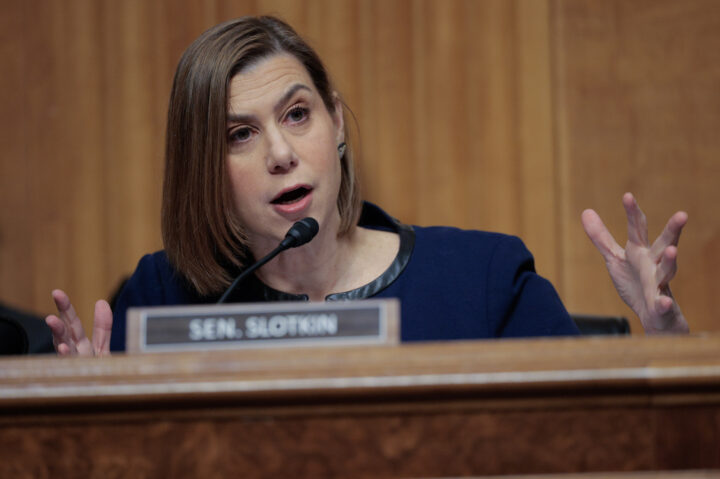
Chip Somodevilla/Getty Images
Sen. Elissa Slotkin (D-MI) in the Dirksen Senate Office Building on Capitol Hill on March 18, 2026 in Washington.
Asked at the Politico Security Summit in Washington on Tuesday if she still calls herself a Zionist, Sen. Elissa Slotkin (D-MI) said, “I believe in a Jewish State of Israel, yes. And that to me isn’t a radical thing to say and I always have.”
“I can say that in the same breath that I criticize the military policy of Bibi Netanyahu,” she added.
Slotkin acknowledged it “used to be easier” to say that she considers herself a Zionist. “I come from a state that has a huge Arab and Muslim population, a very large Jewish population. There’s not been a single issue that I’ve seen that’s been more emotional than this one because so many people have family members who are caught in the middle of this conflict.”
“As someone who served three tours in Iraq,” she continued, “I do have concerns with the way the Israelis are organizing military policy right now, certainly in Gaza but also other places.”
“What I can’t accept, though, is collective punishment that comes from saying, ‘well, I don’t like Bibi Netanyahu’s military policy so Jews in America’s synagogues should be attacked,’ including synagogues I’m very close to and spent my life growing up in,” Slotkin said, referring to the March car-ramming and shooting attack on Temple Israel in West Bloomfield, Mich.
Slotkin called the attack “particularly personal” in an interview with Jewish Insider shortly after.
She continued on Tuesday, “That’s collective punishment that we wouldn’t allow when we’re talking about African Americans or talking about Italian Americans and so we shouldn’t allow it for Jewish Americans, either.”
D.C. JCRC CEO Ron Halber called the DSA’s requirements for its backing ‘an antisemitic manifesto’
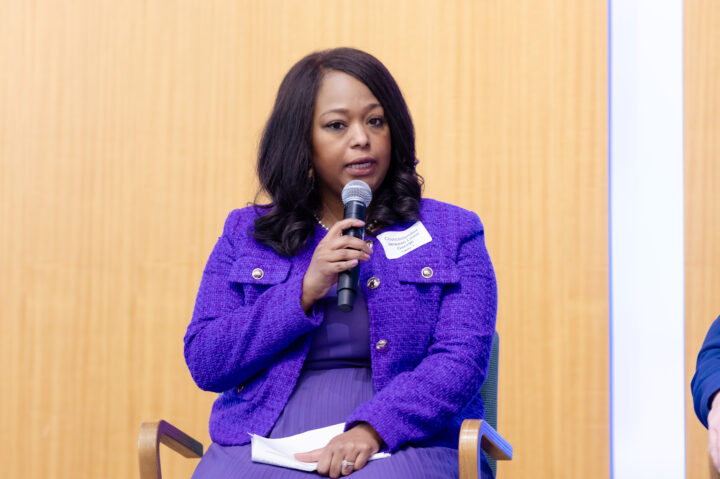
Jewish Community Relations Council of Greater Washington
D.C. City Councilmember Janeese Lewis George speaks at a "Lox and Legislators" breakfast held by the Jewish Community Relations Council of Greater Washington on Dec. 18, 2025
Washington, D.C., mayoral candidate Janeese Lewis George told the Metro D.C. chapter of the Democratic Socialists of America that she will not attend events focused on “promoting Zionism and apartheid,” according to a questionnaire from the group that she filled out prior to earning its endorsement earlier this month.
“I will refrain from going on any political junkets to Israel. I will also not attend events focused on obfuscating the realities of occupation or promoting Zionism and apartheid,” Lewis George wrote in her answers on the questionnaire, which the local DSA group posted to its website. Lewis George described herself as “a proud member of Metro DC DSA.”
The DSA questionnaire asks candidates to publicly support the Boycott, Divestment and Sanctions movement, and to refrain from engaging with “the Israeli government or Zionist lobby groups” — a category that it said includes AIPAC, Democratic Majority for Israel, Christians United for Israel and the more liberal J Street.
It also asks candidates in the region to “oppose legislation that harms Palestinians and supporters of the Palestine solidarity movement,” including legislation promoting the International Holocaust Remembrance Alliance’s working definition of antisemitism, efforts to counter the BDS movement or measures that “send any military or economic resources to Israel.”
Lewis George did not say if she backs the BDS movement but said she supports “the right of all people, including Palestinians, to use nonviolent strategies like boycotts and calls for divestment to build a more just world.” She said D.C. “has no business sending military or economic resources to Israel.”
Lewis George, a D.C. Council member who is running in the open race to replace Mayor Muriel Bowser, defended her appearance at a Jewish Community Relations Council of Greater Washington event in December, where she committed to taking proactive steps to protect the Jewish community.
“In my current role as a councilmember and as mayor, however, I will have to attend events and meet with many people and organizations who do not share my values or with whom I’m not totally aligned,” Lewis George wrote in the questionnaire. “The JCRC legislative breakfast in December was an example. I disagree with the JCRC on a number of issues, including their opposition to using the word ‘genocide’ to describe Israel’s actions in Gaza.”
Lewis George told DSA that she disagrees with JCRC’s “definition of anti-semitism that criminalizes dissent, and their attacks on activists.” At the JCRC event, she gave a speech criticizing antisemitism and pledging to stand by Jewish Washingtonians, although she did not mention that in the DSA questionnaire.
“Attending that JCRC event was not an endorsement of JCRC and does not signal that I agree with their stance on Israel or Zionism. I did not go to the JCRC event to talk about Israel and that was not the focus of the event,” Lewis George wrote. “I went to the event to advocate for an end to ICE collaboration, seek allies in that effort, and build on our shared goal of ending the inhumane treatment of our neighbors who are being taken by ICE.”
Lewis George reiterated her support for George Washington University students who had organized an anti-Israel encampment in the spring of 2024.
“I will continue to stand up against efforts to silence local Pro-Palestinian speech and organizing,” she wrote. “I believe that democracy requires freedom of expression and I oppose the government penalizing anyone for participating in non-violent protest, no matter the subject. People surely disagree on many important issues but I think our community and country are at their best when the government does not stifle dissent.”
Lewis George represents Washington’s Ward 4, which encompasses Upper Northwest D.C. around Rock Creek Park, including the neighborhoods of Shepherd Park, Chevy Chase, Brightwood, Petworth and Sixteenth Street Heights.
JCRC CEO Ron Halber told Jewish Insider on Wednesday that he’s noticed the D.C. DSA chapter has been more active since Zohran Mamdani was elected as mayor of New York City with the backing of DSA in November.
“What we noticed was there’s been an uptick in DSA locally, both in Montgomery County [Maryland] and in D.C., approaching candidates for their endorsement,” Halber said. “They’re basically saying that candidates should not be with any Jewish organization, whether it be a synagogue or a mainstream organization like JCRC, through the criteria they establish. As far as I’m concerned, [the questionnaire] is an antisemitic manifesto. They are making the price of their endorsement the social exclusion of Jews.”
Halber declined to comment on DSA’s endorsement of Lewis George, saying JCRC does not get involved in electoral matters as a nonprofit organization.
A new survey from the Jewish Federations of North America illustrates the complexities of supporting Israel and the word ‘Zionism’ in a post-Oct. 7 landscape
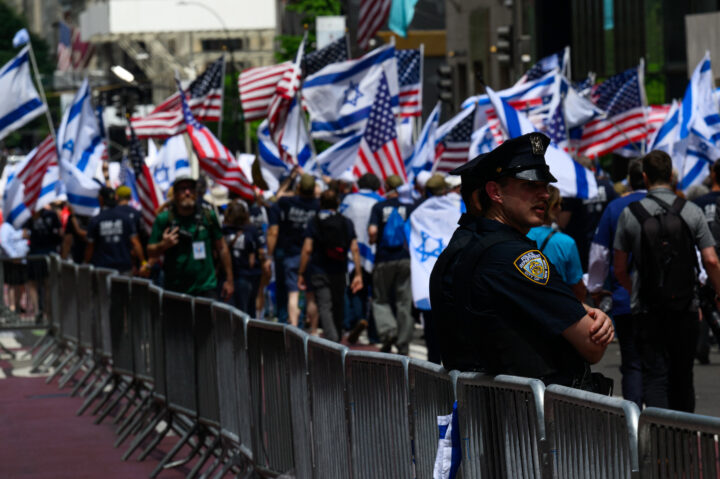
Alexi Rosenfeld/Getty Images
NYPD officers stand on the side during the Celebrate Israel Parade up Fifth Avenue on May 18, 2025 in New York City.
Young American Jews have less of an emotional attachment to Israel than older Jews, but the overwhelming majority of all American Jews, across age groups, believes in Israel’s right to exist as a Jewish and democratic state, new survey data from Jewish Federations of North America reveals.
The results from the survey, which was conducted in March 2025 and released this week, makes clear that a baseline belief in Israel’s existence is still a consistent feature of American Jewish life among at least three-quarters of all Jews in the United States. At the same time, illustrating the complexities of the post-Oct. 7 landscape, one-third of young Jews describe themselves as anti-Zionist or non-Zionist.
Overall, nearly 9 in 10 American Jews believe in Israel’s right to exist, though there is a disparity among age groups. Ninety-eight percent of Jews between the ages of 55 and 74 believe in Israel’s right to exist as a Jewish, democratic state, compared to 76% of American Jews between 18 and 34.
Among younger Jews, a majority still describe feeling emotionally attached to Israel, although there is a larger discrepancy from their parents’ generation. Fifty-seven percent of American Jews between 18 and 34 said they feel emotionally attached to Israel, compared to roughly three-quarters of Jewish Americans between 55 and 74. Among American Jews who are older than 75, 88% described feeling emotionally attached to Israel.
According to the survey, fewer than half of American Jews — across nearly all age categories — identify as Zionists. Among those between the ages of 18 and 34, 35% identify as Zionist. Among Jews over 75, just 33% identify as a Zionist.
JFNA’s chief impact officer, Mimi Kravetz, argued in a Jewish Telegraphic Agency op-ed explaining the survey results that Jews’ reluctance to describe themselves as Zionists, while agreeing with the fundamental tenets of Zionism, is a result of misperceptions about the word, which Kravetz said had experienced “definition creep,” shaped by “political agendas, public discourse, and broader social forces.”
She urged Jewish advocates to respond with unity and a recommitment to the term’s earliest definition.
“For us, Zionism means supporting the State of Israel and the Israeli people and uniting the Jewish people behind this shared commitment,” Kravetz wrote.
But while relatively few American Jews describe themselves as Zionists across age groups, the data shows that far more young Jews identify as anti-Zionists or non-Zionists than older Jews. About one-third (32%) of Jews between 18 and 34 describe themselves as anti-Zionists or non-Zionists. That’s a much larger number than any other demographic: 13% of Jews between 35 and 44 say the same, compared to 15% of Jews between 45 and 54, 1% of Jews between 55 and 64, 4% of Jews between 65 and 74 and 9% of Jews older than 75.
Izabella Tabarovsky’s ‘Be a Refusenik’ offers a productive mindset and practical ideas for Jewish students facing antisemitism
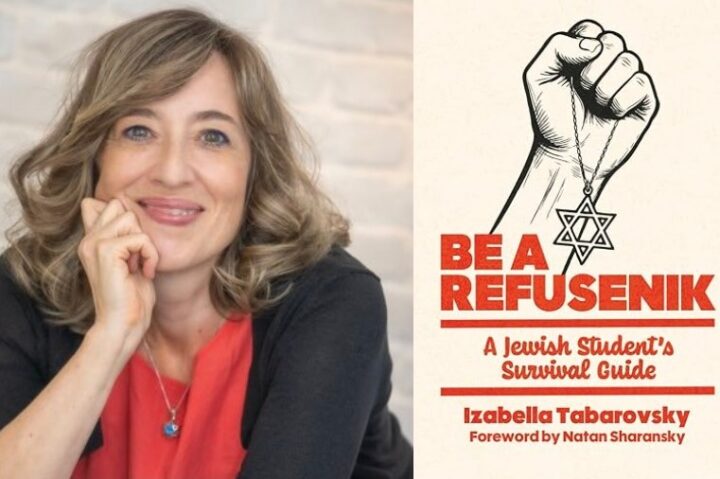
Izabella Tabarovsky
Pocket your kippah. Tuck your Star of David into your shirt. Keep your head down as you walk through the quad, That’s just some of the advice Jewish college students around the country told the Soviet-born writer and activist Izabella Tabarovsky they were given by the leaders of major Jewish organizations as a strategy to weather the anti-Israel and antisemitic storms that have raged on campus since Oct. 7, 2023.
Tabarovsky’s counter-message: Don’t hide. Reclaim your Zionism. And take inspiration from the Soviet refuseniks of the 1980s who stared down Communist Party strongman Leonid Brezhnev, held fast to their Judaism and eventually won their freedom.
Tabarovsky lays out some of these strategies for college students in a new book, Be a Refusenik: A Jewish Student’s Survival Guide, in which she argues that the anti-Israel sentiment on college campuses in recent decades, which has metastasized into antisemitism, mirrors Soviet anti-Jewish propaganda. In the book, Tabarovsky looks back to that era not only to understand the root causes of contemporary antisemitism, but to take inspiration on how to fight it.
The book features a history of Soviet anti-Zionist propaganda with its parallels to the rhetoric on college campuses today, interviews with refuseniks – Soviet Jews who were denied the right to emigrate to Israel, and often imprisoned for trying – and campus activists, and a foreword from the best-known refusenik, Natan Sharansky. Tabarovsky, who was born in the Soviet Union, emigrated to the U.S. in 1990 and now lives in Israel, also offers concrete strategies for students encountering antisemitism to stand proud and strong as Jews.
Tabarovsky told Jewish Insider that she saw a need for her book after many discussions with young Jews: “We’re in a bleak moment, and a lot of books diagnose the bleakness. … I saw a hunger for an inspirational message.”
In the near-decade that she has been writing about the subject, it has become “widely accepted among scholars and people involved in this [activism] that the patterns of anti-Zionist demonization and erasure are some of what Soviet Jews experienced in [former Soviet Union leader Leonid] Brezhnev’s USSR,” she said.
“If American Jews are today encountering the same language, the same explanatory logic and worldview … wouldn’t it make sense to look at how Soviet Jews responded?” Tabarovsky said. “We have this heroic story at the center of the Soviet Jewish story, which is really bleak, but had one really bright light that led to massive change.”
Tabarovsky clarified that, while the U.S. is a democracy and the Soviet Union was an oppressive totalitarian regime, “historic parallels are complex and nothing is ever exactly the same. I would never say that America today is like Brezhnev’s USSR, and the dangers that American Jews face are incomparable to what somebody like Sharansky faced.”
However, she said, “what is similar are the ideological echoes and anti-Zionist erasure. … In every society, there is a scale of punishments that’s different. What’s the worst thing that can happen in America? Your reputation is ruined; you lose your career, you’re ruined financially. All of these things can happen to people who declare themselves Zionists.”
While the refuseniks are remembered for their attempts to emigrate from the Soviet Union, Be a Refusenik focuses on their domestic dissident activity, especially their underground actions to strengthen Jewish identity, spread Jewish education, teach Hebrew and learn about Israel and Zionism. They were “crowdsourcing Jewish knowledge” when the Soviet party line was that “Zionism is racism, is Nazism,” Tabarovsky recounted.
Part of the strategy Tabarovsky suggests for young Jews on campus is modeled after “an inner journey the refuseniks took” in strengthening their Jewish identity.
“Some refuseniks told me this is how they viewed it,” Tabarovsky said, “the system refused to allow them something they wanted, but before that, they refused [to accept] something about the system itself. They refused [to accept] the antisemitism that the system demanded from them, that they erase their Jewish identity, that they give up their sense of peoplehood. … The refuseniks said ‘we don’t buy it; we refuse [to accept] this version of reality. We believe something different.’”
Tabarovsky noted that in her speaking engagement with young American Jews, she realized that many are unfamiliar with the refuseniks, and when she would ask for examples of Jewish heroes, they would usually mention the Warsaw Ghetto Uprising or the Maccabees.
“[Refuseniks] are a real example of Jewish courage and defiance. … They found each other and created a different reality. They wrote their own Jewish story and recreated the Jewish identity that had been taken away from them. … They are the role models we need,” she said.
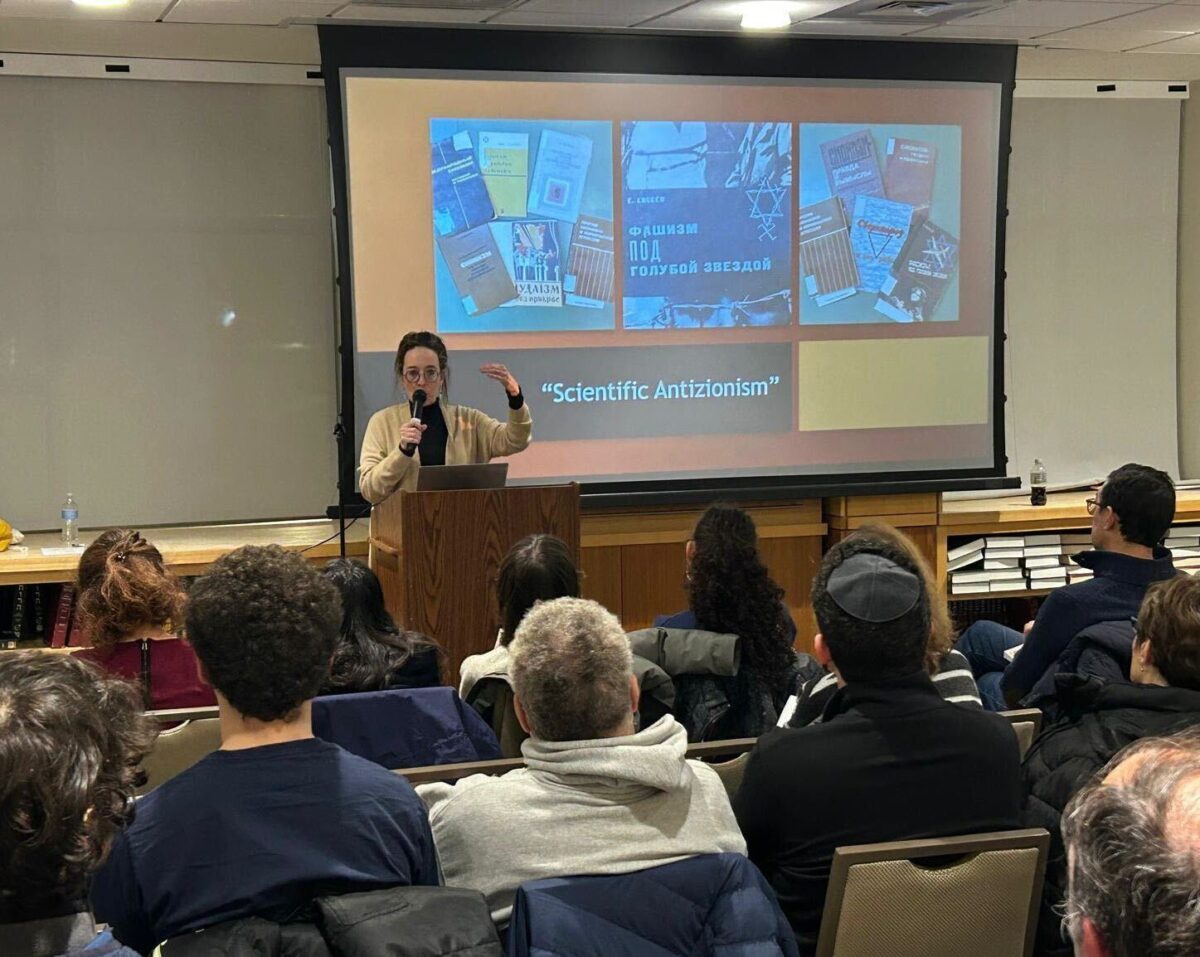
Izabella Tabarovsky speaking at a Be a Refusenik book talk in Needham, MA, organized by Jewish Alumni Strong and Association of Jewish Princeton Alumni. (Yelya Margolin)
Tabarovsky said that American Jews need to rebalance the narratives of Jewish victimhood and heroism, because victimhood has become too dominant.
“You read the horrible things refuseniks went through, but none of them talked about themselves as victims,” she said. “They felt like protagonists in their own story. They took responsibility; they took risks consciously. We need to think of ourselves in these terms, as well.”
Tabarovsky said she heard from many students who were told by large Jewish organizations to keep their heads down and try not to provoke or attract attention, or engage, and applauded those who did not take that advice.
To Jewish students, Tabarovsky suggests: “Reclaim your Zionism.”
“Build a community. Find other people like you. Re-empower yourself and think about your situation strategically,” she said. “The Jewish community has been improvising responses on the fly, while the other side is in the driver’s seat, creating all these propagandistic narratives. … We need to think strategically about how we need to organize ourselves.”
Once that happens, Tabarovsky said she is confident that Jewish students “will know how to act.” One example she cited was Lishi Baker, a rising senior at Columbia studying Middle East history, who she said saw American flags being defaced during anti-Israel protests at Columbia University and organized a counter-protest with American, not Israeli flags, to show that the protests are not only anti-Israel, but anti-American.
Tabarovsky called on students “to be more creative in the way they protest. The other side is doing all kinds of things to attract the media. The Soviet Jewry movement was so creative and knew how to attract attention.”
Adam Louis-Klein, an anthropology Ph.D. student at McGill University, told JI how he found himself launched into Zionist advocacy after Oct. 7

Courtesy
Adam Louis-Klein
Earlier this year, in the heavily saturated world of commentary about the Israeli-Palestinian conflict, a new name started to appear everywhere, though it seemed to come out of nowhere: Adam Louis-Klein, an anthropology Ph.D. student at McGill University. Until this past spring, he had hardly said anything about Israel publicly. He was too busy studying a remote Amazonian tribe.
But then Louis-Klein, 32, built a platform and started writing — first on Facebook and X; then in Times of Israel blog posts; on podcasts, including one from the American Jewish Committee, and a show hosted by the Israeli journalist Haviv Rettig Gur; and in articles published in The Free Press and Tablet.
Anywhere he could, Louis-Klein was making the bold claim that American Jews need to stop arguing about when anti-Zionism crosses a line into antisemitism. In fact, he thinks they need to give up on their efforts to convince people that anti-Zionism is an antisemitic movement.
His thesis — the idea he is trying to get out into the world everyday, alternating between attention-catching social media graphics designed to go viral and lengthy posts using the dense academic jargon of anthropology — is that anti-Zionism should be considered a hate movement, something that is worthy of condemnation on its own, regardless of whether it is deemed antisemitic or not.
“When someone’s marked as a Zionist, anti-Zionists treat those Zionists differently. They treat them in unequal ways. They advocate for violence, or they advocate for discriminating or boycotting them, or excluding them or purging them. Anti-Zionists stigmatize Zionists. They spread libels about Zionists. They call Zionists slurs,” Louis-Klein told Jewish Insider in an interview last week. “It’s its own way of discriminating, and it’s hiding in plain sight. It’s there for everyone to see.”
The perpetual fighting over whether anti-Zionism should be considered antisemitism misses the point, Louis-Klein said — and it might actually make things worse for Jews.
“You’re going to get this continual problem across the line of turning it into some endless debate over ‘is it really antisemitic or not?’” Louis-Klein stated. “This is something that fuels anti-Zionists, because they can tell the Jewish community is not clear and is not setting a clear boundary against anti-Zionism, and is saying, ‘Well, anti-Zionism may be legitimate,’ and so that’s leaving an open space.”
Louis-Klein is the last person who expected that he would be contributing to the highly contentious public discourse surrounding Zionism.
As a Jewish anthropology student, he chose to focus his studies on a tiny Amazonian tribe in the Colombian rainforest. He devoted his research to understanding the Desana people and their relationship to Christian missionaries. It was work that occasionally involved Jews, insofar as Jews, of course, appear in the Bible. Otherwise, though, Judaism did not factor heavily in Louis-Klein’s academic research — and Israel even less so.
The Jewish state was a topic to be avoided if you were a budding anthropologist with an eye toward a successful career in academia, and Louis-Klein was quickly progressing down that path. He earned a bachelor’s degree at Yale and master’s degrees at The New School and the University of Chicago before enrolling at McGill.
He had visited Israel with his family when he was in college, but later drifted away from feeling connected to the country when he became a self-described “radical leftist” after graduating. But Louis-Klein didn’t entirely abandon Israel. And when he walked out of the Amazon on Oct. 9, 2023, after three months living with the Desana tribe, he quickly discovered that the world had changed two days earlier, when Hamas attacked Israel.
“Am Yisrael Chai,” Louis-Klein wrote on social media, unknowingly drawing a line that split his life as an academic into a before and after. His peers were shocked that he was not using the opportunity to distance himself from Israel.
“I’d never witnessed anything like this in my life. Just the way in which people were talking to me was something I’d never seen before. The aggression, the hostility, the gaslighting from people I thought were my friends,” Louis-Klein said. “I was removed from WhatsApp groups. I was bullied, people just being like, ‘Shut up, you’re white,’ kind of thing. I mean, it’s not a story that’s uncommon. now. There are so many Jewish students at universities who’ve experienced this.”
What came next for Louis-Klein was a newfound connection to his Jewish identity and to Israel. But the identity crisis also brought about an intellectual shift, too, one in which Louis-Klein decided that he could use his academic background to investigate the roots of the hatred he was experiencing. His dissertation is now more of a comparative project, looking at both the Desana people and the Jewish people. He has already experienced pushback from colleagues.
“The reaction is obviously extremely negative, and I don’t have any expectations of being able to have an official career within anthropology, but so far, I expect to be able to complete my dissertation,” Louis-Klein said. “Trying to make Jewishness visible, trying to make the experience of antisemitism or anti-Jewish oppression and discrimination visible, was perceived as violent and aggressive to others.”
Louis-Klein founded an organization this fall called Movement Against Anti-Zionism to put forth a more organized push for his message that a stronger campaign against anti-Zionism is needed to make life better for American Jews.
Alongside more than 1,000 health-care professionals, the organization signed onto an open letter last week decrying the reach of anti-Zionist ideology in the medical field. Louis-Klein told JI he wants to see legacy Jewish organizations like the Anti-Defamation League “launch a full-scale campaign against anti-Zionism.”
“Educate about anti-Zionist libels as their own libels and tropes. They are the ‘colonizer,’ ‘apartheid’ and ‘genocide’ libels. They’re used to stigmatize and attack Jews who are marked as Zionists,” he explained. His social media accounts attempt to make these points in the snappy, bright graphics that are now the touchstone of social media activism.
“Antizionism is a hate movement,” one faded pink image says, meant to be liked and shared for an audience that will scroll past it in no more than a second or two.
“If someone is an anti-Israeli racist, let’s put it this way: they hate Israelis for their national identity. That’s clearly a bigotry. And if someone else says, ‘Well, they don’t hate all Jews, it’s not antisemitic.’ … That’s basically a way of legitimizing anti-Israeli racism,” Louis-Klein explained. “The need to prove that something is antisemitic [in order] to prove that it’s bad is a way of legitimizing a bunch of racism.”
Even with a ceasefire in effect in Gaza, Louis-Klein does not anticipate university campuses to go back to business as usual from before Oct. 7.
“What we can do is recognize the historical moment we’re living in and recognize that the only way out is through, so to speak,” he said. “We have to talk about anti-Zionism.”
The report calls for more ideological diversity among faculty, while recommending a balance between free expression and preventing discrimination
Spencer Platt/Getty Images
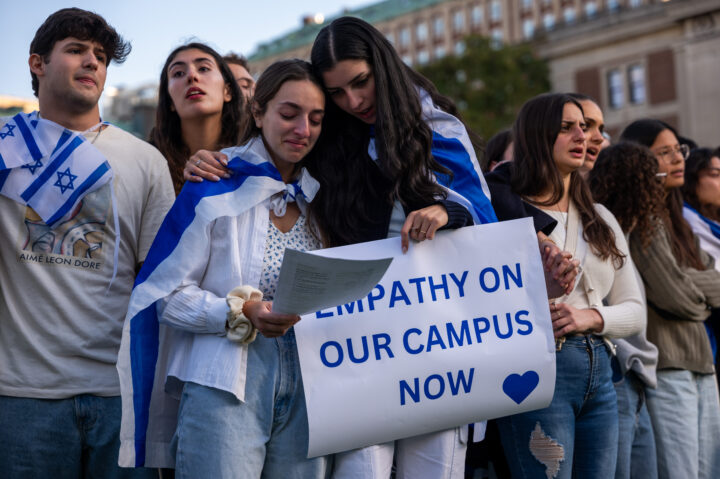
Columbia students participate in a rally and vigil in support of Israel in response to a neighboring student rally in support of the Palestinians at the university on October 12, 2023 in New York City.
The Columbia University task force overseeing efforts to combat antisemitism on campus released its fourth and final report on Tuesday, spotlighting Columbia’s lack of full-time Middle East faculty who are not explicitly anti-Zionist.
According to the report, “Columbia lacks full-time tenure line faculty expertise in Middle East history, politics, political economy and policy that is not explicitly anti-Zionist.” The absence of ideological diversity is having an impact on course offerings — in listening sessions, the task force said it heard from students that classes at the university more often than not treat Zionism as entirely illegitimate.
The report calls on the university to “work quickly to add more intellectual diversity to these offerings” and to “establish new chairs at a senior level in Middle East history, politics, political economy and policy.”
Furthermore, it claims that “academic resources available for teaching and research on Jewish and Israeli topics at Columbia are insufficient, especially in comparison to the resources available for teaching and research on other parts of the Middle East. The University should work quickly and energetically to build up its capabilities here, through academically first-rate full time tenure line additions to the faculty and the curriculum.”
The report also cites numerous instances in which the academic freedom of Jewish and Israeli students was not protected in classrooms and suggests remedies — while trying to find a delicate balance between allowing for free expression and cracking down on discrimination.
“We urge the University to protect freedom of expression to the maximum extent possible while also complying with antidiscrimination laws,” states the report, titled The Classroom Experience at Columbia: Protecting the Academic Freedom of Faculty and Students. “Censorship has no place at Columbia. Neither does discrimination.”
Columbia University Acting President Claire Shipman said in a statement on Tuesday that the university will “continue to work on implementing the recommendations of the task force and addressing antisemitism on our campus.”
“We have also been working this semester to focus on discrimination and hate more broadly on our campuses — which has long been a strong recommendation of the task force. All of this work must become part of our DNA,” said Shipman.
Columbia’s Task Force to Combat Antisemitism was formed in November 2023 as a response to a surge of antisemitism on campus that began as an immediate response to the Oct. 7, 2023, terrorist attacks in Israel. Throughout the following two years of war in Gaza, scenes of masked anti-Israel protesters barging into classrooms and hourslong demonstrations in the center of campus calling for an “intifada revolution” became commonplace at Columbia, which has faced some of the worst antisemitic incidents of any college campus since Oct. 7.
The new report is the first one released since Columbia reached a deal with the Trump administration in July to restore some $400 million in federal funding.
The funding was frozen by the government in March due to the university’s record dealing with antisemitism. The campus has seen less turbulence since the deal was struck and reforms aimed at combating antisemitism — some based on the task force’s earlier recommendations — were announced over the summer.
The 13-member task force, which is led by by Ester Fuchs, professor of international and public affairs and political science; Nicholas Lemann, professor of journalism and dean emeritus of Columbia Journalism School; and David Schizer, professor of law and economics and dean emeritus of Columbia Law School, suggested a range of free expression and anti-discrimination policies that Columbia could adopt.
Among the recommendations are that the university disclose, before students enroll in a course, if the material has the potential to cause students to feel excluded or silenced. If students are not aware in advance, or if it is a required course, and a controversial topic — such as the Middle East — is not the stated topic, “it’s not appropriate to make it a central part of the course,” the report states.
The authors write that academic freedom “entails openness to scholars and students from other countries.” As such, the report states that boycotts of faculty, students, researchers or scholars from other countries “are not consistent with academic freedom.” The academic boycott movement consistently targets Israel, “proposing to restrict the research, teaching, and studying opportunities available to a cohort whose members are overwhelmingly Jewish,” the report continues. Student protesters at Columbia have frequently demanded that the university end its partnership with Tel Aviv University.
In addition, the task force calls for consistency across all university anti-discrimination policies to include Jewish and Israeli students and for applying anti-discrimination policies in regards to classroom disruptions targeting students or instructors for their identity in a protected class.
The latest report builds upon a series of earlier ones released by the antisemitism task force in March 2024, August 2024 and June 2025, each offering solutions to a different key issue impacting Jewish students at the Ivy League university. Each report was based in part on two dozen listening sessions the task force conducted with hundreds of Jewish and Israeli students at Columbia.
The 70-page fourth and final report includes recommendations from the three prior reports and recaps several of the most egregious incidents of antisemitism in the classroom at Columbia since Oct. 7. Those include reports of several instructors encouraging their students, during class, to participate in the 2023-24 academic year’s anti-Israel protests. Some professors held their classes or office hours within anti-Israel encampments (where in several cases it was indicated Zionists were not welcome).
Editor’s note: After publication, Columbia’s Task Force to Combat Antisemitism updated language in the report to read: “Columbia would benefit from full-time tenure line faculty expertise in Middle East history, politics, political economy and policy that is not explicitly anti-Zionist.”
The survey found 64% of young conservatives ages 18-34 agreed with at least one antisemitic statement
Genaro Molina/Los Angeles Times via Getty Images
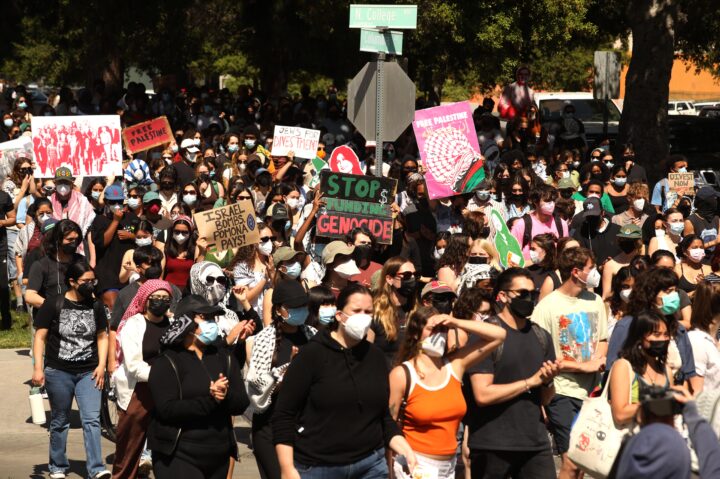
Pomona College students march to Alexander Hall where 20 students were arrested during a sit-in at on Pomona Campus in Claremont on April 11, 2024.
Younger voters hold overwhelmingly more critical views of Israel and of the Jewish people than older generations, a new survey finds in keeping with other recent research on the issue, with antisemitic beliefs strongest among the most conservative cohort.
The Yale Youth Poll, an undergraduate-led research group based at Yale University, surveyed over 3,400 American voters for their views on Israel, Zionism and antisemitism between Oct. 29-Nov. 11, with over half of respondents under the age of 35.
On a basic assessment of whether the American Jewish community has had a positive or negative impact on the United States, over half (54%) of all respondents answered positive, while the same was true of only around a third (35%) of 18-22-year-olds.
In a list of antisemitic statements — including “Jews in the United States are more loyal to Israel than to America,” “It’s appropriate to boycott Jewish American-owned businesses to protest the war in Gaza” and “Jews in the United States have too much power” — 70% of respondents overall disagreed with all three; however, only 57% of 18-22-year-olds and 60% of 23-29-year-olds said the same.
Among those ages 18-34 who self-identified in their responses as “extremely conservative,” a sizeable majority of 64% said they agreed with at least one of the listed statements, far more than any other subgroup of younger voters — 38% of 18-34-year-olds overall said the same, already a notable minority.
Younger people also had overwhelmingly negative views of Zionism: Given a list of possible definitions of the ideology, respondents overall most commonly identified the “positive” definitions, including “self-determination and statehood for the Jewish people,” “the continued existence of Israel in the face of calls for its destruction” and the Jewish people having an equal “right to statehood,” as accurate.
Among voters ages 18-22, however, the most commonly selected definitions described Zionism as “maintaining a Jewish demographic majority in Palestine by driving out the native Palestinian population,” (36% vs. 17% of all respondents), creating “a nation-state where Jews get more rights than others,” (33% vs. 15% overall) and “a form of racism and apartheid against Palestinians” (31% vs. 13% overall). Fifteen percent of respondents under 30 said they believe that Israel should not exist, compared to 5% overall.
The younger cohort’s view of what qualifies as antisemitism was also distinct — asked if comparing the Israeli government’s policies to the Nazis constitutes a form of anti-Jewish prejudice, 46% of 18-34-year-olds said no, compared to 28% of respondents overall. Seventeen percent of younger voters said they did not believe use of the phrase “globalize the intifada” was antisemitic, compared to 12% overall, and 67% said calling the war in Gaza a genocide did not constitute antisemitism, compared to 47% overall.
Nearly half (46%) of 18-22-year-olds think the U.S. should cut off all military aid to Israel compared to 23% of all respondents. This hostility to Israel, as with most of the survey’s findings, decreased with age to only 13% of respondents aged 65 and older.
The letter argues that anti-Israel extremism has become systemic in leading medical institutions

Michael M. Santiago/Getty Images
People watch as Pro-Palestinian activists gather for a rally in solidarity with Hesen Jabr in front of Tisch Hospital at NYU Langone Health on June 14, 2024 in New York City.
Jewish medical practitioners have faced “two years of near-constant abuse and a far longer erosion of professional norms,” according to an open letter published this week decrying the reach of anti-Zionist ideology in the medical field.
More than 1,000 health-care professionals signed onto the letter, the latest of several similar attempts by Jewish doctors, therapists and nurses to garner attention about the exclusion and harassment that many say they have faced in their fields since the Oct. 7 terror attacks in Israel two years ago.
But in this latest missive, its authors and signatories allege that anti-Zionism is a problem unto itself in the medical field — an argument that comes as many people who face accusations of antisemitism defend themselves by saying they are merely opposed to Israel, and not to Jews. The letter marks a rhetorical shift by medical professionals that reflects a broader set of concerns about the influence of anti-Israel ideas in medicine. Anti-Zionism, the letter’s authors write, presents a risk not just to Jewish patients but to the medical field’s integrity.
“Our purpose is to document and expose the pattern by which anti-Zionism has instrumentalized medicine and health, abroad and at home, endangering patients and corroding the ethics of medicine itself,” the letter states. “We must therefore recognize the growing presence of anti-Zionist ideology in contemporary healthcare as an urgent threat.”
Anti-Zionism is just the latest incarnation of thousands of years of antisemitism, according to the letter’s signatories. They trace the arc of antisemitism’s evolution from Christian blood libels about Jews purportedly killing Jesus to Nazi eugenics and, ultimately, to anti-Zionism.
“In the twentieth century, anti-Zionists reconfigured these libels around Israel, the ‘Jew among nations,’” the letter’s writers declare. “Today, anti-Zionism deploys contemporary libels — ‘colonizer,’ ‘apartheid agent,’ ‘genocidaire,’ ‘Zionazi’ — while reproducing the same libel-cycle of earlier eras.”
The letter’s signatories write that American medical institutions are accommodating of anti-Zionist professionals and their influence in the field in a way they might not if the antisemitism exhibited by practitioners had nothing to do with Israel.
“In medicine, institutions both tolerate anti-Zionist rhetoric and permit its operationalization in clinical settings, professional training and organizational policy,” the letter states.
Anti-Israel rhetoric has become widespread at medical schools, showing up in public health trainings and curricula about diversity, equity and inclusion. Since Oct. 7, anti-Israel protesters have demonstrated outside of hospitals in San Francisco, Toronto and New York. Some medical residents have called for boycotts of Israeli institutions.
The new letter calls on institutions including medical schools and professional associations to recognize anti-Zionism “as a form of anti-Jewish hate … and embed this standard into medical and health professions education, DEI programs and professional ethics.” It also urges hospitals and medical offices to “enforce clinical neutrality by banning political insignia in care spaces,” and to better train practitioners to identify anti-Zionism.
“Left unchecked, [anti-Zionism] will corrode ethics and evidence, endanger patients and erode public trust in healthcare,” according to the letter’s signatories. “Name this hatred, educate your institutions and prevent medicine, public health and healthcare from once again becoming a conduit for bigotry, purges and violence.”
The manifesto, by masked individuals who disrupted an Oct. 7 commemoration event, called Zionism ‘a death cult that must be dealt with accordingly’
Genaro Molina/Los Angeles Times via Getty Images
Pomona College students march to Alexander Hall where 20 students were arrested during a sit-in at on Pomona Campus in Claremont on April 11, 2024.
An anonymous manifesto was sent on Wednesday to two Pomona College student-run newspapers by demonstrators who recently stormed a campus vigil for the second anniversary of Hamas’ Oct. 7, 2023, terrorist attacks. The emailed manifesto states that “Zionism is a death cult that must be dealt with accordingly.”
It was sent days after an on-campus event commemorating the Oct. 7 anniversary was disrupted by four masked and keffiyah-clad individuals who barged in chanting “Zionists not welcome here.” The memorial, sponsored by Hillel in a university building and scheduled on the Hebrew calendar anniversary of the attacks, featured a talk by Yoni Viloga, who survived the attack on his family’s home in Kibbutz Mefalsim.
The disruption, which also included chants of “Zionism is still a colonial ideology” and “You’re all complicit in genocide,” lasted about two minutes, until campus safety officers arrived.
The perpetrators of last week’s demonstration wrote in the manifesto that “Viloga served in the zionist occupational forces and is a settler on stolen land. Knowing this, we had to act.”
The communiqué included several antisemitic and threatening statements, such as, “this moment demands … making modern-nazis feel unwelcome, not just from these college campuses, but everywhere,” and said about the event that “Claremont Hillel and every single zionist in that room advance the genocide.”
A Pomona spokesperson told Jewish Insider, “The language we saw today is vile, threatening and highly disturbing. It has no place on our campus.”
The university responded to last week’s disruption by opening an investigation the following day. The spokesperson said about the incident that the university has “every intention of getting to the bottom of what happened. As part of this investigation, we are examining our security protocols, and reviewing security and other kinds of footage, with the intention of identifying and disciplining the individuals involved.”
While the liberal arts college in Claremont, Calif., has faced several anti-Israel demonstrations since the Oct. 7 attacks, last week’s protest was the first to occur in an expressly Jewish space on campus. It also came days after Israel and Hamas agreed to a ceasefire and hostage-release deal.
Spanberger: ‘One can and must denounce these tragedies without using antisemitic language, whether intentional or not’
Win McNamee/Getty Images
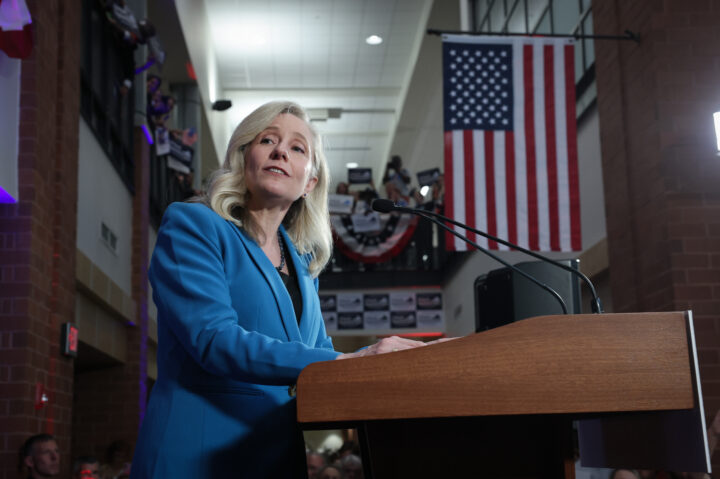
Virginia Democratic gubernatorial candidate, former Rep. Abigail Spanberger speaks to supporters during a rally on June 16, 2025 in Henrico County, Virginia.
Facing pressure from the Virginia Jewish community to speak out against recent anti-Zionist social media posts from state Del. Sam Rasoul, former Rep. Abigail Spanberger, the Democratic gubernatorial nominee, addressed concerns about antisemitism without specifically referencing Rasoul.
“This war continues to unleash heartbreak and tragedy as we witness civilian deaths, starving families, and hostages still held by Hamas. These horrors rightly compel so many to advocate for the mass delivery of aid, the release of all Israeli hostages, and a ceasefire between Hamas and Israel,” Spanberger told the Virginia Scope, a political newsletter, in response to a question about Rasoul, who chairs the Education Committee in the House of Delegates. “However, one can and must denounce these tragedies without using antisemitic language, whether intentional or not.”
She did not specify whether she identified Rasoul’s rhetoric as antisemitic. Spanberger’s campaign did not respond to multiple requests for comment from Jewish Insider.
Rasoul, a Palestinian-American legislator who represents Roanoke, has in recent weeks taken to social media to call Zionism “evil” and said that it is “making the world less safe for my Jewish friends.”
In her statement to the Virginia Scope, Spanberger acknowledged the recent rise of antisemitic violence in America.
“Just recently, antisemitic language led to attacks on peaceful protestors in Colorado and the murder of two Israeli Embassy staff members — as well as a growing, pervasive sentiment of fear among our Jewish neighbors. We must recognize our shared commitment to peace and work to rebuild trust in our communities,” she said.
Rasoul’s rhetoric has drawn criticism from some other Virginia Democrats, including former House Speaker Eileen Filler-Corn and Sen. Tim Kaine (D-VA), who told JI this week that he “forcefully reject[s] any claim that Zionism — the desire of Jewish people to have a state of Israel — is inherently racist or evil.”
State Sen. Schuyler VanValkenbuerg, a Democrat from the Richmond area, echoed Kaine’s sentiments.
“The current Israeli government deserves condemnation for its actions in Gaza. But the claim that Zionism is inherently evil deserves to be forcefully rejected. It’s wrong and it’s dangerous,” VanValkenburg posted on X on Thursday.
The group’s annual conference, being held in August, features a panel that describes the Oct. 7 Hamas terrorism as attacks on ‘military targets’
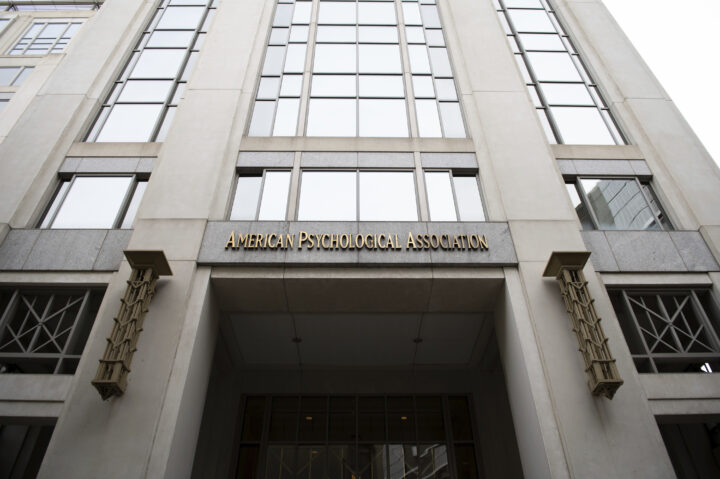
Graeme Sloan/Sipa via AP Images
A general view of the American Psychological Association headquarters in Washington, D.C. on April 23, 2020.
In late February, Dr. Julie Ancis drafted an open letter with a group called Psychologists Against Antisemitism, condemning antisemitism within the American Psychological Association. More than 3,500 people signed on to demand the organization act against what they described as “the serious and systemic problem of antisemitism/anti-Jewish hate” within the APA. With 172,000 members, it is the largest body dedicated to the study of psychology in the world.
For months, the organization appeared to do nothing. Ancis did not even get an acknowledgement that the letter had been received. But then in May, after she and another Jewish colleague raised their concerns in a meeting with Rep. Ritchie Torres (D-NY), Ancis received an invitation from senior APA officials to discuss antisemitism.
The meeting was ostensibly meant as an olive branch from the organization where she had once been a prominent member: In 2010, a division of the APA named Ancis, a distinguished professor at New Jersey Institute of Technology and one of the pioneers of the psychology field’s approach to diversity, equity and inclusion, its Woman of the Year.
Yet when Ancis looked at the list of stakeholders invited to the Zoom meeting, she was astonished to see the names of several APA groups that she considered the biggest perpetrators of antisemitism within the APA. Later, she learned that the list of invited “stakeholders” included Dr. Lara Sheehi, the president of an APA division focused on the study of psychoanalysis, who was called out in the open letter for describing Zionists as “genocidal f**ks.” (Sheehi, who left a teaching position at The George Washington University in 2024 after being accused of antisemitic conduct by some of her students, recently appeared on a podcast to defend the tactics of the man accused of shooting and killing two Israeli Embassy staffers outside the Capital Jewish Museum in Washington in May. She did not respond to a request for comment.)
“The stakeholders should include people who have expertise, not the ones who are promoting antisemitism, where we’re tokenized. It’s an absolute lose-lose situation, and hostile,” Ancis said last week. She decided not to attend. “I’m not going to sit in that farce of a meeting.”
That the APA would host a meeting about addressing antisemitism where the “stakeholders” included both Jews who have scrupulously documented harassment and bias within the organization’s ranks for months, as well as some of the people they identified as the perpetrators of that harassment, is, according to Jewish psychologists, evidence of how this historic organization has lost its way and ceded its moral voice.
“Could you imagine APA having a listening session for LGBTQ+ individuals, which includes people who are known to be homophobic?” asked Dr. David Rosmarin, director of the Spirituality and Mental Health Program at McLean Hospital in Massachusetts and a Harvard Medical School professor. “They want everyone to be included, and all that kind of stuff. What that means is that there’s no room for Jews, because they’re including people who are engaged in antisemitic, anti-Zionist rhetoric, publicly, in the discussions.”
“They’re between a rock and a hard place. They’re trying to appease different constituents, and I feel like they’re appeasing the ones who are loudest and bigger, and that’s not the Jewish professionals,” Dr. Julie Ancis told JI.
Several leading Jewish psychologists told Jewish Insider in interviews last week that the APA has repeatedly failed to respond to the concerns of its Jewish members, despite a stated commitment to promoting an “accessible, equitable and inclusive psychology that promotes human rights, fairness and dignity for all,” according to the organization’s diversity mission. They say the APA has avoided taking a stand against double standards and litmus tests applied to Jewish psychologists who are vilified for their support for Israel.
Instead, the organization has been almost paralyzed in the aftermath of the Oct. 7, 2023, Hamas terror attacks and ensuing war, seemingly afraid to take sides between the Jewish psychologists seeking support and an increasingly vocal contingent of anti-Israel voices in the field, some of whom have described Zionism as a pathology to root out.
“They’re between a rock and a hard place. They’re trying to appease different constituents, and I feel like they’re appeasing the ones who are loudest and bigger, and that’s not the Jewish professionals,” Ancis told JI.
The APA is the key body shaping the education of psychologists in the United States. It accredits masters- and doctorate-level academic programs at hundreds of universities across the country. So while the battle over antisemitism in this organization may seem like an internecine ivory tower fight, the way it is handled is poised to have major implications for the future of psychology — a field that touches the millions of Americans who see a therapist, and whose research shapes the way we understand each other and ourselves.
*****
Concerns about antisemitism in psychology have followed the APA since soon after Oct. 7, when the Association of Jewish Psychologists chided the organization for issuing only a tepid statement about the Hamas attacks. “We … are deeply disappointed and terribly saddened that our professional association could not more forcefully and unequivocally condemn the horrific acts of barbarism against the Jewish people of the State of Israel,” they wrote at the time.
The issue has become a flashpoint again this year in the run-up to the APA’s flagship annual conference, which will be held next month in Denver.
Among the events at next month’s gathering, which is expected to draw several thousand people, is a “critical conversation” called “truth-telling as resistance” focused on understanding the 2024 encampments amid “a global and national effort to distort realities about Palestine and the encampments.”
At a symposium about “resisting anti-Palestinian racism,” psychologists can earn continuing education credit for attending a talk that will discuss “advocacy and actions to resist anti-Palestinian racism” that are “erroneously framed as antisemitism.” Another symposium, focused on mental health during wartime in Gaza and Lebanon, features a talk by a presenter who describes the Oct. 7 terror attacks that killed more than 1,200 people as attacks on “military targets” in Israel.
“What concerns me most are the psychologists who are maybe not Jewish or maybe not aware of these concerns in the Jewish community, who attend these talks with what I consider to be antisemitic rhetoric, and accept and internalize the ideas and rhetoric as true,” said Dr. Caroline Kaufman, a post-doctoral fellow at McLean Hospital. She will be speaking at a symposium about antisemitism, which also offers continuing education credit. “When they treat Jewish clients, or they have Jewish colleagues, or they conduct research, those ideas continue into those endeavors. That is extremely concerning to me.”
Rosmarin, a colleague of Kaufman’s at McLean, put a baseball hat over his yarmulke at last year’s APA convention in Seattle because it didn’t feel like a “safe space,” he said. He worries the organization does not understand the scope of the problem. “This is like a cancer that’s spread throughout the organization,” said Rosmarin, who is also the president of the APA Society for the Psychology of Religion and Spirituality.
*****
The term “gaslighting” — a form of emotional abuse in which one person falsely and repeatedly tells another person that their experience of reality is untrue — has become so popular in recent years that it was named Merriam-Webster’s word of the year in 2022. A growing body of psychological research is devoted to studying the concept, which the APA defines as “manipulat[ing] another person into doubting their perceptions, experiences or understanding of events.”
Given psychology’s deepening understanding of gaslighting, it was particularly ironic that following the APA’s antisemitism meeting, which occurred last Thursday, an email discussion broke out in which several psychologists attempted to invalidate and refute the concerns their Jewish colleagues raised about antisemitism. (The email thread was viewed by JI.)
One psychologist referred to the substance of the Zoom call as “propaganda” and said he would denounce only “actual antisemitism.” Dr. Karen Suyemoto, who chaired the APA’s task force that developed guidelines for addressing race and ethnicity in psychology, agreed.
She called it “imperative” that “actual antisemitism” be addressed, because “the continuing confounding creates barriers to allies and accomplices who do not have [a] nuanced understanding.” (Suyemoto, a University of Massachusetts professor, declined to comment to JI. She was the guest editor of a recent special issue of the APA’s flagship journal that focused on “practicing decolonial and liberation psychologies,” which the Anti-Defamation League, Academic Engagement Network and Psychologists Against Antisemitism criticized in a Tuesday letter as “ethically compromised and biased.”)
To Jewish psychologists, the skepticism from professionals who claim to listen to marginalized communities did not add up.
“We take identity very seriously. We realize that it intersects with both risk and protective factors,” said Kaufman. “That’s a given in our field, and APA seems willing to recognize that for several identities or groups. But it’s seemingly unwilling to address such concerns for the Jewish community. I can’t understand why.”
In 2007, the APA adopted a resolution on antisemitic and anti-Jewish prejudice that detailed modern manifestations of antisemitism alongside a commitment to being a leader in fighting it. (The resolution had the foresight to note that 21st-century antisemitism “may be more difficult for its perpetrators to identify and challenge, as their beliefs about themselves may be that they are not biased against Jews.”)
But since Oct. 7, a vocal group of APA members has been encouraging the organization to revisit this resolution because of its assertion that antisemitism can arise in the context of criticism of Israel. An activist group called Psychologists for Justice in Palestine drafted a petition last year calling on the APA to “refute” that part of the resolution — and instead admit that it is actually “discriminatory” to refer to anti-Zionism as a form of antisemitism.
“With the removal of the claim that criticism of Israel can become antisemitic, it would open psychologists to even more experiences of antisemitism and even more antisemitic aggression, by which Jewish and Israeli psychologists can be excluded, denigrated and denied for reasons that are presumably having to do with Israel, but, from my perspective, are really just antisemitism,” warned Dr. Caroline Kaufman, a post-doctoral fellow at McLean Hospital.
The petition was endorsed by several APA affiliates, including the Asian American Psychological Association; the American Arab, Middle Eastern and North African Psychological Association (AMENA-Psy); and the Society for the Psychology of Women. AMENA-Psy — one of six official APA ethnic associations — declared just four days after the Oct. 7 attacks that the group stands “in full solidarity with our Palestinian siblings in their decolonial struggle for justice.”
The APA ceded to the groups’ demands and agreed to reopen the debate about the 2007 resolution. The APA’s board of directors even created a task force to update the resolution. But the effort was shelved in March, as internal criticism of the organization’s handling of antisemitism began to mount.
“With the removal of the claim that criticism of Israel can become antisemitic, it would open psychologists to even more experiences of antisemitism and even more antisemitic aggression, by which Jewish and Israeli psychologists can be excluded, denigrated and denied for reasons that are presumably having to do with Israel, but, from my perspective, are really just antisemitism,” warned Kaufman.
*****
The solutions that Jewish psychologists seek require a long-term commitment from the APA that they aren’t confident they will receive, although the organization’s leaders stated on last week’s call that they do want to do more to combat antisemitism.
The concerned Jewish members want stronger monitoring on APA-affiliated email servers, which have been used by some APA members to promote boycotts against Israel and, occasionally, to defend Hamas. (An APA spokesperson told JI that “enhanced oversight is now in place to ensure respectful discourse and timely response to violations.”) They are also seeking more stringent oversight of the panels at the summer conference.
“They still struggle to really make a determination as to whether or not anti-Zionism is antisemitism, and so I surmise that people could say some things that would be very hurtful to large swaths of the professional community, and it would be considered acceptable within the new and refined listserv guidelines,” Fordham psychology professor Dr. Dean McKay told JI after last week’s antisemitism Zoom. “That’s one of those places where I don’t think they really know what to do.”
The APA frequently invokes bureaucratic red tape in response to these concerns by asserting that the 54 divisions that fall under the APA umbrella — on topics including developmental psychology, clinical psychology and pediatric psychology — operate autonomously, allowing the APA to claim immunity from the most egregious issues.
“APA’s 54 divisions operate autonomously with their own governance structures,” Kim Mills, the APA’s senior director for strategic external communications and public affairs, told JI in a statement. “Each of them program convention sessions that their leaders believe best represent the concerns of their division and will foster academic discourse on a variety of psychology topics.”
Mills asserted that the APA “unequivocally condemns antisemitism in all its forms and acknowledges the climate of fear such prejudice creates,” and said the organization is “committed to fostering an environment where members of all identities can contribute fully, safely and without discrimination.”
Jewish psychologists are waiting to see if that commitment passes the stress test, but they are not confident. Because while they see general proclamations about the ills of antisemitism as helpful, the true measure of whether the APA is serious about taking on the problem is whether the organization is willing to call out the most extreme members in its ranks, some of whom hold high-profile leadership positions. Doing so would require the APA to wade into the fraught conversation about whether the tactics of anti-Zionist activists can cross a line into antisemitism. It is clear the APA wants to avoid doing that.
“They still struggle to really make a determination as to whether or not anti-Zionism is antisemitism, and so I surmise that people could say some things that would be very hurtful to large swaths of the professional community, and it would be considered acceptable within the new and refined listserv guidelines,” Fordham psychology professor Dr. Dean McKay told JI after last week’s antisemitism Zoom. “That’s one of those places where I don’t think they really know what to do.”
The APA’s diversity webpage features a large section dedicated to explaining antisemitism. However, it does not mention Israel, Hamas or the post-Oct. 7 spike in antisemitism. Nor did Mills refer to Israel or Zionism in a lengthy statement she sent JI last week outlining the organization’s pledge to fight antisemitism. In fact, she ignored a question about Jewish psychologists who feel they have been targeted for being Zionists.
*****
The Jewish psychologists raising concerns about antisemitism in their field know that doing so entails a risk. They worry about the silencing effect on younger Jewish psychologists who are still finding their footing in the field, which is already in a precarious situation amid federal funding cuts to scientific and medical research.
“I’m protected. I’m already mid-career,” said Rosmarin, the Harvard Medical school professor. “I’m animated about this because I care about the next generation.”
Ancis, who spearheaded the open letter to the APA, quit the organization three years ago. She is far enough along in her career to not worry about facing backlash for supporting Israel and speaking out against antisemitism. But she worries about younger people in the field.
“A person coming up trying to get tenure in an APA-accredited program and identifying as a Zionist, I think it’d be extremely difficult,” Ancis said.
Kaufman only completed her Ph.D. four years ago, and she is at the beginning of what she hopes is a career in academia. She has the right credentials: a postdoctoral position at Harvard, an internship at Yale, a speaking slot at a symposium at next month’s APA conference. But she worries that won’t be enough to shield her.
“I have very deep and sincere concerns that my involvement in these issues related to antisemitism will negatively impact the opportunities available to me and my career,” Kaufman told JI. “I hold that truth or that fear in one hand. The other truth in my other hand is that I have a responsibility as a Jewish psychologist to raise my voice and become involved in this issue. There’s truly no other path for me, even if, and I think there will be, serious consequences.”
Torres said the organization is ‘permissive of content that traffics in malicious falsehoods against Zionism, Israel, and the Jewish community’

Al Drago-Pool/Getty Images
Rep. Ritchie Torres, a Democrat from New York, speaks at a House Financial Services Committee hearing on oversight of the Treasury Department and Federal Reserve coronavirus pandemic response on Capitol Hillon September 30, 2021 in Washington, DC.
Concerned with a “persistent and pernicious pattern of antisemitism” at the American Psychological Association, the preeminent professional organization for American psychologists, Rep. Ritchie Torres (D-NY) is urging the body’s leadership to investigate antisemitism within its ranks and better respond to the concerns of Jewish members.
“I have spoken directly with whistleblowers — many of them longtime APA members — who accuse the organization of enabling a hostile environment,” Torres wrote in a letter, obtained by Jewish Insider, that he sent to the APA’s president and president-elect on Wednesday. “These incidents collectively suggest that the APA has not only been dismissive of the legitimate grievances of Jewish psychologists but also permissive of content that traffics in malicious falsehoods against Zionism, Israel, and the Jewish community.”
Torres’ letter comes as the mental health field grapples with an antisemitism problem that has grown more acute after the Oct. 7, 2023, Hamas attacks on Israel. The Association of Jewish Psychologists said in 2023 that it was “deeply disappointed and terribly saddened” by the APA’s actions in the aftermath of Oct. 7.
Torres reported that Jewish and pro-Israel psychologists have been harassed on APA-sponsored listservs, including one email with the phrase “kudos to Hamas,” according to conversations he had with APA members, and that divisions within the organization have “issued politicized and inflammatory statements” accusing Israel of genocide, while “suppressing dissenting academic voices.”
Torres urged the APA to conduct an independent investigation into antisemitism across its affiliated divisions and listservs; to reform accreditation of continuing education programs “to ensure the APA is not lending institutional legitimacy to bigotry”; to enforce “clear standards for respectful discourse,” including “protections for Zionist Jews”; and to make sure that Jews are represented as the APA works to address antisemitism.
“The APA’s legitimacy as a scientific and professional institution is at stake,” Torres wrote, if the body does not take action.
A spokesperson for the APA confirmed that the organization received the letter and that they will reach out to Torres to discuss it.
“In the meantime, I can assure you that the American Psychological Association is categorically not an antisemitic organization,” Kim Mills, APA’s senior director for strategic external communications and public affairs, said.
Please log in if you already have a subscription, or subscribe to access the latest updates.
 Continue with Google
 Continue with Apple