




















The Israeli prime minister called the focus on settler violence an ‘obsession’ and declared that Israel ‘prevented genocide’
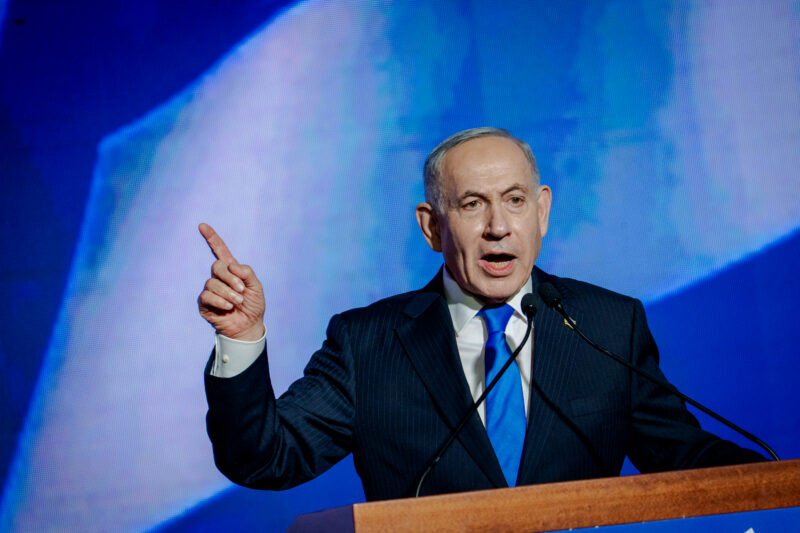
Alexi J. Rosenfeld/Getty Images
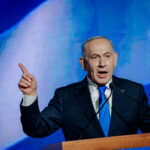
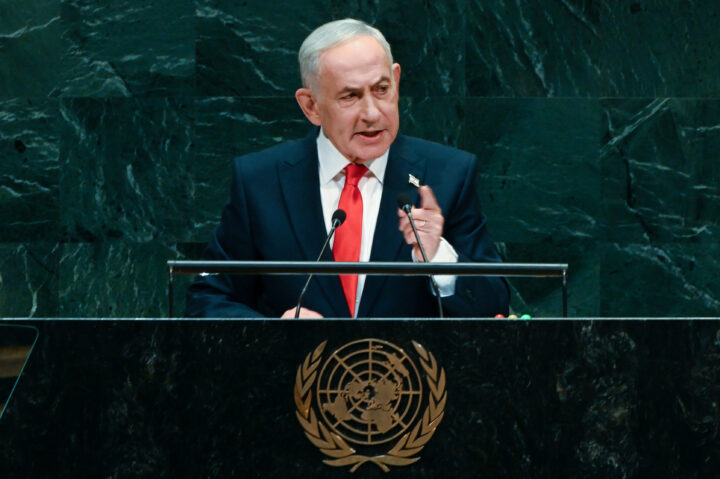
Israeli Prime Minister Benjamin Netanyahu speaks during the 81st session of the United Nations General Assembly at U.N. Headquarters on September 24, 2026 in New York City.


 Add JewishInsider on Google
Israeli Prime Minister Benjamin Netanyahu pushed back against criticism of Israel over Gaza and the West Bank in his address to the United Nations General Assembly on Thursday, taking aim at New York City Mayor Zohran Mamdani, French President Emmanuel Macron, Qatar and Turkey.
After most of the hall conducted a walkout at the outset of his speech, Netanyahu condemned violence by Israeli settlers while dismissing the international focus on settler violence as an “obsession.” He said roughly 150 young Israelis were responsible for throwing stones, destroying olive trees and setting fires in the West Bank and said Israel had deployed the Shin Bet against them.
“I can’t stand that. I won’t stand for vigilantism,” Netanyahu said, before arguing that the attention paid to such attacks was disproportionate to Palestinian terrorism. “We can’t stand settler violence. You don’t know what you’re talking about.”
In his UNGA address, Netanyahu alleged that "several foreign countries have spent untold billions to spread lies" about Israel, calling out Qatar for "massively funding American universities and toxic media outlets like Al Jazeera … [to] brainwash young minds to hate Israel." pic.twitter.com/3yhyYfgy9z
— Jewish Insider (@jewishinsider) September 24, 2026
Netanyahu directly addressed Macron, pointing to the killing of Netanel Shukrun, a French citizen and father of six who was shot in a West Bank terror attack on Sunday, and the serious wounding of IDF reservist Neria Leiter, son of Israeli Ambassador to the U.S. Yechiel Leiter, in a car-ramming attack on Wednesday.
Macron had said in his UNGA address that Hamas had “never operated” in the West Bank, while criticizing Israeli policy there. A French diplomatic official later clarified that Macron meant Hamas does not govern the West Bank.
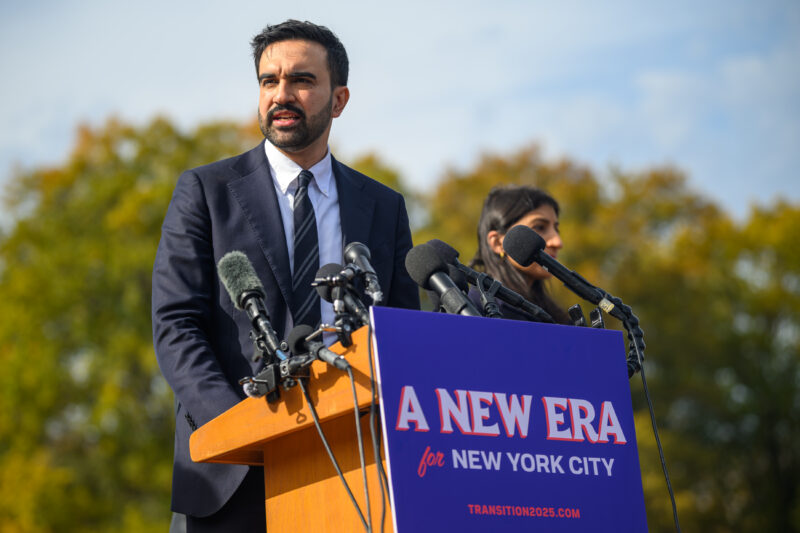
The prime minister also rejected accusations that Israel committed genocide in Gaza, directly addressing Mamdani, who has repeatedly called Netanyahu a war criminal.
“Israel didn’t commit genocide. Israel prevented genocide,” Netanyahu said. He also raised that Mamdani’s wife, Rama Duwaji, had liked multiple Instagram posts celebrating Hamas’ Oct. 7, 2023, attacks. “You try to silence me. Well, you can’t silence me. You can’t silence the truth,” the prime minister said.
In response, Mamdani accused Netanyahu in a statement of using his U.N. address “to repeat baseless lies meant to sanitize his genocide of Palestinians.”
Netanyahu went on to accuse foreign countries of spending “untold billions” to spread anti-Israel messages through traditional and social media, singling out Qatar for “massively funding American universities and toxic media outlets” in what he alleged was an effort to “brainwash young minds to hate Israel, hate America, hate the West.”
He called Turkey the latest “superspreader of antisemitic lies” and Turkish President Recep Tayyip Erdoğan a “tyrant,” accusing Ankara of supporting Hamas and seeking greater influence in Syria.
Netanyahu also responded to Syrian President Ahmad al-Sharaa, who said in his UNGA address on Wednesday that the Golan Heights “will remain Syrian territory.”
“Mr. al-Sharaa, you should know the Jews have been on the Golan Heights since the days of Moses,” Netanyahu said. “You can read it in the Bible.”
The Iranian president cast Tehran as the victim of U.S. and Israeli aggression
Alexi J. Rosenfeld/Getty Images
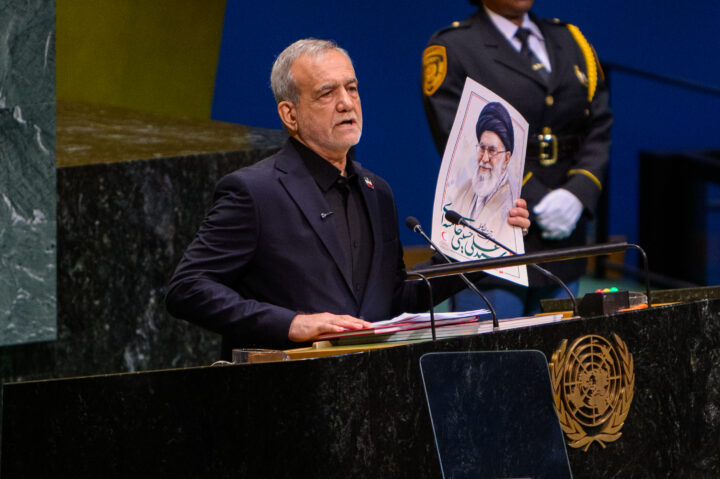
Iranian President Masoud Pezeshkian holds up a poster of assassinated Supreme Leader of Iran Ali Khamenei while addressing the 81st session of the United Nations General Assembly on September 23, 2026 in New York City.
Iranian President Masoud Pezeshkian cast Tehran as a peaceful victim of American and Israeli aggression during an address to the United Nations General Assembly on Wednesday, expressing a readiness for further negotiations while downplaying Iran’s state sponsorship of terror, nuclear escalation and regional strikes.
Addressing the assembly a day after President Donald Trump threatened to “annihilate” the Islamic Republic if a deal is not reached, Pezeshkian claimed Tehran has never sought nuclear weapons and painted its atomic program as strictly intended for energy and medical research.
“Iran does not accept for nuclear technology to be at the exclusive disposal of some of a handful. We say it clearly: no nuclear weapons and no limitations to peaceful nuclear technology,” he said.
Pezeshkian’s portrayal of a purely civilian nuclear program contradicts assessments from the International Atomic Energy Agency and U.S. intelligence, which have repeatedly warned that Iran has enriched uranium to near-weapons-grade purity — a threshold with no credible non-military application. Satellite intelligence has also found ongoing construction and activity at fortified Iranian nuclear facilities, despite Tehran’s public denials.
The Iranian leader also sought to frame his country as a “victim of terrorism” at the hands of Washington and Jerusalem, deflecting from Tehran’s decades-long role as the premier state sponsor of terrorism in the Middle East. Pezeshkian falsely accused the U.S. and Israel of intentionally targeting civilians while insisting Iran acts only in self-defense.
Pezeshkian also rebuffed Trump’s claims that Iran is a “source of instability” and claimed that Tehran rather seeks to “cooperate and collaborate for security.”
“We responded, but we did not hit civilian populations. They came into surrounding territories and targeted our universities, our healthcare centers, our schools, our hospitals, our infrastructures — all of it against international law,” he said. Iran has repeatedly targeted civilian infrastructure during the war with the U.S., including hotels, airports and economic centers across the Gulf and Israel.
Pezeshkian also attempted to pivot toward diplomacy, claiming Iran has always maintained a “commitment to the negotiating table,” but insisted Tehran would “not accept the language of force.”
The Iranian president also accused the international community of enforcing a “double standard” by penalizing Tehran with sanctions while allowing Israel to operate outside the Non-Proliferation Treaty (NPT) framework.
“The nuclear weapon is in Israel, but the inspectors are in Iran. Israel kills, but Iran is subject to sanctions,” he said. Israel has never publicly acknowledged operating a nuclear weapons program.
The group plans to discuss a range of subjects including U.S. allies’ decision to sanction Israel
Aryeh Schwartz/AJC
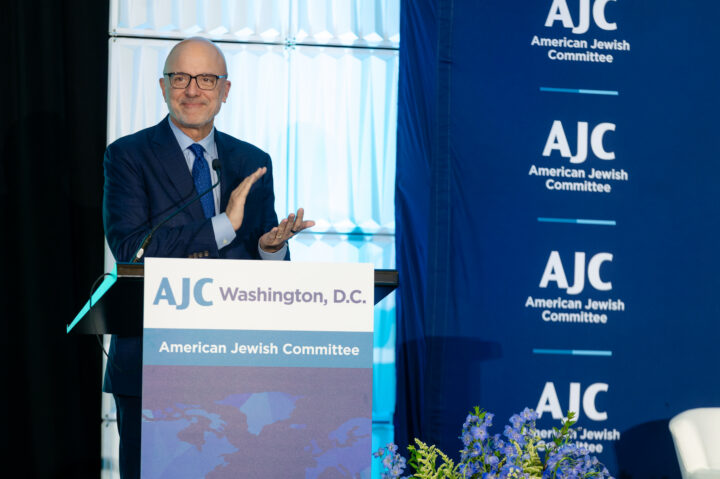
Ted Deutch
This week’s upcoming United Nations General Assembly gathering in New York City will serve as the backdrop for a “diplomatic marathon” by the American Jewish Committee’s leadership to meet with representatives and leaders of more than 50 countries — a tradition the AJC has carried on for decades.
On the agenda are a range of subjects, including confronting close U.S. allies that have recently decided to impose sanctions on what they deem to be Israeli-occupied territories, including West Bank settlements as well as east Jerusalem and the Golan Heights.
“This is an opportunity to have really meaningful conversations with friends who are standing firmly with us and understand the challenges that Israel faces and are supportive,” AJC CEO Ted Deutch said in an interview at the group’s offices in Washington. “And then we’ll have conversations with countries who have been taking challenging positions, and we have very frank conversations as we will this year in particular when we meet with our friends from the U.K. and Canada and Australia and France.”
He argued that those conversations are critical to discuss the countries’ decisions to impose sanctions on what they deem to be occupied territories, a move he said “damages the prospects for peace” and “plays into the hands of extremists who wish to drive a wedge between Israel and her democratic allies.”
“Democratic allies should be coming together, not drifting apart. Israel is a democratic ally of these countries that plays a critical role in the Middle East’s stability,” Deutch said.
He said AJC had similar “difficult conversation[s]” around U.S. allies’ decision to recognize a Palestinian state. “That’s not just meant to be critical, but actually, to help them understand why this is a bad decision.”
In meetings with Germany and other European allies, Deutch said he also plans to discuss the rise of the far-right AfD party and the risk that “rising extremism” across Europe poses to the Jewish community. More broadly, AJC will discuss antisemitism and efforts to fight it and foster Jewish life around the world.
He said that every country that has a Jewish community has a role in making sure that Jewish communities can gather together without fear, but also that the responsibility extends beyond governments alone.
“We also think it’s important for countries to recognize that this is not something that governments can do on their own, that across the country there are roles for each part of society to play in combating antisemitism in ways that don’t just protect Jews but strengthen everyone’s ability to fully participate in those societies … because it’s consistent with who these countries are in maintaining pluralistic democracies,” Deutch added.
He said conversations with global leaders will also touch on issues within the United Nations itself and its bias against Israel. He said that Francesca Albanese, the U.N. special rapporteur for the Palestinian territories who has faced repeated accusations of antisemitism from various nations, “makes a mockery of the system as a whole.”
He said AJC also plans to press countries to designate the Islamic Revolutionary Guard Corps and its proxies as terrorist organizations, and to continue to support both international and country-by-country sanctions on Iran.
“Let’s also continue to remember what Iran represents and why the world should stand against it, and come together around all of the ways that it can,” Deutch said. “While [it is] appropriate for Congress to have that debate [about military action], Iran is a threat and continues to be a threat, we need to continue to remind people of that.”
Deutch said AJC will have “frank conversations” with countries about the situation in Gaza, while also emphasizing that Hamas has not fulfilled its obligation to disarm under the U.S.’ 20-point peace plan, which is a mandatory step for the peace process to move forward.
“We have to shift the focus back to how to make that happen, and it does start with disarming Hamas,” he said. “It shouldn’t be difficult for the world to rally around the idea that this terrorist group that committed the Oct. 7 attacks should no longer be allowed to be an armed organization that poses a threat. We’ve seen what happens when that was allowed in the past.”
But he said it’s also important to provide support and encouragement and express appreciation to those countries that have continued to stand with Israel and the Jewish community. The week will include meetings with various countries across South America, where AJC is working to promote ties with Israel as well as opportunities for expanding and deepening the Abraham Accords.
Deutch said that AJC will be engaging with some states that could join the Abraham Accords, and will emphasize that they face a shared threat from Iran, as has been demonstrated in recent days by the Houthi attacks on Saudi Arabia.
“The Abraham Accords represents the alternative to that, and represents an opportunity for greater security and greater economic integration and more and better opportunities for the people of the region,” Deutch said.
During the UNGA, AJC will also discuss both internally and externally efforts to engage more deeply with Africa, working to provide opportunities for African countries to experience Israeli innovation and technology and see Israel for themselves.
Deutch and AJC additionally plan to push to strengthen the transatlantic alliance and support Ukraine’s defense. AJC will also host a reception with Jewish community members and diplomats, where the group will award Nickolay Mladenov, the high representative of Gaza for the Board of Peace, with the Madeline and Bruce M. Ramer Award for Diplomatic Excellence.
Both at home and abroad, Deutch said that leaders need to understand and call out efforts to deny Israel’s right to exist, and to understand that such rhetoric “put[s] the Jewish community at risk” and that “engaging in age-old antisemitic conspiracy theories” must be confronted.
Efforts by some political actors to bar Jews and supporters of Israel from the “political mainstream … aren’t just calls that affect the Jewish community, that threaten the Jewish community,” but also “undermine our democracy.”
Standing up to that rhetoric “matters to the future and security of democracies around the world,” well beyond the Jewish community itself, he said.
He called on members of Congress and other leaders to show greater courage and leadership in the face of harassment, bullying and threats that have been directed at supporters of Israel in Washington, and which some members say have led their colleagues to soften their support for the Jewish state.
“That’s what the Jewish community has been facing, and for the Jewish community and for supporters of Israel, the response is not to cower. That’s what the antisemites want. What the anti-Israel forces want,” Deutch said.
“For our leaders — I get it. I was a member of Congress. I dealt with people chasing me around with bullhorns, yelling names at me. I understand what that’s like, and I get that there are threats. That should embolden them, embolden members, embolden leaders to stand up against that,” he said. “Members of Congress aren’t mushy about anything, and they shouldn’t be mushy when it comes to standing up against antisemitism and efforts to undermine Israel’s right to exist.”
The Israeli PM said the country’s ‘support quickly evaporated when Israel did what any self-respecting nation would do in the wake of such a savage attack: We fought back’
Michael M. Santiago/Getty Images
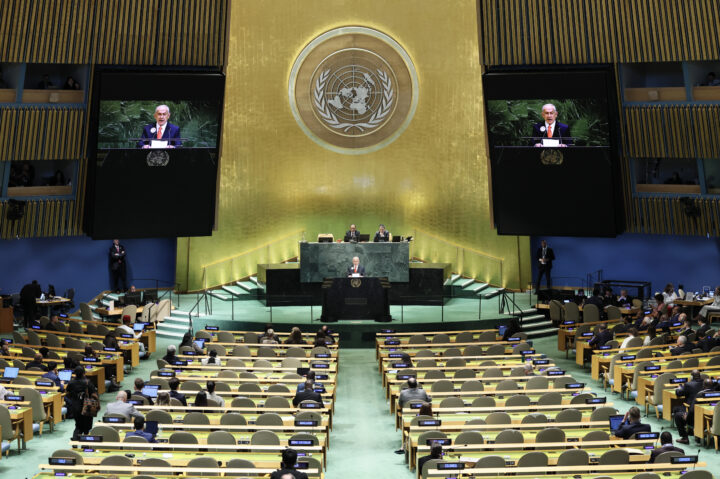
Israeli Prime Minister Benjamin Netanyahu addresses world leaders during the United Nations General Assembly (UNGA) at the United Nations headquarters on September 26, 2025 in New York City.
In Israeli Prime Minister Benjamin Netanyahu’s address to the United Nations General Assembly on Friday morning, he painted a picture of a nation abandoned by its allies, who he said had caved to “radical Islamist constituencies and antisemitic mobs” — a message underscored by the backdrop of a mostly empty General Assembly room, following the walkout of dozens of diplomats at the start of his speech.
Netanyahu began with a victory lap, hailing Israel’s military successes against Hezbollah, Iran and even Hamas over the past year. But much of the speech was defensive in nature, relying on rhetoric he has invoked frequently over the last two years. He articulated the reasons why Israel is still fighting Hamas, despite the fact that Israel “crushed the bulk of Hamas’ terror machine.” And he attacked the U.N. and the countries that he said had shown up for Israel in the days after the Oct. 7 attack but that have since changed course.
“In the days immediately following Oct. 7, many of them supported Israel. But that support quickly evaporated when Israel did what any self-respecting nation would do in the wake of such a savage attack: We fought back,” he said.
He defended Israel’s handling of the war in Gaza as moral and appropriate, saying the nation faces “the false of charge of genocide.”
“The truth has been turned on its head. Hamas is a genocidal terrorist organization whose charter calls for the murder of all Jews on the planet. This genocidal organization is given a pass while Israel, which does everything it can to get civilians out of harm’s way, Israel is put in the dark. What a joke,” said Netanyahu.
Known for his theatrics in his annual U.N. address, Netanyahu wore a large button with a QR code that linked to a website featuring gruesome videos of Hamas’ attack on southern Israel two years ago. He also told the crowd that he had directed the IDF to set up loudspeakers to broadcast his speech out loud on the Gaza border, a measure he said was meant as an attempt to reach Israeli hostages still held in Gaza — and that the remarks were being carried live on the cell phones of Gazans, to convince Hamas to “lay down your arms.”
Netanyahu repeatedly invoked the Sept. 11 terror attacks and the global war on terror as proof of the depravity Israel is fighting in Gaza.
“Giving the Palestinians a state one mile from Jerusalem after Oct. 7 is like giving Al-Qaida a state one mile from New York City after Sept. 11. This is sheer madness. It’s insane, and we won’t do it,” said Netanyahu. The Israeli prime minister has doubled down in his pledge to never allow the creation a Palestinian state after France, the United Kingdom, Australia and Canada unilaterally recognized a Palestinian state this week.
He slammed those nations, saying their move “reward[s] the worst antisemites on earth.” They chose to recognize a Palestinian state, Netanyahu said angrily, even though “nearly 90% of Palestinians supported the attack on Oct. 7 … just the way they celebrated another horror, 9/11.”
Netanyahu offered little to those who want to see Israel present a plan for the end of the war and for the governance of Gaza without Hamas, though he said Israeli “victory” would open opportunities for peace in the region.
“Victory over Hamas will make peace possible with nations throughout the Arab and Muslim world. Our victory would lead to a dramatic extension and expansion of the historic Abraham Accords, which President Trump brokered between Arab leaders and myself five years ago,” said Netanyahu. He did not address whether he would move to annex parts of the West Bank, which Saudi Arabia — Israel’s top target for normalization — said earlier this week would be a “red line,” and that President Donald Trump said yesterday he will not allow.
He closed with a prayer for a speedy victory, even if Israel has to achieve it alone.
“The rise of Israel did not mean that the attempts to destroy us would end. It meant that we could fight back against those attempts, and that is exactly what Israel has done since Oct. 7,” said Netanyahu. “Two years later, the resolve of Israel and the strength of Israel burn brighter than ever. With God’s help, that strength and that resolve will lead us to a speedy victory into a brilliant future of prosperity and peace.”
Netanyahu plans on attacking what he perceives as the moral bankruptcy of countries he sees as rewarding the perpetrators of the Oct. 7 attack and casting Israel as a villain
Avi Ohayon (GPO)
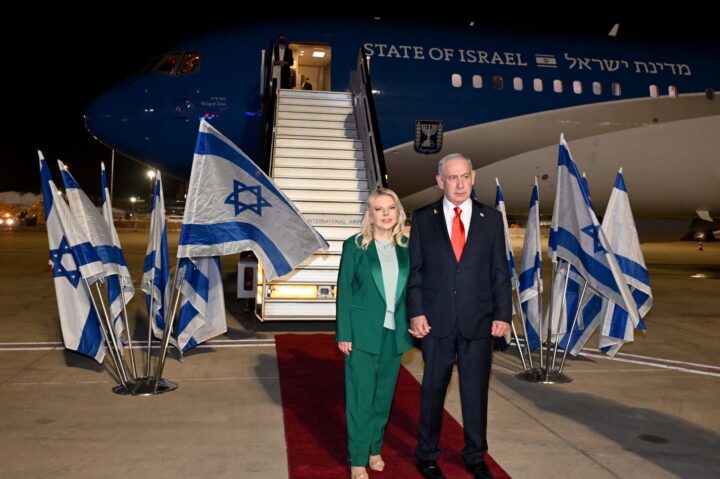
Israeli Prime minister Benjamin Netanyahu and his wife Sara depart to the U.S., Sept. 25th, 2025
Israeli Prime Minister Benjamin Netanyahu will have much to respond to when he stands in front of the United Nations General Assembly’s green marble wall today: a cascade of Palestinian state recognitions by Western countries, a flotilla of activists, influencers and parliamentarians — protected by Spanish and Italian naval ships — and accusations of genocide leveled from the UNGA stage.
On the tarmac at Ben Gurion Airport on Wednesday, Netanyahu vowed to “tell our truth — citizens of Israel, the truth of IDF soldiers, of our state.”
“I will condemn those leaders who, instead of condemning the murderers, rapists and burners of children, want to give them a state in the heart of Israel. This will not happen,” Netanyahu said ahead of his departure from Israel.
Netanyahu also plans on attacking what he perceives as the moral bankruptcy of countries he sees as rewarding the perpetrators of the Oct. 7 attack and casting Israel as a villain. His arrival in New York was accompanied by an advertising campaign launched by his office on billboards and trucks driving around Turtle Bay and Times Square with the message “Remember October 7.”
The signs also feature a QR code that leads to a site depicting the atrocities of that day.
“The goal of the campaign is to remind world leaders and the public about the atrocities perpetrated by Hamas and the unbelievable brutality of the terrorist organization that continues to hold 48 hostages in captivity in Gaza,” Netanyahu’s office said.
Ahead of the speech, Wing of Zion — Israel’s version of Air Force One — took a route that is hundreds of kilometers longer than usual, apparently to avoid the airspace of countries that might act on the International Criminal Court’s warrant for Netanyahu’s arrest.
Wing of Zion flew from Israel over the Mediterranean to Greek and Italian airspace, and then continued crossing over the Mediterranean until it reached the Atlantic Ocean.
The route was longer than the one he took to the U.S. in July, which overpassed France. A French diplomatic source said that Jerusalem asked Paris for authorization to fly over its airspace, which it provided, but the plane took another route anyway.
After France led the charge in the West to recognize a Palestinian state, Netanyahu was not taking any chances and chose not to rely on the goodwill of those same leaders who days earlier unilaterally recognized a Palestinian state.
Upon his arrival in New York, Netanyahu met with friendlier leaders: President Javier Milei of Argentina, Paraguayan President Santiago Peña and Serbian President Aleksandar Vučić. The readouts from the meetings focused on the theme of Netanyahu’s visit; he thanked the leaders for their “staunch opposition to anti-Israel bias at the United Nations.”
With Vučić, Netanyahu also discussed Alon Ohel, a dual Israeli-Serbian citizen held hostage by Hamas, which released a video of him this week.
During a meeting with Arab and Muslim leaders, Trump reportedly promised that he would not allow Netanyahu to annex the West Bank
Michael M. Santiago/Getty Images
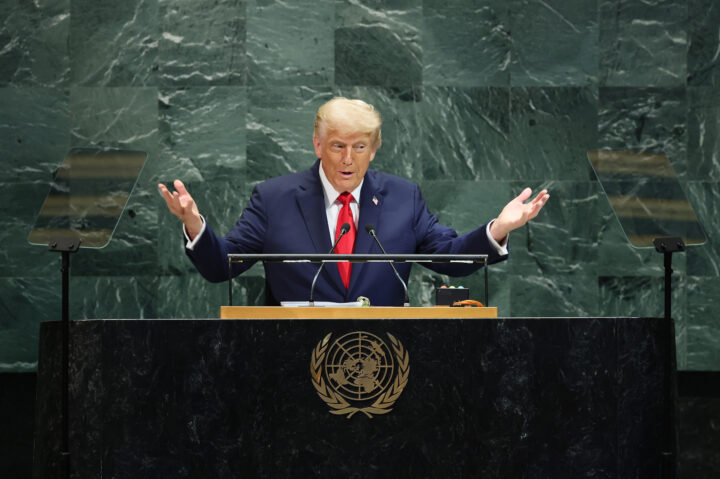
U.S. President Donald Trump speaks during the United Nations General Assembly (UNGA) at the United Nations headquarters on September 23, 2025 in New York City.
By calling the United Nations “useless” and saying many countries were “going to hell” by pursuing liberal governance, President Donald Trump was his usual provocative, impolitic self in his Tuesday speech at the United Nations General Assembly. Where other nations and the U.N. itself have promoted a vision of greater global cooperation in an interconnected world, Trump doubled down on a call for national sovereignty and closed borders. Where nearly all U.N. member states have pledged to make tackling climate change a priority, Trump took issue with the very concept of sustainable energy.
“Immigration and the high cost of so-called green renewable energy is destroying a large part of the free world and a large part of our planet,” Trump said at the close of his address. “Countries that cherish freedom are fading fast because of their policies on these two subjects.”
But it was Trump’s continued support of Israel, even in the face of growing hostility from European countries and other Western allies to the Jewish state, that may have stood out the most. Trump, in his General Assembly speech, blasted the European nations that this week formally recognized a Palestinian state.
“Now, as if to encourage continued conflict, some of this body is seeking to unilaterally recognize a Palestinian state,” he said. “This would be a reward for these horrible atrocities, including October 7th, even while they [Hamas] refuse to release the hostages or accept a ceasefire.”
The U.S. also joined Israel in boycotting the two-state solution conference on Monday, which was hosted by France and Saudi Arabia, and was joined by several major nations, including the United Kingdom, Australia and Canada.
But even while Trump used his nearly hourlong address to place himself firmly on Israel’s side in its nearly two-year-long war with Hamas, reports indicate that he is privately advocating for restraint. . During a meeting Tuesday with Arab and Muslim leaders where U.S. special envoy Steve Witkoff proposed a 21-point plan to end the war in Gaza, Trump promised the world leaders in attendance that he would not allow Israeli Prime Minister Benjamin Netanyahu to annex the West Bank, Politico and The Times of Israel reported.
Trump also touted the Abraham Accords in his keynote speech, which he described as a “very big thing.” The landmark 2020 agreement that normalized ties between Israel and the United Arab Emirates and several other Arab nations was predicated on Netanyahu not annexing the West Bank — and Saudi Arabia warned this week that annexation would be a “red line” to its own improved relations with Israel.
That warning comes as Trump eyes an expansion of the Accords, with Saudi Arabia widely considered the next target for a White House set on furthering its dealmaking prowess in the Middle East.
Netanyahu and Trump will hold their fourth Oval Office meeting of the year next week, offering the two leaders a chance to present a unified front on defeating Hamas — or, depending on what happens in New York this week, an opening for Trump to make the case against annexation, a demand that he and other administration figures have so far refrained from uttering in public.
As the UNGA begins, several countries are recognizing a Palestinian state and the EU is considering suspending free trade with Israel
Stephanie Keith/Getty Images
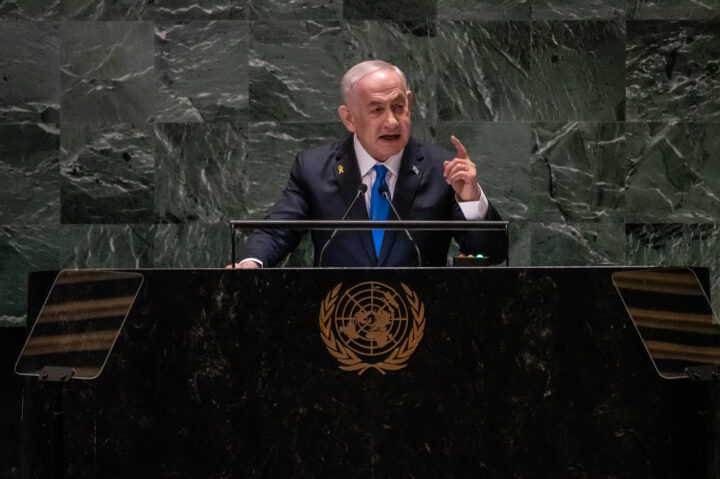
Israeli Prime Minister Benjamin Netanyahu speaks during the United Nations General Assembly (UNGA) at the United Nations headquarters on September 27, 2024 in New York City.
Israeli Prime Minister Benjamin Netanyahu’s planned speech to the United Nations General Assembly on Friday is being overshadowed by European moves to isolate Israel, with the U.K., as well as Canada and Australia recognizing a Palestinian state on Sunday and more to come, as well as an upcoming EU vote on sanctions against Israel.
Netanyahu released a statement, in which he said he has “a clear message to the leaders who recognize a Palestinian state after the terrible massacre of Oct. 7: You are giving a massive prize to terror. … It will not happen. There will not be a Palestinian state west of the Jordan River.”
The prime minister hinted that Israel will increase settlement activity in response: “For years I prevented the establishment of this terror state facing great pressures, domestic and foreign … Not only that, we doubled the Jewish settlement in Judea and Samaria. The response to the latest attempt to force a terror state on us in the heart of our land will be given after my return from the U.S. Wait.”
U.K. Prime Minister Keir Starmer said on Sunday that his country is “acting to keep alive the possibility of peace and a two-state solution. That means a safe and secure Israel alongside a viable Palestinian state. At the moment, we have neither.”
He pushed back against the Israeli argument that recognition of a Palestinian state at this time acts as a reward for Hamas, arguing that “our call for a genuine two-state solution is the exact opposite of [Hamas’] hateful vision. … This solution is not a reward for Hamas, because it means Hamas can have no future.”
Hamas, however, praised the recognition as an “important move” and called for it to be accompanied by ending the “Judaization of the West Bank and Jerusalem, Israel’s isolation and Israel’s leaders brought before international court,” as well as the recognition of the Palestinians’ “natural right to resistance.”
The High-Level Conference on Palestine Statehood, led by France and Saudi Arabia, is set to take place Monday, on the eve of Rosh Hashanah. Nearly a dozen countries have said they would recognize a Palestinian state as part of that effort, following the announcements of the U.K., Canada and Australia on Sunday.
French President Emmanuel Macron argued in an interview with Israel’s Channel 12 News that “recognition of a Palestinian state is the best way to isolate Hamas … What they want is to destroy [Israel], but if we consider that the Palestinian state will always have the objective to destroy Israel, how [do] they want to build a sustainable future? There is no way.”
A recent poll commissioned by the French-Jewish umbrella organization CRIF found that 71% of French people reject the recognition of a Palestinian state before the hostages are freed and Hamas gives up power. In the U.K., a survey in The Telegraph showed 87% of Britons disagree with recognition of a Palestinian state without preconditions, including 89% of Labour voters. A YouGov poll, however, found that 44% of Britons supported the move, while 18% were opposed and 37% unsure.
U.S. Ambassador to France Charles Kushner noted that in conjunction with his announcement of Palestinian state recognition, Macron called for Palestinian recognition of Israel as a Jewish state, the demilitarization of Hamas and the establishment of strong governance for the Palestinians as preconditions for any recognition of Palestinian statehood. “These were France’s own conditions for recognition of a Palestinian state. How can France move forward with next week’s vote when none of these have been met?” Kushner said.
Netanyahu, who was Israel’s ambassador to the U.N. from 1984-1988, is known to relish his addresses to the U.N. General Assembly, embracing theatrical props, puns and long pauses on a platform where he hopes to capture the world’s attention for Israel’s benefit.
After his UNGA speeches, Netanyahu holds court, with other leaders visiting him in a conference room in Turtle Bay. This year, he is expected to meet with Argentinian President Javier Milei, the leaders of Paraguay and Serbia and New York Mayor Eric Adams, and there are reports that he will meet with Syrian President Ahmad al-Sharaa ahead of a possible security agreement between Damascus and Jerusalem. Then, Netanyahu is expected to fly to Washington to meet with President Donald Trump.
Meanwhile, Israel’s Foreign Ministry and Economy Ministry, which oversees foreign trade, have been pushing back against proposed European Union sanctions. The European Commission proposed the roll-back of relations between the bloc and Israel after it “found that actions taken by the Israeli government represent a breach of essential elements relating to respect for human rights” given “the rapidly deteriorating humanitarian situation in Gaza following the military intervention of Israel, the blockade of humanitarian aid, the intensifying of military operations and the decision of the Israeli authorities to advance the settlement plan in the so-called E1 area of the West Bank, which further undermines the two-state solution.”
The proposal, if accepted, would suspend free trade between Israel and the European Union, its largest trade partner.
A source in Brussels estimated that the move would cost Israel 227 million Euros ($266 million) in customs duties per year.
A date has not yet been set for voting on the suspension of free trade, which requires a qualified majority, also known as a “double majority,” meaning 55% of member states, and states representing 65% of the EU population, with at least four states opposed.
Hungary and the Czech Republic said they would oppose the proposal, following calls between their foreign ministers and Israeli Foreign Minister Gideon Sa’ar.
Sa’ar called the proposal “morally and politically distorted.”
“Moves against Israel will harm Europe’s own interests,” Sa’ar warned. “Israel will continue to struggle, with the help of its friends in Europe, against attempts to harm it while it is in the midst of an existential war. Steps against Israel will be answered accordingly, and we hope we will not be required to take them.”
Economy Minister Nir Barkat sent letters to Germany, Hungary, Czechia, Italy, Bulgaria, Greece, Lithuania, Cyprus, Croatia and Latvia asking them to oppose the measure to suspend free trade.
The European Commission also suspended 20 million Euros ($23.5 million) in projects with Israel, dealing with civil service training and regional-EU cooperation related to the Abraham Accords, through 2027. The commission was able to end the cooperation without a vote and noted in repeated statements that it was exempting “civil society and Yad Vashem.”
In addition, the European Commission proposed sanctions against Israeli Finance Minister Bezalel Smotrich and National Security Minister Itamar Ben-Gvir, as well as “violent settlers” and 10 members of the Hamas politburo, which would require a unanimous vote by EU member states. The ban on Israelis is unlikely to be approved, especially not the cabinet ministers.
In another sign of Israel’s increased isolation in Europe, several countries’ public broadcasters said they would boycott the 2026 Eurovision Song Contest if Israel were to take part, as it usually does.
Spain, the Netherlands, Slovenia, Iceland and Ireland have said they will not participate in the contest along with Israel, and Belgium threatened to follow suit.
Israeli public broadcaster Kan said that it will continue to be “a significant part in this cultural event, which cannot become political.”
“Israel is one of the most successful participants in the Eurovision contest — in the past seven years its songs and representatives have finished in 5th, 3rd, 2nd and 1st place,” Kan CEO Golan Yochpaz said.
Austrian Foreign Minister Beate Meinl-Reisinger, whose country is due to host the Eurovision next year, posted on X that the contest “is a symbol of peace, unity, and cultural exchange — not an instrument for sanctions.”
His confirmation vote, by a 47-43 vote, comes days before the start of the U.N. General Assembly
Michael M. Santiago/Getty Images
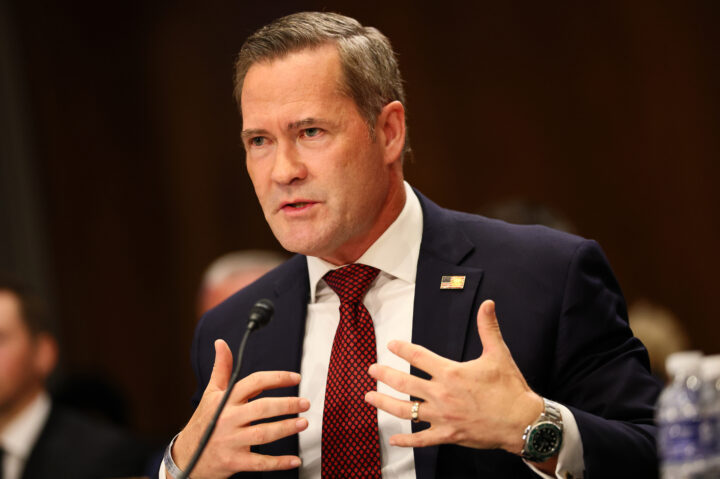
Former National Security Advisor Mike Waltz testifies during his confirmation hearing before the Senate Committee on Foreign Relations in the Dirksen Senate Office Building on July 15, 2025 in Washington, DC.
The Senate confirmed former National Security Advisor Mike Waltz on Friday to be U.S. ambassador to the United Nations, capping off a monthslong confirmation process that was marred by delays just days before the start of the U.N. General Assembly next week.
Waltz, a former congressman from Florida and a Green Beret, was confirmed by a 47-43 vote in the Senate on Friday afternoon, with three Democrats and one Republican crossing party lines. Sens. Jeanne Shaheen (D-NH), the ranking Democrat on the Senate Foreign Relations Committee, John Fetterman (D-PA) and Mark Kelly (D-AZ) voted in favor of Waltz’s nomination, while Sen. Rand Paul (R-KY) was the only Republican to oppose.
Waltz’s journey to his current role began when President Donald Trump removed him from his post as White House national security advisor in late April and selected him to replace Rep. Elise Stefanik (R-NY) as his pick for U.N. ambassador. The White House pulled Stefanik’s nomination in late March, more than two months after the Senate Foreign Relations Committee had advanced her nomination, amid concerns that her absence in the House could hurt Republicans’ ability to govern with their slim majority.
The former national security advisor was facing heavy scrutiny at the time over the Signal chat incident in which Waltz inadvertently added Atlantic Editor-in-Chief Jeffrey Goldberg to a group chat of top national security officials discussing imminent strikes on the Houthis on the non-secure messaging app. Prior to the “Signalgate” incident, Waltz had already been viewed as a vulnerable target for ideological rivals and personal foes in the administration because of his hawkish approach on foreign policy.
While Trump initially stood by Waltz, he eventually relented and in early May announced his intention to move the former congressman to the U.N. post. Waltz had already faced a setback after Trump fired six National Security Council officials whose views were aligned with Waltz. Their ouster was driven by an intervention by far-right activist Laura Loomer.
Waltz, a staunch supporter of Israel and an outspoken critic of Iran, faced delays of his own during his Senate confirmation process this summer, with Paul siding with all Democrats on the Foreign Relations Committee to block his nomination from advancing to the full Senate over concerns with Waltz’s national security and foreign policy positions.
Shaheen eventually broke the stalemate in July, voting for Waltz because of his public and private support for continued U.S. global engagement than other figures in the administration, as well as potential alternatives Trump could nominate.
Multiple outlets reported at the time that Shaheen, who is retiring next year, conditioned her support for Waltz on the Trump administration committing to providing $75 million in aid to Haiti and Nigeria, which had just been approved. Sen. Jim Risch (R-ID), the chairman of the committee, told Jewish Insider that the aid package was not directly tied to Shaheen’s support for Waltz.
During his confirmation hearing that month, Waltz said he would serve as a blockade to “anti-Israel resolutions” in the U.N. General Assembly and vowed to push for the dismantlement of the United Nations Relief and Works Agency over some of its employees’ involvement in the Oct. 7, 2023, Hamas attacks. He also said he supported U.S. sanctions against Francesca Albanese, the U.N. special rapporteur for Israel and the Palestinian territories, amid widespread accusations she has espoused antisemitic rhetoric in her commentary on Israel.
Waltz will take over for Dorothy Shea, the career diplomat who filled the role in an acting capacity as chargé d’affaires during the nine-month vacancy. His first full week on the job will coincide with the General Assembly, bringing world leaders together in New York City for high-level discussions on issues ranging from Russia’s war in Ukraine to European countries’ push for Palestinian statehood.
In an interview with JI, Ambassador Gilad Cohen discusses his push to persuade Japan not to recognize a Palestinian state at the UNGA
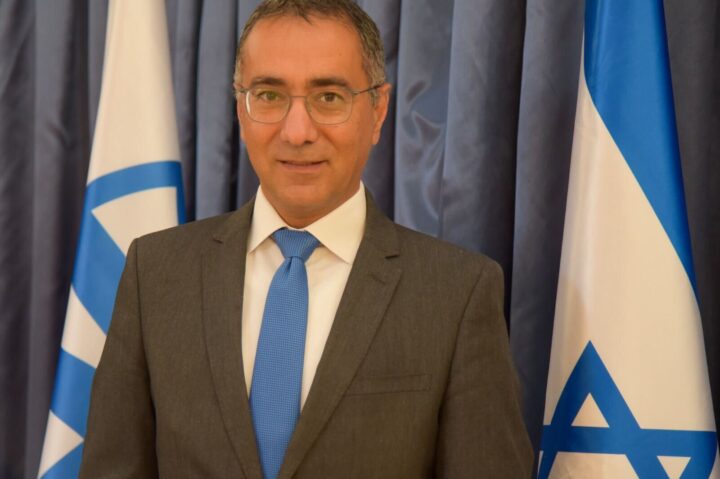
Courtesy Gilad Cohen
Israeli Ambassador to Japan Gilad Cohen
TOKYO — As Japan decided against recognizing a Palestinian state at the United Nations General Assembly on Friday, Israeli Ambassador to Japan Gilad Cohen told Jewish Insider in a wide-ranging interview in Tokyo that he is appreciative of Japan, “an important factor of the international community.”
On Friday evening, Japanese Foreign Minister Takeshi Iwaya called his Israeli counterpart, Gideon Sa’ar, to update him that after weeks of deliberation, Japan decided it will not recognize a Palestinian state at the UNGA.
“Sa’ar appreciated [the] decision and briefed [Iwaya] about Israel’s actions against Hamas chiefs in Qatar and IDF operations in Gaza,” Cohen told JI. “I join my foreign minister in appreciating Japan, a member of the G7, and an important factor of the international community, and for the deep friendship of our nations.”
“A recognition of a Palestinian state would be a reward to Hamas after the Oct. 7 terrorist attacks, would not contribute to peace and would not build on the trust of Israelis in the future,” he said. In recent weeks, Cohen relayed that message to Japanese ministers as the country weighed recognizing a Palestinian state as several governments, including those in Britain, France, Australia and Canada, have announced plans to do at the UNGA.
“This recognition is null and void because when you acknowledge a state there have to be conditions — what are the boundaries? Do you have effective control of the population? Nothing about that works with the Palestinians,” Cohen told JI. “Are they going to dismantle Hamas? Are they going to continue paying salaries for families of suicide bombers? Are they going to continue to have pacts with Iran against Israel? Is there going to be a repetition of Oct. 7 because they have a state? We are the Jewish people, we always have to be concerned and worried.”
For Cohen, who assumed office as ambassador of Israel to Japan in October 2021 following a stint as deputy director general for Asia and Pacific division in the Israel Ministry of Foreign Affairs, Japan’s consideration of recognizing a Palestinian state has been one of only a few disagreements he’s held with local politicians since arriving in Tokyo. In the immediate aftermath of the Oct. 7 attacks, “the Japanese government stood by Israel, called for an immediate and unconditional release of our hostages and said publicly that Hamas should be dismantled,” Cohen said.
“I thank the Japanese for acknowledging that Hamas is a terrorist organization and for saying that Iran is the number one destabilizer of the region. I want to thank the Japanese government for standing on the right side of history.”
When war broke out between Israel and Hamas soon after the Oct. 7, 2023, Hamas attacks on Israel, Japan, as a member of the U.N. Security Council, “was trying to influence the release of the hostages and not to [attack] Israel. They were not mediating, but there were messages Japan was trying to deliver for both sides in order to bring our hostages back,” Cohen recalled.
Looking ahead to the postwar period, Cohen suggested that Japan will contribute to rebuilding the Palestinian economy. “We will welcome any kind of investment in the Palestinian economy to revive it,” he said. “Economy is a major part of the vision of Palestinians living side by side with Israelis in peace and security.”
While tourism from Japan to Israel has seen a decline amid the war, Cohen said that joint business ventures between the two countries have increased over the past two years, as Israeli tech companies engage with Japan’s industrial giants and venture capital networks.
“Investments from Japanese companies in Israel were much higher in 2024 than 2023, including in AI and technology,” he said. “There is a saying that Israel can do things from zero to one and Japanese can take them from one to 10. Israeli innovation and startups can be combined with Japanese wisdom, experience and production ability that Israel doesn’t have.”
When it comes to creating cars, for example, an area that Japan is a global leader in, “Israel should focus on the brain of the car, systems that prevent accidents such as Waze and Mobileye,” said Cohen. “The synergy that we can learn from Japan — and we can share our experience with them — I see a lot of potential in economic relations. Japanese companies are looking at Israeli startups with great interest. In the last two and a half years, there have been direct flights from Israel to Japan, which is important because businessmen and investors do not have time to waste. This is an engine for connecting the people of Israel and Japan.”
Israel is among the handful of countries that Japan has a free trade deal with, an agreement signed by Cohen in March 2023. It allows 200 Israelis to come to Japan annually on a visa for one year of work, study and travel. At the same time, 200 Japanese citizens can come to Israel for one year to do the same.
Cohen sees himself not only as an ambassador of Israel “but also as representing the Jewish people in Japan,” he said, describing a small but vibrant community. Tokyo is home to two Chabad houses and a Jewish community center, which runs a pluralistic synagogue. The cities of Kyoto and Kobe also each have a Chabad. All five centers primarily cater to tourists.
It can be a challenge to navigate Holocaust education and antisemitism awareness in a country with limited historical exposure to those issues, Cohen said, recommending that all Japanese visit the Holocaust Education Center in Fukuyama City, near Hiroshima.
“The Japanese government comes to commemorate our Holocaust memorial days,” Cohen told JI. “They give thanks to [Chiune] Sugihara,” he said, referring to the Japanese diplomat who, while posted in Lithuania, saved thousands of Jews during the Holocaust. “We are participating in ceremonies to commemorate him. In Japan, he became a hero.”
“I see a lot of potential in the future when things calm down in the region,” continued Cohen. “I would like to have future agreements signed with Japan to boost the economy on both sides. I have many things on my agenda, but this will be after Rosh Hashanah.”
Former diplomat says the U.S. should return to the JCPOA and work to ensure Iran is in compliance
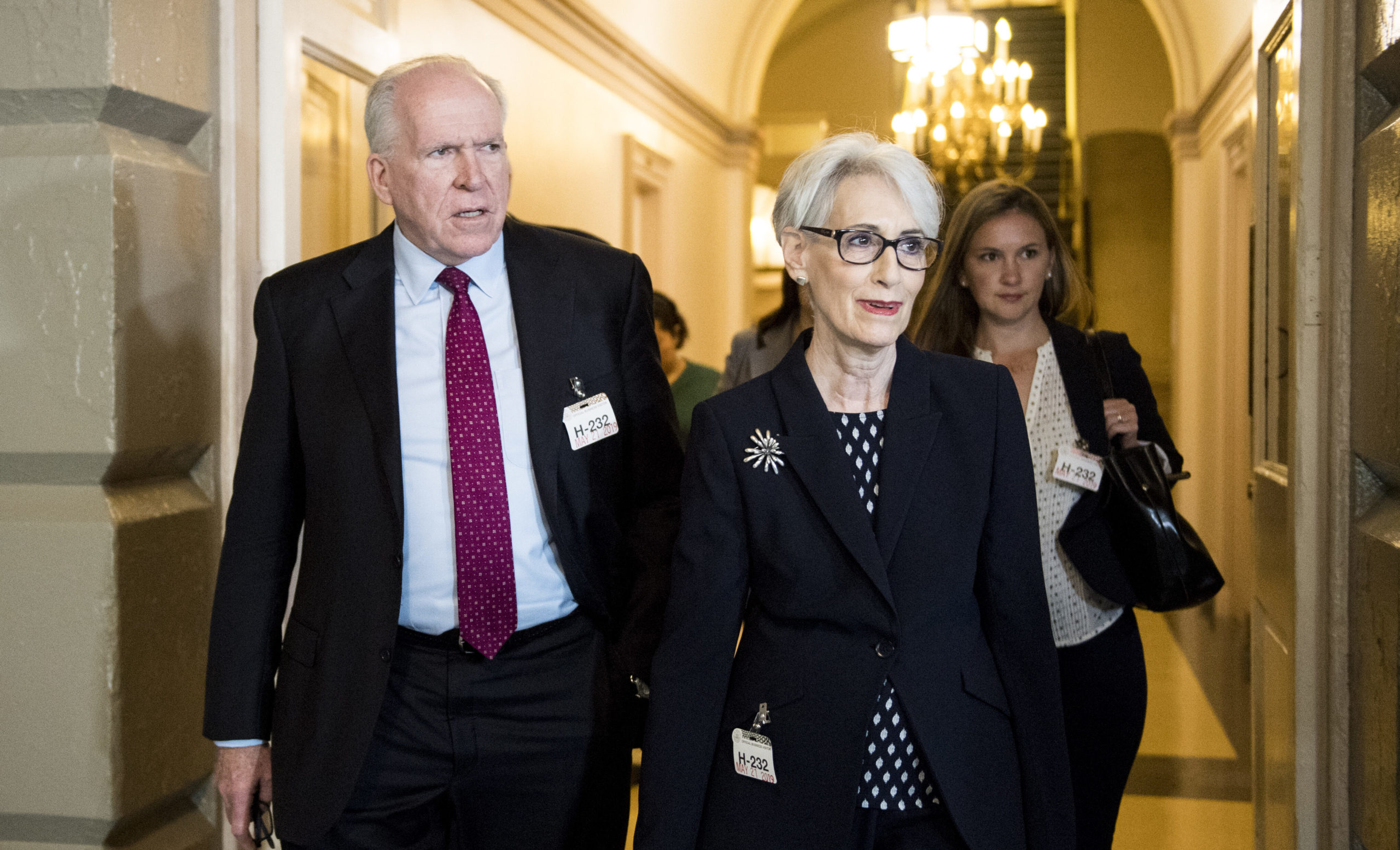
Bill Clark/CQ Roll Call via AP Images
Wendy Sherman, former Under Secretary of State for Political Affairs, and John Brennan, former director of the Central Intelligence Agency, arrive to brief the House Democrats' caucus meeting on Iran in the Capitol on Tuesday, May 21, 2019.
President Donald Trump is reportedly considering easing sanctions on Iran to pave the way for a public meeting with Iranian President Hassan Rouhani in New York at the United Nations General Assembly later this month.
Wendy Sherman, who served as lead negotiator for the Obama administration on the JCPOA, told Jewish Insider on Wednesday that she “would be shocked if Iran agreed to a meeting without some sanctions relief.” According to Sherman, if Trump is serious in offering Tehran some relief, “There are plenty of ways to do this so that everyone’s interests can be met and so that everyone’s face can be saved.”
Bloomberg reported that during an Oval Office meeting on Monday, Treasury Secretary Steve Mnuchin expressed his support for such a move, while then-National Security Advisor John Bolton “forcefully” opposed such a step. On Tuesday, Trump fired Bolton, and Secretary of State Mike Pompeo suggested a meeting with Rouhani is a possibility. The Daily Beast reported on Wednesday that Trump has indicated he is “actively considering” the French plan to grant the Iranian regime a $15 billion credit line if they return to compliance with the 2015 nuclear deal.
Sherman told JI that even if the U.S. relaunches direct negotiations with Iran, it “is a very complicated undertaking. I think what’s most important here is that the president go to a meeting with a strategy; a clear objective and a plan.”
Following that, the former diplomat said, “he will need a team that can follow up, a set of consultations that have happened with our partners and allies, and a really full idea of not only what the first step is, but what the next many steps are. The president, as we know, has gone into some of these meetings thinking that he could simply trust his own instincts and his own impulses and that has never gotten a result good for our national security.”
Sherman claimed that “virtually all” of the 2020 Democratic presidential candidates have said they would return to the 2015 nuclear deal “and I agree with that. Of course, Iran would have to come into full compliance. Likely, we would then, as in all arms control agreements, work for a follow-on agreement.”
Sherman said the conditions of the deal “have changed because of the president’s actions and Iran’s reaction to the president’s actions. The JCPOA remains the essential base but, as a negotiator, you have to take that into account and you have to address where we are.”
Tommy Vietor, Obama’s former National Security Council spokesman, said he believes “Trump should be willing to meet with Rouhani or any other foreign leader. The problem is that Trump is a terrible negotiator. He’s trying to buy a meeting with Rouhani by offering sanctions relief in the hope that it will lead to a negotiation and eventually a deal as strong as the JCPOA. Meanwhile, hard liners in Iran are empowered and our European allies are furious at us for ratcheting up tensions.”
Jason Brodsky, policy director of United Against Nuclear Iran (UANI), told JI that easing sanctions just to meet the Iranian president, “who isn’t its supreme decision-maker, isn’t maximum pressure.” Mark Dubowitz, the CEO of the Foundation for Defense of Democracies, said that Trump appears poised to make “the same mistake President Obama made in 2013 when he relieved the sanctions pressure on Iran to incentivize negotiations that led to the fatally-flawed JCPOA, giving Tehran patient pathways to nuclear weapons. Why President Trump would want to pull an Obama 2.0 is troubling and puzzling.”
Douglas Feith, a former under secretary of Defense for President George W. Bush, said that Trump “deserves credit for the surprising effectiveness of unilateral U.S. sanctions. If Iran wants sanctions relief, it should be willing to alter its behavior substantially. If it does so, some sanctions relief can reasonably be granted.” But, Feith added, “The U.S. should not have to pay Iran anything to come to the table.”
Please log in if you already have a subscription, or subscribe to access the latest updates.
 Continue with Google
 Continue with Apple