







































The pro-Israel Democratic group also backed Chris Pappas and Roy Cooper in their battleground Senate races

Carlos Osorio/AP
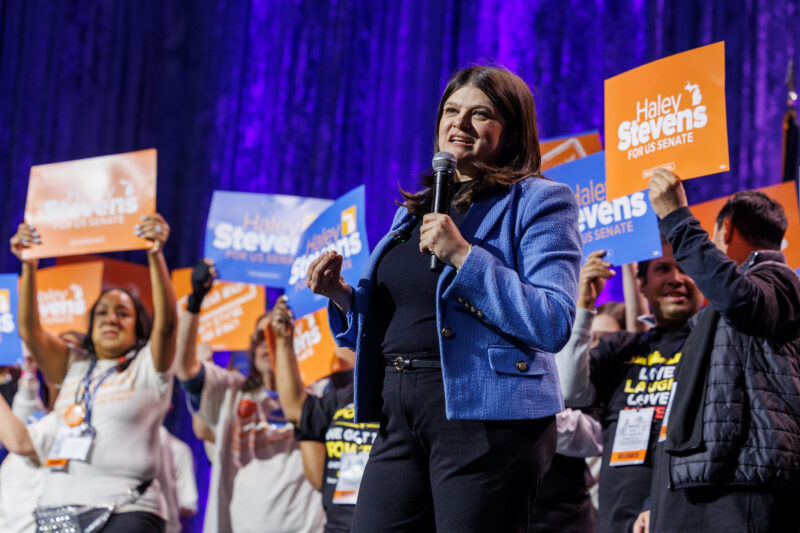
Rep. Haley Stevens (D-MI) speaks Tuesday, Aug. 2, 2022, at an election night party in Birmingham, Mich.


 Add JewishInsider on Google
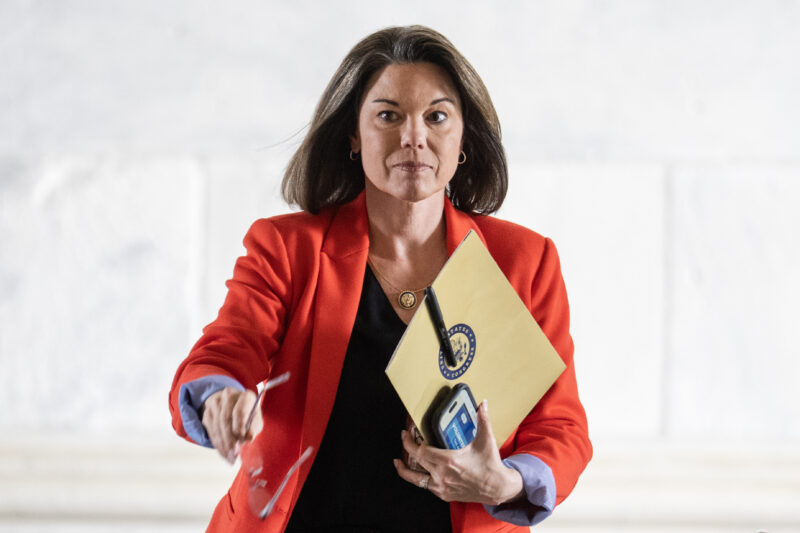
Democratic Majority for Israel on Thursday announced its endorsements of Reps. Haley Stevens (D-MI), Angie Craig (D-MN) and Chris Pappas (D-NH) and former Gov. Roy Cooper as they seek the Senate seats in their respective states.
Stevens faces a particularly competitive primary against state Sen. Mallory McMorrow and former Wayne County health director Abdul El-Sayed, both of whom have sided with the far left on Israel issues and publicly rejected pro-Israel backing. El-Sayed has attacked Stevens over her pro-Israel stance.
DMFI’s endorsement marks the first formal involvement by a pro-Israel group in the race. AIPAC’s PAC and super PAC, which have previously provided significant support for Stevens, have not yet issued an endorsement.
Craig, another moderate pro-Israel Democrat, also faces a left-wing opponent critical of Israel in Lt. Gov. Peggy Flanangan. Cooper and Pappas, both moderates who have been supportive of Israel, are seen as the clear frontrunners in their primaries.
“Chris Pappas, Haley Stevens, Angie Craig, and Roy Cooper are battle-tested leaders who know how to win tough races, hold the Trump administration accountable, and deliver real results for working families. They’ve stood firm against extremism, antisemitism, and efforts to undermine America’s alliances,” DMFI PAC Chair Brian Romick said in a statement.
“Each is a champion of the U.S.-Israel relationship and a clear-eyed advocate for Israel’s security and the region’s long-term stability.”
“DMFI PAC is proud to support these exceptional candidates, and we’re firmly committed to helping them win their races,” he added.
Stevens, in a statement thanked DMFI for its support.
“I’m honored to have DMFI PAC’s endorsement in this race. As a proud pro-Israel Democrat, I believe America is stronger when we stand with our democratic allies, confront antisemitism and extremism, and keep our promises to our friends abroad and our working families here at home,” Stevens said in a statement. “In the Senate, I’ll keep fighting to protect our democracy, support Israel’s security, ensure the ceasefire holds in Gaza, and deliver for Michiganders in every corner of our state.”
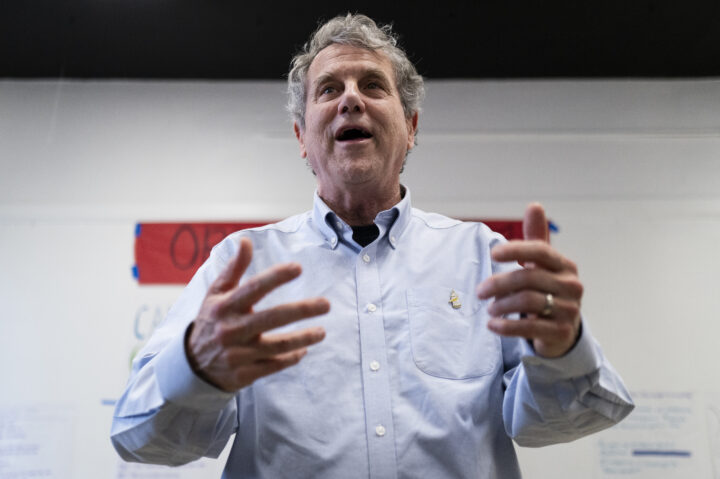
Stephen Maturen/Getty Images
Democratic senate candidate, then-Sen. Sherrod Brown (D-OH), addresses volunteers at a campaign office on November 4, 2024 in Cleveland Heights, Ohio.
It’s notable that Democrats are still relying on experienced, brand-name candidates a bit past their political prime as top recruits for key Senate races.
Former Sen. Sherrod Brown, now 72, is seeking a political comeback after losing his reelection bid last year in Ohio. Former North Carolina Gov. Roy Cooper is pursuing a career change to the Senate at 68 years old. Maine Gov. Janet Mills is being recruited into the Senate race against Sen. Susan Collins (R-ME) even though she’s 77.
To be sure, these are the strongest challengers Democrats could muster in these three must-win battleground states. All are popular statewide officials with a history of winning support from outside the party base. It’s hard to name any other Democratic candidate more capable of flipping these GOP-held seats than the aforementioned recruits.
But there’s another more uncomfortable reality that is drawing the Democrats towards their stars of yesteryear. In today’s fractured media environment, it’s incredibly hard for a new face to emerge and get the type of publicity rising stars would generate from “earned media” on television and in the press, as was common in the recent past.
And given the declining influence of such mainstream platforms, the best way to get attention is by playing to the party’s activist base on social media. It’s how Zohran Mamdani broke through a comparatively dull field of challengers in the New York City Democratic mayoral primary. Going viral is becoming a prerequisite in today’s politics, and the best way to go viral is to play to the extremes — or to, like California Gov. Gavin Newsom, emulate President Donald Trump’s online bullying and trolling.
If you don’t have name identification built up from a career in politics, it’s hard to register any other way these days. And it’s exceptionally hard to break through the noise if you’re a thoughtful moderate.
It’s why we’re seeing a slew of Democratic candidates popping up who are looking to capture the anti-establishment mood within the party amid the desire for a younger generation of leadership. At the same time, most of these change-focused candidates also hold political views that are well out of the mainstream.
Take Democrat Graham Platner, the 40-year-old Maine oyster farmer and former bartender who is disrupting the party efforts to recruit Mills into the Senate race. He exudes authenticity, and is a political outsider who has never run for elective office before. But his support for government-run health care and apparent hostility towards Israel, to name a few issues, would certainly make it harder for him to win over the moderate-minded voters that Collins has easily secured in past elections.
That would be the case in any battleground state or district: Nominate a candidate who captures the imagination of the progressive base, and odds are they’ll be less electable in a general election.
The 2020 Democratic presidential primary was a case study in this dynamic. There were a handful of talented center-left candidates running, like Minnesota Sen. Amy Klobuchar or then-South Bend, Ind., Mayor Pete Buttigieg. But given the party’s alarm about Sen. Bernie Sanders’ (I-VT) electability, only the universally known Joe Biden had the profile to become the mainstream standard-bearer, even though he was 77 at the time.
At a certain point, the party’s bench of baby boomers will run out and the more progressive-minded Gen Zers will be stepping into political office. Whether this new generation can capture the public’s attention without being beholden to the ideological extremes will be one of the most consequential tests for the party’s future.
The former NC governor: He ‘generally does not believe we should withhold aid from a critical ally like Israel when they have to defend themselves against countries like Iran’

Allison Joyce/Getty Images
Former North Carolina Governor Roy Cooper
North Carolina Democratic Senate candidate Roy Cooper, the state’s former governor, rejected efforts to withhold U.S. aid to Israel, days after the Senate voted on legislation to block certain U.S. arms sales to Israel, his campaign told Jewish Insider.
“The Governor believes it’s urgent for the United States to use other means of pressure on the Israeli government to step up now and find ways to get food to people who desperately need it and return the hostages,” a Cooper campaign aide said. “He would consider the specific text of any bills that came before the Senate, but generally does not believe we should withhold aid from a critical ally like Israel when they have to defend themselves against countries like Iran.”
Cooper, a moderate Democrat, has taken other steps in recent days to distance himself from anti-Israel elements of the Democratic Party, including rejecting a series of anti-Israel resolutions passed by state Democratic Party leadership. But it wasn’t until he entered the Senate race that he weighed in against the anti-Israel turn of the North Carolina Democratic party.
The Senate’s Israel votes are proving to be a sensitive issue among Democratic Senate candidates across the country — and is emerging as a dividing line between the party’s moderates and progressives.
But his initial reticence in speaking out against anti-Israel Democratic leaders in his state could become a vulnerability in the red-state contest
Allison Joyce/Getty Images
Former North Carolina Governor Roy Cooper
Former North Carolina Gov. Roy Cooper’s decision to seek the Democratic nomination for North Carolina’s open Senate seat has equipped the party with a moderate standard-bearer with a strong relationship with the state’s Jewish community.
But his handling of anti-Israel activism within the North Carolina Democratic party is expected to become an issue in the Senate race, one that Republicans are already seeking to exploit.
Cooper served two terms as North Carolina governor, winning close contests even in elections when President Donald Trump carried the state. He previously served four terms as the state’s attorney general, where he compiled a tough-on-crime record that allowed him enough bipartisan support to win in a red-leaning state. In his nearly four decades in state politics, Cooper has never lost a race, notching a 16-0 record.
In recent years, Cooper has been forced to address issues of antisemitism among political leaders in the state — one against a Republican rival, and one involving activists within his own political party.
Cooper said he decided to pass up consideration for the role of Vice President Kamala Harris’ running mate because he didn’t want former Lt. Gov. Mark Robinson, a Republican with a history of posting racist and antisemitic content online, to temporarily assume the governor’s responsibilities. (North Carolina’s constitution states that the lieutenant governor, who is elected separately from the governor, assumes power in an acting capacity when the governor leaves the state.)
Cooper told Politico last July that Robinson, who has quoted Adolf Hitler, downplayed the Holocaust in social media posts and referred to himself as a “black Nazi” in an online porn forum, had previously claimed he was the acting governor while Cooper was traveling to Japan on official business.
“I was on a recruiting trip to Japan,” Cooper said, referencing a trip in October of 2023. “He did claim he was acting governor. He did a big proclamation and press conference while I was gone. It was something about support for the state of Israel. It was obviously to make up for all of his antisemitic comments that he’d made, his denial of the Holocaust that he’d made over the years.”
But when confronted with anti-Israel extremism within his own state party, Cooper has been more cautious.
The former governor did not initially weigh in on the resolution passed by the North Carolina Democratic Party last month calling for an arms embargo on Israel, as well as on the other anti-Israel measures adopted by the state party. An advisor to Cooper told CNN at the time that the former governor “generally does not opine on party resolutions.”
Reached for comment on the state party measures by Jewish Insider on Monday, Cooper said in a statement that he opposes the resolutions.
“I don’t agree with the party resolution, and Israel is an important ally. Israel needs to take seriously the job of getting humanitarian aid into Gaza right now. The hostages must be returned and I continue to pray for a swift end to this war and a meaningful peace in the region,” Cooper told JI.
Former Rep. Wiley Nickel (D-NC), who was considering running for the Senate before Cooper announced his candidacy, had condemned the resolution as an “extreme” measure that amounted to a “death sentence for thousands.”
North Carolina Gov. Josh Stein, a Democrat and the state’s first Jewish governor, similarly expressed disapproval with the resolutions to JI on Monday.
“I disagree with the party’s anti-Israel resolutions and believe that our state party should focus on issues we’re facing here in North Carolina like the high cost of living, harmful cuts to people’s health care, and rising levels of antisemitism, Islamophobia, and other forms of hate. What’s happening in Gaza is devastating. Israel must allow in food and humanitarian supplies; Hamas must free the hostages; and they must work to achieve a just and lasting peace,” Stein told JI.
The National Republican Senatorial Committee, Senate Republicans’ campaign arm, have repeatedly hammered Cooper over his initial silence on the matter.
“Cooper’s silence exposes his true character as a radical, pro-Hamas leftist and sends a clear message to Jewish North Carolinians that he’s with the extremists in his party and not them,” Nick Puglia, NRSC’s regional press secretary, said in a statement at the time of the vote.
Cooper offered his thoughts on Israel’s war with Hamas during an interview with the Technician, North Carolina State University’s news site, last March that has since been scrubbed from their website but is available through online archival services, stating that he believes, “This war is devastating. We’re seeing innocent civilians killed.”
“What you have is a terrorist organization, Hamas, that runs Gaza, who invaded Israel and committed atrocities, still holds hundreds of people hostage. At the same time, in Israel’s attempts to defend itself and to rid itself from Hamas, you’re seeing devastating consequences to civilians, women and children,” Cooper told the outlet. “I know that the president is working very hard toward a ceasefire, toward providing aid to Gaza, and that there’s so much hard work going on behind the scenes and now even more publicly, to make sure that the hostages are released, and to make sure that peace is brought to this area of the world.”
“There needs to be a two-state solution here. We need the Arab countries to come together. But I do know that this Biden administration will work hard toward peace. You’re not going to see that from Donald Trump, who talks about how much he admires dictators across the world. That’s not going to be the solution to this,” he continued.
Pointing to the anti-Israel protests taking place on campuses last spring, Cooper added that, “It’s wonderful to live in a democracy when people’s voices can be heard and they’re unafraid to protest. In many countries, that’s not the case.”
In his tenure as governor, Cooper made North Carolina the 37th state in the nation to adopt the International Holocaust Remembrance Alliance’s working definition of antisemitism. Cooper signed the SHALOM Act, which adopted the IHRA language as the state’s official definition of antisemitism, last July after it passed the state House and Senate in bipartisan fashion.
“Defining antisemitism is important to stopping it, and this new law helps do that as antisemitic incidents are on the rise. While we protect the right to free speech, this legislation helps to make our state a more welcoming, inclusive and safe place for everyone,” Cooper said in a statement on the bill.
In the month after the Oct. 7, 2023 attacks on Israel, he co-signed a letter with 10 fellow Democratic governors to congressional leaders urging more funding for the Federal Emergency Management Agency’s Nonprofit Security Grant Program, amid an uptick in “threats in the Jewish and Muslim communities,” according to a press release from his office.
“Many houses of worship in North Carolina rely on the Nonprofit Security Grant Program to protect their congregations, and I encourage Congress to pass more funding for this vital program during this time of increased threats. The right to worship freely and without fear is fundamental to our country, and we are doing everything we can to protect that here in North Carolina,” Cooper said in a statement on the letter.
Please log in if you already have a subscription, or subscribe to access the latest updates.
 Continue with Google
 Continue with Apple