






















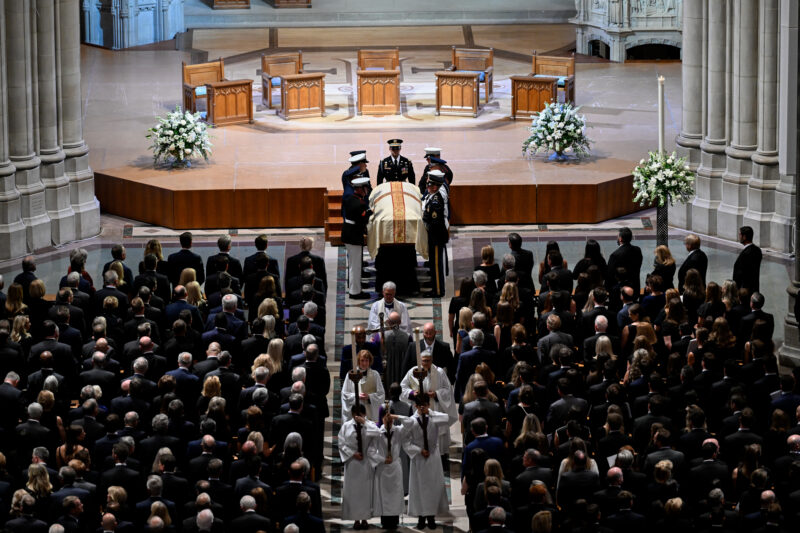





















Lischinsky and his girlfriend, Sarah Milgrim, who were Israeli Embassy employees, were killed in the Capital Jewish Museum shooting earlier this year
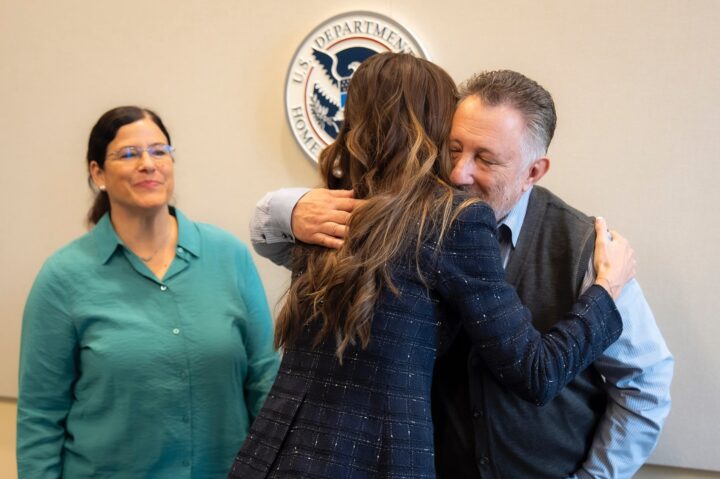
Secretary of Homeland Security Kristi Noem/Facebook
Secretary of Homeland Security Kristi Noem meets with Daniel and Ruth Lischinsky, November 21, 2025


 Add JewishInsider on Google
Six months after the death of their son, Yaron Lischinsky, and his girlfriend, Sarah Milgrim, in a shooting outside the Capital Jewish Museum, Daniel and Ruth Lischinsky visited Washington last week to meet with senior administration officials and visit the sites where their son — who, with Milgrim, worked at the Israeli Embassy — lived, worked and, ultimately, died.
Speaking to Jewish Insider during their time in the U.S. capital, the pair reflected on their son’s life and legacy.
“In the beginning it was a big shock for all of us because it was so unexpected — [it was] like an earthquake,” Ruth Lischinsky said of his killing. “Now, we are feeling much more — we are missing him much more. He’s not coming back home. He’s not calling, no message[s], no nothing. So it’s really hard.”
At first, Daniel Lischinsky said, they equated the experience to being on drugs. “We didn’t know where we are and somebody removed the floor beneath us.” But he said they were grateful for the support of their friends, family and community as they grappled with their loss.
He said that his son was a “very sweet boy” and “very gentle, very artistic, very sensible all the time”; he was passionate about soccer as a child and had visions of being a professional player.
“All the time [he was] looking [out] for other people. What are their needs, how are they feeling, approaching the people that are lonely or on the side when you are in big groups,” Daniel Lischinsky continued. “He was a peacemaker. He tried [to make] people understand one [another], talking with the other and not fighting. He was a big fan of the Abraham Accords and he was a peacemaker. He knew that through diplomacy he can reach and he can make achievements.”
It was that passion, his mother said, that led him to pursue diplomatic service and ultimately land in the Israeli Embassy in Washington. She said she’s been struck by the number of people that knew her son in the nation’s capital.
“I have so many opportunities reaching out to different communities,” she said. “He was in contact with so many people. We were really blown away when we realized it now, that so many people knew him and he had contact with them.”
Lischinsky “loved” his time in Washington and ended up “in the right place,” Daniel Lischinsky said.
During their time in Washington, the Lischinskys visited the site where their son and Milgrim were killed, outside the Capital Jewish Museum.
“Seeing the place where they [were] killed was the hardest part, of course,” Ruth Lischinsky said. “But we wanted to go there to somehow connect.”
They said they regretted that they did not have the opportunity to meet Milgrim in person before her death. The young couple had arranged to visit Lischinsky’s parents in Israel days after they were killed, and Lischinsky was planning to propose.
The Lischinskys traveled to Washington both to meet with administration officials involved in fighting antisemitism as well as to meet with Lischinsky and Milgrim’s colleagues at the embassy, and see where the couple had worked together.
Ruth Lischinsky said she’d been impressed by the dedication to fighting antisemitism expressed by the officials they met with — “they are really serious about it.”
Daniel Lischinsky said that they came to offer any help they can, but also told the officials that “they need to be stronger, much more strong against antisemitism, and against every crazy one that can be suspicious, like this murderer that took the life of our children. We told them that we don’t want to hear anymore about something like this, not here in Washington, D.C., and not in the States.”
Ruth Lischinsky added that the U.S. media needs to do a better job of accurately reporting what is happening in Israel. Daniel Lischinsky said that inaccurate reporting encourages violent attacks such as the one that killed Lischinsky and Milgrim.
The couple also called for better education, starting early in schools, and for stronger law enforcement response to suspicious individuals like Elias Rodriguez, who has been indicted on murder charges for the shooting.
The Lischinskys, referencing an issue that Milgrim’s parents have also spoken about publicly, expressed shock that protesters were allowed to gather for months directly outside the Israeli Embassy in Washington, making so much noise that they were disrupting work inside the building.
The pair have also been traveling to Jewish communities around the world, recently visiting the site of a bombing that targeted the AMIA Jewish community center in Argentina and the Jewish community in Los Angeles.
“We, all the Jewish people, the people in Israel, are praying for you, and you are helping us and praying for us, the Israelis and the people in Israel,” Daniel Lischinsky said. “We are very much encouraged by the support and the love of the Jewish community here in the U.S. It’s really a balsam for our hearts.”
In ‘Don’t Feed the Lion,’ protagonist Theo Kaplan helps middle school readers navigate antisemitism

Long before the Oct. 7, 2023, Hamas terror attacks, parents — especially Jewish parents — wondered and at times struggled with how to speak to their children about antisemitism.
In the midst of the antisemitism that exploded in the wake of the attack on southern Israel and continued to rise through the ensuing war between Israel and Hamas, journalists Bianna Golodryga and Yonit Levi found themselves navigating that challenge — and found no help to guide them.
“The fact that our kids are talking about it, [it’s] something I’m dealing and grappling with in New York City in 2023 at the time,” Golodryga, a CNN news anchor, told Jewish Insider in a recent interview. “I never thought that we’d be having to address [it] so directly. But there were no resources on this issue. I asked my kid’s school about it, [saying], ‘What are you doing to address antisemitism?’ And in a longly worded statement, it was clear that there were no resources. They weren’t really doing anything.”
In Israel, Levi, an anchor on Israel’s Channel 12, was asked about antisemitism by her pre-teen son. “And I was sort of floored by it,” she told JI. “I didn’t even know how to begin answering because I wasn’t planning to answer that question, explaining and answering a lot of other questions that Oct. 7 brought to the table.”
As a result, Golodryga said, “Yonit and I decided to try to write the book we couldn’t find.” The result was their debut book, Don’t Feed the Lion, released on Tuesday.
After the Oct. 7 attacks, Golodryga and Levi spent much of their professional bandwidth reporting on the war. The weekly writing and brainstorming sessions for the book, Golodryga explained, were “cathartic” and provided an opportunity to “step aside and away from all of the breaking news and the heartache of the day.” For Levi, having that support system and the experience of writing the book amid so much turmoil at home was “like a ray of light inside this darkness of the last two years.”
Don’t Feed the Lion is a novel targeted to middle school students, but with lessons, scenarios and parables that anyone who has experienced or witnessed discrimination — in any of its forms — will recognize.
The book’s main plot point revolves around a pair of Jewish siblings in Chicago. The older of the two, Theo Kaplan, a soccer enthusiast and co-captain of his school’s team, is shaken when prominent soccer player Wes Mitchell goes on an antisemitic rant. Days later, the eighth grader’s teammates vandalize his gym locker with a swastika. Theo, who is weeks away from his bar mitzvah, faces inner turmoil as he grapples with the fallout of Mitchell’s comments and the responses to the incident by his friends, teammates and school administrators. (Spoiler alert: the school is more than happy to sweep the incident under the rug.)
Meanwhile, Theo’s younger sister, Annie, sneakily creates an account on a social media platform in an effort to get concert tickets, but ends up falling into a Reddit-esque black hole of antisemitic drivel, which she attempts to fight despite being far outnumbered by anonymous online trolls.
Theo finds himself an ally in Gabe, a new student who moved to Chicago after his mother’s death from COVID-19. Gabe, although an outside observer, becomes the readers’ eyes and ears into the Kaplan family when he is paired with Theo for a family heritage project that sees the two spotlight Theo’s grandparents, Ezra and Talia.
“It’s obviously a fictional book, but there are several real-life experiences that we’ve encountered, that I’ve encountered with some family members, going back several years ago, where antisemitism not only wasn’t really addressed, but when it was facing students and faculty members at schools, it wasn’t treated or given the prioritization that that other forms of hate were given,” Golodryga said.
But whereas many stories and fiction novels about Jewish families settle into tired tropes, Don’t Feed the Lion takes a more realistic approach to the American Jewish experience: Ezra and Talia are a mixed Ashkenazi-Mizrahi couple — a rarity in the world of Jewish literature. The family dynamic is challenging, with estrangement between Theo and Annie’s grandparents and their aunt’s family. And Theo faces the relatable social pressures that many young assimilated Jews encounter as they feel torn between spending Friday nights socializing with friends during a time traditionally set aside for Shabbat meals with family.
Beyond capturing the zeitgeist of the modern American Jewish family, Theo is a relatable protagonist — owing in part to Golodryga and Levi’s own children, who inspired elements of Theo’s personality, backstory and experiences. Golodryga recalled her son’s reaction to the response, in 2022, to antisemitic social media posts made by then-Brooklyn Nets star Kyrie Irving.
“It seemed like everyone was apologizing for him but him, and he was allowed to play,” she explained. Irving was ultimately suspended for eight games, more than a week after the initial social media post, after repeated opportunities in which he had refused to distance himself from the content of the post. NBA heavyweights, including LeBron James and Jaylen Brown, a vice president in the NBA’s players’ union, defended Irving at the time.
Golodryga said her son didn’t know how to approach the situation. “As a New Yorker, he even said, ‘So can I not go to games? Or can that mean that I shouldn’t be a fan, or I can’t watch him anymore? He doesn’t want me to.’ So that’s always sat in the back of my mind.”
Where art perhaps most imitates life is in how administrators in the story respond to the swastika incident — not by addressing it head-on, but by hoping to sweep it under the rug, thereby avoiding the need for disciplinary action that could keep Theo’s soccer team from advancing to the state-level competition.
At the heart of the book, Levi said, is “that the kids really get what’s wrong and what’s right” — even when the adults in the room do not. “At the end of the day, it’s like the grown ups [in the book] and in reality too, sort of obfuscate … and say, ‘Maybe I shouldn’t stand up because it’s not good for my workplace, or it’s too much bureaucracy,’ or all the other things that are said in this book, and the kids at the end of the day, they know, they get what is wrong and what is right.”
Please log in if you already have a subscription, or subscribe to access the latest updates.
 Continue with Google
 Continue with Apple