



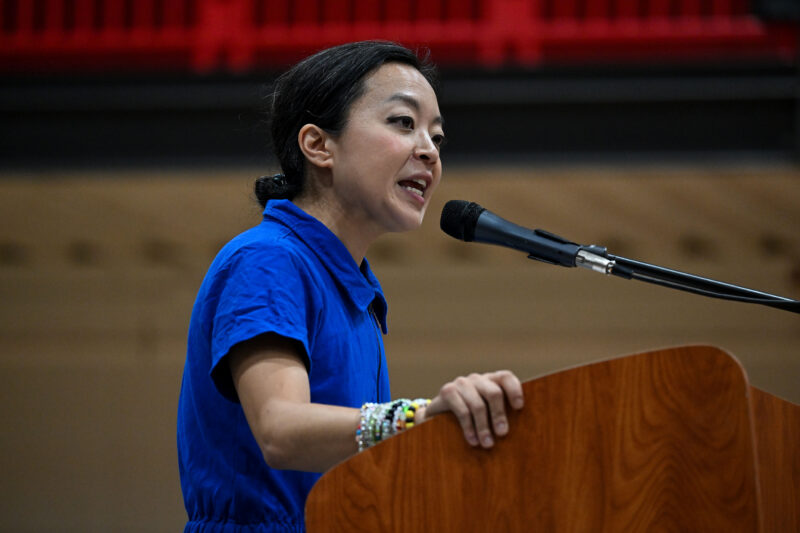




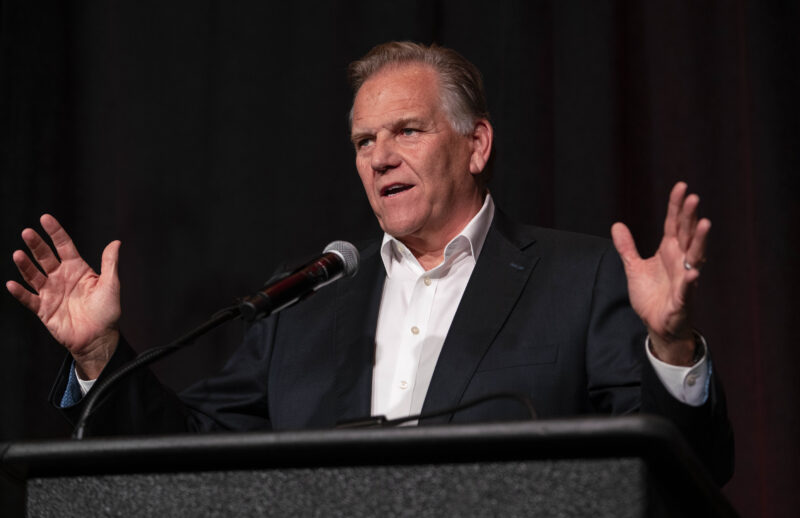

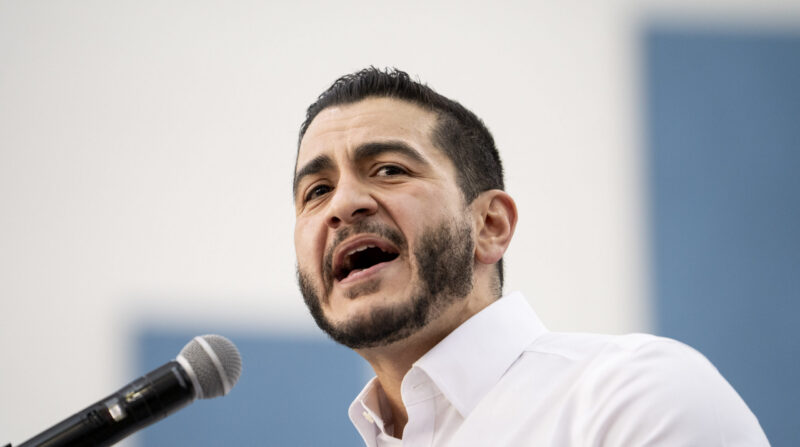






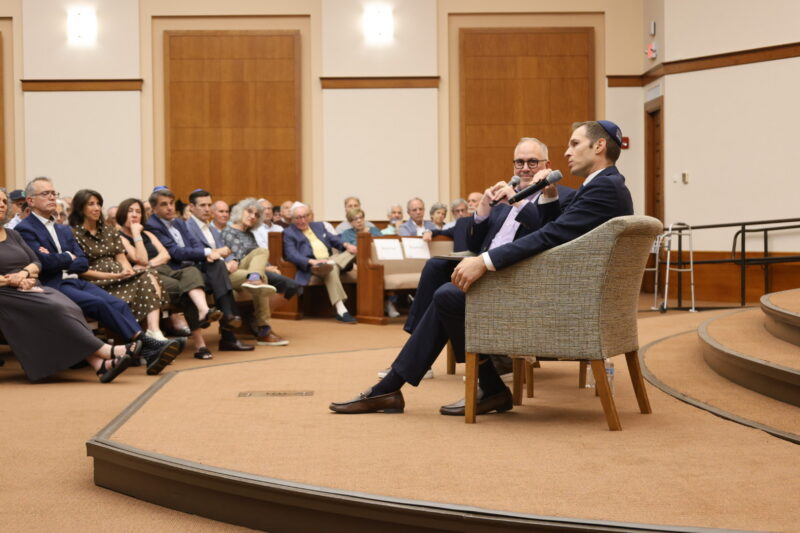



















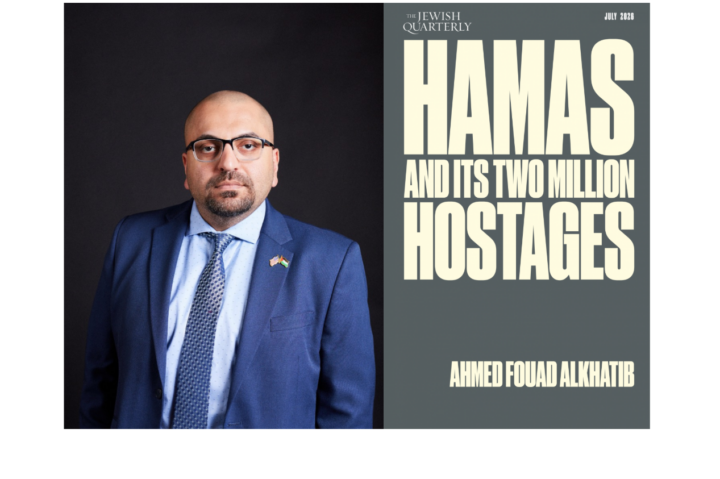
Ahmed Fouad Alkhatib, a Gaza native who lost 33 family members in Israeli airstrikes, argues in his new book that Hamas bears primary blame for Palestinian suffering and political stagnation


 Add JewishInsider on Google
Ahmed Fouad Alkhatib, who lived in the Gaza Strip from the age of 10-15, describes himself as an advocate for the Palestinian people. Since the Oct. 7, 2023, Hamas-led terror attacks in Israel, 33 of Alkhatib’s immediate and extended family members have been killed. But in his latest book, Hamas and Its Two Million Hostages, Alkhatib argues that Hamas — rather than Israel — bears primary responsibility for the suffering and political stagnation of the people of Gaza.
Alkhatib is a resident senior fellow at the Atlantic Council, where he directs Realign for Palestine, a project focused on pragmatic, nonviolent Palestinian advocacy. There, he denounces Hamas and advocates for Palestinian statehood alongside a secure Jewish state.
On Friday, Alkhatib spoke with Jewish Insider about his new book, his experiences growing up in Gaza and his outspoken criticism of Hamas. He also discussed the backlash he has faced from within his own community and why he believes that, ultimately, the terrorist group will have no role in the enclave’s future.
This interview has been condensed and edited for clarity.
Jewish Insider: What inspired you to write Hamas and Its Two Million Hostages, and what does your book add to public debate on this issue that isn’t already out there?
Ahmed Fouad Alkhatib: I wanted to weave in elements of my personal story with Gaza’s contemporary history, and add a human dimension to what I felt was Hamas’ devastating impact on the Palestinian people, their destructive role in setting back the Palestinian national project and the radicalization of the society.
I felt that there’s a consistent gap in the discourse from a Palestinian self-interested point of view. Even though many Palestinians and Arabs and Muslims will tell you privately how devastating Hamas is, there’s a disconnect in the discourse outside of Gaza versus inside Gaza — where you’ll find a ton more willingness to speak out, not just because of the consequences of Oct. 7, but because of the totality of the last 20 years of their rule.
One of the things that’s really frustrating is how there is this persistent narrative that Gazans are all Hamas, Gazans support Hamas. It’s very difficult for the other side, for the Israelis and the pro-Israel folks, to see the humanity of Palestinians because they so fundamentally believe that Gaza is inseparable from Hamas. Nevertheless, I argue and maintain that directly and indirectly, Hamas has taken Gaza captive and is holding 2 million people as hostages.
For the pro-Palestine folks, the goal is to burst the bubble of Hamas, which has been getting normalized since Oct. 7, getting called “resistance” or at best receiving token critique. It’s like a check the box: “Oh, I’m not with Hamas, but let’s keep going on Israel, and Israel this and everything is Israel’s fault.” At its worst, it’s actually been lionizing Hamas — refusing to call for the release of hostages, refusing to acknowledge the pain and suffering they’ve caused for the Palestinian people … Hamas has been a disaster. It has destroyed the seams of the Palestinian society and the fabric, and it’s been part of this devolution.
I also made it a short book deliberately for the average casual reader … I wanted to target a lot of younger audiences … because with the avalanche of new entrants to the scene since [Oct. 7], you have people that quite simply don’t know about Hamas, about the Palestinian people or about Gaza. I believe the theme of this book is that within the imbalance of power dynamics between Israel up here and the Palestinians down here, believe it or not, there is plenty of space for Palestinian agency, responsibility and accountability. That’s not blaming the victims or self-hatred — that’s actually the first step to empowering the Palestinians.
JI: You reflect in the book on your own experiences and those of your family in Gaza. How did these experiences shape the way you approach this book, and how did they shape your understanding of Hamas? Did you find that other Gazans shared your sentiments?
AFA: Well, in some ways, my lived experiences are very central to where I’ve arrived. My family are very devout Muslims and committed Palestinians. My family grew up in a Gaza context, and they were not immune to some of the broader trends. So on one hand the family context was helpful and relevant, and on the other hand it was not necessarily responsible for where I’m at right now because my family was kind of an average lower middle class that engaged in this topic. Very educated, but also not the most politically engaged. Very independent, very willing to stay clear and interested in staying clear from Fatah, from Hamas, from all the other different factions, and I think that was very key.
I remember the hope and optimism of the tail end of the Oslo [Accords] years in the ’90s — flying into Gaza’s airport, these shiny new Palestinian passports, the Palestinian airlines, the cell phones, the industrial zone, the kind of renaissance and the sense of hope and optimism and the march toward statehood. In the midst of all of that, Hamas’ counter-narrative was, “Oh no, the Palestinian Authority and the [Palestine Liberation Organization] sold out, they gave up 78% of historic Palestine, and we are going to bring you something better.”
And I just remember being like, “What’s there that’s better than the opportunity to travel freely, an airport, an incoming seaport, the beginning of the symbol of sovereignty and statehood?” On top of all of that, Hamas said, “We’re going to bring you the whole of Palestine from the river to the sea,” but then said, “Oh, by the way, we need to take this detour so let’s go burn a bar that has liquor, let’s control how women dress, let’s make the society more Islamist.” I distinctly remember [saying to] my parents and my uncles, “This is a detour that has nothing to do with negotiating a better outcome or achieving better results for the Palestinians.”
I tell the story of one time going to a summer camp that turned out to be a Hamas summer camp, and neither my family nor I knew that. I must have been 11, and I just remember being like,
“What is any of this?”
There was a very robust pushback against Hamas and against this trend, but parts of the society ultimately either acquiesced or essentially had no option but to go along because Hamas moved the Overton window — including for the moderate and secular Palestinian Authority and [former PLO and PA leader Yasser] Arafat, who had to accommodate Hamas and incorporate elements of Islamism and resistance culture. That is the theme I try to convey: Hamas slowly and gradually shifted the Overton window of what’s acceptable discourse, not just for itself, but for the entirety of Palestinian society, its national project and its political atmosphere.
JI: You talked to CNN earlier this week about what you described as the “troubling persistence of support” for Hamas among some Palestinian activists and diaspora communities, noting that 44% of American Muslims told Pew Research that they support Hamas. Why does support for Hamas persist in these activist circles, and how do you reverse that trend?
AFA: There are many Palestinians, Palestinian Americans, Muslim Americans and Arab Americans who, when you speak to [them] privately, will tell you that Hamas is a gift to the far right in Israel, that Hamas is gross, that Hamas is disgusting. They don’t want to live under a regime that resembles Hamas — they want to live a normal life. But when you step back in a communal dynamic — whether it be the clergy, elements of the community in academia or parents who are guilt-ridden — you have sociological factors and identity crises that contribute to this trend.
Then there is a much more sinister element: elements of academia, journalism and the “social justice” far left who are not Palestinian or Arab or Muslim, who have concocted a variety of frameworks for how you see these conflicts. They want to map out Israel and Palestine to existing frameworks in domestic discourse around immigration, abortion rights, LGBT issues and Black Lives Matter.
You have modern-day anti-Zionism regularly devolving into antisemitism, and a departure from the broad framework of two peoples, two states. Right now, it is very much so a “river-to-the-sea” eliminationist discourse. Israel is seen as an extension of the United States — whether due to the presence of Ashkenazi Jews that are white-presenting, even though half of Israel are Mizrahi Jews of essentially brown origin and darker origin from Arab lands and from the Middle East, whether it be Israel’s founding being considered a purely European Zionist-led colonial project and not something that has anything to do with Jewish peoplehood and heritage and connection to the land, and so there are just these overly simplistic narratives that are not conducive to productive dialogue.
Part of this support for Hamas is an overcorrection to what people felt was an effort by parts of the pro-Israel community to suppress legitimate critique of Israeli actions. But when the pendulum swung, it didn’t swing toward narrow, targeted advocacy for Palestinian freedom and self-determination next to a safe, secure, recognized Jewish Israel. It swung to, “No, actually, we need resistance to eliminate the Zionist entity.”
Hamas very much so cared about the public relations war and narrative warfare because it thought this level of activism would not only delegitimize Israel, but also coerce Israel into stopping the war. Neither happened. Palestinian suffering was irrelevant to a lot of these communities, because they didn’t react when I and many others in Gaza were saying what was necessary for this suffering to end: closing the page on Hamas taking 2 million people as hostages in its suicidal jihadi nihilism.
JI: Have you faced criticism from within your community for placing so much attention on Hamas in your book rather than Israel, and how are you navigating that?
AFA: It is very frequently that I face critique. People say that I’m obsessed with Hamas, that I’m a nutjob, I’m a Zionist, I’m paid by Israel. Now they’ve shifted to saying that I’m a traitor and a sellout.
I see no shortage of people talking about what Israel has done and what Israel is doing right now in Gaza — including Prime Minister [Benjamin] Netanyahu, whom I acknowledge potentially worsened this situation through direct support for Hamas via Qatari funding. I have no illusions about the fact that Israel bears responsibility in worsening multiple aspects of the discourse, whether it be not empowering the Palestinian Authority, the aggressive expansion of settlements or the recent activities under the current coalition.
My goal is not to simply repeat what people who are even smarter than I am are out there talking about, often speaking in circles to their own choirs. I want to address a gap — and a significant one at that. That gap is that my family and tens of thousands of Palestinians would still be alive had Hamas simply kept its terrorists at home on Oct. 7.
Hamas is treated as an extra on a movie set when it needs to be one of the main antagonists in this whole film. Hamas is a central player in this whole devastation that has befallen Gaza. I see the rightward shift in Israeli society that everybody talks about all the time as inseparable from Hamas and what it did in Gaza and the suicide bombings and what it did to radicalize the Palestinian people in Gaza and in the West Bank.
JI: What do you believe Hamas will look like in the years ahead? Do you believe it is possible for Gaza to have a future without Hamas — and one that is different for both sides of this conflict?
AFA: I don’t believe there can be any coexistence with Hamas. I think they need to be effectively banned from the scene. When people say Hamas can’t be defeated, it absolutely can be defeated. I don’t care about Hamas’ ideology per se. The Nazi ideology lives on all these years. Al-Qaida is alive and well after [Osama] bin Laden. ISIS is alive and well, even though they don’t theoretically control mass territories like they once did.
What I care about is three metrics through which you can judge and assess Hamas’ ability to remain relevant and be defeated: Do they control territory? Do they have an executive force on the ground that can have a monopoly on violence and force and act as an administrative body? And do they control resources — financial, taxation, access to aid and incoming resources, or smuggling? In those three metrics, Hamas has been significantly rolled back.
More likely than not, it is my belief that Hamas is going to be largely irrelevant in Gaza. Hamas is not going to govern like it once did. The days of Hamas reigning supreme and controlling Gaza are over. Hamas may try to remanufacture itself as a political body, as a political entity, but in terms of controlling Gaza like it once did, I see that as incredibly unlikely. Their inventory of weapons and arsenal is very finite. They’re not smuggling weapons like they once did, and a lot of their supplies, workshops and spaces have been destroyed and rolled back. Whether it be through disarmament, Israeli elimination or decay — I think Hamas’ arsenal is going to recede to where it not only no longer constitutes a threat to Israel, but it no longer is adequate to entirely rule the Gaza Strip.
My concern is that Hamas is moving to Turkey. The Turks might be trying to help them reinvent themselves as a political organization. If they enter Palestinian elections, will they then further ruin democratic life? Will they evolve their so-called armed resistance narrative into something that can introduce political stalemate?
Right now, largely speaking, Hamas, Israel, the Board of Peace, the Trump administration and regional and international partners are in agreement over the next steps as far as disarmament, which is a prerequisite to get any kind of withdrawal or reconstruction happening in Gaza. However, now we’re in a space where the disarmament issue is actually logistical in nature. Logistics can make or break a war, a campaign or an effort, and right now, logistically, the disarmament plan is just — it’s not there. It’s not there. That’s what concerns me.
Over a dozen new graduates unfurled Palestinian flags and signs while on stage at the United Palace Theatre receiving their diplomas to applause and cheering

SCREENSHOT
CUNY School of Law commencement ceremony, May 21, 2026
CUNY School of Law once again featured anti-Israel activity at its commencement ceremony on Thursday, allowing antagonistic student activity during its graduation events for the fourth straight year.
Over a dozen new graduates unfurled Palestinian flags and signs while on stage at the United Palace Theatre receiving their diplomas to applause and cheering.
One sign read, “CUNY divest from genocide now.” Another poster said, “resistance is the deepest form of love.”
While anti-Israel protests and speeches surged at university commencements nationwide after the Oct. 7, 2023, Hamas attacks and amid the ensuing war in Gaza, CUNY Law — the only publicly funded law school in New York City — was already grappling with this trend years earlier. The school did not respond to a request for comment from Jewish Insider about this year’s graduation.
In 2023, graduate Fatima Mousa Mohammed delivered remarks that were highly critical of Israel, the NYPD and New York City leadership in her student-selected address. “Israel continues to indiscriminately rain bullets and bombs on worshipers, murdering the old and young,” said Mohammed, a Yemeni immigrant who was a student activist involved with Students for Justice in Palestine. “It continues its project of settler colonialism expelling Palestinians from their homes.”
The year before, Palestinian-American graduate speaker Nerdeen Kiswani encouraged “the fight against capitalism, racism, imperialism and Zionism around the world” and condemned university administration for “normalizing” trips to Israel for students and faculty. Kiswani, who was also involved with SJP while a student, went on to co-found Within Our Lifetime, a radical anti-Israel organization that has engaged in antisemitic demonstrations including outside of New York City synagogues.
In 2024, CUNY Law eliminated live student and faculty addresses at commencement, causing eight CUNY Law graduates to file a federal First Amendment lawsuit against the university.
This year, when the school did not allow a student commencement speaker at all, Jewish Voice for Peace condemned CUNY’s decision, calling it “deeply perverse that an institution that prides itself on being the people’s university and loudly proclaims its commitment to student-centered learning would take steps to silence students at what should be a celebration of their achievements and future promise. This censorship displays a cowardly disregard for your students’ right to political expression. It also deeply damages CUNY’s reputation.”
Mashaal, who resides in Doha, hailed Qatar's ‘honorable role’ in the Palestinian cause
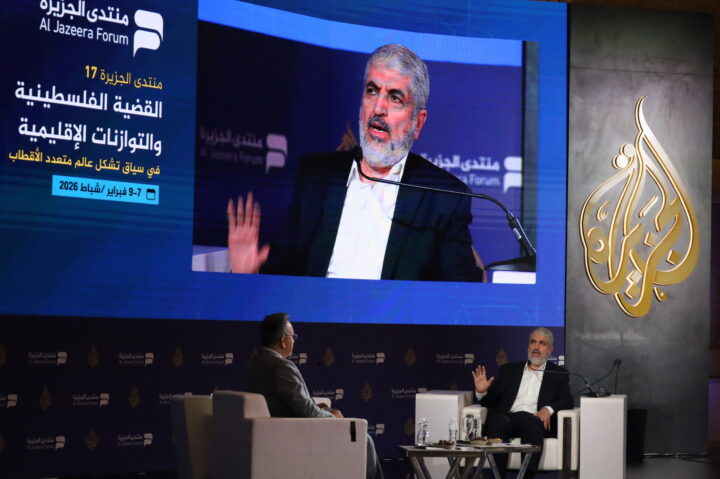
Ali Altunkaya/Anadolu via Getty Images
Hamas leader Khaled Mashaal speaks on the second day of the 17th Al Jazeera Forum held in Doha, Qatar on February 8, 2026.
Hamas leader Khaled Mashaal addressed Qatar’s 17th Al Jazeera Forum on Sunday, at a conference that focused heavily on denigrating Israel, while featuring senior officials from Iran and Somalia.
Mashaal applauded the group’s Oct. 7, 2023, attacks on Israel as having “brought the Palestinian cause back to the forefront of the world” and said that Palestinians “take pride” in “resistance,” a euphemism for violence against Israelis. He called to “pursue Israel and establish that it is a pariah entity that is losing its international legitimacy,” noting the “changes in the elites, universities and social networks” against Israel.
The Hamas leader, who resides in Doha, also hailed Qatar’s “honorable role in the [Palestinian] cause.”
Hamas is designated by the U.S., European Union and other countries as a terrorist organization, and Mashaal is wanted in the U.S. for terrorism, murder conspiracy and sanctions evasion relating to his role in planning the Oct. 7 attacks.
Mashaal was listed on the conference’s program and list of speakers in versions of the Al Jazeera Forum website archived by independent researcher Eitan Fischberger, but as of Sunday Mashaal was no longer listed. At the same time, the Al Jazeera Forum X account extensively promoted Mashaal, with 19 posts about the terror leader’s remarks. The account featured two posts about conference keynote speaker Abbas Araghchi, the foreign minister of Iran.
This year’s Al Jazeera Forum theme is “the Palestinian cause and the regional balance of power in the context of an emerging multipolar world.” The conference website suggests that Israel committed a “genocide in Gaza,” and that Israel “has sought to reoccupy Gaza … or establish settlements in it.” It also argues that Israel faces strategic setbacks as a result.
The speakers’ remarks reflected the forum’s hostile position on Israel.
Araghchi lamented a double standard toward “Israeli expansionism,” arguing that “other countries are demanded to disarm, pressured to reduce defensive capacity, punished for scientific advancement … This is not arms control, not non-proliferation, not security. It is enforcement of permanent inequality. Israel must have a military and strategic edge and others must remain vulnerable.”
Araghchi, speaking a day after he led his country’s negotiations with the U.S. in Oman on dismantling its nuclear program, said that it has an “inalienable right to enrich uranium.”
The Iranian foreign minister also said that “Palestine is the defining question of justice … The strategic and moral compass of our region.”
Somali President Hassan Sheikh Mohamud floated the possibility of war with Israel in a pre-conference interview aired on Al Jazeera. He questioned why Israel would want to build a military base “in Somalia,” referring to reports of activity in Somaliland, whose sovereignty Israel recognized in December. He argued a base could only be offensive, ignoring repeated attacks by the Iran-backed Houthis, from nearby Yemen, on Israel.
“Israel is preparing or positioning itself to attack someone else,” he said. “We will fight in our capacity; we will defend ourselves, and that means that we will confront any Israeli forces coming in, because we are against that and we will never allow that.”
Another speaker was Francesca Albanese, the U.N. special rapporteur who has been sanctioned by the U.S. for “infringement on the sovereignty” of Israel and the U.S. by pursuing International Criminal Court prosecutions of citizens of both countries, as Secretary of State Marco Rubio described her actions last year.
Albanese claimed in her remarks, delivered via video, that Israel had committed a premeditated genocide of Palestinians in Gaza, and that all of humanity “now has a common enemy” in Israel.
The event comes days after students who caused $1 million in damages during a protest against Israel’s war in Gaza were allowed to return to campus

GENNA MARTIN/San Francisco Chronicle via Getty Images
Suzzallo Library at the University of Washington.
A university professor who resigned from her position following a Title VI antisemitism investigation, and another who organized large-scale anti-Israel demonstrations, are among several controversial speakers scheduled to speak at an event on Friday hosted by the University of Washington.
The day-long conference, called “The World as Palestine: On Advocacy, Activism, and Justice,” is organized by the Middle Eastern Studies department and is scheduled to be held in the university’s student union building.
Andrea Brower, a former instructor in a “Solidarity and Social Justice” program at Gonzaga University in eastern Washington, is scheduled to speak during the program’s opening panel, “Reflections from Eastern Washington’s Palestinian Liberation Movement.” She resigned in 2024 after the school opened an antisemitism investigation into the protests she led on campus against Israel’s war in Gaza and her criticism of the university’s investment in companies with ties to Israel.
The panel will examine “academic dissent, critical thought, and resistance with reflections from Eastern Washington’s Palestinian liberation movement,” according to its registration page.
Another speaker on the panel will be Majid Sharifi, the director and professor of international affairs at Eastern Washington University. When Iran fired hundreds of ballistic missiles and drones at Israel in October 2024, Sharifi told CBS News Miami that Iran was “defending itself” after its “sovereignty was violated” by Israel’s assasination months prior of Hamas leader Ismail Haniyeh in Tehran.
The third speaker alongside Brower and Sharifi is Kathryn DePaolis, an associate professor and interim chair and director of the School of Social Work at Eastern Washington University. DePaolis helped create a new group called the Inland Northwest Coalition for the Liberation of Palestine two months after the Oct. 7, 2023, Hamas terrorist attacks. During Israel’s war in Gaza, the organization staged Palestinian “die-ins” in front of the Spokane courthouse.
“The event isn’t about the scholarship of activism, which would be different — it’s activism itself,” a Jewish faculty member at UW told Jewish Insider. “It’s using state resources to promote an ideology and worldview that contributes to antisemitism and anti-Zionism on campus.”
Other panel topics are “Lessons from the Palestinian and Filipino Struggles for Liberation” and “Activism and Civic Engagement in Washington State.” Laila Taji, an author speaking on the latter panel, has ties to the radical student group Students United for Palestinian Equality & Return (SUPER UW), which led a destructive protest on campus last year over the school’s ties to Boeing — and Boeing’s ties to the IDF — that caused more than $1 million in damages to the university’s engineering building.
The event will also screen “The Palestine Exception,” a documentary about “professors and students as they join calls for a ceasefire and divestment from companies that do business with Israel and face waves of crackdown from administrators, the media, the police and politicians,” according to the film’s synopsis.
Neither the UW administration nor Washington Gov. Bob Ferguson responded to requests for comment from JI about the selection of speakers for the event at the university, which is a public college.
The event comes days after students from SUPER UW who were suspended and arrested last spring for their participation in the engineering building vandalism were allowed to return to campus, Victor Balta, a spokesperson for the university, confirmed to JI. “The student conduct hearing process has been completed and the students have been found responsible for violations of the student conduct code and held accountable. The students were out of class and banned from campus for three quarters,” said Balta. Twenty-one students were suspended at the time.
“Suspensions also resulted in forfeiture of tuition paid or the repayment of tuition by any student who must remain in good standing in order to receive financial aid, such as tuition exemption grants for graduate students or work study. Once a suspension is concluded, any outstanding balances due must be paid in order to be eligible for re-enrollment,” Balta continued.
The students could still face criminal charges, though none have been brought in the nine months since the protest. The incident also led the Trump administration’s Task Force to Combat Antisemitism to open a review into the university.
SUPER UW was suspended as an official student organization in December 2024 after its members were charged with “vandalism,” “unauthorized keys, entry, or use,” “failure to comply” and “disruption and obstruction” by the school’s administration, according to the group. As a result, SUPER UW does not have access to school resources but can still gather on campus.
In August, Secure Community Network, found that a manifesto released by SUPER UW — which the student group published on Medium shortly before its building takeover began — was inspired by a foreign terrorist entity.
The document praised Hamas’ Oct. 7 terrorist attacks in Israel as a “heroic victory” and said the group looks to “the rich history of struggle in our university for strength and inspiration as we take action.” SUPER UW also released a statement of solidarity with the Samidoun Palestinian Prisoner Solidarity Network, a fundraising arm of the terror group Popular Front for the Liberation of Palestine that was designated as a terror group by the U.S. Treasury Department in October 2024.
Plus, Trump mulls military action as Tehran murders protesters
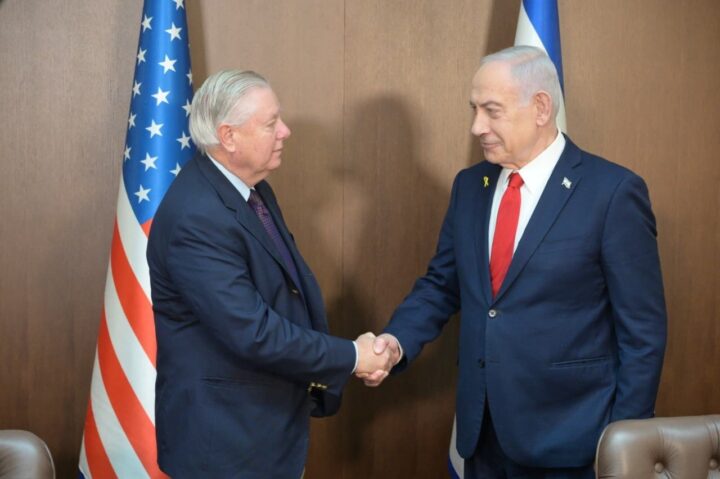
Amos Ben Gershom via Getty Images
Israeli Prime Minister Benjamin Netanyahu (R) meets with U.S. Senator Lindsey Graham (L) at the Israeli Prime Minister's Office in Jerusalem on December 21, 2025.
👋 Good Monday morning!
In today’s Daily Kickoff, we bring you the latest on the anti-government protests in Iran and the U.S.’ new threats to the Islamic Republic if it continues killing protesters, and report on Israeli Prime Minister Benjamin Netanyahu’s comments published on Friday that Israel wants to phase out U.S. aid in the next decade. We cover Saturday’s arson attack targeting Mississippi’s oldest synagogue, and report on New York City Mayor Zohran Mamdani’s stalled and muted response to pro-Hamas demonstrators who rallied outside a synagogue last week. Also in today’s Daily Kickoff: Jerome Powell, Larry Page and Miriam Zivin.
Today’s Daily Kickoff was curated by Jewish Insider Executive Editor Melissa Weiss and Israel Editor Tamara Zieve, with assists from Danielle Cohen-Kanik and Marc Rod. Have a tip? Email us here.
What We’re Watching
- Mahmoud Abbas, the 90-year-old longtime president of the Palestinian Authority, is in a hospital in Ramallah this morning. According to the Palestinian Authority’s official news agency Wafa, he is undergoing routine medical checkups.
- We’re monitoring the situation in Iran where the death toll has risen in recent days as the regime ramps up its crackdown on the nationwide protests. President Donald Trump is set to be briefed tomorrow on options to respond to the escalation. More below.
- Trump is expected to announce the global leaders of the U.S.-backed Gaza Board of Peace this week. The first meeting of the board is set to take place later this month on the sidelines of the World Economic Forum in Davos, Switzerland. The board’s launch comes as Israel prepares plans for a potential ground operation in Gaza in response to Hamas’ refusal to disarm.
- Qatar is signing the U.S.-led Pax Silica declaration today, joining the effort to strengthen AI and semiconductor supply chains. The United Arab Emirates is set to sign onto the declaration later this week. Israel, Japan, South Korea, Singapore, Britain and Australia are already part of the coalition.
What You Should Know
A QUICK WORD WITH JI’S GABBY DEUTCH
As another election year gets underway, two liberal Jewish politicians offered a window last week into just how fraught the issue of Israel has become in some Democratic primaries — and how even pushing back against claims that Israel is committing genocide is inviting intraparty political backlash, at least in the deepest-blue parts of the country.
Rep. Dan Goldman (D-NY) faces a primary challenge from the left in Brad Lander, the former New York City comptroller endorsed by Mayor Zohran Mamdani. When Goldman formally launched his reelection campaign last week, he was asked by a reporter if he believes Israel has committed genocide in Gaza. Goldman equivocated — a notable shift for a lawmaker who in February 2024 signed onto a letter calling claims of genocide in Gaza “false.”
“I think there needs to be a serious investigation into what went on in Gaza during the war,” Goldman said. “What you call it is I think more of a legal matter, in my view, but what we all can agree on is that the destruction [in Gaza] was unconscionable and devastating and I am really grateful that it is over and the hostages are out and we can move forward.” (Lander, in contrast, has accused Israel of genocide.)
Across the country, in San Francisco, California state Sen. Scott Wiener, a Democrat running to replace Rep. Nancy Pelosi (D-CA), was asked the same question at a candidate forum. His two primary opponents — Connie Chan, a member of the San Francisco Board of Supervisors, and Saikat Chakrabarti, former chief of staff to Rep. Alexandria Ocasio-Cortez (D-NY) — both raised placards that said “yes.” Wiener did not raise either the “yes” or “no” placard.
Wiener followed up with a post on X claiming that the Israeli-Palestinian conflict “demands more discussion and certainly more time,” which, after receiving blowback on social media, he subsequently deleted. He then backtracked completely: On Sunday afternoon, Wiener posted a video to social media stating that he’s “stopped short of calling [Israel’s actions in Gaza] a genocide, but I can’t anymore.”
FIREBOMBING PROBE
Jackson’s only synagogue targeted in arson attack
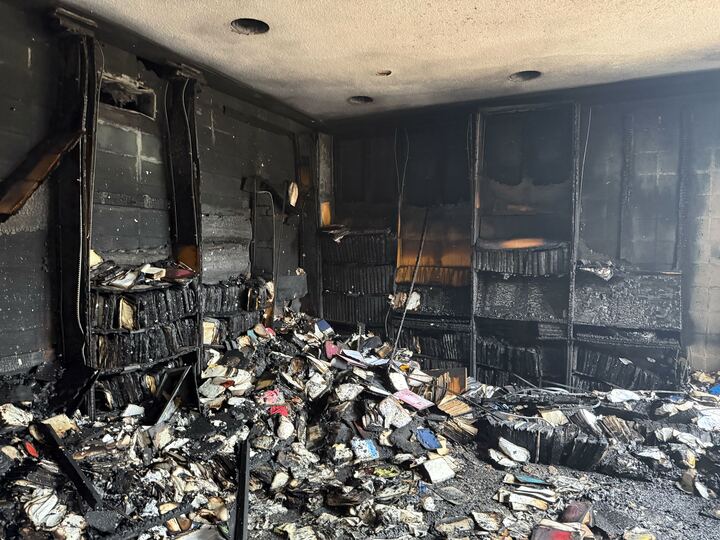
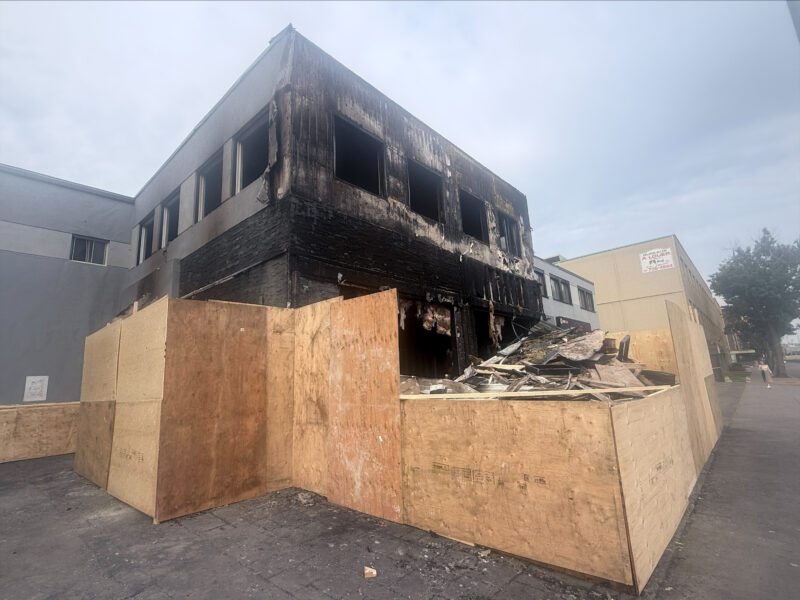
A suspect is under arrest for an arson attack that significantly damaged Mississippi’s largest synagogue early Saturday morning, authorities reported. Local law enforcement arrested a suspect whom they believe purposefully set fire to Beth Israel Congregation in Jackson shortly after 3 a.m. Saturday, Jackson Mayor John Horhn confirmed. The suspect’s name and motive have not been disclosed, Jewish Insider’s Haley Cohen reports. According to internal security camera footage, a person was filmed splashing liquid along a wall and onto a couch inside the synagogue’s lobby shortly before the fire was ignited, Mississippi Today reported.
Storied past: Beth Israel Congregation is the only synagogue in Jackson, the state’s capital and most populous city. The historic building also houses the offices of the Institute of Southern Jewish Life, which supports Jewish life in the region. Located in a major hub of the Civil Rights Movement, Beth Israel was bombed in 1967 by the Ku Klux Klan over the rabbi’s support for racial justice — including providing chaplain services to activists incarcerated for challenging segregated busing in the state.
TOUGH TALK
Tehran threatens to attack U.S. bases as Trump considers military options against Iran
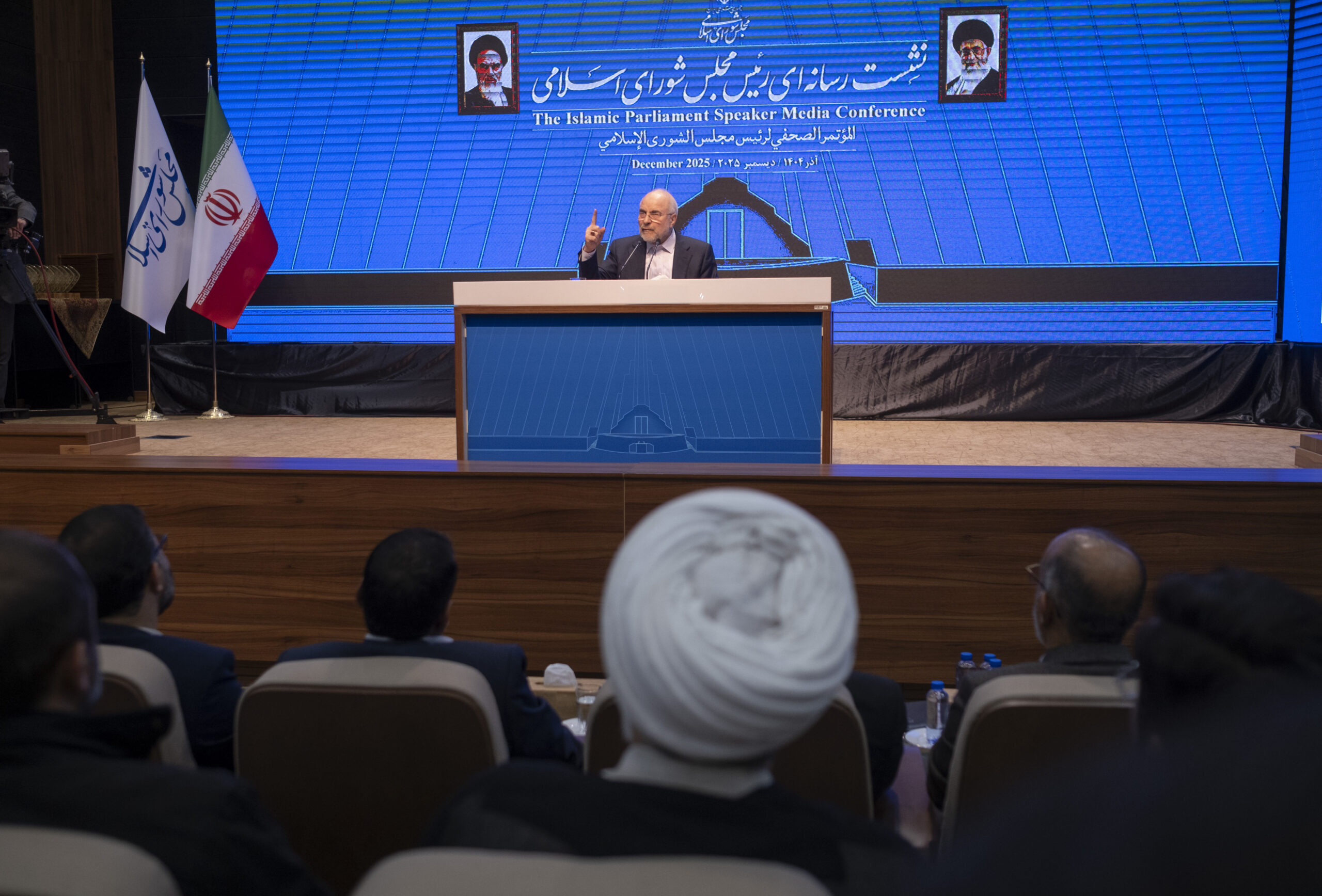
Tensions between the U.S. and Iran escalated on Sunday as President Donald Trump weighed options for striking Iran amid the regime’s crackdown on protesters, and Tehran threatened to strike U.S. bases in response, Jewish Insider’s Danielle Cohen-Kanik reports. Trump was briefed in recent days on options for sites to strike in Iran, The New York Times reported, after he issued several threats warning that the U.S. could get involved if the Iranian regime attempted to violently suppress the nationwide demonstrations that have racked the country for several weeks.
Returning the threat: In response, Mohammad-Bagher Ghalibaf, the speaker of Iran’s parliament, said on Sunday that the country would attack American military bases in the region if the U.S. follows through, and even raised the possibility of a preemptive strike. Ghalibaf also threatened to attack regional shipping lanes and Israel.
Further messaging: Iranian Foreign Minister Abbas Araghchi told a conference of foreign ambassadors today that Tehran “is not seeking war but is fully prepared for war,” and is “also ready for negotiations but these negotiations should be fair.” Speaking to reporters on Air Force One on Sunday, Trump, asked whether the regime has crossed his red line, said, “They’re starting to,” … “We’re looking at it very seriously. The military is looking at it, and we’re looking at some very strong options. We’ll make a determination.”
AID EXIT
Netanyahu: Israel seeking to end U.S. aid within 10 years

Israeli Prime Minister Benjamin Netanyahu announced that Israel is seeking to end the military assistance it receives from the U.S. in the next 10 years, a move that he said is “in the works,” Jewish Insider’s Gabby Deutch and Danielle Cohen-Kanik report.
What he said: In an interview with The Economist released Friday, Netanyahu said that during his December visit to President Donald Trump’s Mar-a-Lago resort in Palm Beach, Fla., he told Trump that Israel “very deeply appreciate[s] the military aid that America has given us over the years.” But, he said, “we’ve come of age and we’ve developed incredible capacity. And our economy, which will reach, certainly within a decade, will reach about a trillion dollars — it’s not a huge economy, but it’s not a small economy. So I want to taper off military aid within the next 10 years.”
Exclusive: Following Netanyahu’s announcement, Sen. Lindsey Graham (R-SC) told JI that he will push forward an effort to end U.S. aid more quickly — a major shift from one of Israel’s closest allies on Capitol Hill, JI’s Emily Jacobs and Marc Rod report.
LEADERSHIP TEST
Mamdani’s slow, muted response condemning pro-Hamas protest alarming NYC Dems
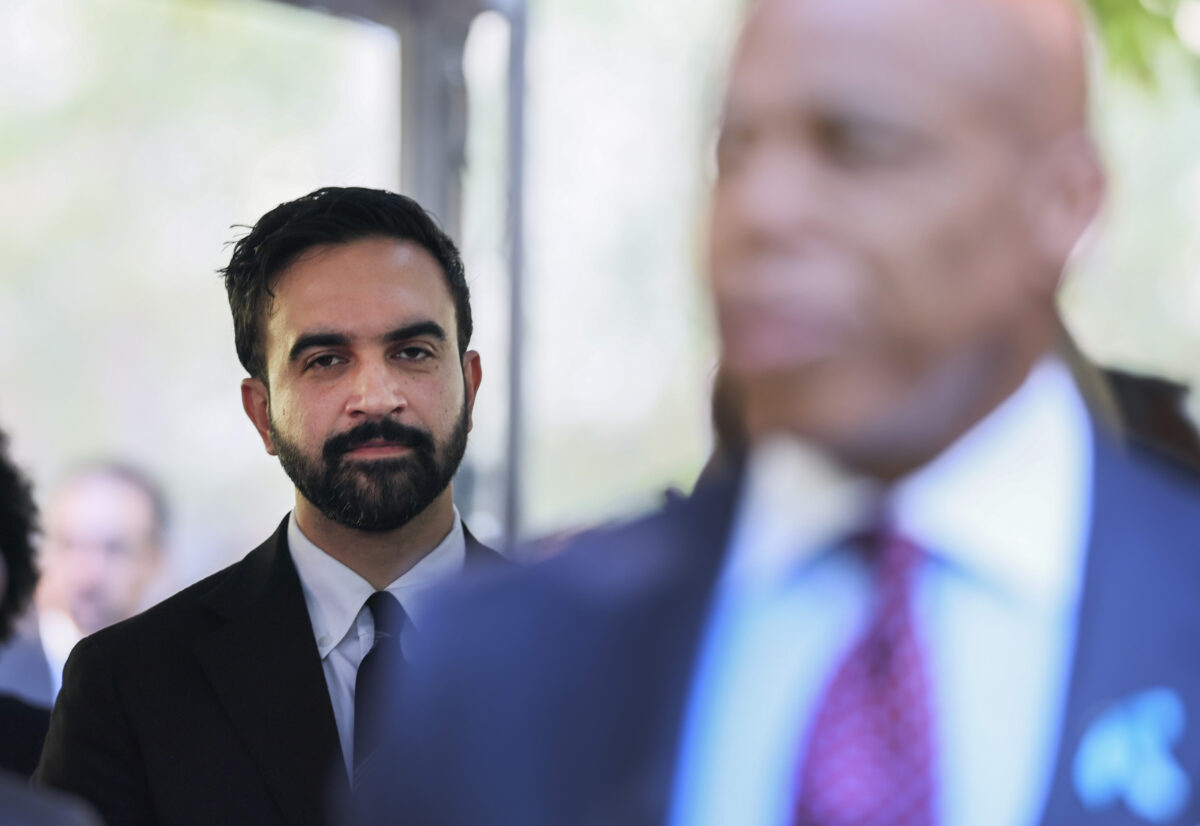
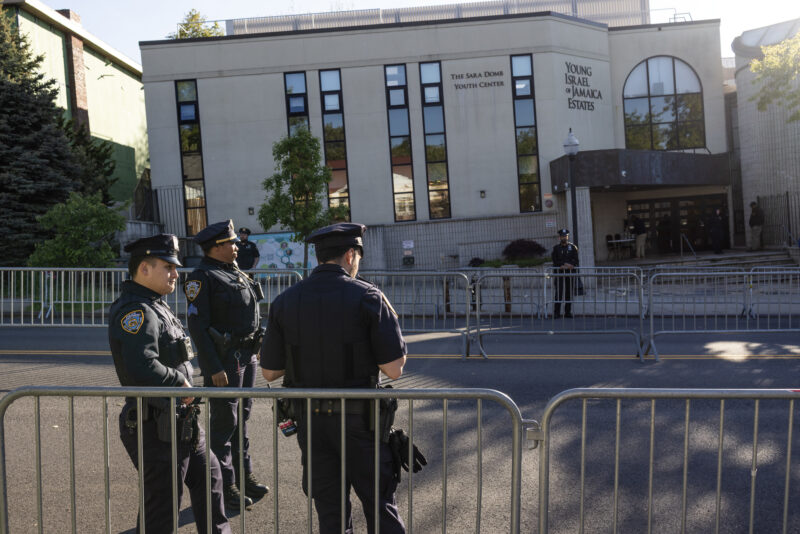
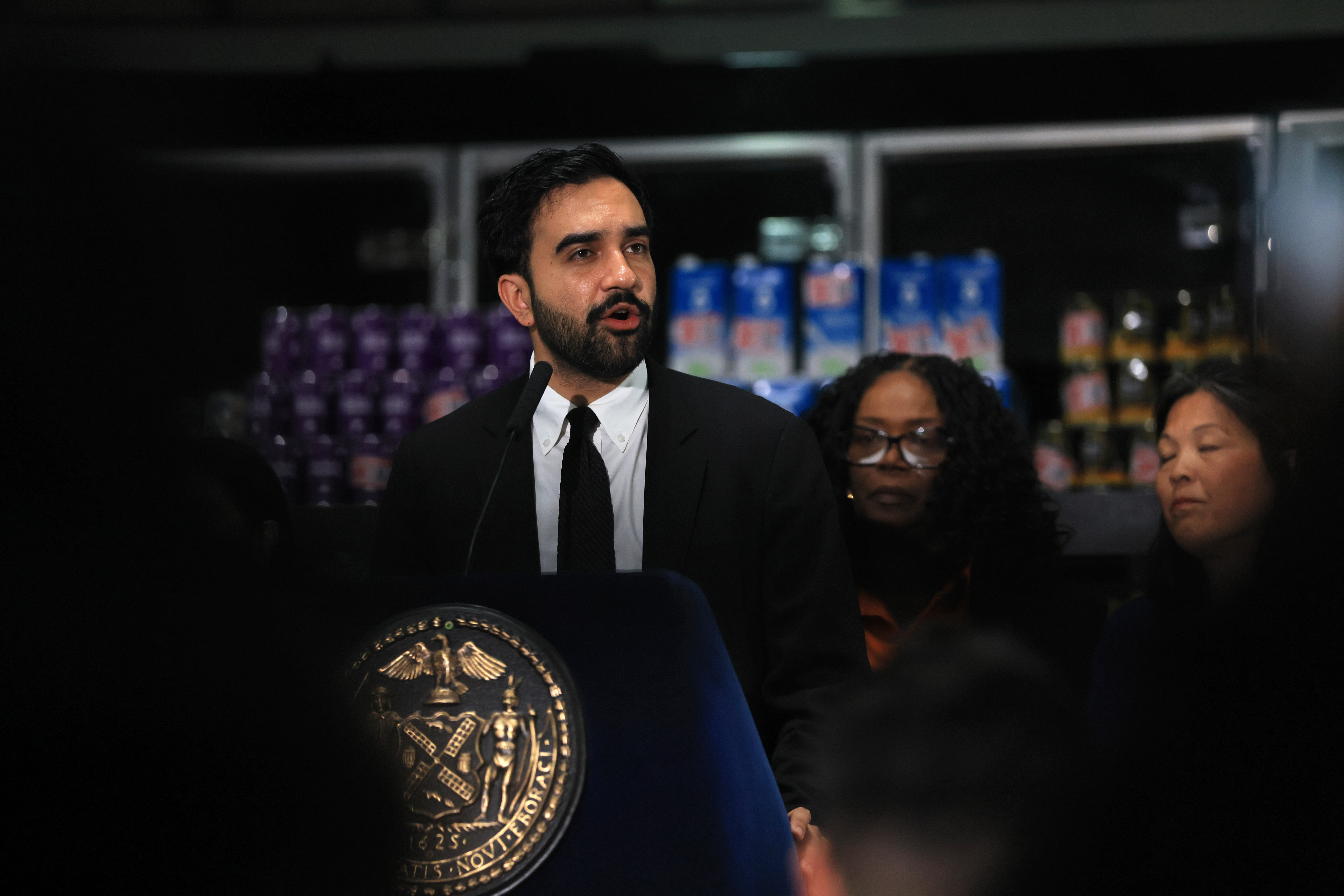
New York City Mayor Zohran Mamdani is facing criticism from Democratic leaders over his delayed and muted response to last week’s pro-Hamas protest in Queens that caused nearby schools and a synagogue to close early in anticipation of the demonstration, where dozens of masked protesters chanted “We support Hamas” near the synagogue, Jewish Insider’s Haley Cohen reports.
Delayed response: The newly inaugurated mayor remained silent Thursday night and much of the following day regarding the demonstration, which marked his first major test in protecting the city’s Jewish community. His spokesperson did not respond to multiple inquiries from JI on Thursday. Mamdani broke his silence late in the afternoon on Friday when he was asked about the protesters’ pro-Hamas chant by Politico reporter Jason Beeferman while leaving a campaign event in Brooklyn for an ally. “That language is wrong,” Mamdani replied. “I think that language has no place in New York City.”
Sign of the times: The Wall Street Journal’s editorial board argues that Mamdani’s response to the protest coupled with efforts by Breads Bakery employees for the company to cut its ties with Israel reflect the political climate in New York City under the new mayor.
WALKING BACK
Mallory McMorrow says Gaza genocide accusations, which she backed, have become ‘political purity test’

Michigan state Sen. Mallory McMorrow, a Democratic candidate for Senate, said in a recent radio interview that accusations of genocide against Israel — with which she has previously agreed — have become a “political purity test,” arguing that there has been too much emphasis on that specific word, Jewish Insider’s Marc Rod reports.
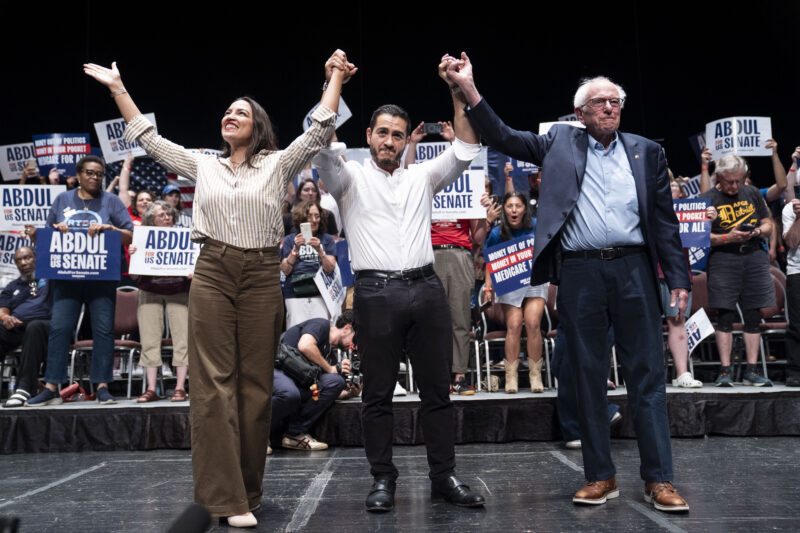
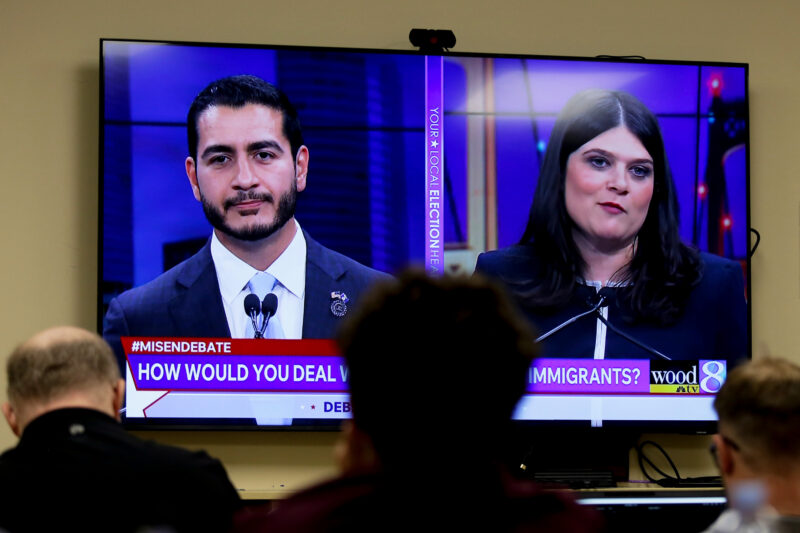
Notable quotable: Asked on local radio station WDET last week whether her stance has changed since October, when she affirmed that she believed the war in Gaza met the definition of a genocide, McMorrow did not offer a direct yes or no answer. “I am somebody who looks at the videos, the photos, the amount of pain that has been caused in the Middle East, and you can’t not be heartbroken,” McMorrow said. “But I also feel like we are getting lost in this conversation, and it feels like a political purity test on a word — a word that, by the way, to people who lost family members in the Holocaust, does mean something very different and very visceral.” McMorrow went on to criticize an unnamed opponent for campaigning on the issue of the war in Gaza, presumably referring to Abdul El-Sayed, the far-left Democrat who has made his opposition to Israel a centerpiece of his campaign.
ON ALERT
Hezbollah’s continued presence in south Lebanon alarms Israel, despite disarmament

The Lebanese Armed Forces announced Thursday that it had taken operational control of the south of the country and successfully completed the first phase of its operation to disarm Hezbollah — a claim that experts say is unlikely to satisfy Israel and could risk further escalation. Under the November 2024 ceasefire agreement between Israel and Hezbollah, the Lebanese government was tasked with removing the terror group south of the Litani River, near Israel’s border, with a deadline of Dec. 31, 2025, before moving to the second phase of disarmament north of the Litani. Experts told Jewish Insider’s Matthew Shea that the Lebanese army’s claim has done little to quell Israeli concerns.
Opposing information: “Despite the statements published today in Lebanon, the facts remain that extensive Hezbollah military infrastructure still exists south of the Litani River,” Israel’s Foreign Ministry stated in a post on X on Thursday. Hanin Ghaddar, a senior fellow at the Washington Institute for Near East Policy, said the situation has become increasingly tense because there is “no indication” that Lebanon will move forward with the next phases of disarmament and that it is “more likely” the country is “not going to move north of Litani” in order to avoid confrontation with Hezbollah.
Worthy Reads
Iran on the Brink: In The Atlantic, Karim Sadjadpour, a senior fellow at the Carnegie Endowment for International Peace, and Jack A. Goldstone, the author of Revolutions: A Very Short Introduction, weigh the likelihood that the Iranian regime will collapse imminently. “One of us, Jack, has written at length about the five specific conditions necessary for a revolution to succeed: a fiscal crisis, divided elites, a diverse oppositional coalition, a convincing narrative of resistance, and a favorable international environment. This winter, for the first time since 1979, Iran checks nearly all five boxes… The final and decisive catalyst for revolution is an international environment that helps sink the regime rather than bolster it. After North Korea, Iran may be the most strategically isolated country in the world. Over the past two years — since Hamas’s October 7, 2023, attack on Israel, which Ayatollah Khamenei alone among major world leaders openly endorsed — Iran’s regional proxies and global allies have been decimated or deposed.” [Atlantic]
Crackdown Crisis: The Washington Post’s David Ignatius posits that the Iranian regime’s protest crackdowns, which have occurred a number of times in recent years, have only served to delay an eventual effective uprising. “The Iranian regime is on a one-way street to disaster. A senior European diplomat in Tehran shared that assessment with me several years ago, and it remains true. Iran has powerful security tools, but they’re getting rusty. The regime couldn’t protect its proxies Hamas in Gaza, Hezbollah in Lebanon, and President Bashar al-Assad in Syria. And most important, Iran couldn’t shield itself from Israel’s systematic assault in June. … The wild card this year is whether the regime’s hard-liners have lost their edge. Like the Soviet Union during its last years, the security agencies may have lost their ideological commitment and discipline. They’ve watched helplessly as their proxy forces were crushed in Gaza, Lebanon and Syria. And they’ve suffered the same scourge of inflation and economic stagnation as the rest of the nation. They’re not broken, but they appear more fragile than in the past.” [WashPost]
Read His Lips: In Semafor, Jason Greenblatt, who served as the White House Middle East envoy during the first Trump administration, posits that Iran should take seriously President Donald Trump’s warnings that the U.S. could back the protesters demonstrating against the regime if Tehran continues to use violence against them. “Trump has established a record of acting when he draws lines. He views the June conflict with Iran — short, focused, and devastating to its strategic military assets — as proof that decisive and limited force can restore balance rather than prolong instability. In his view, hesitation invites escalation. Clear consequences reduce it. Diplomacy is preferable, but diplomacy without credibility is meaningless. … What separates Trump from many of his predecessors is not an appetite for war, but a refusal to tolerate endless gray zones. His worldview is not anti-Iranian or anti-Venezuelan. It is anti-destabilization. That applies equally to nuclear brinkmanship in the Middle East and narco-state behavior in the Western Hemisphere that corrodes security at home and abroad.” [Semafor]
The Torture Chronicles: In The Atlantic, Russia-Israeli academic Elizabeth Tsurkov recounts her 902-day captivity in Iraq. “The interrogators kept threatening me with torture, but in those opening weeks, they refrained from acting on the threats — I assume on orders from higher up. Instead, because they were clearly untrained in conducting interrogations that did not involve torture, they fell back on interrogation methods they had probably seen in movies. To intimidate me, Maher would blow smoke in my face, but because he was using an e-cigarette, all I got was a gust of strawberry-smelling vape. It wasn’t quite the tough-guy routine he was after. Later, he tried the ‘good cop, bad cop’ routine on me but undermined the effect by playing both characters himself, on alternate days, which just made him seem deranged.” [Atlantic]
Word on the Street
President Donald Trump told The New York Times that neither the Republican Party nor the MAGA movement have space for antisemitism, saying that the GOP doesn’t “need” or “like” people who espouse antisemitism; the president also called himself “the least antisemitic person probably there is anywhere in the world”…
Far-right commentator Tucker Carlson joined a lunch with Trump and Vice President JD Vance on Friday, later attending a meeting between the president and oil and gas executives regarding Venezuela…
Federal prosecutors opened a criminal investigation into the Federal Reserve and its chair, Jerome Powell, over renovations made to the agency’s Washington headquarters; Powell released a video alleging that the investigation came as a result of his clashes with the Trump administration over interest rates…
Former Rep. Marjorie Taylor Greene (R-GA) denied the White House’s allegation that she had tipped Code Pink off to a lunch the president was having at Joe’s Seafood, Prime Steak & Stone Crab in September, where the far-left activist group confronted the president in a now-viral incident…
Steve Bannon is reportedly laying the groundwork for a 2028 presidential bid in an effort to push an America First agenda during the primary season. Former Rep. Matt Gaetz (R-FL), who has appeared on Bannon’s “War Room” podcast, told Axios, “The Bannon campaign will merge the foreign policy of Rand Paul with the tax policy of Elizabeth Warren”…
Police in New Jersey arrested a man suspected of throwing a rock at a yeshiva school bus on the New Jersey Turnpike, injuring an 8-year-old girl; the man, Hernando Garciamorales, had been linked to a series of prior rock-throwing incidents…
Google co-founder Larry Page bought two Miami properties for $173.4 million, amid an influx of Silicon Valley execs to South Florida as California gears up for a referendum on a tax on billionaires…
A U.K. medical tribunal cleared the rector of the University of Glasgow of misconduct allegations for social media posts and an op-ed in which he praised members of Hamas and the People’s Front for the Liberation of Palestine…
Israel struck at least seven Hezbollah sites in southern Lebanon on Sunday, days after the Lebanese Armed Forces claimed that the Iran-backed terror group had fully disarmed…
Israeli police detained Tzachi Braverman, the chief of staff to Israeli Prime Minister Benjamin Netanyahu, for questioning over allegations that he attempted to hinder an investigation into the leaking of a classified military document in 2024…
The Associated Press reports on an ethics debate inside Israel over Sara Netanyahu’s retouching of official government photos…
The U.S. conducted strikes against ISIS targets in Syria, weeks after an attack by an ISIS-aligned member of Syria’s security forces killed two U.S. servicemembers and a civilian interpreter…
Sheikh Mohammed bin Abdulrahman Al-Thani, Qatar’s prime minister and foreign minister, met with Ben Black, CEO of the U.S. International Development Finance Corporation, in Doha on Monday…
The Qatari prime minister also met with U.S. Under Secretary of State for Economic Affairs Jacob Helberg and discussed “the close strategic relations” between the two countries, according to the Qatari Foreign Ministry…
A Bahraini court sentenced political activist Ebrahim Sharif to six months in prison and a fine over a recent interview in Lebanon in which Sharif criticized Arab states and said more support should be given to the Palestinians…
In The New York Times’ “Modern Love” column, Taiwanese-American economist David Woo reflects on his marriage to Israeli architect Margalit Shinar, who is 40 years his senior…
Jewish actors Timothée Chalamet and Seth Rogen took home awards at the Golden Globes — Chalamet for his role in the movie “Marty Supreme” and Rogen for his satire show “The Studio”…
Richard Hirschhaut is joining Jewish National Fund-USA as its national campaign director for the West Coast and Mountain states after six years as the director of the American Jewish Committee’s Los Angeles office…
Mothers Against Campus Antisemitism tapped Miriam Zivin as the advocacy group’s new board president, following a weekslong dispute between the organization’s founder and board, eJewishPhilanthropy’sJay Deitcher reports…
Sen. Lindsey Graham (R-SC) delivered the opening remarks at a Tzedek Association fundraising event in Deal, N.J….
Chabad of Westport hosted former hostage Eliya Cohen and survivor of the Nova music festival massacre Ziv Aboud, who recently got engaged and have been touring the U.S. in recent weeks, sharing their stories and working to fight misinformation…
Hessy Levinsons Taft, whose baby photo was used on the cover of the Sonne ins Haus pro-Nazi magazine as a depiction of the ideal Aryan infant by editors who did not know she was Jewish, died at 91…
Dr. Jerome Lowenstein, a physician who later became publisher of the Bellevue Literary Press, which published the 2010 Pulitzer Prize-winner for fiction, died at 92…
Pic of the Day

Israeli Foreign Minister Gideon Sa’ar (right) met with his Japanese counterpart, Toshimitsu Motegi, in Jerusalem on Sunday, as part of a nine-day trip by the Japanese foreign minister that will also include visits to the West Bank, Qatar, the Philippines and India. According to the Japanese Foreign Ministry, Motegi explained during the meeting Japan’s position on the situation in Gaza and the West Bank and “stated that Japan will play a proactive role in promoting peace and stability in the Middle East, in improving the humanitarian situation in Gaza and in engaging in the early-recovery and reconstruction efforts.”
Birthdays
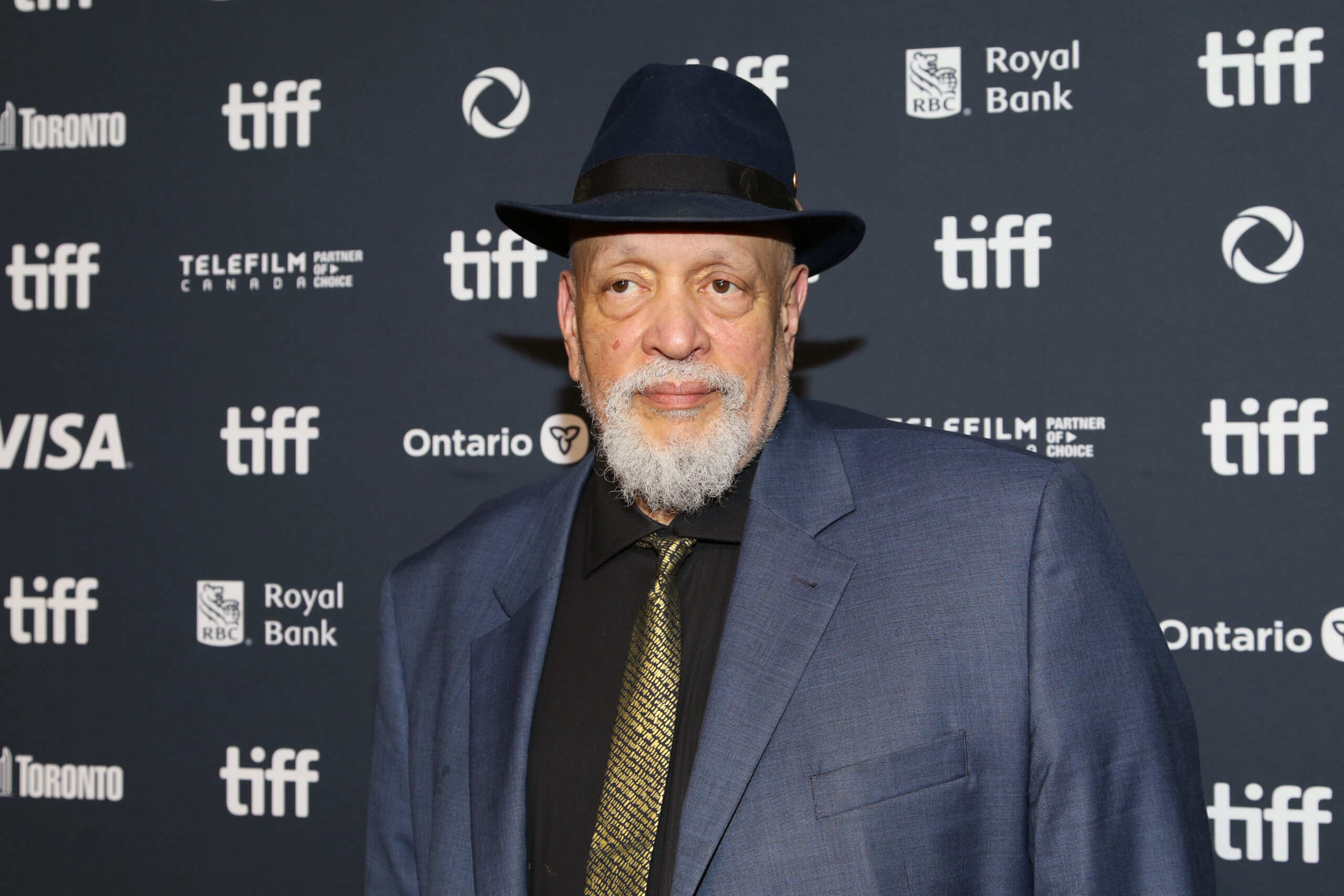
Author of over 40 books, most widely recognized for his crime fiction, Walter Ellis Mosley turns 74…
Real estate and casino magnate, he is a minority owner of the Chicago Bulls and Chicago White Sox, Neil Gary Bluhm turns 88… U.S.-born biochemist, he moved to Israel in 1973, winner of the Israel Prize (1999) and professor emeritus at Hebrew U, Howard “Chaim” Cedar turns 83… Stephen Moses… Israel-born jewelry designer, editor and businesswoman, she was the first lady of Iceland from 2003 until 2016, Dorrit Moussaieff turns 76… NYC-based psychiatrist and president of the Child Mind Institute, Harold S. Koplewicz, MD turns 73… Radio personality on Sirius XM, Howard Stern turns 72… British novelist and grandson of J.R.R. Tolkien (one of the latter’s two Jewish grandchildren), Simon Mario Reuel Tolkien turns 67… Senior director of philanthropic engagement at Jewish Funders Network, she was a consultant for DreamWorks on the film “The Prince of Egypt,” Tzivia Schwartz Getzug… Midday news anchor at Washington’s WTOP Radio, Debra Feinstein turns 64… Board member and former chair of Hillel International, she is also a board chair of Mem Global (f/k/a Moishe House), Tina Price… Member of the Maryland House of Delegates, Jon S. Cardin turns 56… Identical twin comedians and actors, Randy Sklar and Jason Sklar turn 54… Filmmaker known for parody films, Aaron Seltzer turns 52… First-ever woman to be an MLB coach, in 2024 she was a co-founder of a women’s pro baseball league, Justine Siegal Ph.D. turns 51… Rabbinical advisor of Shabtai, Shmully Hecht turns 51… Recording artist and musical entertainer, Yaakov Shwekey turns 49… Professional golfer, Rob Oppenheim turns 46… Two-time Olympian (2012 and 2016) in beach volleyball, now a chiropractor and performance coach, Josh Binstock turns 45… Founder of The Jewish Majority, Jonathan Schulman… Director of major gifts in the mid-Atlantic region for American Friends of Magen David Adom, Ira Gewanter… Executive director of the Hillel at Virginia Tech, Amanda Herring… VP of finance and operations at NYC-based Hornig Capital Partners, Daniel Silvermintz… Israeli tennis player, Lina Glushko turns 26…
Plus, UNSC adopts U.S. resolution on Gaza

Andrew Harnik/Getty Images
President Donald Trump speaks before signing an executive order in the Oval Office of the White House on March 31, 2025 in Washington, DC.
Good Monday afternoon!
This P.M. briefing is reserved for our premium subscribers like you — offering a forward-focused read on what we’re tracking now and what’s coming next.
I’m Danielle Cohen-Kanik, U.S. editor at Jewish Insider and curator, along with assists from my colleagues, of the Daily Overtime briefing. Please don’t hesitate to share your thoughts and feedback by replying to this email.
📡On Our Radar
Notable developments and interesting tidbits we’re tracking
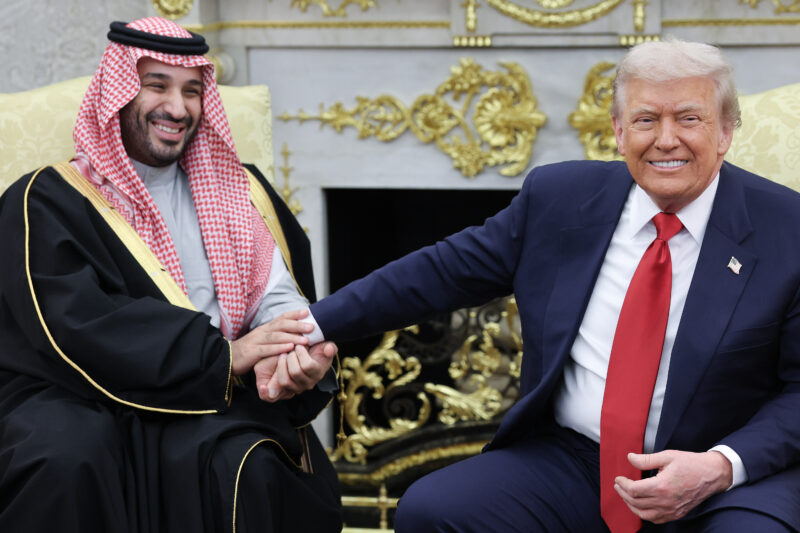
Washington is preparing for Saudi Crown Prince Mohammed bin Salman’s visit tomorrow, where he’ll meet President Donald Trump at the White House and be hosted for dinner with administration officials, members of Congress and business leaders. On Wednesday, MBS is expected to meet with lawmakers on Capitol Hill, Punchbowl News reports, and the U.S.-Saudi Investment Forum will take place at the Kennedy Center.
Trump confirmed to reporters in the Oval Office this afternoon that the U.S. will sell F-35 fighter jets to Saudi Arabia, without offering details of the deal…
In a blurring of the lines between the political and the personal, the president may have more than just defense deals on his mind: The Trump Organization is in talks to bring a Trump property to one of Saudi Arabia’s largest government-owned real estate developments, The New York Times reports…
The U.N. Security Council just adopted the U.S.-sponsored resolution backing Trump’s 20-point peace plan, including the creation of an international stabilization force in the Gaza Strip, with 13 votes in favor and Russia and China abstaining. The resolution contains language on “a credible pathway to Palestinian self-determination and statehood”…
The Journal also reports on Hamas’ rising popularity inside Gaza since the start of the ceasefire with Israel, as Gazans see the terror group as capable of restoring order and preventing lawlessness, which may pose an issue to the implementation of the ceasefire that requires Hamas to disarm…
In the latest fallout at the Heritage Foundation over its president’s defense of Tucker Carlson after his friendly interview with neo-Nazi influencer Nick Fuentes, Robert George, a prominent board member, resigned today, citing the lack of a “full retraction” by Heritage President Kevin Roberts of the video defending Carlson, Jewish Insider’s Matthew Kassel reports.
George’s decision to step down indicates that Roberts is likely safe in his role, for now, as its board remains split about his future, according to a former Heritage staffer familiar with internal discussions…
Trump weighed in on the Carlson controversy over the weekend, saying when asked by reporters what role Carlson should play in the conservative movement after his interview with Fuentes, “I found [Carlson] to be good. I mean, he said good things about me over the years. I think he’s good. We’ve had some good interviews.”
“You can’t tell him who to interview. I mean, if he wants to interview Nick Fuentes, I don’t know much about him, but if he wants to do it, get the word out. People have to decide. Ultimately, people have to decide. … Meeting people, talking to people for somebody like Tucker, that’s what they do. You know, people are controversial. Some are, some aren’t. I’m not controversial, so I like it that way”…
Also evoking backlash, a producer for former Rep. Matt Gaetz’s (R-FL) weeknight show on the right-wing One America News Network has reportedly been fired after he shared a vehemently antisemitic social media post depicting Jews as cockroaches, JI’s Matthew Kassel reports.
Vish Burra, who was a booker and script writer for Gaetz, had drawn widespread backlash for posting an AI-generated animated video last week showing him entering a “scheming room” with Stars of David on the door to find a group of cockroaches counting money, who scurry away upon his arrival. The post has since been deleted.
Burra also defended Roberts in a separate post, writing, “I will expose the vermin in the venomous coalition and their transgression against MAGA, America First, and Kevin Roberts at The Heritage Foundation. It all starts with Susan Lebovitz-Edelman,” referring to a Jewish trustee at the conservative Manhattan Institute who is married to hedge fund manager Joseph Edelman…
Political alliances are developing in the Democratic primary to replace New Jersey Gov.-elect Mikie Sherrill in a special election for the state’s 11th Congressional District: Gov. Phil Murphy announced he’s backing Essex County Commissioner Brendan Gill, his former campaign manager and a front-runner in the race, while Tahesha Way, his lieutenant governor, is expected to launch a campaign shortly.
The field of nine other Democrats also includes former Rep. Tom Malinowski (D-NJ), who represented the neighboring district until 2023 and today received the endorsement of Sen. Andy Kim (D-NJ), in an apparent act of reciprocity — Malinowski supported Kim in his bid for Senate in 2024 against the governor’s wife, Tammy Murphy. The primary is expected to take place in late January-early February…
In nearby New York, pro-Israel Rep. Grace Meng (D-NY) drew a primary challenger today: Chuck Park, who served as a foreign service officer until 2019 and as chief of staff to New York City Councilman Shekar Krishnan, an ally of Mayor-elect Zohran Mamdani, announced an anti-establishment bid for the Queens district…
Now that he is about to assume leadership of the largest city in the U.S., Mamdani will need to receive top-level security clearance from the Trump administration, marking the first test of the new mayor’s relationship with Washington, Politico reports. Trump told reporters on Sunday that Mamdani “would like to come to Washington and meet and we’ll work something out” and “we want to see everything work out well for New York”…
⏩ Tomorrow’s Agenda, Today
An early look at tomorrow’s storylines and schedule to keep you a step ahead
Keep an eye on Jewish Insider tomorrow morning for a deep dive into the shifting anti-Israel dynamics on the far right.
Saudi Crown Prince Mohammed bin Salman’s White House visit will begin tomorrow with an arrival ceremony on the South Lawn and a greeting on the South Portico, before an Oval Office bilateral meeting and signing and lunch in the Cabinet Room. A formal dinner, hosted by First Lady Melania Trump, will take place in the evening in the East Room.
The American Jewish Committee will hold a webinar, “Unpacking the Saudi White House Visit,” tomorrow afternoon with Jason Isaacson, AJC’s chief policy and political affairs officer; Anne Dreazen, vice president of AJC’s Center for a New Middle East; and Michael Ratney, former U.S. ambassador to Saudi Arabia.
The National Task Force to Combat Antisemitism, a project that was closely affiliated with the Heritage Foundation until earlier this month when it broke with the conservative think tank over Heritage President Kevin Roberts’ defense of Tucker Carlson, is hosting a summit in Washington tomorrow in response to the recent developments. The gathering, “Exposing and Countering Extremism and Antisemitism on the Political Right,” will feature remarks from task force co-chairs Luke Moon, Pastor Mario Bramnick and Ellie Cohanim; U.S. Ambassador to Israel Mike Huckabee; Ralph Reed, president of the Faith and Freedom Coalition; and Tony Perkins, president of the Family Research Council. Discussion topics will include “replacement theology,” the path ahead for Gen Z and “overcoming the Woke Right.”
The Jewish Federations of North America’s General Assembly wraps up tomorrow in Washington. Sen. Ted Cruz (R-TX) is slated to speak and JI’s Lahav Harkov will moderate a panel on the Middle East in a post-Oct. 7 world.
U.S. Ambassador to the U.N. Mike Waltz will deliver remarks with pop diva Nicki Minaj tomorrow on the persecution of Christians in Nigeria.
Stories You May Have Missed
MILITARY MATTERS
Israel said to eye new defense agreement with U.S. as future of military assistance faces uncertainty
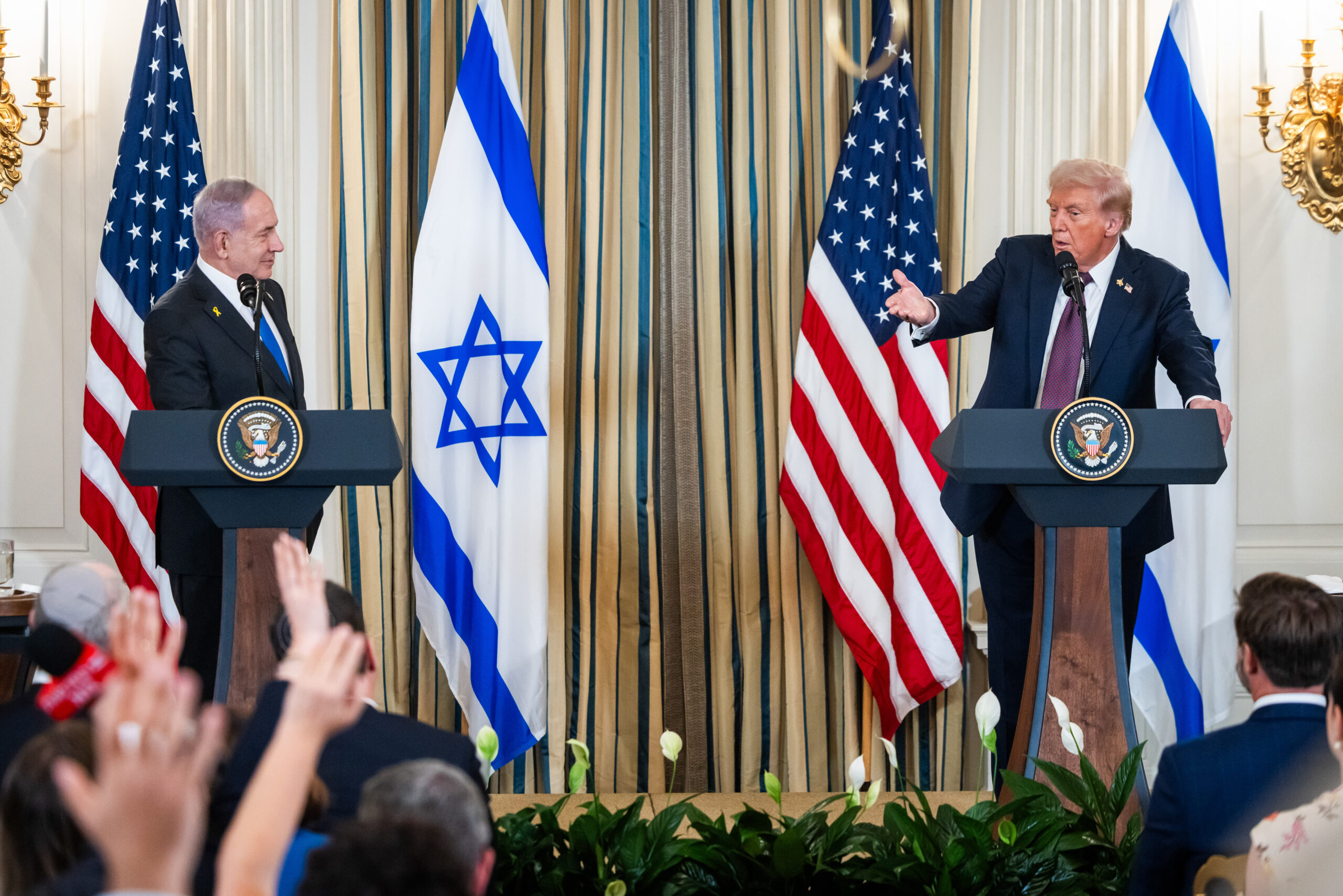
Jerusalem is looking to secure a new MOU – which would reportedly run through 2048 and includes ‘America First’ provisions – amid growing skepticism in U.S. politics over foreign aid
MANHATTAN MOMENTUM
Crowded field of Democrats seeks to win over Jewish voters in race to succeed Nadler
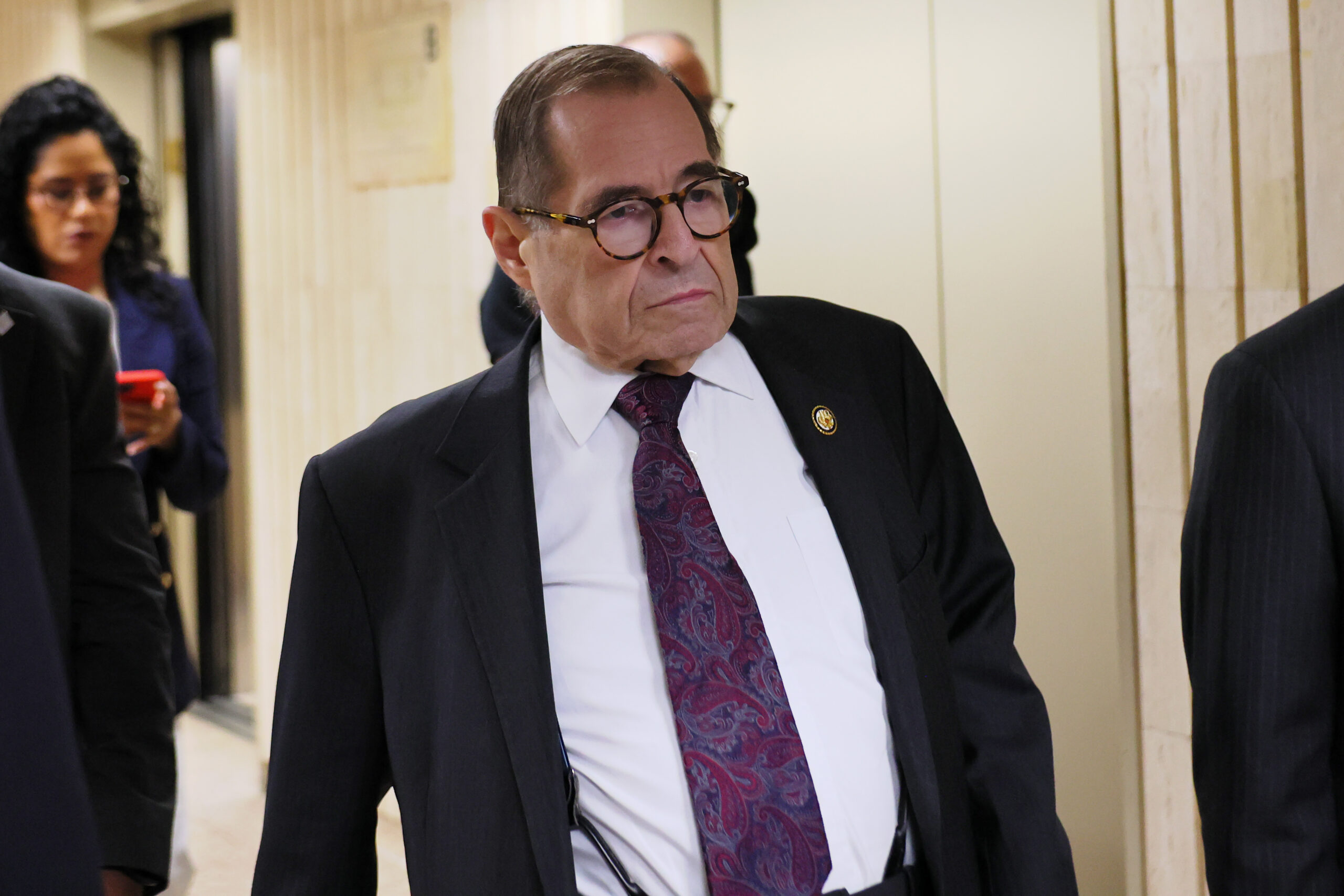
Andrew Cuomo carried the district in the NYC mayoral race, underscoring its pro-Israel constituency
Plus, moderates speechless in Seattle
Shmulik Almany
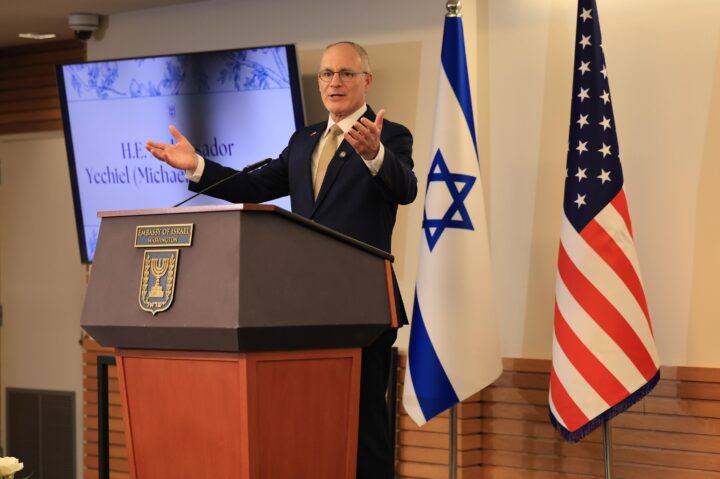
Israeli Ambassador to the U.S. Yechiel Leiter addresses Rosh Hashanah reception at the Israeli Embassy in Washington, Sept. 18th, 2025
Good Thursday afternoon!
This P.M. briefing is reserved for our premium subscribers like you — offering a forward-focused read on what we’re tracking now and what’s coming next.
I’m Danielle Cohen-Kanik, U.S. editor at Jewish Insider and curator, along with assists from my colleagues, of the Daily Overtime briefing. Please don’t hesitate to share your thoughts and feedback by replying to this email.
📡On Our Radar
Notable developments and interesting tidbits we’re tracking
Israeli Ambassador to the U.S. Yechiel Leiter said in an interview with The Jerusalem Post that Israel “prefer[s] that Turkey not receive F-35s from the U.S.,” breaking with Washington over the move that President Donald Trump indicated he was open to during a meeting with Turkish President Recep Tayyip Erdogan in September.
But Leiter dismissed concerns around Saudi Arabia potentially acquiring F-35s, which is currently under negotiation ahead of Crown Prince Mohammed bin Salman’s visit to the White House next week. “There’s no indication that Israel’s qualitative edge will be compromised,” he said. Leiter has recently become Israeli Prime Minister Benjamin Netanyahu’s main conduit in Washington after the resignation of Strategic Affairs Minister Ron Dermer…
Israel is seeking a new 20-year memorandum of understanding with the U.S. when the current one expires in 2028, U.S. and Israeli officials told Axios, double the length of past agreements.
New Israeli propositions, including redirecting some of the funds towards joint U.S.-Israeli R&D rather than direct military aid, are reportedly designed to make the lengthy deal more attractive to Trump as well as the GOP, which has grown weary of foreign aid…
Trump told MBS in a phone call last month that he expects to see progress made on Israel-Saudi normalization now that the ceasefire in Gaza is in force, U.S. officials also told Axios, which MBS said he was “willing to work on”…
Israel and White House advisor Jared Kushner are preparing contingency plans in case Trump’s 20-point Gaza peace plan doesn’t come to fruition, Israeli media reports. The IDF’s chief of staff, Lt. Gen. Eyal Zamir, told Israeli Security Cabinet officials that the IDF will soon present its alternative…
Meanwhile in the U.S., the Democratic primary for the seat of retiring Rep. Jerry Nadler (D-NY) in New York’s 12th Congressional District, which has one of the largest Jewish constituencies in the country, gets more crowded by the day.
Shortly after the entry of JFK’s grandson, Jack Schlossberg, into the race, Erik Bottcher, a Democratic city councilman and LGBTQ activist, told The New York Times he’s jumping in (and that he supports Israel’s right to exist as a Jewish state). There are rumors that Lincoln Project co-founder George Conway is eyeing a bid, as well.
Among the many other candidates are longtime Nadler aide Micah Lasher, who today got the endorsement of Comptroller-elect Mark Levine; state Assemblyman Alex Bores; and gun control activist Cameron Kasky, who posted yesterday on social media, “If you are a Democrat running in 2026 and do not fully support an arms embargo to the State of Israel … Stop wasting everybody’s time”…
Seattle Mayor Bruce Harrell conceded to his opponent, socialist Katie Wilson, today after last night’s ballot drop made it mathematically impossible for him to prevail.
Though the moderate Harrell led in the polls for the week following Election Day, Wilson eventually gained ground and now leads him by a 0.7% margin — just shy of 2,000 votes. With only several hundred votes left to be counted, The Seattle Times said the race is “on pace to be the closest in modern Seattle politics.”
Wilson joins New York City Mayor-elect Zohran Mamdani, as well as progressive challengers who prevailed in several Seattle City Council races, as evidence of the far left’s growing popularity in major U.S. cities. However, their small (or razor thin, in Wilson’s case) margins of victory and Minneapolis Mayor Jacob Frey’s win over his DSA-aligned opponent are proof the fringe still lacks a mandate in the Democratic Party…
Former Rep. Elaine Luria (D-VA) announced raising more than $500,000 in the first 24 hours after the launch of her comeback bid for her seat in Virginia’s 2nd Congressional District.
The Jewish, pro-Israel Navy veteran sent out a fundraising email this afternoon with the subject line “Chutzpah,” saying the “Yiddish term that means guts or courage … runs in my family” and she’s “not afraid of a little mishigas”…
Sen. John Fetterman (D-PA) was hospitalized today after suffering a “ventricular fibrillation flare-up” and subsequent fall and face injuries, but is doing well, his spokesperson reported. His scheduled discussion this evening with UJA-Federation of New York about his new book has been cancelled…
The New York Times profiles Heritage Foundation President Kevin Roberts and his path from leading a small Catholic college to helming the prominent think tank and sparking controversy among conservatives over his embrace of Tucker Carlson.
Roberts claimed as part of his defense over releasing the controversial video during a staff meeting last week, “I actually don’t have time to consume a lot of news. I consume a lot of sports,” and “I didn’t know much about this [Nick] Fuentes guy. I still don’t.”
“‘Who could believe that the head of a think tank doesn’t think?’ said Charles Jacobs, the president of the Jewish Leadership Project, which resigned from a Heritage Foundation task force meant to fight antisemitism after Mr. Roberts’ video was released”…
Joining the list of Heritage resignations, Adam Mossoff, a law professor at George Mason’s Scalia Law School and a prominent pro-Israel advocate, announced he is resigning as a Heritage visiting fellow today “based on [his] considered judgment” of Roberts’ video and “subsequent commentary”…
⏩ Tomorrow’s Agenda, Today
An early look at tomorrow’s storylines and schedule to keep you a step ahead
Keep an eye on Jewish Insider tomorrow morning for a preview of President Donald Trump’s meeting next week with Saudi Crown Prince Mohammed bin Salman.
New York City Mayor Eric Adams is traveling to Israel tomorrow for a five-day trip where he plans to meet with government officials and economic development and high-tech leaders.
The Texas Tribune Festival, taking place this week in Austin, continues tomorrow with speakers including former Transportation Secretary Pete Buttigieg, Sen. Michael Bennet (D-CO), Democratic Texas Senate candidates James Talarico and Rep. Colin Allred, Sen. Chris Murphy (D-CT), comedian John Mulaney, former Sen. Joe Manchin (I-WV), venture capitalist Joe Lonsdale and former U.S. Attorney General Eric Holder. On Saturday, Sens. Amy Klobuchar (D-MN) and Adam Schiff (D-CA) are slated to speak.
MSNBC is launching its rebrand on Saturday as MS NOW, part of its separation from NBCUniversal, with dozens of veteran journalists recruited as part of its expanded newsroom.
On Sunday, the Museum of Jewish Heritage – A Living Memorial to the Holocaust will present its fourth annual New York Jewish Book Festival.
Sunday evening, the Jewish Federations of North America’s General Assembly kicks off in Washington, with an opening plenary including former U.S. Ambassador to Japan Rahm Emanuel, authors Sarah Hurwitz and Micah Goodman, CNN contributor Scott Jennings and Rabbi Angela Buchdahl, senior rabbi at Central Synagogue in New York City.
We’ll be back in your inbox with the Daily Overtime on Monday. Shabbat Shalom!
Stories You May Have Missed
BROTHERHOOD PARADOX
Israel’s neighbors have banned the Muslim Brotherhood, but Israel hasn’t. Why not?
One of its branches is banned for Hamas ties. The other sits in the Knesset
WOOD-N’T TAKE IT
Another Maine Democrat takes page from Platner playbook
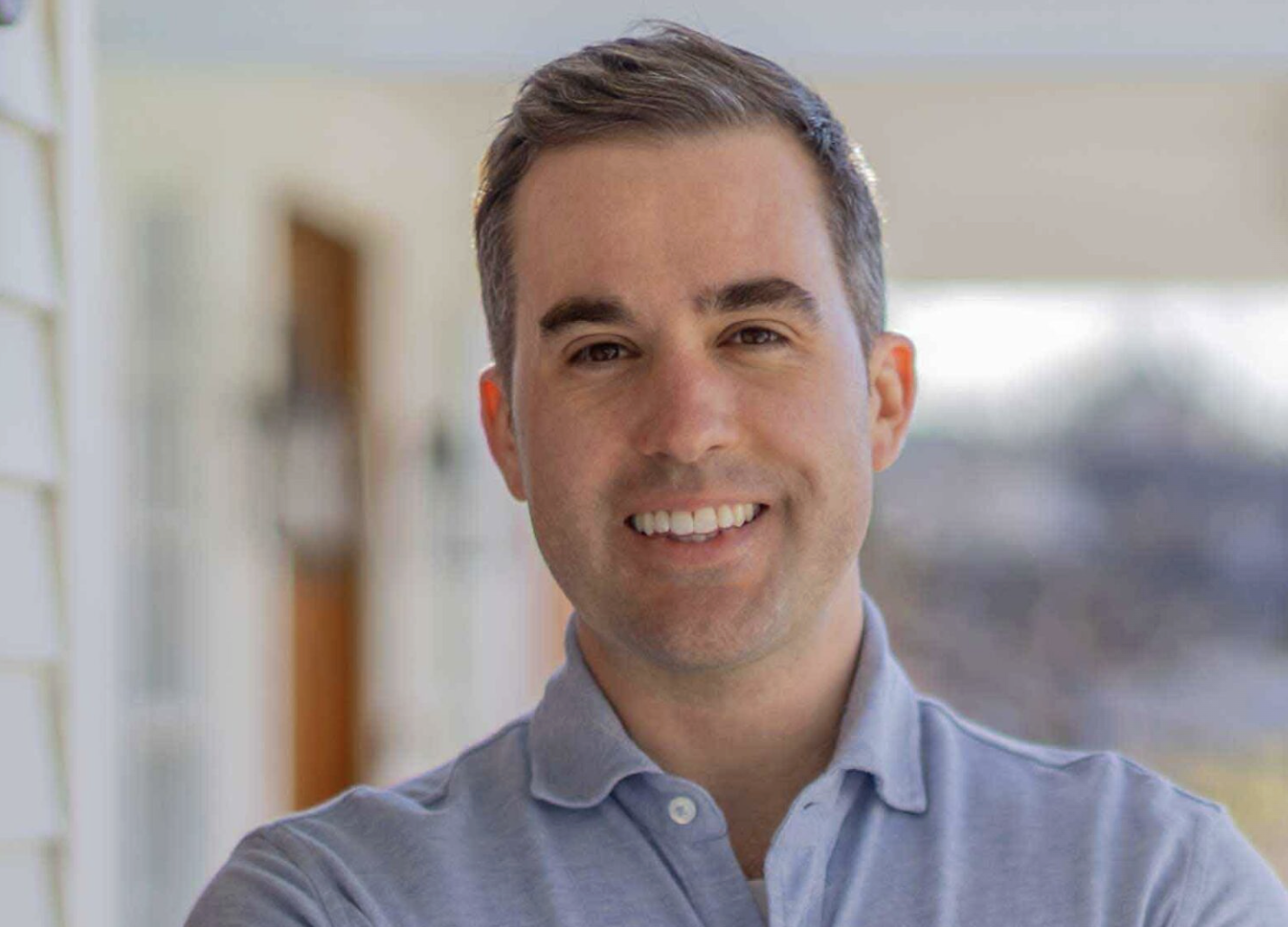
Jordan Wood, now running to succeed Rep. Jared Golden, said he won’t take money from AIPAC in his newly launched House campaign
One of its branches is banned for Hamas ties. The other sits in the Knesset
AHMAD GHARABLI/AFP via Getty Images
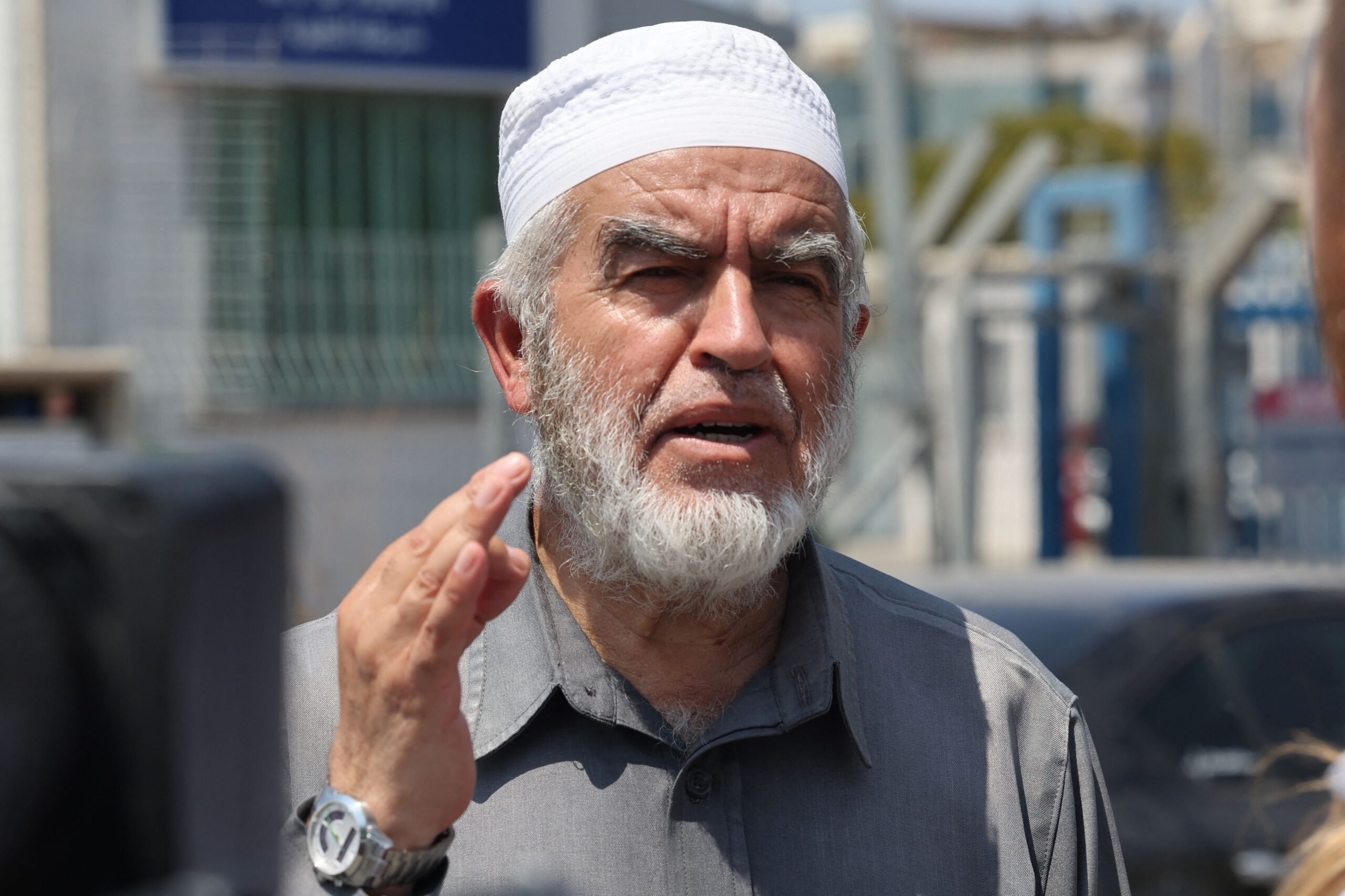
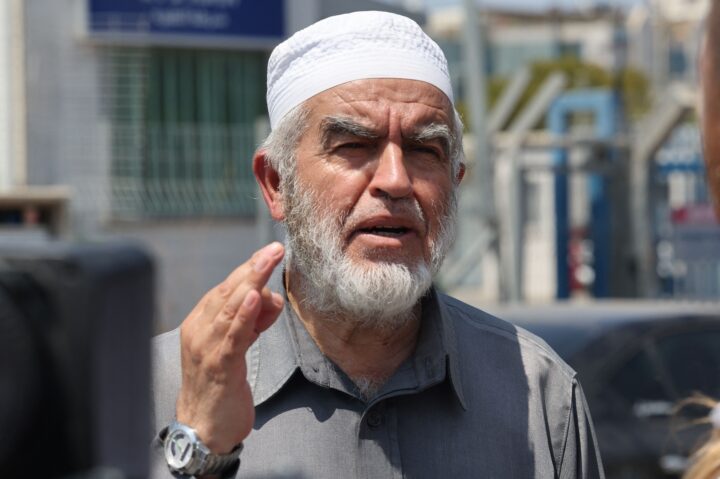
Sheikh Raed Salah, leader of the radical northern branch of the Islamic Movement in Israel, speaks on August 23, 2023, outside a police station during the funeral of the director-general of the Arab city of Tira in Israel, who was gunned down on August 21 evening.
While Congress is working on a bill to designate the Muslim Brotherhood a terrorist organization in the U.S., and the Islamist group is banned from Egypt, Syria, Saudi Arabia, the United Arab Emirates and beyond, the group’s status in Israel is much more complicated.
The matter drew renewed attention this week after Mansour Abbas, the leader of the Ra’am party in the Knesset, an ideological offshoot of the Muslim Brotherhood, declined to call for the eradication of Hamas on Israeli radio.
In an interview with Israeli public broadcaster KAN, Abbas mostly lamented the high rate of crime and gun violence in Israeli-Arab society, but when he mentioned Gaza, the interviewer, Asaf Liberman, asked whether he sees Hamas as part of the enclave’s future.
“Palestinian society needs to pick its leadership and go on a new path towards peace and reconciliation,” Abbas responded.
Liberman twice repeated his question and sharpened it: “Does Hamas need to be destroyed?”
Abbas added that an international force must enter Gaza and after an interim period a security force of the Palestinian Authority would be trained, but after being pressed to make his position on Hamas clear, he said the interview was beginning to feel like an “interrogation,” and pointed out that he had gone on air to talk about domestic issues facing Arab Israelis. “If you want to talk about crime, fine, if not, bye,” he said, before hanging up.
Abbas has previously condemned Hamas’ Oct. 7 attacks, calling them unjustifiable and inhumane, and called for the release of the hostages. The other reporter who conducted the interview, Suleiman Maswadeh, later noted that Abbas and his family had recently received death threats, and hinted that was the reason the Knesset member avoided repeating his previously articulated position — which Maswadeh said does not include a future for Hamas in the governance of Gaza.
In 2021, the Ra’am party became the first Arab party in 50 years to join an Israeli governing coalition, which was celebrated by many in Israel and abroad as a milestone for coexistence, while the Israeli right criticized the 2021-2022 government for what it characterized as working with the Muslim Brotherhood.
Monday’s interview sparked headlines and analysis in right-leaning Israeli media and comments by politicians on the right about the viability of center and left-wing parties once again forming a coalition with Ra’am to oust Prime Minister Benjamin Netanyahu, when Ra’am’s leader would not say that he is for eradicating Hamas.
“The Muslim Brotherhood is a very generic term,” said Michael Milshtein, head of the Palestinian Studies Forum at the Moshe Dayan Center at Tel Aviv University. “It’s not membership in an organization; it’s a denomination. Mansour Abbas is the Muslim Brotherhood. Raed Salah, his rival, is also the Muslim Brotherhood. Hamas is the Muslim Brotherhood. [Turkish President Recep Tayyip] Erdogan is the Muslim Brotherhood.”
The historic and recent connections between Hamas and Ra’am, both of which were founded by adherents of the Muslim Brotherhood, shed light on the nuances of the international Sunni Islamist movement and its status in Israel.
Michael Milshtein, head of the Palestinian Studies Forum at the Moshe Dayan Center at Tel Aviv University, emphasized, in an interview with Jewish Insider on Wednesday, that the Muslim Brotherhood is an ideology aiming to make Muslim societies more religious, and is not one centralized organization spanning the Muslim world.
“The Muslim Brotherhood is a very generic term,” Milshtein said. “It’s not membership in an organization; it’s a denomination. Mansour Abbas is the Muslim Brotherhood. Raed Salah, his rival, is also the Muslim Brotherhood. Hamas is the Muslim Brotherhood. [Turkish President Recep Tayyip] Erdogan is the Muslim Brotherhood.”
Muslim Brotherhood founder Hasan al-Banna’s brother, Abd al-Rahman al-Banna, founded the group’s branch in Mandatory Palestine in 1935; its leaders included Mufti of Jerusalem Hajj Amin al-Husseini, who incited the deadly Hebron riots against Jews in 1929 and collaborated with Hitler, and Izz al-Din al-Qassam, leader of the 1935 Arab Revolt against the British and namesake of Hamas’ short-range Qassam rockets.
Gaza-based Sheikh Ahmad Yasin formed the Muslim Brotherhood-inspired Hamas in the 1980s. Sheikh Abdullah Nimar Darwish founded the Islamic Movement in Israel in 1971, which also espoused Muslim Brotherhood ideology.
In 1979, Darwish founded an underground group in Israel called The Family of Jihad with a goal of establishing an Islamic state. However, after his arrest and conviction for involvement in killing an accused collaborator and membership of a terrorist organization, he renounced violence and decided to promote Islamism within the confines of Israeli law.
Fissures began in the Islamic Movement in Israel after the Oslo Accords, with the northern branch, led by Sheikh Raed Salah, opposing it, while the southern branch supported it. The two parts of the movement officially split when the southern branch ran for the Knesset in 1996 as Ra’am, and Salah advocated boycotting national elections.
The leaders of the northern branch were arrested in 2003 for aiding Hamas and in 2015, the branch was banned, after the police and Shin Bet demonstrated that it had close ties to Hamas and the Muslim Brotherhood, and received funds from groups affiliated with Hamas.
Darwish, however, continued to be the spiritual leader of the Islamic Movement’s southern branch and said he was committed to obeying the laws of Israel. He engaged in interfaith dialogue events, often with former Labor lawmaker Rabbi Michael Melchior, and spoke out against Holocaust denial.
While Islamic Movement Southern Branch leaders have met with Hamas leaders and taken part in mediation efforts between the Palestinian Authority and Hamas, in 2022, then-leader of Hamas Yahya Sinwar declared Mansour Abbas a traitor for joining the governing coalition and saying Israel is a Jewish state. Abbas has said that his decision to join the governing coalition in 2021 came from the values he “absorbed from the legacy of Sheikh Abdullah Nimr Darwish.”
As such, the more radical of the two major offshoots of the Muslim Brotherhood is outlawed in Israel.
Yet, more recently, the Islamic Movement Southern Branch has come under scrutiny for its own possible ties to Hamas.
In the decades since its establishment, the Islamic Movement has faced repeated crackdowns on its charities. The Islamic Relief Committee, founded in 1987 with the stated goal to help the needy in the West Bank and Gaza, was shut down by Israeli authorities in 1995 for aiding Hamas members’ families, the first in a series of such actions.
“Israel’s anti-terrorism law and the whole discipline has been to focus on specific organizations and declaring them as terrorist organizations because of their goals, because of the means that they use, rather than focusing on an idea, which the Muslim Brotherhood really is,” Lt.-Col. (res.) Maurice Hirsch, the former director of the IDF Prosecution for Judea and Samaria, told JI.
In July, the Israeli Justice Ministry unit dealing with nonprofit organizations found grounds to shut down “Aid 48,” a charity affiliated with Ra’am, on suspicion of providing funding to terrorist organizations. “Aid 48” is the Islamic Movement Southern Branch’s main charity. According to an investigation by the ministry, in 2020-2021, the organization transferred NIS 2 million to a charity in Hebron that Israel had declared in 2012 to be part of a terrorist organization; in 2023, “Aid 48” worked with three such Palestinian charities; in 2020, the organization gave NIS 933,000 to a Turkish organization run by Hamas members, which funneled money to the terrorist organization.
Lt.-Col. (res.) Maurice Hirsch, the former director of the IDF Prosecution for Judea and Samaria, currently the director of the Initiative for Palestinian Authority Accountability and Reform in the Jerusalem Center for Public Affairs, explained to JI that Israeli law makes it easier to crack down on smaller subgroups than an umbrella term like the Muslim Brotherhood.
“Israel’s anti-terrorism law and the whole discipline has been to focus on specific organizations and declaring them as terrorist organizations because of their goals, because of the means that they use, rather than focusing on an idea, which the Muslim Brotherhood really is,” he said on the sidelines of a JCFA conference last week.
In order to declare the Muslim Brotherhood a terrorist organization, “you have to break it down into intelligence,” Hirsch said, adding that the authorities would have to determine who they are seeking to arrest and what money and possibly weapons need to be seized.
Hirsch recounted taking part in the Israeli Security Cabinet meeting in 2015 when the government decided to outlaw the Islamic Movement Northern Branch.
“Some of the questions that were asked were, what is the next step? Who do we operate against now? It was a bit clearer than the entire Muslim Brotherhood, but even then there was a question,” he said.
“I would be very careful because, at its core, the Muslim Brotherhood is a movement that aims to change society. They have a lot of social organizations. It’s very different from Islamic Jihad or ISIS, who are not interested in social activism,” said Milshtein, adding that the Muslim Brotherhood ideology is up for interpretation by its adherents.
When it comes to the southern branch, Hirsch, who has worked with the “Choosing Life” organization of relatives of victims of terror whose lawsuit led to the shuttering of “Aid 48,” argued that “there is a clear connection between Ra’am and funding Hamas … That connection was there all along. It’s partly ideological and partly the idea of the Muslim Brotherhood in its different constellations, including in Israel.”
Milshtein acknowledged that there have been cases of leaders of “Aid 48” meeting with Hamas leaders and funding going to Hamas ahead of its invasion of Israel on Oct. 7, 2023, but said that Abbas “took care of” those responsible when he learned of the incidents.
“I would be very careful because, at its core, the Muslim Brotherhood is a movement that aims to change society. They have a lot of social organizations. It’s very different from Islamic Jihad or ISIS, who are not interested in social activism,” he said, adding that the Muslim Brotherhood ideology is up for interpretation by its adherents.
“If you ask Mansour Abbas, there is no problem with being part of the Muslim Brotherhood and part of the government in a state that defines itself as Jewish,” he said. “If you ask Hamas, they want jihad against Israel.”
Plus, Cait Conley emerges as Dem front-runner against Lawler
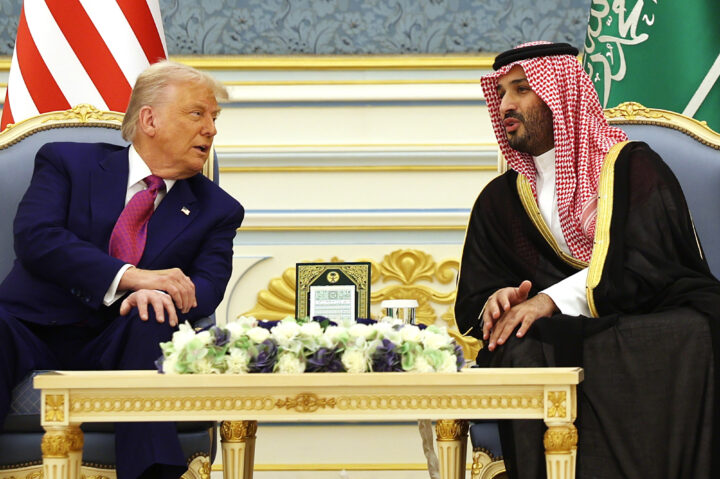
Win McNamee/Getty Images
President Donald Trump meets with Saudi Crown Prince Mohammed bin Salman during a “coffee ceremony” at the Saudi Royal Court on May 13, 2025, in Riyadh, Saudi Arabia.
Good Wednesday afternoon!
This P.M. briefing is reserved for our premium subscribers like you — offering a forward-focused read on what we’re tracking now and what’s coming next.
I’m Danielle Cohen-Kanik, U.S. editor at Jewish Insider and curator, along with assists from my colleagues, of the Daily Overtime briefing. Please don’t hesitate to share your thoughts and feedback by replying to this email.
📡On Our Radar
Notable developments and interesting tidbits we’re tracking
U.S. and Saudi officials are working to finalize a defense pact between the two countries ahead of Crown Prince Mohammed bin Salman’s visit to Washington next week, Axios reports. The agreement would reportedly contain similar guarantees to those Qatar received from the U.S. last month, with the Saudis also looking to purchase a weapons package that would include F-35 fighter jets.
The Trump administration also told the Saudis that it would like to see progress made on Saudi-Israel normalization, U.S. officials said. The negotiations on these deals quietly brought White House advisor Jared Kushner to Riyadh over the weekend and the Saudi defense minister to the U.S. earlier this week…
Jordan Wood, a former congressional aide and Democratic candidate for Senate in Maine, announced that he is switching his candidacy to now run for the House in Maine’s 2nd Congressional District, where Rep. Jared Golden (D-ME) has said he will not seek reelection.
Wood joined his fellow Maine Senate candidate Graham Platner in vowing not to accept support from AIPAC, saying in an interview last week, “There’s a tremendous amount of distrust right now among Democratic primary voters that the money that AIPAC has put into our political system has affected our priorities when it comes to foreign aid to Israel”…
Another shifting race is New York’s 17th Congressional District, where Jessica Reinmann, a Democratic nonprofit executive who was challenging Rep. Mike Lawler (R-NY), dropped out of the Democratic primary today and endorsed Cait Conley.
An Army veteran with extensive counterterrorism experience in the Middle East, Conley told Jewish Insider in April about her commitment to Israel’s security and concerns around threats posed by Iran.
With her background in national security, Conley is viewed as having the strongest profile to win back the swing seat for the party, according to Democratic sources familiar with the race.…
The Wall Street Journal reports on financial gains made by U.S. businesses over the two-year Israel-Hamas war; out of the $32 billion of military-related sales the U.S. has greenlit to Israel since October 2023, $19.3 billion is through contracts with Boeing, Lockheed Martin has secured $743 million, Caterpillar secured $295 million, and more…
An Israeli-founded AI cybersecurity company, Tenzai, founded just six months ago, came out of stealth yesterday with a $75 million seed round. Its technology, which finds hackable vulnerabilities in code, drew support from major venture capital firms including Greylock Partners, Lux Capital and Battery Ventures…
Israel reopened the Zikim border crossing into Gaza today to facilitate increased food and humanitarian aid flow, as part of its compliance with the ongoing ceasefire agreement with Hamas…
After being heckled by anti-Israel protesters at a podcast taping earlier this week, former Vice President Kamala Harris paused the conversation to tell the audience: “A lot of what this process has been for me has been about reflection. Look, we should’ve done more as an administration. We should’ve spoken publicly about our criticism of the way that Netanyahu and his government were executing this war.”
“We had more levers in terms of leverage that we did not use. … But let’s be very clear, that the inhuman nature of what has happened to the Palestinian people in Gaza, the innocent civilians, the extent of hunger, famine, suffering, death, is something that we must acknowledge,” Harris continued…
⏩ Tomorrow’s Agenda, Today
An early look at tomorrow’s storylines and schedule to keep you a step ahead
Keep an eye on Jewish Insider tomorrow morning for reporting on the status of the Muslim Brotherhood under Israeli law.
The U.S. House is expected to approve a spending package to reopen the government this evening, which would fund the government through Jan. 30.
The U.S. Commission on International Religious Freedom is holding a hearing tomorrow morning on religious freedom in Syria during the country’s transition out of dictatorship.
The DP World Tour golf championship kicks off in Dubai, UAE, tomorrow.
Stories You May Have Missed
NEXT STEPS
After Mamdani win, socialists look to challenge Democratic incumbents in NYC
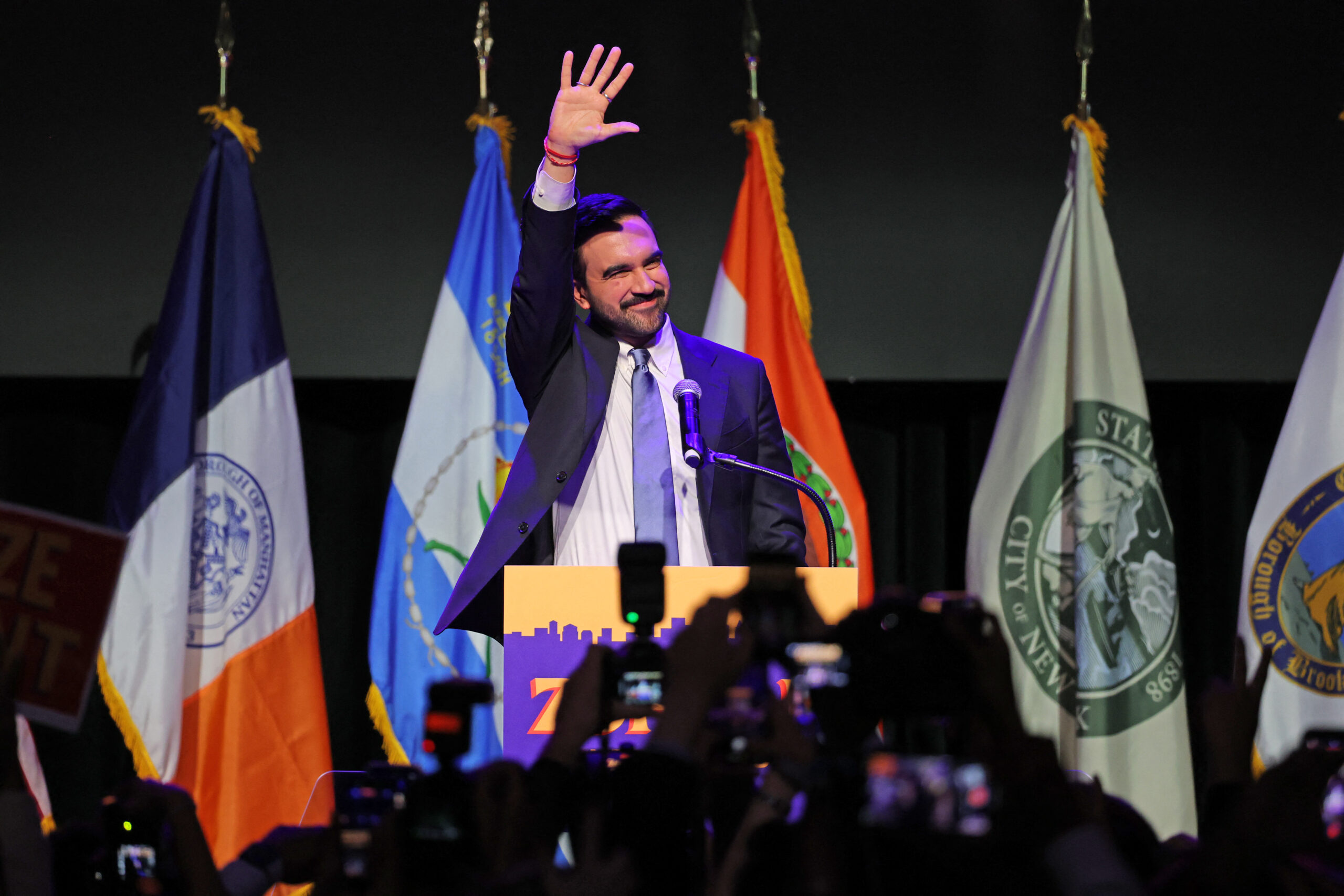
Pro-Israel Democratic Reps. Hakeem Jeffries, Ritchie Torres and Dan Goldman are facing long-shot challengers from the far left
HISTORY LESSONS
Clintons tie Trump’s Gaza peace plan to Oslo Accords in Rabin memorial discussion
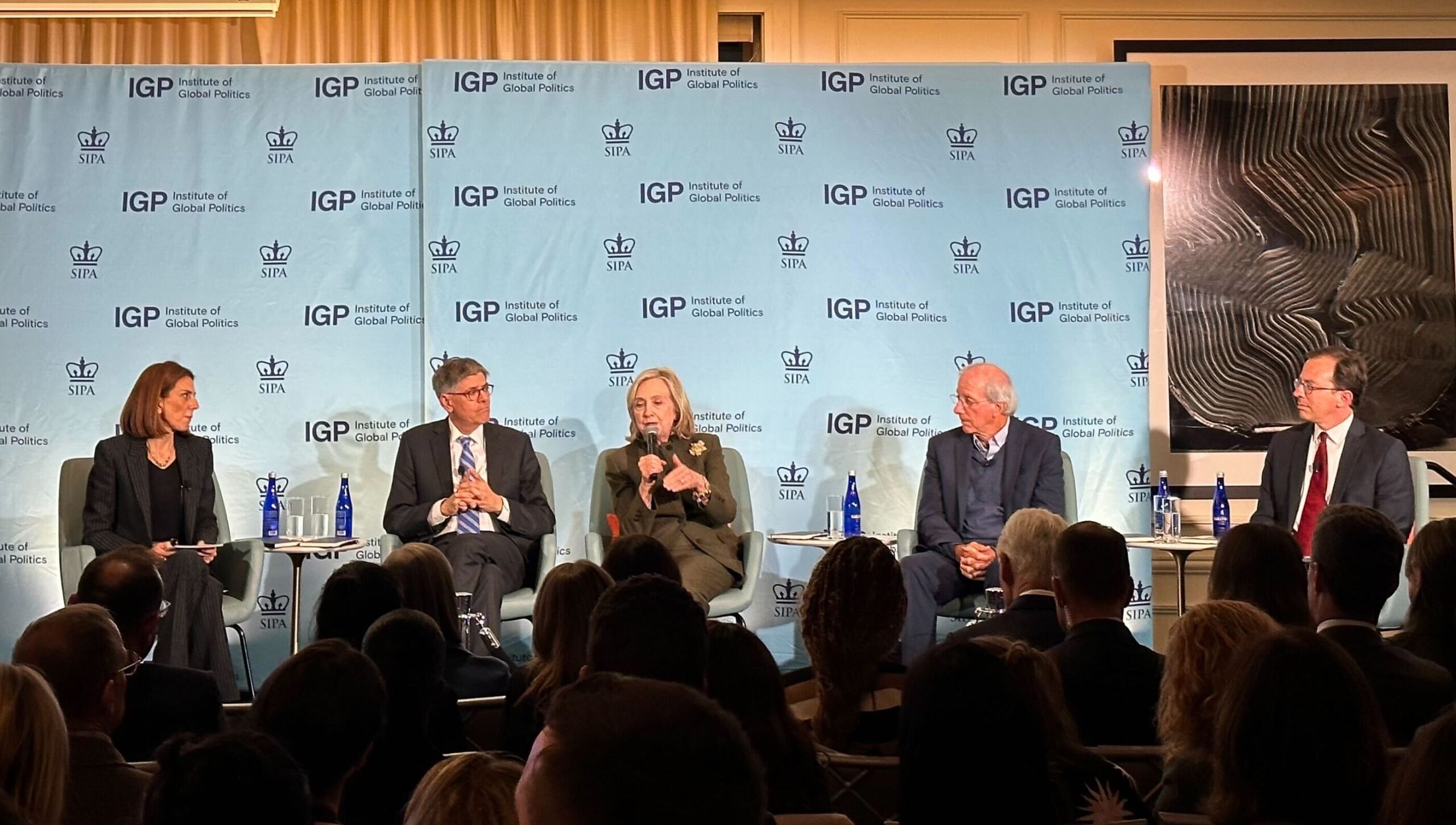
Former President Bill Clinton invoked slain Israeli Prime Minister Yitzhak Rabin’s ‘law’: ‘We will fight terror as if there are no negotiations. We will negotiate as if there is no terror’
Plus, Elaine Luria wants a rematch
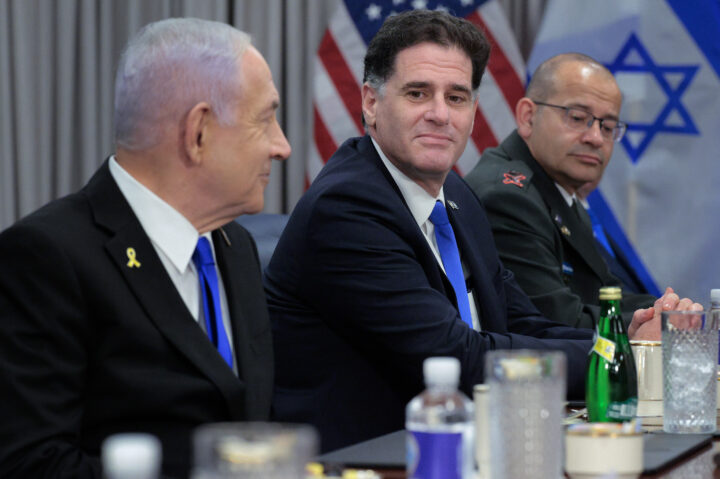
Chip Somodevilla/Getty Images
Israeli Prime Minister Benjamin Netanyahu (L) is joined by Israeli Minister of Strategic Affairs Ron Dermer and other officials for a meeting with U.S. Secretary of Defense Pete Hegseth at the Pentagon on July 09, 2025 in Arlington, Virginia.
Good Tuesday afternoon!
This P.M. briefing is reserved for our premium subscribers like you — offering a forward-focused read on what we’re tracking now and what’s coming next.
I’m Danielle Cohen-Kanik, U.S. editor at Jewish Insider and curator, along with assists from my colleagues, of the Daily Overtime briefing. Please don’t hesitate to share your thoughts and feedback by replying to this email.
📡On Our Radar
Notable developments and interesting tidbits we’re tracking
Michigan Democratic Senate candidate Abdul El-Sayed sidestepped a question about Israel’s right to exist during an interview with the anti-Israel media outlet Zeteo last week, Jewish Insider’s Marc Rod reports.
Zeteo founder Mehdi Hasan asked El-Sayed how he would respond if and when he faces questions on the campaign trail about whether he supports Israel’s right to exist as a Jewish state. Pressed after initially dodging the question, El-Sayed said, “Israel exists. Palestine doesn’t. And so I always wonder why nobody asks me why Palestine doesn’t have a right to exist.”
El-Sayed also dismissed AIPAC donors as “MAGA billionaires throwing their money around to try to dictate the outcome for a Democratic primary,” though AIPAC has not yet endorsed a candidate in the Michigan Senate race…
Chi Ossé, a far-left Gen Z New York City councilman, is planning to launch a primary challenge to House Minority Leader Hakeem Jeffries (D-NY), The New York Times reports, despite discouragement from his ideological ally, Mayor-elect Zohran Mamdani, who clinched Jeffries’ endorsement shortly before the general election. Ossé’s insistence on running reportedly caused him to be disinvited from Mamdani’s election night party…
Elsewhere in New York, Bruce Blakeman, the first Jewish executive of Nassau County who just won reelection last week, is considering mounting a bid for governor, he told Politico, where he would face off against Rep. Elise Stefanik (R-NY) in the GOP primary. Both are allies of President Donald Trump; Blakeman said he “told [Trump] that I was interested, and he didn’t discourage me. And I think he’s had the same conversation with Elise. I think the president is going to play it out and see what happens at the convention”…
Also throwing her hat in the ring, former Rep. Elaine Luria (D-VA), a moderate Jewish Democrat with a strong pro-Israel record, plans to launch a comeback campaign tomorrow, Punchbowl reports. Luria would likely be the front-runner in the already crowded Democratic primary to win back Virginia’s 2nd Congressional District from Rep. Jen Kiggans (R-VA), who defeated her in 2022…
Ron Dermer, Israel’s minister of strategic affairs and longtime advisor and confidante to Prime Minister Benjamin Netanyahu, resigned from his post today after three years in the role, JI’s Tamara Zieve reports. “This government will be remembered both for the October 7 attack and for its management of the two-year, seven-front war that followed,” Dermer wrote in his resignation letter. Israeli media had reported for months that Dermer’s departure was expected.
Dermer has led Israel’s ceasefire and hostage-release negotiations since February and is expected to stay on as Netanyahu’s envoy to continue handling the future of the Gaza portfolio, political sources recently told JI…
The State Department denied reports today that White House advisor Jared Kushner met with Gaza militia leader Yasser Abu Shabab to discuss ceasefire issues including dozens of Hamas terrorists still “stuck” in tunnels on the Israeli side of the ceasefire lines, though U.S. officials told Axios Kushner did speak with Netanyahu about the issue during their meeting in Jerusalem yesterday, and is eager to resolve it without impact on the next phase of the deal…
Saudi Arabia is set to host a U.S.-Saudi investment summit in Washington next Wednesday, a day after Crown Prince Mohammed bin Salman’s visit to the White House. An invite obtained by CBS News shows the event taking place at the Kennedy Center, co-hosted by Saudi Arabia’s Ministry of Investment and the U.S.-Saudi Business Council…
An undated letter from Houthi Chief of Staff Yusuf Hassan al-Madani to Hamas’ Al Qassam Brigades indicates that the Yemeni terror group has halted its attacks on Israel and ships in the Red Sea amid the ongoing ceasefire: “We are closely monitoring developments and declare that if the enemy resumes its aggression against Gaza, we will return to our military operations deep inside the Zionist entity, and we will reinstate the ban on Israeli navigation in the Red and Arabian Seas,” the letter reads…
⏩ Tomorrow’s Agenda, Today
An early look at tomorrow’s storylines and schedule to keep you a step ahead
Keep an eye on Jewish Insider tomorrow morning for an analysis on congressional redistricting efforts and additional reporting on Syrian President Ahmad al-Sharaa’s Washington meetings.
The International Conference of Chabad-Lubavitch Emissaries kicks off tomorrow, drawing 6,200 rabbis from 111 countries to New York City.
Former First Lady Michelle Obama will appear at Washington’s Sixth & I Synagogue tomorrow evening to discuss her forthcoming book, The Look.
Stories You May Have Missed
BETTER TOGETHER
Black and Jewish college students explore shared adversity and allyship at DC-area ‘Unity Dinner’

Sponsored by Robert Kraft’s Blue Square Alliance, Hillel International and the United Negro College Fund, the event brought together over 100 students in an effort to rebuild the Black-Jewish alliance of the Civil Rights Movement
PEACEKEEPING PROSPECTS
Concerns in Israel as U.S. seeks United Nations mandate for international force in Gaza

Israeli experts are pessimistic about the effectiveness and safety of a U.N.-led force, given Israel’s experience with similar mandates in the past
In a speech at a ‘No Kings’ rally, Bush spent time eulogizing convicted murderer Assata Shakur
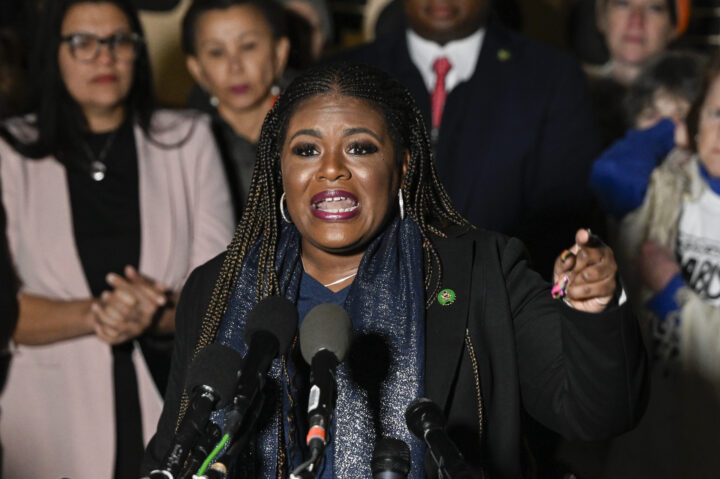
Celal Gunes/Anadolu via Getty Images
Rep. Cori Bush at a press conference in front of the U.S. Capitol to call for a ceasefire in Gaza on November 13, 2023.
In her congressional comeback attempt against Rep. Wesley Bell (D-MO), former Rep. Cori Bush (D-MO) is continuing to lean into extreme rhetoric and stances.
Speaking at an anti-Trump “No Kings” rally in St. Louis shortly after launching her campaign, Bush dedicated extensive time to eulogizing murderer and escaped convict Assata Shakur, an activist who killed a police officer in 1977 and later escaped from prison. Shakur died in Cuba in September.
Bush, in her remarks, described Shakur as “an activist that we recently lost” who “gave us a mantra that we live by. She said it is our duty to fight for our freedom.”
During those remarks, Bush — who has faced repeated accusations of antisemitism — made passing reference to fighting antisemitism and other forms of bigotry.
She finished other remarks about the Trump administration — seemingly unrelated to Israel policy — with a shout of “Free Palestine.”
On X, Bush continues to attack Israel and its supporters as a central message of her campaign, including reposting unfounded claims accusing Israel of violating its ceasefire agreement with Hamas — a subject she has otherwise not addressed on her account, including when the agreement was initially announced.
Bush reposted a response on X to her announcement video that explicitly framed her campaign around her opposition to AIPAC, reading, “Rematch in St. Louis, Cori Bush taking on AIPAC again.”
In that video, Bush continued to implicitly blame her 2024 loss to Bell on AIPAC. Discussing that loss, she said she faced attacks for the fact that she “spoke truth,” accusing her opponents of spreading “lies and hate” about her, while flashing up a series of headlines relating to AIPAC spending in the race.
Responding on X to a video of House Speaker Mike Johnson (R-LA) discussing plans to jointly nominate President Donald Trump for the Nobel Peace Prize with Israeli and other international lawmakers, Bush said, “You should probably tell him [Trump] this won’t get him into heaven.”
Since launching her campaign, Bush has also reposted X posts accusing Israel of genocide, supporting International Criminal Court and International Court of Justice efforts targeting Israel, attacking American supporters of Israel and attacking CBS News editor-in-chief Bari Weiss and the publication she founded, The Free Press, for their Israel coverage.
The coordinated announcements mark a significant shift in the West’s posture — one that, while largely symbolic, underlines concerns about growing efforts to isolate Israel diplomatically
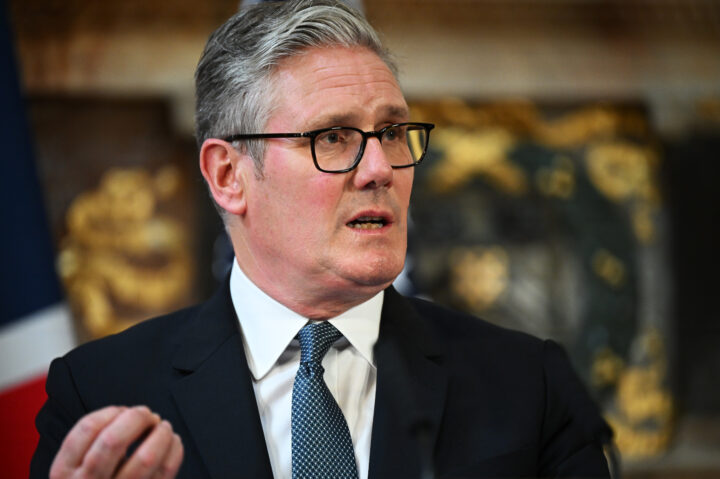
Leon Neal/Getty Images
UK Prime Minister Keir Starmer talks at a press conference at Chequers at the conclusion of a state visit by U.S. President Donald Trump, on September 18, 2025 in Aylesbury, England.
In a move that has sent ripples through diplomatic circles and sparked outrage in Jerusalem, multiple countries — including some of Israel’s key allies — officially recognized a Palestinian state yesterday. The coordinated announcements by the U.K., Canada, Australia and Portugal, with more to come, mark a significant shift in the West’s posture — one that, while largely symbolic, underlines concerns about growing efforts to isolate Israel diplomatically.
“Today, to revive the hope of peace for the Palestinians and Israelis, and a two-state solution, the United Kingdom formally recognises the State of Palestine,” said Prime Minister Keir Starmer.
“The man-made humanitarian crisis in Gaza reaches new depths. The Israeli government’s relentless and increasing bombardment of Gaza, the offensive of recent weeks, the starvation and devastation are utterly intolerable,” he said.
While Starmer said that the move toward a two-state solution “is not a reward for Hamas, because it means Hamas can have no future,” the terror group hailed it as “a gesture to the struggle, steadfastness and sacrifices of our people on the path to liberation and return.”
In President Donald Trump’s meeting with Starmer last week, Trump described the statehood push as “one of our few disagreements.”
The chain of Palestinian statehood recognition is unlikely to bring any immediate changes on the ground. As U.K. Deputy Prime Minister David Lammy said yesterday in an interview with Sky News, “any decision to recognize a Palestinian state … does not make a Palestinian state happen overnight. That has to be part of a peace process, it has to be based on 1967 borders, it has to be based on a shared capital in Jerusalem. That will be for final-status discussions. But it is to keep that process alive.”
Lammy stressed that the U.K. rejects any role for Hamas, “has been crystal clear that it is a terrorist organization” and is working on efforts to reform the Palestinian Authority.
Israel and many of its supporters have slammed the move as rewarding terrorism, as the country continues its war against Hamas in Gaza, where 48 hostages kidnapped during the group’s Oct. 7, 2023 attacks remain in captivity.
Israeli Prime Minister Benjamin Netanyahu said he has “a clear message to the leaders who recognize a Palestinian state after the terrible massacre of Oct. 7: You are giving a massive prize to terror. … It will not happen. There will not be a Palestinian state west of the Jordan River.” Netanyahu hinted that Israel will increase settlement activity in response. Far-right National Security Minister Itamar Ben-Gvir and several other coalition members went a step further by calling for annexation of the West Bank, which Saudi Arabia has reportedly said would have “major implications.” Read more on Netanyahu’s reaction and upcoming UNGA speech here.
Sen. Lindsey Graham (R-SC) delivered a scathing assessment of the statehood development, writing on X: “80 years after the end of WWII, where over 6 million Jews were killed by the Nazis for simply being Jewish, the so-called civilized world is rewarding modern day religious Nazis with an arbitrary Palestinian state designation,” pointing to the lack of defined borders, leadership, and security arrangements.
The Hostages Families Forum also condemned the decision, saying in a statement: “As families who deeply want peace in the region, we believe that any discussion about recognizing a Palestinian state must be contingent upon the immediate release of all hostages … Any nation that fails to uphold this essential prerequisite acts against international law and effectively enables terrorism while legitimizing the October 7th massacre.”
Additional countries are expected to recognize a Palestinian state later today — on the eve of Rosh Hashanah — at the High-Level Conference on Palestine Statehood, led by France and Saudi Arabia.
And well into Rosh Hashanah tomorrow, when Israeli officials will be observing the Jewish high holiday, the U.N. Security Council will hold a critical meeting on the Gaza war.
In the face of these efforts to sideline Israel, Netanyahu is set to address the United Nations General Assembly on Friday, where he’s set to push back forcefully against the recognitions and reassert Israel’s red lines.
In Sunday’s Cabinet meeting, Netanyahu said that he will “present the truth. It is the truth of Israel, but it is also the objective truth of our just struggle against the forces of evil. I will also present our vision for true peace, peace that grows out from strength. … We have to fight both in the U.N. and in all the other fronts against the slanderous propaganda aimed at us, and against the calls to create a Palestinian state that will endanger our existence and constitute an absurd prize for terrorism.”
As the UNGA begins, several countries are recognizing a Palestinian state and the EU is considering suspending free trade with Israel
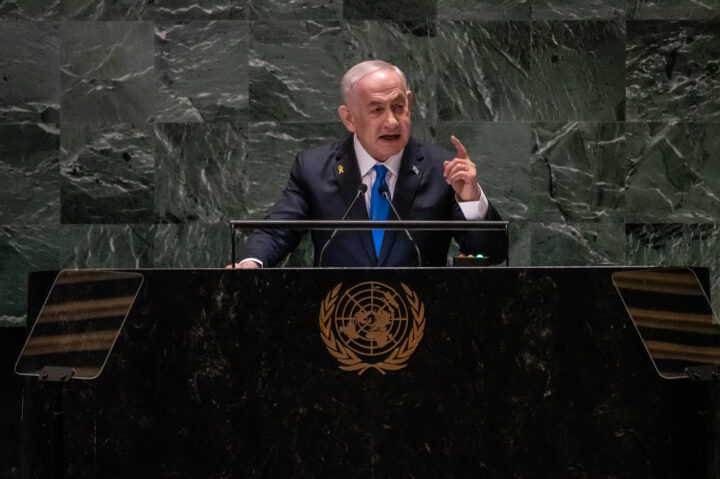
Stephanie Keith/Getty Images
Israeli Prime Minister Benjamin Netanyahu speaks during the United Nations General Assembly (UNGA) at the United Nations headquarters on September 27, 2024 in New York City.
Israeli Prime Minister Benjamin Netanyahu’s planned speech to the United Nations General Assembly on Friday is being overshadowed by European moves to isolate Israel, with the U.K., as well as Canada and Australia recognizing a Palestinian state on Sunday and more to come, as well as an upcoming EU vote on sanctions against Israel.
Netanyahu released a statement, in which he said he has “a clear message to the leaders who recognize a Palestinian state after the terrible massacre of Oct. 7: You are giving a massive prize to terror. … It will not happen. There will not be a Palestinian state west of the Jordan River.”
The prime minister hinted that Israel will increase settlement activity in response: “For years I prevented the establishment of this terror state facing great pressures, domestic and foreign … Not only that, we doubled the Jewish settlement in Judea and Samaria. The response to the latest attempt to force a terror state on us in the heart of our land will be given after my return from the U.S. Wait.”
U.K. Prime Minister Keir Starmer said on Sunday that his country is “acting to keep alive the possibility of peace and a two-state solution. That means a safe and secure Israel alongside a viable Palestinian state. At the moment, we have neither.”
He pushed back against the Israeli argument that recognition of a Palestinian state at this time acts as a reward for Hamas, arguing that “our call for a genuine two-state solution is the exact opposite of [Hamas’] hateful vision. … This solution is not a reward for Hamas, because it means Hamas can have no future.”
Hamas, however, praised the recognition as an “important move” and called for it to be accompanied by ending the “Judaization of the West Bank and Jerusalem, Israel’s isolation and Israel’s leaders brought before international court,” as well as the recognition of the Palestinians’ “natural right to resistance.”
The High-Level Conference on Palestine Statehood, led by France and Saudi Arabia, is set to take place Monday, on the eve of Rosh Hashanah. Nearly a dozen countries have said they would recognize a Palestinian state as part of that effort, following the announcements of the U.K., Canada and Australia on Sunday.
French President Emmanuel Macron argued in an interview with Israel’s Channel 12 News that “recognition of a Palestinian state is the best way to isolate Hamas … What they want is to destroy [Israel], but if we consider that the Palestinian state will always have the objective to destroy Israel, how [do] they want to build a sustainable future? There is no way.”
A recent poll commissioned by the French-Jewish umbrella organization CRIF found that 71% of French people reject the recognition of a Palestinian state before the hostages are freed and Hamas gives up power. In the U.K., a survey in The Telegraph showed 87% of Britons disagree with recognition of a Palestinian state without preconditions, including 89% of Labour voters. A YouGov poll, however, found that 44% of Britons supported the move, while 18% were opposed and 37% unsure.
U.S. Ambassador to France Charles Kushner noted that in conjunction with his announcement of Palestinian state recognition, Macron called for Palestinian recognition of Israel as a Jewish state, the demilitarization of Hamas and the establishment of strong governance for the Palestinians as preconditions for any recognition of Palestinian statehood. “These were France’s own conditions for recognition of a Palestinian state. How can France move forward with next week’s vote when none of these have been met?” Kushner said.
Netanyahu, who was Israel’s ambassador to the U.N. from 1984-1988, is known to relish his addresses to the U.N. General Assembly, embracing theatrical props, puns and long pauses on a platform where he hopes to capture the world’s attention for Israel’s benefit.
After his UNGA speeches, Netanyahu holds court, with other leaders visiting him in a conference room in Turtle Bay. This year, he is expected to meet with Argentinian President Javier Milei, the leaders of Paraguay and Serbia and New York Mayor Eric Adams, and there are reports that he will meet with Syrian President Ahmad al-Sharaa ahead of a possible security agreement between Damascus and Jerusalem. Then, Netanyahu is expected to fly to Washington to meet with President Donald Trump.
Meanwhile, Israel’s Foreign Ministry and Economy Ministry, which oversees foreign trade, have been pushing back against proposed European Union sanctions. The European Commission proposed the roll-back of relations between the bloc and Israel after it “found that actions taken by the Israeli government represent a breach of essential elements relating to respect for human rights” given “the rapidly deteriorating humanitarian situation in Gaza following the military intervention of Israel, the blockade of humanitarian aid, the intensifying of military operations and the decision of the Israeli authorities to advance the settlement plan in the so-called E1 area of the West Bank, which further undermines the two-state solution.”
The proposal, if accepted, would suspend free trade between Israel and the European Union, its largest trade partner.
A source in Brussels estimated that the move would cost Israel 227 million Euros ($266 million) in customs duties per year.
A date has not yet been set for voting on the suspension of free trade, which requires a qualified majority, also known as a “double majority,” meaning 55% of member states, and states representing 65% of the EU population, with at least four states opposed.
Hungary and the Czech Republic said they would oppose the proposal, following calls between their foreign ministers and Israeli Foreign Minister Gideon Sa’ar.
Sa’ar called the proposal “morally and politically distorted.”
“Moves against Israel will harm Europe’s own interests,” Sa’ar warned. “Israel will continue to struggle, with the help of its friends in Europe, against attempts to harm it while it is in the midst of an existential war. Steps against Israel will be answered accordingly, and we hope we will not be required to take them.”
Economy Minister Nir Barkat sent letters to Germany, Hungary, Czechia, Italy, Bulgaria, Greece, Lithuania, Cyprus, Croatia and Latvia asking them to oppose the measure to suspend free trade.
The European Commission also suspended 20 million Euros ($23.5 million) in projects with Israel, dealing with civil service training and regional-EU cooperation related to the Abraham Accords, through 2027. The commission was able to end the cooperation without a vote and noted in repeated statements that it was exempting “civil society and Yad Vashem.”
In addition, the European Commission proposed sanctions against Israeli Finance Minister Bezalel Smotrich and National Security Minister Itamar Ben-Gvir, as well as “violent settlers” and 10 members of the Hamas politburo, which would require a unanimous vote by EU member states. The ban on Israelis is unlikely to be approved, especially not the cabinet ministers.
In another sign of Israel’s increased isolation in Europe, several countries’ public broadcasters said they would boycott the 2026 Eurovision Song Contest if Israel were to take part, as it usually does.
Spain, the Netherlands, Slovenia, Iceland and Ireland have said they will not participate in the contest along with Israel, and Belgium threatened to follow suit.
Israeli public broadcaster Kan said that it will continue to be “a significant part in this cultural event, which cannot become political.”
“Israel is one of the most successful participants in the Eurovision contest — in the past seven years its songs and representatives have finished in 5th, 3rd, 2nd and 1st place,” Kan CEO Golan Yochpaz said.
Austrian Foreign Minister Beate Meinl-Reisinger, whose country is due to host the Eurovision next year, posted on X that the contest “is a symbol of peace, unity, and cultural exchange — not an instrument for sanctions.”
Michael Schill said no Northwestern students have been disciplined for anti-Israel behavior

Valerie Plesch for The Washington Post via Getty Images
Michael Schill, president of Northwestern University, before a House Committee on Education and the Workforce hearing, "Calling for Accountability: Stopping Antisemitic College Chaos" on Capitol Hill on May 23, 2024.
Michael Schill, the Northwestern University president who announced his resignation last week amid widespread controversy over his tenure, appeared unfazed to hear that a Palestinian professor he hired as part of a deal with encampment protestors had once met with the late Hamas leader Yahya Sinwar, an interview with the House Committee on Education and Workforce, released on Thursday, reveals.
In the Aug. 5 interview, which was released as a response to Schill’s resignation announcement on Thursday, House investigators pressed Schill on the hiring of Mkhaimar Abusada as a visiting associate professor of political science.
Abusada, who Schill described as “someone who is regularly quoted as an authority on Palestine governance and politics,” published a piece in Haaretz last year about his 2018 meeting with Sinwar.
“Hypothetically, if somebody, you know, 4 years, 5 years before Oct. 7 has met with someone who — and, I mean, I’m not sure — my guess is — I’ve never been to Gaza, but it’s a pretty small place, and that you are going to meet people and talk to people,” said Schill, who claimed to not be aware of that meeting when he hired Abusada but noted in the interview that the professor’s position had been extended to August 2026. “I don’t know whether a seasoned professor who is doing the politics of Gaza could avoid getting to know some of these people, or whether that would be not doing his job right.”
Schill, who will remain as president in an interim role until his successor is chosen, oversaw a period of antisemitic turmoil on the Chicago-area campus after the Oct. 7, 2023, terrorist attacks and was accused of failing to respond in an adequate manner, leading some lawmakers to call for his resignation.
The 135-page interview transcript provides new, detailed information on Schill’s response to years of campus turbulence, including his controversial handling of a violent anti-Israel encampment in spring 2024 and the university’s close ties to Hamas-allied Qatar.
The interview comes as Northwestern is in talks with the Trump administration to restore $790 million in funding for the university that was pulled by the federal government over an alleged failure to protect Jewish students.
Jewish alumni expressed optimism that Schill’s resignation, and the interview being made public, would lead to Northwestern leaders making necessary reforms.
“Northwestern’s board needs to take control of the situation in a way they have declined to until now [and] clear out all other administrators who have been part of this culture of enabling antisemitism on campus,” Rich Goldberg, a senior advisor at Foundation for Defense of Democracies who holds bachelor’s and master’s degrees from Northwestern, told Jewish Insider.
“Those who are negotiating on behalf of the Trump administration, now seeing this transcript, will need to review any additional information that’s come to light, additional questions that they might have for the university, see if this changes anything that’s been under negotiation to date, and with Schill stepping down, hopefully signaling the board of the university wanting to see real changes made,” Goldberg continued.
Michael Teplitsky, president of the Coalition Against Antisemitism At Northwestern, said that Abusada “should never have been at Northwestern.”
“There must be a massive turnaround and restructuring at the university and they have to make meaningful changes,” said Teplitsky.
When anti-Israel encampments emerged on college campuses across the country in spring 2024, Schill, who is Jewish, became the first university president to strike a deal with demonstrators. The deal included no disciplinary action taken against students and acceded to several demands of the protesters, which drew strong condemnation from many Jewish leaders. Among other concessions, Schill committed to hire two Palestinian professors, which would include Abusada, and offer full scholarships to five students from Gaza.
Schill acknowledged in the interview that — despite telling Congress that “discipline has been meted out to many of those students” who participated in the encampment and other antisemitic incidents on campus — no students had actually faced disciplinary action for anti-Israel activity on campus. Schill said that the university had reason to believe some demonstrators could be armed and claimed that university leadership had no option but to negotiate with the encampment organizers because they were dangerous. The university was afraid to send in the police to remove them, he said.
“We didn’t think our students were armed, but we didn’t know,” Schill told the House committee. “There was a suspicious tent off to the side, and we knew that our students were trying to avoid the people in that tent, and we didn’t know what was inside the tent. And so we were concerned about that.”
The released testimony also puts a spotlight on Northwestern Provost Kathleen Hagerty’s support for the encampment and BDS activism on campus, which Schill argued she may have viewed as a “teachable moment.”
In a series of exposed text messages, Hagerty wrote that “if the students really cared about actual divestment, then they need the patience to do the work to actually make it happen.”
In an April 27 text exchange with a professor, Hagerty wrote that for Northwestern to boycott Sabra, an Israeli hummus company that is sold at the university, it would “probably be pretty easy,” adding that she is “all for making a deal.”
Schill responded to the text messages by highlighting his support for the Jewish state. “I view Israel as our number one strategic partner in the world,” he said.
“I don’t think [Schill] is the only administrator that needs to go,” said Goldberg. “Clearly the provost needs to follow him out the door as someone who is also chiefly responsible for the culture of enabling antisemitism at the university and implementing the encampment appeasement.”
The interview also raised new questions around Northwestern’s relationship with Qatar. Schill said that students on Northwestern’s Qatar campus are exempted from completing the university’s mandatory antisemitism training and acknowledged several examples of professors on the Qatar campus engaging in extreme pro-terrorism and antisemitic activism and speech on social media.
He said that Northwestern’s contract with Qatar prevents it or its affiliates from criticizing the country. “NU, NU-Q, and their respective employees, students, faculty, families, contractors and agents, shall be subject to the applicable laws and regulations of the State of Qatar, and shall respect the cultural, religious and social customs of the State of Qatar,” said Schill. He said that Qatar has given Northwestern $737 million since 2008.
“The initial deal to put a campus out in Qatar was put together, it was in the era after 9/11,” Teplitsky told JI. “I think people had hopes and ambitions to build bridges in the Middle East, in Qatar. It had wonderful intentions. I think now looking back and looking at it specifically through the lens of Northwestern University… looking at it from a perspective of … values that Northwestern lists on its website, that relationship has not been a good one. It’s been one of failure.
Teplitsky continued, “Should Northwestern be registered, as long as they continue to have this campus, with the Department of Justice as a foreign agent? I believe that they should have to register as a foreign agent if they choose to continue to have this campus.”
Jewish Insider Senior Congressional Correspondent Marc Rod contributed reporting.
Sen. Tom Cotton called the move a ‘shameful endorsement of terrorists’

Chesnot/Getty Images
French President Emmanuel Macron waves to media as he waits for Lebanese Prime Minister Najib Mikati prior to their meeting at Elysee Palace on October 23, 2024 in Paris, France.
The Trump administration, congressional Republicans and American Jewish groups are blasting French President Emmanuel Macron’s announcement on Thursday that France will recognize a Palestinian state at the United Nations General Assembly later this year.
Macron’s decision would make France the most prominent European Union country, and one of the U.S.’ closest allies, to unilaterally recognize a Palestinian state, and could create momentum for other countries to make similar decisions. U.S. policy has long held, on a bipartisan basis, that a Palestinian state can only be recognized in the context of a mutually agreed diplomatic solution between Israel and the Palestinians.
“The United States strongly rejects [Macron’s] plan to recognize a Palestinian state at the [UN] General Assembly,” Secretary of State Marco Rubio said. “This reckless decision only serves Hamas propaganda and sets back peace. It is a slap in the face to the victims of October 7th.”
Top Republican lawmakers largely argued that the decision constituted a reward for Hamas for its Oct. 7, 2023, attacks on Israel and its intransigence in recent hostage talks, the most recent round of which collapsed just hours before Macron’s announcement.
Sen. Tom Cotton (R-AR), the chair of the Senate Intelligence Committee, said that the announcement is a “shameful endorsement of terrorists.”
“The best way for this conflict to end is to back Israel in its righteous mission of rescuing the hostages and defeating Hamas,” he continued.
Graham (R-SC) called the decision “curious and disturbing on multiple levels” and said he is “certain this will embolden Hamas and make a ceasefire more difficult.”
“In addition, here are some questions that come to mind. Who’s in charge? What are the borders and boundaries? What is the governance structure? Does Hamas stay involved politically or militarily? Is the West Bank and Gaza part of a single state? Are they allowed to have an army? Does the education system change?” Graham continued. “Other than these few missing details, it seems like a foolproof plan!”
Rep. Brian Mast (R-FL), the chair of the House Foreign Affairs Committee, said in a statement, “Choosing to reward terrorism, hostage taking and genocide against Jews is the wrong choice.”
Rep. Randy Fine (R-FL) said that “France has a long history of surrendering.”
“They surrendered their country to Muslim terrorists long ago,” Fine continued. “Now they want to surrender the Holy Land to Hamas. America and Israel don’t surrender, especially to countries like ‘Palestine’ that don’t exist.”
Rep. Carlos Gimenez (R-FL) said Macron’s decision “is a slap to the face to the Jewish community & the state of Israel.”
“President Macron must rethink this decision and side with freedom & democracy, not a terrorist regime,” Gimenez continued.
Macron’s push for Palestinian statehood had previously faced criticism and scorn from congressional Republicans ahead of a conference the country is set to co-chair on a two-state solution, which was rescheduled from June to early next week.
“It certainly sounds like they take us for granted and think that they can act without consequence. France has a long history of doing this in foreign policy. They’re consistently a problem and have been forever, but I’d say it’s very unhelpful of them at this present moment,” Sen. Josh Hawley (R-MO) told Jewish Insider in June.
Sen. Lindsey Graham (R-SC) said he had tried to dissuade French officials from going ahead with the move.
Several senators downplayed France’s influence in Europe and said that the U.S. should ignore the effort.
AIPAC also condemned the French announcement.
“President Macron is acting as Hamas’ handmaiden with the announcement that France will unilaterally recognize a Palestinian state,” the organization said in a statement. “By taking this action, President Macron is rewarding Hamas’ barbaric attack on the Jewish state on October 7. Moreover, this unilateral recognition makes peace and reconciliation even more elusive.”
“We urge the Administration and Congress to express their opposition to the French government concerning this irresponsible action,” the statement continued.
The American Jewish Committee said the announcement “comes at an extremely troubling time, with Hamas continuing to reject proposals for a ceasefire and the return of the remaining hostages” and noted that France is not asking for any preconditions, including those that Macron himself had previously laid out.
“By offering recognition without conditions — and without demanding the release of hostages or the disarmament of Hamas — France removes any incentive for compromise. It sends a dangerous message: you can get what you want through violence, without giving anything in return,” AJC said. “It only emboldens terror groups like Hamas by legitimizing violence and hostage-taking as viable tactics to achieve political goals. It undermines efforts by leaders across Europe and the Middle East, who are still working toward a negotiated two-state solution. France has undercut its own credibility as an honest broker — a role it has long claimed in the Middle East,” the group continued.
Former U.S. Ambassador to the United Nations Nikki Haley said, “Calling for a Palestinian state, without conditions being met by the PA, does nothing to end this war. Hamas is still holding hostages and Israel’s borders are not secure.”
“If France wants to do something productive they should help eliminate Hamas,” she continued.
Please log in if you already have a subscription, or subscribe to access the latest updates.
 Continue with Google
 Continue with Apple