






















‘Does getting a deal with Israel help him become king or not?’ Ortagus posited at an event hosted by the Foundation for Defense of Democracies

John Lamparski/Getty Images for Concordia Summit
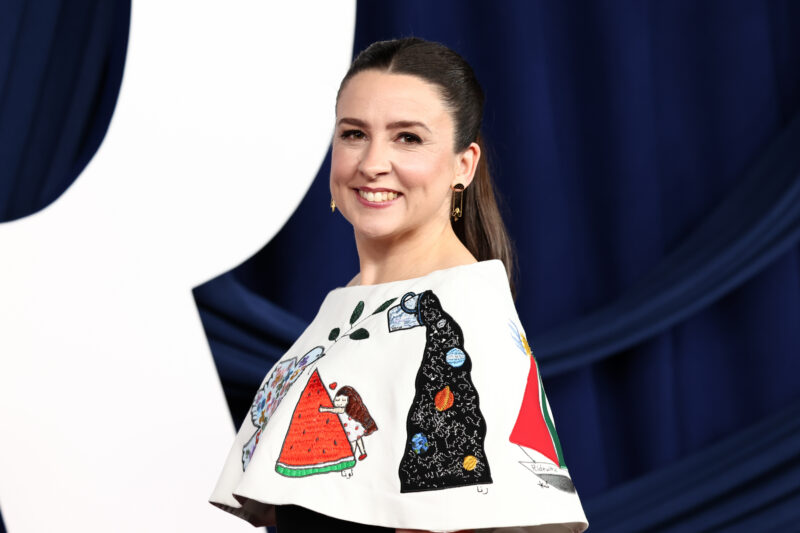
Morgan Ortagus speaks onstage during 2024 Concordia Annual Summit at Sheraton New York Times Square on September 25, 2024 in New York City.


 Add JewishInsider on Google
Morgan Ortagus, the former deputy presidential envoy for Middle East peace, suggested on Thursday that normalizing relations between Saudi Arabia and Israel was not a top priority for Saudi Crown Prince Mohammed bin Salman, citing security concerns and his focus on ensuring he becomes king.
Ortagus made the comments while participating in an event at the Foundation for Defense of Democracies with Hussain Abdul-Hussain, a research fellow at FDD, discussing his book, The Arab Case for Israel: And Other Essays from a Distant Conflict, for which Ortagus wrote the forward.
Ortagus served under White House Special Envoy Steve Witkoff before joining the U.S. mission to the United Nations as a senior advisor last June. She quietly departed the Trump administration in February of this year.
Ortagus said that the Saudi crown prince’s top priority is becoming king and ensuring a peaceful transition from his father, King Salman, explaining that conversations about Riyadh normalizing relations with Israel should be viewed through that lens.
“When you look at it from the lens of MBS, everybody is a politician of some sort. What’s the most important thing that he has to do in the next few years? Actually become king,” Ortagus said. “Does getting a deal with Israel help him become king or not? Does it help that peaceful transition?”
“He got there in a very interesting manner and took out a lot of his family members in order to get where he is, but he still has that hurdle of becoming king and getting through the Shura Council and having that peaceful transition,” she continued. “I think, as for most politicians around the world, certainly here in America, that transition is more important to him than a peace deal in Israel.”
Following publication of this story, a representative for Ortagus reached out to note that her comments were not a suggestion that Saudi-Israeli normalization was unlikely and that she believes “a deal between Saudi Arabia and Israel will happen under the Trump administration.” They added that her comments “were meant to explain why it’s hard and will take time, not to question whether it happens.”
Evangelical leader Mike Evans recently claimed that the crown prince told him that he was prepared to recognize Israel but for the opposition of his father. Saudi officials have publicly rejected the idea of normalization without a path to a Palestinian state.
Abdul-Hussain noted that he had broadly been supportive of MBS’ approach to regional security and economic issues since rising to power in 2015, but criticized what he described as a pivot on the issue of normalization with Israel. He said that he did not know the reason for the shift by the Saudis, but surmised that economic factors were at play.
While Ortagus concurred that economic issues did play a role, she argued that security concerns after Hamas’ Oct. 7, 2023, attacks on Israel prompted the crown prince’s reversal.
“The threats to MBS and to the king and to the whole government in Saudi Arabia went up exponentially after Oct. 7,” Ortagus said. “It was very low before, so I think it’s also very much a security situation.”
Turning to the possibility of Israel and Lebanon normalizing ties and working together to disarm Hezbollah, Ortagus and Abdul-Hussain expressed doubt that the warnings from senior Lebanese officials of a possible civil war if Hezbollah is disarmed and the Lebanese Armed Forces’ decision to keep Gen. Rodolphe Haykal in charge of the LAF — despite Haykal being sympathetic to Hezbollah — were obstacles to reaching a deal.
“I think it comes down to the capabilities, not just the capabilities of the LAF, but the institutional will to actually do the disarmament of Hezbollah, which just fundamentally is not there,” Ortagus said.
Abdul-Hussain shared Ortagus’ skepticism about the Lebanese government’s commitment to reaching a deal.
“Knowing Lebanese politicians, I expect President [Joseph] Aoun to run for the exit. He’s thinking, ‘Well, if they’re talking to Hezbollah too, then talking to me doesn’t mean much,’” Abdul-Hussain said of the Lebanese president. “I think we in this town are not really resolved on which direction we’re going, and I want us to go in the direction of: We will not do the ceasefire the way Hezbollah wants it to be.”
Both Abdul-Hussain and Ortagus rejected the idea that Israel and Lebanon could successfully normalize relations without Hezbollah being disarmed. Ortagus also said that all parties involved in the U.S.-led peace talks between Israel and Lebanon “have to do a better job of making the argument, specifically to the Shia from the south … that you will have a better life” if the two countries normalize relations and disarm Hezbollah.
Ortagus and her partner, Antoun Sehanaoui, a Lebanese banker and producer, also hosted a book party in Georgetown for Abdul-Hussain on Thursday evening, where she praised Abdul-Husain and Sehanaoui for speaking out in favor of peace with Israel, a stance she said puts their lives, livelihoods and families in Lebanon at risk.
Abdul-Husain said his book came about through his own personal story, growing up in a Hezbollah stronghold in Lebanon and being educated that Israel was evil and aimed to conquer Lebanon. But he said that as he learned Hebrew and came to understand Israel and its true goals, his views continued to evolve, “until I reached the point I thought what they had taught us was not really correct.”
“I came up with my own ideas, and I thought that Israel is a successful story, whether we like it or not, whether we think it caused us injustice or not, it’s still a successful story,” Abdul-Hussain said. “If you are Arab or Palestinian, and you think that Israel caused you injustice, or is still causing you injustice, then moving on and forgetting about and taking this injustice is much more to your interest than trying to wind the clock back to a time when Israel did not exist and start building from there.”
He said that evidence shows that the stronger the relations an Arab state has with Israel, the more successful it is, economically and otherwise.
On Iran, at the FDD event, Ortagus argued that the U.S. is winning the war despite it still being unfinished more than 100 days since its launch, citing Iran’s heavily degraded military capabilities and what she described as the weak status of the current regime.
“Nothing about war now is easy and simple. No one’s going on a ship anymore to sign a declaration of the end of the war, it’s just not how it happens,” Ortagus said. “So you have to look at the president’s and the administration’s goals, and as much as people like to critique every single thing this president and administration does, he is the only president in 47 years of the Islamic Republic to be willing to take kinetic action in order to coerce the regime back to the negotiating table.”
“His negotiators, by the way, should be able to get a great deal because of the amount of leverage that he’s given them. The president talks about this all the time. He talks about what he’s done to destroy their nuclear facilities, their military capabilities, their Navy, their Air Force. We fly with impunity over their skies,” she continued. “To everyone sort of prognosticating that this has somehow been a failure. Look at the metrics, look at the facts, look at the capabilities, look at the regime strength today and look at their economy. … I just think it’s a matter of time before this regime falls.”
She suggested that the mass pro-democracy protests in Iran earlier this year forced President Donald Trump to expedite his plans to target the regime and what remains of its nuclear program while defending the extended length of the conflict.”
“All of these protestations by Europeans and other feckless individuals who never get in the fight are wrong,” Ortagus said. “Obviously, I think, we had a moment of opportunity after the protest earlier this year where we had to decide on action probably a little bit earlier than we had planned on, because it was the moment when we, when the president clearly told the people of Iran, the protesters that we were going to stand by them, and that help is on the way, so help had to get on the way.”
Ortagus described the president as “the leading hawk at the White House,” saying he “has fundamentally understood this issue since his very first campaign in 2016, of how destabilizing it would be for the region if Iran were to obtain a nuclear weapon. He set red lines for himself and said it will never happen on my watch, and I think he very much understands that any deal cannot be like the JCPOA [the 2015 nuclear deal] has to make sure that they can’t actually obtain a nuclear weapon. I think he’s very clear on that, and I know that his negotiators are.”
Ortagus said she believed both the president and U.S. negotiators are of the view that not reaching a deal with Iran, because the regime would not make necessary concessions, “is somewhat better than a bad deal.”
She suggested that the White House was also aware of the logistical hurdles involved in getting any agreement approved by the Senate, warning that Sens. Ted Cruz (R-TX), Tom Cotton (R-AR) and Lindsey Graham (R-SC) will not vote to approve a deal that does not address key concerns about the regime, its terror financing network and its nuclear and ballistic missile programs.
“Anybody who’s not a freshman senator was around during JCPOA, and Republican senators have been very on the record for what they would accept in any deal with Iran, certainly even during the Biden years,” Ortagus said. “Republican senators are going to get a say in whatever the final deal looks like. The beauty of our democracy is this comes down to not only what the president is willing to sign, and I happen to think that he’s one of the most hawkish people in the room on this issue, it also comes down to what the U.S. Senate and what Republicans in the Senate are going to abide by.”
This story was updated on June 12 to reflect clarifications from Ortagus’ representative about her comments on Saudi-Israel normalization.
Despite announcing sweeping security, investment and defense agreements, the fate of a Saudi-Israel normalization deal remains uncertain
Win McNamee/Getty Images
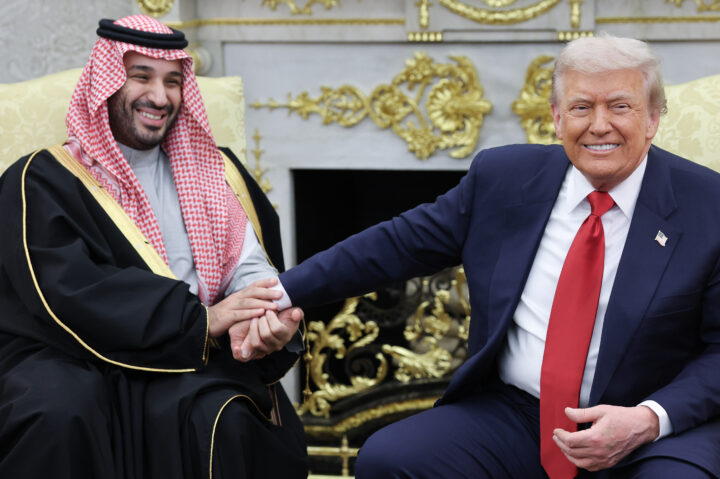
President Donald Trump (R) meets with Crown Prince and Prime Minister Mohammed bin Salman of Saudi Arabia during a bilateral meeting in the Oval Office of the White House on November 18, 2025.
During Tuesday’s meeting between President Donald Trump and Saudi Crown Prince Mohammed bin Salman, the leaders strengthened their relationship and confirmed the completion of several deals. Any plan to utilize such transactions as part of normalization with Israel, however, was notably absent.
While taking questions from reporters in the Oval Office, Trump confirmed that the U.S. would sell Saudi Arabia F-35 fighter jets of similar caliber to Israel’s. At a dinner that evening, the president added that a strategic security agreement had crossed the finish line, while also formally naming Saudi Arabia a major non-NATO ally. On Wednesday, the two countries announced a strategic artificial intelligence partnership.
“The main takeaway of the visit was the normalization of the U.S.-Saudi relationship,” said Aaron David Miller, a senior fellow at the Carnegie Endowment for International Peace and former State Department negotiator. “[There was] very little, it seemed to me, not surprisingly, on the side of normalization to Israel. It’s almost as if Israel was sort of an afterthought this visit.”
When asked by reporters why normalization with Israel was not prioritized, Trump did not provide much of a response, instead asserting that Israel is “going to be happy.”
Observers had anticipated that Trump would roll out the red carpet for MBS on his visit to Washington. What remained unknown was whether the deepening ties between Washington and Riyadh would come with progress between Saudi Arabia and Israel, the United States’ closest ally in the region.
But the deals announced this week were made without any apparent requirement of progress toward normalization, leading some experts and leaders of pro-Israel groups to raise questions about the Trump administration’s strategy.
“By the way this was done, President Trump seems to have elevated the partnerships with Saudi Arabia and maybe, to some degree, with other Gulf states, above pretty much all other U.S. partnerships, including Israel,” said Dan Shapiro, a former U.S. ambassador to Israel under former President Barack Obama.
“So that means that other considerations, like ensuring the right incentives are still in place for Saudi Arabia to normalize relations with Israel or ensuring that military sales are done in a way that protects U.S. interests and Israel’s security interests, may be less important than they have been under previous administrations.”
Shapiro said that while it is reasonable for the U.S. to strengthen its partnerships with Gulf countries, the deals gave away major incentives for normalization “without knowing whether it can be achieved later.” He also added that it came without guarantees from the Saudi government on limiting military cooperation with China and Russia.
Anne Dreazen, the vice president for the American Jewish Committee’s Center for a New Middle East, told JI that Saudi-Israeli normalization could not have been achieved on this visit, adding that it was “not in the cards right now.”
“Now the paradigm is shifting where it’s about peace between Israel and Saudi Arabia being logical and good based on its own merits, when they can get the politics right and when they can reach agreement on the Palestinian issue,” said Anne Dreazen, the vice president for the American Jewish Committee’s Center for a New Middle East.
“Right now we’re not there. The politics in Israel and Saudi Arabia are not right for this,” said Dreazen. “I think President Trump realized that it wasn’t going to happen in this visit and wanted to move ahead with these deals because there’s a strong perception that making some deals with Saudi Arabia is in America’s interest.”
Dreazen, however, still believes normalization is “going to happen,” adding that she has confidence from conversations with Saudi officials that political differences will be resolved in the future.
Trump’s decision to make significant deals with Saudi Arabia while not pressing for normalization suggests the White House is taking a different approach than in the past, Dreazen argued.
“Now the paradigm is shifting where it’s about peace between Israel and Saudi Arabia being logical and good based on its own merits, when they can get the politics right and when they can reach agreement on the Palestinian issue,” said Dreazen, a shift from how former President Joe Biden approached negotiations.
But with MBS leaving Washington with so many deliverables, it’s unclear whether he will still prioritize normalization.
The Israelis are “going to be right to worry that the Saudis may feel like they’ve gotten everything they want and don’t have any need left for normalization,” Shapiro said.
Following his Oval Office meeting with Trump, the Saudi crown prince told reporters, “We want to be part of the Abraham Accords, but we want also to be sure that [we] secure a clear path [toward a] two-state solution.”
Leaders of pro-Israel groups said normalization between Israel and Saudi Arabia should remain a top policy priority for the U.S.
“The United States would be stronger and more secure if our major non-NATO allies worked together to promote regional peace, stability and prosperity,” said AIPAC spokesman Marshall Wittmann. “This objective would be advanced if Saudi Arabia joined the Abraham Accords, and U.S. leaders should urge it to do so.”
In a statement released on Wednesday, Democratic Majority for Israel’s president and CEO, Brian Romick, said that expanding the Abraham Accords must be “central to U.S. policy,” and urged Congress to play an active role in reviewing U.S. defense agreements with Saudi Arabia.
“Any substantial upgrade in the U.S.–Saudi relationship — including access to advanced U.S. defense systems — must be tied to meaningful, measurable progress toward Saudi-Israeli normalization,” Romick said in a statement. “It is now incumbent on the Trump Administration to use our leverage with Saudi Arabia to make real progress toward normalization.”
“There’s clearly a political dynamic going on here,” said Israel Policy Forum chief policy officer Michael Koplow. “Trump went out of his way to almost poke at the Israelis. He implied that [the U.S. is] OK with the Saudis getting F-35s but [the Israelis] want the Saudis to get a less advanced version, and he almost seemed to boast about the fact that he’s going to give the Saudis whatever he wants no matter what Israel says.”
Trump’s promise of F-35 sales to Saudi Arabia has raised questions about which model and allowances Riyadh will receive and whether Israel will maintain its qualitative military edge, which the U.S. is bound by law to uphold. To date, Israel is the only country in the Middle East to have obtained the fighter jet.
U.S. officials and experts told Reuters that the F-35 jets the U.S. plans to sell to Saudi Arabia will lack superior features that Israel’s fleet has.
Israel Policy Forum chief policy officer Michael Koplow voiced concerns about the security aspect of the deals.
“It doesn’t surprise me that all of these things are going ahead,” said Koplow. “What surprises me more is that some of the things that have been discussed over the past couple of days seem to put Israel in a more difficult security position, particularly this question of sales of F-35s.”
Israel’s government, meanwhile, has stayed largely quiet about the F-35 sales, though the Israeli Air Force has objected to the deal, warning that it could damage Israel’s air superiority in the region
“There’s clearly a political dynamic going on here,” said Koplow. “Trump went out of his way to almost poke at the Israelis. He implied that [the U.S. is] OK with the Saudis getting F-35s but [the Israelis] want the Saudis to get a less advanced version, and he almost seemed to boast about the fact that he’s going to give the Saudis whatever he wants no matter what Israel says.”
From a Trump nominee with a ‘Nazi streak’ to a Sanders-endorsed candidate with a Totenkopf tattoo, the normalization of political hate speech is bipartisan — and increasingly tolerated
AP Photo/Alex Brandon
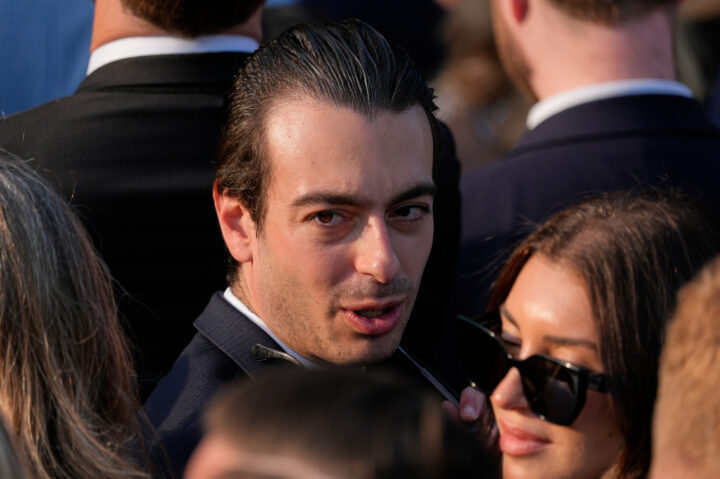
Paul Ingrassia arrives before Trump speaks during a summer soiree on the South Lawn of the White House, June 4, 2025, in Washington.
One of the defining characteristics of our age is the utter lack of institutional gatekeepers and red lines against hate in our politics and culture. Extremist rhetoric, antisemitism, racism and approval of political violence are all becoming commonplace in our discourse, to the point where Americans have become numb to the crazy.
Just take a look at the headlines over the last month of scandals that have captured national attention — and would have been unthinkable not long ago.
1. Paul Ingrassia, President Donald Trump’s nominee to lead the Office of Special Counsel, withdrew himself from consideration yesterday after belated backlash over his history of racist and antisemitic comments — including a recently revealed text message chain where he said he has a “Nazi streak.” We reported on Ingrassia’s extremist record in May, revealing a string of antisemitic and racist public social media posts, including this shocking comment on X days after Hamas’ Oct. 7, 2023, terror attack: “I think we could all admit at this stage that Israel/Palestine, much like Ukraine before it, and BLM before that, and covid/vaccine before that, was yet another psyop.”
Ingrassia also has been an ally of Nick Fuentes, a virulently antisemitic podcast host and far-right influencer who has long trafficked in Holocaust denial. He attended a rally in 2024 for Fuentes, and in 2023 defended Fuentes after he was banned from Twitter.
Ample documentation of Ingrassia’s bigotry didn’t stunt his nomination, though the new shocking revelations from the private text chain caused key Republicans — most notably, Senate Majority Leader John Thune (R-SD) and Sens. Ron Johnson (R-WI), Rick Scott (R-FL) and James Lankford (R-OK) — to withdraw their support and end his chances of getting confirmed.
But the fact that he got as close as he did to receiving a hearing for the plum role shows just how much antisemitism is becoming normalized.
2. Graham Platner, the embattled far-left candidate in Maine’s Senate race, already under scrutiny over social media posts declaring himself a communist and calling the police “bastards,” acknowledged he has a skull-and-crossbones tattoo on his chest that his just-departed political director characterized as “anti-Semitic.” A former acquaintance of Platner’s said he called the tattoo “my Totenkopf,” referring to a symbol adopted by a Nazi SS unit.
Platner is facing Maine Gov. Janet Mills, the favorite of the party establishment (for good reason) in the Democratic Senate primary. Platner has been endorsed by Sen. Bernie Sanders (I-VT), praised by several progressive senators and backed by a number of leading labor unions, including the UAW.
Despite Platner’s remarkable baggage and Nazi-themed tattoo, Sanders still is standing behind him. ”I personally think he is an excellent candidate. We don’t have enough candidates in this country who are prepared to take on the powers that be and fight for the working class,” Sanders said Tuesday, when pressed by reporters about the tattoo allegations.
3. A Young Republicans group chat from this year, with 2,900 pages of comments leaked to Politico, was filled with racist and antisemitic texts, with participants including elected lawmakers and up-and-coming professionals in GOP politics. Peter Giunta, a Young Republicans official, joked “I love Hitler” in the chat and said everyone who voted against him for a leadership position “is going to the gas chamber.” Joe Maligno, the general counsel for the New York Young Republicans, later responded: “Can we fix the showers? Gas chambers don’t fit the Hitler aesthetic.”
Politico characterized the group conversations as featuring a “dynamic of easy racism and casual cruelty” that played out in “often dark, vivid fashion” — and noted “the love of Nazis within their party’s right wing” as a common theme of the discourse. The chat included the N-word a dozen times.
But while many Republicans quickly spoke out against the unadulterated hate in the conversation, Vice President JD Vance downplayed the episode as young people “telling stupid jokes.” “I refuse to join the pearl clutching,” Vance said on X, arguing the private conversation was less significant than the scandal involving Jay Jones, the Virginia Democratic attorney general nominee who sent texts wishing political violence against a GOP colleague and his family.
4. Jay Jones’ text messages in 2021 saying his GOP colleague, former House Speaker Todd Gilbert deserved to be killed and calling Gilbert’s children “little fascists” shocked the political world — and upended a race in which Democrats were initially favored. The comments were especially shocking amid a rise in political violence, coming after the assassination of conservative pundit Charlie Kirk and the attempted killing of Trump in the last two years.
But while many Democrats condemned the comments, no prominent members of the party withdrew their endorsement of the nominee. Even as polls show a small but critical mass of persuadable voters have switched their support to GOP Attorney General Jason Miyares, Jones has maintained near-universal partisan support.
Sen. Tim Kaine (D-VA), reflecting the general Democratic sentiment in the state, said on NBC’s “Meet the Press”: “Those texts, private texts with a colleague, cannot be defended. They cannot be defended. But Jay Jones has apologized earnestly,” Kaine said.
***
All of these recent episodes are bad enough on their own. But taken together, they are indicative of a deeper problem in our culture. It’s a telling sign of the times that so many political leaders have instinctively rallied around the partisan flag instead of speaking out with the moral clarity that, not long ago, came naturally for them.
To be sure, there have been some pockets of political principle, mixed in with a smattering of self-interest. The opposition of several key Senate Republicans to Ingrassia’s nomination cut short his political aspirations, at least for now. Former Rep. Abigail Spanberger, the Democratic nominee for Virginia governor, hasn’t affirmed her endorsement for Jay Jones even as she won’t distance herself from him, either. Senate Minority Leader Chuck Schumer (D-NY) endorsed Mills’ candidacy, shortly after news of Platner’s tattoos was revealed.
But these are the exceptions to the rule, and the half-hearted nature of the distancing underscores how difficult taking on a radicalized base is in our polarized political world.
This is the type of environment in which antisemitism is thriving — a nihilistic body politic with no rules, standards or expectations for respectable behavior. And it’s as much a demand-side problem, with voters growing numb and desensitized towards growing extremism, as it is about the supply of politicians catering to their constituents. Until Americans put their principles ahead of partisanship, we’re likely to see this dynamic continue to worsen.
The Oklahoma senator said, ‘The United States needs to make a clearer statement to the world that, if you join the Abraham Accords … it's different for this group, so wouldn't you like to join this club?’
AJC/Martin H. Simon
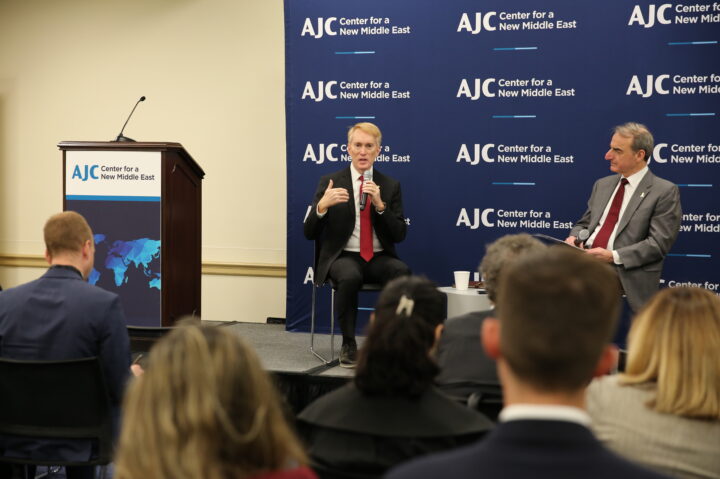
Sen. James Lankford (R-OK) speaks at AJC's Abraham Accords 5th Anniversary Commemoration on Capitol Hill in Washington on Sept. 10, 2025.
Sen. James Lankford (R-OK) urged the Trump administration to offer clearer incentives, including favorable trade and tariff treatment, to countries that normalize relations with Israel.
“The United States needs to make a clearer statement to the world that, ‘If you join the Abraham Accords, this is what happens to trade. We change the rules on what we do, on trade, on tariff, on relationships — it’s different for this group, so wouldn’t you like to join this club?’” Lankford said at an American Jewish Committee event in Washington marking the five-year anniversary of the Abraham Accords. “I think that’s something that we’ve yet to define clearly as an American government and as a State Department and our Commerce [Department], and I think it’s an area that is unfinished business.”
He also urged other countries in the region not to give Hamas the result it sought, through the Oct. 7, 2023, attacks, in scuttling regional normalization efforts and isolating Israel globally.
“I think one of the biggest challenges right now is communicating to other nations, ‘Don’t show Hamas they were successful based on what your behavior changes now, and your relationship with Israel in the future. Don’t allow that terrorist extremist group to be the one that speaks for you and your nation,’” Lankford said. “If you say you oppose extremism, then don’t support their methods.”
He said that’s “a hard conversation to have among friends. I think it’s also difficult because we have broken relationships with multiple nations. That means sitting down with people you don’t normally sit down with and saying, ‘How do we get past this?’ And those are not simple conversations.”
Lankford said that offering favorable trade terms and offering a “package of what it means to be a part of this club” would help “smooth some of that.”
Asked by Jewish Insider about the Israeli attack on Hamas leaders in Qatar, Lankford said that Israel has been “very, very clear. It has been for decades. If you kill us and … [in] an act of terrorism, we don’t care where you are anywhere in the world, we’re going to come after you.”
“Their statement is pretty clear: ‘We had an opportunity, we’re going to take the opportunity,’” Lankford said. “An air strike may not be the most elegant way to be able to do that. And so I think there’s some disagreement on that. There’s not disagreements on, if someone is trying to kill you — it’s been American policy as well — we’re going to find you.”
He added that Qatar is an ally of the United States, but also of Iran.
On the issue of recent Israeli strikes on Syria, Lankford largely defended Israel, saying that Israel had been clear that it not allow Turkey to take over Syria and that it would protect the Druze population. He said that Israel’s focus on the atrocities against the Druze had raised that issue to global attention.
“Syria and its disjointed government at this point, as they’re trying to be able to form, has either allowed or encouraged the attack on the Druze in the south, that can’t be allowed,” Lankford said. “The leadership in Syria needs to control its own military and militant factions to be able to make sure they’re not slaughtering the Alawites, as it was allowed just a few weeks before that, or the Druze.”
Lankford, who recently visited Lebanon, said he remains encouraged by the progress that it has made toward eliminating Hezbollah, particularly setting an end-of-year deadline to disarm the terrorist group and moving to secure its banking system to prevent Hezbollah’s financing.
Lankford said he believes Lebanon is on track to meet the deadline the country set to disarm Hezbollah.
“I think that’s one of the greatest opportunities for peaceful connections between two neighbors that say they don’t want war with each other,” Lankford said, referring to potential relations and a stable, established border between Israel and Lebanon. “Good fences make good neighbors at times, and this is a good spot to be able to do that.”
‘We think [we] will have some, or a lot of announcements, very, very shortly, which we hope will yield great progress by next year,’ the Middle East envoy said

CHIP SOMODEVILLA/GETTY IMAGES
White House special envoy Steve Witkoff briefly speaks to reporters as he walks back into the West Wing following a television interview on the North Lawn of the White House on March 19, 2025 in Washington, D.C.
Speaking at an event celebrating Israeli Independence Day on Monday, Middle East envoy Steve Witkoff suggested that he expects additional countries will join the Abraham Accords in the coming year.
“We think [we] will have some, or a lot of announcements, very, very shortly, which we hope will yield great progress by next year,” Witkoff said of the prospects for additional normalization between Israel and Arab states, at an event organized by the Israeli embassy in Washington.
Witkoff only gave a glancing mention of Iran, with which he is the lead U.S. negotiator, in his brief remarks, pledging that Tehran would never obtain a nuclear weapon, but not elaborating on the talks beyond that.
The U.S. envoy emphasized the need for Israeli unity, saying, “I urge the Israeli people to choose unity over division, vision over disagreement and hope over despair. When you do, Israel’s future will shine brighter than ever.”
Witkoff also said that one of the most joyous moments of his life was visiting with recently freed hostages from Gaza and singing Am Yisrael Chai with them and their families. He pledged to work “tirelessly this year” toward “peace, prosperity and for Israel, unity.”
The event for Yom Ha’Atzmaut also featured remarks from Secretary of Energy Doug Burgum.
Please log in if you already have a subscription, or subscribe to access the latest updates.
 Continue with Google
 Continue with Apple