























Ortagus: MBS prioritizing security, succession over Israel normalization
‘Does getting a deal with Israel help him become king or not?’ Ortagus posited at an event hosted by the Foundation for Defense of Democracies

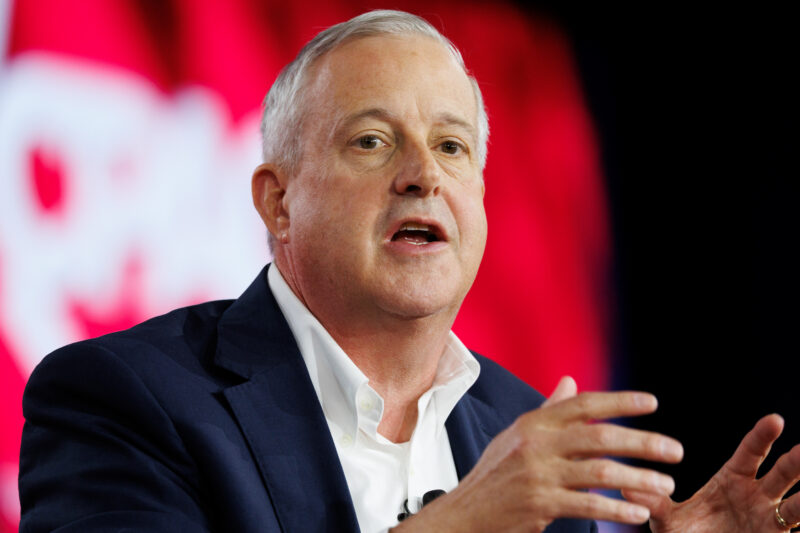
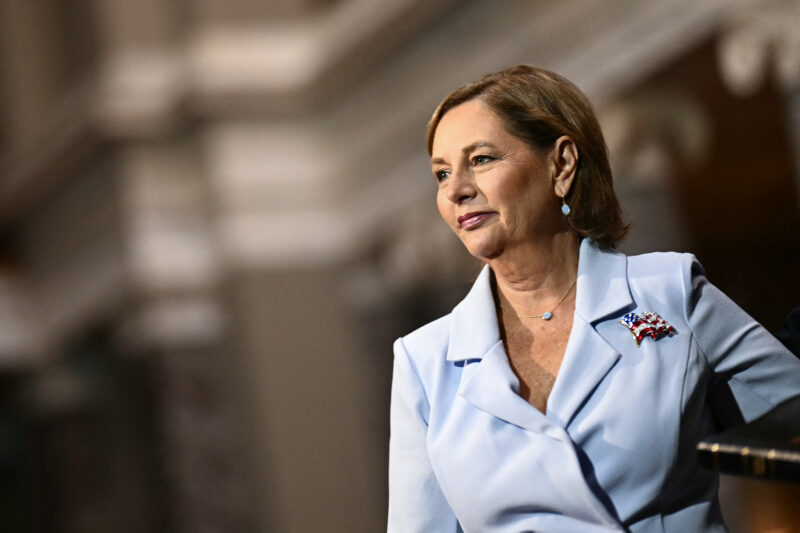
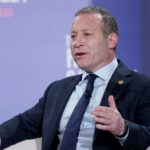
John Lamparski/Getty Images for Concordia Summit
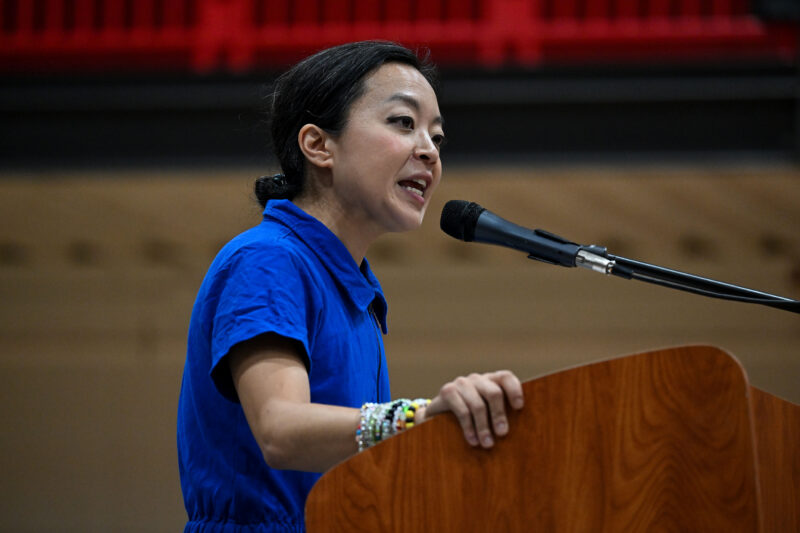
Morgan Ortagus speaks onstage during 2024 Concordia Annual Summit at Sheraton New York Times Square on September 25, 2024 in New York City.


 Add JewishInsider on Google
Morgan Ortagus, the former deputy presidential envoy for Middle East peace, suggested on Thursday that normalizing relations between Saudi Arabia and Israel was not a top priority for Saudi Crown Prince Mohammed bin Salman, citing security concerns and his focus on ensuring he becomes king.
Ortagus made the comments while participating in an event at the Foundation for Defense of Democracies with Hussain Abdul-Hussain, a research fellow at FDD, discussing his book, The Arab Case for Israel: And Other Essays from a Distant Conflict, for which Ortagus wrote the forward.
Ortagus served under White House Special Envoy Steve Witkoff before joining the U.S. mission to the United Nations as a senior advisor last June. She quietly departed the Trump administration in February of this year.
Ortagus said that the Saudi crown prince’s top priority is becoming king and ensuring a peaceful transition from his father, King Salman, explaining that conversations about Riyadh normalizing relations with Israel should be viewed through that lens.
“When you look at it from the lens of MBS, everybody is a politician of some sort. What’s the most important thing that he has to do in the next few years? Actually become king,” Ortagus said. “Does getting a deal with Israel help him become king or not? Does it help that peaceful transition?”
“He got there in a very interesting manner and took out a lot of his family members in order to get where he is, but he still has that hurdle of becoming king and getting through the Shura Council and having that peaceful transition,” she continued. “I think, as for most politicians around the world, certainly here in America, that transition is more important to him than a peace deal in Israel.”
Following publication of this story, a representative for Ortagus reached out to note that her comments were not a suggestion that Saudi-Israeli normalization was unlikely and that she believes “a deal between Saudi Arabia and Israel will happen under the Trump administration.” They added that her comments “were meant to explain why it’s hard and will take time, not to question whether it happens.”
Evangelical leader Mike Evans recently claimed that the crown prince told him that he was prepared to recognize Israel but for the opposition of his father. Saudi officials have publicly rejected the idea of normalization without a path to a Palestinian state.
Abdul-Hussain noted that he had broadly been supportive of MBS’ approach to regional security and economic issues since rising to power in 2015, but criticized what he described as a pivot on the issue of normalization with Israel. He said that he did not know the reason for the shift by the Saudis, but surmised that economic factors were at play.
While Ortagus concurred that economic issues did play a role, she argued that security concerns after Hamas’ Oct. 7, 2023, attacks on Israel prompted the crown prince’s reversal.
“The threats to MBS and to the king and to the whole government in Saudi Arabia went up exponentially after Oct. 7,” Ortagus said. “It was very low before, so I think it’s also very much a security situation.”
Turning to the possibility of Israel and Lebanon normalizing ties and working together to disarm Hezbollah, Ortagus and Abdul-Hussain expressed doubt that the warnings from senior Lebanese officials of a possible civil war if Hezbollah is disarmed and the Lebanese Armed Forces’ decision to keep Gen. Rodolphe Haykal in charge of the LAF — despite Haykal being sympathetic to Hezbollah — were obstacles to reaching a deal.
“I think it comes down to the capabilities, not just the capabilities of the LAF, but the institutional will to actually do the disarmament of Hezbollah, which just fundamentally is not there,” Ortagus said.
Abdul-Hussain shared Ortagus’ skepticism about the Lebanese government’s commitment to reaching a deal.
“Knowing Lebanese politicians, I expect President [Joseph] Aoun to run for the exit. He’s thinking, ‘Well, if they’re talking to Hezbollah too, then talking to me doesn’t mean much,’” Abdul-Hussain said of the Lebanese president. “I think we in this town are not really resolved on which direction we’re going, and I want us to go in the direction of: We will not do the ceasefire the way Hezbollah wants it to be.”
Both Abdul-Hussain and Ortagus rejected the idea that Israel and Lebanon could successfully normalize relations without Hezbollah being disarmed. Ortagus also said that all parties involved in the U.S.-led peace talks between Israel and Lebanon “have to do a better job of making the argument, specifically to the Shia from the south … that you will have a better life” if the two countries normalize relations and disarm Hezbollah.
Ortagus and her partner, Antoun Sehanaoui, a Lebanese banker and producer, also hosted a book party in Georgetown for Abdul-Hussain on Thursday evening, where she praised Abdul-Husain and Sehanaoui for speaking out in favor of peace with Israel, a stance she said puts their lives, livelihoods and families in Lebanon at risk.
Abdul-Husain said his book came about through his own personal story, growing up in a Hezbollah stronghold in Lebanon and being educated that Israel was evil and aimed to conquer Lebanon. But he said that as he learned Hebrew and came to understand Israel and its true goals, his views continued to evolve, “until I reached the point I thought what they had taught us was not really correct.”
“I came up with my own ideas, and I thought that Israel is a successful story, whether we like it or not, whether we think it caused us injustice or not, it’s still a successful story,” Abdul-Hussain said. “If you are Arab or Palestinian, and you think that Israel caused you injustice, or is still causing you injustice, then moving on and forgetting about and taking this injustice is much more to your interest than trying to wind the clock back to a time when Israel did not exist and start building from there.”
He said that evidence shows that the stronger the relations an Arab state has with Israel, the more successful it is, economically and otherwise.
On Iran, at the FDD event, Ortagus argued that the U.S. is winning the war despite it still being unfinished more than 100 days since its launch, citing Iran’s heavily degraded military capabilities and what she described as the weak status of the current regime.
“Nothing about war now is easy and simple. No one’s going on a ship anymore to sign a declaration of the end of the war, it’s just not how it happens,” Ortagus said. “So you have to look at the president’s and the administration’s goals, and as much as people like to critique every single thing this president and administration does, he is the only president in 47 years of the Islamic Republic to be willing to take kinetic action in order to coerce the regime back to the negotiating table.”
“His negotiators, by the way, should be able to get a great deal because of the amount of leverage that he’s given them. The president talks about this all the time. He talks about what he’s done to destroy their nuclear facilities, their military capabilities, their Navy, their Air Force. We fly with impunity over their skies,” she continued. “To everyone sort of prognosticating that this has somehow been a failure. Look at the metrics, look at the facts, look at the capabilities, look at the regime strength today and look at their economy. … I just think it’s a matter of time before this regime falls.”
She suggested that the mass pro-democracy protests in Iran earlier this year forced President Donald Trump to expedite his plans to target the regime and what remains of its nuclear program while defending the extended length of the conflict.”
“All of these protestations by Europeans and other feckless individuals who never get in the fight are wrong,” Ortagus said. “Obviously, I think, we had a moment of opportunity after the protest earlier this year where we had to decide on action probably a little bit earlier than we had planned on, because it was the moment when we, when the president clearly told the people of Iran, the protesters that we were going to stand by them, and that help is on the way, so help had to get on the way.”
Ortagus described the president as “the leading hawk at the White House,” saying he “has fundamentally understood this issue since his very first campaign in 2016, of how destabilizing it would be for the region if Iran were to obtain a nuclear weapon. He set red lines for himself and said it will never happen on my watch, and I think he very much understands that any deal cannot be like the JCPOA [the 2015 nuclear deal] has to make sure that they can’t actually obtain a nuclear weapon. I think he’s very clear on that, and I know that his negotiators are.”
Ortagus said she believed both the president and U.S. negotiators are of the view that not reaching a deal with Iran, because the regime would not make necessary concessions, “is somewhat better than a bad deal.”
She suggested that the White House was also aware of the logistical hurdles involved in getting any agreement approved by the Senate, warning that Sens. Ted Cruz (R-TX), Tom Cotton (R-AR) and Lindsey Graham (R-SC) will not vote to approve a deal that does not address key concerns about the regime, its terror financing network and its nuclear and ballistic missile programs.
“Anybody who’s not a freshman senator was around during JCPOA, and Republican senators have been very on the record for what they would accept in any deal with Iran, certainly even during the Biden years,” Ortagus said. “Republican senators are going to get a say in whatever the final deal looks like. The beauty of our democracy is this comes down to not only what the president is willing to sign, and I happen to think that he’s one of the most hawkish people in the room on this issue, it also comes down to what the U.S. Senate and what Republicans in the Senate are going to abide by.”
This story was updated on June 12 to reflect clarifications from Ortagus’ representative about her comments on Saudi-Israel normalization.
More Stories
DYNAMIC DUO
Vance defends friendship with Tucker Carlson despite ‘political disagreements’
JORDAN'S AGENDA
Jim Jordan said he plans to make fighting antisemitism a priority on Judiciary Committee
PRESSURE CAMPAIGN
Rep. Jared Moskowitz: Pro-Israel Democrats are being ‘ostracized’ in the Democratic Party
WELL WISHES
Mamdani visits Borough Park Judaica store ahead of the High Holidays
Daily Overtime
A sweet stop for Mamdani in Borough Park
CULTURE CLASH
Sister of Qatar’s emir promotes Venice exhibit depicting ‘bullets in children’ in Gaza
Please log in if you already have a subscription, or subscribe to access the latest updates.
 Continue with Google
 Continue with Apple