








































































Rep. Tom Barrett of Michigan said military operations ‘are ongoing’ despite the administration’s claim otherwise

Tom Williams/CQ-Roll Call, Inc via Getty Images
Rep. Tom Barrett (R-MI) conducts a news conference at the Republican National Committee after a meeting of the House Republican Conference on Sept. 9, 2025.


 Add JewishInsider on Google
Rep. Tom Barrett (R-MI) on Thursday introduced an authorization for use of military force (AUMF) in Iran that would limit the length and scope of U.S. military operations, dismissing assertions by the administration that the operation that began in February had already concluded.
The AUMF marks one of the most concrete actions by congressional Republicans thus far to limit U.S. operations against Iran, and may preview further action by Republicans wary of the undefined and unclear scope of and plans for U.S. action against Iran. Senate Republicans are working on a similar AUMF effort.
In a statement, Barrett’s office noted that the administration notified Congress on May 1 that the use of military force against Iran had concluded, meeting a 60-day deadline under the War Powers Act for executive use of military force without congressional approval.
But, Barrett’s office noted, U.S. operations “are ongoing” and described his AUMF as an effort “reclaiming Congress’s authority under Article 1 of the Constitution and giving President Trump clear legal authority to stop Iran from procuring a nuclear weapon with clear safeguards and limitations.”
The AUMF would authorize the administration to use U.S. military force against Iran’s nuclear program, against “imminent threats” to U.S. forces or facilities by Iran or its proxies, to blockade Iran’s ports and to protect safe passage through the Strait of Hormuz — but that authorization would terminate on July 30, which falls 90 days after the War Powers Act deadline, irrespective of the current tenuous ceasefire agreement.
Barrett’s AUMF provides a 30-day wind-down period “only as necessary to end the deployment or engagement of the Armed Forces.”
The resolution would ban “sustained ground combat operations” in Iran, seizing or holding any territory within Iran and “nation-building or stabilization operations or the establishment of long-term security governance within Iran.” This would prevent the U.S. from occupying Iran’s Kharg Island oil facilities, an option discussed earlier in the war.
It would permit rescue operations or intelligence collection or sharing.
Barrett’s legislation states that U.S. servicemembers and the American people “deserve to know the clear mission scope and objective for the use of any military force.”
“Two things have been clear from the very beginning: Iran cannot be allowed to develop a nuclear weapon and the United States of America cannot be dragged into another endless war,” Barrett, a veteran, said in a statement. “The Commander in Chief has the sole authority to lead our troops in wartime, but I’ve lost too many friends on the battlefield to allow that to happen without Congress exercising its constitutional role to clearly define the mission with safeguards and a deadline. If we don’t learn from our foreign policy failures of the past, we are bound to repeat them.”
Barrett hails from a swing district rated as a toss-up by the Cook Political Report. His decision to introduce an AUMF comes amid concerns that the war could be a political liability for Republicans in the midterm elections in November.
The AUMF also requires detailed reports to Congress every 30 days on the U.S. operations — addressing frustrations from both sides of the aisle about a lack of information from the administration — including an explanation of the legal authority and policy justifications for “each action and operation” undertaken, the “expected scope and duration” of these actions and an assessment of civilian and military casualties.
The House is likely to vote on a Democratic-led war powers resolution to halt operations in Iran when it returns next week, which could pass. Progressive House Democrats have teed up a series of additional war powers votes in the coming weeks, with plans to force votes as frequently as every day.
The Virginia senator said Trump has failed to make a ‘real case … as to why we should be in a war with Iran’

Drew Angerer/Getty Images
Sen. Tim Kaine (D-VA) speaks to reporters on his way to a classified all-Senate briefing.
Sen. Tim Kaine (D-VA) told reporters on Wednesday that a Senate resolution blocking the use of military force against Iran without congressional authorization is likely to come up for a vote next week, though it could come as early as Thursday.
“The president made no real case last night as to why we should be in a war with Iran,” Kaine said, referring to Trump’s State of the Union address on Tuesday evening, where some Democrats hoped he would lay out a clear approach and strategy to his engagement with Tehran.
Kaine said that the timing of the vote may be affected by both the negotiations between the U.S. and Iran in Geneva on Thursday, as well as some Senate absences this week.
“We want [the diplomacy] to work. Would the vote help it, would it hurt it?” Kaine said. “[Senate Minority Leader Chuck] Schumer knows I’m full-speed ahead.”
Asked whether he thinks Democrats will unite behind the resolution, Kaine noted that only Sen. John Fetterman (D-PA) opposed a separate resolution after the U.S. strikes on Iran’s nuclear facilities last summer.
“We should not send our sons and daughters into another war in the Middle East. [Trump] declared the nuclear program was obliterated just a few months ago. So, what — now we’re going to go to war to stop a nuclear program?” Kaine said, accusing Trump of “stumbl[ing] us toward” a potential war by leaving the Joint Comprehensive Plan of Action, the 2015 Iran nuclear deal, in his first term.
Kaine emphasized that the current deployment of the aircraft carrier USS Gerald Ford to the Middle East is significantly longer than normal, with the extended mission pushing the ship and its sailors beyond normal limits.
The Virginia senator pointed out the carrier — already at sea for about eight months — is now facing maintenance issues. Normally, such issues would be addressed during scheduled repairs following a six-month deployment. Instead, those repairs are being deferred because of the ship’s extended time away.
A vote on similar legislation in the House was originally expected this week, but has now been pushed until at least next week. A handful of House Democrats have voiced opposition to that resolution, and some others have declined to say how they plan to vote.
Other passed amendments aimed to counter the BDS movement, strengthen the U.S.-Israel defense partnership and counter the Iranian regime

GETTY IMAGES
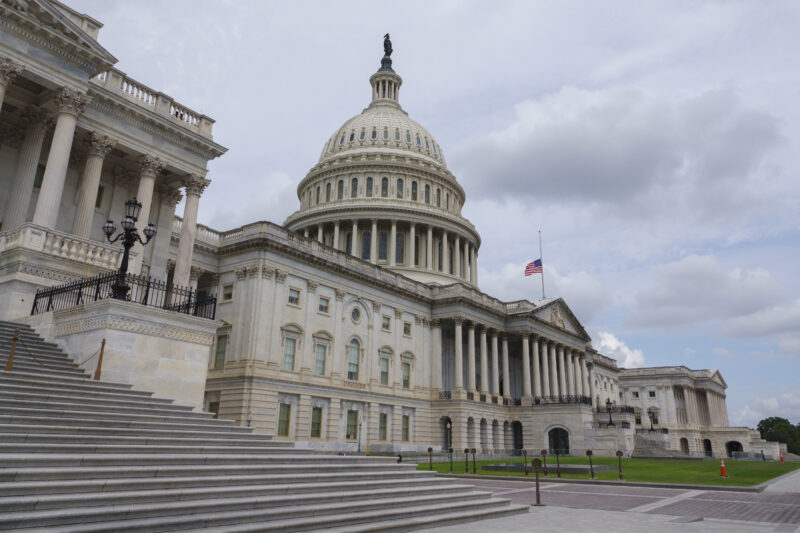
A general view of the U.S. Capitol Building from the National Mall, in Washington, D.C., on Thursday, May 29, 2025.
The House passed its version of the 2026 National Defense Authorization Act on Wednesday, including an amendment that would repeal the Authorizations for Use of Military Force that allowed for the Iraq war and the Gulf War.
The House also passed a series of amendments aimed at countering the Boycott, Divestment and Sanctions movement targeting Israel and enhancing defense cooperation with Israel.
An effort to repeal the Authorization for Use of Military Force passed by a bipartisan 261-167 vote, with 49 Republicans voting with 212 Democrats in favor of the amendment.
Rep. Brian Mast (R-FL), the chair of the House Foreign Affairs Committee, said he agreed that there should be sunsets on AUMFs, but said that changes should not be made without discussions with key U.S. military leaders about how the repeal would impact U.S. activities and counterterrorism efforts and whether additional authorities would be needed to re-authorize ongoing U.S. operations.
“These are questions that were not asked, and the answers were not given,” Mast said. “We have, I think, probably large agreement on reasons to sunset things, but it should not be done in absence of doing something of this gravity in the proper way.”
Rep. Greg Meeks (D-NY), the ranking member of the Foreign Affairs Committee, said that the AUMFs are “long obsolete” and that keeping them effective “only risk[s] abuse by administrations of either party to sanction military force that Congress has not consented or approved.”
He said he’s committed to ensuring that the provision remains in the final version of the NDAA agreed to in negotiation with the Senate.
Repeal efforts for the AUMFs have seen substantial momentum in recent previous years.
Other amendments approved by voice votes as part of broader amendment packages aimed to counter international targeting of Israel, including banning the Defense Department from contracting with entities boycotting Israel, instructing the administration to monitor the impact of global arms embargoes, and other sanctions imposed on Israel, and determine how the U.S. can mitigate such issues. They also urged the administration to engage with allies to ensure they do not enforce International Criminal Court arrest warrants against Israeli officials and called on the Pentagon not to participate in defense exhibitions that exclude Israel.
To further reinforce U.S.-Israel defensive cooperation, other amendments would order the creation of a Defense Innovation Unit field office in Israel to engage with the government and private sector there on technological development and mandate that the U.S. and Israel study the possibility of integrating Israel into the U.S. defense industrial base.
Additionally, the House added requirements that the Pentagon report to Congress on the status of integrated air and missile defense cooperation in the Middle East, including lessons learned from recent attacks in the region; on joint U.S.-Israel efforts to increase production of Arrow missile defense interceptors, stockpiles of which were significantly depleted during the Israel-Iran war, including whether further authorizations or funding are needed; on U.S.-Israel joint military exercises, the missions rehearsed and how regional partners can be invited to join; and on the status of pending deliveries of military aircraft and air-launched munitions, including the reasons for any delays and how they can be resolved.
Other amendments would require the U.S, Egypt and Israel to study steps that they can take to block smuggling into Gaza from tunnels in Egypt or via the Mediterranean Sea and the Pentagon to report to Congress on the U.S.-Bahrain partnership agreement and possibilities for expanding it to include other regional allies.
Additional amendments seek to support Iranian dissidents and counter the Iranian regime: requiring a strategy on encouraging and enticing top Iranian officials to defect; requiring the Pentagon to help develop technologies to counter internet blockages imposed by Iran and other adversaries; requiring a strategy to counter Iran and Hezbollah’s operations in South America; and expanding reporting requirements regarding Iran’s terrorism strategy, proxies, relationship with Russia, supply chains and weapons production capabilities.
Another amendment would require the Pentagon to quickly release all files on the Iranian proxy attack on the Tower 22 facility in Jordan that killed U.S. service members in January 2024.
An additional amendment would award a medal to servicemembers involved in the U.S. strikes on Iran’s nuclear facilities.
Two amendments by Rep. Marjorie Taylor Greene (R-GA), which aimed to block U.S. support for Ukraine and Taiwan, were resoundingly defeated 372-60 and 422-9, respectively. An amendment proposed by Greene to strip out programs supporting Israel from the bill did not receive consideration or a vote on the floor.
Greene made similar efforts to block funding for Israel, Ukraine and Taiwan during consideration earlier this year of 2026 Pentagon funding, which were defeated along similar lines.
The amended NDAA passed the House by a 231-196 vote, with just 17 Democrats voting for the bill as most voiced objections to provisions relating to transgender medical care and renewable energy, among other issues. The Senate is considering its own version of the NDAA this week as well.
Among a slew of other issues, a series of proposed amendments aimed at cracking down on Turkey were not approved for consideration on the House floor.
Please log in if you already have a subscription, or subscribe to access the latest updates.
 Continue with Google

 Continue with Apple