























The network's new ‘Global Perspectives’ forum comes amid ongoing concerns about its ability to cover the Gulf state objectively
Thomas Fuller/NurPhoto via Getty Images
The CNN logo appears on a smartphone screen in the Apple app store in this photo illustration in Ontario, Canada, on February 26, 2026.


 Add JewishInsider on Google
A year and a half after CNN announced its plans to launch a network hub in Qatar, the media company is deepening its ties to the Gulf state with a Middle East speaker series in the capital of Doha that is slated for late October.
CNN said this week it was kicking off its inaugural “Global Perspectives” event in Doha on Oct. 29 with a newly unveiled lineup featuring government officials, business leaders and cultural figures, among others.
The upcoming forum will be hosted in partnership with Media City Qatar, where CNN inked a deal last year to open a new broadcasting studio as part of an ongoing effort to build the network’s presence in the Middle East.
That agreement — which entailed an annual fee of several million dollars that Qatar would pay to CNN, according to sources — raised some concerns among critics who had questioned if it would jeopardize the network’s ability to produce objective journalism on the Gulf state.
CNN is among several media companies, including The Wall Street Journal and Bloomberg, that have expanded their business relationships with Qatar — even as the emirate has faced scrutiny for its lack of press freedoms, record of human rights abuses and sponsorship of Hamas.
Late last year, CNN also served as a co-sponsor of Qatar’s Doha Forum, whose panels elevated several prominent figures who have embraced hostile views on Israel or espoused antisemic tropes — including far-right media commentator Tucker Carlson; Trita Parsi, the founder of a pro-Iran lobbying group; and Nika Soon-Shiong, the publisher of Drop Site News and the daughter of Los Angeles Times owner Patrick Soon-Shiong.
In a statement, Ellana Lee, CNN’s global head of productions, said next month’s series will explore “the ways in which power, influence, technology, business and culture intersect in today’s constantly shifting world,” while “looking to the future through the prism of this unique and increasingly important region.”
The tentative early roster for the Doha conference features Tareq Amin, CEO of Humain, a Saudi AI company; Vitali Klitschko, the mayor of Kyiv; and Mohammed Saif Al-Sowaidi, the CEO of the Qatar Investment Authority, the state’s sovereign wealth fund — which is among several Gulf investors that are backing the pending merger of David Ellison’s Paramount Skydance and CNN’s parent company, Warner Bros. Discovery.
Multiple CNN anchors and correspondents — including Wolf Blitzer, Christiane Amanpour and Becky Anderson — will lead the discussions in Doha, which will later be highlighted on a dedicated show, according to an announcement.
Anderson, an international anchor for CNN based in Abu Dhabi, on Monday interviewed Majed Al Ansari, the spokesperson for Qatar’s Foreign Ministry, where he argued that “the nucleus” of tensions with Iran stem from “what happened in Gaza” during Israel’s war against Hamas.
Speaking at a conference in Abu Dhabi on Monday, Al Ansari gave Anderson a shoutout while discussing efforts to advance Qatar’s narrative around the globe. “I look in front of me now and I see a lot of the media people that represent the best and the brightest,” the Qatari advisor said from the stage of the Hili Forum, “including Becky from CNN and others.”
“But is our narrative getting through?” he asked, adding that “we need to speak with one voice in the Gulf.”
The press freedom group has already removed eight people confirmed as Hamas or Palestinian Islamic Jihad from its database of journalists killed during the Israel-Hamas war
AMAURY CORNU/Hans Lucas/AFP via Getty Images
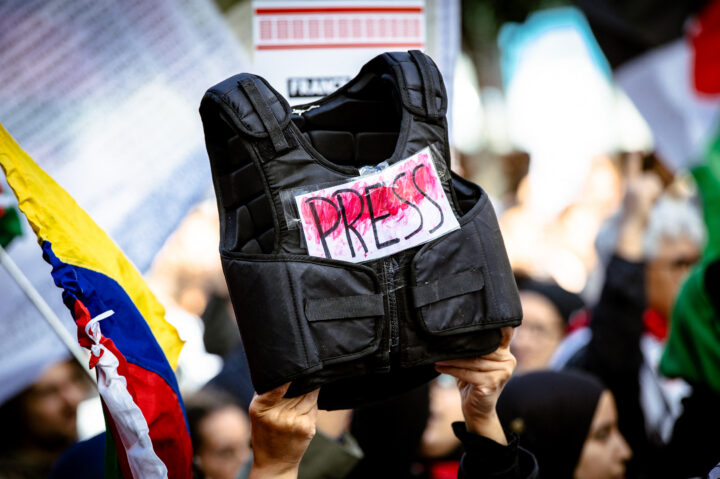
Demonstration against Israel, in Paris, France on October 4, 2025.
The Committee to Protect Journalists announced it will conduct a review of its database of members of the media killed during the Israel-Hamas war, after Hamas and Palestinian Islamic Jihad published obituaries that identified individuals CPJ listed as journalists as members of the terrorist groups.
“CPJ has always been clear that we do not include anyone in our data sets if there is evidence that they were engaging in combat or inciting imminent violence,” said CPJ CEO Jodie Ginsberg. “This is consistent with international humanitarian law, which considers journalists affiliated with non-state actors to be civilians, provided they do not directly participate in hostilities.”
CPJ, which has faced criticism for an alleged anti-Israel bias, said it recently removed eight individuals from its “killed” database after confirming they were Hamas or PIJ members. Another 12 names were removed for unrelated reasons. All 20 of these individuals were previously documented on CPJ’s Journalist casualties page.
Currently, CPJ — which said it uses at least two independent sources of information to identify someone as a journalist — claims 209 journalists or members of the media were killed by Israel amid its war in Gaza. In cases where the Israel Defense Forces is accused of killing a Palestinian, CPJ said it asks Israel for further information.
Jewish Insider reported in 2024 that one-third of the Palestinian journalists listed by CPJ as being killed in the war in Gaza were employed by terrorist groups. Out of 100 Palestinian journalists on the list, 33 worked for “Hamas-affiliated” media, such as Al-Aqsa Voice Radio, Al-Quds Al-Youm, Quds News Network and others. Another two worked for Palestinian Islamic Jihad outlets Kan’an and Mithaq Media Foundation.
During the Israel-Hamas war, CPJ said Israel was “engaging in the deadliest and most deliberate effort to kill and silence journalists that CPJ has ever documented.”
CPJ said the review is expected to be completed in July.
This year is being treated inside the Beltway as the most high-profile WHCD weekend in at least a decade, the result of Trump’s decision to participate in this year’s dinner after boycotting it for his entire presidency
Tasos Katopodis/Getty Images
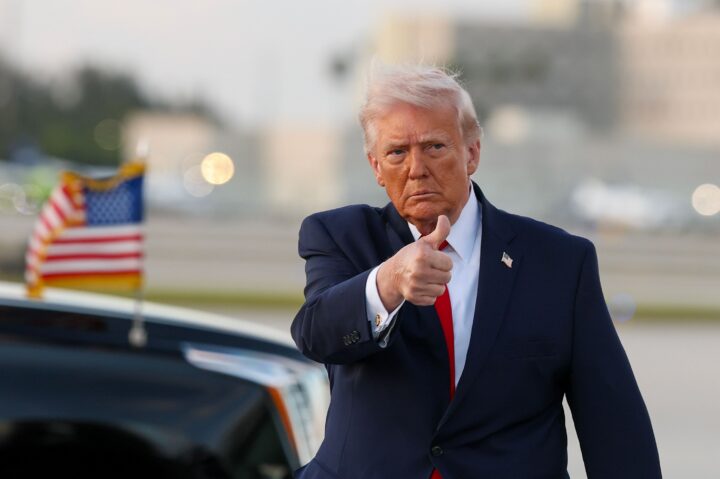
U.S. President Donald Trump waves to the media after walking off of Air Force One at Miami International Airport on April 11, 2026 in Miami, Florida.
A who’s who of the leading names in media, tech and global and domestic politics are flocking to the nation’s capital for the scores of exclusive parties surrounding the annual White House Correspondents’ Dinner this Saturday — where President Donald Trump will make his first-ever appearance as president and deliver a roast of the political press corps.
The correspondents’ dinner, and the parties thrown in its honor, have always generated enough fanfare to maintain its status as the biggest weekend of the social calendar in Washington. This year, however, is being treated inside the Beltway as the most high-profile WHCD weekend in at least a decade, the result of Trump’s decision to participate in this year’s dinner after boycotting it for his entire presidency.
In addition to Trump’s roast, guests will be entertained by Oz Pearlman, a famed mentalist known for his mind-reading tricks. Pearlman, who is Jewish and was born in Israel, marks a shift from the traditional entertainment choice at the dinner, which is usually a monologue delivered by a comedian. Those comedians’ jokes about Trump were a factor in why the president has skipped previous dinners, and the White House Correspondents’ Association canceled its planned entertainer last year over backlash to her past comments.
The dinner could make for some awkward moments: one of the WHCA’s award winners this year is a team from The Wall Street Journal, for reporting on Trump’s ties to disgraced financier Jeffrey Epstein — an article that led Trump to sue the Journal. And that’s not to mention Trump’s routine hostility toward and criticisms of the media more broadly. It is unclear if the president will be present for the award ceremony.
Celebrities have historically flocked to Washington for WHCD weekend, though the number of famous names willing to appear for the dinner or other events dwindled during the first Trump administration. That trend began to reverse during the Biden administration, though it picked up again last year when Trump returned to office.
Nicki Minaj, the rap superstar who has become an advocate for the Trump administration, will be attending the dinner as a guest of the Washington Times. No other media organizations have announced celebrity guests for their respective tables at the dinner.
Regardless of a diminished turnout of famous faces, this weekend will be jam-packed with nonstop events, and it has already begun.
Trump’s announcement in early March that he would attend Saturday’s dinner — leading many senior administration officials to also make plans to attend the festivities and Donald Trump Jr. to organize an ultra-exclusive event at his Executive Branch Club in Georgetown on Friday night — prompted an avalanche of interest from major companies, U.S. officials, foreign diplomats and dignitaries, top corporate powerbrokers and domestic political firms.
Boeing, Meta and Amazon swiftly organized intimate, invite-only gatherings for this weekend or became lead sponsors for events being hosted by D.C.-area embassies, media outlets, political operatives and high-profile consulting groups. Foreign ambassadors stationed in the U.S. and others looking to connect with the president’s circle or the broader Washington political orbit began calling in favors to get on the guest lists for all of the weekend’s events, making invitations all-the-more difficult to secure for those who have attended in the last decade.
The parties start early on Friday with Axios Live’s annual WHCD weekend kickoff brunch at 9:00 a.m., followed by MS NOW’s brunch at 11:00 a.m. and Punchbowl News’ WHCD weekend kickoff gathering the publication’s townhouse in Capitol Hill at noon.
Meghan McCain’s “Renegade Women’s Cocktail Party” at The Graham in Georgetown starts at 4 p.m. while YouTube’s official WHCD party at Floreria Atlantico in Georgetown and the Motion Picture Association’s reception at the Downtown headquarters begin at 5:30.
Later that night, Semafor is hosting a “house party” at the private residence of its founder, Justin B. Smith, starting at 8 p.m.; Creative Artists Agency’s annual Friday evening party, sponsored by Vanity Fair, will take place this year at 7:30 p.m. at the Belgian ambassador’s residence near Georgetown; and United Talent Agency will host their annual “Celebration of American Journalists” at 9:00 p.m. at Osteria Mozza in Georgetown.
The Qataris are once again hosting a Friday evening correspondents bash with Washingtonian magazine, which starts at 8 p.m. at the Georgetown Four Seasons, which Qatari Ambassador Meshal Al Thani is slated to attend. At 7 p.m., doors will open for the Daily Mail’s party with Brunswick Review Business Magazine at the British ambassador’s residence.
Saturday’s festivities start at 11 a.m. with the annual White House Correspondents’ garden brunch, hosted by Tammy Haddad at the Beall-Washington House in Georgetown. Ahead of the dinner, Puck is hosting a “penthouse pre-party” on the rooftop of The Hepburn, located next to the Washington Hilton. At the Hilton, where the dinner is taking place, The Wall Street Journal and ABC News have their respective annual pre-dinner receptions at 5:30 p.m. The Washington Post has a cocktail reception at the Hilton starting at 6 p.m., the same time that Politico’s pre-dinner event with CBS News — featuring new CBS News honcho Bari Weiss — takes place just down the hall.
Alongside the dinner, Substack is hosting its “New Media Party” at 8 p.m. at the Renwick Gallery, located blocks from the White House; afterward, MS NOW and NBC News have dueling parties starting at 11:30 p.m., with the former hosting theirs at Dupont Underground in Dupont Circle and the latter hosting theirs at the French ambassador’s residence in Kalorama. Time’s WHCD afterparty at the Swiss ambassador’s residence in Woodley Park begins at 11 p.m.
On Sunday, NOTUS and Politico are hosting a brunch at the home of Robert Allbritton starting at 11:00 a.m., and CNN’s “WHCD Weekend Finale” brunch reception starts at 12:30 p.m.
Piker, a far-left streamer who has been the subject of favorable media profiles despite a laundry list of antisemitic and terror-justifying rhetoric, is a case study in how traditional journalists normalize extremists
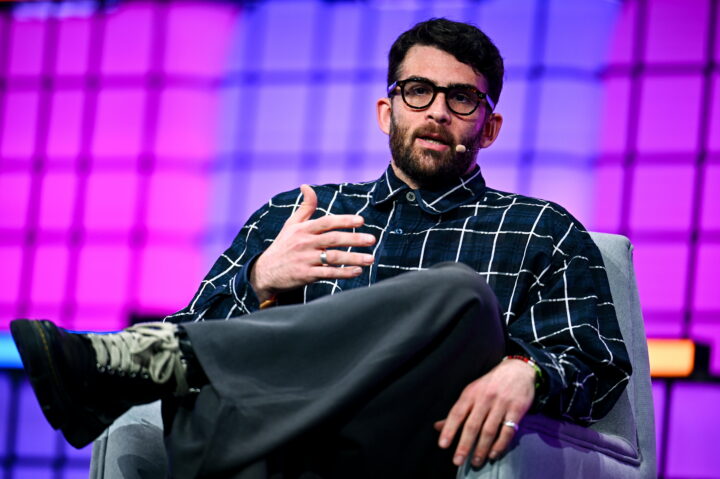
Shauna Clinton/Sportsfile for Web Summit Qatar via Getty Images
Hasan Piker during day two of Web Summit Qatar 2026 at the Doha Exhibition and Convention Center in Doha, Qatar.
A useful rule of thumb to live by: Social media isn’t real life.
But one of the challenges in the brave new world of media is that extremist influencers can often create the perception of influence simply by dominating so much of the online discourse.
Hasan Piker, a far-left streamer who has been the subject of favorable media profiles despite a laundry list of antisemitic and terror-justifying rhetoric, is a case study in how traditional journalists normalize extremists — and how politicians conclude there’s a marketplace for radical views in the electoral marketplace, even when it’s typically a mirage.
In part because Democrats have been desperate to find anti-establishment voices that claim to speak for young men, Piker is seen as a popular, edgy podcaster by liberal leaders in both media and politics. (Nevermind the fact that Piker gets only about 36,000 viewers on a typical stream — about 1/25th of the typical nighttime audience of MS NOW, as The Atlantic’s David Frum pointed out.)
The New Yorker invited Piker to speak at its annual festival, treating the antisemitic streamer as just another one of the many thought leaders in attendance. Leading progressives, such as Sen. Bernie Sanders (I-VT) and Rep. Alexandria Ocasio-Cortez (D-NY), joined him at rallies and on his show.
And a handful of leading Democratic presidential contenders — most notably California Gov. Gavin Newsom — expressed interest in going on his show.
This, despite the fact Piker has justified Hamas’ Oct. 7 terror attacks, forcefully denied some of the terror group’s atrocities, has called Orthodox Jews “inbred” and claimed America deserved 9/11.
Any one of those comments on their own would have typically disqualified anyone from playing a part in our political discourse. Yet in the wave of glowing profiles, Piker’s antisemitism and anti-Americanism didn’t even merit a mention.
It wasn’t until March 19, when Third Way President Jon Cowan and Lily Cohen, a press advisor from the center-left think tank, took the initiative to co-write a column for The Wall Street Journal calling out Piker’s antisemitism without any caveats. The decision to call out the crazy — when few in the press or politics had the courage to do so — was a moment that proved that one principled voice in defense of normalcy can break the mirage of those who believe there’s a political marketplace for this garbage.
The op-ed, headlined “Democrats Are Too Cozy with Hasan Piker,” generated outsized attention, in a way that previous efforts to spotlight Piker’s antisemitism hadn’t. Reporters who once gave Piker a free pass were now asking Democrats whether they agreed with his extremist positions.
Suddenly, when presented with his indefensible comments, some Democrats started building up enough courage to speak out against him. First, it was Rep. Brad Schneider (D-IL), head of the moderate New Democratic Coalition, who called Piker an “unapologetic antisemite.” Then, state Sen. Mallory McMorrow, running for the U.S. Senate in Michigan, told JI that Piker is “somebody who says extremely offensive things in order to generate clicks” — and called on one of her primary opponents, Abdul El-Sayed, to cancel a scheduled rally with him.
Even left-wing lawmakers and candidates — such as Maine Senate candidate Graham Platner and a progressive Democratic state legislator from Michigan — canceled scheduled appearances with Piker.
By the end of the month, only three of the 14 prospective Democratic presidential candidates that Politico interviewed said they would appear on a livestream with Piker if invited. That marks a sea change from just weeks earlier, when he was being treated as the trendy fad in progressive politics.
The dynamic is a reminder that the delusions of a social media echo chamber will persist unless they get confronted by political reality. Sometimes that reality is as simple as speaking up against craziness when everyone else is afraid to speak the truth.
It would be heartening to conclude that this episode is proof that antisemitism can be confronted when good people speak up.
But this past week also featured Politico publishing a virulently antisemitic cartoon that could have been drawn from the Nazi tabloid Der Sturmer — one that they pulled from their website and apologized for. This is the same publication, owned by Axel Springer, that gave Piker a credulous interview last year making no mention of his extremism. (And last week, it also blatantly misrepresented leading Democrats’ comments on AIPAC to manufacture an anti-Israel narrative.)
It all goes to show that the antisemitic rot fueled by social media is entering into the mainstream. It will take more brave and principled voices like Cowan and Cohen to stem the tide.
Ambitious Democrats are still trying to figure out a political message that manages to keep pro-Israel voters within their coalition while reacting to the dramatic shift in public opinion towards the Jewish state within their base
Kyle Mazza/Anadolu via Getty Images
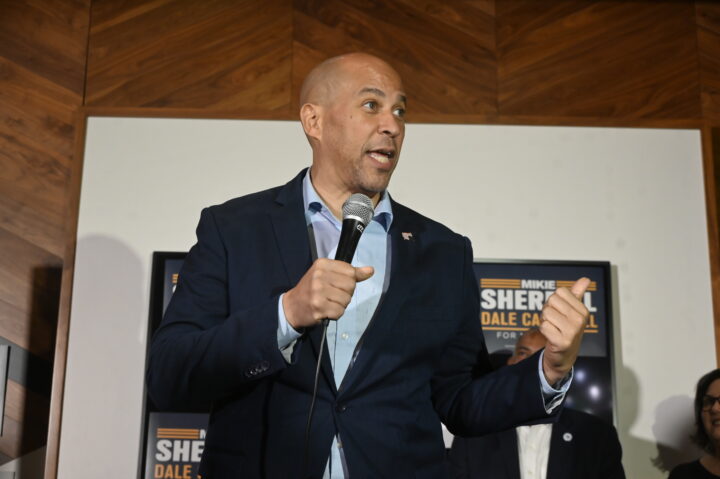
Sen. Cory Booker (D-NJ) speaks at a get out the vote rally in Camden, New Jersey, United States on November 2, 2025.
You would think the media wouldn’t need to twist Democratic candidates’ views on Israel, given the challenges pro-Israel supporters are already facing within the party. But in a Politico story suggesting that Democrats are running away from AIPAC, the publication misrepresented the views of two leading presidential contenders — and ignored the latest pro-Israel comments made in its own pages by a top-tier candidate.
The story leads by noting pro-Israel Sen. Cory Booker (D-NJ) said he’s not taking PAC money from anyone and then twists his comments to suggest that he had shifted his views on AIPAC or his support for Israel. The omission (buried at the end of the story) is particularly egregious because in the same interview, Booker told Politico that he was troubled by the “singling out of AIPAC” compared to other American advocacy groups.
“Somehow, AIPAC seems to be drawing a lot of attention, and that’s problematic to me,” Booker said. That doesn’t sound like an example of someone turning on the pro-Israel advocacy group.
The story then cites Pennsylvania Gov. Josh Shapiro, one of the leading supporters of Israel in the party, as someone who’s flip-flopping on AIPAC for noting that as a governor, he’s never taken or solicited money from AIPAC. (Which is true, as a matter of fact, because AIPAC only spends money in federal races, not statewide campaigns.)
But that narrow, semantic statement was taken as evidence that Shapiro has changed his tune, when in reality he’s been speaking on left-wing podcasts in defense of the Jewish state, testing a measured, pro-Israel message as he mulls over a presidential campaign.
And perhaps most notably, the story avoids referencing Politico’s own interview with California Gov. Gavin Newsom published the same day, where he backtracked from his anti-Israel comments on the “Pod Save America” podcast earlier in the month. In the interview, Newsom said he “revere[s]” Israel and is “proud to support the state.” And he walked back his earlier comments that seemingly called Israel an apartheid state, saying he was only referencing a column by the New York Times’ Tom Friedman. This latest article appears to fit a pattern of anti-Israel content from Politico that stands in contrast to the pro-Israel stance of its parent company, Axel Springer.
To be sure, Newsom has been carefully calibrating his remarks to different audiences, and has distanced himself from AIPAC lately, in a shift from his longtime support for a close U.S.-Israel relationship. But his latest favorable comments towards the Jewish state — clearly intended as cleanup from his overly zealous criticism just weeks before — is a sign that Democratic candidates are still calibrating their views, not embracing the anti-Israel activists.
The reality is that ambitious Democrats are still trying to figure out a political message that manages to keep pro-Israel voters within their coalition while reacting to the dramatic shift in public opinion towards the Jewish state within their base.
And while it may be easy for Democrats to look at the polling and use AIPAC as a convenient boogeyman, the reality is that by embracing an anti-Israel worldview, candidates will end up dealing with the baggage that comes with the movement — from associating with antisemitic podcasters to championing Senate candidates that had Nazi-linked tattoos. That’s where the polling doesn’t fully reflect the implications of any anti-Israel shift within the party.
It’s a reminder of how so many Democrats running for president in 2020 looked at the polling reflecting the party zeitgeist of the moment and embraced a whole panoply of radical views, from defunding the police to embracing government-funded benefits for undocumented immigrants. That sudden shift to the far left, backed up by the primary polling of the moment, still haunts the party to this day.
It’s why most of the opposition against Israel is still confined to progressive spaces, as more mainstream Democratic candidates try to figure out how to balance concern over Israel’s right-wing government with support for the country itself. The Politico story, in its haste to declare waning support for Israel within the party, instead got nuanced responses that didn’t fit the narrative.
Coverage of social media activity by the wives of Rep. Dan Goldman and Mayor Zohran Mamdani has raised questions about how — and when — the press scrutinizes the families of public officials
John Lamparski/Bloomberg via Getty Images
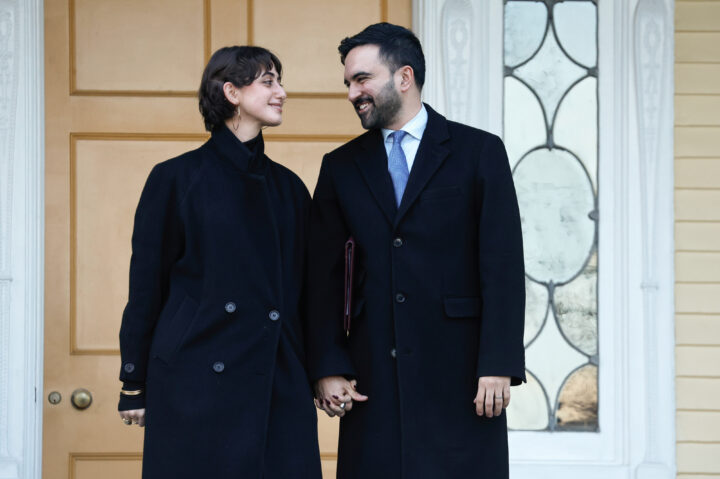
Zohran Mamdani, mayor of New York, and his wife Rama Duwaji during a news conference at Gracie Mansion in New York, US, on Monday, Jan. 12, 2026.
Recent days have offered a tale of two New York public officials’ wives and a revealing look at inconsistent standards from some mainstream media outlets on how they scrutinize the families of elected officials depending on the political viewpoints expressed.
The first was a New York Times story focused on the pro-Israel social media posts of Rep. Dan Goldman’s (D-NY) wife. Under the headline “Congressman Faces Questions About Wife’s Social Media Stances on Israel,” the Times wrote of the instances — believed to be 10 in all — that Corinne Goldman, who served as treasurer on her husband’s campaign, liked posts related to the Israel-Hamas war in the weeks after the Oct. 7, 2023, Hamas terror attacks, including one comparing “Jews for Palestine” to “Chickens for KFC.”
Days later, Jewish Insider uncovered the social media activity of Rama Duwaji, the Syrian-American wife of New York City Mayor Zohran Mamdani, in the days after the attacks. That activity included liking posts that unambiguously celebrated Hamas’ Oct. 7, 2023, attacks — as they were underway — and included still images from the attacks, in which more than 1,200 were killed and 251 taken hostage.
The only Jewish communal official quoted in the Times’ story was Sophie Ellman-Golan, the director of strategic communications at the far-left Jews For Racial & Economic Justice, which endorsed Mamdani in last year’s Democratic mayoral primary.
A day after JI’s report, The Free Press published its own investigation that found Diwaji had liked dozens of additional anti-Israel posts, including one saying Israel was waging a “vile land grab” and another that suggested that the Times, which had done its own investigation into sexual violence on Oct. 7 had “fabricated” a “mass rape” hoax.
In his first public statement addressing JI’s reporting, Mamdani said his wife — who less than a month ago was the subject of a cover profile and photo shoot for The Cut — was a “private person.”
It was a response that was unsatisfactory to some. Deborah Lipstadt, the Biden administration’s special envoy to monitor and combat antisemitism, responded to Mamdani’s statement by rhetorically asking, “But Jessica Tisch has to apologize when her brother says something?” — referring to the NYPD commissioner’s recent apology over her brother’s assertion that Mamdani was an “enemy of the Jewish people.”
The Times, which covered Mamdani’s response, changed its headline on the story at least twice after publication, from “Mamdani Says His Wife’s Views on Gaza Are No One’s Business,” to “Mamdani Defends Wife Amid Criticism of her Support for Palestinian Cause,” eventually landing on “After Social Media Scrutiny, Mamdani Says His Wife Is a ‘Private Person.’”
In response to the second headline, Tel Aviv-based research analyst Daniel Paul Rubenstein wrote on X that he “did not expect to see the New York Times refer to the October 7 Massacre as an expression of the ‘Palestinian Cause’ – but here we are.”
The social media defense of Duwaji from elements of the left was swift, with many arguing that New York City’s first lady — who lives in Gracie Mansion at the taxpayer’s expense — should not be subject to criticism over her views, despite those views including the embrace of terrorism.
In a misdirection, some turned their ire toward Bari Weiss, after CBS News shared a 60-second clip confirming JI’s reporting.
Former Obama administration official Ben Rhodes took to X to say, “There’s a war, high prices, job losses, AI unleashed, and on and on. But Bari Weiss’s CBS is on the case of the NY Mayor’s wife’s likes from years ago. WTF is going on.” Meanwhile, Status’ Natalie Korach dedicated the bulk of Sunday’s newsletter to Weiss and Mamdani, saying that the reporting — though first done by JI — “struck many as peculiar, something that might have appeared on The Free Press, Bari Weiss’ anti-woke and vehemently pro-Israel opinion site.”
New Yorker reporter Jason Zengerle’s book, ‘Hated By All the Right People: Tucker Carlson and the Unraveling on the Conservative Mind,’ comes out Tuesday

Courtesy/Andrew Kornylak
Book cover/Jason Zengerle
In his richly reported new book, Hated by All the Right People: Tucker Carlson and the Unraveling of the Conservative Mind, Jason Zengerle tracks the evolution of the mainstream conservative journalist for The Weekly Standard, CNN and FOX News into a prominent figure in the far-right media ecosystem whose commentary increasingly descends into open antisemitism.
Zengerle, a veteran political reporter, ruminates over Carlson’s troubling transition from magazine writer to cable news pundit to his current position as a widely followed podcast host whose credulous interviews with Nazi sympathizers and Holocaust deniers, among others, have done little to dampen his influence in the MAGA movement he helped build.
In a recent interview with Jewish Insider, Zengerle, whose book will be published Tuesday, warned that Carlson’s efforts to smuggle antisemitic views into mainstream discourse should not be taken lightly.
“Tucker has credibility, and he comes across as a credible person,” Zengerle said. “That he’s giving voice to these really pretty fringe and dangerous sentiments is not to be underestimated, because people trust him.”
Whether Carlson personally believes the “awful things” he promotes, Zengerle writes in his book, “matters less than that he says them at all, and that millions of people — members of Congress, titans of industry, the president and just everyday Americans — listen to and take their cues from him.”
“What matters is that by saying these things, Carlson has finally achieved the fame, power and influence that for so long eluded him,” he adds.
Zengerle, 52, was recently hired as a staff writer for The New Yorker, and has previously contributed to The New York Times Magazine, GQ and The New Republic, among other publications. His book on Carlson is his first.
Speaking with JI last week, Zengerle discussed Carlson’s professional ascent, his motivations for demonizing Israel and why conservative Jews are so frightened by his potential role in shaping the future direction of the Republican Party after President Donald Trump leaves office, among other topics.
The conversation has been edited and condensed for clarity.
Jewish Insider: This book has been in the works for a while. How did the idea initially come about?
Jason Zengerle: It’s been a bit of a roller coaster. The initial idea sort of came from a conversation I was having with my agent about a book I didn’t want to write, about the Republican civil war that was about to unfold. This is not long after [the] Jan. 6 [2021 Capitol riot]. The people who are going to be vying to inherit Trump supporters, because Trump was obviously a finished product, would never be coming back. And I was sort of talking to my agent about the various characters, and explaining why I didn’t think, no matter how many positions [Sens.] Josh Hawley (R-MO) or Ted Cruz (R-TX) or Tom Cotton (R-AR) took that would seem to appeal to Trump’s base, there was no way they’re ever going to inherit those voters, because they just lacked the charisma and entertainment value that Trump obviously has.
Offhandedly, I said something like, ‘You know, the only guy who really can do that is Tucker Carlson.’ That was the genesis of the idea. Then, obviously, when I started the book, Tucker was at the height of his powers. He had the highest-rated show on Fox. Trump had kind of exited the stage. And Tucker, in a lot of ways, had sort of replaced Trump, just in terms of the headspace he was occupying among both liberals and conservatives. You had this weird Tucker economy of liberal journalists and people on Twitter who would clip his show, sort of like outrage bait.
For the first couple years I was working on the book, Tucker was sort of occupying that space. And then he got fired from Fox, and everyone was predicting that he would basically suffer the same fate all Fox stars suffer when they leave Fox, which is irrelevance. Like, who thinks about Bill O’Reilly these days, right? But I thought that wasn’t going to happen. I thought Tucker was going to stay in the picture. That might have been some motivated self-reasoning on my part, because I wanted the book to be relevant. My original publisher definitely thought he was going to fade away because they canceled my contract.
JI: It certainly seems you were right in suspecting that he would continue to be not only relevant, but extremely influential during the campaign and in influencing hiring decisions for key roles in the Trump administration, as you detail in the book. He’s had a circuitous and occasionally rocky career from print journalism to cable news and now to an independent podcast. How do you view his evolution? Is there a moment where you see a clear turning point toward the type of demagogic commentator he would become, or do you think it was more gradual?
JZ: I think there are definitely inflection points in his career, and you can point to a number of them. I think one was certainly the war in Iraq. I think that had a pretty profound impact on his thinking. You know, I think he harbored some private doubts about the wisdom of going to war there, but was not really comfortable expressing them publicly, for a couple of reasons. Today, he talks a lot about how Bill Kristol and all these guys kind of misled him, and that’s why he hates them so much. At the same time, his best friend and now business partner was Neil Patel, who was working for Scooter Libby [chief of staff to former Vice President Dick Cheney]. And if you want to look at the disinformation that was put out into the world that supported going into Iraq, that was coming from Dick Cheney’s office. And I think Neil played a role in that. The fact that his best friend was sort of making the case for war, I think, made it difficult for him to oppose it. Two, the job he had at CNN at the time, on “Crossfire,” was to represent the right and the Bush administration — so just from a practical standpoint, he had to kind of support the war.
But anyway, the fact that things went so badly for Tucker at CNN, I think, made him reexamine a number of his priors and a lot of his time in his early career, when he was at The Weekly Standard and even after he had started writing for Talk and Esquire. There was such an effort among people like Kristol to excommunicate Pat Buchanan from the conservative movement. I think what happened with Iraq made Tucker reconsider Buchanan a bit, and he sort of saw that, ‘OK, well, I actually think this guy was right about foreign policy, and maybe he’s right about some other stuff as well.’ I think that led him to become much more hawkish on immigration.
I think that what happened with Jon Stewart and CNN was a pretty big inflection point in the sense that the public humiliation he suffered, obviously, was difficult for him. But I also think he felt that his friends in the elite D.C. political and media circles didn’t come to his aid the way he would have liked. That started to breed a certain resentment he felt toward them that really grew as his career limped along. It made it a lot easier for him, when Trump came on the stage and started attacking the swamp and D.C. elites, to join in on those attacks, because I think he still nursed a grudge. So you can see things gradually, but you can also point to these crossroads moments, as well.
JI: You write that, while you didn’t know Carlson well, he often served as an “eager interview” subject and source for your stories over the years. Still, he didn’t agree to any interviews for your book. Why do you think that was?
JZ: I think it really is that Robert Novak expression: “a source, not a target.” I think he plays that game.
JI: There’s an interesting recollection in the prologue about your occasional interactions with Carlson when he would stop by the New Republic offices back in the late ’90s during your time as an intern there. You describe him then as a “hotshot young writer for The Weekly Standard,” and say he “seemed so much older, wiser and worldlier than we were.”
JZ: Maybe it didn’t take much to impress me. But the thing about him back then — and the thing I think others admired about him and looked up to him for — was that he was really courageous. The targets he picked, whether it was Grover Norquist or George W. Bush — it took guts to do that as a conservative journalist, and that was admirable.
JI: You write in the book that Carlson has “come a long way from the days when he described himself as a pro-Israel, Episcopalian neocon.” On his show now, he regularly promotes antisemitic tropes and conspiracy theories, incessantly attacks Israel and hosts neo-Nazis and Holocaust deniers for friendly interviews. Do you have insight into what sparked this openly antisemitic streak?
JZ: It’s funny, someone who’s close to him was telling me that they thought this basically started with his conclusion that all the people who were opposed to him and Trump, post-2016, were big Israel supporters. So Tucker’s like, ‘Alright, I’m just going to piss these people off by going after Israel,’ and that’s kind of where it started. I don’t know if that’s the case.
I mean, Bill Kristol looms so large in his mind and in his own story. The story that he tells people, and the story I think he tells himself, is he was misled and used and kind of exploited by the neocons, that he was this young, naive, innocent writer who got just basically used to get us into a war and support free trade deals and do all these things that hurt the white working class in America, and that what he’s doing now is his penance. And I think that’s not a true story. I don’t think that’s what happened.
Kristol is just such a huge figure in his own mythology. Even before Tucker went in this direction, he was really close to Kristol. He really looked up to him. He was his first boss, and I think he had a real impact on Tucker’s career. But now, Tucker wants that all to be a negative impact. He did an interview recently with his brother, Buckley Carlson, where he talked about how Kristol hates Christians. Bill Kristol, who hired Fred Barnes and took vacations with Gary Bauer. He’s recast all this stuff.
JI: Do you think Carlson’s hostility toward Israel and descent into nakedly antisemitic vitriol, such as when he called Ukrainian President Volodymyr Zelensky “ratlike” and “a persecutor of Christians,” is motivated by more than just resentment of those he believes have spurned him? There’s been a lot of attention recently about a generational turn away from Israel on the right, which raises a question of whether he’s opportunistically tapping into that or directly influencing it.
JZ: I guess it’s both. I do think he’s making the calculation that that is where the energy is, and therefore he wants to make sure he stays out in front of it. He has a very good political radar and good professional radar. I think the Nick Fuentes episode was him recognizing he was in this feud with this guy, and he was losing, and him sort of deciding you cannot be successful in conservative media or conservative politics these days unless you have the support of these neo-Nazis. Unfortunately, it’s not going to work for you, and so he needed to get back on their good side. I think that’s part of the calculus.
At the same time, I think he is influencing some of these people, maybe not the hardcore Nick Fuentes supporters, but young conservatives who, you look at what happened or what’s happening in Gaza and had questions and qualms and concerns. And then Tucker is out there — and Fuentes is out there as well — making the argument about how Gaza is wrong, but taking it so much further than that, and going into these really ugly corners of anti-Israel sentiment and taking them to those places.
Now, I don’t want to get too far afield here, but that JD Vance talk at Ole Miss, where the frat boy asked that question about Israel persecuting Christians — that was a real light bulb moment for me. That this stuff had penetrated that deep that you have this guy who appears to be your regular old SEC frat boy saying this stuff. And I think Tucker is responsible for a lot of that, because that’s something he did at Fox, and he continues to do. He’s really good at taking ideas and arguments and even just stories from extreme, far-right fringy areas, often on the internet, and smuggling them into the mainstream. I think he’s doing that with the Israel stuff and with the Jewish stuff.
JI: His interview in 2024 with Darryl Cooper, the self-proclaimed podcast historian and Holocaust revisionist who has described Winston Churchill as the “chief villain” of World War II, seems an early instance of that effort.
JZ: That’s a perfect example. You have to be really steeped in this stuff to see what this individual is saying and doing and the rhetorical tricks they’re playing. Tucker just brings and vouches for these people, and I think that’s pretty dangerous. Tucker has credibility, and he comes across as a credible person. The fact that he’s giving voice to these really pretty fringe and dangerous sentiments is not to be underestimated, because people trust him, and it validates them.
JI: There’s been some intermittent speculation about whether Carlson will run for president. Do you have any thoughts on that?
JZ: I don’t think he just wants to be a podcaster. I don’t think that’s his goal here. I think he has a real vision for what he wants this country to be, and he wants to achieve that vision, and if it turned out that running for office was the way to do that, I could see him doing it. I don’t think it’d be his first choice. I think right now, he has a nice, nice setup where he obviously has a president who listens to him. Maybe even more importantly, he has a vice president who I think he’s even closer to and more in alignment with. Just sort of thinking through the steps, as long as he thinks JD Vance and he are on the same page ideologically, and as long as he thinks JD Vance is capable of being elected president, that he has the political talent to pull that off, I can’t imagine him doing anything on his own.
But if one of those two things changes, and I think it’s quite possible that the latter becomes a sticking point — if Tucker at some point were to conclude that JD Vance actually isn’t capable of being elected president and that his his ideological project is in jeopardy — I could certainly see him taking a shot at it. The way you would run for president now, it’s so different from how you had to do it before. He could probably do a lot of it from his podcast studio. But I think what’s more important is just understanding why he would do it, which is sort of the bigger point. He really does have a project he’s working on, and I think he’ll do what he thinks is necessary in order to bring that project to fruition.
JI: How would you characterize that project?
JZ: He wants the United States to look like it did in the 1950s. I think he’s very much in alignment with Stephen Miller. Beyond the immigration stuff and us being a much whiter country, I think he wants to return to traditional gender roles.
JI: While some Republican lawmakers have spoken out against Carlson, it seems notable that Trump and Vance have both so far refrained from explicitly distancing themselves from him.
JZ: There’s this weird thing going on where certain Jewish conservatives feel like, as long as Trump’s there, everything’s going to be fine. You know, his grandchildren are Jewish, he might say some stuff, he might do some things, but at the end of the day, the worst-case scenario will never occur. They view Tucker as this bad influence on Vance, and if they can just get rid of the bad influence, Vance will be OK. But they’re really terrified of Tucker. They’re really terrified of what comes after Trump. And they’re terrified that Tucker will have a major influence on whatever comes after Trump. They’re worried about the influence he has on Vance. They want to believe that Vance would be OK, left to his own devices. They think Tucker is leading him in a bad direction, and therefore they need to take out Tucker.
I think it goes beyond Israel. I think it’s genuine fear about what it would mean to be Jewish in the United States. I’ve been talking to some of these folks recently. I think it’s a real, deep-seated fear about, in Tucker Carlson’s America, what would it be like to be Jewish here?
An April 2025 Pew Research Center survey found 72% of Jewish Americans held a favorable view towards Israel
Spencer Platt/Getty Images
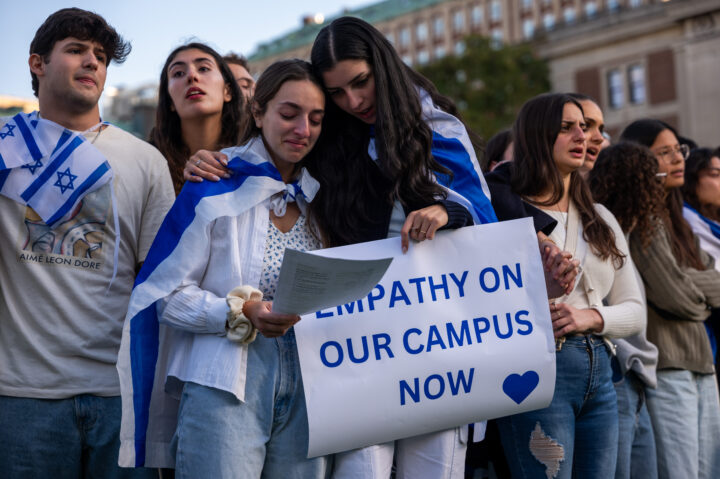
Columbia students participate in a rally and vigil in support of Israel in response to a neighboring student rally in support of the Palestinians at the university on October 12, 2023 in New York City.
One of the biggest challenges in our modern media ecosystem is breaking out of the echo chambers that so many are locked into.
Ezra Klein’s New York Times column this week, headlined “Why American Jews No Longer Understand Each Other,” is a worthwhile example of how even the best-intentioned columnists can struggle to understand the world outside their own social and informational bubble.
The column portrays a vocal minority of anti-Zionist sentiment within the Jewish community as much larger than it actually is. The characterization of a roughly even divide within the Jewish community between Zionists and anti-Israel Jews is at odds with numerous reputable polls tracking Jewish public opinion.
Public polling serves as a useful reality check to much of the framing in the column, and underscores the breadth of Jewish support towards Israel. An April 2025 Pew Research Center survey found 72% of Jewish Americans held a favorable view towards Israel. A fall 2024 poll of Jewish voters commissioned by the conservative Manhattan Institute found 86% of Jews considering themselves “a supporter of Israel.” A spring 2024 survey of Jewish voters commissioned by the Democrat-affiliated Jewish Electoral Institute (JEI) found 81% of Jewish respondents were emotionally attached to Israel.
This doesn’t paint the portrait of a community that is meaningfully divided over Israel — even amid the wave of negative, if not hostile, coverage towards the Jewish state in recent months.
Klein’s column interviews four Jewish voices — from anti-Israel polemicist Peter Beinart to the publisher of the anti-Zionist Jewish Currents publication to the rabbi of a deeply progressive Park Slope synagogue to self-proclaimed “progressive Zionist” Brad Lander — while just one (former Biden antisemitism envoy Deborah Lipstadt) reflects the mainstream Jewish majority.
The other canard advanced in the column is that younger Jews, in particular, have become hostile towards Israel. And while Gen Z Jews’ level of support for the Jewish state is not as high as their older counterparts, the degree of support towards Israel among the younger Jewish generation is still significant — especially when compared to their non-Jewish counterparts on campuses.
A November 2023 poll commissioned by the American Jewish Committee asked: “Thinking about what being Jewish means to you, how important is caring about Israel?” Two-thirds of Jewish respondents between the ages of 18-29 said it was important — with 40% saying it was “very important.” (Over four-fifths of Jews older than 30 responded in the affirmative.)
A February 2024 Pew Research Center study found a 52% majority of Jews ages 18-34 considered Israel’s conduct in its war against Hamas to be acceptable, while 42% disagreed. By a 61-26% margin in the same poll, Gen Z Jews also favored the U.S. continuing to provide military aid to Israel to help it defeat Hamas.
In a thorough study and survey of Jewish student public opinion in the summer of 2024, Tufts University political scientist Eitan Hersh flagged that the source of anti-Israel Jewish student opinion is almost entirely concentrated among the “very liberal” faction of Jewish students on campus, which make up 18% of the Jewish population. That closely matches the 22% of Jewish students who said they feel no connection to Israel at all.
By comparison, an outright 54% majority of Jewish college students said they “feel their own well-being is connected to what happens to Jews in Israel.”
“We see that the gaps between liberals and very liberals (the former more moderate, the latter further left) are enormous. In fact, they vastly exceed the gaps between conservatives and liberals,” Hersh concluded.
Indeed, the biggest disconnect on college campuses these days is between Jewish students, who still largely support Israel, and their non-Jewish counterparts, who have become downright hostile towards the Jewish state — or, among elements of the right, have become more apathetic towards Israel.
For example, Hersh’s survey found that 51% of Jewish college students blamed Hamas for the conflict in Gaza, while 18% blamed Israel. But among non-Jewish college students, more blamed Israel (35%) than Hamas (18%) for the current war. Nearly one-third (30%) said both, in a sign of apathy and exhaustion towards the conflict.
Those findings are consistent with a new analysis from political science professor Eric Kaufmann in Tablet, which found that far from becoming more critical of Israel, liberal Jews on campus have instead become more isolated from their non-Jewish peers while moving more towards the political center.
“Ivy League Jews went from being well to the left of the median Ivy League student to leaning right of the average,” Kaufmann concluded. “In the Ivy League, Jews now self-censor more than conservatives do.”
Months after their release, former hostages are quietly navigating the long, complex path to recovery inside a specialized ward at Beilinson Hospital in central Israel

Beilinson Hospital
Released hostages Naama Levy, Karina Ariyev, Agam Berger, Liri Albag and Daniella Gilboa gesture to well-wishers over a railing at Beilinson Hospital
When Israelis held hostage by terrorists in Gaza are released, there is a flurry of attention. Members of the media descend on the hospitals to which the newly freed hostages are sent. Dozens of photos of the former hostages and their families are disseminated from the hospitals. Siblings and other relatives give interviews about the returnees’ medical conditions and what they said about their treatment in Gaza.
Soon after, however, the public no longer hears much from most of them. To be sure, some gave high-profile interviews, while others found themselves on red carpets. Some were cheered by whole soccer arenas. The divorce of one former hostage from her husband has turned into gossip fodder in Israel. But for the most part, their day-to-day struggles are not on the public’s radar, even as the former hostages’ recoveries from their physical and mental injuries continues.
Beilinson Hospital in Petah Tikva, in central Israel, has treated and continues to treat hostages released in the ceasefire that took place earlier this year: female soldiers Naama Levy, Karina Ariyev, Agam Berger, Liri Albag and Daniella Gilboa, as well as Tal Shoham, Omer Wenkert, Eliya Cohen and Omer Shemtov.
Dr. Michael Bahar, director of the Rehabilitation Unit at Beilinson, who has been overseeing their recovery, told Jewish Insider in the hospital this week that his department “built rehabilitation programs based on each patient’s specific needs. It’s a multidisciplinary process, working with physical therapists, occupational therapists, dieticians, nurses and psychologists. For the rehabilitation of the female soldiers, “we work with the IDF,” he added.
“It’s been three months, and for some it continues, and we’re always thinking about the next stage,” Bahar said. “Every day of treatment has a schedule, matching each patient’s needs — physical, cognitive and beyond.”
The returnees come to the hospital multiple times a week for treatments that range from more traditional medical appointments to working with dieticians to ensure they are eating properly after over 500 days of malnutrition to exercises that strengthen injured limbs and improve aerobic activity.
Some of the treatments are in groups and include enjoyable but rehabilitative activities, such as cooking and dance classes. The returned hostages exercise using virtual reality headsets, and a ping-pong table was brought in at the request of one of the hostages, who then played with his family.
“They are accompanied by their psychologist, who plays a central role, because they can say when it’s too early to do something or if it’s the right time … They are starting to deal with participation in active lives in society, in school, with family,” Bahar said. The former hostages have had to consider whether the time is right to start working or studying, what kind of social activities they feel comfortable doing, whether they can drive and more.
The Rehabilitation Unit at Beilinson also treats many wounded soldiers, and Bahar said they and the former hostages have found it meaningful to undergo joint treatment and exercises together, including in the department’s pool.
“The soldiers felt that they were fighting to free the hostages, so we connected between them,” Bahar said. “One evening the [female soldier hostages] went to visit the wounded soldiers in the department. It was an indescribable moment. They couldn’t speak, they were so excited … It was very significant, very powerful for the soldiers and the returnees.”
Some of the hostages are still undergoing complex medical procedures, which they were given the option to delay. Freed hostage Romi Gonen, who was treated at Sheba Medical Center in Tel Hashomer, shared this week that she is undergoing a second surgery on her hand.
Dr. Noa Eliakim-Raz, head of the Returnees Ward and one of Beilinson’s six internal medicine departments, said that the staff has made sure to treat the returnees as “free people with the right to choose” after a year and a half in which their freedom was violently taken from them.
“Medically, we thought it was good to postpone some procedures and to give them the right to decide. If they say they want to postpone in order to go abroad, we can let them prioritize and decide for themselves. It’s clear to them that we are here for them, whenever they need us,” she said.
Beilinson set up the Returnees Ward on a floor of the Schneider Children’s Medical Center, which is in the same complex as the larger hospital. The entrance is through a corridor decorated with a cartoon dinosaur mural, with glass sliding doors that few hospital employees are able to access. They open up to signs that say “Now you’re home,” “We’ve waited for this moment,” and feature psalms thanking God for their return.
The department was set up after the November 2023 ceasefire, in which 105 hostages — mostly women and children — were released. Beilinson treated seven adult returnees — six mothers and a grandmother — while their children released from captivity were cared for at Schneider, all in the same department.
“Once that ended, we realized that everyone else who would come back would be adults and we started to prepare to receive them,” Eliakim-Raz said. “We hoped we would not have much time, but we had a lot of time to prepare.”
The department has room for up to 12 hostages, though the most it has treated simultaneously is nine. Two hospital rooms were designated for each returnee, one for the former hostage and another for family to sleep next door. Lounges were set up for the returnees to spend time together and to receive guests, including one with a sweeping view of the hospital campus, including the helipad on which the freed hostages arrived. A closet was filled with supplies the families may have forgotten to bring them: sweatsuits and pajamas, fluffy towels, slippers and flip-flops, stuffed animals, markers and paper — and lice removal shampoo.
Over time, Eliakim-Raz and her team compiled a medical protocol of hundreds of pages to prepare for the hostages’ return, listening to the testimony of those who already returned and poring over medical papers about other hostage situations, like in the Yom Kippur War, and Holocaust survivors. They also performed simulations of handling a group of freed hostages.
“So much changed, because being a hostage for 50 days is not like being there for over a year,” she said. “The preparation was complex. Soldiers male and female have different needs, there are other areas of care for young women, and much older adults have totally different problems. We prepared for every population and every scenario we could think of.”
“Every discipline involved needed to know what to prepare for, what it means psychologically and physically. The dieticians had to think about what they would encounter in someone who spent 550 days underground … What effect does a lack of stimuli have on younger and older people,” Eliakim-Raz said.
Dr. Michal Steinman, director of nursing at Beilinson, said that they also considered what being kept underground for long periods of time would mean, and whether the returnees would need dimmer lights or special glasses. They also thought they may need to help the returnees adapt to a more normal sleep schedule, though she found that “each one managed to keep track of time in their way. It was an amazing survival instinct, but it had psychological and bodily consequences.”
Steinman said she is “used to working on evidence-based medicine, but here we had to work based on clues. We examined the stories we heard and read and had to think of different variations to prepare. It was detective work.”
“We were well-prepared, but the real moment was indescribable,” Steinman said of the hostages’ arrival.
Each time hostages landed on the helipad in Beilinson, Eliakim-Raz said she “tried to give them a feeling of a home, more than a hospital. It’s a sort of warm capsule between captivity and home … It gives a lot of security. They are protected here. We didn’t let media in, and only people they wanted to see could be here. It was very closely managed.”
Steinman said the hospital’s treatment also extended to the hostages’ relatives, who in some cases had neglected their own health and underwent examinations by the doctors at Beilinson. Steinman and a mental health professional held nightly group meetings with the parents of the hostages when they were staying in the hospital, to answer questions about their children’s health.
“The public is excited about the hugs and kisses” when the hostages are reunited with their families, Eliakim-Raz said, “but the real difficult stage is at the end of the process when they have to go home.”
The continued outpatient rehabilitation program gives the returnees “continuity,” Bahar said. “They went back home but are still in this very safe environment.”

The medical literature about Holocaust survivors and Yom Kippur War prisoners of war who returned to Israel shows that those who are back from Gaza are likely to have long-term risks to their health.
“We see [in the literature] PTSD [post-traumatic stress disorder], depression and dangerous behaviors,” Eliakim-Raz said. “The body remembers and we don’t understand how, but it is in a more inflamed state than their peers. That can impact metabolic symptoms and cause a higher rate of strokes … I hope that they will have nothing and be healthy and happy, but the literature says that chances are that is not what’s going to happen.”
“If we don’t continue to reach out [to the hostages] now, maybe no one will make that connection in the future. They deserve that someone will examine them. We want to continue — they deserve that … We are going to actively invite them to checkup days and bring them in as a group to try to catch things early,” she said.
Like many Israelis, Steinman continues to try to follow what her patients are up to through the media.
“When I see them on TV, I’m so excited,” she said. “The group we met are inspirational. They went through a very difficult captivity and returned with a strong enough foundation to be rehabilitated and build a quality life. The scars will remain, but they all have great mental strength.”
That being said, the hostages who stayed at Beilinson all expressed forms of survivors’ guilt.
“They don’t feel ready to be fully rehabilitated until their friends get out” of Gaza, Eliakim-Raz said.
Meanwhile, the team at Beilinson is preparing in case they are entrusted with the care of some of the 20 remaining living hostages when they are released. Nurses check the medications in the department every week to make sure they aren’t expired, and the clothing to see that it fits the season.
Steinman said that recent hostage talks and the hope that the remaining hostages will be freed “takes me back to the long time we waited before … We’re back in the days of anticipation, and I don’t know when it will happen. For the 500 days of preparation before [the ceasefire that began in January], it was an emotional time. Sometimes we despaired.”
Steinman and Eliakim-Raz said that they put off travel plans because they don’t want to miss the hostages coming home: “This is where I need to be,” Steinman said.
“Everyone is waiting to see them return — though you can’t compare it to the families. For us, as a medical team, there is anticipation … We knew what to do and we did it well, and we want to do it again,” she added.
The Pennsylvania Democratic senator’s criticism of his party drew loud applause from pro-Israel activists

Gabby Deutch
Sen. John Fetterman (D-PA) speaks at a NORPAC advocacy event in Washington on May 20, 2025.
As Sen. John Fetterman (D-PA) faces attacks from the media and fellow lawmakers in the Democratic Party, he hit back at members of his own party on Tuesday in remarks to a group of bipartisan activists in Washington.
Speaking to members of NORPAC, a pro-Israel advocacy organization, Fetterman offered some of his sharpest criticism yet of the Democratic Party’s approach to Israel after the Oct. 7 Hamas attacks.
“Israel and your community deserves much better from my party,” Fetterman said, earning loud applause.
He described how American universities have produced a “monoculture that produced, actually, rampant antisemitism,” and called to address it — but suggested Democrats are not interested in doing so.
“We have to address that. But in my party, you will pay a price,” said Fetterman. “That’s OK. I think that’s what defines character … that you’re going to support things even if it moves against your own political interest.”
Several recent reports have suggested that Fetterman is struggling with mental health challenges, which Fetterman has denied.
Please log in if you already have a subscription, or subscribe to access the latest updates.
 Continue with Google
 Continue with Apple