














































































Netanyahu offered a highly atypical letter of support for the resolution, following a meeting with the Indiana congressman last week
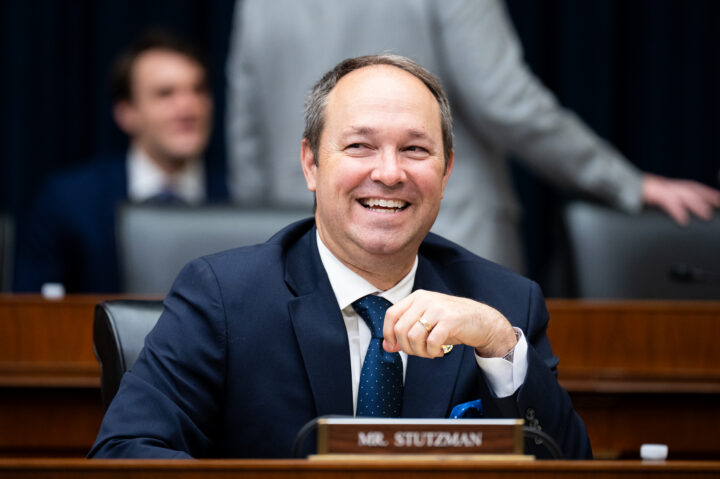
Bill Clark/CQ-Roll Call, Inc via Getty Images
Rep. Marlin Stutzman (R-IN) at a House Financial Services Committee on May 7, 2025.


 Add JewishInsider on Google
Rep. Marlin Stutzman (R-IN) introduced a resolution on Wednesday endorsing and praising Israeli Prime Minister Benjamin Netanyahu’s call to wind down U.S. aid to Israel over the next decade, the latest twist in the rapidly evolving U.S. conversation over the future of the U.S.-Israel relationship and U.S. aid to Israel.
Few Republicans, at this point, have publicly endorsed Netanyahu’s effort, which comes amid talks between the U.S. and Israel over the next memorandum of understanding on military aid. Top U.S. officials have confirmed in recent days that ending U.S. aid to Israel is part of those discussions. Future American aid is largely expected to pivot toward a model based on trade, partnership and joint development.
Stutzman said he had discussed the resolution and the effort with Netanyahu and other Cabinet ministers during a visit to Israel alongside Rep. Abe Hamadeh (R-AZ) last week, and that the Israeli officials were strongly supportive.
“We thought this was a good opportunity to get a sense of Congress, and of course support not only Israel, but support the administration, and as they move ahead in the next negotiations of MOU, and I’m excited about it. I think it’s a big step for both countries,” Stutzman told Jewish Insider during an interview in his Capitol Hill office on Wednesday.
He said he would not have moved ahead with the resolution if he did not find that he and Netanyahu were on the same page in their goals, and said he would walk it back if President Donald Trump offered a strong counterargument. Netanyahu himself offered a letter of support for the resolution, which Stutzman publicized alongside the resolution.
Netanyahu said in the letter to Stutzman that he was “glad to receive your proposed Congressional resolution endorsing my plan to shift the framework for US-Israel defense cooperation from aid to partnership” and that the “time has now arrived for us to move from aid recipient to partner.”
Such public letters from Netanyahu directly endorsing U.S. legislation are highly atypical, even for legislation supportive of Israel. The resolution “commends Prime Minister Benjamin Netanyahu for his bold proposal.”
Stutzman said he had discussed the resolution with the White House, House Speaker Mike Johnson (R-LA) and House Majority Leader Steve Scalise (R-LA), though none of them have given their backing to the resolution yet.
The congressman called it an expression of support from the House for “the efforts of both our countries to take this step in our maturing relationship.” He said that winding down aid is a “mature step” that acknowledges Israel’s role as a regional power and its growing economy. And he said it would communicate to the administration the support from Congress for winding down U.S. aid as part of the MOU talks.
Some pro-Israel voices in the U.S. have griped about the way Netanyahu has approached the wind-down of U.S. aid to Israel, with his comments being decontextualized and weaponized by critics of Israel in the United States to suggest Netanyahu himself supports a severing of the U.S.-Israel relationship or an immediate end to all U.S. aid.
“I’m sure people will try to weaponize it, and they’ll try to create conspiracy theories out of it, but you know what, I was in the room, there was nothing but discussion about our relationship and our partnership,” Stutzman said, when asked about such concerns. “I’m sure there will be some out there that try to use it as fuel for something. They already are, and it’s laughable, because you know it’s more out of a spirit of hatred for Israel than realizing that it’s in the best interest of both countries.”
He argued that the resolution should attract widespread support from budget hawks — for saving U.S. taxpayer money — and from pro-Israel colleagues for giving Israel the opportunity to “stand on their own two feet and be a standing partner beside us and not look like they’re dependent on us.”
Stutzman also said that the resolution, and ending U.S. aid, would remove an argument made by antisemites that the U.S.-Israel relationship is coercive or exploitative, though he acknowledged that it would not solve the problem of antisemitism.
“I hear too many young people especially say that, ‘Israel controls the United States,’ or ‘the United States controls Israel,’” Stutzman said. “No, we just have such common values, and it’s a very natural relationship.”
In addition to the provisions on U.S. aid, the resolution “condemns antisemitism in all its forms, including physical attacks on Jewish individuals and institutions, the harassment of Jewish Americans, the spread of antisemitic propaganda, and the delegitimization of Israel’s right to exist.”
Stutzman said he wants to see the next MOU with Israel — after the current one expires in 2028 — move the U.S.-Israel relationship toward partnership between American and Israeli companies, which he said would be beneficial for the U.S., Israel and other Middle Eastern countries.
The resolution “strongly supports” a new MOU “to replace traditional military assistance with a framework of joint defense codevelopment, coproduction, and mutual investment that will strengthen both nations’ defense industries and military readiness.”
He said the U.S. should also be exploring a Middle Eastern analogue to NATO, including Israel and Gulf states, to include an Article V-style defense guarantee from the United States to protect its various partners in the Middle East. He argued that the war in Iran, during which Tehran has struck various U.S. Gulf allies, has “helped show the world who the real problem was, and that’s Iran and the IRGC.”
Stutzman predicted that Trump will be able to bring regional partners, which are increasingly splitting into camps — Israel and the UAE on one side, and other Gulf and Arab states like Saudi Arabia and Qatar on the other — back together after the war in Iran ends, by touting his ability to defang the Iranian regime, and pointing to the threat it poses to all of them.
He said he believes reports that Saudi Crown Prince Mohammed Bin Salman would be willing to normalize relations with Israel if not for objections from his father, King Salman. Saudi Arabia has publicly rejected the idea of normalization prior to progress toward a two-state solution.
Stutzman’s resolution praises Netanyahu and Israel for their cooperation with the U.S. in military operations against Iran.
Asked about the resolution, Rep. Randy Fine (R-FL), one of the most vocal pro-Israel Republicans in the House, said he’s “not a huge fan of resolutions,” which are nonbinding, and that he “struggle[s] with this issue,” calling it a “win for Israel” to wean off of U.S. aid but a “terible decision for America” because “American benefits much, much more from that $3.8 billion than it costs us.”
He said that ending U.S. aid will not stop antisemitism.
“The unfortunate thing is people believe this will stop the antisemitism. It’s not driven by the aid to Israel, they’ll come up with something else,” he said. “I support getting rid of it, just because I like to call BS on all the antisemites, but you’re not going to see me running around to pass a resolution, which doesn’t mean all that much.”
He said that he hasn’t reviewed Stutzman’s resolution yet so he couldn’t commit to how he might vote on it, but said he would consider it. “But I’d rather we actually do things that would solve the problem than just talk about solving the problem.”
Netanyahu’s letter has already been weaponized by anti-Israel forces on the left and right, who are linking it to a provision of the 2027 National Defense Authorization Act set for a markup in the House Armed Services Committee on Thursday, which aims to enhance U.S.-Israel technological cooperation and sharing.
Those relatively routine measures, which enjoy bipartisan support and further existing programs, are being undertaken independent of the current MOU, and would not impact the level of U.S. foreign military financing being provided to Israel next year or in the future — though they do model the sort of joint development and co-production which are likely to be the focus of the next MOU.
Former Rep. Marjorie Taylor Greene (R-GA) posted a highlighted version of the letter pointing to sections where Netanyahu referenced “my plan” for the future of U.S. aid, suggesting that it was referring to the NDAA provision.
The anti-Israel group A New Policy posted the same highlighted graphic. Neither acknowledged the fact that Netanyahu’s letter referenced a different piece of legislation, instead declaring that he was discussing the NDAA language.

Anna Moneymaker/Getty Images
Rep. Debbie Wasserman Schultz (D-FL) speaks during a press conference on new legislation to support Holocaust education nationwide at the U.S. Capitol Building on January 27, 2023, in Washington, D.C.
Good Monday morning.
In today’s Daily Kickoff, we talk to Rep. Marlin Stutzman about his recent meeting with Syrian President Ahmad al-Sharaa in Damascus and Rep. Debbie Wasserman Schultz about her conversations with Israeli and Arab leaders during her recent trip to the Middle East. We report from a gathering in Denver of moderate Democratic elected officials from around the country, and interview former JFNA executive Elana Broitman about her newly released comic book about a menopausal superhero. Also in today’s Daily Kickoff: Nathan Fielder, Menachem Rosensaft and Hussein al-Sheikh.
What We’re Watching
- The American Jewish Committee’s Global Forum continues today. John Spencer, Ellie Cohanim and Bill Kristol will all speak on the main stage.
- Canadians head to the polls today in a federal election pitting Prime Minister Mark Carney and his Liberal Party against Conservative leader Pierre Poilievre.
- The Hostage and Missing Families Forum is hosting an event tonight at the Marlene Meyerson JCC Manhattan featuring former Israeli hostage Noa Argamani as well as the relatives of slain hostages Omer Neutra, Itay Chen and Shiri Bibas.
What You Should Know
A QUICK WORD WITH JI’S JOSH KRAUSHAAR
As official Washington spent this weekend at the parties surrounding the White House Correspondents Dinner, an intimate group of moderate Democratic elected officials, policy wonks and strategists met in Denver to present ideas for rehabilitating their party from the center, Jewish Insider Editor-in-Chief Josh Kraushaar reports in a dispatch from the event.
Will Marshall, president of the Progressive Policy Institute (PPI), gathered together a lineup of prominent Colorado centrists — Democratic Gov. Jared Polis and Sens. John Hickenlooper (D-CO) and Michael Bennet (D-CO), among them — along with some former red-state Democratic officials, including former Sen. Doug Jones (D-AL) and former Rep. Tim Ryan (D-OH) to brainstorm ideas for a new moderate movement.
Of note: Rep. Joe Neguse (D-CO), a rising star in the party who is rumored to be mulling a Senate bid as Bennet runs for governor, was in attendance and gave a paean to former President Bill Clinton’s brand of politics, directly quoting from a seminal speech from the then-candidate breaking with the left and calling for a more-mainstream direction for the party.
Neguse quoted from Clinton’s 1991 Democratic Leadership Council speech: “Our burden is to give the people a new choice rooted in old values, a new choice that is simple, that offers opportunity, demands responsibility, gives citizens more of a say, provides them responsive government.”
Neguse, Colorado’s first Black member of Congress, first ran for office as a progressive but has grown more pragmatic over time — and sounded like the type of future national leader the party is looking for. If Bennet wins the governorship in 2026, Neguse would be a strong contender to be appointed to his Senate seat.
Not at the moderate Democratic event: Colorado Attorney General Phil Weiser, who is running for governor and will be clashing with Bennet in the primary. In an interview with JI at an outreach event for Black voters, Weiser said he plans to position himself as a “populist problem solver” — while playing up his strong voice against President Donald Trump’s policies.
Weiser touted the fact that he’s already filed 13 lawsuits against the Trump administration, saying he’s on the front lines of fighting the “lawlessness of the White House.” In the campaign, he plans to contrast his active record litigating Trump’s immigration and tariff policies in the state with Bennet’s time as a lawmaker in Washington.
But Weiser also sounded like he would be tacking to the senator’s left in the primary.
Weiser’s speech on Saturday centered on how he would fight to protect DEI programs in the state. Asked about what he thought about the Democratic Socialists of America movement — which has a foothold within the party in Denver — he noted their “deep empathy for how working class people are struggling.” He also noted that he endorsed against a DSA-backed legislator who went on an anti-Israel, antisemitic rant in the state House.
Weiser, who speaks openly about his Jewish faith, also slammed the Trump administration for its overreach in cracking down against antisemitism, saying he was “horrified” about Trump’s actions. “Using antisemitism as a cudgel against marginalized individuals or to take away freedom is so horrifying to me,” he told JI.
Bennet, for his part, underscored how Colorado is one of the biggest Democratic success stories because it has nominated candidates who focus on returning results over red-meat slogans. On a PPI panel, he talked passionately about how the country’s health care and education systems are broken — and the Democratic Party has done little to fix it.
“Where is our agenda to reform the education system for the American people? Joe Biden said not a word about it, and these people deserve better than Donald Trump, who is destroying both what’s left of our health care system and what’s left of our education!”
He added: “Trump is not the cause of all our problems. He is the symptom of the lack of economic mobility that we have, the sense that people no matter how hard they work, can’t get ahead.”
peace prospects

New Syrian President Ahmad al-Sharaa last week discussed his conditions for normalizing relations with Israel with Rep. Marlin Stutzman (R-IN), who was one of the first American lawmakers to visit the country since the overthrow of the Assad regime, Jewish Insider’s Marc Rod reports.
Conditions: During a meeting at the presidential palace in Damascus, al-Sharaa told Stutzman that his concerns in Syria’s relationship with Israel are keeping Syria as a unified country and not allowing regions to be divided off, Israel’s military encroachment into Syria around the Golan Heights and the Israeli bombing campaign targeting Syrian military assets. Al-Sharaa said any agreement with Israel would have to address those points, but Stutzman told JI last week that al-Sharaa said that, “outside of those couple of items — and I’m sure there’s going to be other issues that he would bring to the table, but he was open to those conversations about normalizing relations with Israel.” Stutzman said he felt al-Sharaa was being honest and upfront about those conditions. He said they did not specifically address the issue of whether al-Sharaa’s government is seeking to reclaim the Golan Heights.
TAKING ON TEHRAN
Arab and Israeli leaders are insisting that any U.S. deal with Iran also include provisions to address Iran’s other malign activities in the region, including support for terrorist proxies, Rep. Debbie Wasserman Schultz (D-FL) told Jewish Insider’s Marc Rod following a trip earlier this month to meet with Israeli and Arab leaders in the Middle East. Wasserman Schultz traveled with Sen. Joni Ernst (R-IA) to the Middle East for the third time since Oct. 7, 2023, visiting Israel, the United Arab Emirates, Bahrain and Jordan.
Common goals: “There was a very clear urgency that the leaders we spoke to had to make sure that we … don’t let Iran up from their very weakened state. They’ve been badly pummeled and had significant defeats,” Wasserman Schultz told JI last week. “The consensus across the region, no matter where we went, was that we needed to make sure that continued and that we prevented them from achieving their nuclear weapons goals and that we particularly prevented them from continuing their support for terrorist activity.”
trump talks

President Donald Trump said he’d be open to meeting directly with Iran’s president or Supreme Leader Ayatollah Ali Khamenei, but also suggested that the U.S. could attack Iran to keep it from acquiring a nuclear weapon, in an interview with Time magazine, released on Friday. When asked if he would consider such a meeting, the president responded, “Sure,” Jewish Insider’s Danielle Cohen reports.
War stance: Pressed if he is worried Israeli Prime Minister Benjamin Netanyahu could “drag you into a war” with Iran, Trump responded, “No. By the way, he may go into a war. But we’re not getting dragged in.” The president clarified that he did not mean the U.S. wouldn’t join a war if Israel initiates one: “You asked if he’d drag me in, like I’d go in unwillingly. No, I may go in very willingly if we can’t get a deal. If we don’t make a deal, I’ll be leading the pack.”
BOOKSHELF

It’s an unlikely origin story for a comic-book superhero: standing at the front of a boardroom in a snazzy blazer, delivering an important presentation until it’s derailed by … a hot flash. That’s when she begins to discover her superpower. Meet Mina, the star of “Holy Menopause: Adventures of a Middle-Aged Superheroine,” a new comic book published by Bunny Gonopolskaya, the pen name of Elana Broitman, a former Jewish communal executive and government affairs consultant who is most familiar to Jewish communal leaders not as an artist or a writer, but as the former senior vice president of public affairs at Jewish Federations of North America until September 2023. Broitman talked to Jewish Insider’s Gabby Deutch about her new book.
Sexism shift: Broitman, 58, has held senior roles in the private sector, on Capitol Hill and at nonprofits. She never felt like sexism held her back in her career until she hit menopause — and sexism combined with more subtle ageism to make a potent, toxic combination. “I felt gaslighted and ignored,” Broitman told JI in an interview last week. “My way of working through emotions was always to just do some art. I started with a painting of an elderly Wonder Woman, because my whole concept was, Hey, we’re pretty badass, right? We’ve made it here. We have all this wisdom. We can do lots of things, and we’re not about to get dismissed.”
Worthy Reads
Power Chats: Semafor’s Ben Smith spotlights the growing use of “power group chats,” in which dozens, or sometimes hundreds, of power brokers and public figures engage in debate and conversation through the group messaging features of Signal and WhatsApp. “But their influence flows through X, Substack, and podcasts, and constitutes a kind of dark matter of American politics and media. The group chats aren’t always primarily a political space, but they are the single most important place in which a stunning realignment toward Donald Trump was shaped and negotiated, and an alliance between Silicon Valley and the new right formed. … The chats are occasionally marked by the sort of thing that would have gotten you scolded on Twitter in 2020, and which would pass unremarked-on on X in 2025. They have rarely been discussed in public, though you can catch the occasional mention in, for instance, a podcast debate between [Mark] Cuban and the Republican entrepreneur Vivek Ramaswamy, which started in a chat. But they are made visible through a group consensus on social media. Their effects have ranged from the mainstreaming of the monarchist pundit Curtis Yarvin to a particularly focused and developed dislike of the former Washington Post writer Taylor Lorenz.” [Semafor]
Has Ben-Gvir Really Changed?: The Atlantic’s Graeme Wood reflects on his interaction with Israeli National Security Minister Itamar Ben-Gvir at an event in New Haven, Conn., in which Ben-Gvir was pressed about his previous support for Jewish extremist Baruch Goldstein, whose portrait was displayed for decades in Ben-Gvir’s home. “[Ben-Gvir] framed his transformation as moral, and said he was not who he was when he was 17. Getting married and having six kids mellows a man out, he said. His whole answer took no more than a couple of minutes. I told Ben-Gvir that I found his contrition perfunctory and unconvincing, and I challenged him, if he was sincere, to prove it. I asked him to tell us all what it was like to idolize a murderer — and then to tell us what he would say to his younger self, or someone still in the thrall of a terrorist, to persuade him to give up violence and mellow out sooner rather than later. He couldn’t even bring himself to pretend. He just asserted that he had changed. ‘I’m sure you did things when you were 17 that you are not proud of,’ he said. (He removed the portrait when he was 44.) And he said again that time and family make a difference — but he added not a word about the inherent value of human life, or the disgrace brought upon religion and country by someone who massacres civilians, especially in a moment of total vulnerability.” [TheAtlantic]
Corbyn-ism Coming to America: In the Jewish Chronicle, Shany Mor raises concerns about the “Corbynization” of left-wing American circles. “As with so many more benign trends, Britain is just ten or so years ahead of the US. And the long march of geostrategic antisemitism’s institutional capture in the US is only about a decade behind Britain’s. Each major milestone – the capture of academia, the arts world, the various NGOs, a few major newspapers and journals of the smart set – was reached on these shores well before crossing the pond. And just as in Britain, so in the United States there is no realistic path to building a majority coalition around antisemitism either in its geostrategic or conventional forms. … American liberals, American Jews, and especially liberal American Jews would be well advised to be extra vigilant about this British import, which no tariff will protect them from. The British experience of the 2010s has a few useful lessons and warnings for what awaits the Americans in the 2020s.” [JewishChronicle]
Word on the Street
American and Iranian negotiators concluded a third round of nuclear talks in Oman over the weekend, amid disagreements over Iran’s domestic uranium enrichment; the parties will meet in Europe in the coming weeks…
The Trump administration restored thousands of foreign student visas — largely for students who had committed minor or dismissed infractions — that had been previously revoked…
Donald Trump Jr., alongside investment banker Omeed Malik and Alex Witkoff, the son of Middle East envoy Steve Witkoff, is opening a members club in Washington; Malik’s 1789 Capital had previously invested in Tucker Carlson’s new media company…
The chair of the United Arab Emirate’s Executive Affairs Authority met in Washington last week with senior Trump administration officials, including Treasury Secretary Scott Bessent and Commerce Secretary Howard Lutnick, National Security Advisor Mike Waltz and Middle East envoy Steve Witkoff…
Reps. Debbie Wasserman Schultz (D-FL), Mariannette Miller-Meeks (R-IA), Troy Carter (D-LA) and Brian Fitzpatrick (R-PA) introduced a resolution commemorating Jewish American Heritage Month…
Reps. David Kustoff (R-TN) and Wasserman Schultz introduced legislation to enable Holocaust survivors to recoup pre-Holocaust insurance policies, the latest in a long series of congressional attempts to move the issue forward…
The Los Angeles Times spotlights a lawsuit between Irish hotelier Patrick McKillen and members of the Qatari royal family over the alleged lack of payment for work done on the Maybourne Beverly Hills…
Israeli Foreign Minister Gideon Sa’ar spoke on Friday to Pennsylvania Gov. Josh Shapiro about the recent arson attack at the governor’s mansion in Harrisburg…
In The Wall Street Journal, Eugene Kontorovich calls on the Trump administration to again withdraw from UNESCO over what he alleges is antisemitism within the body, years after the Biden administration reversed a decision by the first Trump administration to pull out…
The NYPD is investigating clashes that took place last week outside of Chabad-Lubavitch headquarters in Crown Heights, Brooklyn, between demonstrators and counterprotesters during a surprise visit by Israeli National Security Minister Itamar Ben-Gvir…
“60 Minutes” correspondent Scott Pelley addressed the recent departure of the show’s executive producer in the final minutes of Sunday’s episode; Pelley cited disagreements with CBS parent company Paramount+ over the show’s coverage of “the Israel-Gaza war and the Trump administration”…
In the latest episode of HBO’s “The Rehearsal,” comic Nathan Fielder compared Paramount+ to Nazi Germany after discovering that a 2015 episode of his “Nathan for You” comedy series that dealt with antisemitism was removed from the streaming service…
NPR spotlights the “shlissel challah,” a key-shaped loaf that is traditionally made the Shabbat after Passover…
Israel slammed the Spanish government’s cancellation of a €6.6 million deal that would have seen Madrid purchase 15 million bullets from Israel’s IMI Systems…
Israel sent its envoy to the Vatican, Yaron Sideman, to attend the funeral of Pope Francis, opting against sending an official Israeli delegation, days after Israel’s Foreign Ministry deleted a post memorializing the pontiff, who died last week…
Israeli Prime Minister Benjamin Netanyahu accused Shin Bet head Ronen Bar of lying to an Israeli court that Netanyahu had demanded personal loyalty from him…
Senior Biden administration official Amos Hochstein said that Israel “missed” an opportunity to reach a normalization agreement with Saudi Arabia last year…
Hussein al-Sheikh was appointed vice president of the Palestine Liberation Organization amid an ongoing debate over who will succeed 91-year-old Palestinian Authority President Mahmoud Abbas…
Israel struck a Hezbollah facility in southern Beirut that contained precision missiles on Sunday evening…
At least 40 people were killed in an explosion at the port of Bandar Abbas in Iran following the outbreak of a small fire in a section of the port with large shipping containers…
Iran’s Infrastructure Communications Company said it repelled a large cyber attack the day after the port explosion…
Amateur golfer Jay Sigel, whose plans to go pro were deferred for several decades by a college injury, died at 81…
Pic of the Day

Attorney and professor Menachem Rosensaft, who was born in a displaced persons camp at Bergen-Belsen, spoke at a memorial ceremony on Sunday at the concentration camp marking the 80th anniversary of its liberation.
Birthdays

Comedy writer, television producer and showrunner, Daniel Joshua Goor turns 50…
Former Israeli ambassador to the U.S., he also served four terms in the Knesset, Zalman Shoval turns 95… White House chief of staff for Presidents Reagan and Bush 41, secretary of the Treasury and secretary of state, James Baker turns 95… Retired judge of the Maryland Court of Appeals (now known as the Supreme Court of Maryland), Judge Irma Steinberg Raker turns 87… Retired four-star United States Marine Corps general, Robert Magnus turns 78… Retired SVP and COO of IPRO and former president of the Bronx/Riverdale YM-YWHA and the Riverdale Jewish Center, Harry M. Feder… Cantor who has served in Galveston, Texas, Houston and Buffalo, N.Y., Sharon Eve Colbert… Criminal defense attorney, Abbe David Lowell turns 73… Director of congregational engagement at Temple Beth Sholom of Miami Beach, Fla., Mark Baranek… Associate Justice of the Supreme Court of the United States, Elena Kagan turns 65… American-born Israeli writer and translator, David Hazony turns 56… Director of criminal justice innovation, development and engagement at USDOJ during the Biden administration, Karen C. Friedman… Retired soccer player, she played for the U.S. Women’s National Soccer Team from 1997 to 2000, Sara Whalen Hess turns 49… Founder of GlobeTrotScott Strategies, Scott Mayerowitz… Actress and film critic, she is the writer and star of the CBC comedy series “Workin’ Moms,” Catherine Reitman turns 44… Model, actress and TV host, known for her role in the soap opera “Fashion House,” Donna Feldman turns 43… CEO and founder of The Branch, Ravi Gupta… Freelance journalist, formerly at ESPN and Sports Illustrated, Jason Schwartz… Senior editor at Politico Magazine, Benjamin Isaac Weyl… President of Saratoga Strategies, a D.C.-based strategic communications and crisis management firm, Joshua Schwerin… Head coach of the women’s soccer team at Yeshiva University, Ryan Alexander Hezekiah Adeleye turns 38… Israeli artist and photographer, Neta Cones… Marketing director at College Golf Experience, Jeffrey Hensiek… Associate in the finance department of Fried, Frank, Harris, Shriver & Jacobson, Robert S. Murstein… Senior reporter for Cybersecurity Dive, Eric J. Geller… Founder and CEO of Diamond Travel Services and CEO of A Better Way ABA, Ahron Fragin… Midfielder for Major League Soccer’s New York Red Bulls, Daniel Ethan Edelman turns 22…
Rep. Marlin Stutzman visited Syria last week as one of the first members of Congress to visit the country following the fall of the Assad regime

Rami Alsayed/NurPhoto via Getty Images
The President of the Syrian Arab Republic, Ahmad Al-Sharaa, delivers a speech at the People's Palace during the swearing-in ceremony of the new government, in Damascus, Syria, on March 29, 2025.
New Syrian President Ahmad al-Sharaa discussed last week his conditions for normalizing relations with Israel with Rep. Marlin Stutzman (R-IN), who was one of the first American lawmakers to visit the country since the overthrow of the Assad regime.
Al-Sharaa’s apparent openness to normalization is a striking step given his history as a fighter and leader in Al-Qaida and ISIS, and the campaign of Israeli military strikes against Syria, motivated by concerns about al-Sharaa and other new Syrian leaders’ jihadist pasts, among other issues.
During a meeting at the presidential palace in Damascus, al-Sharaa told Stutzman that his concerns regarding Syria’s relationship with Israel are keeping Syria as a unified country and not allowing regions to be divided off, Israel’s military encroachment into Syria around the Golan Heights and the Israeli bombing campaign targeting Syrian military assets.
Al-Sharaa said any agreement with Israel would have to address those points, but Stutzman told Jewish Insider last week that “outside of those couple of items — and I’m sure there’s going to be other issues that he would bring to the table, but [al-Sharaa] was open to those conversations about normalizing relations with Israel.” Stutzman said he felt al-Sharaa was being honest and upfront about those conditions.
He said they did not specifically address the issue of whether al-Sharaa’s government is seeking to reclaim the Golan Heights, which Israel captured in the Six-Day War in 1967. Israel has floated the prospect of attempting to create and protect an autonomous zone for the Druze minority in southern Syria and strongly opposes any sanctions relief for the regime, as has been floated by lawmakers in the U.S.
The congressman noted that al-Sharaa used the word “Israel” on various occasions, rather than using euphemisms like “Zionist [entity]” preferred by Israel’s antagonists in the region, which Stutzman suggested was a positive sign.
The Indiana congressman said he believed al-Sharaa, who some in the United States and Israel — including members of the Trump administration — think still harbors jihadist aims, is sincere in his interest in reforming Syria and moving beyond Islamist extremism.
“He sees the prosperity of the West, it seems to me like he may want to be a part of that, and I think that’s something we should be open to,” Stutzman explained. “His past is dubious. We can’t ignore it. But at the same time, it seems like he’s stretching a hand to the West to have a dialogue.”
Stutzman called for a “trust-but-verify approach” to the new regime. He said that he and al-Sharaa had discussed the issue of lifting U.S. sanctions, which Stutzman said would ultimately be a decision best left to President Donald Trump and Secretary of State Marco Rubio.
“He wanted to keep Syria unified. That was a really top priority for him,” Stutzman said. “And respecting all human rights, religious rights, he seemed agreeable to that. Actions speak louder than words, and that’s what we have to watch, but I truly believe that we should be engaging in a conversation with him.”
“He’s already pushing Hezbollah and the Iranians out of the region, and he has a good relationship with Turkey for the most part, and is reaching out to the countries in the Middle East,” Stutzman added, saying that welcoming members of Congress into the country for an unrestricted visit was another positive sign.
Stutzman said he believes al-Sharaa is currently committed to keeping Iran, Russia and China out of Syria, but said that if al-Sharaa cannot find friends in the West, he will likely turn to American adversaries.
He said that al-Sharaa is highly interested in building economic relationships with Gulf states and making Syria peaceful and prosperous.
“He was very thoughtful and measured, but you could tell a couple of times he got excited, he was getting excited when I asked him about his vision for Syria economically, and he started talking about trade and commerce and tourism and the relationship with Qatar and Saudi Arabia and UAE, and the fact that they could be an energy resource to the West as well as trade routes,” Stutzman said.
Al-Sharaa pitched to Stutzman plans to build rail lines and trucking routes through Syria to the Gulf and the West to cut down shipping times, as well as a gas line to Europe that could help undermine Russia’s energy dominance.
The Indiana lawmaker noted that he was particularly struck by the fact that a Christian woman, Hind Kabawat, is a member of al-Sharaa’s Cabinet. She met with Stutzman and Rep. Cory Mills (R-FL), who also traveled to Syria, and took them to meet with other Christian leaders.
He said that he was also impressed by al-Sharaa’s opening of the presidential palace to the Syrian people.
Stutzman added that, in general, he saw a sense of optimism among the Syrian people, which “shows you how bad it was before.” He added, “their spirit is not broken,” drawing stark contrasts between his visit to Syria and the dejected people he saw on a visit to Russia in 1995 after the fall of the Soviet Union.
“There seemed to be a sense of hope and optimism,” he said. “The opportunities there are endless if President al-Sharaa takes advantage of it.”
He said that Christian leaders in Syria with whom he met were aware of but did not seem especially worried by al-Sharaa’s jihadist background. The Christian leaders noted that al-Sharaa’s father was an academic, that some of them had known al-Sharaa in their school days and that al-Sharaa, while a member of terrorist groups, had been fighting against the Assad regime.
The surprise trip came about through long relationships between Stutzman and members of the Syrian American community, including the leaders of the Syrian American advocacy group that organized the trip, who live in Indiana.
“I’ve learned a lot from them, and they asked me to be supportive of lifting sanctions,” Stutzman said. “I said, ‘It’s hard to just say that without knowing more and seeing what’s on the ground.’ And so the opportunity came to go over, and that’s why I went.”
Please log in if you already have a subscription, or subscribe to access the latest updates.
 Continue with Google

 Continue with Apple