

































































The progressive lawmaker rejected calls for the left to ally with the far-right former lawmaker on anti-Israel activism

Sven Hoppe/picture alliance via Getty Images
Rep. Alexandria Ocasio-Cortez (D-NY) takes part in the Munich Security Conference.


 Add JewishInsider on Google
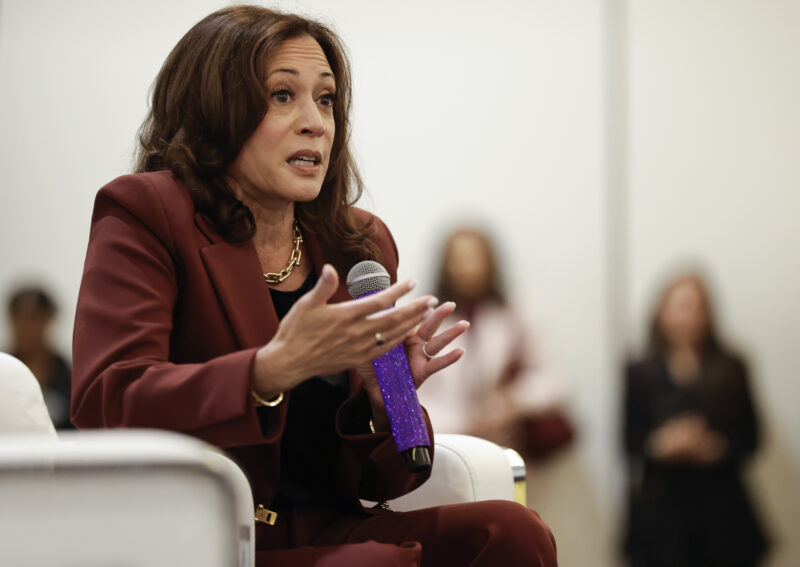
Rep. Alexandria Ocasio-Cortez (D-NY) expressed skepticism of allying with former Rep. Marjorie Taylor Greene (R-GA) on issues like Israel policy, calling Greene a “proven bigot and antisemite.”
The comments have, notably, earned her the opprobrium of others on the far left, and also mark a break with some more mainstream Democrats who have urged their party to join forces with the disgruntled GOP ex-lawmaker.
“There are certain places, certain areas where I don’t think that we should ignore some folks’ record on some of these issues. It’s about where we trust intent, where we trust where those outcomes are going,” Ocasio-Cortez said at an event last week at the University of Chicago Institute of Politics.
“I personally do not trust someone like Marjorie Taylor Greene, a proven bigot and antisemite, on the issues of what is good for Gazans and Israelis.”
“I don’t think that it benefits our movement, in that instance, to align the left with white nationalists,” she continued. “I don’t think it serves us.”
The comments run counter to calls from both the far-left and certain more mainstream Democrats to praise and align with Greene and other Republicans with histories of antisemitism and other controversies who have broken with President Donald Trump over Middle East policy and other issues.
Some on the far left have reacted with outrage.
Peter Daou, a former Democratic strategist who later served as a campaign strategist for presidential candidates Marianne Williamson and Cornel West, asserted that Greene has “far more intellectual honesty … and far more courage on the defining moral issue of our time” than Ocasio-Cortez.
Ryan Grim, a founder of the Hamas-sympathetic news site Drop Site News, said that Greene “sacrificed her political career to stand against genocide, against Trump, against the Epstein Class, and to defend the survivors of Epstein’s trafficking. If that doesn’t earn credibility I don’t know what possibly could.”
Susan Abdulhawa, a prominent Palestinian writer and activist, said, “as a leftie, I’d say [Greene] has more credibility and honor than [Ocasio-Cortez] on this matter.
Greene herself responded, “AOC refused to vote for my amendment to strip funding for Israel. She can run her mouth all she wants but votes are the only thing that matters, not a bunch of words and nasty name calling.”
At the same time, Ocasio-Cortez said that there are areas where cross-partisan alliances are needed because certain issues are “anti-establishment” and will “require a massive bipartisan consensus of people willing to come together across those differences,” like outlawing stock trading by members of Congress.
Ocasio-Cortez is seen as having ambitions for higher office, either running for Senate against Sen. Chuck Schumer (D-NY) or for president in 2028.
You couldn’t draw up a better test on the degree of Trump’s impact on the Republican Party than examining the results from four states holding highly consequential primaries next month that will be a benchmark of the president’s power

Win McNamee/Getty Images
President Donald Trump walks toward reporters before answering questions prior to boarding Air Force One on April 10, 2026 at Joint Base Andrews, Maryland.
There’s been a lot of debate lately over whether President Donald Trump is losing some of his grip on the Republican Party, amid growing economic concerns and the ongoing military operations in Iran.
While the media coverage has been amplifying any sign of intraparty discontent — to the point that former Rep. Marjorie Taylor Greene (R-GA) is getting strange new respect from some Democrats and mainstream press alike — polls continue to show Trump with widespread backing from within his own party, and especially within the MAGA faction of the GOP.
Ultimately, election results are the best reality check. And you couldn’t draw up a better test on the degree of Trump’s impact on the Republican Party than examining the results from four states holding highly consequential primaries next month that will be a benchmark of the president’s power.
Key races in Indiana, Kentucky, Louisiana and Texas will speak volumes about the president’s ability to shape the GOP agenda for the remainder of his second term — and most consequentially, whether he will be able to maintain a unified front with his party on continuing to pursue military action against Iran.
The biggest intraparty showdown, especially when it comes to foreign policy, is the May 19 primary between Rep. Thomas Massie (R-KY) and military veteran Ed Gallrein. Massie, one of the few anti-Israel Republicans in Congress, is being opposed by Trump but also has a solid base of grassroots support in the northern Kentucky district, which has thus far supported his anti-establishment brand of politics. But Gallrein has proven to be a credible challenger, raising millions and giving Massie the biggest political test of his career.
Trump has spent some valuable political capital to boost Gallrein, including appearing at a recent rally in Massie’s district to promote his challenger. He’s been joined by the Republican Jewish Coalition, which has poured $3.5 million into the race, airing five ads underscoring Massie’s record of breaking with Trump. (Further drawing Trump’s ire: Massie also joined with Democrats in championing the release of the Epstein files.)
It’s never easy to beat a sitting incumbent, but Trump also has an imposing record of winning primaries in which he chooses to engage. If Massie pulls out a victory despite breaking so flagrantly with Trump on a number of key issues, it will be a sign of the president’s diminished political clout.
Another high-profile race where Trump’s engagement in a primary hasn’t yet been definitive: Sen. Bill Cassidy’s (R-LA) uphill fight to win renomination against Trump-endorsed Rep. Julia Letlow (R-LA) and state Treasurer John Fleming. The primary will be held on May 16, with the top two finishers heading to a runoff if no one wins a majority of the vote.
Cassidy, largely because of his vote to impeach Trump in 2021, has long faced challenges with the GOP base. Trump, looking to secure Cassidy’s defeat, backed Letlow earlier this year in hopes she’d consolidate the MAGA vote. But Trump’s endorsement hasn’t translated into a groundswell for Letlow, and the presence of Fleming, a former right-wing congressman, has complicated the political math in the primary.
Cassidy looks like a long shot even if he heads to a runoff, and Letlow holds a narrow lead in the limited public polling of the race. But there’s a chance that Fleming could sneak past Letlow on the primary ballot and face Cassidy in a runoff, blocking Trump’s candidate from the race. If that happened, it would be another sign that Trump’s endorsement doesn’t carry the same weight as it once did.
The first Trump test of the month (May 5) will be in Indiana, where the president is trying to punish certain Republican state legislators for not backing a redistricting plan, championed by the White House, which would have allowed the GOP to gain an additional seat.
Finally, it’s the spring race where Trump has remained on the sidelines that may be a signal of his limited political powers. After Sen. John Cornyn (R-TX) finished ahead of Texas Attorney General Ken Paxton in the state’s primary last month, reports indicated the president was close to endorsing Cornyn for reelection, in an effort to prevent an expensive and competitive general election against Democrat James Talarico.
But amid furious pushback from right-wing activists and polls suggesting that a Trump endorsement wouldn’t have moved the needle that much, the president has not gotten involved in the race. That alone speaks volumes about the limited level of the president’s political capital.
Trump boasts a near-perfect record in GOP primaries throughout his decade-long political career, with the most prominent setbacks being in Georgia (working against Gov. Brian Kemp and Secretary of State Brad Raffensperger in 2022). So if the president’s chosen candidates end up falling short in these key contests, it will be a sign that Republicans may already be preparing for the post-Trump era.
Omar is finding common cause with Greene over their anti-Israel views, even though the Republican wanted her deported from the country

Kevin Dietsch/Getty Images
Rep. Ilhan Omar (D-MN) speaks at a press conference on committee assignments for the 118th U.S. Congress, at the U.S. Capitol Building on January 25, 2023, in Washington, D.C.
Rep. Ilhan Omar (D-MN) in an interview on the “Pod Save America” podcast praised former Rep. Marjorie Taylor Greene (R-GA) — once a vocal Omar foe who called for the congresswoman’s deportation while they were both in the House — and far-right influencer Candace Owens over the pair’s break with President Donald Trump.
All three have faced repeated accusations of antisemitism. Owens, in particular, has become a propagator of rampant and often bizarre conspiracy theories, including becoming one of the most prominent antisemitic voices on the right. Greene and Owens have broken with Trump over his continued support for Israel and the war in Iran, among other issues.
“I think as Americans, it is really important for us to work together for the preservation of everything that is good in our country, and to support leaders that we can trust to safeguard what is good of our country,” Omar said, in response to a clip of Greene disavowing Trump on conspiracy theorist Alex Jones’ podcast. “And I believe the thing that has been very fascinating, especially about Marjorie and Candace, is that they are not just coming out — like the other ones that you’d mentioned — where they’re saying, ‘This action is wrong,’ right? They’re saying, ‘I am done with you.’”
“We should give them credit for that, the fact that they’ve had this wake up call to finally seeing this con man, this corrupt, chaotic man for what he is,” Omar continued. “I think is an important thing for us to put our arms around and say, ‘Yes, and now let’s figure out, how do we save our country from the disaster that this man is creating?’”
While Omar is not the first Democrat to praise Greene or to suggest that Democrats should be partnering with her, her comments are particularly notable in light of the enmity between the two women while they served in the House together.
Greene, in 2024, sought to censure Omar for allegedly working as a foreign agent on behalf of Somalia, in what Greene described as “treasonous tendencies” in violation of Omar’s oath of office.
“I would love to have her expelled. I’d love to have her deported,” Greene said at the time. “Unfortunately, I don’t think we have the votes to do that.”
Asked about the past opposition that she faced from Greene and others, Omar brushed it off as a product of their “brainwashed” cult-like devotion to Trump and his movement.
“I’m glad, as my fellow Americans, that they understand that, that they want us to chart a new chapter in America,” Omar continued.
Omar said she had approached Greene on the House floor before Greene resigned from Congress to thank her for her advocacy against Israel and opposition to U.S. support for Israel.
What makes the otherwise sleepy contest significant is the potential for the results to indicate if there are any fissures within the MAGA coalition that may represent discontent with Trump’s hawkish turn amid the Iran war

Megan Varner/Getty Images
Clay Fuller, Trump endorsed Republican candidate for Congressional district 14, speaks to members of the media after arriving early to his voting precinct to cast his vote on March 10, 2026 in Lookout Mountain, Georgia.
Today’s special election runoff in Georgia between Republican Clay Fuller and Democrat Shawn Harris to determine the successor to former Rep. Marjorie Taylor Greene (R-GA) isn’t much in doubt. The northwestern Georgia district that Greene represented backed President Donald Trump by 37 points in 2024, one of the largest GOP margins in the country.
What makes the otherwise sleepy contest significant is the potential for the results to indicate if there are any fissures within the MAGA coalition, ones that may represent Republican discontent with Trump’s hawkish turn amid the Iran war. In this race, the margins will be as notable as the winner.
Greene, since leaving Congress, has emerged a loud Republican voice against the Iran war and against Trump’s strong alliance with Israel. Fuller, a military veteran with a background in counterterrorism operations and district attorney for the Lookout Mountain Judicial Circuit, has been a stalwart supporter of Trump’s military operations in the Middle East, and Trump has endorsed him in the race.
Harris, the Democrat, holds foreign policy views closer to the isolationist Greene, attacking the pro-Israel advocacy group AIPAC and describing Israel’s war against Hamas as a “genocide” — views which place him on the left flank of the Democratic Party. This despite Harris’ time serving as defense attache in Israel during his years in the National Guard, work history that he has not publicized during the campaign.
It’s worth noting that Greene, since she was first elected to the seat in 2020, has underperformed Trump’s standing in the district, only winning 64% of the vote against Harris in 2024 — four points below Trump’s 68% showing at the top of the ticket. And since breaking with Trump in his second term, her political standing has taken an even bigger hit.
Greene has not endorsed either candidate in the race.
If Harris wins over 40% of the vote in this ruby-red district, it’s a sign that Democrats are making inroads into rock-ribbed conservative turf, potentially over frustrations with rising gas prices and the Iran war. But if he doesn’t perform much better than he did in 2024 — and he only won 37% of the vote in the first round of balloting, compared to the 36% he tallied two years ago — it’s a sign that the media hype over a MAGA fissure is greatly overstated.
The election also carries some relevance for another big political showdown in Georgia later this year: Sen. Jon Ossoff’s (D-GA) reelection campaign. Given a divided GOP primary field and an unfavorable national environment for Republicans, Ossoff starts with some advantages in what otherwise looks like a tough reelection.
If the GOP base turns out strongly for Fuller, it’s a sign that Republicans will still be able to rely on conservative voter enthusiasm and engagement in the run-up to the closely watched Senate battleground.
But if there are signs of GOP weakness in one of the reddest parts of the state, it would be evidence that Trump’s political problems aren’t just limited to swing voters, but could extend to even redder states and districts on the battleground map.
Fuller has expressed strong support for Israel and for U.S. strikes against Iran

Megan Varner/Getty Images
Clay Fuller, the Trump-endorsed Republican candidate for Congressional district 14, speaks to members of the media after arriving early to his voting precinct to cast his vote on March 10, 2026 in Lookout Mountain, Georgia.
Clay Fuller, a veteran and district attorney, is expected to succeed former Rep. Marjorie Taylor Greene (R-GA) in the House, bringing a pro-Israel voice to replace one of the House’s most anti-Israel Republicans.
Fuller led all Republicans on the all-party primary ballot in Georgia’s 14th Congressional District, winning 35% of the vote. Even though he finished narrowly behind Democrat Shawn Harris, a military veteran, the Republican vote is likely to consolidate behind Fuller in next month’s runoff election.
Fuller has expressed support for Israel and for the U.S. strikes on Iran.
“President Trump tried the peace route with Iran not once, not twice, but THREE separate times — and they refused. He’s the peace President, but you can’t negotiate with a death cult,” Fuller said in a post on X last month, emphasizing he had supported operations against Iran during his time in the military and that the regime and its proxies had killed many Americans. He added, “This mission is not in vain. Victory through strength.”
Fuller’s Air Force career included work on counterterrorism operations, and he was deployed in 2024 to the Al Udeid airbase in Qatar supporting U.S. Central Command operations.
The day after Hamas’ Oct. 7, 2023, attacks on Israel, Fuller blasted the Biden administration for unfreezing $6 billion in Iranian funds as part of an earlier hostage deal, highlighting Iran’s support to Hamas.
In 2024, he praised Israel and the IDF for eliminating senior Hezbollah official Ibrahim Aqil, pointing to Aqil’s involvement in the attack on the Marine Corps barracks in Beirut in 1983.
AIPAC congratulated Fuller on Tuesday’s results.
“AIPAC also congratulates Clay Fuller for advancing to the April runoff to replace Marjorie Taylor Greene, who worked throughout her tenure to weaken the U.S.-Israel relationship,” the group said in a statement. “Voters in Georgia’s heavily Republican 14th District now have the opportunity to elect a representative who reflects the values of thousands of pro-Israel Georgians and who understans the importance of the U.S.-Israel partnership.”
Harris has his own history with Israel — he served as defense attaché at the U.S. Embassy in Israel starting in May 2021, at the rank of brigadier general, according to his National Guard biography and a Facebook post by the Georgia National Guard.
But that hasn’t stopped him from taking a hostile stance toward Israel and its supporters.
“I’m not taking AIPAC money. I’m not taking money from outside groups trying to buy influence in this race,” he said on X on Wednesday, responding to AIPAC’s statement on Fuller. “No strings. No special favors. No backroom agendas. My loyalty is to the voters of Northwest Georgia. Always.”
The post was accompanied by a graphic reading “in case anyone was wondering… AIPAC is supporting Clay Fuller.”
Harris has also described the war in Gaza as a genocide, though he expressed support for the “people of the region, both in Israel and Palestine, who want to work hard and live their lives in peace, and deserve better from their leaders.”
“I am one of the very few candidates or currently serving Members of Congress who have lived in the region and worked on extraordinarily complex issues within Israel and the Middle East,” he continued.
Harris said previously he would not accept support from AIPAC or the Council on American-Islamic Relations.
His tone has changed significantly since Oct. 7, 2023, when Harris said, “Just as America has the right to defend itself, we must always support Israel’s right to defend itself, and we also must continue working to achieve a stable and just peace in the Middle East.”
He has also criticized the U.S. operations in Iran, citing the need for a “clearly defined mission and end goal” as well as consultation with Congress, and questioning whether the operation has “an achievable objective.”
Plus, the Jewish siblings atop Anthropic

Mandel NGAN / AFP via Getty Images
President Donald Trump steps off Air Force One at Palm Beach International Airport in West Palm Beach, Florida, on February 27, 2026.
👋 Good Tuesday morning!
In today’s Daily Kickoff, we preview today’s special election in Georgia to succeed former Rep. Marjorie Taylor Greene, and spotlight the high-stakes GOP primary in Kentucky, where Ed Gallrein, with backing from President Donald Trump and the Republican Jewish Coalition, is aiming to unseat Rep. Thomas Massie. We report on a threat from a group of six Senate Democrats to obstruct Senate proceedings in order to force hearings and debate on the Iran war, and spotlight siblings Dario and Daniela Amodei, the co-founders of Anthropic, as the AI company confronts the federal government. Also in today’s Daily Kickoff: Argentine President Javier Milei, Ari Emanuel and Lt. Gen. Joshua Rudd.
Today’s Daily Kickoff was curated by JI Executive Editor Melissa Weiss and Israel Editor Tamara Zieve, with assists from Danielle Cohen-Kanik and Marc Rod. Have a tip? Email us here.
What We’re Watching
- Today is the special election in Georgia’s 14th Congressional District for the seat that was previously held by former Rep. Marjorie Taylor Greene (R-GA). More below.
- Secretary of Defense Pete Hegseth and Chairman of the Joint Chiefs of Staff Gen. Dan Caine are slated to give a press briefing at 8 a.m. ET.
- The Senate Armed Services Committee is holding a classified briefing today on the U.S. and Israel’s military campaign in Iran.
- The Senate is voting this morning on the nomination of Lt. Gen. Joshua Rudd to be director of the National Security Agency and commander of U.S. Cyber Command.
- National Review and the Republican Jewish Coalition are co-sponsoring a daylong symposium on antisemitism. Speakers include Sens. Jim Banks (R-IN), Tom Cotton (R-AR) and Ted Cruz (R-TX), White House antisemitism envoy Rabbi Yehuda Kaploun, the Justice Department’s Leo Terrell, the Department of Education’s Noah Pollak, Brandeis Center founder Ken Marcus and Texas Lt. Gov. Dan Patrick.
What You Should Know
A QUICK WORD WITH JI’S MARC ROD
Voters are casting ballots today in the special election for the ruby-red House seat previously held by Rep. Marjorie Taylor Greene (R-GA), but the final outcome will likely remain uncertain for another month.
With 17 candidates on the all-party ballot, the race is expected to go to a runoff — unless any candidate receives 50% or more of the vote, making today’s race effectively a competition over which two candidates are likely to finish with the most support.
On the GOP side, the race is dominated by two candidates. The first is Clay Fuller, a local district attorney, veteran and former White House fellow who is backed by President Donald Trump.
The second, former state Sen. Colton Moore, a hard-line conservative rabble-rouser often at odds with his own party’s leadership, is running as the anti-establishment populist — a profile that more closely matches Greene’s.
The district is one of the most Republican in the country: Trump carried the district by 37 percentage points in 2024, and paid a visit to the district in late February to throw his support behind Fuller.
A third Republican candidate, Brian Stover, a local businessman, has raised a significant amount of campaign cash and is a wild card.
On the Democratic side, the likely leader is Army veteran Shawn Harris, who lost to Greene in 2024 by nearly 30 points. He’s pulled in $4.2 million from Democrats outraged by Greene and who’ve been attracted by a far-fetched pitch that he can flip the seat. But he’s likely to secure a runoff spot, given how many Republican candidates are on the ballot.
Fuller’s campaign has been touting Trump’s endorsement, and his own military service. Fuller’s Air Force career included work on counterterrorism operations, and he was deployed in 2024 to the Al Udeid airbase in Qatar supporting U.S. Central Command operations. He also has the support of the conservative Club for Growth.
He has backed the U.S.-Israeli offensive against Iran, and expressed support for Israel. “President Trump tried the peace route with Iran not once, not twice, but THREE separate times—and they refused. He’s the peace President, but you can’t negotiate with a death cult,” Fuller said, emphasizing he had supported operations against Iran and that the regime and its proxies had killed many Americans.
MIXED MESSAGES

President Donald Trump drew two contradictory timelines for the ongoing war in Iran in remarks on Monday, saying that the conflict was both drawing to a close and in its early stages, Jewish Insider’s Lahav Harkov reports. In a call with CBS News, Trump said, “The war is very complete, pretty much. [Iran has] no navy, no communications; they’ve got no air force. Their missiles are down to a scatter. Their drones are being blown up all over the place, including the manufacturing of drones. … There’s nothing left in a military sense.”
Timeline talk: The war has progressed faster than initially expected, the president added: “We’re very far ahead of schedule.” Also Monday, the Department of Defense posted on X that “we have only just begun to fight, with a graphic of a missile interceptor and the text: “No Mercy.” At a news conference after his CBS News interview, Trump was asked whether the war is “very complete” or “just beginning.” The president responded, “I think you could say both. It’s the beginning of building a new country. We could call it a tremendous success right now, or we could go further.” Trump added, “And we’re going to go further.”
More from Trump: The president also said repeatedly on Monday that he believed the Iranian regime was going to “take over the Middle East” and would have obtained a nuclear weapon “within weeks” had he not ordered the U.S. military operation against Iran, JI’s Emily Jacobs reports.
BLUEGRASS BATTLE

President Donald Trump is headed to Kentucky this week to rally with Ed Gallrein, his endorsed candidate to take on anti-Israel and isolationist Rep. Thomas Massie (R-KY) in the increasingly heated primary between the two men, Jewish Insider’s Marc Rod reports.
The latest: The campaign stop comes at a time when Massie has made himself the face of GOP opposition to the war in Iran — among the litany of other issues on which he has also broken with the president. Massie was one of two lead sponsors of a failed effort in the House last week to stop the war in Iran, while Gallrein said in a statement that the war was justified and would prevent further attacks on U.S. servicemembers and the nation. In a ruby- red district, Massie’s opposition to the war could cost him politically, as polling shows Republicans have rallied strongly behind the administration and its efforts. For its part, the Republican Jewish Coalition is taking aim at Massie over his opposition to the war in a significant ad campaign.
EXECUTIVE ACTION

The Trump administration on Monday moved to designate the Sudanese Muslim Brotherhood (SMB) as a Specially Designated Global Terrorist (SDGT) entity and announced plans to impose a Foreign Terrorist Organization (FTO) designation on March 16, Jewish Insider’s Matthew Shea reports.
Rubio’s statement: “The Sudanese Muslim Brotherhood uses unrestrained violence against civilians to undermine efforts to resolve the conflict in Sudan and advance its violent Islamist ideology,” Secretary of State Marco Rubio said in a press release. “The United States will use all available tools to deprive the Iranian regime and Muslim Brotherhood chapters of the resources to engage in or support terrorism.” Experts have previously told JI that the Sudanese Armed Forces (SAF) is heavily influenced by the SMB, working alongside several Islamist militias and receiving attack drones from Iran’s Islamic Revolutionary Guard Corps (IRGC), which has been designated as a terrorist organization by both the U.S. and the European Union.
CLAUDE’S PARENTS

Siblings Dario and Daniela Amodei are like countless other Americans who have built a family business together. Except that the business the Jewish siblings have built is artificial intelligence giant Anthropic, one of the fastest- growing companies in America — and in the five years since they left cushy jobs at rival OpenAI to start it, they have each amassed billions in wealth. But a dispute over Anthropic’s stated commitment to safety has now put the company squarely in conflict with the Trump administration, Jewish Insider’s Gabby Deutch reports.
Legal battle: On Monday, Anthropic sued Secretary of Defense Pete Hegseth, Secretary of State Marco Rubio and several other Trump administration officials over Hegseth’s decision to designate Anthropic a national security “supply-chain risk” last month, after the company told the Pentagon that it would not allow its technology to be used for mass domestic surveillance or in fully autonomous weapons. Hegseth is “within his right to cancel the contract. But I think that the people in the Department of War, they’re trying to turn the screw. They’re trying to make it tough for Anthropic to survive,” Will Rinehart, a senior fellow at the American Enterprise Institute who researches tech policy, told JI.
RUNNING INTERFERENCE

A group of six Senate Democrats is threatening to immediately begin obstructing proceedings on the Senate floor in order to force public hearings in the Senate Armed Services Committee and Foreign Relations Committee and debate on the chamber floor on the war in Iran, Jewish Insider’s Marc Rod reports.
The plan: JI first reported that several of those lawmakers — including Sens. Cory Booker (D-NJ), Tim Kaine (D-VA), Tammy Duckworth (D-IL), Chris Murphy (D-CT), Tammy Baldwin (D-WI) and Adam Schiff (D-CA) — introduced a series of five new war powers resolutions late last week. The senators indicated in a meeting with reporters on Monday that they plan to force votes on those, and possibly additional, war powers resolutions when they become eligible for votes next week, but that those resolutions are just part of a broader strategy to disrupt normal Senate business in an attempt to force greater public discussion about the war in Iran.
TERROR PROBE

The two Pennsylvania men who allegedly hurled improvised explosive devices toward a protest against New York City Mayor Zohran Mamdani will face federal charges for “ISIS-inspired terrorism,” NYPD Commissioner Jessica Tisch revealed Monday, Jewish Insider’s Will Bredderman reports.
ISIS inspiration: Mamdani and Tisch addressed the press near the scene of the crime, the mayoral residence of Gracie Mansion, where far-right provocateur Jake Lang held a protest on Saturday to “Stop the Islamic takeover of New York City.” Tisch said Lang and his supporters were the targets of two homemade bombs that Emir Balat, 18, who had traveled from Pennsylvania with his accused accomplice Ibrahim Kayumi, 19, flung from amid the counter-demonstration. Tisch confirmed earlier reporting that the Islamic State appears to have inspired the alleged perpetrators’ actions — but maintained nothing at present pointed to any link between the attempted attack and the ongoing U.S. and Israeli military campaign against Iran.
Bonus: Mamdani posted a photo of his wife, who has come under fire in recent days for her social media support for Hamas’ Oct. 7 attacks, and former Columbia protest leader Mahmoud Khalil, who is facing potential deportation for his role in anti-Israel activity on the campus, having an iftar meal at Gracie Mansion.
Worthy Reads
Wolpe’s Wit: In a tongue-in-cheek essay in The Atlantic, Rabbi David Wolpe responds to a statement from California Gov. Gavin Newsom’s office reaffirming his belief in Israel’s right to exist, issued after the governor came under fire for a series of anti-Israel remarks. “Given this statement, I feel it is appropriate to affirm that I believe that Gavin Newsom also has the right to exist, and I further believe that California itself has the right to exist. And the right to defend itself, specifically from Nevada, but not necessarily from Oregon. … As a spiritual leader, it is my responsibility to follow my conscience and not the shifting polls, which, coincidentally, currently align with my conscience. Yes, this position may arouse some ire. Many insist that California is a colonial enterprise, and much of it was stolen from its original inhabitants, the members of the liberal-arts faculty of UC Berkeley.” [TheAtlantic]
Chaos Be Damned: In The Washington Post, Douglas Feith, who served as undersecretary of defense for policy from 2001-2005, posits that President Donald Trump is attempting a new strategy in Iran. “Trump shows no concern about chaos. He is giving the Iranians a chance to take control away from the ayatollahs. Trump sees that as a gift — he doesn’t think the U.S. owes Iranians an on-the-ground effort to prevent chaos or to make their country stable, let alone democratic and prosperous. The president’s goal is to deprive Iran of the power to hurt the U.S. and its interests. If dangers develop down the road, he expects to be able to deal with them far more easily than if he had left in place the Islamic regime that was pursuing nuclear weapons and developing ever-longer-range missiles.” [WashPost]
Doha’s Decision: In his Substack “The Abrahamic Metacritique,” Hussein Aboubakr Mansour observes the developing inflection point in Qatar as the Arab state’s leaders determine its political and diplomatic future. “The question we should ask is whether Qatar will use this moment of crisis to do what its critics have demanded for years: sever its ties to political Islam, expel the Muslim Brotherhood networks it has funded and housed since the 1990s, abandon the Hamas patronage that made it indispensable as a mediator but also made it a target, and, perhaps, reposition as a clean, reliable American partner. The question sounds simple, but the answer is not.” [AbrahamicMetacritique]
Ari the Interviewer: The New York Times’ Brooks Barnes spotlights former Endeavor CEO Ari Emanuel following the launch of the Hollywood agent’s new podcast, in which he takes center stage as an interviewer. “For people who have dealt with the combative Mr. Emanuel over the decades, this can be a bit like watching a body-swapping comedy: Who are you, and what have you done with Ari Emanuel? In contrast to his reputation, Mr. Emanuel comes across on ‘Rushmore’ as eminently likable. He’s polite and thoughtful. He’s able to maintain his focus for more than 90 seconds. Mr. Emanuel even allows himself brief moments of vulnerability — when the armor slips, and he’s not the alpha.” [NYTimes]
Word on the Street
The Wall Street Journal does a deep dive into President Donald Trump‘s potential backing of either Vice President JD Vance or Secretary of State Marco Rubio — the latter of whom the president has expressed a growing preference for — as the GOP’s 2028 presidential candidate…
Politico looks at the diplomatic efforts of White House Special Envoy Steve Witkoff and Jared Kushner as they represent a presidential administration that “views diplomacy like a real-estate venture, requiring a business mindset and a small team tasked with securing a big development deal”...
The Wall Street Journal spotlights the Florsheim loafers being gifted by Trump to all manner of White House visitors, noting that while at the White House in January, far-right commentator Tucker Carlson was given a pair of brown wingtips…
The Atlantic’s Jeffrey Goldberg reflects on the consequences of “Signalgate” a year after he was accidentally added to a group chat of senior Trump administration officials ahead of and during a U.S. operation targeting the Houthis…
Led by Sen. Chris Van Hollen (D-MD), 31 Senate Democrats pressed the administration for accountability for the death of a U.S. citizen in the West Bank, writing that there has been “a consistent pattern in which Americans are being killed in the West Bank by settlers or the IDF without justice or accountability, despite promises from U.S. officials”…
The Oklahoma Statewide Charter School Board rejected for the second time in as many months a proposal for a virtual Jewish charter school, citing a state Supreme Court ruling that charter schools must be non-sectarian…
A mayoral candidate in Ann Arbor, Mich., featured an open Hamas supporter in his campaign video, JI’s Haley Cohen has learned…
A kosher concessions stand is setting up shop at Camden Yards for the Baltimore Orioles’ upcoming season; Birdland Kosher will sell ballpark and American Jewish fare, including hot dogs, chicken nuggets, soft pretzels, hot pastrami sandwiches on rye, potato knishes and chocolate chip cookies…
Australia will grant asylum to five members of Iran’s national women’s soccer team who had been in the country when the war broke out; the move came after President Donald Trump called on Canberra to help the women and offered them asylum in the U.S….
Team Israel was eliminated from the World Baseball Classic following its 10-1 loss to the Dominican Republic on Monday; the Israeli team will still play against the Netherlands today in Miami…
Comic book colorist Tatjana Wood, who survived the Holocaust in hiding at a Quaker school in the Netherlands before immigrating to the U.S. and becoming an award-winning artist, died at 99…
Pic of the Day

Argentine President Javier Milei was the featured guest at Yeshiva University last night for the latest in its “Great Conversations” series hosted by the school’s president, Rabbi Ari Berman (right).
Birthdays

Co-founder of Twitter and then Jelly, which he headed from 2014 until its acquisition by Pinterest in 2017, Christopher Isaac “Biz” Stone turns 52…
Member of the Pro Football Hall of Fame, he played for the San Diego Chargers of the AFL and then for the Oakland Raiders of the NFL, Ron Mix turns 88… Long Beach, Calif., general surgeon, Leonard M. Lovitch, MD… Former chairman and president of Purdue Pharma, he and his family are the subject of multiple lawsuits relating to the opioid crisis, Richard Sackler, MD turns 81… Author and publisher of the Phoenix Scottsdale Jewish Friendship Trail Guidebook, Michael Alan Ross… Senior cryogenics engineer at Raytheon Missile Systems in Tucson, Ariz., he is also an adjunct professor at the University of Arizona, Lawrence Sobel… Founder and CEO of Cambridge, Mass.-based Pegasystems, Alan N. Trefler turns 70… Editor-at-large of Mishpacha Magazine, Binyamin Rose turns 70… Founder of two Israeli companies, Strategy3i Ltd. and Fluenzy, Jeffrey Kahn turns 68… Winner of four gymnastics medals in the 1984 Summer Olympic Games, now in the reverse mortgage business in Sarasota, Mitch Gaylord turns 65… Record producer, former co-president of Columbia Records and a co-founder of Def Jam Records, Frederick Jay “Rick” Rubin turns 63… Financial journalist for CNBC and one of the co-hosts of its morning show “Squawk on the Street,” David Faber turns 62… Executive director until 2024 of the America Israel Friendship League, Wayne L. Firestone turns 62… Stage, screen and television actor, he is the son of novelist Norman Mailer, Stephen Mailer turns 60… Investigative reporter for The New York Times since 2000, Danny Hakim… Former White House official in the Clinton administration, she is now the first lady of Pennsylvania, Lori Shapiro turns 53… Real estate agent on Bravo’s “Million Dollar Listing,” Josh Altman turns 47… Former IDF officer, then a financial executive, Aliza Landes… Former deputy assistant secretary at the U.S. State Department, now executive director at The Vandenberg Coalition, Carrie Filipetti… Actor and director, he is the son of Kate Capshaw and Steven Spielberg, Sawyer Avery Spielberg turns 34…
Greene has stayed on the sidelines in the race to replace her, not endorsing or rallying for any of the candidates, as she continues to air her disappointment with Trump and the GOP leadership
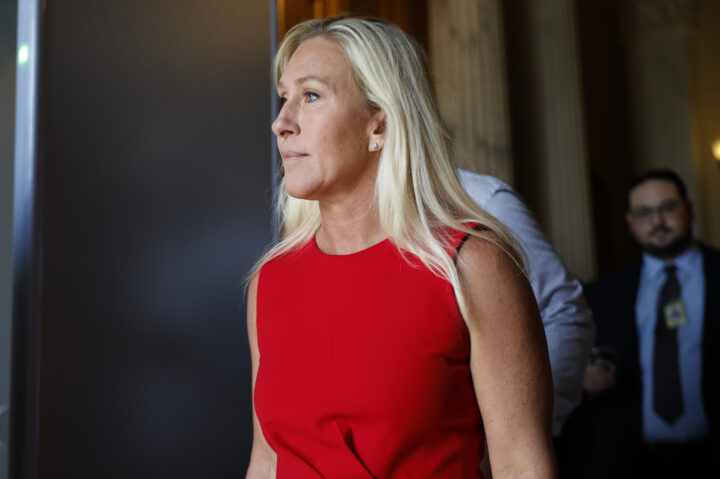
Chip Somodevilla/Getty Images
Rep. Marjorie Taylor Greene (R-GA) leaves the House Chamber following the last vote of the week at the U.S. Capitol on September 12, 2024 in Washington, DC.
Voters are casting ballots today in the special election for the ruby-red House seat previously held by Rep. Marjorie Taylor Greene (R-GA), but the final outcome will likely remain uncertain for another month.
With 17 candidates on the all-party ballot, the race is expected to go to a runoff — unless any candidate receives 50% or more of the vote, making today’s race effectively a competition over which two candidates are likely to finish with the most support.
On the GOP side, the race is dominated by two candidates. The first is Clay Fuller, a local district attorney, veteran and former White House fellow who is backed by President Donald Trump.
The second, former state Sen. Colton Moore, a hard-line conservative rabble-rouser often at odds with his own party’s leadership, is running as the anti-establishment populist — a profile that more closely matches Greene’s.
The district is one of the most Republican in the country: Trump carried the district by 37 percentage points in 2024, and paid a visit to the district in late February to throw his support behind Fuller.
A third Republican candidate, Brian Stover, a local businessman, has raised a significant amount of campaign cash and is a wild card.
On the Democratic side, the likely leader is Army veteran Shawn Harris, who lost to Greene in 2024 by nearly 30 points. He’s pulled in $4.2 million from Democrats outraged by Greene and who’ve been attracted by a far-fetched pitch that he can flip the seat. But he’s likely to secure a runoff spot, given how many Republican candidates are on the ballot.
Fuller’s campaign has been touting Trump’s endorsement, and his own military service. Fuller’s Air Force career included work on counterterrorism operations, and he was deployed in 2024 to the Al Udeid airbase in Qatar supporting U.S. Central Command operations. He also has the support of the conservative Club for Growth.
He has backed the U.S.-Israeli offensive against Iran, and expressed support for Israel. “President Trump tried the peace route with Iran not once, not twice, but THREE separate times—and they refused. He’s the peace President, but you can’t negotiate with a death cult,” Fuller said, emphasizing he had supported operations against Iran and that the regime and its proxies had killed many Americans.
Despite not receiving Trump’s support, Moore is also trying to tie himself closely to the president, describing himself on his campaign website as “Trump’s #1 Defender” and “a Proven Warrior for President Trump” — pointing to his vocal efforts to contest the results of the 2020 election and opposition to subsequent investigations of Trump and his allies — and using the campaign slogan, “God. Guns. Trump.”
Moore has repeatedly found himself at odds with Georgia’s GOP establishment, having been expelled from the Republican caucus, banned from the Statehouse floor and arrested when he tried to enter the 2025 State of the State address.
Moore doesn’t appear to have addressed the war in Iran, but said, days after the Oct. 7, 2023, Hamas attacks, “The Jewish people are the indigenous people of Israel.” And according to a candidate questionnaire from 2022, he is a longtime supporter of Israel, having attended AIPAC conferences and, as a college student, having served as co-chair of the University of Georgia AIPAC chapter. “There is no Palestinian land, it is all the land of Israel,” he said in the questionnaire.
So despite his MAGA bona fides, his record appears decidedly more supportive of Israel than Greene, who has advanced antisemitic conspiracy theories and became one of the few anti-Israel Republicans in Congress.
However, Moore was also the only Republican member of the state Senate to vote against a bill in 2024 codifying the International Holocaust Remembrance Alliance’s working definition of antisemitism — echoing Greene’s stance on the Antisemitism Awareness Act in the same year.
As of Feb. 18, Stover had raised $940,000 (around two-thirds of that was in the form of a personal loan to his campaign), Fuller $787,000 and Moore $342,000.
The normally voluble Greene has stayed on the sidelines in the race to replace her, not endorsing or rallying for any of the candidates, as she continues to air her disappointment with Trump and the GOP leadership.
Greene rode into office on a record of antisemitic conspiracy theories, and has emerged as one of the most vocal GOP opponents of Israel in the House
Kayla Bartkowski/Getty Images
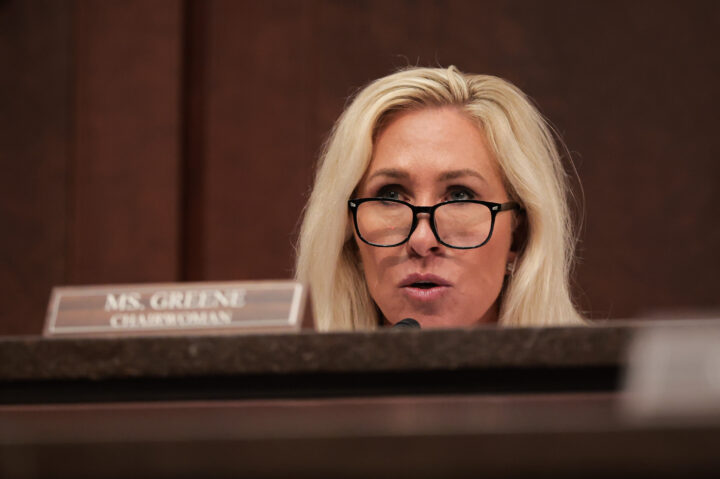
Rep. Marjorie Taylor Greene (R-GA) speaks at the U.S. Capitol on May 07, 2025 in Washington, DC.
Rep. Marjorie Taylor Greene (R-GA), who entered office in 2021 with a record of espousing antisemitic conspiracy theories and emerged since Oct. 7, 2023, as one of the most vocal opponents of Israel in the House Republican conference, announced on Friday that she will resign her seat, effective Jan. 5, 2026.
Greene’s announcement comes a week after President Donald Trump disavowed her, calling her a “traitor” and indicating that he would endorse a primary challenger, if a viable one emerged.
The Georgia congresswoman rose to political prominence due to her long history of promoting various antisemitic and otherwise fringe conspiracy theories. Greene was elected in spite of efforts from fellow Republicans to defeat her after she won the GOP primary in her district in 2020. She continued to face accusations of antisemitism during her time in office and repeatedly invoked a range of antisemitic tropes.
Though she initially cast herself as a supporter of Israel, she more recently flipped on the issue, now condemning the Jewish state, accusing it of genocide in Gaza and repeatedly attempting to pass measures to cut off all U.S. aid.
In her farewell message, Greene repeatedly railed against U.S. foreign engagement and “foreign interests.”
“Americans’ hard earned tax dollars always fund foreign wars, foreign aid, and foreign interests,” Greene said in a lengthy resignation letter. “America First should mean America First and only Americans First, with no other foreign country ever being attached to America First in our halls of government,” Greene said.
Jewish Republicans have long opposed the congresswoman, and the Republican Jewish Coalition repeatedly backed challengers to her. The RJC responded mockingly to her announcement with a gif of Trump waving, with the caption, “And we say bye bye.”
The controversial Georgia congresswoman spent much of her first term in office in the political wilderness, sidelined by her own party and expelled from her committee assignments by bipartisan House votes led by Democrats.
But she later emerged as a key ally of Trump in the House after Republicans retook the chamber in the 2022 midterms, and also became a close ally of House Speaker Kevin McCarthy (R-CA).
Greene’s influence waned, however, after McCarthy was booted from the speakership in 2023, and she has more frequently been relegated to the sidelines as a hard-right opponent of the House Republican leadership’s agenda. She contemplated a run for Senate or governor in Georgia, but Republican leaders declined to back those efforts.
In recent months, she has grown increasingly critical of key elements of the Republican and Trump agendas, including his support for Israel and attack on Iranian nuclear facilities in June 2025.
Following Trump’s break with Greene last week, she implied that Israel and pro-Israel interests had pressured him into disowning her.
In her resignation letter, Greene was defiant, insisting that she could beat back any primary challenger but saying that she did not want to put herself, her family and her district through such a challenge.
“I have too much self respect and dignity, love my family way too much, and do not want my sweet district to have to endure a hurtful and hateful primary against me by the President we all fought for, only to fight and win my election while Republicans will likely lose the midterms,” Greene said. “And in turn, be expected to defend the President against impeachment after he hatefully dumped tens of millions of dollars against me and tried to destroy me.”
She said that she is being cast aside by “MAGA Inc” to be replaced by “Neocons, Big Pharma, Big Tech, Military Industrial War Complex, foreign leaders, and the elite donor class.”
But she also teased plans for a political comeback. Greene has been rumored to have aspirations for a presidential run in 2028, something she has denied.
“When the common American people finally realize and understand that the Political Industrial Complex of both parties is ripping this country apart, that not one elected leader like me is able to stop Washington’s machine from gradually destroying our country, and instead the reality is that they, common Americans, The People, possess the real power over Washington, then I’ll be here by their side to rebuild it,” Greene said.
Rep. Randy Fine (R-FL), one of the few Jewish Republicans in the House, said on X, “One antisemite down. One to go.”
The Maryland congressman recently said the Democratic Party should have ‘room for Marjorie Taylor Greene if she wants to come over’
Annabelle Gordon/Bloomberg via Getty Images
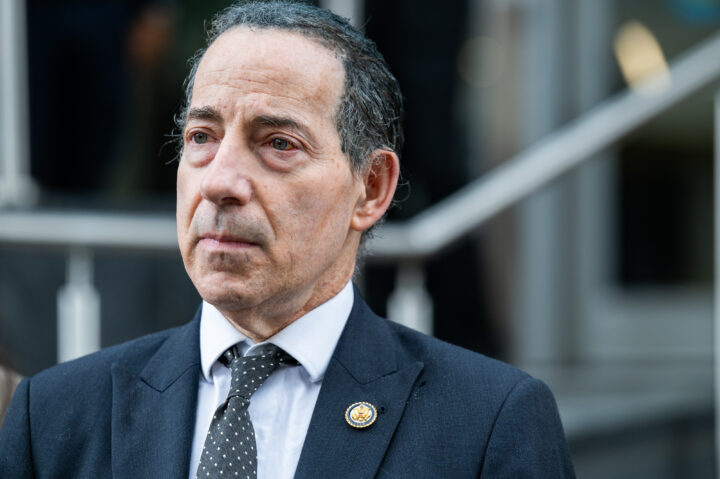
Rep. Jamie Raskin (D-MD) during a news conference in Washington, D.C., on Thursday, May 22, 2025.
Rep. Jamie Raskin (D-MD) told Jewish Insider on Tuesday that Rep. Marjorie Taylor Greene (R-GA) would need to reject antisemitism and other forms of bigotry if she wanted to join the Democratic coalition, tempering his recent comment that the Democratic Party should be enough of a “big tent” to accommodate Greene.
Greene, who has recently earned friendly treatment from some Democrats and liberal-leaning media programs such as “The View” over her break with President Donald Trump, has continued to invoke antisemitic tropes, most recently suggesting over the weekend that Israel had pressured Trump to denounce her, and has promoted a variety of other conspiracy theories.
But that rhetoric, for which many liberals previously condemned Greene, has gone increasingly overlooked.
“We are a big tent. We must be a huge, vast tent. I say this is a party that’s got room for Marjorie Taylor Greene if she wants to come over. We’ve got room for anybody who wants to stand up for the Constitution and the Bill of Rights today,” Raskin said in remarks to Florida Democrats shared on social media last weekend.
Asked about Greene’s ongoing promotion of antisemitic tropes and conspiracy theories, Raskin told JI in a statement, “Before I would welcome Rep. Greene or any other leaders who might flee from Trump’s autocratic personality cult, I would of course want to see them repudiate all the forms of authoritarianism, antisemitism, racism, transphobia and bigotry that they have promoted as Republicans and that have become so intertwined with the MAGA Republican brand under Trump.”
He said he believes that some of his colleagues may end up switching parties.
“I have real hope that a whole lot of my Colleagues will continue to evolve away from the dangerous and divisive swamps of MAGA politics,” Raskin said. “I meet Independents and Republicans every day joining the Democratic Party, and I am delighted to work with them and anyone else who will stand up against antisemitism, racism and corruption and for democracy, equality, freedom and progress for all.”
Jewish Democratic groups urged Democrats to keep Greene at a distance.
“She has a track record of antisemitism and opposition to Israel that goes back before she was even in Congress and continued as recently as a few days ago,” Democratic Majority for Israel CEO Brian Romick told Jewish Insider. “The House is a legislative body and you need to get 218 [votes]. You should get 218 [with] whoever you can get to 218, but just because someone votes with you today doesn’t make them a good person or your friend.”
Halie Soifer, the CEO of the Jewish Democratic Council of America, said that Greene’s rift with Trump “doesn’t change her many years of espousing extremist views, including dangerous lies about Jewish Americans, whether it be the infamous ‘space laser’ accusation or other antisemitic conspiracy theories. So if she really wants to distinguish herself from the toxic politics of Donald Trump, she needs to do more than simply call for the release of the Epstein files.”
Soifer also argued that Greene’s views of Israel — she has accused the country of genocide in Gaza and sought to cut off military aid — “are not aligned with those of Jewish Dems either.”
“If she’s going to provide an additional vote for passage of critically important measures for the American people, including reducing their otherwise skyrocketing prices of health care, then the Democrats should gladly take that support,” Soifer said. “However, that doesn’t mean aligning with her and her extremist views. It doesn’t change the fact that she has continued to perpetuate antisemitic conspiracy theories and espouse extremist and even antisemitic views.”
The president accused the right-wing lawmaker of being a traitor and ‘having gone Far Left’

ELIJAH NOUVELAGE/AFP via Getty Images
Rep. Marjorie Taylor Greene speaks alongside then-former President Donald Trump at a campaign event in Rome, Georgia, on March 9, 2024.
President Donald Trump on Friday night publicly disavowed Rep. Marjorie Taylor Greene (R-GA), once one of the president’s closest and most committed allies on Capitol Hill, saying he was withdrawing his endorsement of Greene and is prepared to support a primary challenger to the far-right Georgia congresswoman.
Greene, long dogged by controversy for her record of promoting antisemitic and otherwise fringe conspiracy theories, has emerged as one of the most vocal opponents of Israel on the right, accusing the country of genocide and leading efforts attempting to cut off U.S. aid to the Jewish state.
She has also repeatedly publicly criticized Trump’s policies and Republican leadership on Capitol Hill since the start of the government shutdown, earning Trump’s ire. Her breaks with the GOP have made her into a budding star in liberal media circles, where her ongoing promotion of conspiracy theories has increasingly been overlooked.
Trump said on his Truth Social platform that he has heard that “wonderful, Conservative people are thinking about primarying Marjorie” and that “if the right person runs, they will have my Complete and Unyielding Support,” accusing her of having “gone Far Left.”
Greene’s district is among the most heavily Republican in the country, and losing Trump’s support could prove a significant blow to the congresswoman.
“All I see ‘Wacky’ Marjorie do is COMPLAIN, COMPLAIN, COMPLAIN!” Trump wrote, adding that Greene’s criticism began after he showed her statewide polling that placed her at just 12% support and discouraged her from running for Senate or governor, both positions Greene had been eyeing.
According to NOTUS, Greene is discussing a presidential run in 2028, though she denied that to the publication.
“[Greene] has told many people that she is upset that I don’t return her phone calls anymore, but with 219 Congressmen/women, 53 U.S. Senators, 24 Cabinet Members, almost 200 Counties, and an otherwise normal life to lead, I can’t take a ranting Lunatic’s call every day,” Trump continued in his post.
He later called Greene a “Traitor” and a “disgrace to our GREAT REPUBLICAN PARTY!”
Greene responded on X, saying Trump had lied to her and claiming that two recent text messages about files related to child sex trafficker Jeffrey Epstein had “sent him over the edge,” saying it is “astonishing really how hard he’s fighting to stop the Epstein files from coming out.”
Greene is one of a small number of Republicans cosponsoring a measure to force a vote, over Republicans’ objections on files related to Epstein. Trump, an associate of Epstein, has sought to prevent the full release of those files, calling the push for further disclosure “the Epstein hoax.”
“Most Americans wish he would fight this hard to help the forgotten men and women of America who are fed up with foreign wars and foreign causes, are going broke trying to feed their families, and are losing hope of ever achieving the American dream,” Greene said. “I have supported President Trump with too much of my precious time, too much of my own money, and fought harder for him even when almost all other Republicans turned their back and denounced him. But I don’t worship or serve Donald Trump.”
In a subsequent post, Greene shared a graphic showing she has not received support from pro-Israel groups alongside another graphic comparing her “Liberty Score” to that of Trump-backed pro-Israel Sen. Lindsey Graham (R-SC). In the post, she wrote: “This and the Epstein files is why I’m being attacked by President Trump. It really makes you wonder what is in those files and who and what country is putting so much pressure on him?”
She also claimed that Trump’s posts are driving a wave of security threats against her.
Trump has also worked to defeat Rep. Thomas Massie (R-KY), another of the most vocal anti-Israel Republicans The president has endorsed retired Navy SEAL Ed Gallrein, who is challenging Massie in the GOP primary.
On Friday, Trump called Massie a “LOSER!” in a separate Truth Social post, claiming that “the Polls have him at less than an 8% chance of winning the Election” and mocked his recent remarriage.
The Georgia congresswoman has recently boosted claims Israel had a hand in assassinating Charlie Kirk, and has baselessly accused the Jewish state of meddling in American elections
Chip Somodevilla/Getty Images
Rep. Marjorie Taylor Greene (R-GA) leaves the House Chamber following the last vote of the week at the U.S. Capitol on September 12, 2024 in Washington, DC.
Rep. Marjorie Taylor Greene (R-GA) first became a household name for her embrace of a range of wild conspiracy theories — including antisemitic claims about the Rothschild family like the idea that space-based weapons controlled by the Jewish banking family were the cause of California wildfires.
But as the congresswoman has emerged as an unlikely star in liberal circles and mainstream media after breaking with her party on the government shutdown, health care funding and the Jeffrey Epstein files, her erstwhile critics have all but ignored her increasingly frequent use of antisemitic tropes and embrace of conspiracy theories targeting Jews.
Earlier this week, the controversial Georgia congresswoman vowed on X, “No bar codes on me. I’ll never take 30 shekels. I’m America only! And Christ is King!”
Her rejection of “30 shekels” appears to be a reference to the pieces of silver paid to Judas Iscariot to betray Jesus, and the currency of Israel. Greene’s mention of “bar codes” refers to claims by former Rep. Matt Gaetz (R-FL) about AIPAC fundraising events, which AIPAC has denied.
She has also repeatedly boosted claims that Israel and Jewish people were involved in last month’s killing of Turning Point USA founder Charlie Kirk and are seeking to co-opt his organization.
“Do not allow a foreign country, foreign agents, and another religion tell you about Charlie Kirk,” Greene said on X. “And I hope a foreign country and foreign agents and another religion does not take over Christian Patriotic Turning Point USA.”
Last week, Greene reposted an X post by Holocaust denier Evan Kilgore, in which Kilgore shared a video of Candace Owens — a primary propagator of Israel-related conspiracy theories about Kirk’s death — claiming that Kirk had announced prior to his death that he was abandoning his support for Israel.
And she lauded a eulogy delivered by far-right commentator Tucker Carlson at Kirk’s funeral, in which Carlson compared Kirk’s killing to the death of Jesus.
“It’s becoming increasingly clear that no matter which party is in charge, the secular government of Israel always gets its way,” Greene wrote on X.
Greene has been one of the few Republican lawmakers to attack AIPAC and other pro-Israel advocacy groups, accusing them of exercising malign influence over the U.S. government and demanding they register as foreign agents. AIPAC is funded and led by American citizens, not the Israeli government.
She has accused Israel of “meddling in campaigns and elections” and of “meddling in government policy — government of the United States policy — as well as dictating what America does in foreign wars.”
“It’s becoming increasingly clear that no matter which party is in charge, the secular government of Israel always gets its way,” Greene added on X.
Regarding the war in Gaza, Greene has employed language sometimes indistinguishable from that of far-left Israel opponents, accusing Israel of committing genocide and of deliberately killing innocent people and children, particularly Christians. She led an effort in the House to cut off U.S. missile defense aid to Israel, which failed overwhelmingly.
She also shared posts suggesting that Israel had foreknowledge of Hamas’ Oct. 7, 2023, attacks and chose to delay its response, and claimed that “Most of America has Israel fatigue” because politicians ignore domestic problems in order to “talk about Israel all day” and that a GOP colleague is “fighting for his life to maintain his pro Israel money.”
“I am not suicidal and one of the happiest healthiest people you will meet. I have full faith in God and Jesus Christ is my Lord and Savior. As a sinner, I am only saved through His grace and mercy,” Greene said. “With that said, if something happens to me, I ask you all to find out which foreign government or powerful people would take heinous actions to stop the information from coming out.”
Greene described the Anti-Defamation League as a “dangerous hate group that targets Christians,” praising the FBI for recently cutting ties with the group.
Amid her escalating social media campaign against the pro-Israel world and her advocacy for the release of files related to the Epstein investigation, Greene suggested last month on X that a foreign government or other powerful individuals were planning to assassinate her.
“I am not suicidal and one of the happiest healthiest people you will meet. I have full faith in God and Jesus Christ is my Lord and Savior. As a sinner, I am only saved through His grace and mercy,” Greene said. “With that said, if something happens to me, I ask you all to find out which foreign government or powerful people would take heinous actions to stop the information from coming out.”
The post was widely interpreted — including by at least one fellow lawmaker — as a suggestion that Israel or Jewish people were targeting Greene.
“Why do crazy people keep thinking ‘the Jews’ are trying to kill them?” Rep. Ted Cruz (R-TX) replied.
Greene has also claimed Israel is operating a social media campaign targeting her.
Outside of Israel policy and the Jewish community, Greene has also continued to lean into other conspiracy theories, such as posting in August that it is “oddly consistent and strange” that several mass shooters have authored manifestos, asking, “who tells them to do that?” In the past, she has repeatedly spread conspiracy theories about mass shootings, speculating that demonic possession or military mind control may be responsible for school shootings.
Last month, she also shared a Carlson documentary claiming the truth of the 9/11 attacks had been covered up and convened a congressional hearing on weather modification that heavily featured conspiracy theories and false and misleading claims.
“The RJC has endorsed multiple GOP primary challengers to Marjorie Taylor Greene. She is out of step with the Republican Party, and with President Trump. The people of Georgia deserve better — and we are determined to do what we can to retire her,” RJC CEO Matt Brooks said.
“While the president and congressional Republicans back our ally, Rep. Marjorie Taylor Greene is aligned with Reps. Ilhan Omar and Alexandria Ocasio-Cortez to demonize Israel and weaken a partnership that makes America safer, strong and more prosperous,” AIPAC spokesperson Marshall Wittmann told Jewish Insider. “Our 5 million members will not be deterred by her rancid anti-Israel and unhinged raving.”
The Republican Jewish Coalition, which has repeatedly opposed Greene, said it continues to support efforts to defeat her.
“The RJC has endorsed multiple GOP primary challengers to Marjorie Taylor Greene. She is out of step with the Republican Party, and with President Trump. The people of Georgia deserve better — and we are determined to do what we can to retire her,” RJC CEO Matt Brooks said.
Greene did not respond to a request for comment.
Greene has recently been a thorn in the side of GOP leadership for a number of reasons, including criticizing the party’s approach to a health care tax credit central to the current government shutdown, critiquing the Trump administration’s mass deportation strategy and Middle East policy, backing an effort to force a House vote on the release of documents related to the Epstein investigation, accusing the party of blocking women from leadership roles and voting against other elements of the House Republican leadership’s agenda.
Her disputes with the Trump administration could create an opportunity for a Republican primary challenger to make a run against her — though Trump hasn’t personally spoken out against Greene as he has against Rep. Thomas Massie (R-KY), another anti-Israel House GOP colleague, and Greene has continued to profess her loyalty to Trump and his movement.
She does not yet face any serious primary competition.
Greene previously accumulated influence in the House as a close ally of Trump and former House Speaker Kevin McCarthy (R-CA) but has found herself increasingly sidelined. National Republican Party leaders did not back her as she considered a run for Georgia’s Senate seat against Sen. Jon Ossoff (D-GA) or the state’s governorship.
The Virginia congressman said Israel must remain in Gaza until Hamas is defeated; ‘We want to get the hostages home, but if we don’t finish the job, you’re going to have more hostages’

Kobi Gideon/GPO
Israeli Prime Minister Benjamin Netanyahu meets with a delegation of Republican legislators on a trip organized by the American Israel Education Foundation on August 5, 2025.
Fresh off his first congressional trip to Israel, Rep. John McGuire (R-VA) said that the future of his party remains pro-Israel, despite a vocal fringe of House Republicans opposing U.S. support for Israel amid its war against Hamas.
“I don’t know where they are with their thoughts and ideas,” McGuire, a freshman lawmaker representing Virginia’s 5th Congressional District, told Jewish Insider on Thursday, referring to attempts to block all U.S. funding to Israel by Rep. Marjorie Taylor Greene (R-GA) and Rep. Thomas Massie (R-KY).
“I do understand that [the U.S. is] $37 trillion in debt, but as a Christian, I certainly support Israel and the Jewish people, and as an ally we would not have been able to successfully do that mission against Iran without the help of Israel,” McGuire said, referring to the U.S. and Israeli strikes on Iran’s nuclear facilities in June, calling Greene and Massie “outliers” in the GOP.
McGuire was elected to Congress in 2024 after challenging a Republican congressman, Bob Good, who voted against military assistance to Israel. McGuire’s campaign last year was backed by AIPAC’s super PAC and the Republican Jewish Coalition.
McGuire visited Israel earlier this month with the AIPAC-affiliated American Israel Education Foundation, alongside 44 other freshmen House Republicans, a trip that he described as “heartbreaking, inspirational and enlightening.”
The group met with leaders including Israeli Prime Minister Benjamin Netanyahu and U.S. Ambassador to Israel Mike Huckabee. McGuire said that he had not heard in meetings with leaders a plan for bringing the war to an end, but said that in a sideline conversation, Netanyahu appeared receptive to his advice to “get the job done,” and remain in Gaza until Hamas is defeated.
A former U.S. Navy SEAL, McGuire said he was particularly inspired while learning about Israel’s mandatory army service. “The U.S. should have a similar program,” he said, describing a “connection” he felt with Netanyahu over their shared military service. “He’s a special-ops guy, I’m a special-ops guy. One thing you learn in the military is there’s a bully on every corner and if you don’t stand up to them it just gets worse. We want to get the hostages home, but if we don’t finish the job, you’re going to have more hostages.”
“The resilience that Israeli people have, despite being surrounded by folks that want to destroy them, they still are hopeful for the future,” McGuire continued. “They’re very patriotic to their country. When you drive around Israel, you see Israeli flags on every car. I’d like to see American flags on every car.”
The trip also included visits to several kibbutzim infiltrated by Hamas on Oct. 7, 2023, and meetings with family members of victims of the attacks, including a musical performance by Kibbutz Be’eri survivor and songwriter Daniel Weiss, whose parents were murdered by the terrorist organization.
It was the congressman’s second time in the Jewish state, following a 2019 visit with his church.
McGuire, a member of the cybersecurity subcommittee of the House Armed Services Committee, lauded Israel as a world leader in cybersecurity innovations and said the U.S.-Israel technology partnership is “strong.”
“Watching the mission to take out Iranian nuclear capabilities, American and Israeli soldiers were in the same command/control rooms working together to make sure that the mission was a success,” he said, referring to the June 22 strikes on three Iranian nuclear facilities.
Back stateside, McGuire said he is not satisfied with the steps being taken by leadership at the University of Virginia, located in his district , to address anti-Israel demonstrations and antisemitism on campus. He has not been in touch with the UVA administration yet regarding antisemitism, but said he is “working towards that.”
The amendment sought to cut $500 million in cooperative missile defense funding
Kayla Bartkowski/Getty Images
Rep. Marjorie Taylor Greene (R-GA) speaks at the U.S. Capitol on May 07, 2025 in Washington, DC.
The House of Representatives on Thursday rejected, in a 422-6 vote, a bid by Rep. Marjorie Taylor Greene (R-GA) to block the $500 million in cooperative missile-defense funding the U.S. provides annually to Israel.
Greene’s amendment sought to strip the funding, provided annually under the terms of the U.S.-Israel memorandum of understanding, from the House’s 2026 Defense funding bill. Rep. Ilhan Omar (D-MN), had introduced a similar amendment.
Greene, Omar and Reps. Al Green (D-TX), Summer Lee (D-PA), Thomas Massie (R-KY) and Rashida Tlaib (D-MI) voted for the aid cutoff.
The House also defeated Greene-led amendments that would have cut military funding for Jordan by a 400-30 vote, for Ukraine by a 353-76 vote and for Taiwan by a 421-6 vote. Only Republicans voted for each of those amendments.
Legislators also rejected, by a 355-76 vote, an amendment by Rep. Greg Steube (R-FL) to cut funding for the Lebanese Armed Forces. All of the votes in favor came from Republicans.
Steube has long opposed funding for the LAF, arguing that it is complicit in Hezbollah’s actions against Israel and infiltrated by Hezbollah members and sympathizers.
Greene argued on the House floor that the Israel funding is “money we don’t have” and that Israel is “very capable of defending themselves.”
Referring repeatedly to the Jewish state as “nuclear-armed Israel,” Greene suggested that Israel’s undeclared nuclear capabilities should deter any threats — even though that has not been the case in the past. Israel has long maintained a policy of nuclear ambiguity, neither confirming nor denying its possession of a nuclear arsenal.
She also highlighted the U.S.’ extensive use of its own ballistic missile interceptors to defend Israel during the recent Iran-Israel war.
Greene noted Israel’s bombing this week of a church in Gaza, for which the Israeli government apologized, calling it a mistake, and said that “an entire population is being wiped out as they continue their aggressive war in Gaza.”
The funding in question supports programs including Iron Dome, Arrow and David’s Sling that are jointly developed by Israel and the United States. The systems, designed to intercept threats like missiles and drones, do not have offensive applications.
Reps. Ken Calvert (R-CA) and Betty McCollum (D-MN), the chair and ranking member of the House Appropriations Committee’s Defense Subcommittee, both spoke on the House floor against Greene’s amendment, as did Rep. Randy Fine (R-FL).
Calvert said that Israel’s success in intercepting ongoing attacks has come partly as a result of the U.S. missile-defense funding provided in past years. He highlighted that the funding supports the U.S.’ defense industrial base, funding production of the systems in both the U.S. and Israel and joint technological development.
McCollum is a vocal longtime critic of Israeli policy toward the Palestinians and the Israeli military operations in Gaza.
“To be clear, I have disagreements with Prime Minister Netanyahu’s government,” McCollum said, describing the war in Gaza as a “tragedy.” “But the funding in this bill does not support offensive weapons for Israel. … This bill provides for defensive measures only.”
McCollum said that everyone in the region deserves safety and that “Israeli children deserve to go to bed at night knowing that missiles from Yemen, Iran or from the Houthis or anywhere else in the region will not rain down on them.”
Fine highlighted that there is a significant American population in Israel under threat from air attacks. He said the co-development of missile-defense programs with Israel helps support America’s own air defense, including President Donald Trump’s Golden Dome proposal for a national air-defense infrastructure.
Addressing Greene’s comments, he noted that America has nuclear weapons, but that hasn’t deterred some adversaries from trying to attack it.
“When we oppose this amendment, when we vote it down, we are not only standing with Israel, we are standing with the best interests of the United States,” Fine said.
The post, which opposed Israeli strikes in Iran, was boosted by Code Pink and a strategist for Sen. Rand Paul (R-KY)
Kayla Bartkowski/Getty Images
Rep. Marjorie Taylor Greene (R-GA) speaks at the U.S. Capitol on May 07, 2025 in Washington, DC.
A tweet by Rep. Marjorie Taylor Greene (R-GA) opposing U.S. support for Israel’s ongoing campaign against Iran is bringing into sharp relief the convergence between the far left and far right in opposition to the Israeli operation.
Greene, posting on X on Sunday, lambasted “fake” America First leaders, arguing “the list of fakes are becoming quite long and exposed themselves quickly. Anyone slobbering for the U.S. to become fully involved in the Israel/Iran war is not America First/MAGA. Wishing for murder of innocent people is disgusting.”
She went on to claim that a regional war or global war, which would likely overwhelm the Middle East, BRICS and NATO, is inevitable and that “countries are required to take a side.”
“I don’t want to see Israel bombed or Iran bombed or Gaza bombed,” Greene said. “And we do NOT want to be involved or required to pay for ANY OF IT!!!”
The Georgia Republican went on to deny that Iran was close to attaining a nuclear weapon and suggested that Iran’s pursuit of nuclear weapons was not particularly significant because “more countries than is public have some sort of nuclear capabilities.”
Greene also repeatedly denied that she was antisemitic.
That post has won plaudits from prominent far-left figures, including Code Pink activist Medea Benjamin and Drop Site News co-founder Ryan Grim.
“You don’t have to agree with [Greene] on everything to applaud her incredibly strong anti-war position!” Benjamin wrote. “Yes, we are sick and tired of foreign wars. All of them. And yes, we don’t want to be forced to pay for them.”
Benjamin’s post was reshared by Doug Stafford, the chief strategist for Sen. Rand Paul (R-KY), who has repeatedly re-shared and praised Benjamin and Code Pink in the wake of the Israeli operation.
Grim also re-shared Greene’s post, calling her “presently the most sensible member of Congress.”
David Friedman, the former U.S. ambassador to Israel, responded to Greene that her comments were not antisemitic, but “just stupid.”
“We all want peace and we all love our country. What we don’t want is a radical, America-hating Islamist dictator getting a nuke that will be within range of the USA within a few years (if not less). If you don’t think that risk is real, get better intel,” Friedman said.
Greene has a history of promoting antisemitic conspiracy theories, including on the campaign trail

Marjorie Greene (Greene for Congress)
Controversial congressional candidate Marjorie Taylor Greene appears to be headed for Washington following her victory on Tuesday in the Republican runoff in Georgia’s 14th congressional district. Her win raises concerns among Jewish organizations who have sounded the alarm over her candidacy for months. The district’s overwhelmingly Republican make-up all but ensures that Greene will win the general election in November.
Greene has been a vocal promoter of the QAnon conspiracy theory — which alleges that President Donald Trump is working to take down a network of Democratic politicians and celebrities who practice satanism, pedophilia and cannibalism — and has posted Facebook videos expressing antisemitic, racist and Islamophobic views.
Even after launching her campaign, Greene continued to unapologetically propagate antisemitic conspiracy theories, including falsely accusing Democratic megadonor and Holocaust survivor George Soros of “turning people over to Nazis where they were burned in offices” in a recent television interview. She also dismissed questions about a photo she took with a former Ku Klux Klan leader who described her as a “friend.”
“Ms. Greene has a history of propagating antisemitic disinformation,” Allison Padilla-Goodman, Southern division vice president of the Anti-Defamation League, said in a statement to Jewish Insider. “ADL previously called on Ms. Greene to disavow her relationship with a prominent white supremacist leader and retract past antisemitic statements. ADL said that ‘failure to do so is a moral failure and unbecoming of someone seeking elected office.’ Ms. Greene’s continued insistence on propagating such antisemitism shows she has decided to double down on hate, which, to say the least, is deeply problematic.”
Republican leaders spoke out against Greene after her Facebook videos surfaced, but only House Minority Whip Steve Scalise (R-LA) actively worked to boost her opponent, physician John Cowan, frustrating some House Republicans, according to Politico. Scalise, House Minority Leader Kevin McCarthy (R-CA) and the National Republican Campaign Committee did not respond to requests for comment.
The Republican Jewish Coalition opposed Greene during the runoff and endorsed Cowan.
“We are really proud to have endorsed John Cowan. We do not endorse Greene and we think she is the antithesis of what our party stands for,” RJC communications director Neil Strauss said in a statement to JI. “We can hold our heads up high tonight for standing up to Greene, just like we did when we stood up to [Rep.] Steve King by supporting Randy Feenstra.”
Rabbi Abraham Cooper, associate dean of the Simon Wiesenthal Center, said he was hopeful that Republican leaders would continue to distance themselves from Greene.
“During the primary campaign, top national Republican leaders in Congress, led by the House Minority Leader, denounced her bigotry with good reason. Some even endorsed her opponent. Yet she will likely be elected to Congress this fall,” Cooper said in a statement to JI.
Cooper called on Republican leaders to marginalize Greene within the Republican caucus as they did with King after he questioned why white supremacy was considered offensive.
“If Ms. Green[e] doesn’t change course,” Cooper said, GOP leaders “may have to apply [the] same standards to her.”
In Georgia’s deep red 9th district, State Rep. Matt Gurtler, who also refused to apologize for taking a photo with the same former KKK leader, lost his runoff race against gun store owner and Navy veteran Andrew Clyde.
Please log in if you already have a subscription, or subscribe to access the latest updates.
 Continue with Google
 Continue with Apple