





































































Vance is facing what’s likely to be, at minimum, some skeptics in the crowd, given his relationship with antisemitic commentator Tucker Carlson, his involvement in peace talks with Iran and his public criticisms of Israel
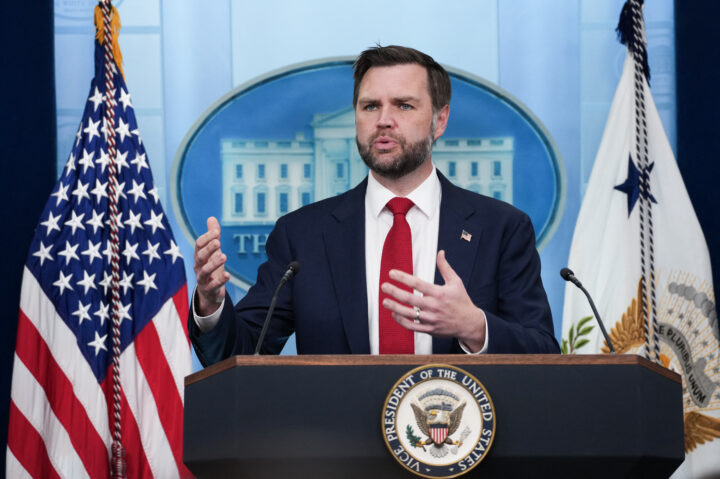
Ken Cedeno / AFP via Getty Images
US Vice President JD Vance speaks during a press briefing in the Brady Briefing Room of the White House in Washington, DC, on June 18, 2026.


 Add JewishInsider on Google
LAS VEGAS — The Republican Jewish Coalition’s annual leadership summit kicked off in the blazing heat of Las Vegas on Sunday, with a series of speeches by pro-Israel House members and Senate candidates, including Georgia GOP Senate nominee Mike Collins, North Carolina GOP Senate nominee Michael Whatley and senior GOP lawmakers including Reps. Jim Jordan (R-OH) and Lisa McClain (R-MI).
The program is set to continue on Monday with video remarks by President Donald Trump, House Speaker Mike Johnson (R-LA) and in-person speeches by other major Republicans in pro-Israel politics.
But the most anticipated remarks of the day will be one the public won’t be able to see, a closed-door appearance by Vice President JD Vance at a Monday night VIP gala. It will be Vance’s first address to the group as vice president.
Vance is facing what’s likely to be, at minimum, some skeptics in the crowd, given his relationship with antisemitic commentator Tucker Carlson — attendees at last year’s RJC conference brandished “TUCKER IS NOT MAGA” placards — his involvement in peace talks with Iran and his public criticisms of Israel.
The session will be a major test for the vice president in front of large GOP donors and national party activists ahead of his anticipated 2028 presidential run. Vance’s remarks could help soothe fears among pro-Israel Republicans, or they could further fuel their anxieties and prompt them to consider efforts to oppose his candidacy.
Three Jewish Republican House members who spoke to Jewish Insider on Sunday agreed that it’s a positive sign for both Vance and the RJC that he’s traveling to Las Vegas to make the address.
Rep. Randy Fine (R-FL), who acknowledged that he’s been critical of the vice president at times, told JI he’s “glad that he’s coming” and “interested to hear what he has to say,” adding that the vice president “has a big hill to climb coming into this room” but he hopes for the sake of the Republican Party that Vance is successful.
“He could make his problem better, he could make his problem worse. I have no idea what he’s going to say, but I do think it’s a good thing that he’s coming,” Fine continued. He said that Vance should address “his relationships with evil people, starting with Tucker Carlson … who’s clearly an insane Jew hater.”
Vance’s office did not immediately respond to a request for comment.
Rep. David Kustoff (R-TN) also said he’s “glad that the vice president is here, and I think that that speaks volumes.” He said he expects Vance will address the “strong relationship that the United States has enjoyed with Israel, and that it should continue, and that we need to do what we need to do to ensure that Iran does not get a nuclear weapon.”
Rep. Craig Goldman (R-TX) agreed it’s a good sign that the RJC is welcoming Vance, and predicted that many in the crowd will be surprised by the vice president. “He’s nothing but impressive, he’s smart as a whip and he knows the issues. And so I hope he’s very upfront. … I know he’s going to do a tremendous job, and he’s very direct and very honest. And I know he will be with the RJC as well.”
The keynote address, scheduled for Monday night, comes as some Jewish Republicans have been deeply skeptical of the vice president’s worldview
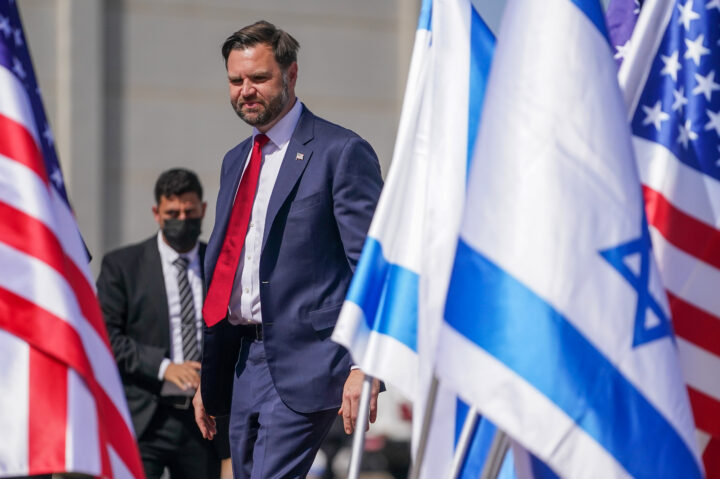
Vice President J.D. Vance arrives at Ben Gurion airport on October 21, 2025 in Tel Aviv, Israel (Photo by Nathan Howard - Pool/Getty Images)
Vice President JD Vance will appear at the Republican Jewish Coalition’s annual leadership summit in Las Vegas, Nevada, to deliver the keynote address at Monday night’s closed-door gala dinner for VIP attendees.
Vance’s address comes as Jewish and pro-Israel Republicans have expressed concern over his critical tone toward Israel and his association with far-right commentator Tucker Carlson, who has hosted numerous antisemitic guests on his podcast over the last two years.
The appearance will be Vance’s first at the RJC’s annual summit since entering public office. Vance attended the three-day confab as a guest in 2021 while running in the GOP primary for his former Senate seat, though he did not deliver remarks at that year’s gathering.
President Donald Trump will be delivering videotaped remarks at the gala dinner on Monday night. Several of the GOP’s top Senate recruits will also be in attendance, including former GOP Rep. Mike Rogers, who’s running against Democrat Abdul El-Sayed in the pivotal Michigan Senate contest. Rep. Mike Collins (R-GA), who’s running against Sen. Jon Ossoff (D-GA), will also be speaking.
The summit has evolved somewhat in recent years as rising antisemitism within the GOP caused intra-party fissures. Carlson’s decision to host neo-Nazi influencer Nick Fuentes for a friendly interview on his podcast in the days leading up to last year’s confab prompted the RJC to make fighting right-wing antisemitism a key focus of the summit, which has historically been centered around celebrating broad GOP support for a strong U.S.-Israel relationship and connecting Republican politicians and candidates with potential donors.
Signs saying “Tucker is not MAGA” were featured at last year’s 2025 summit.
While Vance has condemned antisemitism and argued that it has no place in the GOP, he has said he rejects the notion that Jew hatred is spreading in the conservative movement. He also dismissed the suggestion that the rise in anti-Israel sentiment in the Republican Party was the result of antisemitism.
He said after being heckled over Israel’s war in Gaza at a Turning Point USA event in April that “the humanitarian situation in Gaza was an absolute catastrophe” when Trump began his second term and defended the ceasefire brokered by the president. In a pivot from his tone two years prior, Vance instead criticized the Biden administration for failing to reach a deal to stop the fighting and declined to defend Israel’s conduct in Gaza.
Since the Iran war was launched six months ago, the vice president has led several rounds of direct peace talks with Iran while emphasizing publicly that the administration was looking for a peaceful end to the conflict. He has also largely defended the war in public by noting the efforts to end the conflict.
In June, he issued a scathing public rebuke of Israeli officials who have criticized Trump for approving the memorandum of understanding between the U.S. and Iran, during which he cautioned Israeli skeptics of the deal against “attacking the only powerful ally” it has left and urged them to “wake up and smell the reality of the situation that country is in.”
The new award will be given at the group’s yearly leadership summit in August

(Amir Levy/Getty Images)
US Senator Lindsey Graham (R-SC) attends a press conference on US-Israel relations on February 17, 2025 at the Kempinski Hotel in Tel Aviv, Israel.
Former Sen. Norm Coleman (R-MN), chairman of the Republican Jewish Coalition, announced on Tuesday evening that the RJC would award the inaugural Lindsey Graham Statesman Award at the group’s yearly leadership summit in August, which will be dedicated to the late South Carolina senator after his death earlier this month.
Coleman, a former colleague and longtime friend of Graham’s, made the comments at a virtual event organized by the Israeli-American Council to pay tribute to the late senator’s support for Israel and the Jewish people. The former Minnesota senator was one of several prominent Jewish and pro-Israel figures who gathered to honor Graham’s record of support for the Jewish community.
“To our Jewish community, Lindsey was more than an ally. He was family and he said so himself. Reflecting once on how our community had rallied around him, he put it simply, ‘We are family,’ and he meant it,” Coleman said. “At the RJC leadership summit taking place next month in Las Vegas, we will be dedicating the event in his memory and awarding the first annual Lindsey Graham Statesman Award.”
Coleman said that Graham’s sudden death was a loss for the Jewish community and for the U.S. as a whole, telling attendees, “Our hearts break because Lindsey had so much left to give. He was not finished. There were more fights he wanted to win, more people he wanted to lift up, more good he wanted to do. We were not ready to lose him.”
“Our community is diminished tonight. The United States is diminished tonight, but every one of us who knew Lindsey Graham is richer for it and better for it,” he said.
Attendees at the virtual gathering, which was hosted by IAC CEO Elan Carr, included Dr. Miriam Adelson, the philanthropist and Republican megadonor; Betsy Berns Korn, the former AIPAC president and chair of the Conference of Presidents of Major American Jewish Organizations; Jewish Federations of North America CEO Eric Fingerhut; American Jewish Committee (AJC) CEO Ted Deutch; Pastor John Hagee, the founder and chairman of Christians United for Israel; and Rabbi Levi Shemtov, the executive vice president of American Friends of Lubavitch (Chabad).
Ronen and Orna Neutra, the parents of slain Israeli American hostage Omer Neutra, made an unscheduled appearance to speak about Graham’s advocacy for their son and other hostages during their captivity in Gaza. Omer Neutra’s remains were taken by Hamas terrorists into Gaza and held there for more than two years after he was killed during Hamas’ Oct. 7, 2023, attacks on Israel.
“Our family came to know Sen. Graham shortly after Oct. 7, when our son, [IDF] Capt. Omer Neutra, was taken hostage,” Orna Neutra said. “From the earliest days of the crisis, Sen. Graham was one of the strongest and most consistent voices in the Senate supporting Israel and calling for the hostages to be released. He spoke clearly about Iran’s role in supporting Hamas and argued that Hamas could not remain in power after the war.”
“Whenever we asked to meet, [Graham] made himself available,” she continued. “He was straightforward and matter of fact. He never told us what we wanted to hear, only what he believed. He offered no false hope. He listened carefully. He asked thoughtful questions, and he treated our concerns with seriousness and respect.”
Orna Neutra recounted a meeting Graham had with several hostage families where he told them, “I wish you were all my constituents. I wish you were all from South Carolina.” She explained that Graham was suggesting “that he wished he could do even more for each and every one of us personally.”
Berns Korn similarly praised Graham for his allyship with the Jewish people and remarked how she would accidentally cross paths with the South Carolina senator almost every time they separately visited the Israeli prime minister’s office.
“To me, to the conference, to the Jewish community, and to the people of Israel, Sen. Graham was more than an ally. He was a true friend,” Berns Korn said. “Friends like Lindsey Graham come along once in a generation.”
“You’d make the long trip, race through the schedule, thinking we’re moving fast, and somehow Lindsey and his staff [were] already there, already briefed, already asking the next question, and already formulating a strategy,” she continued. “That was Lindsey. He was present. He was engaged. He listened carefully and moved with purpose. He built trust with Israeli leaders and American Jewish organizations. He built coalitions across the aisle and developed relationships with communities who valued his wise counsel, judgment, and his leadership.”
Shemtov noted that Norm Brownstein, the veteran Washington lobbyist, was a mutual friend of his and Graham’s, and said that Brownstein “would often tell me that the one thing about Lindsey Graham was that he had a genuine friendship with the Jewish people and a genuine concern for the needs of the Jewish people and for the needs that Israel had, whatever they were, and he always would reiterate that not only in words but in practice.”
“Within darkness, within negativity, there is always the latent opposite. So, as we see dark forces in the political world that are beginning to emerge and expand, sadly, let us not forget the bright ones we’ve been fortunate to know, people like Sen. Lindsey Graham,” Shemtov said. “The Jewish people have survived for millennia through strong faith in God, and through the many agents and messengers that God sent from outside the Jewish community to be our friends, our supporters, and those who reinforced us.”
Deutch, who served in Congress from 2010-2022 as a Democrat, recounted his first experience traveling with Graham after being elected to the House, joining Graham’s delegation to the Munich Security Conference at the invitation of the late Sen. Joe Lieberman (I-CT). Deutch praised Graham for his emphasis on bipartisanship while on the international stage.
“Lindsey always understood why it was so important for us to do that together,” Deutch said in a prerecorded address. “When I think about what we’ll miss about him, the way that he stood up for American leadership, understanding that especially how much that leadership was strengthened when we did it together as Americans, Democrats and Republicans standing together, that’s the way that I’m going to remember him.”
The AJC CEO urged attendees “to think about that and reflect upon that in the way that we go about our work, whether we work in the Jewish world, we work in the government or diplomatic world or whether we’re just American citizens who are thinking about how to make the country better for all of us.”
Fingerhut praised Graham for understanding that, “In times of evil, indifference to evil is evil. Neutrality always helps the killer, not the victim.”
“Lindsey Graham always took seriously all those who threaten other people. Lindsey Graham always took seriously all those who threatened the Jewish people,” Fingerhut said. “Lindsey Graham understood the dangers of indifference and neutrality, and Lindsey Graham understood that neutrality helps the killer, not the victim. Lindsey Graham was not neutral. He took sides. He was not indifferent. He was passionate and committed and relentless.”
In Coleman’s remarks, the RJC chairman highlighted Graham’s close friendships with Adelson and her late husband, Sheldon, telling the audience that, “They were always talking. When he [Graham] went into battle, he was comforted by knowing that they would be with him.”
For her part, Adelson spoke of the friendship that she and her late husband, the billionaire casino mogul, shared with Graham over more than three decades, reminiscing about the South Carolina senator’s aversion to gambling and his daily phone calls with her spouse.
“We met Lindsey and — as a physician, I love to see the brain, the eyes are [the window into] our brain — they were so pure and blue. You could see what he was thinking about. He was so honest, with integrity, and Sheldon and me fell in love with him.”
Adelson said that her late husband’s longtime secretary told her that “there was not a day that” Sheldon did not “talk with Lindsey.”
“They talked about Israel,” Adelson said. “Lindsey gave him advice. Sheldon gave him advice, and they had fun.”
She shared that Graham had once opted to meet tourists in the Adelsons’ Las Vegas Sands property rather than gamble in the VIP room alongside the late Sen. John McCain (R-AZ), who had accompanied Graham to visit the couple.
“Instead of playing, he was meeting people,” Adelson said of Graham. “Lindsey loved people, and they loved him from the left, from the right. He was a fantastic person.”
Adelson said that Graham and her late husband were similar in their steadfast commitment to their families, comparing Sheldon Adelson supporting his first wife’s three children from a previous marriage to the late senator adopting his younger sister, Sen. Darline Graham (R-SC) after their parents died. Adelson said she hoped to meet Graham’s sister, who was appointed to serve out the remainder of her brother’s term last week and has since announced plans to run for a full term, for dinner in Washington, D.C., in the near future and urged her to “choose life and success” in her new role.
“Know that so many people loved your brother and admired him,” Adelson said before acknowledging that she was tearing up. “He is a good man. Inside the heart, he is such a good man, and I want to tell you, Darline … that I really admired and loved your brother. I miss him.”
JDCA’s top activists made clear this week that a major concern is making sure pro-Israel Jews continue to be welcome in the party
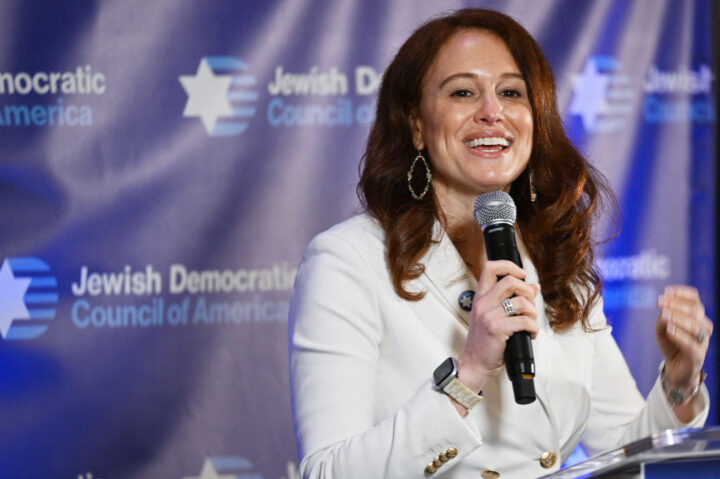
MANDEL NGAN/AFP via Getty Images
Jewish Democratic Council of America CEO Halie Soifer in Washington on May 24, 2023.
When a group of Jewish Democratic activists and donors convened in Washington this week for the annual leadership summit of the Jewish Democratic Council of America, the message seemed to be one of defiance: defiance against President Donald Trump, to be sure, but also a defiant attitude pushing back against some of the recent shifts within the party.
JDCA’s primary objective is to elect Democrats. But as more Democrats have taken positions critical of or outright hostile to Israel, JDCA’s top activists made clear this week that another major concern is making sure pro-Israel Jews continue to be welcome in the party.
“We are fighting to ensure that the views and values of Jewish Americans continue to find their political home in the Democratic Party in Michigan and beyond, and we have work to do,” Halie Soifer, the group’s CEO, said on Tuesday night. She noted that the JDCA hopes to help defeat Michigan Senate candidate Abdul El-Sayed, a far-left candidate who appears to be rising in the polls.
“It’s clear there’s one candidate whose views are antithetical to ours, and we want to ensure he’s defeated,” said Soifer, though she did not name El-Sayed directly. JDCA has not endorsed either of his opponents, state Sen. Mallory McMorrow or Rep. Haley Stevens (D-MI).
“We at JDCA only support Democrats, but we do not support them all,” Soifer told the summit. “We understand it’s not just about electing Democrats. It’s about electing Democrats who align with us, and this includes efforts to ensure that candidates who have espoused anti-Israel and/or antisemitic views are defeated before November.”
Over the two-day gathering, a parade of high-profile speakers from Democratic leadership — Senate Minority Leader Chuck Schumer (D-NY) and House Minority Leader Hakeem Jeffries (D-NY), along with Reps. Nancy Pelosi (D-CA) and Steny Hoyer (D-MD), respectively the former House speaker and majority leader — addressed the convening. Their appearances seemed designed to affirm that Democrats remain pro-Israel and committed to fighting antisemitism.
“We have to decisively confront antisemitism from wherever it comes from,” said Jeffries. “I will always hold firm in my support for the State of Israel as a Jewish and democratic state and eternal homeland for the Jewish people.”
Schumer did not specifically discuss Israel but raised concerns about the increasing use of the word “Zionist” as a slur.
“I’ve long said we must fight antisemitism wherever and whenever it appears, even if it’s in our own party. I’ll continue to do so,” said Schumer. “Today, antisemitism takes all different forms: Holocaust denialism, conspiratorial delusions of Jewish or Zionist control of the world, replacing the word ‘Jewish’ with the word ‘Zionist’ to demonize Jewish communities.”
The outgoing Democratic leaders were not as sanguine, instead offering a note of caution about how the dynamic towards Israel has shifted within the Democratic Party.
“Always, but right now, we really have to work together to make sure that support for Israel is, without question, bipartisan,” Pelosi said. “It doesn’t mean we don’t have our differences of opinion … but it should not weaken the fact that we have bipartisan support. That has always been the tradition, and we must make sure we get through this place where we are, where there may be some doubt in people’s minds as to whether that is a value.”
Pelosi is retiring at the end of this year, as is Hoyer, who was even more blunt: “How many of you have been anxious yourselves about rhetoric heard from some Democratic officials and candidates? We ought to be,” he said.
Speaking to reporters on Wednesday, Sen. Chris Coons (D-DE) said he hoped to prove that Sen. Bernie Sanders (I-VT) does not speak for the party on matters related to Israel, though he noted with worry that Sanders’ attitude — one that is deeply critical of Israel — appears to be on the rise.
“It’s clearer and clearer to me that there is real alarm about a fundamental break between Democrats as a party and Israel as a nation, and I’m going to do everything I can to resist and oppose that break, while criticizing [Benjamin] Netanyahu and his values and decisions,” said Coons. “I’m trying to be an effective and engaged voice with a perspective that you just heard and not have Bernie Sanders be the only senator whose perspective and attitude is heard across the country.”
Forty Senate Democrats voted last month for a Sanders-authored resolution attempting to block some arms sales to Israel, a record high. Coons said he knows those senators still support Israel’s right to exist, but cautioned that being too critical of Netanyahu can give cover to people who are actually anti-Israel.
“I strongly support Israel’s right to exist, its right to be a Jewish homeland and a democracy, and its value to the American people as a partner and ally,” said Coons. “I think we are at risk of some of my colleagues, in trying to send a message to Netanyahu or in opposition to his policies and stances, to be misunderstood as abandoning that commitment.”
Coons said that on the campaign trail, and on recent trips around the country, he hears “profound concern about where’s the Democratic Party going on Israel.” Some Jewish politicians who addressed the JDCA summit expressed a deeper sense of unease and discomfort about their Jewish identity, against the backdrop of rising antisemitism.
Sen. Elissa Slotkin (D-MI), who spoke at a cocktail reception Tuesday evening, talked about how challenging it is to be a Jewish elected official in the current environment.
“It has become deeply, deeply complicated to be a Jew in America,” said Slotkin. “There’s not a single day that goes by for myself representing the state of Michigan that I am not feeling torn.”
Minneapolis Mayor Jacob Frey delivered a jolt of energy to the room with an impassioned speech about his community’s support for immigrants in the face of ICE enforcement activity, which resulted in the killing of two American citizens by ICE agents in his city in January. When a JDCA member asked him for advice on how to respond to others in the Democratic Party who have made anti-Zionism a political litmus test, he expressed concern.
“It has been deeply concerning for me personally, as a proud Jew,” Frey said. “I am a great supporter of the endurance of our American Republic, a big believer that America should continue to exist, and an adamant opponent of Donald Trump. The same thing can apply to Israel.”
Ultimately, though, the gathering was a political pep rally — a chance for Democratic activists and donors to hear from politicians at all levels of government and gin up excitement ahead of this year’s midterm elections. Everyone who addressed the gathering all but guaranteed that Democrats would take back control of the House and Senate.
The conversations seemed meant to ressure Jewish Democrats about both the party’s fortunes for November and its treatment of pro-Israel Jews. One JDCA activist described the group’s work as “grasstops,” which was demonstrated by the appearances from top party leaders.
But the anti-Israel sentiment that has steadily grown within the party over the past three years is not coming from party leaders; it is driven by far-left activists. Whether JDCA has a plan to counter that grassroots energy remains to be seen — and the answer will only come at the ballot box later this year.
Plus, partisan redistricting endangers pro-Israel lawmakers
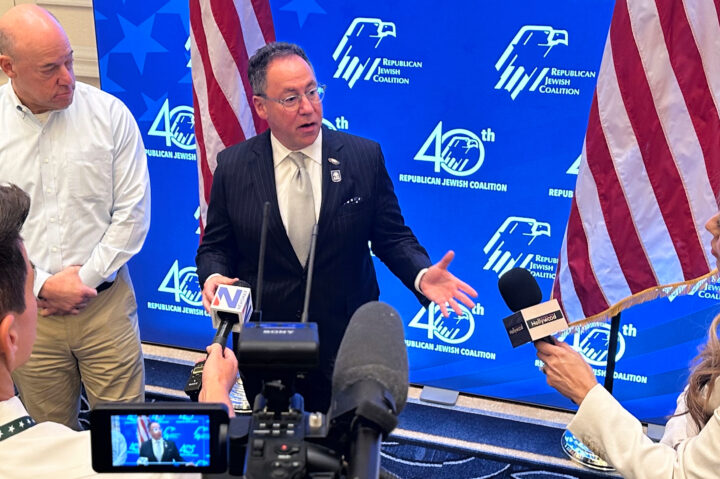
Republican Jewish Coalition CEO Matt Brooks, center, alongside Ari Fleischer, an RJC board member and press secretary to former President George W. Bush, answers questions from members of the news media about confronting antisemitism within the Republican Party, during the coalition's annual conference at the Venetian Resort in Las Vegas, Saturday, Nov. 1, 2025. (AP/Thomas Beaumont)
Good Monday morning!
In today’s Daily Kickoff, we report from the Republican Jewish Coalition’s annual leadership summit in Las Vegas, and look at how mid-decade redistricting efforts in a handful of states could affect pro-Israel legislators. We report on newly obtained audio of Maine Senate candidate Graham Platner expounding on his Israel views, and cover the arrest of Israel’s former military advocate-general, who resigned from her position last week. Also in today’s Daily Kickoff: Michael Eisenberg, Sylvan Adams and Gordon Gee.
Today’s Daily Kickoff was curated by Jewish Insider Executive Editor Melissa Weiss and Israel Editor Tamara Zieve, with assists from Danielle Cohen-Kanik and Marc Rod. Have a tip? Email us here.
What We’re Watching
- The Foundation for Defense of Democracies is hosting a virtual event with former Israeli Defense Minister Benny Gantz on his vision for the future of Israel’s security and relationships around the world.
- The Anti-Defamation League is hosting its annual real estate reception in New York City. This year’s event will honor Feil Organization CFO Eric Lowenstein.
- Elsewhere in New York, Birthright Israel is holding its annual gala tonight. Actor Jonah Platt is slated to emcee the evening’s events, which will honor Lynn Schusterman.
- In Israel, the annual Christian Media Summit kicked off last night in Jerusalem.
What You Should Know
A QUICK WORD WITH JI’S MATTHEW KASSEL
LAS VEGAS — Until last week, the Republican Jewish Coalition’s annual leadership summit was expected to be a triumphant gathering to celebrate President Donald Trump’s accomplishments in the Middle East, chief among them his administration’s recently brokered ceasefire deal between Israel and Hamas, Jewish Insider‘s Matthew Kassel reports.
That all changed after Tucker Carlson hosted the neo-Nazi influencer Nick Fuentes on his podcast for a sympathetic interview, provoking fierce backlash. By the time that Kevin Roberts, the president of the Heritage Foundation, came to Carlson’s defense on Thursday, the RJC recognized its conference would require a thematic update to more forcefully emphasize the urgency of confronting rising antisemitism — and its enablers — within the GOP.
“If there was ever a time for the RJC, this is our time,” Norm Coleman, the organization’s national chairman, said in opening remarks on Friday. “We have been called to this moment to fight the scourge of antisemitism.”
But even as multiple speakers at the three-day summit held at the Venetian Resort — including congressional leaders, conservative activists and media personalities — alluded to antisemitism in their ranks, many talked in broad strokes, didn’t mention Carlson by name or downplayed the issue as confined to the fringes, despite Carlson and Fuentes each commanding a significant number of dedicated followers on the far right.
SPEAKING UP
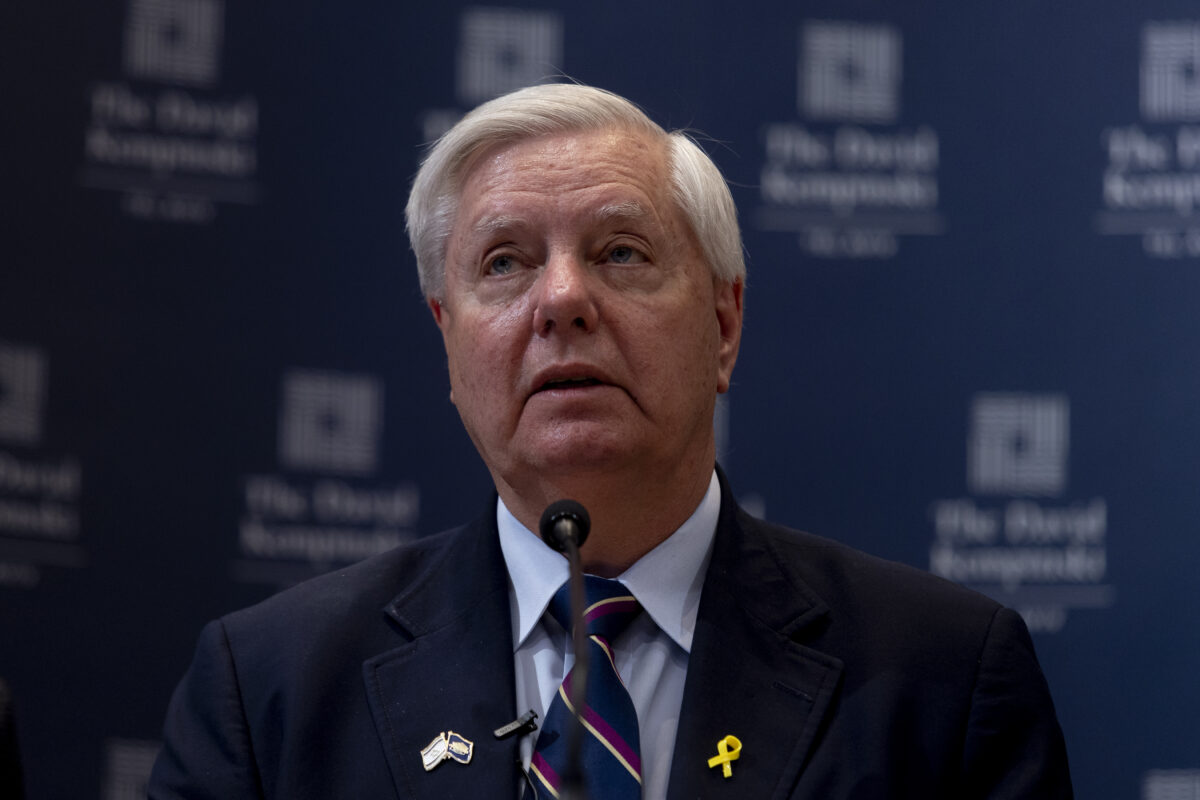
Sen. Lindsey Graham (R-SC) spoke out against Tucker Carlson for giving a friendly platform to Nick Fuentes, the neo-Nazi influencer, on his podcast this week, calling it “a wake-up call” for the Republican Party as it grapples with rising antisemitism within its ranks. “How many times does he have to play footsie with this antisemitic view of the Jewish people and Israel until you figure out that’s what he believes?” Graham said of Carlson in an interview with Jewish Insider’s Matthew Kassel on Friday on the sidelines of the Republican Jewish Coalition’s annual leadership summit at the Venetian Resort.
‘Niche market:’ Graham said that “antisemitism has been with us, and it’ll always be with us, and the goal is to limit it, fight back and contain it. I am confident that if anybody in the Republican world ran for office as a member of Congress, for the Senate or any major elected office and spouted this garbage, it would get creamed,” Graham told JI. “This is a niche market. It won’t sell to a wider audience.”
Drawing a red line: Rep. Randy Fine (R-FL) called Tucker Carlson “the most dangerous antisemite in America” in remarks on Saturday at the conference, in what was an unusually direct rebuke of the far-right commentator who is facing backlash over his recent friendly interview with the neo-Nazi influencer Nick Fuentes, Jewish Insider’s Matthew Kassel reports.
OUT OF BOUNDS
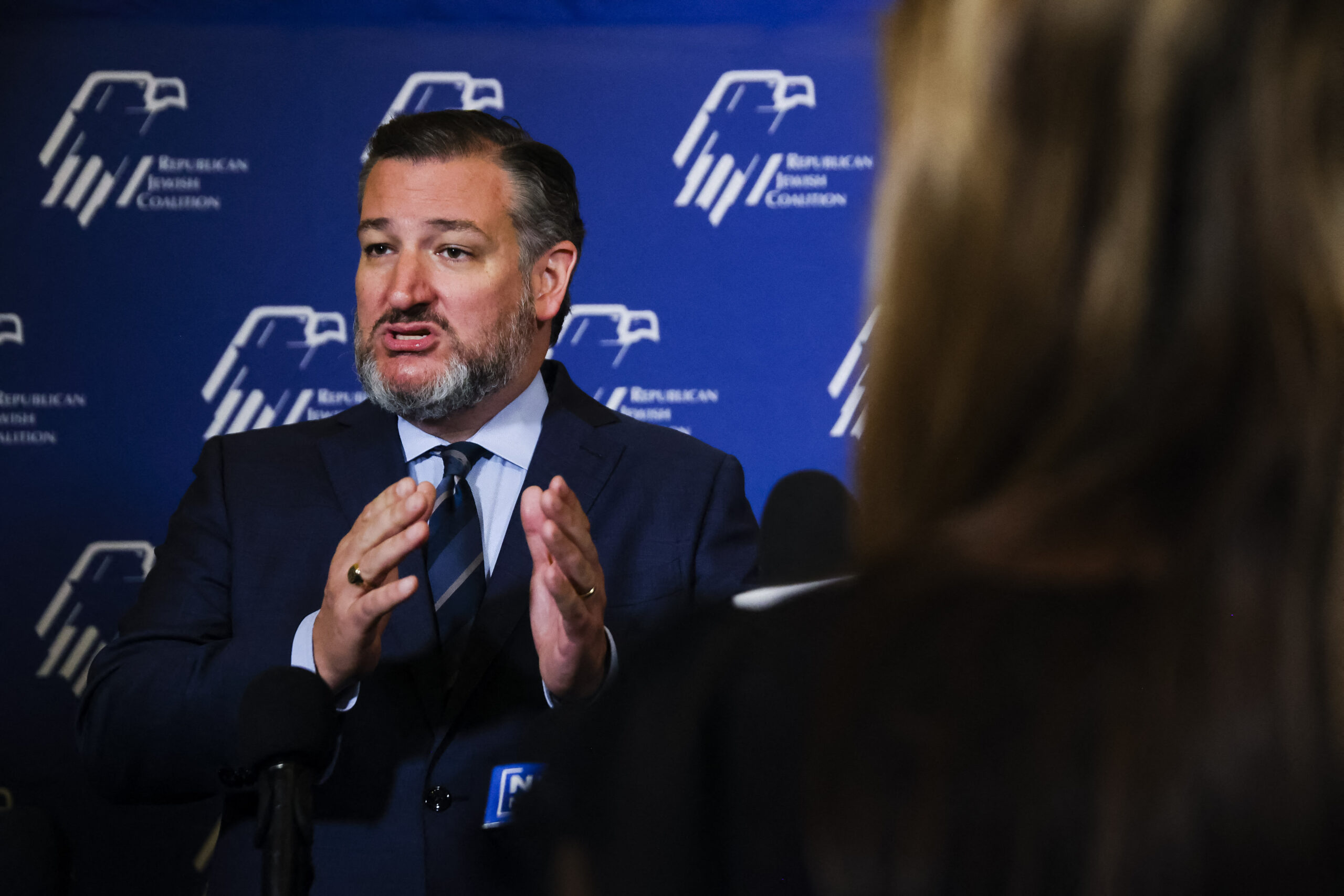
Sen. Ted Cruz (R-TX) criticized Republicans who refuse to disavow prominent antisemites in the conservative movement as “cowards” after the Heritage Foundation and its president, Kevin Roberts, defended Tucker Carlson and his friendly interview with neo-Nazi influencer Nick Fuentes. Cruz warned during a half-hour address at the opening of the Republican Jewish Coalition’s annual summit in Las Vegas on Thursday evening that young Christians were turning away from supporting Israel, something he argued was the result of pro-Israel Christians being maligned by leading voices in the America First movement, Jewish Insider’s Emily Jacobs reports.
Cruz’s comments: The Texas Republican senator did not mention the Heritage Foundation, Roberts, Carlson or Fuentes by name, though he accused anyone who uncritically promotes Adolf Hitler of being “complicit” in spreading virulent antisemitism. Fuentes has praised Hitler on multiple occasions; in his statement, Roberts said he “disagree[s] with” some of Fuentes’ views, “but canceling him is not the answer.” “The last year, we’ve seen three prominent people on the right publicly muse, ‘Gosh, maybe Hitler’s not all that bad.’ No. He is the embodiment of evil, a grotesque bigot. And if you’re confused by that, you’re an imbecile,” Cruz said on Thursday. “Too many people are scared to confront them. I want to ask you, how many elected Republicans do you see standing up and calling this out? How many do you see willing to take on the voices in the anti-Israel right?”
Bonus: Following Roberts’ comments last week, Heritage’s chief of staff, Ryan Neuhaus, was reassigned to serve as a senior advisor, while the think tank’s executive vice president, Derrick Morgan, was moved into the chief of staff role on an interim basis through the end of the year.
PLATNER’S POSITION
Like many progressives now running for Congress, Graham Platner, a Democratic Senate candidate in Maine, has made opposition to Israel a central part of his messaging. But more so than many candidates, the political newcomer seems particularly invested in engaging on Middle East policy. In a private conversation with attendees of an August fundraiser in Maine, Platner defended his stances on Israel and shared previously undisclosed details about his personal ties to the region, according to audio of the discussion, recently shared with Jewish Insider’s Matthew Kassel.
What he said: While he said he agreed that Hamas is a terrorist organization, Platner claimed that Israeli Prime Minister Benjamin Netanyahu had “publicly stated that” Israel was “funding Hamas to make sure that there was going to be no non-radical leadership within Gaza in order to keep a Palestinian state from happening.” While members of Netanyahu’s coalition have made this argument, the prime minister has never personally made such a claim. New York Times reporting from shortly after the Oct. 7 attacks alleged that the Israeli prime minister had allowed the Qatari government to send money into the Gaza Strip for several years in order to “maintain peace in Gaza.”
Family ties: In the conversation, which took place before controversy ensnared his campaign, Platner noted his stepbrother is Seth Frantzman, an Israeli author, journalist and security analyst who has long worked for for The Jerusalem Post and lives in Jerusalem, saying they are “very close,” according to the audio.
Bonus: Platner’s finance director became the latest campaign departure last week, following the exits last month of Platner’s campaign manager and political director. Ronald Holmes said in a LinkedIn post that he “began to feel that my professional standards as a campaign professional no longer fully aligned with those of the campaign.”
MAPPING MOVES
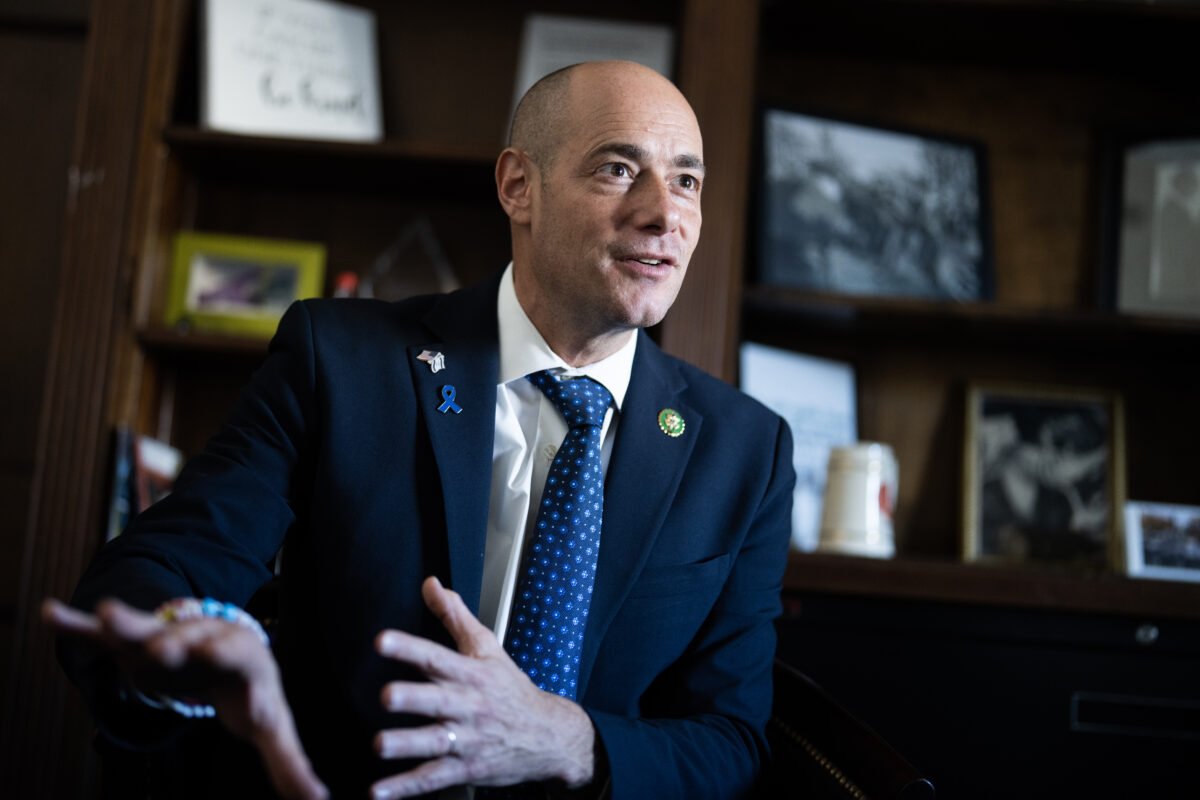
Triggered by President Donald Trump’s efforts to gain a partisan edge in the 2026 midterm elections, a cascade of states is undertaking unusual mid-decade redistricting efforts, in what has become a growing race between Democrats and Republicans to shore up incumbents, knock out lawmakers from the opposing party and create more-winnable seats. On both sides of the aisle, the efforts could endanger a number of vocal pro-Israel incumbents, Jewish Insider’s Marc Rod reports.
Who’s in danger: The districts of Reps. Greg Landsman (D-OH) and Don Davis (D-NC) have been redrawn to be less favorable to the incumbents, and in Florida, Republicans are considering efforts to pack Democratic voters into a smaller number of districts, potentially endangering several pro-Israel incumbents including Reps. Debbie Wasserman Schultz, Jared Moskowitz and Darren Soto. On the Republican side, a series of GOP lawmakers in California with strong records on Israel and antisemitism could be impacted by the redistricting push, including Rep. Ken Calvert — who chairs the Appropriations subcommittee on defense funding — as well as Reps. Darrell Issa, Kevin Kiley, Doug LaMalfa and David Valadao.
LEGAL TROUBLES

Former IDF Advocate-General Yifat Tomer-Yerushalmi was arrested on Sunday evening, reportedly on grounds of obstruction of an investigation, after disappearing and leaving behind a note raising concerns of a potential suicide. The arrest came two days after she resigned her post following a determination by police that she had leaked sensitive materials showing alleged abuse of a Palestinian detainee at Israel’s Sde Teiman prison to the media, Jewish Insider’s Lahav Harkov reports.
Chain of events: Police found Tomer-Yerushalmi’s car at a beach north of Tel Aviv, hours after relatives reported that she was missing. According to Israeli media, she had left a note to her family telling them, “don’t look back.” The ensuing manhunt involved police, the Israeli Navy, drones with geothermal detection and more. Tomer-Yerushalmi was arrested after police found her safe, but without her phone, which had last been tracked near her car and then turned off. The disappearance of the phone raised police officers’ concern that she had possibly staged a suicide attempt to cover up the destruction of evidence caused by the disposal of her phone, Ynet reported. National Security Minister Itamar Ben-Gvir said on Monday that Tomer-Yerushalmi remains on suicide watch in jail.
UNIVERSITY INSIGHTS
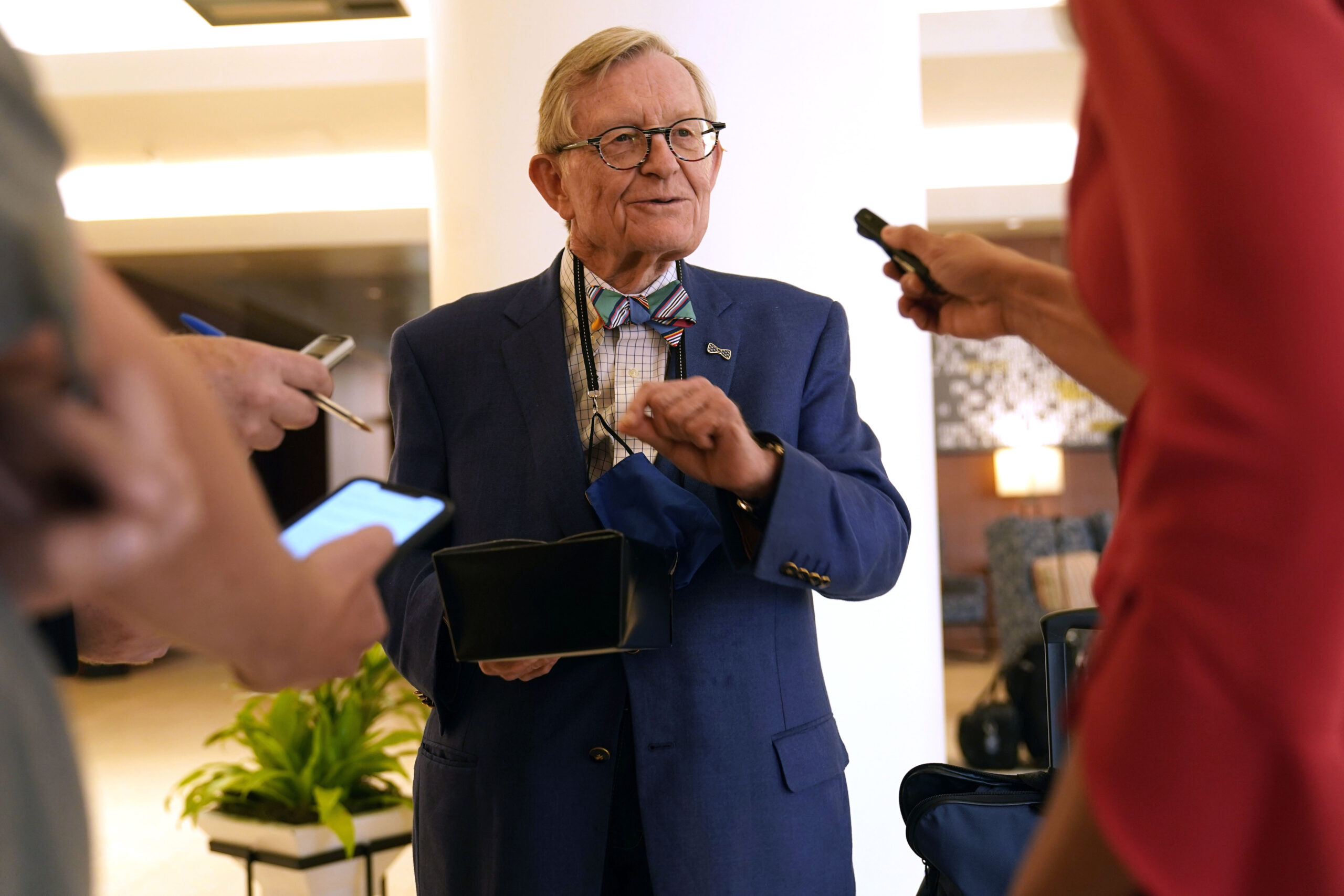
Gordon Gee has served as president of more American universities than almost anyone, as far as he knows. Most recently he led West Virginia University, from which he retired in July; before that, he oversaw Ohio State, Vanderbilt, Brown and the University of Colorado over a span of 45 years. In an interview with Jewish Insider’s Gabby Deutch last week, Gee, 81, looked back on his career and reflected on the state of academia, noting a growing chasm between what he described as two different kinds of universities: those like Vanderbilt, that have held firm to the principles of institutional neutrality, and those like his alma mater, Columbia University, that have struggled to take an impartial stance in response to campus protests and antisemitism — and that are wary of making significant change.
Fear factor: “The biggest challenge facing university presidents is fear,” said Gee. “I think the university presidents, in many ways, are paralyzed, and a lot of it is brought on by themselves, because of the fact that they allowed themselves to become kind of engaged in this ‘go along, get along’ response, and now all of a sudden, when they discover that they’ve got to take a stand, it’s becoming very difficult for many of them.”
Bonus: In The Atlantic, University of Chicago law professor Aziz Huq suggests that the Trump administration’s recent offer to prioritize federal funding for schools that agree to a series of dictates from the government provides universities that don’t agree to the compact with new opportunities, noting that “[w]ithdrawal from the embrace of the federal government, while painful, also is a chance to confront some latent, long-simmering weaknesses of the existing higher-education model.”
Worthy Reads
Roberts’ Rules of Disorder: The Wall Street Journal’s editorial board weighs in on Heritage Foundation CEO Kevin Roberts’ response to recent antisemitic comments by far-right commentators Tucker Carlson and Nick Fuentes. “Amid criticism on Friday, Mr. Roberts scrambled to list Mr. Fuentes’s odiousness, but his initial contribution was to join in the Jew-baiting. His video framed the issue not as antisemitism, but as Christian freedom of conscience in the face of a hostile attempt to impose loyalty to Israel on Americans. … If conservatives — and Republicans — don’t call out this poison in their own ranks before it corrupts more young minds, the right and America are entering dangerous territory.” [WSJ]
Boycotting The Times: The Atlantic’s Jonathan Chait reflects on a push by anti-Israel figures to refuse to submit future op-eds to The New York Times over the paper’s perceived bias toward Israel. “But the extent to which these writers object to the sword depends on who is wielding it. The letter’s demands come from a coalition of nine groups, three of which have declined to condemn Hamas for the October 7 attack, while six — the U.S. Palestinian Community Network, the Palestinian Feminist Collective, the Palestine Solidarity Working Group, the Palestinian Youth Movement, Pal-Awda, and National Students for Justice in Palestine — rationalized or directly endorsed the massacre.” [TheAtlantic]
Fear of Mamdani: In the Jewish News Syndicate, William Daroff and Betsy Berns Korn, respectively the CEO and chair of the Conference of Presidents of Major American Jewish Organizations, raise concerns about New York City mayoral front-runner Zohran Mamdami over what they describe as his demonstrated “hostility toward the concerns of the Jewish community and contempt for the broader public interest” ahead of tomorrow’s election. “What begins as a debate about policy too often becomes a campaign of hostility toward Jews. In this context, any candidate who fails to condemn terrorists who burned families alive, abducted civilians, and committed rape and other war crimes, as Hamas and other Palestinian terrorists did in southern Israel on Oct. 7, 2023, forfeits the moral right to seek public office.” [JNS]
PA Still Key: In the National Interest, David Makovsky and Shira Efron posit that the Palestinian Authority Security Forces could serve as an “imperfect but plausible” option on the ground in postwar Gaza. “Despite their shortcomings, these forces have over three decades of experience in security coordination with the IDF in the West Bank. … The PA today is like a car without wheels: it cannot drive Gaza out of the post-October 7 morass. But wheels can be added — reforms that build credibility, training that professionalizes the PA’s security forces, and service delivery that tangibly improves daily life for suffering Gazans. With each milestone, the PA gains a larger role, international donors gain confidence, Israel gains a more stable frontier, Gazans gain a path out of limbo, and Palestinians everywhere regain agency that could help establish a political horizon.” [NationalInterest]
Word on the Street
In a wide-ranging CBS “60 Minutes” interview that aired Sunday night, President Donald Trump described the ceasefire between Israel and Hamas as being “very solid”; Trump also said that the U.S. would be “involved” in Israeli Prime Minister Benjamin Netanyahu’s corruption trial, two weeks after the president, speaking at the Knesset, called on Israeli President Isaac Herzog to pardon Netanyahu…
Netanyahu said on Sunday that Israel would “act as necessary” if Lebanon does not move to fully disarm Hezbollah, amid concerns that the Iran-backed terror group is rearming in defiance of the ceasefire inked last year…
Amos Hochstein, who served as a senior official in the Biden administration overseeing the Lebanon portfolio, cautioned that Israel’s muscular approach to Hezbollah in Lebanon could be “counterproductive” and that Beirut is “in a really tough spot” as it works to shore up international support…
Israeli Energy Minister Eli Cohen said his U.S. counterpart, Energy Secretary Chris Wright, canceled a planned trip to Israel following Jerusalem’s decision to hit pause on a $35 billion gas agreement with Egypt that would be the biggest gas deal in Israel’s history…
Video from a May 2024 city council meeting in Hamtramck, Mich., that was recently viewed by local media showed Mayor Amer Ghalib, the Trump administration’s nominee to be U.S. ambassador to Kuwait, voicing support for the council’s passage of a boycott, divestment and sanctions resolution targeting Israel; Ghalib told members of the Senate Foreign Relations Committee that he had not supported the resolution…
The Diocese of Harrisburg, Pa., condemned and apologized for a Halloween float representing a local Catholic school that included a replica of the front gates of Auschwitz with the words “Arbeit Macht Frei”…
The Wall Street Journal spotlights Palantir’s new “Meritocracy Fellowship” in which 22 high school graduates spend four months at the company in lieu of pursuing a traditional college track…
A spokesperson for Zohran Mamdani said that the New York City Democratic mayoral candidate, if elected, would reassess the partnership between the Roosevelt Island campus of Cornell University and Israel’s Technion…
Former U.K. Labour party leader Jeremy Corbyn, who was ousted from the party’s leadership over a series of antisemitism incidents, phone-banked for Mamdani over the weekend…
A London bus driver was suspended after refusing to return a dropped bank card to a visibly Jewish man and hurling antisemitic insults at the passenger for an hour until police arrived…
A French court sentenced four Bulgarian men to prison terms ranging between two and four years over the vandalism last year of Paris’ Holocaust memorial…
The bodies of three Israelis were repatriated to Israel and identified overnight as dual American Israeli citizen Capt. Omer Neutra, Col. Asaf Hamami and Staff Sgt. Oz Daniel; the exchange came a day after Israeli forensics determined that three bodies given to Israel by Hamas on Friday evening did not belong to any of the remaining hostages…
Israel announced a series of tax benefits aimed at luring Israeli high-tech workers abroad back to the country amid an exodus that followed the Oct. 7, 2023, attacks and ensuing war…
Canadian Israeli philanthropist Sylvan Adams committed $100 million to help rebuild the Soroka Medical Center in Beersheva, Israel, which sustained significant damage during the 12-day war between Israel and Iran in June, eJewishPhilanthropy’s Judah Ari Gross reports…
Omani Foreign Minister Badr Albusaidi told attendees at the IISS Manama Dialogue in Bahrain over the weekend that Gulf countries should reverse course on their isolation of Iran and deepen diplomatic, economic and security cooperation with Tehran…
Iranian President Masoud Pezeshkian said that Iran would rebuild its nuclear facilities with “greater strength,” while denying that the country is seeking nuclear weapons…
The New York Times published a belated obituary for World War II partisan fighter and poet Hannah Senesh as part of the paper’s “Overlooked No More” series; Senesh was executed at age 23 after being captured by the Nazis in 1944…
Dutch-Jewish resistance member Selma van de Perre, who forged and delivered documents and helped Jewish families seeking shelter, died at 103…
Pic of the Day

Israeli Prime Minister Benjamin Netanyahu met in Jerusalem over the weekend with Aryeh Lightstone, who is serving as a senior advisor to White House Special Envoy Steve Witkoff; White House senior advisor Josh Gruenbaum and venture capitalist Michael Eisenberg, who is working with the U.S. team overseeing ceasefire efforts.
Birthdays
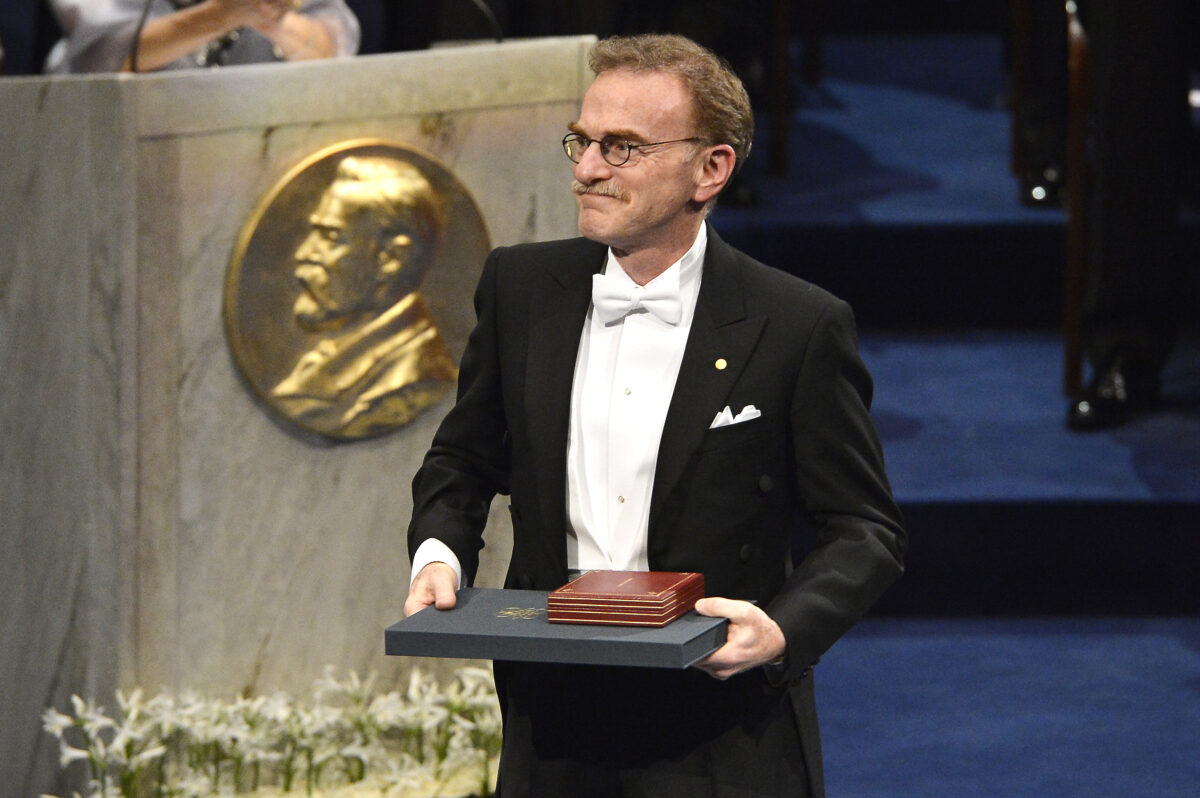
Winner of the 2013 Nobel Prize in medicine, professor at Yale University, James Rothman turns 75…
Chancellor emeritus of The Jewish Theological Seminary where he also served as a professor of Jewish history, Ismar Schorsch, Ph.D. turns 90… Senior U.S. District Court judge in California, he is the younger brother of retired SCOTUS Justice Stephen Breyer, Judge Charles Breyer turns 84… U.S. senator (D-HI), Mazie K. Hirono turns 78… Resident of Great Barrington, Mass., and a part-time researcher at UC Berkeley, Barbara Zheutlin… Rabbi emeritus at Temple Anshe Sholom in Olympia Fields, Ill., Paul Caplan turns 73… Actress, comedian, writer and television producer, best known for the long-running and award-winning television sitcom “Roseanne,” Roseanne Barr turns 73… Comedian, talk show host, political and sports commentator, Dennis Miller turns 72… Manuscript editor and lecturer, author of books on the stigma of childlessness and on the Balfour Declaration, Elliot Jager turns 71… Award-winning Israeli photographer whose works have appeared in galleries in many countries, Naomi Leshem turns 62… Regional director of development for The Washington Institute for Near East Policy, Jeanne Epstein… Podcaster and clinical professor of marketing at the New York University Stern School of Business, Scott Galloway turns 61… Co-founder and former CEO of Blizzard Entertainment, now CEO of Dreamhaven, Michael Morhaime turns 58… Entrepreneur-in-residence at Loeb Enterprises, he was previously co-chair of the board of the Yeshiva University Museum, Edward Stelzer… VP for federal affairs at CVS Health, she was the White House director of legislative affairs in the last year of the Obama administration, Amy Rosenbaum turns 54… Director of development for States United Democracy Center, Amie Kershner… Partner at political consulting firm GDA Wins, Gabby Adler… Agent at Creative Artists Agency, Rachel Elizabeth Adler… Actress who won three Daytime Emmy Awards for her role on “ABC’s General Hospital,” Julie Berman turns 42… Director of corporate responsibility, communications and engagement at Southern Company Gas, Robin Levy Gray… Senior managing director at Guggenheim Securities, Rowan Morris… General manager of NJ/NY Gotham FC, a women’s soccer team based in Harrison, N.J., Yael Averbuch West turns 39… Former captain in the U.S. Marine Corps, he is a co-founder of D.C.-based Compass Coffee, Michael Haft turns 39… New York state senator, Michelle Hinchey turns 38… Deputy coordinator for global China affairs at the U.S. Department of State, Julian Baird Gewirtz turns 36… Recent MBA graduate at The Wharton School, Ben Kirshner turns 33… Marketing manager at American Express, Caroline Michelman turns 33… Founder and CEO of Noyse Publicity Management, Noy Assraf turns 30… Actress and model, Diana Silvers turns 28… Stu Rosenberg…
Even as multiple speakers at the three-day summit alluded to antisemitism in their ranks, many talked in broad strokes

(AP Photo/Thomas Beaumont)
Attendees watch a recorded video address by President Donald Trump during the Republican Jewish Coalition's annual summit at the Venetian Resort in Las Vegas, Saturday, Nov. 1, 2025.
LAS VEGAS — Until last week, the Republican Jewish Coalition’s annual leadership summit was expected to be a triumphant gathering to celebrate President Donald Trump’s accomplishments in the Middle East, chief among them his administration’s recently brokered ceasefire deal between Israel and Hamas.
That all changed after Tucker Carlson hosted the neo-Nazi influencer Nick Fuentes on his podcast for a sympathetic interview, provoking fierce backlash. By the time that Kevin Roberts, the president of the Heritage Foundation, came to Carlson’s defense on Thursday, the RJC recognized its conference would require a thematic update to more forcefully emphasize the urgency of confronting rising antisemitism — and its enablers — within the GOP.
“If there was ever a time for the RJC, this is our time,” Norm Coleman, the organization’s national chairman, said in opening remarks on Friday. “We have been called to this moment to fight the scourge of antisemitism.”
But even as multiple speakers at the three-day summit held at the Venetian Resort — including congressional leaders, conservative activists and media personalities — alluded to antisemitism in their ranks, many talked in broad strokes, didn’t mention Carlson by name or downplayed the issue as confined to the fringes, despite Carlson and Fuentes each commanding a significant number of dedicated followers on the far right.
The speakers also argued that anti-Jewish hatred had become an endemic problem for Democrats — especially in the wake of Hamas’ Oct. 7, 2023, terror attacks. And in a preview of GOP messaging ahead of the midterms next year, many took aim at Zohran Mamdani, the far-left Democratic nominee for New York City mayor and fierce critic of Israel favored to win the election on Tuesday.
Rep. Byron Donalds (R-FL), who is now running for governor of Florida, relied on euphemism to refer to right-wing antisemitism, declaring that the GOP would “not stand idly by” as “some in other parts of politics try to demonize Jewish Americans” and “try to weaken or destroy the relationship between the United States of America and the nation of Israel.”
“I will always call out and confront antisemitism wherever it is and whoever spreads it,” Rep. Lisa McClain (R-MI), the House Republican conference chair, said on Saturday, but shared no examples of such prejudice in her own party.
Some, including Sens. Ted Cruz (R-TX), Dave McCormick (R-PA) and Lindsey Graham (R-SC), more forcefully addressed growing antisemitism on their side of the aisle.
In an interview with Jewish Insider shortly before he took the stage on Friday, Graham described Carlson’s interview with Fuentes as a “wake-up call” for the Republican Party. “How many times does he have to play footsie with this antisemitic view of the Jewish people and Israel until you figure out that’s what he believes?” Graham said of the former Fox News host.
But in his speech later, the South Carolina senator adopted a more sanguine attitude, speaking more like a stand-up comedian as he sought to lighten the mood. “I just want to make it really clear: I’m in the ‘Hitler sucks’ wing of the Republican Party,” he said to applause. “What is this Hitler shit?”
“I feel good about the Republican Party,” he added, saying the GOP “has figured it out when it comes to Israel.”
Cruz also criticized Republicans who refuse to disavow right-wing antisemites in the conservative coalition, though he ultimately didn’t mention any of the offending individuals by name in his RJC speech.
McCormick, in his fireside chat with conservative author Douglas Murray, directly confronted the lack of right-wing voices challenging virulent antisemitism. “This very week, you had an avowed antisemite, Fuentes, given a platform. This is a guy that says Hitler is cool, says Jews should be terminated…and those views went unchallenged,” McCormick said.
In his own speech at the summit, McCormick said: “Let’s face it, antisemitism is running wild on the progressive left and the leaders of the Democratic Party are not confronting it with their new star Mamdani,” McCormick said. “But I’m also sad to say we see that ugliness on the right too, and we must confront it. Jews can’t be slandered, antisemites can’t be given platforms.”
Their comments sidestepped a more deeply rooted challenge for mainstream Republicans following recent controversies in which young party leaders were caught sharing pro-Nazi messages in leaked group chats, and Paul Ingrassia, the controversial Trump ally, withdrew his nomination to lead the Office of Special Counsel after text messages were unearthed where he allegedly made antisemitic and racist remarks.
Vice President JD Vance also faced criticism from Jewish Republicans last week over his recent appearance at a conservative campus event, where he chose not to confront some students who asked questions that invoked antisemitic tropes. While some attendees at the RJC summit told JI that they had been troubled by Vance’s performance, it was not a topic of discussion on the main stage.
Taking the floor on Saturday, however, Rep. Randy Fine (R-FL), a freshman congressman from Florida who is one of four Jewish Republicans in the House, criticized those who focus only on left-wing antisemitism or just broadly talk about anti-Jewish prejudice on the right.
“It’s easy to talk about antisemitism on the left,” Fine said in his remarks. “I want to talk about the dark force rising on our side. Multiple speakers have talked about the rise of antisemitism on the right. But it is not enough to speak in platitudes or generalities about the fight. We must call evil by its name.”
He called Carlson “the most dangerous antisemite in America” and said he did not belong in Trump’s movement — a message that was amplified by a line of student attendees who stood before him holding up posters declaring “Tucker is not MAGA.”
Fine also said that he was canceling a scheduled event with the Heritage Foundation, adding that the group had “no future” in his office. “I will be calling on all of my colleagues on the Republican side to do the same,” he confirmed.
Matt Brooks, the RJC’s CEO, told JI last week that his group would be reassessing its relationship with Heritage, noting that he was “disgusted” by Roberts’ decision to stand with Carlson. The RJC has not yet further clarified how it plans to move forward with regard to Heritage.
As the summit neared its conclusion on Saturday, one RJC member, Jon Tucker of Chicago, voiced optimism that Trump, set to deliver a prerecorded message later that evening, would choose to speak out against what he termed the “ultra-right wing, isolationist” and “anti-Christian Zionist” voices in the Republican Party.
“I would hope the president comes out and has something to say about it, just like Ronald Reagan did back in the ’80s when he, famously, kicked the right wing out of the Republican Party,” he told JI, expressing concern that — in the absence of direct condemnation from the top — “we could lose” the GOP to “radicals.”
When he finally appeared on screen, Trump made no mention of antisemitism’s ascendance within the GOP, instead touting his administration’s efforts to target universities for their alleged failure to address antisemitism while listing his achievements in the Middle East, including the ceasefire deal.
He also credited the RJC with helping him to perform particularly well among Jewish voters in 2024, even as he reiterated his complaint that he should have received more support in light of his pro-Israel policies.
“I can’t imagine we didn’t do better than that after all I’ve done for the Jewish vote, I must be honest with you,” Trump said. “But that’s OK.”
This story was updated on Monday to reflect Sen. Dave McCormick’s comments regarding Nick Fuentes.
Hanging over the three-day conference is the specter of rising antisemitism on the party’s far right, an issue that Sam Markstein, the group’s national political director, said the RJC does not intend to avoid
(Ronda Churchill/Bloomberg via Getty Images)
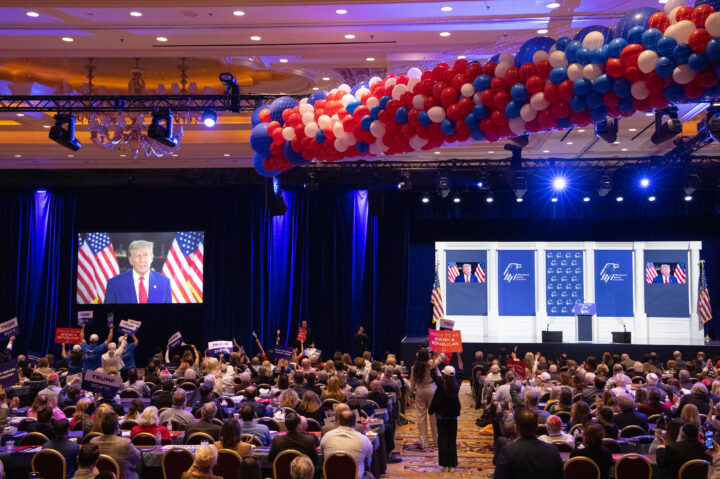
Former US President Donald Trump, left, speaks virtually during the Republican Jewish Coalition (RJC) Annual Leadership Meeting in Las Vegas, Nevada, US, on Thursday, Sept. 5, 2024.
The Republican Jewish Coalition’s annual leadership summit kicks off tonight at the Venetian Resort in Las Vegas with much to celebrate.
President Donald Trump’s recently brokered ceasefire and hostage-release agreement is certain to be among the administration’s accomplishments touted by a range of high-profile speakers including Cabinet officials, congressional leaders, pundits and media figures.
The RJC, which was established in 1985, is also celebrating its 40th anniversary this year, and the proceedings will feature “content about where we came from and where we are today,” said Sam Markstein, the group’s national political director.
“It’s come a long way from its humble beginnings,” Markstein told Jewish Insider in an interview on Thursday.
Hanging over the three-day conference, however, is the specter of rising antisemitism on the party’s far right, an issue that Markstein said the RJC does not intend to avoid.
It’s a particularly timely, and urgent, subject as the RJC prepares to convene days after Tucker Carlson hosted the neo-Nazi influencer Nick Fuentes on his podcast for a friendly interview. Carlson has faced backlash for not only inviting Fuentes onto his show but for failing to challenge any of his viciously antisemitic views — including admiration for Adolf Hitler and Holocaust denial.
During the interview, Carlson himself also expressed his disdain for Christian Zionists including Mike Huckabee, the U.S. ambassador to Israel, whom he accused of being “seized by this brain virus.”
Huckabee, for his part, is slated to give remarks, via livestream, during the RJC’s confab. Other outspoken critics of Carlson’s antisemitic turn, including Sen. Ted Cruz (R-TX) and Fox News host Mark Levin, will also be in attendance.
The summit will also feature House Speaker Mike Johnson (R-LA), Sens. Dave McCormick (R-PA) and Lindsey Graham (R-SC), Arkansas Gov. Sarah Huckabee Sanders and Kristi Noem, the homeland security secretary, among others. The four Jewish Republicans serving in the House are joining as well: Reps. Craig Goldman (R-TX), Randy Fine (R-FL), Max Miller (R-OH) and David Kustoff (R-TN).
It remains to be seen if Trump will speak at the summit as he has in recent years, either virtually or in person. The president has not commented on Carlson’s interview with Fuentes, with whom Trump himself had dinner in 2022 at his home in Palm Beach, Fla. Carlson has been a top ally of Trump, even as they have clashed over the administration’s military actions in the Middle East.
According to Markstein, there will be several speakers at the summit who will talk about what he called “the challenges facing the Republican Party,” citing “certain media personalities.”
He added that the tenor of the conference with regard to such issues will thematically echo a speech delivered earlier this year by Matt Brooks, the RJC’s CEO, who warned against the “woke right” and said the GOP “must combat the rise of neo-isolationism” that is now fueling anti-Israel sentiment within the party.
“It certainly will take on a little added resonance considering who Mr. Carlson platformed this week,” Markstein told JI.
The RJC will also now find itself on the opposing side of the Heritage Foundation, the right-wing think tank behind Project 2025 whose president, Kevin Roberts, forcefully defended Carlson on Thursday.
“Conservatives should feel no obligation to reflexively support any foreign government, no matter how loud the pressure becomes from the globalist class or from their mouthpieces in Washington,” Roberts said in a video posted to social media, adding that Heritage would not be “policing the consciences of Christians.”
Brooks told Jewish Insider that the RJC has worked with Heritage in various ways over the years, particularly its foreign policy team, “but obviously there’s going to be a reassessment of our relationship with Heritage in light of this.”
“They’re becoming more like Tucker Carlson and less like Ronald Reagan. Tucker Carlson represents the Barack Obama-Bernie Sanders wing of the Republican Party,” Brooks said of Heritage. “I believe that there’s still a vibrant Trump-Reagan wing of the Republican Party, and Heritage continues to position itself away from that — I think to their detriment.”
Roberts’ comments came a day after Vice President JD Vance, speaking at a Turning Point USA event on Wednesday at the University of Mississippi, faced scrutiny for using conspiratorial rhetoric while he discussed Israel with a group of conservative college students.
Vance also avoided directly calling out antisemitic questions from some audience members, including one who suggested that Trump had been pressured into holding pro-Israel stances because he received political donations from Miriam Adelson, the GOP megadonor whose late husband built the Venetian Resort and is a frequent guest at the RJC’s summit.
Markstein, for his part, said broadly that the RJC would stand firm against such thinking. “If folks believe that Israel is not an ally to the United States,” he warned, “they’re going to have to go through the RJC first.”
At the Israel on Campus Coalition’s conference, some students praised Trump’s campus crackdowns — but want lasting changes over financial settlements
Spencer Platt/Getty Images
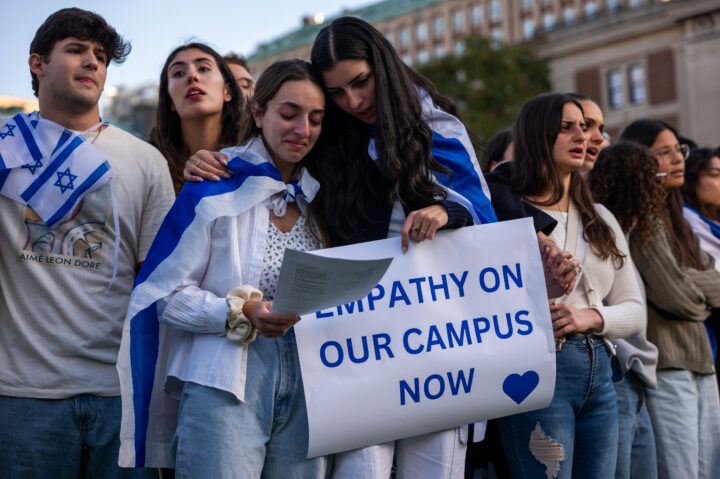
Columbia students participate in a rally and vigil in support of Israel in response to a neighboring student rally in support of the Palestinians at the university on October 12, 2023 in New York City.
WASHINGTON — When hundreds of pro-Israel college students from around the country gathered in the nation’s capital earlier this week for the Israel on Campus Coalition’s three-day annual national leadership summit, the rise of antisemitism on campuses sparked by the aftermath of the Oct. 7th terrorist attacks nearly two years ago was still a topic of conversation throughout panels and hallways.
This year, however, some students also said that antisemitism is lessening — though they offered mixed views about what is leading to the improved campus climate.
Some attributed it to the Trump administration’s ongoing pressure campaign on universities to crack down on antisemitic behavior, which has included federal funding cuts from dozens of schools. Others said their campuses started to take a serious approach to antisemitism, before President Donald Trump was reelected, in the fall semester following the wave of anti-Israel encampments from the previous spring.
But many student leaders from universities that have been targeted by the Trump administration — facing billions of dollars in slashed funds — said that if their school enters into negotiations to restore the money, they would like a deal to include structural reforms, unlike the one made last week between the federal government and Columbia University.
The penalties under that deal were largely financial, with Columbia agreeing to pay a $200 million settlement over three years to the government.
Harvard University has signaled a willingness to settle next, The New York Times reported this week, which could see the school agree to the Trump administration’s demand for as much as $500 million to end its clash.
“If there is a settlement in the coming days, I don’t think that Harvard paying a fine would be helpful,” Kyra Esrig, an incoming sophomore at Harvard, told Jewish Insider at the ICC summit. Instead, Esrig hopes to see “more of a focus on antisemitism itself without this maneuvering to get it to be a DEI incentive that every time they talk about antisemitism they have to add that they’re not anti-Muslim as well.”
“I want to see something specific in writing — [outlining] the steps the university will take to change antisemitism. I want to see an action-specific type of agreement. If the university treads more carefully around the issue, if the university is at least a little more responsive to people’s concerns around antisemitism, I think that will be a good thing.”
Esrig does not believe antisemitism has improved on campus since the Trump administration slashed $2.6 billion in funding from the university in the spring.
“It’s not like the Trump administration came into power and then there was sweeping change. For Harvard to change its culture, that’s an incredibly difficult thing to do and I don’t know that the Trump administration can go about issuing that.”
“I’m not entirely sure what the Trump administration is trying to gain,” Ezra Galperin, an incoming junior at the Ithaca, N.Y. school, told JI. “I think Cornell’s administration has been pretty effective in combating antisemitism — before there were threats from the Trump administration — with President Kotlikoff coming on. [Kotlikoff] makes a point of listening to Jewish students.”
Rather, “a lot of the positive changes are coming from the original backlash after Oct. 7,” she said, pointing to the university expanding its kosher lunch options in August 2024.
“That’s a result of the powerful force of Jewish students at Harvard saying that we need certain resources,” Esrig said.
Cornell University faced a $1 billion funding cut in April from the federal government amid a civil rights investigation into its handling of antisemitism. Ezra Galperin, an incoming junior at the Ithaca, N.Y., school studying government, noted an improvement in campus antisemitism this year compared to last.
But he attributes the shift to the university’s new president, Michael Kotlikoff, who stepped into the role in March.
“I’m not entirely sure what the Trump administration is trying to gain,” Galperin told JI. “I think Cornell’s administration has been pretty effective in combating antisemitism — before there were threats from the Trump administration — with President Kotlikoff coming on. [Kotlikoff] makes a point of listening to Jewish students.”
“There’s progress to be made, but I don’t think it warrants a millions of dollars fine,” Galperin said.
If Cornell does enter into a settlement with the government, there are two reforms Galperin hopes to see. “I want to make sure organizations like Students for Justice in Palestine that stir things up on campus are held accountable,” he said. “I want to see accountability for the grad students union who is seemingly selective in the students they choose to represent, alienating those who are pro-Israel. That’s my main hope for the year.” (Cornell SJP was suspended in March for disrupting the “Pathways to Peace” event where former Israeli Foreign Minister Tzipi Livni, former U.S. Ambassador to Israel Dan Shapiro and former Palestinian Prime Minister Salam Fayyad spoke.)
“What I would like to see, in light of the cuts, is a deal to be made which would include a mask ban imposed and enforced, for regulations to be actually written down more clearly and then enforced and then for punishments to be enforced on those who have breached the regulations that are made,” said Maximillian Meyer, a rising junior at Princeton University and student president of the campus group Princeton’s Tigers for Israel.
“If a deal is to be struck, I do hope it’s something tangible,” Galperin continued. “There is a sense that the Columbia deal was insufficient and a bit of a ploy.”
Maximillian Meyer, a rising junior at Princeton University and student president of the campus group Princeton’s Tigers for Israel, said he is taking a wait-and-see approach to the government’s crackdown on his campus, which also faced a funding freeze in April.
“I would be in support of a settlement — but not just any settlement,” Meyer told JI.
“What I would hope the Trump administration’s cuts would do, at a minimum, is to compel the university administration to enforce its own regulations. Even since the Trump administration made its cuts, the Princeton administration has not enforced its policies on time, place and manner restrictions.
“What I would like to see, in light of the cuts, is a deal to be made which would include a mask ban imposed and enforced, for regulations to be actually written down more clearly and then enforced and then for punishments to be enforced on those who have breached the regulations that are made,” Meyer continued, pointing to anti-Israel demonstrators repeatedly disrupting former Israeli Prime Minister Naftali Bennett’s speech at the university — including pulling a fire alarm — just days after the Trump administration slashed funding.
“The university should have been prepared for disruptions, but was undeterred by Trump’s funding cuts,” Meyer said. He called on Princeton to “work with the Trump administration to do something about [antisemitism]” rather than “the university’s current posture which is fighting against the administration.”
But Uriel Alvin, a student at City College of the City University of New York, expressed concern that any government intervention does more harm than good on campus.
“After the [Gaza solidarity] encampments [in spring 2024], we saw protests afterwards because of NYPD’s involvement shutting down the encampments,” said Uriel Alvin, a student at City College of the City University of New York. “I think having intervention causes more problems — adds to the flame more than it puts it out. I don’t think it was helpful for Columbia either.”
Alvin said he has worried about wearing a kippah on campus since Oct. 7, and that he “hasn’t felt any better this year.”
Earlier this month, Félix Matos Rodríguez, chancellor of CUNY, was called to testify during a House Committee on Education and Workforce hearing over his alleged failure to address campus antisemitism. That hearing, or any approach that involves the government, “wouldn’t help things,” Alvin said.
“After the [Gaza solidarity] encampments [in spring 2024], we saw protests afterwards because of NYPD’s involvement shutting down the encampments,” he said.
“I think having intervention causes more problems — adds to the flame more than it puts it out. I don’t think it was helpful for Columbia either.”
Please log in if you already have a subscription, or subscribe to access the latest updates.
 Continue with Google

 Continue with Apple