













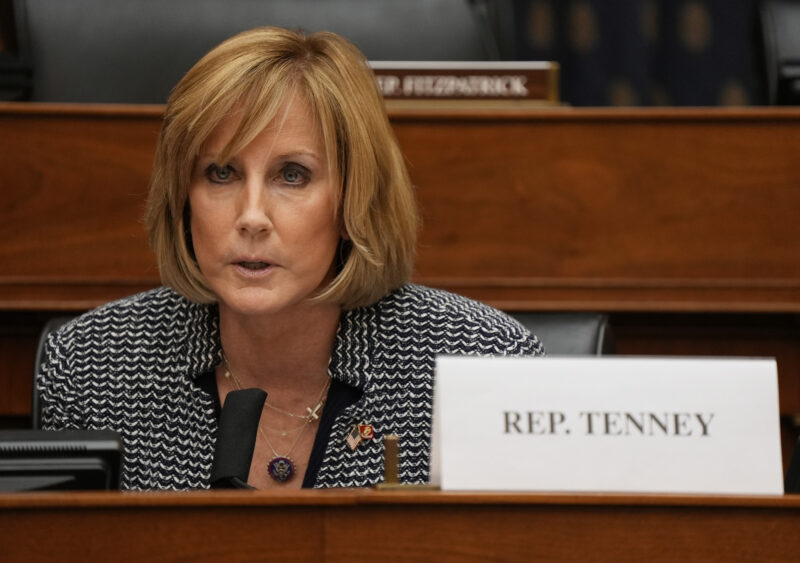
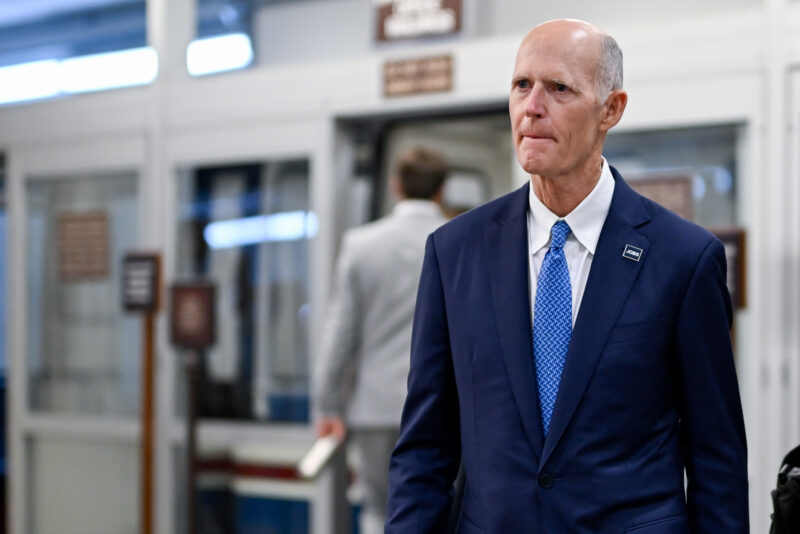
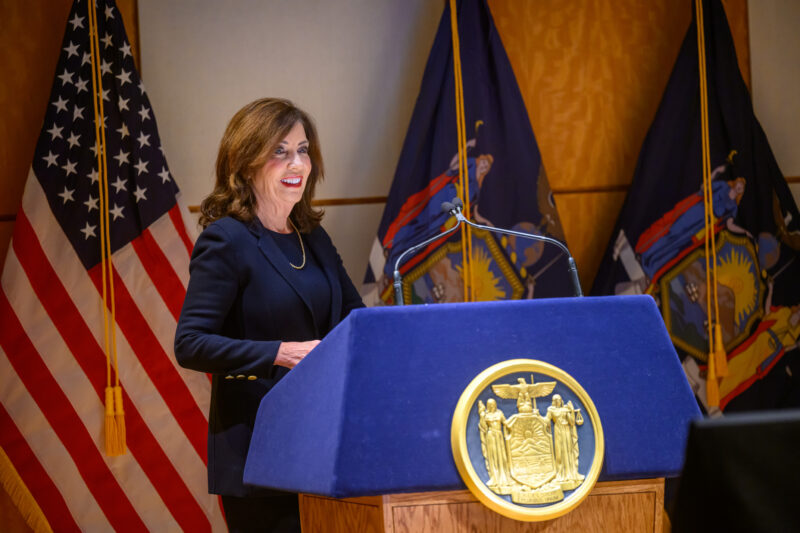
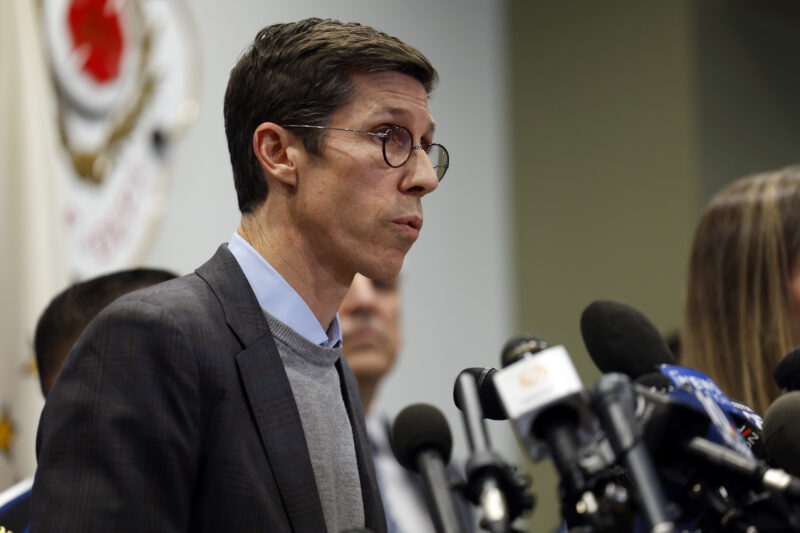










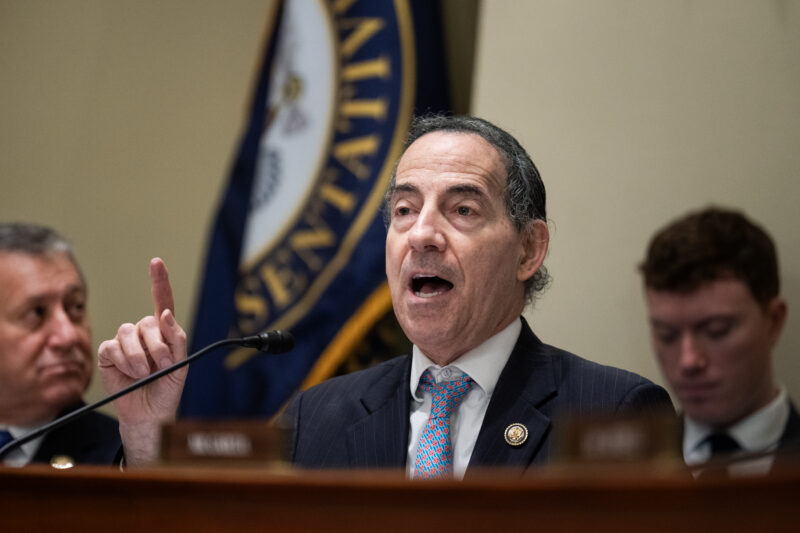












Nessel, who still hasn’t endorsed Democratic Senate nominee Abdul El-Sayed, said she won’t support Republican Mike Rogers
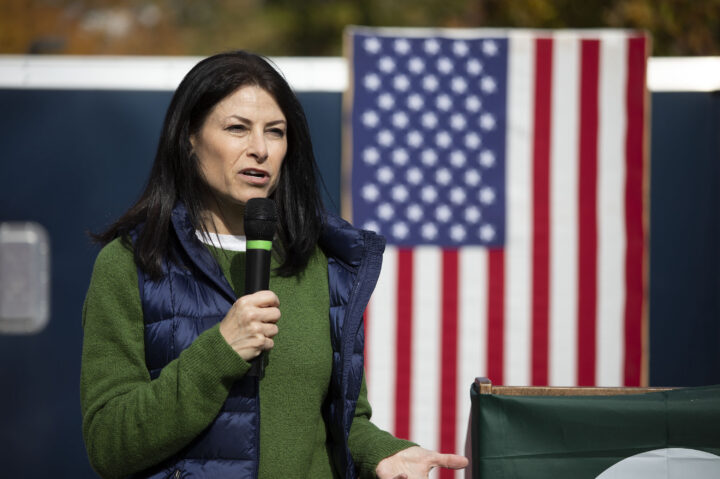
Bill Pugliano/Getty Images
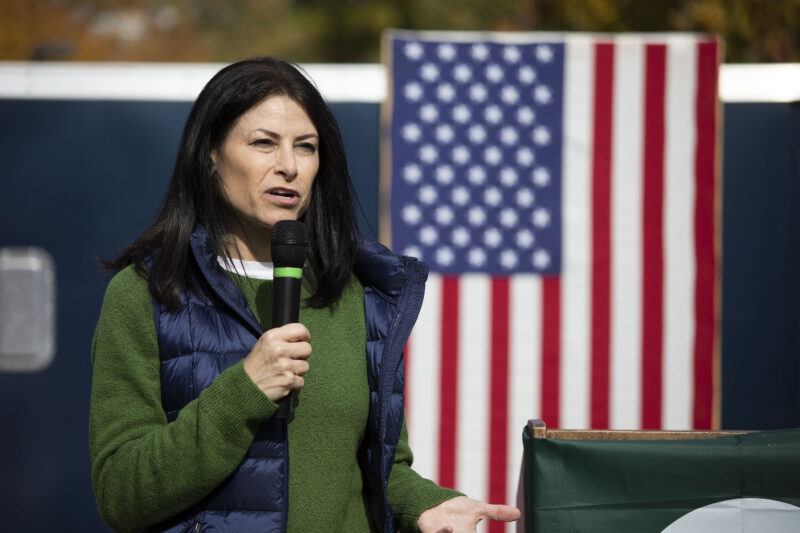
Michigan Attorney General Dana Nessel speaks on Oct. 16, 2022 in East Lansing, Michigan.


 Add JewishInsider on Google
Michigan Attorney General Dana Nessel, a Jewish Democrat, encouraged Jewish voters on Sunday to put aside concerns about their safety “in exchange for the opportunity to save the rest of humanity,” in a stark reference to the choices facing Jewish Democrats in the closely contested Senate election this November.
“We have a moral imperative to place the needs of the world above even our own self-interest and, yes, even our own survival,” Nessel told attendees in her remarks at the Michigan Democratic Jewish Caucus’ annual “Summer Simcha” gathering, where she was honored, according to reports confirmed by Jewish Insider.
Nessel’s comments did not explicitly refer to Abdul El-Sayed, the Democratic Senate nominee who has faced profound skepticism from Jewish Democrats over his hostile rhetoric toward Israel as well as his equivocal response to a violent terrorist attack on a synagogue outside Detroit in March.
But her plea to attendees suggested she was moving toward voting for El-Sayed, who also appeared at the event on Sunday to apologize for his initial comments on the synagogue attack in which he had claimed that “hurt people hurt people” and “violence is a cycle,” in remarks that were widely seen as insensitive to Jewish safety.
El-Sayed voiced regret for those remarks on Sunday, asking the caucus members “for forgiveness and a moment of grace” for what he called an ill-timed response. He also clarified that there was “an opportunity for context later on,” a sentiment that some voters found offensive in light of the attack, which had been perpetrated by a Lebanese American man who has lost relatives in Israeli strikes in Lebanon, including a brother who was a Hezbollah commander.
Nessel has been among the most high-profile Jewish Democrats in Michigan to withhold an endorsement of El-Sayed, whose response to the synagogue attack she had criticized in a podcast interview last week as “making excuses” for domestic terrorism that raised questions about how he would respond to other potential acts of violence.
Despite her reservations with El-Sayed, Nessel has also clarified that, unlike some Jewish Democrats in the state, she will not back former Rep. Mike Rogers (R-MI), the GOP nominee now aggressively courting Jewish voters who could help decide the election in a key battleground state.
In her speech on Sunday, Nessel alluded to Queen Esther, the biblical heroine of the Jewish holiday of Purim, in a dramatic illustration of the high stakes of the race.
“It is perhaps up to us now to follow in her path,” Nessel said, “and sacrifice the comfort, safety and security and even the very future of our own people in exchange for the opportunity to save the rest of humanity.” (In the Purim story, however, Queen Esther risked her own life to save the Jews rather than putting aside Jewish safety for a supposed greater good.)
She suggested the election hinged on more than just Israel, whose existence as a Jewish state El-Sayed has refused to acknowledge. “What good is defending the historic homeland of our ancestors and demanding that candidates acknowledge its right to exist, if the planet upon which it rests is no longer inhabitable?” she said to attendees at the event in Birmingham on Sunday.
“Come November, what do your Jewish values tell you to do?” Nessel asked, arguing against voting to empower Republicans when other urgent factors are also at play that go beyond Israel as well as the Jewish community.
One Jewish caucus leader who has spoken privately with Nessel said her remarks “certainly suggest” she will vote for El-Sayed even if she has not offered her endorsement.
“I think there is a difference between holding your nose and voting for someone and endorsing and I think she appreciates the distinction,” the caucus leader told JI, speaking anonymously to discuss a sensitive subject.
Joan Lowenstein, a Jewish caucus member, told JI after the event on Sunday that “the people who will vote for El-Sayed agree with” Nessel’s comments to the crowd.
“Many do not agree and don’t want to turn their backs on Jewish life in the U.S. or in Israel so that we can have a Democratic Senate,” she said, adding that “even though many of us disagree with each other, we respect the validity of these views.”
Nearly half of likely Pennsylvania voters surveyed in the NYT/Siena poll called Shapiro's Israel stance 'about right,' while only 14% said he is too supportive
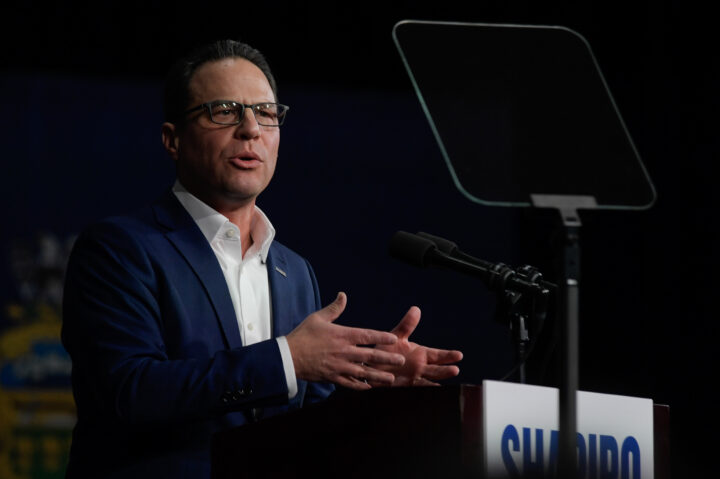
Matthew Hatcher/Getty Images
Pennsylvania Gov. Josh Shapiro speaks at a rally on January 8, 2026 in Philadelphia, Pennsylvania.
A new poll found that nearly half of voters in Pennsylvania view Gov. Josh Shapiro, a Jewish Democrat mulling a presidential bid in 2028, as “about right on support of Israel,” even as he has faced skepticism from the far left over his positions on the Jewish state.
The New York Times/Philadelphia Inquirer/Siena University poll, released Tuesday, showed that 47% of voters approve of Shapiro’s stances on Israel, with 14% saying he is “too supportive” and 19% feeling he is “not supportive enough.”
Forty percent of respondents under 30 said Shapiro is too supportive of Israel, underscoring a generational divide on the issue. 59% of Democrats still believe he is “about right” in his approach, according to the poll; 39% of Republicans said the same, while another 40% said he is not supportive enough.
The survey results indicate that Shapiro, a popular centrist who led his Republican gubernatorial rival, Stacy Garrity, by 16 points in the poll, could be well positioned as he mulls a presidential campaign.
Even as the Democratic Party has recently become more hostile toward Israel, Shapiro has continued to voice support for upholding ties to the key U.S. ally, while remaining outspoken against Prime Minister Benjamin Netanyahu and his right-wing governing coalition.
With a growing number of Democratic lawmakers calling for an end to U.S. aid to Israel, Shapiro has reiterated his commitment to such assistance, while otherwise arguing it should be used to exert leverage over the country’s use of American-made weapons.
More broadly, the poll showed that while half of likely voters in Pennsylvania, a key battleground state, believe the Democratic Party is too far to the left, 29% said they felt the same about Shapiro. The poll surveyed 760 likely voters in Pennsylvania and was conducted Aug. 17-21.
The poll stands in contrast to findings concerning voter sentiment toward Israel in a survey released Monday by the far-left IMEU Policy Project that was conducted by YouGov. That poll found broad Democratic support for sanctioning Israel and cutting off U.S. weapons sales among primary voters in the six states recently chosen to lead off the 2028 Democratic presidential nominating contest — South Carolina, Nevada, New Hampshire, New Mexico, Michigan and Virginia.
The Times/Siena poll also showed Pennsylvania voters largely back Sen. John Fetterman’s (D-PA) outspoken defense of Israel, with 41% saying he is “about right,” 29% saying he is “too supportive” and 7% saying he is “not supportive enough,” though 51% of Democrats surveyed believe he is “too supportive.”
The survey found that Fetterman is viewed far more favorably among Republican voters than Democrats as he has continued to publicly spar with members of his own party as he accuses them of moving too far to the left. While his criticism has stoked speculation over whether he will formally cross the aisle, he has denied that he intends to switch parties.
‘I represent a pro-Israel, anti-Netanyahu district and this is a pro-Israel, anti-Netanyahu vote,’ Rep. Jake Auchincloss told JI
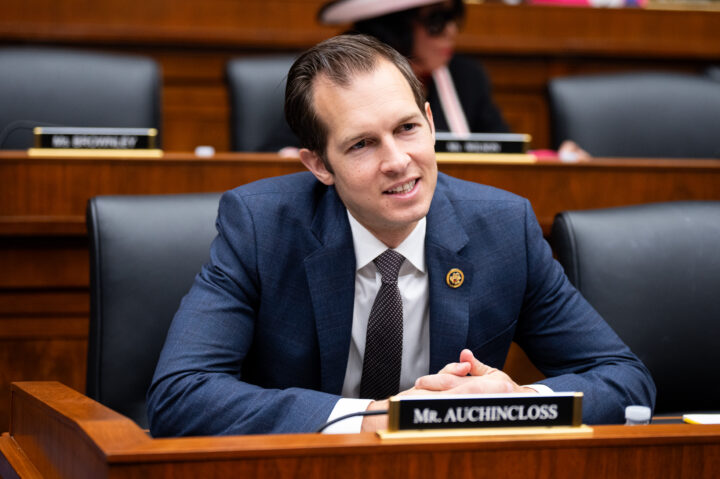
Bill Clark/CQ-Roll Call, Inc via Getty Images
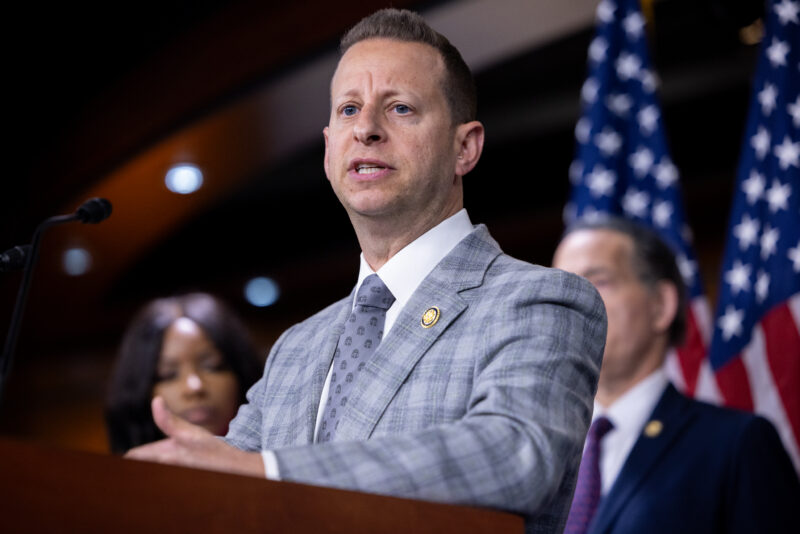
Rep. Jake Auchincloss (D-MA) participates in the House Transportation Committee hearing on Thursday, June 27, 2024.
Of the 103 House Democrats who voted to cut off the $3.3 billion in U.S. aid to Israel last week, few came as more of a surprise than Rep. Jake Auchincloss (D-MA), a Jewish Democrat who has generally been a reliable pro-Israel vote in the House.
Auchincloss, in an interview with Jewish Insider this week, said that he approached the vote as a protest of the war with Iran, and argued that the vote wasn’t anti-Israel.
“This president, in conjunction with Prime Minister Netanyahu, has launched an illegal, catastrophic war that nine out of 10 Israelis think has led to Iranian gains, and that even fewer of my constituents support,” Auchincloss said. “And foreign military financing is a form of appropriations for a war I believe to be illegal and unwise.”
He also pointed to comments by Israeli Prime Minister Benjamin Netanyahu calling for the U.S. to phase out aid to Israel over the next 10 years, arguing that Democrats can’t be expected to take a position on aid “to the right of Netanyahu” — though the Israeli prime minister hasn’t called for an immediate halt to aid.
“That grant of foreign military financing is a privilege that Congress grants annually to both our head of government and to counterparty heads of government,” Auchincloss said. “Every year, Congress has the right — Congress has the responsibility — to determine whether that privilege is warranted. Given Trump and Netanyahu’s decision-making about this debacle with Iran, I do not think it is warranted.”
He said he would evaluate his position on future FMF to Israel on a year-by-year basis depending on whether he believes such aid is deserved. “That’s not only my right as a member of Congress, that’s my responsibility — particularly when 18 Americans have died overseas.”
But he said that he continues to support the U.S-Israel relationship and said the U.S. should continue to work to preserve Israel’s qualitative military edge (QME), and suggested he would not, at this point, support a cutoff of support for Israeli missile-defense systems or an embargo on Israel buying U.S. systems with its own funds.
He said he also believes in continued U.S. support for the Abraham Accords and other efforts to bring Israel and the region closer together, including through the India-Middle East-Europe Corridor (IMEC).
Some observers have seen Auchincloss’ vote as a concession to left-wing Democrats in his suburban Massachusetts district, in light of the party’s shifting stance on Israel and primary challenges to other pro-Israel Democrats. The district includes a substantial Jewish population.
Auchincloss himself won his first primary in 2020 with 22% of the vote, scoring a narrow victory over a divided field that included several candidates to his left. Some on the left still see him as vulnerable to a one-on-one challenge in a future race — or as a potential candidate for higher office in deep-blue Massachusetts.
“I represent a pro-Israel, anti-Netanyahu district and this is a pro-Israel, anti-Netanyahu vote,” Auchincloss asserted, arguing that he’s “confident … a majority of my Jewish constituents would agree with me.”
“I hear why people see this vote through the lens of primaries and the national Democratic scene,” Auchincloss said. “I represent about 100,000 Jewish constituents. They are super smart and engaged on this issue. If I try to take political votes or symbolic votes or too-clever-by-half 4D-chess votes, it doesn’t hang together. I have to be able to defend the internal logic of each and every vote to this community, and I am confident that I can say to this community on this vote: This is a rejection of Trump and Netanyahu’s decision-making to take away the credit card.”
Asked whether the U.S.-Israel relationship can be sustained and repaired while Netanyahu continues to lead Israel — as some prominent U.S. figures have suggested that Netanyahu being ousted in the upcoming Israeli elections is necessary to continued bilateral relations — Auchincloss said that the relationship should be bigger than any one leader.
“The U.S.-Israel alliance is deeper than personalities,” he said. “Certainly, you know, Congress and our decisions about appropriations and policy need to be calibrated to the individuals who are going to be executing that policy, right? But the U.S.-Israel alliance is based on shared interests, on common values, and a long history.”
He suggested he was unconcerned by AIPAC’s decision to halt fundraising for him following the vote, explaining that his votes aren’t shaped by endorsements or contributions and that he’s taken votes both supported and opposed by AIPAC over the course of his career.
Though he diverged from House Minority Leader Hakeem Jeffries (D-NY) on the Israel aid vote, Auchincloss praised the Democratic leader’s approach to the issue and called it a model for how the party as a whole should approach Israel policy going forward.
“Hakeem is pointing the way with a steady hand, which is to say, ‘We’re a party that supports qualitative military edge for Israel, which is surrounded by terrorists and the world’s largest state sponsor of terrorism, and has a right to defend itself against those terrorists and needs QME to be able to do that, but we’re not a party that yields congressional oversight to Trump and Netanyahu as Republicans have,”’ Auchincloss said.
Asked about the possibility of conditions on further U.S. aid to Israel, Auchincloss said that the next U.S.-Israel memorandum of understanding should be crafted around supporting Israel’s QME, expanding and supporting normalization and, critically, provisions that can garner support from both chambers of Congress and both parties.
Even as he sided with progressives in the party on the Israel aid vote, Auchincloss has also found himself vocally at odds with the left over his criticisms of former Maine Senate candidate Graham Platner.
Auchincloss long opposed Platner and faced strong backlash from the party in late May for saying that Platner’s tattoo and comments about it were “disqualifying” and saying he would support another candidate in the primary if he were a Maine voter.
“Character should matter in politics,” Auchincloss told JI. “Ten years ago, Republicans decided that it doesn’t. They’ve become a cult of personality, and Platner demonstrates to Democrats the hazards of agreeing that character doesn’t matter.”
“And I think it’s a problem for the Democratic Party to wrestle with [the fact] that it would have been more politically damaging for him to have a Star of David tattoo than to have a Totenkopf tattoo,” Auchincloss continued, an apparent reference to comments from a Platner supporter on the campaign trail earlier this year.
Auchincloss also said he remains concerned about surging antisemitism globally, and continues to be involved in other efforts to combat antisemitism and anti-Israel sentiment, including as one of a handful of Democrats who signed a letter earlier this week condemning plans by Malaysia to round up and expel Israeli citizens.
He said he’s been in discussions with Jewish community groups about the role of social media in promulgating antisemitism and is working on legislation to combat it, while also arguing that it will require a “multifaceted approach.”
“Antisemitism tends to mushroom in failed societies, and social media has become a failed society as one big online toxic brew. And politics is downstream of media and information and culture,” Auchincloss said.
He said that even as political leadership is necessary to call out and reject antisemitic candidates, leaders also need to look “upstream to media and culture and information,” particularly on antisemitism.
Auchincloss is making his own efforts to steer the direction of the Democratic Party, including as the chair of Majority Democrats, a new campaign group backing moderate and liberal Democratic lawmakers and candidates around the country.
In his view, Auchincloss said that he sees himself and the group as occupying a third corner of the party, separate from the left and the establishment. “There is the opportunity for a faction that will redefine the center of American politics and be disruptive of the establishment without being socialist,” Auchincloss said.
He said he believes his faction and the party as a whole should be focused on “the new American dream” — a robust primary and secondary education, the ability to own a home by age 30 and retire by 65 — as “partners to help you achieve that economic security.” Auchincloss said the party should also be aggressive about confronting corruption across the political spectrum and should not yield “faith, family and the flag” to conservatives.
“I don’t think Americans are going to vote for Democrats to lead this country if they don’t think Democrats like this country,” Auchincloss said. “And so we have to be the party of patriotism — not of blood and soil nationalism, but of true constitutional patriotism. And then, finally, we need a cross-ideological governing platform that is willing, even self-consciously celebratory, of dragging and dropping good ideas from across factions of American life.”
He also said that Democrats should be strongly supportive of public safety, including cracking down on petty crime, and support a national wealth tax.
Auchincloss pointed to Sen. Jon Ossoff (D-GA), increasingly seen as a potential 2028 presidential candidate, as someone who he believes is a strong leader for the party, particularly on anticorruption issues.
He said that he sees an anti-establishment mood across the party — which he said will look different in deep-blue and purple seats, while emphasizing that Democratic Socialists of America members have won “about 1%” of Democratic Party primaries.” He said he believes that the extremism problem is much more severe on the GOP side, asserting that 2020 election deniers have won more than half of GOP primaries to date.
“American politics is horseshoeing, but it’s not horseshoeing symmetrically,” Auchincloss alleged.
Asked whether he’s comfortable being in the same political coalition as those DSA members, Auchincloss said that he’s “not a bouncer” and doesn’t have the capability to police who’s winning Democratic primaries.
“What I’m concerned about is less about being a bouncer at the door and more about do we have music at this party that people want to come and dance to? Like, are we filling the room? Because enrollments for Democratic Party are going down,” Auchincloss said.
He said that, as with Platner, character matters, but that Democrats also shouldn’t be fixated on a “checklist at the door” for who can and can’t be part of the party, and should instead concentrate on a “governing vision” that will attract voters.
The defeated New York congressman pointed to antisemitic attacks during his campaign while urging Democrats to remain a broad coalition
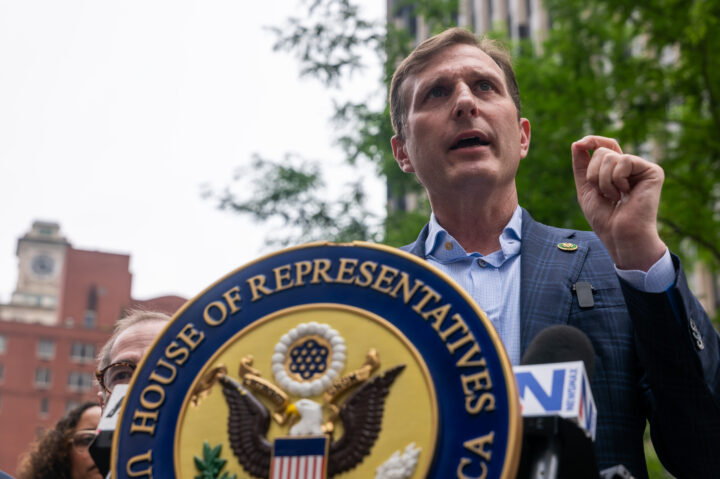
(Spencer Platt/Getty Images)
Rep. Dan Goldman (D-NY) speaks at a news conference on June 18, 2025 in New York City.
Rep. Dan Goldman (D-NY), a pro-Israel Jewish Democrat who was unseated in a bitter primary on Tuesday, warned in his concession speech that antisemitism “will ultimately be the undoing of our democracy if we all don’t lean in and speak out.”
“Jews have given back so much to this country,” the two-term lawmaker said. “As history has taught us, antisemitic tropes and stereotypes, some of which I heard personally on this campaign, will ultimately be the undoing of our democracy if we all don’t lean in and speak out — even if it’s not politically expedient.”
Goldman, who was resoundingly defeated by Brad Lander, the former city comptroller backed by New York City Mayor Zohran Mamdani, faced blowback during the campaign over his support for Israel and ties to the pro-Israel lobbying group AIPAC — some of which invoked hostile antisemitic rhetoric.
In the final days of the primary, a Brooklyn coffee shop Goldman patronized wrote in an incendiary online post it was banning him over his pro-Israel views, calling him a “genocide enabler” and saying his purchase “probably” came from AIPAC — which endorsed him but did not engage directly in the race.
The Department of Justice’s Civil Rights Division said Monday it had opened an investigation into the cafe for discrimination, though Goldman clarified he did not believe the incident warranted legal scrutiny.
“Every day I tried to approach this job with integrity, with seriousness and courage to stand up for what is right, even when it was not politically expedient,” the ousted congressman said in his concession speech, in an apparent reference to his defense of Israel over the course of the primary.
Goldman, a former federal prosecutor who rose to national prominence as the lead counsel during President Donald Trump’s first impeachment, shared a range of progressive policy views with Lander, a fellow Jewish Democrat who identifies as a progressive Zionist.
Despite their agreements on several key issues, the race ultimately became a referendum on support for Israel in the Democratic Party and Goldman’s refusal to disavow his Zionist ideals. He lost by more than 30 points, with 90% of the vote tallied as of Wednesday.
Lander, who accused Israel of genocide in Gaza and called for ending U.S. aid to the Jewish state, largely aligned his campaign with the anti-Zionist far left as he touted his endorsement from Mamdani, a key ally who also played a decisive role in helping elevate two democratic socialists with records of vocal anti-Israel activism to the nomination on Tuesday.
In his victory speech, Lander, who won a decisive 66% of the vote in New York’s 10th Congressional District, praised Goldman “for how he responded to some of the toxic rhetoric that he and his staff faced over the past couple days,” saying his opponent had acted “with grace and with gratitude.”
“That is something we need more of in our politics,” Lander added.
Even as he raised alarms about antisemitism on the left, Goldman called on his supporters to “remember the enemy to all that we want and all that we hope for is in the White House, not in our own party.”
The Democratic Party, Goldman said, “has always been at its strongest when it has welcomed a broad coalition of voices united by those shared democratic values of equal rights, social justice, human rights.”
“We have never required unanimity of opinion to stand together against the forces that truly threaten our democracy,” he argued in his concession speech. “And we should not demonize, or push away, anyone who shares our mutual goals.”
A spokesperson for Goldman did not respond to a request for an interview on Wednesday.
Rocque Perez, a former Tucson city council member, has throughout his campaign fixated to an unusual degree on Hernandez’s pro-Israel views
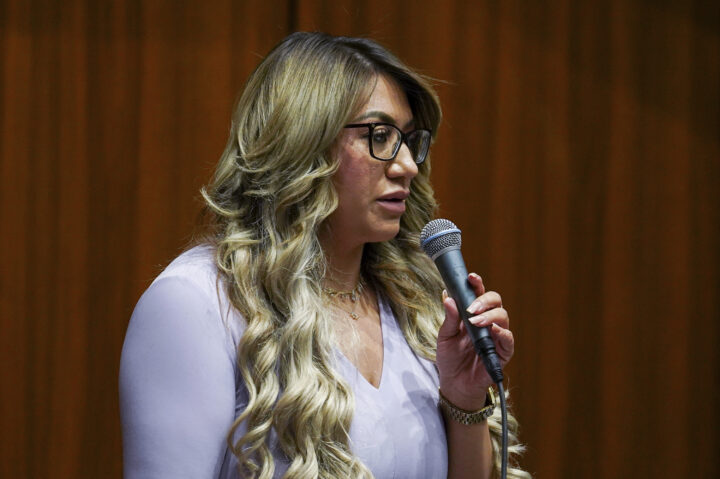
Samantha Chow/AP
State Rep. Alma Hernandez, D-Tucson, speaks during a House session, Wednesday, April 23, 2025, at the state Capitol in Phoenix.
Alma Hernandez, a Jewish Democrat and Arizona representative now running for an open state Senate seat in Tucson, is raising alarms about rhetoric from her primary opponent that she and other Jewish leaders claim has crossed a line into antisemitism — with no pushback from local elected officials.
Hernandez, who is term-limited in Arizona’s House, has long been an outspoken supporter of Israel and identifies as a “proud Zionist,” fueling tensions with some Democratic colleagues, particularly on the left.
But her left-wing rival in the state’s July 21 primary election, Rocque Perez, a former Tucson city council member, has throughout his campaign fixated to an unusual degree on her pro-Israel views, while using language that Hernandez says promotes antisemitic tropes about dual loyalty and Jewish control of U.S. politics.
“At the end of the day, I consider this guy to be an antisemite, and someone who is so obsessed that this is all he talks about,” Hernandez told Jewish Insider in an interview. “He hasn’t told voters what he would do differently from me. He is just telling voters that I support genocide.”
In fundraising solicitations, campaign literature and online posts, Perez has frequently cast Hernandez as influenced by “foreign” and “overseas interests” in a thinly veiled allusion to Israel, saying that he is vying “to unseat” an “Israel-First Dem tied to big money.”
“Wish I was fooling with y’all, but I don’t think genocide is a joke,” Perez wrote in a characteristic post in April. “If anything, it’s made me even more determined to give Tucson a real choice — someone who isn’t beholden to corporations of allegiances abroad.”
Elsewhere, he has accused Hernandez of being “bankrolled” by AIPAC, the increasingly villainized federal lobbying group whose political arm does not engage in state-level races, where foreign policy is not typically a top issue. In a recent message, meanwhile, he asked his supporters to contribute $5 to “unseat a Zionist!”
“Alma’s record of placing her own political identity above the needs of her district is the true concern,” Perez wrote in the Arizona Daily Star last December, equating Hernandez’s efforts to secure funding for a Holocaust education center in Phoenix to pro-Israel legislative advocacy he dismissed as “largely directed toward international posturing” at the expense of other urgent local challenges.
For Hernandez and Jewish activists in the state who have been troubled by Perez’s messaging, his attacks are a local example of how rising anti-Zionism on the far left has increasingly intersected with antisemitism that has often been met with silence from Democratic Party leaders.
While Perez has won endorsements from several Tucson city council members as well as the county attorney, among others, none have commented on his rhetoric or responded to concerns from Jewish community members. On Tuesday, he said in a post that he had also been endorsed by Rep. Adelita Grijalva (D-AZ) and Tucson Mayor Regina Romero.
Last month, the Center for Jewish Resilience at Jewish Philanthropies of Southern Arizona, which tracks local incidents of antisemitism, sent a letter to city council members supporting Perez, highlighting what the group called his “repeated pattern of public rhetoric” espousing “longstanding antisemitic tropes and narratives.”
The organization, which did not return a request for comment on Tuesday, invited the officials “to speak further” but did not hear back from them, according to Hernandez.
“What is alarming about this cycle is there is this individual who is so out there with his rhetoric and people are just pretending that it’s not a big deal,” said Hernandez, 33. “I have been in office for a total of eight years representing this community. The fact that I’m a Mexican Jew has never been disqualifying for anyone to say, ‘Hey, I can’t support you because of that.’”
Perez’s campaign did not respond to a request for comment.
Erika Neuberg, a Jewish community leader in Arizona who is close to Hernandez, said the “race is exposing” Democratic leaders as unwilling to even acknowledge rhetoric that Jewish voters have found concerning. “You don’t have one Democratic leader looking at this rhetoric and saying this is alarming,” she told JI. “This is an attempt to disenfranchise a segment of the population.”
Andrew Kunsberg, a Jewish Democratic leader in Tucson who is backing Hernandez, said, “When you accuse somebody of being a Zionist, to me, you’re accusing them of being Jewish, and it’s already affected her race.” In canvassing for her campaign recently, he has heard from voters who say they won’t vote for a Zionist, he told JI. “To me, this is not normal.”
Kunsberg said that he has been involved in a range of local legislative races, “but quite frankly, I have never seen anything like it in my entire life.”
“She is running against the most flawed candidate I have ever seen and yet is being supported by almost our entire city council and our county attorney,” he said.
Perez’s backers have continued to stand behind him, even as the 27-year-old has faced unrelated scrutiny over past deleted posts advocating political violence against conservatives, which he has called “material put out without my consent.”
“It just seems that in our Democratic politics, individuals do not care, as we’re seeing with what’s going on with” Graham Platner, Hernandez told JI, referring to Maine’s Democratic Senate nominee. “I mean, the man literally had a Nazi tattoo, and people are like, ‘Oh, he’s fine, he’s great, he’s a progressive.’”
As early voting begins next week, Hernandez, who has clashed with local Democrats for her votes with Republicans in the Legislature, echoed other Jewish supporters in saying she was not certain whether she would prevail in the primary, even as she dismissed Perez as unserious.
“I don’t want to say that I’m completely safe in this election, because I don’t think that anyone is at this point,” she said. “Do I consider him a serious person? Absolutely not. I think he’s a joke.”
But that “doesn’t mean he can’t win an election when he is receiving the support of the establishment,” she added.
“In any other world, I felt like people would be ringing the alarms,” she told JI. “Unfortunately, these folks are encouraging the behavior.”
The Michigan senator endorsed the pro-Israel congresswoman as Craig trails Lt. Gov. Peggy Flanagan
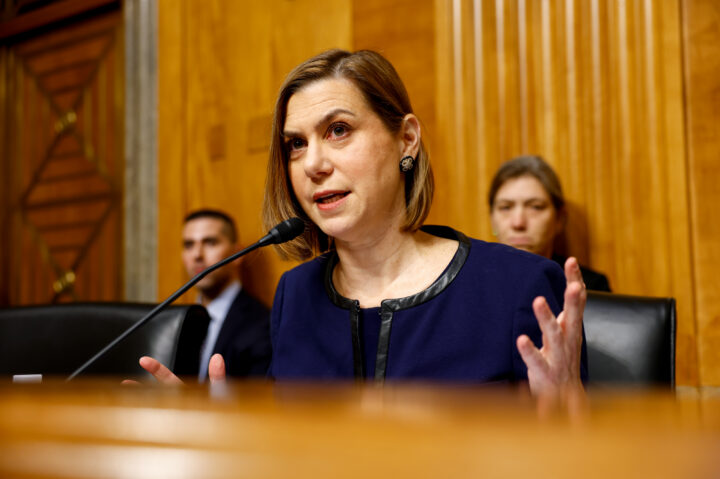
Kent Nishimura/Bloomberg via Getty Images
Senator Elissa Slotkin (D-MI) during a Senate Homeland Security and Governmental Affairs Committee confirmation hearing in Washington, DC, on March 18, 2026.
Sen. Elissa Slotkin (D-MI) announced her endorsement on Thursday of Rep. Angie Craig (D-MN) in Minnesota’s Senate primary, calling the moderate congresswoman “a leader and a fighter” who has “stepped up” while serving in the House.
“The Democratic Party needs a new generation of leadership, and we need more of those leaders to be from the Midwest — Angie Craig is both,” Slotkin, a Jewish Democrat viewed as a potential 2028 presidential contender, said in a statement. “I hope to serve with her in the U.S. Senate.”
Craig, a pro-Israel Democrat, has also earned endorsements from Sens. Tammy Baldwin (D-WI), Andy Kim (D-NJ), Ruben Gallego (D-AZ), Jacky Rosen (D-NV) and Catherine Cortez Masto (D-NV), among other lawmakers.
Slotkin’s support comes as polls have shown Craig trailing her Democratic rival in the Aug. 11 primary, Lt. Gov. Peggy Flanagan, a progressive who has won endorsements from several leading Israel critics such as Sens. Bernie Sanders (I-VT), Elizabeth Warren (D-MA), Chris Murphy (D-CT) and Chris Van Hollen (D-MD). Flanagan is also backed by Sen. Tina Smith (D-MN), who is retiring at the end of the year.
In the most recent poll, conducted for Flanagan’s campaign between May 31 and June 3, the lieutenant governor held a 17-point lead over Craig, with 55% of the vote share. Other surveys have similarly shown Flanagan with a commanding advantage in the race.
Last month, Craig announced that she would not seek support from the state Democratic Party at its convention, effectively ceding that endorsement to Flanagan, who was widely expected to win.
Earlier, Craig’s campaign had called on the state party to formally investigate a series of alleged instances of antisemitic activity among delegates ahead of the convention, which in recent years has been marked by mounting intraparty divisions over Israel.
The 25th overlaps with the congressman's former district, which was largely dismantled, but leans more Republican
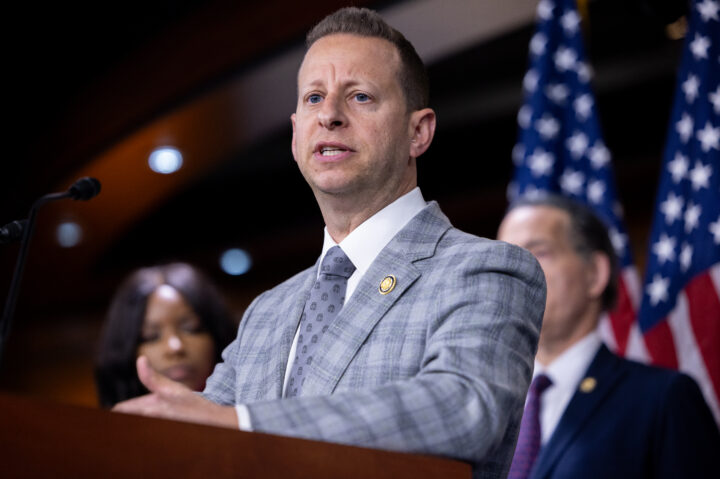
Nathan Posner/Anadolu via Getty Images
Rep. Jared Moskowitz (D-FL) speaks at a press conference on Capitol Hill on Sept. 8, 2025.
Rep. Jared Moskowitz (D-FL), a Jewish Democrat who is among the most vocal supporters of Israel in Congress, announced on Thursday that he would seek reelection in a new South Florida House district recently drawn to favor Republicans, after his own was largely erased, setting the stage for what is expected to be a costly and competitive race.
“The American people are struggling to afford a regular way of life. Many barely have enough money for their bills and feel squeezed by rising costs,” Moskowitz said in a statement. “We must work together to bring back the American dream for the middle class in America. I have never hesitated to work with anyone across the aisle if I think it’ll improve the lives of my constituents.”
The two-term congressman won’t be unfamiliar to voters in the new 25th Congressional District, the product of recent Republican-led redistricting that dismantled his current seat. The recently approved House map overlaps in many ways with his previous constituency, stretching along Florida’s coast from Delray Beach down south to Miami Beach. The Cook Political Report rates the race a toss-up, even as the district leans Republican.
Moskowitz’s campaign said the district is estimated to be 25% Jewish, a demographic that makes him a strong fit for the seat, according to election analysts.
“Political extremism is expanding, and antisemitism is spreading and becoming mainstream,” he said on Thursday, adding, “When I see people in my own party talking about concentration camps or deporting Jews, I am going to be an immovable object to that movement. My kids are never going to hide in attics,” referring to an antisemitic activist who had sought the Democratic nomination to a congressional seat in Texas.
Moskowitz is facing a left-wing primary challenge from Oliver Larkin, who had also been running in the congressman’s old 23rd Congressional District. The GOP primary for the 25th District is more crowded, and includes former Boca Raton Mayor Scott Singer, former state Rep. George Moraitis and Joe Kaufman, who previously ran against Moskowitz in 2024. Moskowitz reported nearly $1.22 million on hand at the close of the most recent quarter, which ended in March.
Maureen O’Toole, a spokesperson for the National Republican Congressional Committee, said in a statement that Moskowitz had “just sealed his own political fate,” claiming that “by choosing to run in a district President Trump won by nine points, he has guaranteed a loss in November.”
Rep. Debbie Wasserman Schultz (D-FL), a fellow Jewish Democrat whose South Florida seat was also eliminated, announced last week that she would run in the state’s 20th Congressional District, a safe Democratic seat that has been represented by a Black lawmaker for more than three decades.
Plus, Michigan Dems swap Jewish regent for Hezbollah cheerleader
Jose Juarez/AP
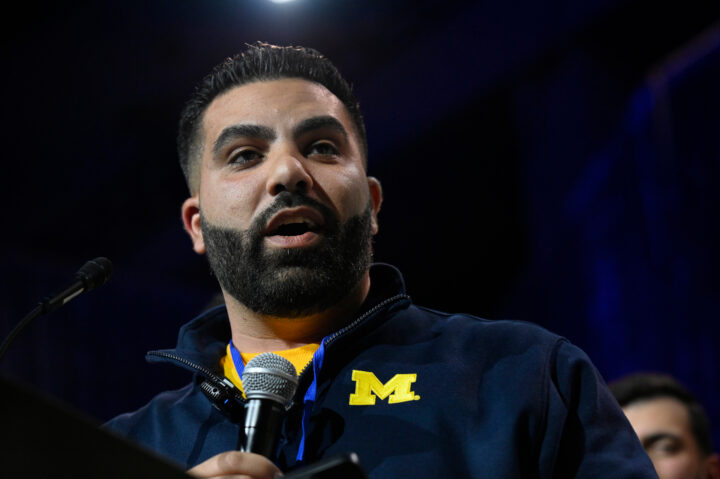
Amir Makled, a candidate for the University of Michigan Board of Regents, addresses delegates after winning the party's nomination during the Michigan Democratic Party State Endorsement Convention, Sunday, April 19, 2026, in Detroit.
👋 Good Monday morning!
In today’s Daily Kickoff, we look at deepening concerns among Jewish Democrats over the party’s increasing embrace of terror supporters and antisemitism, and report on recent polling from Israel that indicates a divide in public opinion over the Trump administration-brokered recent ceasefires with Iran and Lebanon. We cover the weekend’s Alex Soros-backed inaugural Global Progressive Summit in Barcelona, and break down the results of last week’s special election in New Jersey’s 11th Congressional District, where progressive Analilia Mejia sailed to victory, despite a lack of support from some of the district’s most Jewish areas. Also in today’s Daily Kickoff: Rabbi Ephraim Mirvis, Raz Hershko and Luke Lindberg.
Today’s Daily Kickoff was curated by JI Executive Editor Melissa Weiss and Israel Editor Tamara Zieve, with assists from Danielle Cohen-Kanik and Marc Rod. Have a tip? Email us here.
What We’re Watching
- Vice President JD Vance is expected to return to Islamabad, Pakistan, this week for a second round of talks with senior Iranian officials amid conflicting reports over the status of the talks, with Iran saying it has not yet decided whether it will send representatives to the negotiations.
- Meanwhile, Tehran threatened retaliation this morning for the U.S.’ weekend attack on and seizure of an Iranian-flagged ship in the Gulf of Oman that had attempted to evade the Navy’s blockade of the Strait of Hormuz.
- Argentine President Javier Milei is in Israel today after arriving over the weekend ahead of events around Israel’s Yom HaZikaron and Yom HaAtzmaut, the country’s back-to-back commemorations of Israel’s fallen soldiers and victims of terror, and its Independence Day. Yesterday, Milei and Israeli Prime Minister Benjamin Netanyahu launched the Isaac Accords between the two countries. Read more about the initiative here.
- Israel will hold official Yom HaZikaron events at the Western Wall this evening and at Mt. Herzl, the country’s military cemetery, tomorrow morning.
- In Washington, Secretary of State Marco Rubio will speak this morning at a State Department ceremony unveiling the portrait of former Secretary of State Mike Pompeo.
What You Should Know
A QUICK WORD WITH JI’S JOSH KRAUSHAAR
Events in recent days may well be marking a tipping point in the decline of the Democratic Party — at least when it comes to its treatment of Jews, on top of its growing hostility toward Israel.
The weekend ended with the news that Michigan Democratic delegates, at their statewide convention Sunday, nominated a Hezbollah supporter, Amir Makled, to the University of Michigan Board of Regents, choosing to oust a Jewish member, Jordan Acker, whose home and car were repeatedly vandalized with antisemitic graffiti and his family threatened.
Acker’s offenses? He backed efforts to hold anti-Israel campus protesters at the University of Michigan accountable for assaulting police and engaging in intimidation of Jewish students, among other instances of student misconduct. He declined to support efforts to divest university funds from Israel, along with other members of the Board of Regents, as a radical faction of students had demanded.
Acker’s non-Jewish Democratic ticketmate, Paul Brown, who also supported discipline against anti-Israel students, wasn’t targeted and was renominated for election. But the Democratic delegates ousted Acker in exchange for Makled, who has posted on social media with comments praising Hezbollah’s leaders and retweeted antisemitic messages from the conspiracy-theorizing influencer Candace Owens.
The results mark a new low for Michigan Democrats. Also over the weekend, Michigan Senate candidate Abdul El-Sayed told CNN that he believes the Israeli government is just as evil as Hamas. Read more here.
In the same interview, El-Sayed also said that Sen. Chris Van Hollen (D-MD) should replace Senate Minority Leader Chuck Schumer (D-NY) as the Democratic leader in the upper chamber, citing Schumer’s continued support for U.S. aid to Israel. Van Hollen is among the most vocal critics of Israel in the Senate.
Michigan is a closely watched bellwether of the direction of the Democratic Party, and the latest developments underscore that a more radical faction of the party appears to be growing. This, in the state where dozens of Jewish preschoolers were nearly killed in a terrorist attack last month by a Hezbollah sympathizer who targeted the state’s largest synagogue.
dem defections
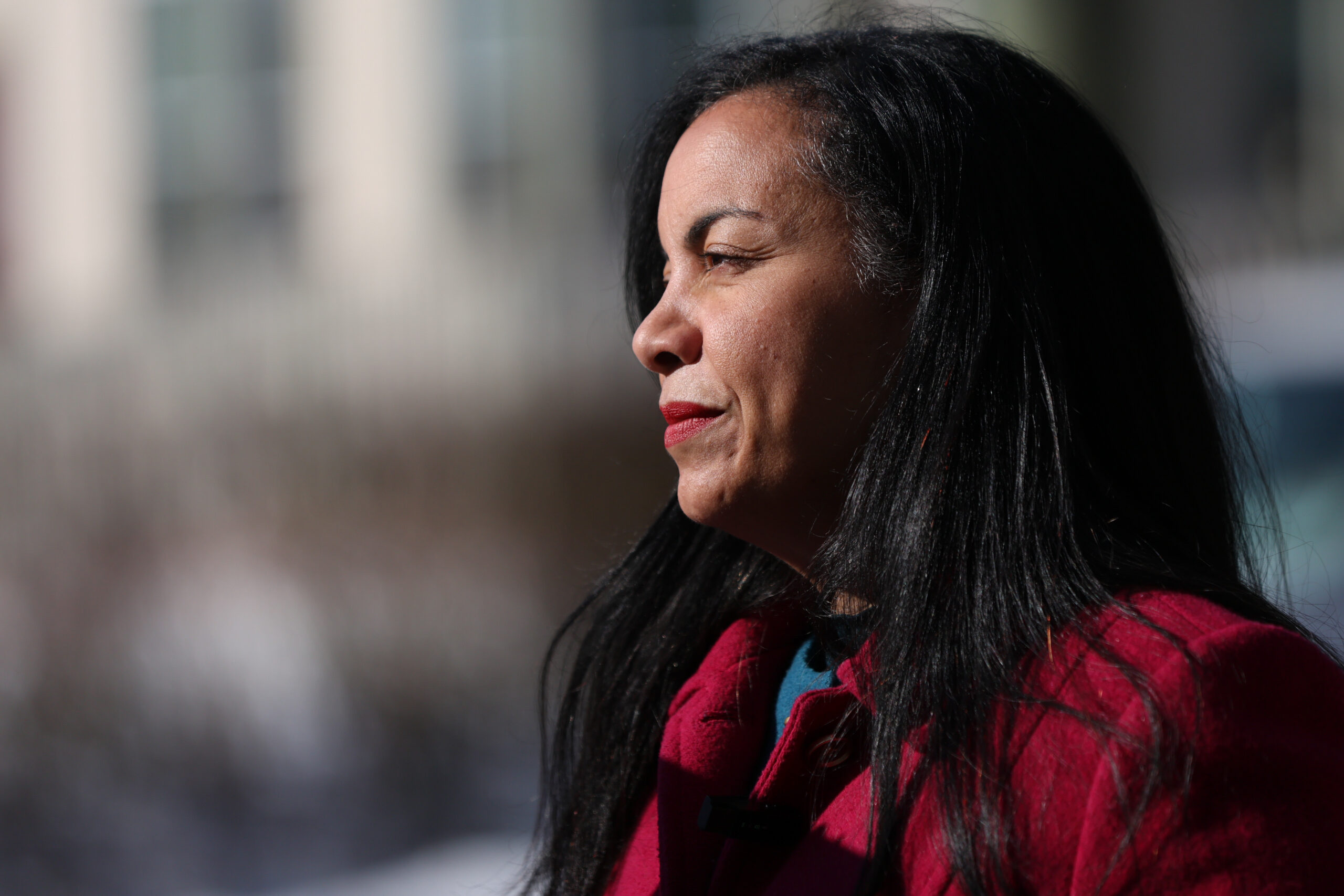
Rep.-elect Analilia Mejia (D-NJ) cruised to victory in last Thursday’s special election for New Jersey’s 11th Congressional District, but the results showed notable defections among Jewish Democrats — an early warning sign for both the left-wing Mejia and her party, Jewish Insider’s Marc Rod reports.
By the numbers: Mejia ran significantly behind other recent Democratic candidates in two municipalities that have traditionally strongly favored Democrats — Livingston Township and Millburn Township — both areas with significant Jewish populations. In Millburn, Mejia lagged 22 percentage points behind former Vice President Kamala Harris’ performance in the 2024 presidential election, and 17 percentage points behind Harris in Livingston.
SPEAKING OUT
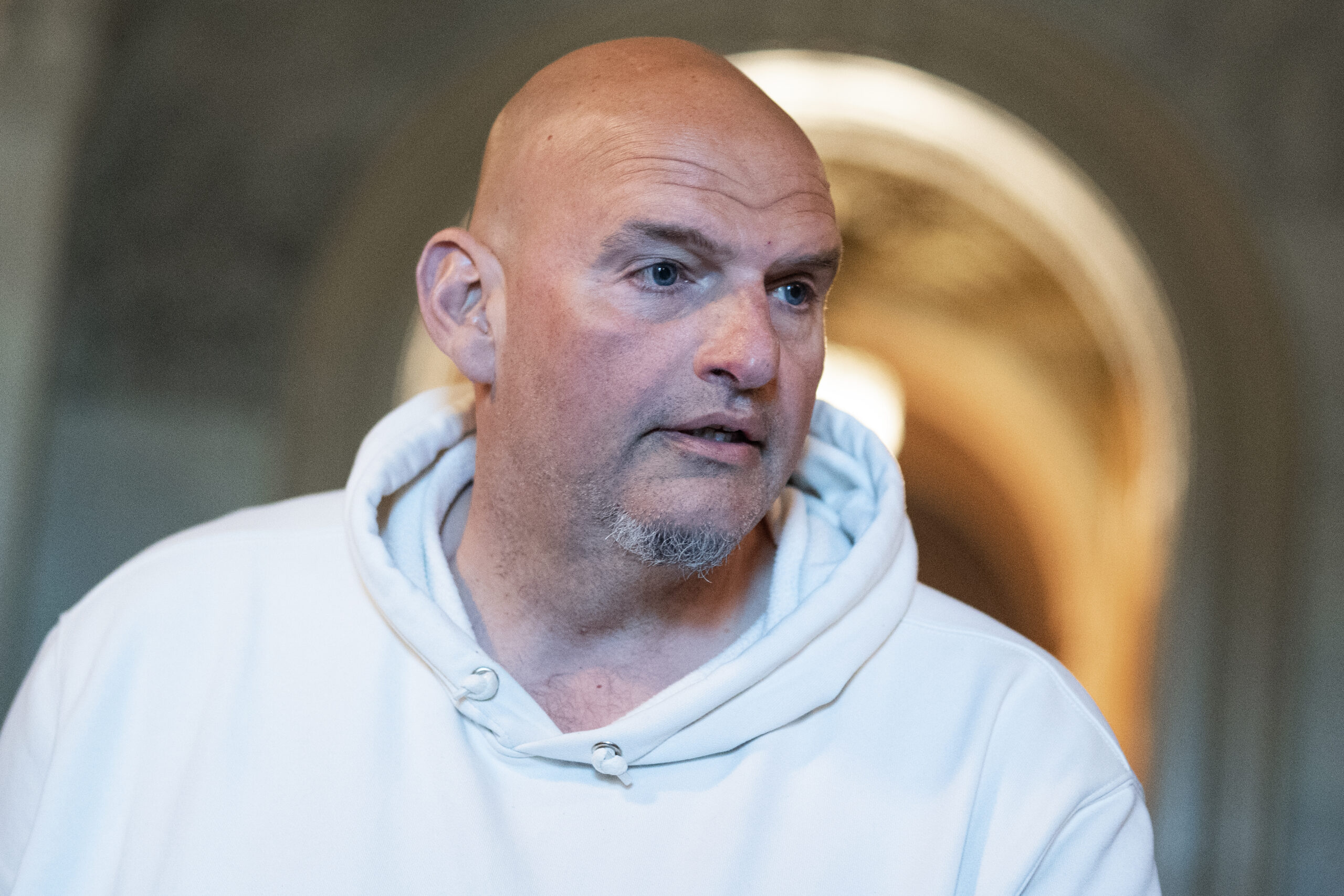
Sen. John Fetterman (D-PA) said on Friday that the Democratic Party “absolutely” has an issue with rising antisemitism, calling out the party’s embrace of candidates including Graham Platner in Maine and Abdul El-Sayed in Michigan while criticizing the recent progressive push to cut off defensive aid to Israel, Jewish Insider’s Emily Jacobs reports.
What he said: The Pennsylvania senator made the comments after being asked on CNN’s “The Arena with Kasie Hunt” if he believed the Democratic Party has a problem with antisemitism. Fetterman argued that the growing support for both candidates in their respective primaries was indicative of a tolerance for antisemitism within the party. “I mean, the guy that’s going to win the primary in Maine has a Nazi tattoo on his chest and now that’s no problem for a lot of voters,” Fetterman said.
IDENTITY CRISIS
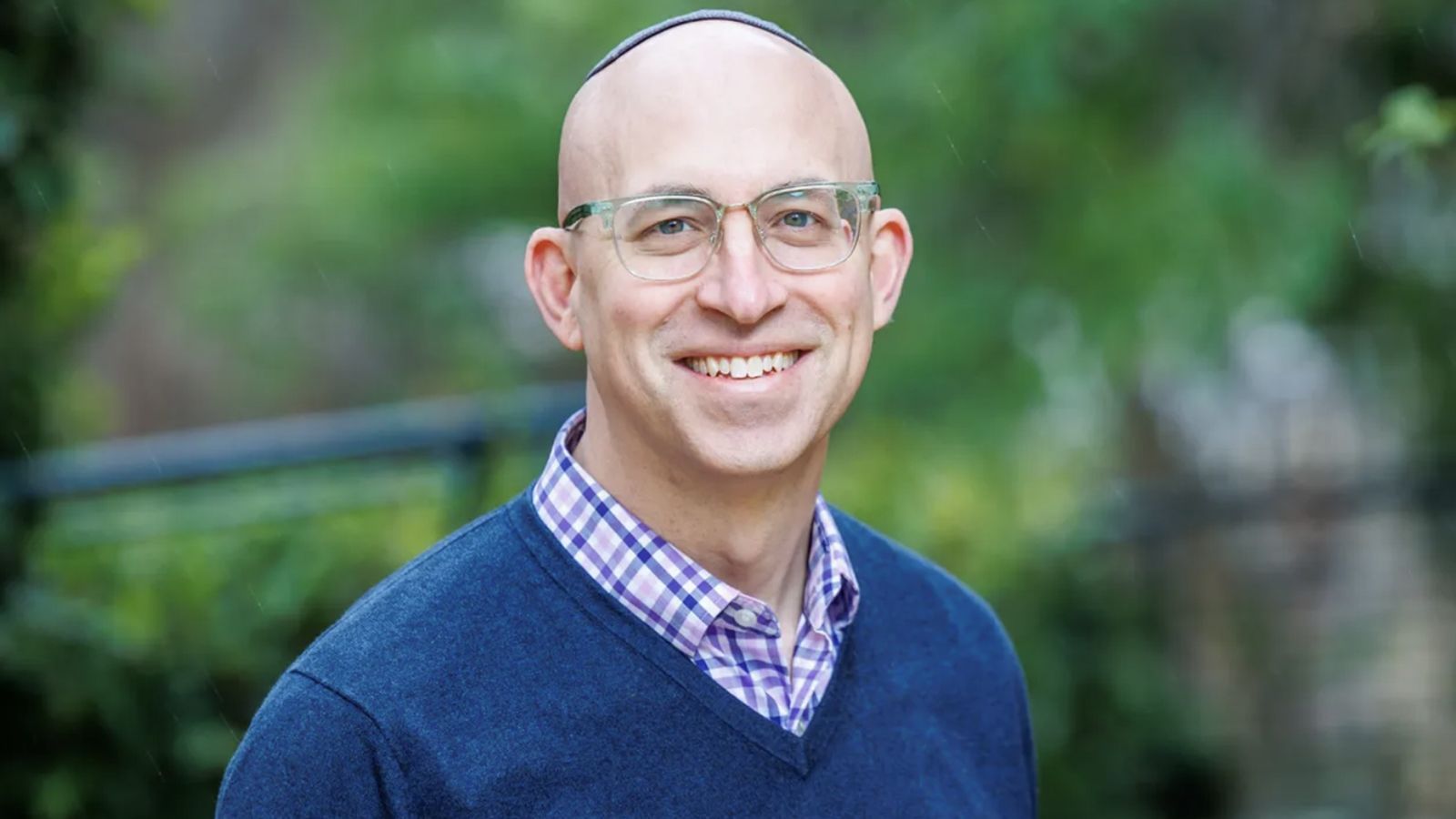
Amid a surge in antisemitism across the political spectrum, many American Jews have described feeling a growing sense of isolation. But for Yehuda Kurtzer, president of the Shalom Hartman Institute, being “politically homeless” is not a crisis to be solved, but rather a position to be embraced, Jewish Insider’s Matthew Shea reports.
A different perspective: “I don’t think some measure of political homelessness is a fundamentally bad thing,” Kurtzer said on Thursday while speaking alongside Jeffrey Goldberg, editor-in-chief of The Atlantic, at the Capital Jewish Museum in Washington. “I think Americans have become hyper-partisan in ways that reflect that partisan political identity has become part of our identities in ways that are not healthy for Americans.” Kurtzer and Goldberg sat in conversation at an event focused on American Jewry ahead of the upcoming 250th anniversary of the founding of the United States.
the view from israel

A weekend of diplomatic turbulence has deepened fault lines in Israel over the ceasefires in Lebanon and Iran, with public opinion split along political lines over whether President Donald Trump is serving Israeli interests — or overriding them. Trump’s announcement of a ceasefire in Lebanon on Thursday, before any known progress had been made in talks between Jerusalem and Beirut toward dismantling Hezbollah, already made waves in Israel, Jewish Insider’s Lahav Harkov reports.
Tough talk: Israeli Prime Minister Benjamin Netanyahu said on Friday that “we have not yet finished the job,” but said Israel was “provid[ing] an opportunity to advance an integrated diplomatic and military solution with the Lebanese government,” at Trump’s request. Within an hour of the release of Netanyahu’s statement, Trump published a Truth Social post in which he “PROHIBITED” Israel from continuing to bomb Hezbollah targets, adding: “Enough is enough!!!” Shira Efron, a senior fellow at RAND who serves as the think tank’s distinguished chair for Israel policy, told JI that “there is no question that the tone – ‘prohibited’ in upper case, ‘enough is enough’ – struck a sensitive note in Israel, and people are talking about a vassal state.”
Under pressure: Rep. Brian Fitzpatrick (R-PA), a moderate Republican and co-chair of the House Problem Solvers Caucus, introduced a war powers resolution on Thursday that aims to enforce the deadlines for the war in Iran laid out in the 1973 War Powers Act, breaking with all Republicans except Thomas Massie (R-KY) JI’s Marc Rod reports.
ENVOY SPOTLIGHT
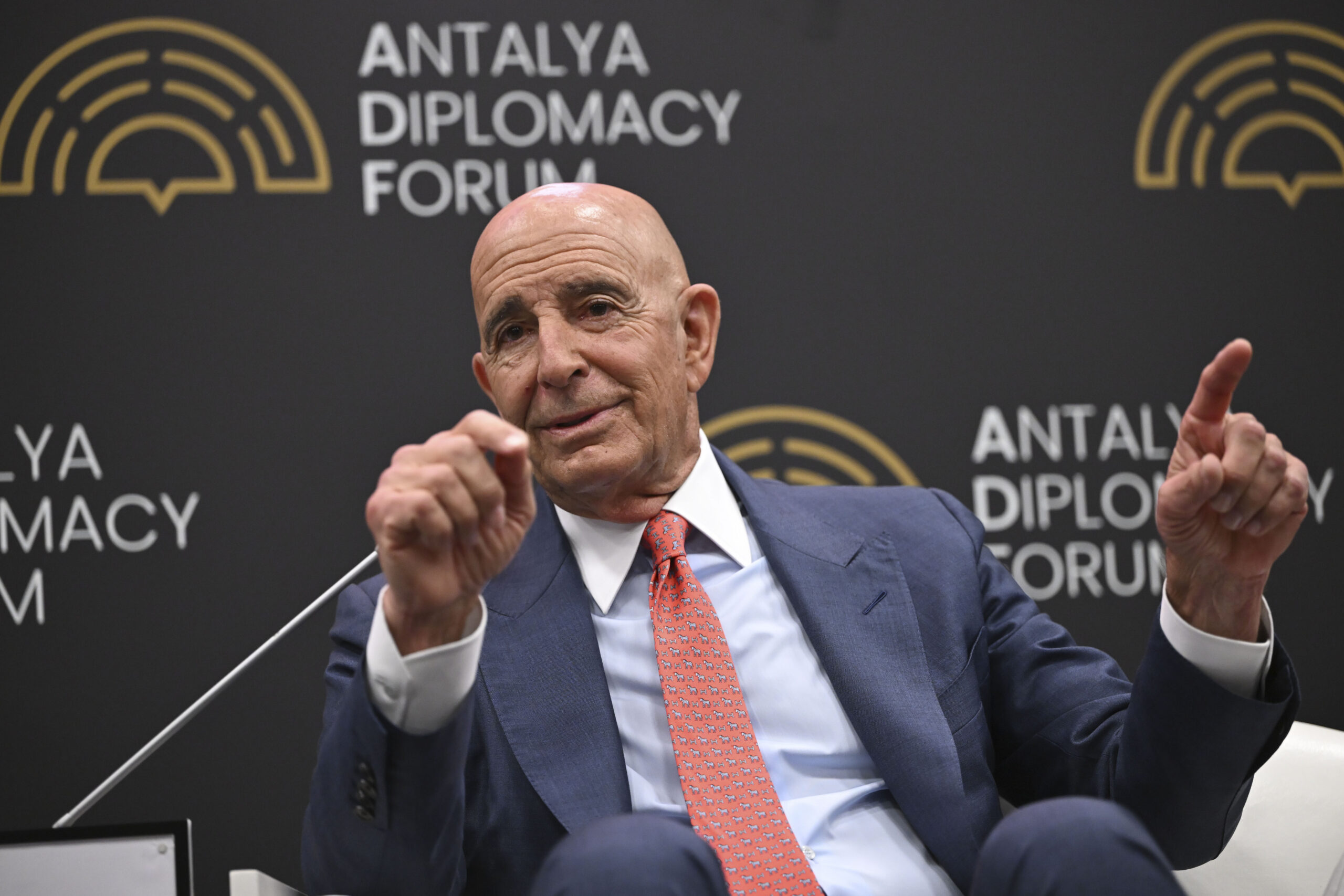
U.S. Ambassador to Turkey Tom Barrack faced fresh condemnation from two Senate Republicans and conservative influencers for a series of comments he made at the Antalya Diplomacy Forum in Turkey this weekend in which he repeatedly criticized Israel and praised Ankara, Jewish Insider’s Marc Rod reports.
Hezbollah hiccups: To comments by Barrack claiming that the current ceasefire in Lebanon “is so delicate because everybody has been equally untrustworthy” — referring to both Israel and Hezbollah — Sen. Lindsey Graham (R-SC) said he “respectfully and strongly disagree[s].” Barrack said at the conference there needs to be “a path with Hezbollah, and that path has to be not killing Hezbollah.” He further dismissed the idea that the Lebanese Armed Forces would act to disarm Hezbollah, as is required under the terms of the current and past ceasefires. “I always get in trouble because Hezbollah, in American parlance, and most of the West, is a foreign terrorist organization. Hezbollah, in Lebanon, is also a political organization,” Barrack added.
UNITING THE GLOBAL LEFT
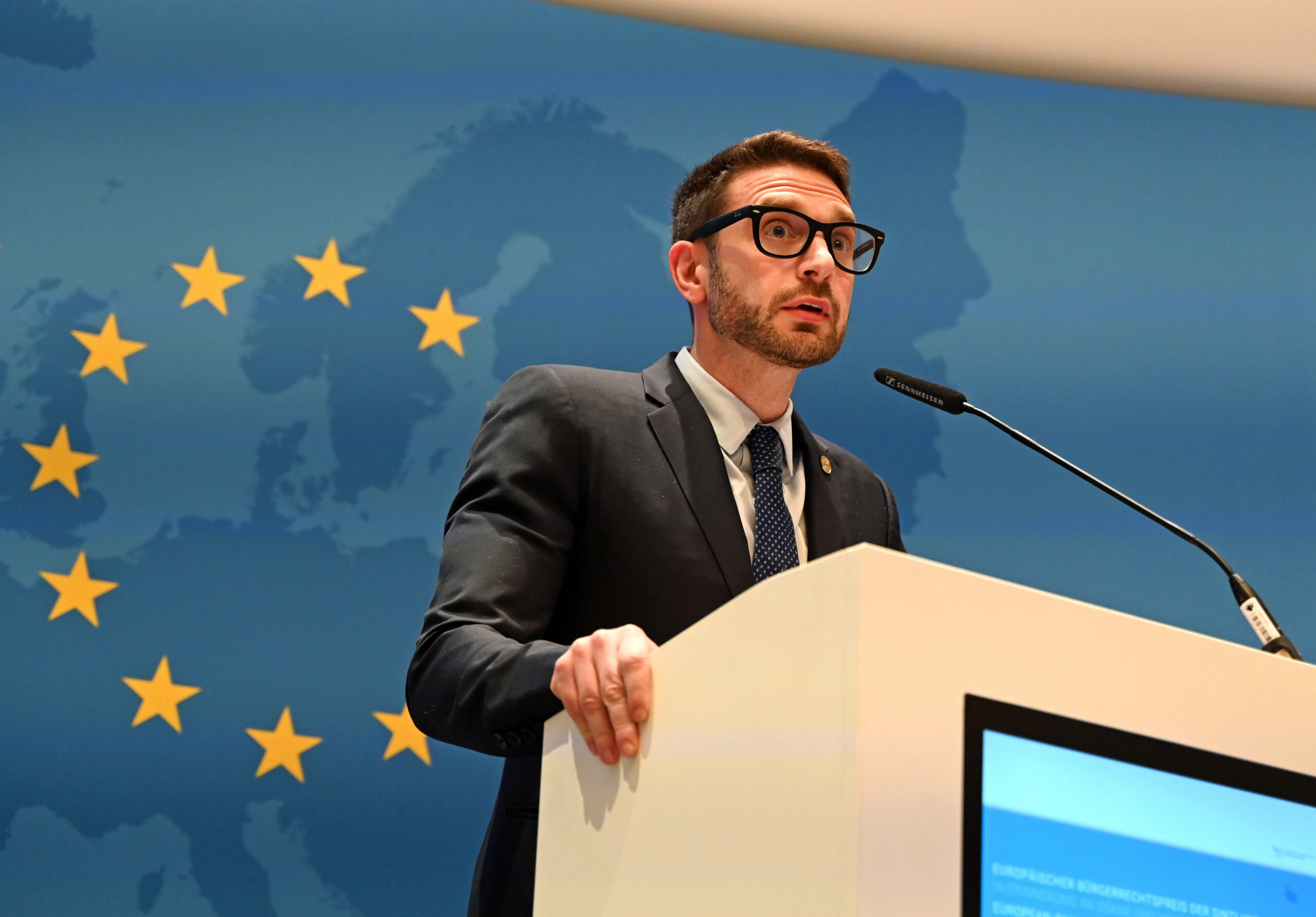
A range of Israel critics, from Sen. Chris Murphy (D-CT) to Israeli lawmaker Ahmed Tibi, were among those gathered in Barcelona, Spain, over the weekend for the inaugural Global Progressive Summit, backed by left-wing philanthropist Alex Soros. The conference brought together representatives from over 40 countries, offering, according to its website, “a necessary alternative to conservative and far-right forces,” Jewish Insider’s Lahav Harkov reports.
In attendance: Spanish Prime Minister Pedro Sánchez, an outspoken critic of Israel who called on Saturday to downgrade EU-Israel relations, hosted the two-day conference, whose American attendees also included Minnesota Gov. Tim Walz, with Soros. Sen. Bernie Sanders (I-VT), New York City Mayor Zohran Mamdani and former Secretary of State Hillary Clinton sent video messages. South African President Cyril Ramaphosa, whose government petitioned the International Criminal Court to prosecute Israeli leaders, Brazilian President Lula de Silva and U.K. Justice Secretary David Lammy were also in attendance.
Worthy Reads
Dumb and Dumber: The Atlantic’s Yair Rosenberg explores the expanding platforms of influencers and public figures who are uneducated on the issues about which they speak and unchallenged by interviewers. “Talking with Piker about a political coalition to save American democracy without discussing his affinity for China’s rulers is like teaming up with Carlson without interrogating his praise for Russian President Vladimir Putin — or with Donald Trump without examining his outlook toward Israeli Prime Minister Benjamin Netanyahu. And yet, only the debate over the latter tends to happen, such that Israel crowds out all other considerations, including extremely consequential beliefs that can end up going unchallenged.” [TheAtlantic]
It’s All Relative: In The Washington Post, the American Enterprise Institute’s Danielle Pletka raises concerns about the presence of relatives of officials from American adversaries who are living in the U.S., amid an effort to deport some of those family members. “The U.S. is littered with other nepo babies, wives and cousins — what the Iranians and Arabs call aghazadeh and the Russians call mazhor — enjoying the privileges of living in the land of the free, often made possible by the ill-gotten gains of the fam back home. It’s little wonder why they came. … It turns out the easiest route is through higher education, with some institutions explaining outright how F-1 student visa holders can transfer to permanent status upon graduating.” [WashPost]
Dropping the Trump Name: The New York Times’ Eric Lipton spotlights an effort by the wealthy Khayyat family in Syria to influence U.S. foreign policy in Syria through the Trump family’s business dealings. “Such a mixing of personal and diplomatic affairs has long been the norm in Middle Eastern nations, where a small set of players have historically run, and profited from, their dominant role in society. But it has become the way Washington operates in Mr. Trump’s second term, too. … [A friend of Mohamad Al-Khayyat, Syrian American businessman Tarek] Naemo, who is based in Florida and runs an investment firm that he said had done deals with partners including the Qatari Investment Authority, began with his wife to court at least a dozen members of Congress, starting with Speaker Mike Johnson.” [NYTimes]
Word on the Street
President Donald Trump nominated Under Secretary of Agriculture Luke Lindberg to serve as the next head of the World Food Program, following Cindy McCain’s announced departure from the role over health issues…
The New York Times looks at divisions within the conservative campus movement in the wake of Turning Point USA founder Charlie Kirk’s assassination in September, finding that members of some campus chapters and breakaway groups are split “over support for Israel, the showcasing of conspiracy theorists and who is rightfully American,” as well as disagreements over the war against Iran…
Buckley Carlson, the son of Tucker Carlson, departed his role as deputy press secretary to Vice President JD Vance to start his own consulting firm…
Commerce Secretary Howard Lutnick was spotted with Philadelphia 76ers owner Josh Harris as the 76ers took on the Boston Celtics in Massachusetts over the weekend…
Authorities in Los Angeles arrested an Iranian woman with permanent U.S. residency status accused of brokering sales of Iranian weapons to the Sudanese Armed Forces for use in the African country’s yearslong civil war…
A George Washington University alumna is suing the school and her former employer, Ernst & Young, as well as a number of GWU officials, alleging that she faced retaliation and discrimination in the wake of an address she delivered at one of the school’s 2025 commencement ceremonies; her remarks calling for GWU to divest from Israel deviated from those approved by the school…
Rümeysa Öztürk, the Tufts University graduate student who was detained for more than a month by immigration officials for co-authoring an op-ed critical of Israel, is returning to Turkey, having completed her Ph.D. studies at the Boston-area school…
The New York Times reviews When We See You Again, Rachel Goldberg-Polin’s account, which will be released tomorrow, of her life before and after the 2024 death of her son, Hersh Goldberg-Polin, at the hands of his Hamas captors…
Canada’s Centre for Israel and Jewish Affairs, with the backing of more than 80 Jewish groups, is calling on the federal government in Ottawa to increase funding to address “rising security demands” as the country sees a sharp increase in antisemitism…
A French peacekeeper was killed and three others members of UNIFIL, the U.N.’s peacekeeping force in Lebanon, were injured in what France and UNIFIL said was a Hezbollah attack; French President Emmanuel Macron, whose government was sidelined from recent U.S.-brokered talks between the Lebanese and Israeli ambassadors to Washington, called on Beirut to “immediately arrest those responsible and assume their responsibilities alongside UNIFIL”…
An appeals court in France ruled than an Algerian-born nanny who worked for a French Jewish family was not acting out of antisemitism when she poisoned family members, despite having told police, “Because they have money and power, I should never have worked for a Jewish woman; she only brought me trouble”; the woman was sentenced to two-and-a-half years in prison, less than if she was found to have been motivated by antisemitism…
Kanye West’s upcoming concert in Poland, which was slated to take place in June, was called off by organizers, one of whom cited “formal and legal reasons,” weeks after West’s planned concerts in France and the U.K. were also cancelled amid public outcries over his past antisemitic comments…
Helen Mirren, Skylar Astin and Liev Schreiber were among more than 1,000 signatories to an open letter organized by Creative Community for Peace in support of Israel’s continued participation in the Eurovision Song Contest…
U.K. Chief Rabbi Ephraim Mirvis decried the “sustained campaign of violence and intimidation” targeting British Jews amid a series of attacks on Jewish communities around the country…
Mirvis’ statement came shortly before the arrest of two teenagers in connection with an arson attack that caused minor damage to London’s Kenton United Synagogue; British authorities are investigating whether the recent spate of attacks targeting Jewish sites in the country is linked to Iran…
A British court rejected an effort by the International Centre of Justice for Palestinians to issue a summons for a dual U.K.-Israeli citizen who traveled to Israel on Oct. 8, 2023, to rejoin his unit as a reservist in the wake of Hamas’ deadly attacks the day prior…
Sixteen Arab and Muslim countries — including Saudi Arabia, Jordan and Egypt, but excluding Abraham Accords signatories the United Arab Emirates, Morocco and Bahrain — signed onto a Qatar-led statement condemning Israel for appointing former Israeli Ambassador to Kenya Michael Lotem as the country’s first ambassador to Somaliland, four months after Jerusalem recognized the African state…
The New York Times explores the impact of the war in Iran on Qatar and other U.S.-allied Gulf nations, finding Doha [t]rapped between their chief ally and their neighbor” and now being “forced to rethink their security strategies”…
The UAE’s minister of state for international cooperation said that 90% of the sites struck in the Gulf nation by Iran over the course of the recent conflict were civilian infrastructure; Reem Al Hashimy said that approximately 2,800 missiles and drones launched by Iran had hit targets in the UAE…
The governor of the UAE’s central bank, who met last week in Washington with Treasury Secretary Scott Bessent, introduced the possibility of working with Washington to create a currency-swap line as a potential financial backstop should the Gulf state face further economic challenges…
Iran said it executed two people alleged to have collaborated with Israel’s Mossad…
The IDF released a map showing the Lebanese territory under its control as it fights against Hezbollah in the southern part of the country…
IDF spokesperson Lt. Col. Nadav Shoshani said the military was conducting an investigation following the surfacing of a photo in which an IDF soldier is pictured desecrating a statue of Jesus in the southern Lebanese Christian village; Israeli Prime Minister condemned the incident, saying he “was stunned and saddened” and that Israel “express[es] regret for the incident and for any hurt this has caused to believers in Lebanon and around the world”…
Senior Hamas officials confirmed to The New York Times that the terror group was willing to relinquish some of its weapons to the Palestinian administrative committee operating under the Trump administration’s Board of Peace…
Israeli Olympic silver medalist Raz Hershko won gold in her weight class at the European Judo Championships in Tbilisi, Georgia…
Pic of the Day

Yizhar Hess, vice chairman of the World Zionist Organization, hosted a reading on Sunday of Israel’s Declaration of Independence at the egalitarian section of the Western Wall in Jerusalem. Hess was joined by members of the Sydney Jewish community as well as former Israeli hostage Shoshan Haran.
Birthdays

Israeli model, swimwear designer and social media star, Neta Alchimister turns 32…
Stanford University professor and 2020 Nobel Prize laureate in economics, Paul Robert Milgrom turns 78… Chairman of the media networks division of Activision Blizzard, he previously held high-ranking roles at NFL Network, ESPN and ABC, Steve Bornstein turns 74… Philadelphia-based development professional, currently at AJC after a long career for a number of organizations, Andrew Demchick turns 70… Immigrants rights activist and professor at Salem State University, she is the eldest daughter of Noam Chomsky, Aviva Chomsky turns 69… Television and radio host, syndicated columnist and political commentator, Steve Malzberg turns 67… Past president and executive director of the D.C.-based Electronic Privacy Information Center, now at the Center for AI and Digital Policy, Marc Rotenberg turns 66… Author, journalist and former co-host of “The Femsplainers Podcast,” Danielle Crittenden Frum turns 63… Semi-professional race car driver and restaurateur, he was previously CEO, president and chairman of the Trust Company of New Jersey, Alan Wilzig turns 61… Television producer and game show host, known professionally as J.D. Roth, James David Weinroth turns 58… Israeli jazz bassist, composer, singer and arranger, Avishai Cohen turns 56… British film director, Sarah Gavron turns 56… Member of the U.S. House of Representatives, one of four Jewish Republican congressmen, Randy Fine (R-FL) turns 52… VP of government and public affairs at Cleveland-based GBX Group, a historic real estate development firm, Seth Foster Unger… Deputy associate administrator at the General Services Administration, Michael C. Frohlich… Chief philanthropy and leadership officer at the World Jewish Congress, Elliott G. Mendes… President and CEO at the Los Angeles-based Skirball Cultural Center, Jessie Kornberg turns 44… Former general manager of Bird in Israel, he is a nephew of Israel’s past president Reuven Rivlin, Yaniv Rivlin… ESPN sportscaster and former Fox Sports and NFL Network personality, Peter Schrager turns 44… New York-based national security and human rights lawyer, Irina Tsukerman… Co-founder of The Free Press and its head of strategy, Nellie Bowles turns 38… PM breaking news editor at CNN Politics, Kyle Feldscher… Policy advisor and counsel to U.S. Sen. Jack Reed (D-RI), Zachary L. Baum… Systems engineer at Google X, Joseph Gettinger turns 38… Facilitator, coach and workshop organizer, Daniela Kate Plattner… Research analyst at the U.S. Department of State during the Biden administration, David Mariutto… VP at Cedar Capital Partners, Alex Berman… CEO of Social Lite Creative and news anchor on ILTV, Emily K. Schrader… Israeli scientist, engineer and artificial intelligence researcher at Massachusetts Institute of Technology, Dr. Maor Farid turns 34… Working on advertising platforms at Apple, McKenna Klein… Senior associate at LvlUp Ventures, Andrew J. Hirsh… R&B, soul, pop singer and teen actress, at 13 she was the runner-up on the second season of “The X Factor,” Carly Rose Sonenclar turns 27… Diane Kahan…
As the new head of NYC’s leading business advocacy group, Fulop said he’s preparing for ‘this experiment of what it means to be an executive in a DSA world’
Eduardo Munoz Alvarez/Getty Images
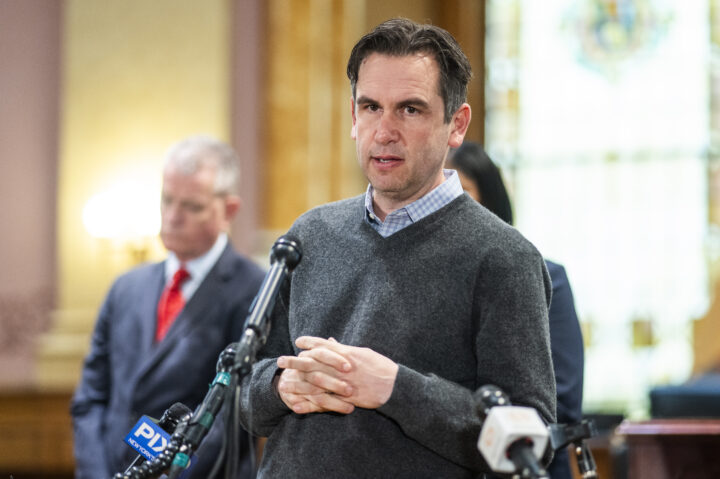
Jersey City Mayor Steven Fulop speaks during a press conference on April 11, 2025 in Jersey City, New Jersey.
As he settles into his role leading the Partnership for New York City, a prominent business advocacy group, Steve Fulop, the former longtime mayor of Jersey City, N.J., has a few major issues on his mind, chief among them countering the rise of antisemitism.
For Fulop, a Jewish Democrat who assumed his new job last month, just five days after he left office on Jan. 15, such efforts are not only personal as a former yeshiva student who was also the grandson of Holocaust survivors. They are directly connected, he explained to Jewish Insider, to promoting a friendlier climate where businesses can feel safe and welcome in the city.
Many of the Partnership’s Jewish board members, representing some of the city’s most powerful firms in finance, real estate and other leading sectors, also share his sense of urgency, Fulop said, as do many of the 800,000 employees who make up his group’s core constituency.
“They often say of the tax conversation that we could talk about whether people stay or go, if they migrate elsewhere,” Fulop said of his conversations with members in an interview with JI on Tuesday at his fifth-floor office in the Financial District, which looks out on Jersey City. “But if you continue on a trend where it feels like antisemitism is increasing and quality of life is decreasing, that is a trigger for people to leave very, very fast.”
Citing statistics from January that showed a sharp, year-on-year uptick in antisemitic incidents in New York City, Fulop emphasized that the city now finds itself on an “alarming” track. “Those are things that will push people to leave immediately,” he warned.
“Obviously you have a fringe far left that often says antisemitic things and has normalized it, and that’s not OK,” he said. “If it continues on a trajectory, we will be vocal on it.”
Fulop said that he has met with New York City Mayor Zohran Mamdani “multiple times,” and described their discussions as “very positive and pleasant,” despite clear differences on hot-button topics ranging from support for Israel to proposed tax hikes on wealthy New Yorkers.
“To be honest with you, I don’t think we’re going to agree on everything,” he told JI, “but we do try to find places where we agree,” including such shared affordability issues as “housing growth” and child care.
Speaking from his own experience as a former Democratic “outsider” who also rose to mayor in his 30s, Fulop, who turns 49 next week, acknowledged that Mamdani has a “tough job” as he faces pressure from his far-left base in the Democratic Socialists of America, which has aggressively pushed boycotts of Israel. “There is clearly antisemitic rhetoric coming from that base,” Fulop said.
“Even if he’s not sympathetic to some of them, his base is very vocal,” Fulop said. “That’s going to be something that we pay attention to, when you start talking about some of the rhetoric around the BDS language, where the left pushes, and how [Mamdani] stands up to them,” he elaborated, referring to the Boycott, Divestment and Sanctions movement targeting Israel. “It’s early days at this point.”
Fulop’s assessment underscores how the business community, in conjunction with Jewish leaders and others concerned about Mamdani’s policies, is now formalizing an approach to act as a bulwark against the mayor while navigating a new political landscape it views as largely inhospitable to its goals.
Even as he expressed a desire to be “helpful” to Mamdani, Fulop has also indicated that he will not hesitate to stake out more adversarial positions on key areas where they are not aligned. In November, for instance, he described Mamdani’s proposal for a corporate tax hike as “absolute suicide” for the city.
“The goal is to be more aggressive on tenor, not necessarily adversarial all the time,” he said. “To be clear that we think that a fragile city environment is at risk.”
Regarding the administration’s track record on Israel and antisemitism a month and a half into Mamdani’s tenure, Fulop voiced reservations in particular about the mayor’s skepticism of the partnership between Cornell University and Israel’s Technion on Roosevelt Island, which Mamdani’s team had suggested during the campaign he would review.
“We think that would be shortsighted and a double standard to Israel,” Fulop, who said he held a call “with some people affiliated with the partnership” to discuss the situation last week, told JI. “Singling out one country that happens to be the Jewish state is, I don’t think, OK with anybody.”
In his final days as mayor, Fulop signed executive orders banning Jersey City from engaging in BDS and regulating the kinds of protests outside houses of worship that Mamdani has struggled to condemn decisively as mayor.
“The guy following me wants to be like Mamdani, but he’s less charismatic,” Fulop said of his mayoral successor, James Solomon, a progressive Democrat. “I thought that there was risk, and better off putting guardrails in place — because you don’t know where things go.”
During an unsuccessful Democratic primary campaign for governor of New Jersey last year, Fulop had criticized efforts to legally codify the International Holocaust Remembrance Alliance’s working definition of antisemitism. But he said he believed that Mamdani had made a strategic error when, on his first day as mayor, he swiftly revoked — as part of a blanket repeal of all of former Mayor Eric Adams’ executive orders following his September 2024 indictment on federal corruption charges — an executive order that had adopted the definition in the city, along with an order prohibiting BDS in city agencies.
“It obviously elevated the idea that the incoming administration is anti-Judaism,” he told JI, saying he is closely monitoring Mamdani’s next steps amid rising rates of antisemitism the mayor has vowed to confront.
Fulop said that the Partnership’s board members, who met with Mamdani during the campaign as he drew criticism over his refusal to condemn calls to “globalize the intifada” and rejection of Israel’s right to exist as a Jewish state, remain worried about his hostile views on Israel and commitment to fighting antisemitism. “Very, very very, very” worried, Fulop said.
Mamdani’s office did not respond to a request for comment from JI.
Eric Goldstein, the CEO of UJA-Federation of New York, which was among the first groups that Fulop met with when he took over the Partnership, said he looked “forward to working with” the former mayor.
“Steve brings a strong record of public service, principled leadership and a commitment to civic responsibility,” he told JI. “We also support and appreciate Steve’s deep support of Israel’s existence as a Jewish homeland and commitment to fighting antisemitism and the delegitimization of Israel.”
Now that he is no longer a politician, Fulop, a former Goldman Sachs banker and Marine veteran who recently relocated to Hell’s Kitchen across the river from Jersey City, is appreciating his time away from elected office, he said.
“It’s a little bit of a different world not being on the elected side, which I’m thankful for, to be honest,” he told JI. “We’re in a very polarized environment here for people in elected office. So, for me, I think this is kind of a sweet spot of advocacy and impact without some of the headaches of being in elected office.”
Fulop praised his predecessor, Kathy Wylde, the former longtime Partnership leader who reportedly faced internal backlash from members who felt that she was too deferential to Mamdani. But the group finds itself in a moment “where we need to be more assertive with both our actions and voice,” he said, noting that he is seeking to focus on a “very narrow subset” of advocacy issues, including antisemitism.
To that end, he says he is expanding the group’s political advocacy arm, hiring an executive director to help steer its current $10 million in reserves, on top of lobbying, research and a venture capital fund.
“I think we have a reasonable, centrist message that most people agree with — whether it’s antisemitism or homeless encampments,” he explained. “I think we’re in a place where most people would say, ‘You know what? What they’re saying kind of makes a lot of sense.’”
New York City is now “in a unique time and space,” Fulop told JI. “We haven’t seen a socialist mayor of prominence anywhere in this country for decades.”
“The Partnership has a significant voice in that,” he said. The city is “going to be front and center in this experiment of what it means to be an executive in a DSA world.”
If elected in January, Menin would be the first Jewish speaker of the New York City Council
Lev Radin/Pacific Press/LightRocket via Getty Images
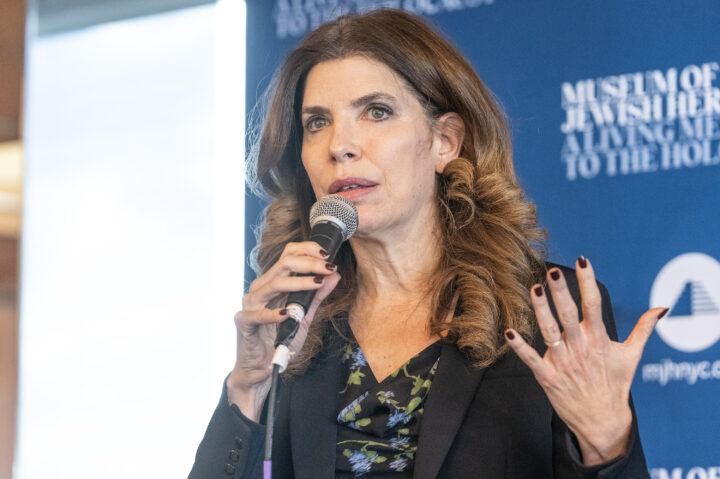
Council member Julie Menin speaks during rally of 240 Holocaust survivors for 240 hostages kidnapped by Hamas during terrorist attack on Israel on October 7, 2023.
Julie Menin, a moderate Jewish Democrat from Manhattan who last week declared an early victory in the New York City Council speaker race, is widely expected to serve as an ideological counterweight to the incoming administration of Mayor-elect Zohran Mamdani, a democratic socialist hoping to advance a range of far-left agenda items.
Some of their biggest clashes could stem from their sharply opposing views on Israel and antisemitism.
Menin, who would be the Council’s first Jewish speaker if officially elected in January during an internal vote, is an outspoken supporter of Israel and visited the country on a solidarity trip months after Hamas’ Oct. 7, 2023, attacks. The daughter of a Holocaust survivor, Menin, 58, has advocated for Holocaust education funding and warned of rising antisemitism as a three-term city councilwoman.
For his part, Mamdani, a 34-year-old Queens state assemblyman, has long been a detractor of Israel — whose right to exist as a Jewish state he has refused to recognize. He has said that he will not participate in the Israel Day parade up Fifth Avenue, which Menin regularly attends, and indicated that he could move to enact some policies aligning with the Boycott, Divestment and Sanctions movement targeting the Jewish state, even as he has also promised to protect Jewish New Yorkers by calling for a major increase in funding to prevent hate crimes, among other measures.
Their diverging approaches to such issues were on display late last month, when Menin and Mamdani each shared contrasting statements responding to a demonstration outside of a synagogue in her district during an event about immigration to Israel.
While Mamdani admonished the synagogue for promoting “activities in violation of international law,” a comment he revised after facing backlash, Menin condemned the protest as “not acceptable,” saying “congregants must have the right to worship freely and to enter and exit their house of worship without impediment.”
Jewish community leaders suggested that Menin, whose district includes a wide swath of the Upper East Side, could find herself at odds with Mamdani if he chooses to act on some of his campaign pledges that raised red flags among pro-Israel advocates. The mayor-elect has said, for instance, he intends to revoke the city’s embrace of a working definition of antisemitism used by the International Holocaust Remembrance Alliance. He has also indicated he will reassess the partnership between Cornell University and Israel’s Technion, potentially kicking the joint Cornell Tech campus out of its home on Roosevelt Island, which sits in Menin’s district.
A spokesperson for Menin said that she was not available for an interview with Jewish Insider on Monday.
In a recent conversation with Errol Louis of NY1, Menin defended the Cornell-Technion partnership, saying that it has “created thousands and thousands of tech jobs.”
“I was just there last month. They’ve created hundreds of new tech companies, innovative tech companies that are now housed in New York City, that are really the future of our great city,” Menin added. “I think, look, we need to really try to come together on these issues, and I think it’s absolutely possible to do so.”
One Jewish leader close to Menin, who spoke with JI on condition of anonymity to address a sensitive issue, said that “the community sees her as a check and a safeguard” against Mamdani’s administration and that she “understands the historical importance of this moment,” as she is poised to become the first Jewish speaker. “She is a proud Jewish woman who represents a proud Jewish district.”
Still, the Jewish leader noted, Menin is “not the type to look for any fights,” stressing she is more likely to first seek common ground on divisive issues, unless she has “no choice but to push back.”
In recent public statements, Menin has struck a collaborative tone in regard to Mamdani, who will be the city’s first Muslim mayor, stressing their shared focus on affordability goals such as universal childcare, one of the mayor-elect’s top priorities.
Menin announced last week that she had secured enough backing to become the next speaker, touting votes from at least 36 members of the council. Though allegiances could shift in the coming weeks, Menin, who added endorsements Monday, is not expected to fall below the minimum threshold of 26 votes required to win in the 51-seat body. Her chief rival, Crystal Hudson, a progressive from Brooklyn who was seen as more closely aligned with Mamdani’s agenda, conceded the race last week.
In a statement last Wednesday, Menin, who did not make an endorsement in the mayoral race, said she was “honored and humbled by the trust and faith that my colleagues have put in me to lead the City Council as a force of action for New York families.”
“With this broad five-borough coalition, we stand ready to partner with Mayor-Elect Mamdani’s administration and deliver on a shared agenda that makes New York more affordable through universal child care, lowers rent and health care costs and ensures that families across the city can do more than just get by,” she continued.
A spokesperson for Mamdani, who did not publicly take sides in the speaker race, did not respond to a request for comment on Monday.
Dora Pekec, a spokesperson for the mayor-elect, said in a statement last week that Mamdani “looks forward to working with her and the entire City Council to deliver on our affordability agenda for New Yorkers.”
Lynn Schulman, a Jewish councilwoman from Queens and an ally of Menin, said she believed her colleague “will be an excellent speaker” and “fair to everybody,” especially as she prepares to negotiate a massive, $116 billion budget.
“The Council is made up of a very broad and diverse group,” she told JI. “I think that there is going to be a lot of collaboration. Julie is someone who’s always brought a lot of people together. We have to work as a collegial body.”
Sydney Altfield, CEO of Teach Coalition, an Orthodox advocacy group, said that she was “encouraged” that Menin locked up a super majority among council members, adding that she had “worked closely” with the likely speaker and trusts “she is someone who can turn policy into progress.”
“As New York moves forward with a Muslim mayor, a Catholic governor and now the potential of a Jewish council speaker, we have the chance to see something powerful,” Altfield said in a statement to JI. “Leaders from every faith standing shoulder to shoulder for our children.”
Despite looming tensions over Israel, Sara Forman, executive director of New York Solidarity Network, a local pro-Israel group, said it was “premature” to speculate about any possible friction with Mamdani, focusing instead on how Menin is poised to become the first Jewish speaker — which she called “hugely significant in this moment” of rising antisemitism.
“It gives the community some reassurance moving forward that there’s somebody just like us,” Forman said.
Like the retiring congressman, New York Assemblyman Micah Lasher endorsed the anti-Israel mayoral nominee
Tasos Katopodis/Getty Images
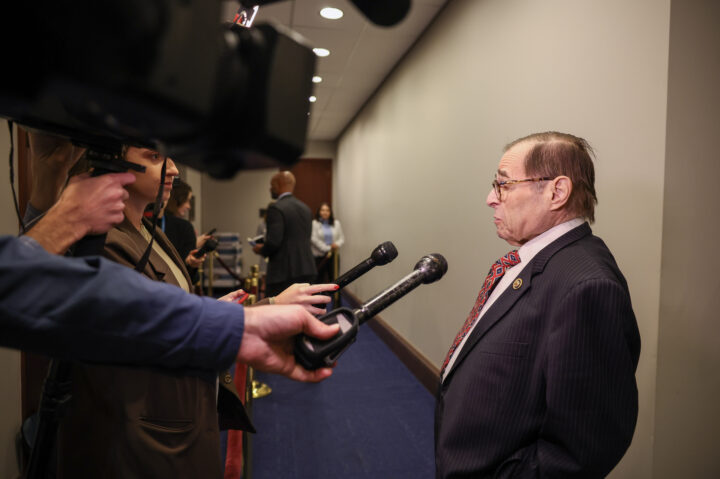
Rep. Jerry Nadler (D-NY) speaks to the media before as closed door meeting at Capitol Hill on November 13, 2024 in Washington, DC.
Rep. Jerry Nadler’s (D-NY) surprise decision on Monday to retire at the end of his current term has set off what is expected to be a crowded primary to succeed the long-serving Jewish Democrat — with a growing number of candidates weighing bids for the coveted Manhattan House seat he has held for more than three decades.
The looming open-seat primary has also raised questions about whether candidates will embrace Nadler’s increasingly skeptical views on Israel, and how the issue will shape the race. The 78-year-old lawmaker, who represents one of the largest Jewish constituencies in the nation, has long identified as a pro-Israel progressive, even as he has vocally criticized Israel’s conduct during its ongoing war in Gaza and drew scrutiny from some Jewish community leaders over his early endorsement of Zohran Mamdani, the far-left Democratic nominee for mayor of New York City.
In an interview first announcing his retirement on Monday, Nadler, the dean of New York’s congressional delegation, told The New York Times that he believed Israel was committing mass murder and war crimes in Gaza “without question,” and said he would back efforts to withhold offensive weapons transfers to Israel during the rest of his term — in a sharp break from his previous stance on continued military aid to the Jewish state.
It remains to be seen how Nadler’s approach will influence the race. The list of potential candidates includes Micah Lasher, a Jewish assemblyman who is expected to claim Nadler’s blessing, according to people familiar with the situation. Lasher, a former aide to Nadler, has built strong ties to the pro-Israel community, but he faced backlash from local rabbis over his similarly quick choice to support Mamdani, in spite of the nominee’s hostile views on Israel.
One Jewish leader said it was premature to draw conclusions about Lasher’s positions on Israel, while voicing confidence that he “makes up his own mind” on tough issues, regardless of where his allies may stand.
“Lasher is center-left but has always been relatively moderate on Israel,” a pro-Israel strategist added in assessing the assemblyman’s stances on the Middle East.
Still, “the Zohran thing threw a lot of people off,” another Jewish leader said of Lasher, 43. “I do worry with Micah that, because of the political pressures, he could end up turning himself into a Jerry.”
Lasher did not respond to a request for comment from Jewish Insider on Tuesday.
Despite speculation about his approach, Jewish activists and some Democratic strategists broadly suggested that the pro-Israel community would, by varying degrees, likely be comfortable with Lasher, in addition to other lawmakers from state and local office who are said to be mulling campaigns of their own in Nadler’s district, which covers Manhattan’s Upper West and East Sides.
Among them are two City Council members, Erik Bottcher and Julie Menin, who are also eyeing bids for state Senate and Council speaker, respectively. Menin, a Jewish Democrat, was among some local elected officials who chose not to attend a meeting with Mamdani this summer that had been organized by Nadler, a person familiar with the matter told JI. Keith Powers, a city councilman who recently lost a bid for Manhattan borough president and is looking at another open state Senate race, is also weighing a bid, sources said, as is Alex Bores, an assemblyman on the East Side.
“I commend Congressman Nadler for his years of public service,” Bores said in a statement shared with JI on Tuesday, indicating he is exploring a bid for the open House seat. “Rep. Nadler has always led with his convictions and cared deeply about his constituents; that is the exact kind of representation that the people of the 12th Congressional District deserve.”
Pro-Israel strategists indicated that they had more urgent concerns about another possible candidate, Lina Khan, the former commissioner of the Federal Trade Commission and a progressive icon who now lives in Harlem and has been “shopping around for a district for months,” according to a source familiar with the situation.
Khan, whose name has been floated as a potential candidate, could be a prolific fundraiser in a campaign, sources speculated. While she does not appear to have publicly addressed key Middle East questions, the anti-monopoly advocate has praised Mamdani’s campaign, raising early concerns that he would have a close and powerful ally in Congress if both are elected. Khan did not respond to a request for comment about her plans.
In addition to Khan, another prominent figure whose name has been privately mentioned in the days after Nadler’s unexpected announcement is Chelsea Clinton, according to people familiar with the conversations. Clinton has not confirmed her interest in the race to succeed Nadler but is actively considering a campaign after debating a run for an open City Council seat last cycle, said one person informed of her thinking. Her mother, former Secretary of State Hillary Clinton, voiced appreciation for Nadler in a social media post on Tuesday, after he officially announced his departure from the House.
Chelsea Clinton, 45, has been outspoken against antisemitism and would bring considerable name recognition to the race, though pro-Israel activists said they were largely unfamiliar with her views on Israel’s war in Gaza.
The primary is likely to draw outside spending from pro-Israel groups including AIPAC and Democratic Majority for Israel, both of which have engaged in a number of House races where divisions over Middle East policy have fueled mounting tensions amid the war in Gaza.
Brian Romick, chairman of DMFI’s political arm, DMFI PAC, said the group “will be watching closely as the field takes shape and look forward to meeting with the candidates.”
A spokesperson for AIPAC declined to comment on Tuesday.
Two potential candidates who would likely align most closely with AIPAC and are currently weighing bids include Natalie Barth, a philanthropist who has previously served as the president of Park Avenue Synagogue, and Elisha Wiesel, son of the Holocaust survivor and Nobel Peace Prize-winner Elie Wiesel, people familiar with their plans told JI.
Wiesel, who has been critical of Mamdani’s approach to Israel and antisemitism, had endorsed former Rep. Carolyn Maloney (D-NY) when she ran against Nadler in a bitterly contested primary three years ago.
Whitney Tilson, a former hedge fund executive who ran a failed campaign for New York City mayor as a moderate pro-Israel Democrat, is also considering a bid to replace Nadler, writing in a social media post on Tuesday that residents of the district, which had narrowly favored Mamdani in the primary, “have a special responsibility to lead the” fight against President Donald Trump, “defend the rule of law” and “support our allies, especially Israel and Ukraine.”
Shabbos Kestenbaum, a Jewish campus activist who has celebrated Trump’s crackdown on antisemitism, also confirmed to JI on Tuesday that he is weighing a campaign, saying he has been “encouraged to run by a group of New Yorkers from a broad ideological spectrum.”
“I am actively considering it,” he said. “If I can make a positive difference to my city and community, I would be foolish not to. There is a strong desire amongst New York Democrats for a return to normalcy. The party has steered too far to the left and I will help in any way I can, including running for office.”
Some observers have suggested that Rep. Dan Goldman (D-NY), a moderate Jewish Democrat whose deeply progressive district includes Lower Manhattan and parts of Brooklyn, could potentially jump over to Nadler’s race — where he could face a more friendly electorate and forestall challengers to his left.
But a spokesperson for Goldman, Simone Kanter, dismissed such speculation. “No truth at all, no idea where that’s coming from,” he told JI on Tuesday.
As the field takes shape, Nadler is already facing a younger challenger, Liam Elkind, who in his launch video in July called on the veteran congressman to retire to make room for a new generation of party leadership.
But Elkind, a 26-year-old nonprofit leader who is running on a broadly pro-Israel platform, is likely to face an uphill battle with the primary now expected to draw more well-known rivals with establishment credentials.
Please log in if you already have a subscription, or subscribe to access the latest updates.
 Continue with Google
 Continue with Apple