












































The three leading Democratic candidates agreed that the county can do better dealing with anti-Jewish hate
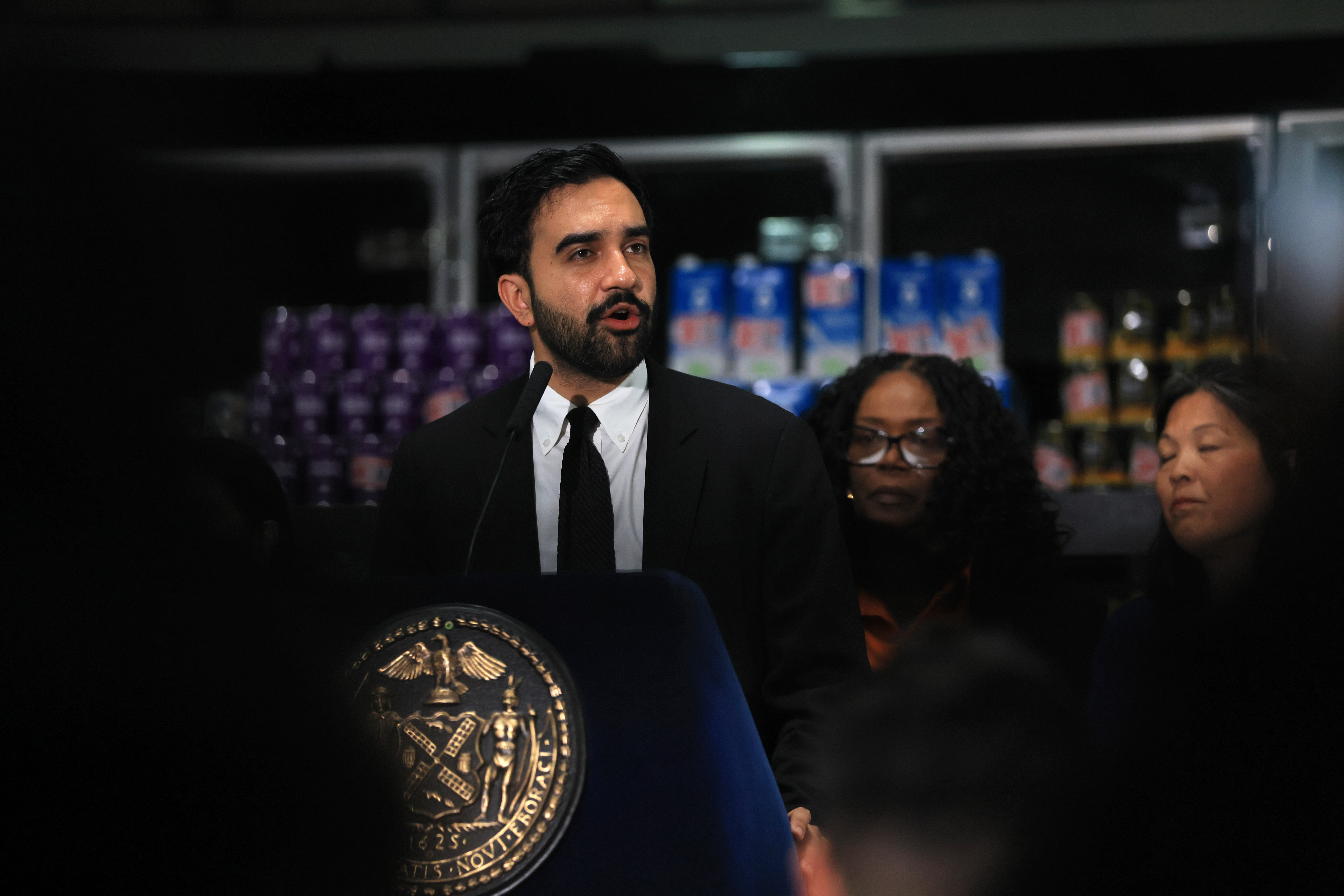
Robb Hill for The Washington Post via Getty Images
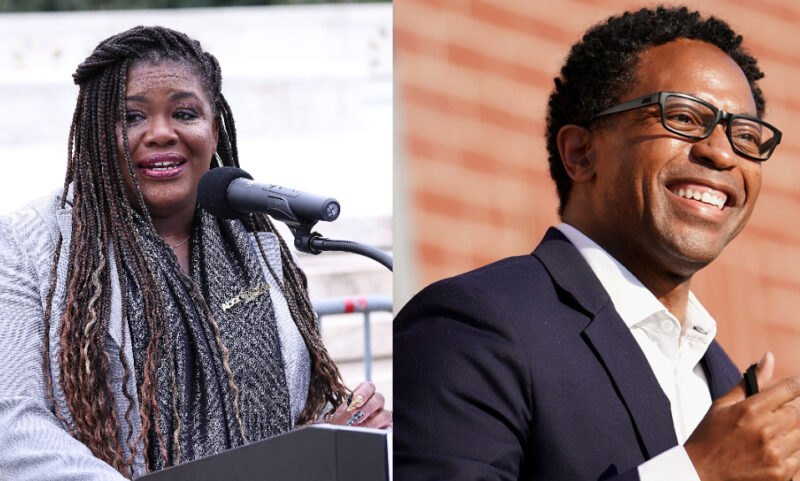
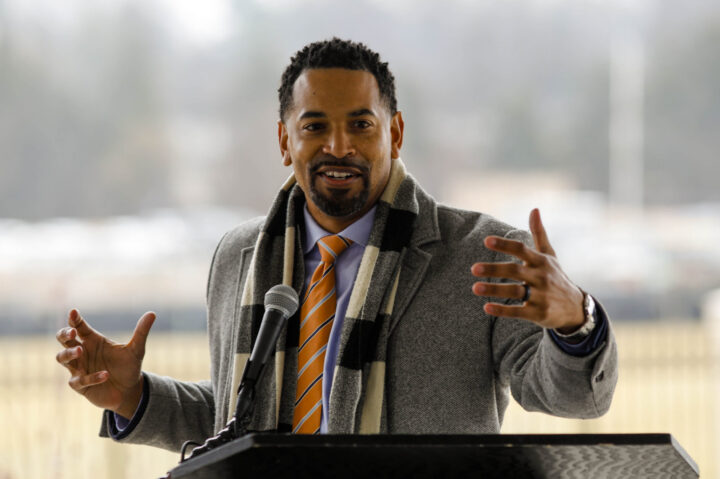
Will Jawando, of the Montgomery County Council, speaks at the dedication of the Phil Alperson Way on February 25, 2022.


 Add JewishInsider on Google
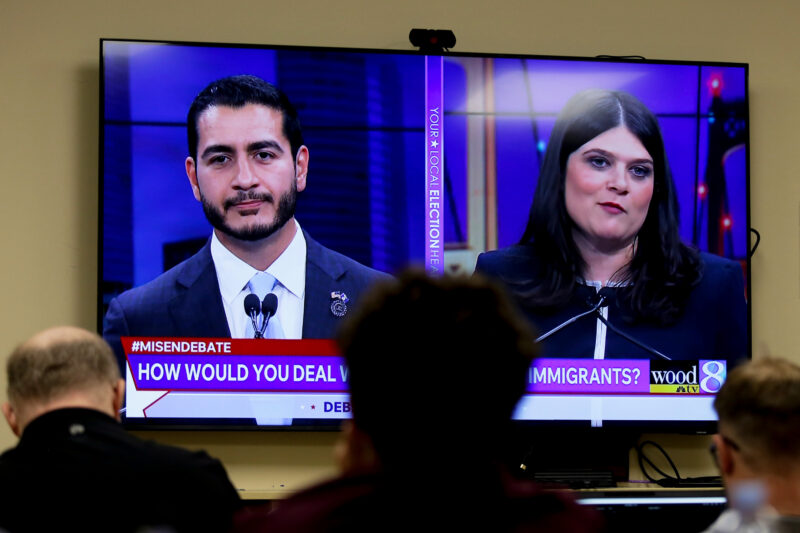
The three leading Democratic candidates in the race for executive of Montgomery County, Md., pledged to address the rise of antisemitism within the local school system, while some noted their disappointment that the school board has yet to adopt a Jewish group’s recommendations for doing so.
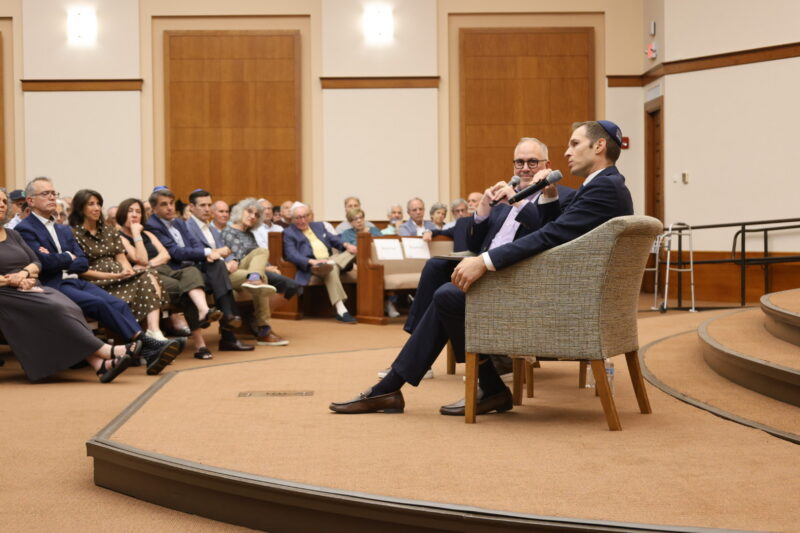
As the June 23 primary approaches, the Jewish Community Relations Council of Greater Washington hosted a forum on Monday in which the group’s CEO, Ron Halber, asked Councilmembers Andrew Friedson, Evan Glass and Will Jawando how each would address rising antisemitism in Montgomery County’s K-12 schools if elected as executive.
Earlier this month, the JCRC called out the uniquely high rate of antisemitic incidents in the school district and called on the district to incorporate specific antisemitism training. Montgomery County, which is just outside of Washington, D.C., is home to more than 35 active synagogues and has the largest Jewish population in the state.
“I am disappointed that MCPS has not accepted that [training]. I will continue to urge them to do so,” said Jawando, the most progressive Democrat in the race. “There is some Holocaust and antisemitism education happening but we need to start it earlier, in middle school.”
Jawando said as county executive, he would create a Jewish community advisory board and dedicated Jewish liaison to work with schools.
Friedson called for “much better coordination between the school system, county government, JCRC and ADL to ensure better communication and coordination, and ultimately the training to avoid incidents.”
“That’s been offered” to MCPS, continued Friedson. “It has not been fully accepted, which continues to be a major frustration for all of us.”
Glass acknowledged that for years, “most of the antisemitism” in the area has come from schools. “The county executive has to use the bully pulpit to call out hate whenever they see it, wherever it is and for whomever it is pointed at.”
“I will continue to make sure that MCPS does better, either in their appointed leadership and also in their elected leadership.”
The question came at a fraught time for the district — located just outside of Washington, D.C. — as a new report from the Anti-Defamation League showed that Maryland ranked ninth in total antisemitic incidents nationwide in 2025, two-thirds of which occurred in Montgomery County. Among the top ten states with total incidents, Maryland ranked first in the percentage of incidents occurring at K-12 schools, at 34%.
Jawando, who has positioned himself as the most progressive of the candidates, has been critical of the Maryland Israel Development Center, which promotes relations between Maryland and Israeli businesses. “We should never use Montgomery County tax dollars to support the development or production of offensive weapons, whether that’s bombs or munitions or anything else. For me, that’s a nonstarter and I will always oppose it. That’s one reason my office is looking into exactly how MIDC funds are used,” he told the Montgomery Perspective last year.
Friedson, who has positioned himself as the most moderate among the Democratic candidates, has campaigned on a pro-business platform focused on job growth as the county faces slower economic expansion than some of its D.C. metro neighboring counties.
Both Friedson and Glass are Jewish and have longstanding ties to the county’s Jewish community.
Outside of the public school system, Montgomery County has experienced a surge in antisemitic vandalism targeting Jewish institutions.
All three candidates running to replace term-limited County Executive Marc Elrich also said they would retain the local Nonprofit Security Grant Program, one of the few outside of the federal program, in the county budget. Halber and other Jewish leaders have called for increasing NSGP funding in Montgomery County.
JCRC CEO Ron Halber: ‘They're a fringe, radical, antisemitic organization’

Spencer Platt/Getty Images
Members of the Democratic Socialists of America May 01, 2019 in New York City.
Amid the rise of a DSA-aligned mayoral candidate in the city, a senior Jewish community leader in Washington, D.C., excoriated the Democratic Socialists of America as an “evil” organization committed to driving Jews out of society.
Speaking on a webinar with other Washington-area Jewish leaders on Tuesday, Ron Halber, the CEO of the Jewish Community Relations Council of Greater Washington, stridently criticized the far-left group.
“I think they’re a fringe, radical, antisemitic organization, and I happen to even think they’re evil,” Halber said. “They are trying to do in America what [the Boycott, Divestment and Sanctions movement] seems to do internationally, which is to make being Jewish unacceptable in polite society.”
He said that the group wants to make Jews feel “isolated” and force them to “renounce Zionism” and their connection to Israel in order to participate in the political process. Antisemitism is “core to their belief,” he continued.
Halber described the activist group as emboldened and energized during the second Trump administration — as numerous DSA-aligned candidates make gains in local and national elections — and said that the Jewish community “should view DSA with alarm, because they are having a radical impact.”
And, he added, the Jewish community should be “very, very wary of political candidates who go out and seek their endorsement and who wish to affiliate.”
The Metro DC DSA did not immediately respond to a request for comment.
Halber said it’s the responsibility of Jewish organizations to come together with allies to expose the DSA as “the fringe of American society that most people in America would be repulsed by.”
Tali Cohen, the Anti-Defamation League’s Washington regional director, said on the webinar that she has been “astonished by the rhetoric coming out of the D.C. DSA chapter.”
Cohen said the group is attempting to “isolat[e] the Jewish community through exclusionary policies” — requiring endorsees to cut ties with “the overwhelming majority of organized Jewish community institutions” — and has “embrace[d] antisemitism as an organizational orthodoxy” through its embrace of anti-Zionism.
“If you read DSA’s platform, they have disproportionately and overwhelmingly chosen to focus on the world’s only Jewish state,” she continued. “The selective focus can suggest that something else is at work beyond just policy concerns.”
Cohen also raised concerns about the group’s opposition to the International Holocaust Remembrance Alliance’s working definition of antisemitism and its efforts to defund the D.C. police, a project she said endangers the Jewish community.
The event comes following a high-profile clash between Jewish communal groups and the Washington DSA chapter over its endorsement questionnaire for the city’s mayoral race that required candidates to pledge to refrain from engaging with “Zionist lobby groups.”
Mayoral candidate Janeese Lewis George, a DSA member endorsed by the group, said in response to the questionnaire that she would not attend events “promoting Zionism and apartheid.”
Alan Ronkin, the regional director of the American Jewish Committee in Washington, and ADL experts also spoke on the webinar.
‘Too many Jewish students and educators at too many MCPS schools continue to face too many threats,’ said COO Guila Franklin Siegel
Sarah L. Voisin/The Washington Post via Getty Images
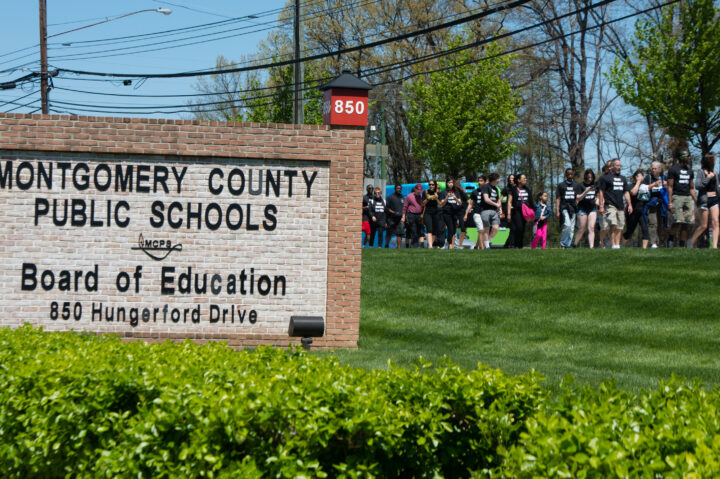
Montgomery County Public Schools building on April 27, 2014.
The leading Jewish advocacy group representing the Washington, D.C., area is raising the alarm on a uniquely high rate of antisemitic incidents in Maryland’s Montgomery County public school system.
Guila Franklin Siegel, chief operating officer at the Jewish Community Relations Council of Greater Washington, said Tuesday that the JCRC is receiving “significantly higher” reports of antisemitism out of MCPS, located just outside of Washington, than others in the region.
Montgomery County’s public school system is the largest school district in the state and hosts a sizable Jewish student population.
The statement comes amid a new report from the Anti-Defamation League showing that Maryland ranked ninth in total antisemitic incidents nationwide in 2025, two-thirds of which occurred in Montgomery County. Among the top ten states with total incidents, Maryland ranked first in the percentage of incidents occurring at K-12 schools, at 34%.
“While the details vary, these incidents reveal a harsh truth: too many Jewish students and educators at too many MCPS schools continue to face too many threats,” said Franklin Siegel, whose statement came the day after JCRC leadership met with MCPS Superintendent Thomas Taylor and his senior management team.
Incidents in recent months include anti-Jewish and anti-Israel graffiti on school walls, most recently at Greenwood Elementary School last weekend; inflammatory anti-Israel messaging at Olney Elementary School’s recent cultural night; “Heil Hitler” gestures and speech occurring at middle school events; and, according to JCRC, “physical threats and harassment directed toward Jewish students at multiple schools.”
Franklin Siegel said MCPS and JCRC leadership discussed “progress on the steps MCPS needs to take to protect Jewish students, educators, and staff.”
“Our messages were simple: MCPS must establish a zero-tolerance policy on antisemitism and other forms of hatred and bias; train and empower administrators and teachers to correctly identify and respond to antisemitism; and rigorously enforce disciplinary codes, making it clear that anyone who engages in antisemitic or other hateful behavior will face meaningful consequences,” Franklin Siegel said.
MCPS said it “will be in compliance with recently adopted state law requiring anti-bias training for school educators and staff” starting in August, according to Franklin Siegel.
The school district also committed “to improv[ing] school participation rates in JCRC’s gold-standard Student to Student and Holocaust speakers’ programs” and to “drafting specific guidelines for culture and international nights. The district must ensure these events are safe and educational for all students and families, not political battlefields,” she added.
But Franklin Siegel called on the school district to go further in protecting Jewish students.
“MCPS should follow the lead of other schools in our area by incorporating specific antisemitism training as well,” she said. “More lessons about Jewish history beyond antisemitism and the Holocaust should be included in its curricula. And given that bias incidents are so often connected to the proliferation of hate speech online, MCPS also needs to discipline students who harass and bully Jewish students on social media accounts, even when those accounts are not formally affiliated with schools. The district has that authority, and principals must enforce it.”
MCPS, which serves over 156,000 students, did not respond to a request for comment from Jewish Insider.
City Councilmember Janeese Lewis George pledged to support Jewish communal security funding
Jewish Community Relations Council of Greater Washington
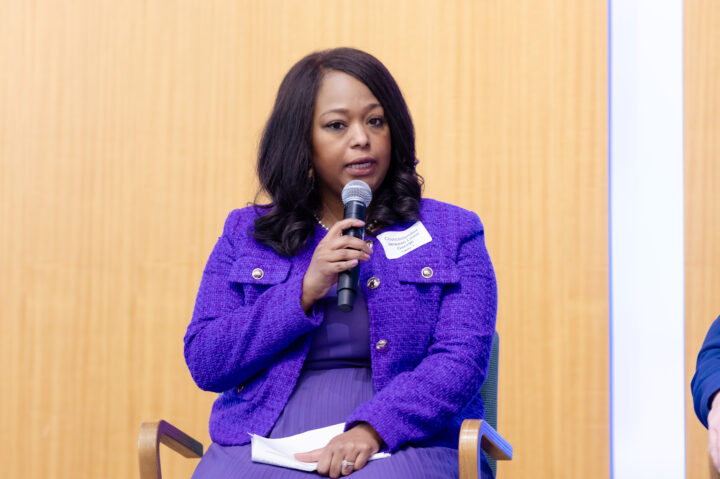
D.C. City Councilmember Janeese Lewis George speaks at a "Lox and Legislators" breakfast held by the Jewish Community Relations Council of Greater Washington on Dec. 18, 2025
D.C. City Council member and mayoral candidate Janeese Lewis George, speaking on a panel at a Jewish Community Relations Council of Greater Washington breakfast on Thursday, committed to standing up for the Jewish community and taking proactive steps to ensure its security.
Lewis George’s presence at the event and comments are particularly notable given that she’s a self-identified democratic socialist. Many DSA-aligned elected officials across the country, including incoming New York City Mayor Zohran Mamdani, have had combative or nonexistent relationships with mainstream Jewish organizations in their cities and districts.
“I learned at a very young age how important it was to loudly condemn and loudly stand up for our Jewish neighbors,” Lewis George said. She said that she learned through education programs in D.C. schools “how important it was that we support each other in solidarity, in our connected struggles, our connected history.”
She said that, as a member of the city council, she has seen a rise in antisemitic activity in her district, and that it is critical to call it out. She committed to providing security for educational institutions and synagogues and emphasized the importance of having proactive plans to protect the community.
Lewis George also expressed support for security funding the city has provided to Jewish and other nonprofit institutions, acknowledging that those costs are high. The JCRC is pushing for a significant increase in the funding available.
“Overall, we have to be more proactive, and we have to not wait to be react[ive] in this moment when we have seen such a rise [in antisemitism],” Lewis George said. “More than just the words, we have to back them with action. That is really showing up and creating the funds and creating the spaces to protect our Jewish neighbors.”
Outgoing Mayor Muriel Bowser, who took office more than a decade ago, said that she did not anticipate the rise in antisemitism that she saw and had to confront in office, but said that she felt it was important for her to learn more about the Jewish community and visit Israel.
She said she hopes for a day when she won’t have to receive calls after yet another antisemitic attack and that the city is again adding security around Jewish institutions. She also emphasized her administration’s efforts to bring together faith and community leaders across the city to speak out against antisemitism.
D.C. Attorney General Brian Schwalb, who is Jewish, drew a comparison between the Maccabees and the D.C. fight for home rule, saying that “we are also fighting back” against long odds and what he described as government overreach.
He also praised Bowser for her response to the Capital Jewish Museum shooting, in which two Israeli Embassy employees were killed.
“The Bondi attack [in Sydney, Australia,] is, unfortunately, another example of antisemitic violence, targeting Jews for being Jews. It has spiked in recent times, whether it’s on the other side of the world, whether it’s across town at the museum, whether it’s from the left or from the right, threats of violence directed at Jewish people for being Jewish and Jewish organizations for being focused on Jewish issues — those threats are real and they are on the rise,” Schwalb continued. “It affects all of us. It’s harder for me to get into my synagogue here for the high holiday than it is for me to get into the Supreme Court.”
Walkinshaw: ‘We have to be united. We have to be firm in our opposition to hatred in any form or opposition to antisemitism’
Tom Williams/CQ-Roll Call, Inc via Getty Images
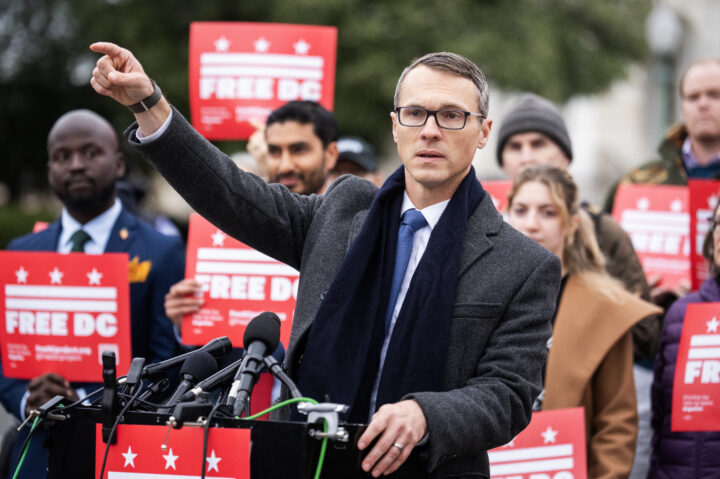
Rep. James Walkinshaw (D-VA) speaks during a news conference outside the U.S. Capitol to oppose House bills that would undo D.C. laws and programs on Tuesday, November 18, 2025.
Rep. James Walkinshaw (D-VA) touted his history with local Jewish organizations and vowed to make combating antisemitism a priority in Congress while speaking to members of Northern Virginia’s Jewish community on Wednesday.
Walkinshaw appeared at the Jewish Community Relations Council of Greater Washington’s “Lox and Legislators” breakfast in Falls Church, Va., where he lauded attendees for helping to “build communities in ways that make our communities better and stronger for all of us,” recounted his visits to the Fairfax community’s eruv and highlighted his relationships with Congregation Olam Tikvah and the JCRC.
Walkinshaw, who won a special election in August to replace the late Rep. Gerry Connolly (D-VA), his longtime boss, cited Alexis de Tocqueville’s Democracy in America while noting that the recent celebration of the fourth anniversary of the eruv’s opening highlighted “the quintessential Americanness of that eruv project.” An eruv is a boundary that allows observant Jews to carry items outside their homes on Shabbat, a foundational feature that makes communities accessible to religious Jews.
“The United States of America, a nation founded on the principle of religious liberty and freedom, where everyone is free to express their faith,” Walkinshaw said. “A lot of folks who remember their [de] Tocqueville, Democracy in America, from high school or college history courses. … He traveled across the country in the 1830s and was impressed by our institutions and our founding documents.”
“He [de Tocqueville] wrote that what actually made — to borrow a phrase — what made America great was our spirit of association and our ability to come together in all kinds of different ways, as faith communities, as neighborhoods, as communities,” he continued. “To solve problems together and work together to make our communities, our states, our nation even better and stronger.”
Walkinshaw expressed concern about the rise in antisemitism nationally and in Virginia, vowing to fight for an increase in Nonprofit Security Grant Program funding for the next fiscal year and to urge the House Education and Workforce Committee to “take a holistic look at antisemitic incidents in school districts across the country,” something he penned a letter to Committee Chairman Tim Walberg (R-MI) about last month.
“We have to be united. We have to be firm in our opposition to hatred in any form or opposition to antisemitism,” Walkinshaw said. “We can’t allow antisemitism to be a partisan issue. We have to stand against it, Democrats and Republicans, no matter where it takes place.”
The Virginia lawmaker went on to say that “so much of what the Jewish community does in Northern Virginia, what the JCRC does across our region, is build communities in ways that make our communities better and stronger for all of us.”
“The Fairfax eruv is an affirmation of Jewish belonging here in Northern Virginia, and in Fairfax an affirmation that Jewish people and Jewish families are welcome here and should feel safe here in Fairfax and in Northern Virginia,” he told the crowd. “We know that’s not a feeling that we can take for granted.”
Reached for comment by Jewish Insider on his outreach to Northern Virginia’s Jewish community since taking office, Walkinshaw said in a statement, “Throughout my career in Northern Virginia, I’ve worked closely with our region’s diverse communities, including the Jewish community, to advance safety, dignity, and opportunity for all.”
“As a Member of Congress, I’m proud to continue that work — advancing progressive policies, confronting all forms of hate including antisemitism, and advocating for democratic values and human rights,” his statement added.
Ron Halber, the CEO of the Jewish Community Relations Council of Greater Washington, gave Walkinshaw a glowing assessment based on his job performance since taking office in September.
“I really have a very, very strong and positive feeling about Rep. Walkinshaw,” Halber told JI. “He’s incredibly thoughtful. I think he has spent a great deal of his career on Capitol Hill, and that he’s just ready for this job.”
“He’s got deep relationships in the Jewish community. I think the Jewish community overall is very, very positively disposed to him. He had a tremendous reaction, a tremendously positive reaction in that room, including from myself,” Halber continued. “I think he’s a great guy, and I think he’s going to do great things. … He’s done a lot of outreach to the Jewish community, makes himself accessible. I think we’re going to have a champion for the Jewish community with him.”
Halber went on to predict that Walkinshaw, who he described as “an excellent speaker,” could become a rising political star. “He’s young, and I think he’s going to become a leader in Congress very quickly. I think he’s very, very smart about a lot of issues,” Halber said.
William Daroff, CEO of the Conference of Presidents, to Van Hollen: ‘Labeling American Jews as apologists when they challenge you is not discourse. It is a smear’

Joe Raedle/Getty Images
Rabbi Susan Shankman (L) hugs Ron Halber, the Executive Director of the Jewish Community Relations Council of Greater Washington, as they gather together at the Washington Hebrew Congregation during a vigil for Israel on October 09, 2023 in Washington, DC.
Several major Jewish organizations rallied around Ron Halber, the CEO of the Jewish Community Relations Council of Greater Washington, after a spokesperson for Sen. Chris Van Hollen (D-MD) attacked Halber as an “apologist for the Netanyahu government” and unrepresentative of his community.
The Van Hollen spokesperson’s comments came in response to remarks by Halber to reporters in which Halber said that many in the Maryland Jewish community feel “betrayed” by the senator and that he has failed to show empathy for Israel and the Jewish people.
The JCRC’s Board of Directors, in a statement late Thursday, offered Halber, who has led the group for nearly three decades, its full support, and applauded his work.
“Recent personal attacks leveled against [Ron] by Sen. Chris Van Hollen are undignified, unwarranted, and untrue. Ron and his leadership team have our full backing and support,” the board said in a statement. “In a time marked by division and discord, political leaders should model respectful behavior and discourse. We are deeply disappointed that Sen. Van Hollen chose instead to malign Ron and our organization, but we are heartened by the outpouring of support from so many partners and friends. They know what we know: Ron and the JCRC support not only Jewish families, but the millions of people who live in the DMV.”
William Daroff, the CEO of the Conference of Presidents of Major American Jewish Organizations, said he’s known, worked with and respected both Halber and Van Hollen for decades, and that Van Hollen has been his representative for much of that time.
“That is why I am stunned, offended, and frankly angry at Senator Van Hollen’s personal attack on Ron,” Daroff said on X. “Ron is a respected communal leader who has spent decades serving Maryland Jews, advocating for security, and giving voice to a community that is anxious and afraid in this moment of rising hostility.”
He said that Halber’s criticism was “not partisan” and was at its core a call for empathy for Israeli lives, Israel’s security dilemmas and the “vulnerability so many Maryland Jews feel today,” but was “met instead with derision.”
“We can disagree about Israeli policy. We can debate strategy and tone. But labeling American Jews as apologists when they challenge you is not discourse. It is a smear. It cheapens the conversation at a time when Jewish anxiety is real and rising, and when we need leaders who hear us rather than dismiss us,” Daroff said. “Our community deserves respect. We deserve empathy. We deserve partnership grounded in good faith. We will speak up for those expectations.”
The Jewish Federation of Greater Washington, another major D.C.-area Jewish umbrella organization, also offered support for “the vital role Ron Halber and the JCRC of Greater Washington play in advocating for Israel, Jewish safety, belonging, and connection across Greater Washington.”
“Ron has worked tirelessly for years to build a stronger Jewish community and Greater Washington region,” the organization continued. “At a time of extreme divisiveness in our society, our public officials should not be contributing to these divides through personal attacks.”
AIPAC said the statement by Van Hollen’s team was “shameful.”
“Disagreeing with you, Senator, doesn’t make American Jews apologists for a foreign leader,” the group said on X. “Resorting to this tired and toxic trope only reflects the shallowness of the Senator’s arguments.”
The Jewish Federations of North America, the umbrella group that represents hundreds of Jewish communities and groups around the country, said in a statement that it “stand[s] with our esteemed colleague Ron Halber … following the deeply troubling personal attack leveled against him.”
“Ron and [the JCRC of Greater Washington] understand and speak for their community, and their well-documented concerns should be listened to and addressed on the merits,” JFNA continued. “We are grateful to all the public officials in the Greater Washington DC area who are engaged in productive conversations and collaborations with the Jewish community.”
Yehuda Kurtzer, the president of the Shalom Hartman Institute, called the statement “unconscionable” and said Halber deserves an apology from Van Hollen.
“Politicians need to have thicker skins in responding to criticism, especially when it is directed at them by respected representatives of minority communities. That’s part of the job,” Kurtzer said on Facebook. “Van Hollen has the right to cut off contact with the organized Jewish community even though I think that’s a toxic political choice. But he should not respond publicly like this.”
He added that, “to characterize a pro-Israel view as an apologetic for a foreign government is to evoke unfounded suspicion of foreign interference and to cast the[m] as therefore ‘un-American.’ This is dangerous stuff and politicians shouldn’t do it.”
Halber’s counterparts in other parts of the country have also rallied to his defense. “The contempt with which [Sen. Van Hollen] showed for Ron, the DC JCRC, and the Jewish community is unacceptable. He needs to apologize,” Tyler Gregory, the CEO of the Bay Area JCRC, said.
Jeremy Burton, the CEO of the Boston JCRC said that “Labeling American Jews as ‘apologists’ just because you disagree with them & their (our) attachment to the Israeli people is unacceptable” and also called on Van Hollen to apologize.
Amy Spitalnick, who leads the Jewish Council for Public Affairs, lamented both Van Hollen’s attack on Halber as well as New York Jewish figures’ criticisms of Mayor-elect Zohran Mamdani.
“We can’t even engage without resorting to ad hominem attacks. A Senator’s office calls a respected Jewish community professional an ‘apologist for Netanyahu.’ Multiple leaders call the Mayor-elect an ‘enemy of the Jewish people,’” Spitalnick said. “Countering antisemitism and hate, protecting democracy, advancing peace and security for Israelis and Palestinians all require us to engage — not disparage and smear — even and especially when we disagree. This is all so dangerous.”
Rabbi Yaakov Menken, executive vice president of the Coalition for Jewish Values, said that “This was a display of bigotry unbecoming a US senator. [Van Hollen] owes the entire community, and especially [Halber], an apology.
Though he did not address the situation or the senator directly, Democratic Maryland Gov. Wes Moore — who addressed a JCRC legislative breakfast the same day as Halber and Van Hollen’s comments and offered praise and thanks to Halber — also reaffirmed his partnership with the D.C. JCRC in an X post on Thursday.
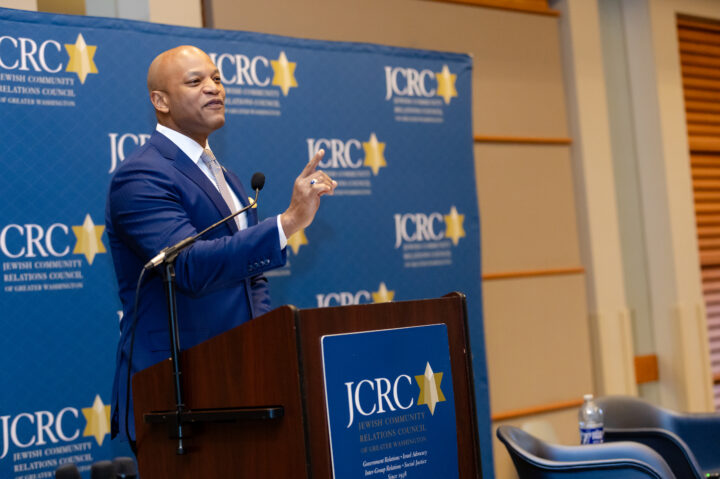
“There’s no higher goal for me than ensuring people feel safe where they live, work, and worship. That’s why our administration is fully committed to combating antisemitism in all its forms, and why I’m proud to announce that my upcoming budget proposal will preserve historic funding for hate crime protection grants,” Moore said, alongside a photograph from his speech in front of a JCRC banner. “Thank you to @JCRCgw for your partnership in this work.”
Eileen Filler-Corn, the Jewish and Democratic former speaker of the Virginia House, said on Facebook that she’s “offended by the personal attack directed at Ronald Halber,” describing him as a “respected leader in our Jewish community” and an “essential” advocate for the community.
“We can and should have healthy debates about the Israeli government and disagreement is part of a vibrant democracy, but labeling American Jews as ‘apologists’ for Netanyahu simply because they express support for the State of Israel is unacceptable, unproductive and entirely out of line,” Filler-Corn said. “Our community is hurting. We are being targeted and antisemitism is surging. At a moment like this, personal attacks on those who advocate for our safety and dignity do nothing but deepen the pain.”
Van Hollen does have some defenders in the Jewish community. Hadar Suskind, the CEO of the left-wing Israel advocacy group New Jewish Narrative, praised Van Hollen’s engagement since the Oct. 7, 2023, terror attacks and with the war in Gaza.
“Chris has always been there for his Jewish constituents and in support of the people of Israel,” Susskind said on X. “But you know what, like the majority of Marylanders, including Jewish Marylanders, he disagrees with many of the policies and actions of the Netanyahu government. And he is 100% right to do so and to say so.”
“As American Jews who care about Israel we should want all of our elected officials [to] do what Senator Van Hollen is doing, speak the difficult truths that need to be told and support a better future for Israelis and Palestinians,” he continued. “The days of demanding that elected officials ‘pick a side’ and show loyalty to ‘one team’ are over.”
The Maryland Democrat, rumored as a potential presidential candidate, said he wants Maryland to be a ‘shining example’ where ‘hate will absolutely find no oxygen’
Jewish Community Relations Council of Greater Washington
Maryland Gov. Wes Moore speaks at the Jewish Community Relations Council of Greater Washington's annual Maryland "Lox & Legislators" breakfast on Dec. 3, 2025.
Speaking to the Jewish Community Relations Council of Greater Washington’s annual Maryland legislative breakfast on Wednesday, Maryland Gov. Wes Moore, touted as a prospective presidential candidate, offered support for Israel and for members of the Jewish community facing antisemitism.
“Today, I want to be loud and clear, that Maryland stands with the Israeli people and we support their right to exist in the region with the same sense of safety and security that we all want,” Moore said, echoing remarks he made at a memorial days after the Oct. 7, 2023, Hamas attacks on Israel, which had been his most recent address to the JCRC.
Pointing to his background as a veteran and a Rhodes scholar who studied the rise of Islamism in the Western Hemisphere, Moore emphasized that he understands clearly the threat of groups like Hamas and Hezbollah, and that Hamas “has not been and will never be a faithful partner in any peace process.”
He said that lasting peace requires “humane leadership” for the Palestinians, as well as by Israel, the United States and any other countries involved in the future of Gaza.
“The safety and the peace and security of all people has got to be something that we not just believe in, but we advocate for,” Moore said. “A very clear understanding that the safety of Palestinians is also the safety of Israelis, and the safety of Israelis is the safety of Palestinians.”
“The message that I had on Oct. 13, 2023, has not changed, because I understand that it’s rooted in an internal sense of who I am,” Moore added, explaining that his “foundation comes from faith and with that, an understanding of our commitment to humanity.”
Moore emphasized that many of his ancestors have been ministers, and also recounted the story of how his great-grandfather and his family, who lived in South Carolina, were forced to leave the United States for Jamaica when they faced threats because his great-grandfather preached a message of equality.
He said that his patriotic foundation comes from his grandfather, who witnessed that rejection from the United States, but later returned to the U.S. anyway. “It birthed an unbelievable love that he held on to [for] the remainder of his life.”
Moore also expressed a strong commitment to ensuring the safety of the Jewish community in Maryland, saying that he wants to see Maryland be a “shining example” where “hate will absolutely find no oxygen.”
He announced that, in his 2027 budget request to the state legislature, he would be maintaining support for $10 million in funding for Maryland’s Protecting Against Hate Crimes Grant Program, which offers funding for nonprofits and religious organizations.
The program, with Moore’s support, was doubled in the 2026 budget from $5 million in the 2026 budget.
“We are going to make sure that people know that not only do we believe in being a loving community, but that we also believe in consequences for those who don’t,” Moore said. “Because as Dr. [Martin Luther] King said, ‘Laws don’t change the heart, but laws do protect it from the heartless.’ For those in our society that choose to foment hate … I want to be very clear, in the state of Maryland, you will find accountability, and in the state of Maryland, you will find consequences.”
He also made reference to the partnership between Black and Jewish leaders in the Civil Rights Movement, who he said were pursuing that same goal, to ensure that everyone can feel safe and have their voice and vote counted.
“We are going to ensure that every single Marylander, including our Jewish Marylanders, that they know that they are coming up in a state that’s loving and supportive … and knows that people should be able to relish in support of their God without knowing that it’s something that is going to cause them to be a target,” Moore said.
Moore said he’d been inspired by a meeting with Sigal Manzuri, who lost two daughters in the Nova Music Festival massacre on Oct. 7. He said he met Manzuri alongside Pennsylvania Gov. Josh Shapiro, and has kept in touch with her since.
“She said to me, as we were praying together, ‘Keep searching for love, because in love there is light,’” Moore said. “I think about her words oftentimes because we’ve seen dark times before, in this state and in this country.”
He connected Manzuri’s words to the need to recognize the dark parts in Maryland and U.S. history, while also recognizing that American democracy is “still the greatest experiment in world history. … Nobody here can argue that our history has been neat, that our history has not had hills and valleys, but it’s always been a history that has been worth fighting for, and it’s always been a history where we fought together.”
Moore also generally praised the attendees — leaders in the Jewish community in various capacities — for choosing to “lean in” in “dark, challenging, difficult times.”
“I’m grateful to walk hand in hand with you today, tomorrow and always to make sure that in this moment we fulfill our promise, tikkun olam,” Moore concluded, using the Hebrew phrase for repairing the world.
Moore and his speech were met with an enthusiastic reception from the crowd.
Several members of Maryland’s congressional delegation also addressed the breakfast meeting.
Notably, Sen. Angela Alsobrooks (D-MD) — who reneged on her pledge as a candidate to support U.S. aid to Israel when she voted earlier this year to suspend some weapons sales to the Jewish state — and Rep. Jamie Raskin (D-MD) — who has supported various measures against Israel, including a bill that critics have described as an effective arms embargo for key systems — received warm welcomes and standing ovations from the JCRC crowd.
Alsobrooks made only a brief mention of Israel during her remarks — praising the ceasefire agreement between Israel and Hamas — focusing otherwise on her efforts to combat antisemitism and other broader policy goals and initiatives.
“I know that I am not alone in welcoming the ceasefire in Gaza, urging, still, the return of the final two hostages,” Alsobrooks said, in comments that were made hours before the body of Thai hostage Sudthisak Rinthalak was identified. “It is my profound prayer as we go into 2026 that a permanent end to the war will be there, and that the beginning of healing that leads to a durable peace and the security that Israelis deserve. Peace and security and self-determination for our Palestinians, brothers and sisters as well. This is a fight that must continue every single day.”
She said that the wounds of Oct. 7 have not yet healed, and have continued to fester in part through the surging antisemitism seen across the country.
Alsobrooks said it is “our profound duty to speak up in this moment against rising antisemitism, at a time when we are seeing the vitriol and the violence against our Jewish brothers and sisters rising in a way that we have never, ever seen before.”
Raskin, speaking about security grants for Jewish institutions, said, “We’ve seen a sequence of racist and antisemitic hate crimes around the country that constitute a direct threat to people’s safety and security in their homes, in synagogues, in churches, at nursery schools and so on. … That’s a tremendously valuable investment of money.”
Reps. Glenn Ivey (D-MD) and April McClain Delaney (D-MD) also spoke on a panel alongside Raskin, also offering support for the security grant program.
Despite having publicly spoken out against Raskin for sponsoring legislation that would severely restrict U.S. aid to Israel and expressed concerns about Alsobrooks’ votes to halt certain arms sales to Israel, JCRC CEO Ron Halber said he believes both remain friends and supporters of Israel.
“Jamie Raskin, I believe, is a friend of the Jewish community and I believe he is a supporter of Israel,” Halber insisted to reporters at the close of the breakfast. “We haven’t been happy with some of his votes, but he does it in a thoughtful style. … He is a progressive Zionist who’s disappointed with the Israeli government, but he’s not disappointed with the entire State of Israel.”
He said he’d had an hourlong conversation with Alsobrooks after her votes on the aid measures, and said, “I think that that vote did not represent a shift in her commitment to Israel’s strategic qualitative edge and support for Israel militarily.”
“I consider Angela Alsobrooks a friend of the Jewish people and a friend of the state of Israel,” he added later.
He pointed blame for her and other Democrats’ votes to block arms shipments toward rhetoric online accusing Israel of genocide and deliberate starvation of Palestinians, adding, “those combined created an enormous groundswell that senators who normally wouldn’t have voted that way, voted that way.”
That stands in stark contrast to Halber’s description of Sen. Chris Van Hollen (D-MD) as the most problematic anti-Israel leader in the Senate and who has left the “overwhelming majority” of the Maryland Jewish community feeling “betrayed.”
Halber, at a JCRC breakfast, had lamented the Maryland senator’s worsening relationship with his Jewish constituents

Celal Gunes/Anadolu via Getty Images
Sen. Chris Van Hollen (D-MD) speaks during a rally around the National Mall in Washington, D.C., on September 19, 2025.
A spokesperson for Sen. Chris Van Hollen (D-MD) attacked Jewish Community Relations Council of Greater Washington CEO Ron Halber by name, accusing the Jewish leader of being an “apologist for the Netanyahu government” in response to Halber’s own criticisms of the Maryland senator to reporters earlier Wednesday.
In his role, Halber works to build bridges between the Jewish community in the Washington area and local elected officials. The comments reflect a remarkable breach between a leading representative of the D.C.-area Jewish community and a senator whom Halber said had once been an ally on a range of issues.
“Sen. Van Hollen, I think, has dramatically lost his way with support for Israel. He’s become the leading senator agitating against Israel in the United States Senate,” Halber told reporters at a JCRC breakfast event in Washington’s Maryland suburbs. “His social media is filled with a lack of empathy for Jewish suffering. It’s filled with a lack of empathy for Israel’s strategic position. It’s almost like [he] cannot wait for the next opportunity to jump down Israel’s throat.”
Halber said that the situation with Van Hollen is a “shame” because Van Hollen and the JCRC have worked together on a range of issues in the past, including funding for Jewish institutions and various domestic policy issues.
Maryland Gov. Wes Moore, Sen. Angela Alsobrooks (D-MD) and Reps. Jamie Raskin (D-MD), Glenn Ivey (D-MD) and April McClain Delaney (D-MD) were all in attendance at the breakfast, along with numerous local officials.
“I’m very upset about it, and so are many people in this room, because that’s not the Sen. Van Hollen that so many people in this room worked hard to get elected,” Halber continued. “On the issue of Israel, I would say the overwhelming majority of the Jewish community feels betrayed by the senator.”
The Van Hollen spokesperson fired back, accusing Halber of running cover for the Israeli government and failing to represent the range of viewpoints in Maryland’s Jewish community.
“Senator Van Hollen is committed to a values-based foreign policy that holds our friends and our adversaries to the same standards. That’s why he continues to support the people of Israel, but the actions of the Netanyahu Government have increasingly not aligned with our values,” the spokesperson said in a statement.
“The Senator often speaks with Marylanders who hold varying perspectives here and has met on many occasions with families of hostages and victims of the heinous Hamas attacks of October 7th. Instead of representing the diversity of views that, in the Senator’s experience, are held by the Jewish community of Maryland, Ron Halber has become an apologist for the Netanyahu government.”
Halber said he’d had a two-hour meeting with Van Hollen a year ago, asking the senator to moderate his rhetoric by showing a greater level of “empathy” and “understanding” of the situation Israel and its people are facing — recommendations Halber said the senator had failed to implement, making Halber “angrier.”
“I think it’s very easy to stand with Israel when you’re crying over Jewish victims, but it’s harder to stand up with Israel when she’s doing the right thing,” Halber continued. “And I think the senator has shown a lack of strategic understanding of Israel’s dilemma. And I’m not saying he’s got to be Israel’s cheerleader, but it would be nice if he had more balance in his remarks.”
He said that many people have delivered a similar message to Van Hollen, asking him to offer greater acknowledgement of Israel’s struggles, but have instead received a “consistent, one-sided narrative.”
“The hard thing is to show up when your friends need you, and right now, we’ve needed him, and he hasn’t been there,” Halber concluded.
Responding to the Van Hollen spokesperson’s accusation that Halber’s views are unrepresentative of the Jewish community, the JCRC head emphasized that more than 60 elected officials joined the breakfast event, with similar participation expected at upcoming Virginia and D.C.-focused breakfasts, and that a diverse array of Jewish organizations — religiously and politically — participate in the JCRC and the gatherings.
“Our job is to articulate a representation that represents the broad swath and mainstream of the Jewish community, which I believe we successfully do, and I’m proud of our record,” Halber said. “[JCRC member organizations] all know that JCRC represents the community with dignity and with the greatest broadest consensus and inclusivity as possible. … I’m very proud of the ability of the JCRC to bring such a diverse Jewish community under one tent where they all feel comfortable and represented.”
At the JCRC breakfast, Halber won plaudits from Moore, Maryland’s Democratic governor, who praised him as a dependable sounding board and advisor on difficult issues.
“When you’re debating, when you’re trying to understand the moment, when you’re trying to remember how we need to respond, when we are watching walls collapse among us, and who can help you get that clarity, even when I have to call him [Halber] at 11 o’clock at night,” Moore said. “By the end of the conversation, I’m lifted up.”
The demonstration portraying Israeli and U.S. leaders drinking the blood of Gazans was organized by Hazami Barada and Atefeh Rokhvand, who have been involved in setting up anti-Israel encampments across the D.C. area

A demonstration at Union Station in Washington, D.C., portrayed Israeli and U.S. leaders eating and drinking the blood and organs of Gazans
An antisemitic art display at Washington Union Station on Thursday depicting U.S. and Israeli leaders drinking the blood of Gazans is drawing widespread condemnation for echoing the historic blood libel against Jews.
“This is the kind of stuff that Nazi soldiers were shown during World War II, with the idea to make it that Jewish people were not humans,” Ron Halber, CEO of the Jewish Community Relations Council of Greater Washington, told Jewish Insider. “This is exactly what that is in the modern day. It is done to make Jews look like animals.”
The demonstration, displayed both inside and outside of D.C’s main train station, was organized by Hazami Barada and Atefeh Rokhvand, two anti-Israel activists who have been involved in several protests around Washington since the Oct. 7, 2023, terrorist attacks in Israel, including leading a protest encampment outside of the Israeli Embassy and outside of then-Secretary of State Tony Blinken’s home for months in 2024.
Barada protested a community vigil for the first anniversary of the Oct. 7 attack, which took place at The Anthem, a music venue in the nation’s capital. Rokhvand is an elementary school teacher who spoke at the Muslim Student Association conference in 2024.
Another local activist, Hasan Isham, took credit on Instagram for 3D printing the masks used in the protest, which featured people dressed in suits wearing masks to resemble Israeli Prime Minister Benjamin Netanyahu, President Donald Trump, Secretary of State Marco Rubio, former President Joe Biden and Blinken. The five officials were sitting at a long “Friendsgiving dinner” table decorated with the Israeli flag while eating doll limbs drenched in fake blood. A menu placard read: “Starter: Gaza children’s limbs.” “Main: Stolen Organs.” “Dessert: Illegally harvested skin.” “Drink: Gaza’s spilled blood.”
Leading Jewish groups condemned the demonstration, with the Anti-Defamation League calling it “nothing less than abhorrent.”
The American Jewish Committee said that “blood libel was on full display” and called on “leaders and authorities [to] condemn this display and ensure that public spaces are not used to spread dangerous hate.”
“This was nothing less than the revival of one of the oldest and most dangerous antisemitic tropes in history. Blood libel has fueled violence, persecution, and massacres of Jews for centuries. Seeing it resurface in our nation’s capital is both horrifying and unacceptable,” AJC said in a statement.
Union Station is within U.S. Park Police jurisdiction, which manages its own permits. Park Police did not respond to an inquiry from JI asking whether a permit was provided for the demonstration. First Amendment permits had previously been granted for a pro-Palestinian encampment outside of Union Station, but were revoked after demonstrators burned American flags in 2024.
The display on Thursday was removed by Amtrak police within five minutes of being fully set up, according to the Metropolitan Police Department. After being removed from Union Station, the organizers moved the display to outside the station.
“Whether inside or outside, this was absolutely disgusting… and done to incite hatred against Jewish people,” said Halber. “The result is that this could lead to violence against Jews. It was designed to use the worst antisemitic stereotypes against Jews to demonize Jews. It’s nothing more than a modern-day blood libel.”
“This happened at Union Station where members of Congress and people advocating on Capitol Hill pass through,” continued Halber. “This is seen by a lot of people.”
JCRC of Greater Washington CEO Ron Halber: ‘It’s difficult when two-thirds of our community is voting for a political party whose base is hostile to Israel’
Jemal Countess/Getty Images for Court Accountability
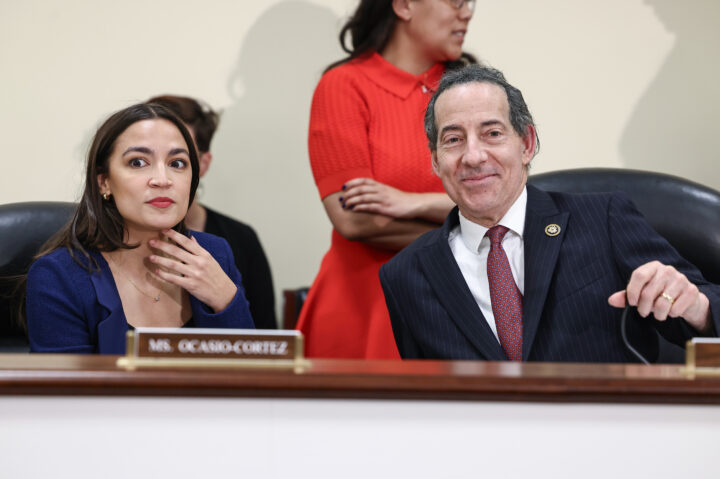
Rep. Jamie Raskin (D-MD) chats before a roundtable discussion on Supreme Court Ethics conducted by Democrats of the House Oversight and Accountability Committee at the Rayburn House Office Building on June 11, 2024 in Washington, DC.
Ron Halber, the CEO of the Jewish Community Relations Council of Greater Washington, strongly criticized Rep. Jamie Raskin (D-MD) over his recent decision to support legislation that seeks to severely restrict U.S. aid to Israel, casting the congressman’s move as part of a troubling pattern that has sparked concern among pro-Israel activists in his Maryland district.
“Jamie’s signing on that legislation was extremely disappointing,” Halber said in an interview with Jewish Insider on Tuesday, referring to the Block the Bombs Act, a bill led by far-left lawmakers that would place unprecedented new conditions on U.S. weapons transfers to Israel.
Raskin, who became a co-sponsor of the bill earlier this month, has not issued any statement regarding his decision.
“It unfortunately follows his signing on to other similar letters and a vote against additional arms to Israel last year, which really raised a lot of people’s eyebrows,” Halber, who said he considers Raskin a friend, told JI.
Halber said that he had spoken with Raskin, one of the most prominent progressive Jewish lawmakers in Congress, three times over the last two days, asking him to withdraw his name from the bill and instead issue a statement expressing the concerns about the war in Gaza that had motivated him to back the controversial legislation.
Raskin said he would be considering the request and indicated he was “not opposed to Israel using arms in other theaters” outside of Gaza, according to Halber, who described “a very honest and frank conversation” about the bill, which was introduced in May in response to the worsening humanitarian crisis in the war-torn enclave.
While he acknowledged that Raskin is “pulled by both being a leader of the Progressive Caucus and by his own progressive Zionism,” Halber said that the legislation represents “a bridge too far” for the pro-Israel community. The bill effectively amounts to an arms embargo on Israel, he said, arguing that it “seeks to unilaterally disarm one of our closest allies” as Israel defends itself on multiple fronts.
“I’m hoping that Jamie will take his name off the bill and use a statement to express his concerns,” Halber told JI, noting that the congressman has also fielded messages from several Jewish leaders leaders in his Montgomery County district who have aired objections. “If he doesn’t, we will be disappointed, but that’s his decision to make and he has to live with the ramifications of his decision,” Halber added. “I don’t see how that helps him.”
Natalie Krute, a spokesperson for Raskin, declined multiple requests for comment about his decision to back the bill, and did not immediately respond to JI on Tuesday regarding his recent conversations with Halber.
Halber’s private engagement with Raskin, who joined 32 other lawmakers in supporting the bill, underscores the challenges that mainstream Jewish groups are now facing as even some of the most reliable defenders of Israel in the Democratic Party shift away from reflexively backing the Jewish state, amid growing outrage over the crisis in Gaza.
“It’s difficult when two-thirds of our community is voting for a political party whose base is hostile to Israel,” Halber said of the waning support for Israel among Democrats. “I think a lot of my colleagues are also finding this a very difficult era,” he added.
Halber said he had also recently spoken with Sen. Angela Alsobrooks (D-MD) after she faced scrutiny from Jewish leaders this month for voting in favor of Sen. Bernie Sanders’ (I-VT) resolutions to block some U.S. arms sales to Israel, despite vowing to oppose such efforts during her Senate campaign last year.
“I’m convinced that her vote was more about sending a message of moral outrage to the Israeli government about the number of children who are malnourished in Gaza,” he said of their discussion, adding he was “a little more forgiving” in assessing her decision because it had coincided with a surge of media coverage about the humanitarian crisis in Gaza.
Alsobrooks was among 27 Senate Democrats, the majority of the caucus, who voted earlier this month to block shipments of U.S. aid to Israel — marking a dramatic turn against the Jewish state for the party. “While I didn’t like that Democratic senators voted” for the resolutions, “it was understandable, and they knew it wasn’t going to pass,” Halber said on Tuesday. “The question is, if it was going to pass would they have supported it — and I hope not.”
Even as the Block the Bombs bill is also not expected to pass, Halber indicated that he viewed Raskin’s move as a more egregious offense, calling it a “safe way” to register discontent with Israel’s conduct in Gaza that nevertheless “went too far” for his heavily Jewish district.
“Obviously, he’s trying to maintain a leadership position within the House Progressive Caucus,” Halber said of the congressman’s thinking. But on his home turf, “there are a lot of” constituents who do not support imposing sweeping new conditions on Israel, he told JI.
Still, Halber suggested that his lobbying to convince Raskin to withdraw his name from the bill is part of a broader effort to “push back against” the growing influence of what he called the “radical left,” whose views on Middle East policy he described as a “huge danger” to Israel’s continued security in the region.
“Once the war comes to an end, the whole Jewish community is going to have to re-strategize,” Halber said of the challenges ahead as his organization and others like it reckon with their traditional approach to engaging on such issues. “We have a lot of work to do with young people and with Democrats and independents.”
The war in Gaza “is going to impact Israel’s image for years to come,” Halber predicted. “Hopefully, once the media isn’t covering it every day, we can provide more context about what happened” and help “rebuild” Israel’s reputation among skeptical voters.
Please log in if you already have a subscription, or subscribe to access the latest updates.
 Continue with Google
 Continue with Apple