







































The International Federation of Social Workers is set to hold a vote on Feb. 18 to expel Israel over its members’ service in the IDF

Leon Neal/Getty Images
A university student studying social work helps provide emotional support to families who have been forced to evacuate from their homes in the south of Israel on October 16, 2023 in Beit Shemesh, Israel.


 Add JewishInsider on Google
The largest global membership organization for social workers from around the world will vote next week on whether to expel Israel’s leading social work body, sparking a feverish advocacy campaign by Jewish and Israeli practitioners to urge members to vote against the measure.
The vote by the International Federation of Social Workers is scheduled for Feb. 18, and it comes after several members in the IFSW complained that some Israeli social workers served in combat roles in the Israel Defense Forces during Israel’s war against Hamas in Gaza. The IFSW alleges that military service violates social workers’ professional and ethical commitments to nonviolence.
The Israeli Union of Social Workers — and its allies in the United States and Canada — argue that such a request ignores Israel’s mandatory draft policy, holds Israel to a different standard from other member nations and singles out the only Jewish state. The leader of the Israeli body said it would be “entirely unimaginable” for Israeli social workers to ask not to serve in combat, noting that it would come across as “elitist” and “mark our union as illegitimate in the eyes of both the government and the public.”
“If we believed that removing the [IUSW] from the IFSW would promote peace, guarantee the rights and security of both nations — we ourselves would vote in favor,” IUSW’s chair, Inbal Hermoni, wrote in a letter urging countries to vote against the measure. “This is a noble goal. However, this is not the case.”
The IFSW comprises 141 country members — including Russia, Iran and China — representing more than 3 million people. The only other country to ever face a similar punishment from the IFSW was South Africa, which was suspended during the era of apartheid rule.
Last year, the IFSW voted to formally censure Israel — the second time the body had done so.
“This position was grounded in our ethical mandate: social workers are called to uphold human dignity, promote peace, and work for social justice. Active participation in combat contradicts these principles,” IFSW President Joachim Mumba, who is from Zambia, said last year.
Social workers, psychologists, doctors and other practitioners in the so-called “helping professions” have complained about antisemitism that they say has become normalized since the Oct. 7, 2023, terror attacks in Israel — with double standards, anti-Zionist litmus tests and outright antisemitism now viewed as widespread and even acceptable among others working in those fields.
“This vote shouldn’t be seen in isolation. It’s a reflection of the systemic hostility towards Israel and towards Jews that have come to permeate these professional spaces,” said Guila Franklin Siegel, chief operating officer of the Jewish Community Relations Council of Greater Washington. “In fighting against this, we are fighting against a much bigger problem.”
Andrea Yudell, a therapist in Washington, told Jewish Insider on Thursday that voting to expel Israeli social workers “would effectively legitimize the hostility that we’ve been seeing in the field.”
A petition organized by several groups for Jewish therapists in the U.S. and Canada is urging the National Association of Social Workers and the Canadian Association of Social Workers — the two membership organizations in each country — to publicly oppose next week’s vote.
“It imposes a nationality-based collective sanction, treating professionals as ethically suspect solely because of their national affiliation. No other national association is held to this standard,” the petition states. It has been signed by more than 11,000 people. Spokespeople for NASW and CASW did not respond to requests for comment.
Several U.S. Jewish organizations are helping to circulate the petition and generate attention about the vote, which the Anti-Defamation League called “collective punishment.”
The issue, according to Jewish social workers, goes deeper than just professional drama among the practitioners. The spread of antisemitism in a field predicated on compassion could threaten to alienate or harm Jewish clients who turn to social workers to help meet their emotional and material needs.
“It’s not just the social workers themselves. It’s the people we are trying to serve. Those people. It’s unethical to them,” said Jennifer Kogan, a licensed clinical social worker in Washington, D.C. “Jewish clients are affected by this. They don’t feel safe.”
The resolution came after a pro-Israel student group hosted IDF soldiers, which protesters disrupted by calling them ‘baby killers’ and comparing the IDF to the KKK
G Fiume/Getty Images
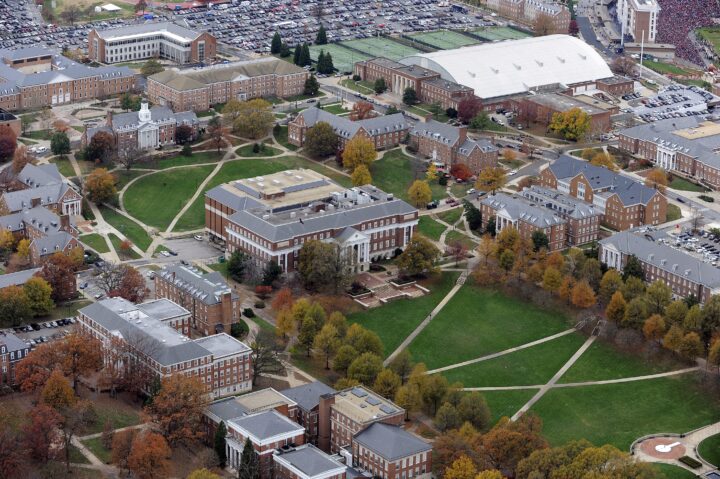
An aerial view of the University of Maryland campus in College Park, Maryland.
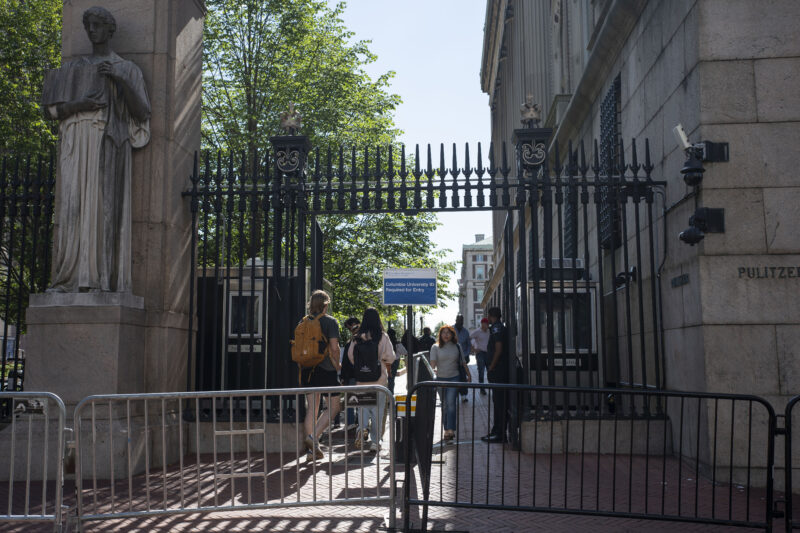
The University of Maryland, College Park student government unanimously passed two resolutions hostile towards Israel on Wednesday night, including one that called for the school to ban members of the Israel Defense Forces from speaking on campus.
The resolution, targeting Israelis, called for the university to prohibit people who are “committing war crimes” and “genocide” from speaking on campus.
It came as a response to an event hosted by the campus chapter of Students Supporting Israel on Oct. 21 featuring former IDF soldiers who spoke to students about their experiences serving during Israel’s war with Hamas.
During the event, protesters packed the outside hallway shouting “baby killers” and “IOF [Israel “Occupation” Forces] off our campus,” while several others protested from outside of the building with chants comparing the IDF to the Ku Klux Klan, the university’s student-run Jewish newspaper, The Mitzpeh, reported.
The second resolution called on the university to issue an apology to students who faced disciplinary action for protesting that event. The resolution stated that “two student journalists were wrongfully detained by the University of Maryland Police Department for over an hour while attempting to document the event.” At the time, UMPD said in a statement that the student journalists refused to provide identification or credentials.
Both resolutions passed 25-0, with one abstention.
UMD has one of the largest Jewish student populations in the country — nearly 20% of the College Park undergraduate student body of more than 30,000 students is Jewish, according to Hillel International. But there are “very few” Jewish students remaining in student government, junior criminology and criminal justice major Meirav Solomon told Jewish Insider.
Solomon was removed as a student government member in 2023 after being put on a “blacklist” of students who she said were accused of “not believing in human rights.” She told The Mitzpeh at the time that the list profiled candidates with “Jewish-sounding names,” and most students denounced by the document had never voiced a public opinion on the Israeli-Palestinian conflict.
The current student government is mostly composed of Students for Justice in Palestine members, or people who support the group, Solomon said.
The latest resolutions follow the passing of a separate resolution — voted on at the start of Yom Kippur — calling on the university and its charitable foundation to implement a boycott of companies and academic institutions with ties to “Israel’s regime of apartheid and occupation.”
“Jewish students on campus are already feeling very unsafe,” said Solomon. “But these resolutions have the most shocking language I’ve seen. This is extreme language and doubles down on making Jewish students feel that they don’t have a voice in student government.”
When the BDS vote was announced in October, UMD President Darryll Pines told the university’s newspaper, The Diamondback, that the university supports SGA’s right to debate the issue. But he added that the university wants to ensure the process is “open and fair and has dialogue from all parties of our broad student body.”
“Resolutions voted on by the Student Government Association are student-led and reflect perspectives of voting members of the SGA,” a university spokesperson told JI at the time of the BDS resolution vote. “They have no bearing on university policy or practice.”
This story was updated on Thursday to reflect the outcome of the vote.
To mark the second anniversary of the Oct. 7 attacks in Israel, the Jewish Insider team asked leading thinkers and practitioners to reflect on how that day has changed the world. Here, we look at how Oct. 7 changed Israel’s relations with the world
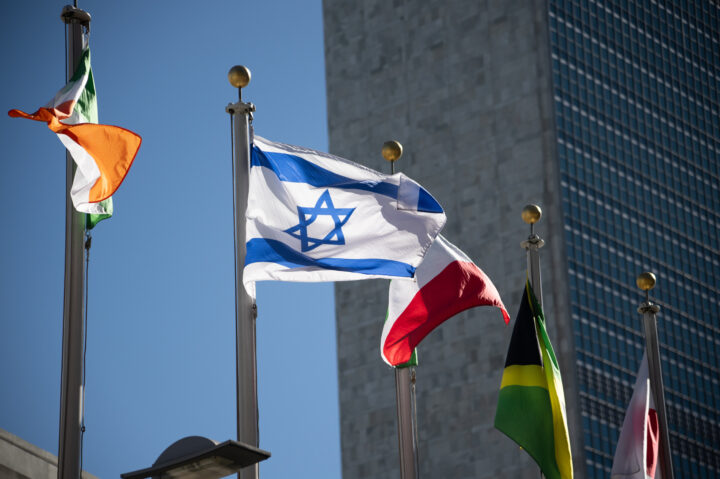
NEW YORK — October 13, 2023: The Israeli flag flies outside the United Nations following Hamas’s deadly attack on Israel (Photo by Noam Galai/Getty Images)
The IDF operation aims to seize Gaza City, one of two remaining areas of the Gaza Strip still under Hamas control and home to the vast majority of the enclave's population
Abdalhkem Abu Riash/Anadolu via Getty Images
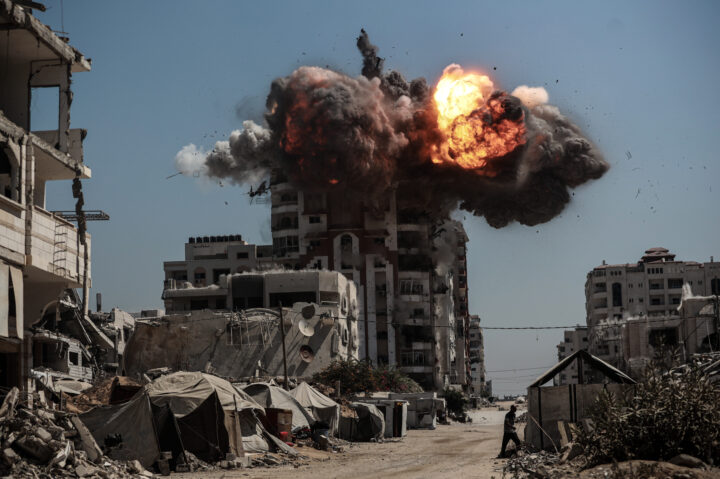
Smoke rises following Israeli airstrikes that hit and destroyed multiple buildings and high-rise towers in Gaza City, Gaza on September 14, 2025.
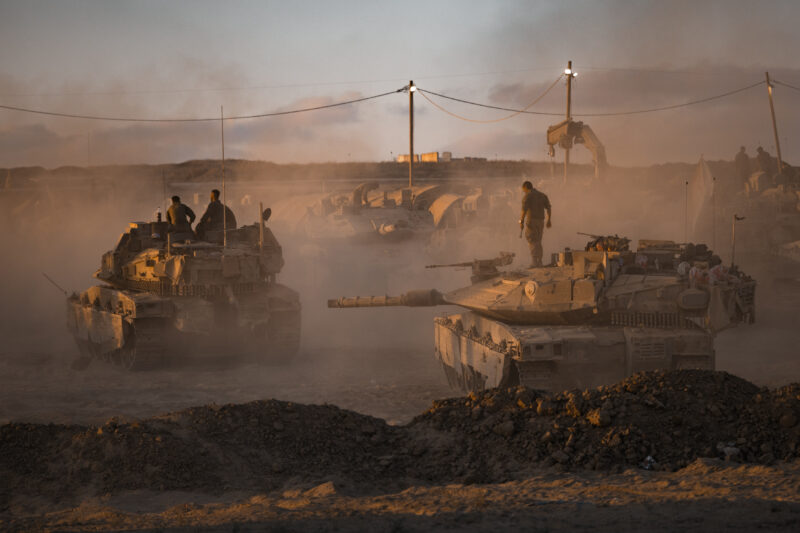
The Israel Defense Forces launched a major ground operation in Gaza City on Tuesday morning, Israeli Prime Minister Benjamin Netanyahu and the military announced.
“We started intensive action in Gaza,” Netanyahu said at the Tel Aviv District Court, where he asked to postpone his testimony in his ongoing corruption trial in light of “important things happening.”
The IDF operation, known as Gideon’s Chariots II, aims to seize Gaza City, one of two remaining areas of the Gaza Strip still under Hamas control and home to the vast majority of the enclave’s population at this point in the war, though the Israeli military said that a significant percentage of the city’s residents had fled the area ahead of the offensive.
The ground campaign in Gaza City follows several days of aerial bombings and fighting on the outskirts of the city.
The new operation comes as Israel faces growing foreign and domestic pressure to end the war, which is nearing its two-year mark. The families of hostages being held in Gaza also warn that the ground campaign threatens their loved ones who are being held captive in the city. An IDF official said that the offensive in Gaza City was entering a “new phase,” targeting the network of Hamas-built tunnels after weeks of operating in the city’s periphery.
Two divisions entered Gaza City on Tuesday, and more will gradually be added, the military official said.
Gaza City is “Hamas’ main stronghold,” and the IDF expects to encounter 2,000-3,000 Hamas fighters there, the military official said.
IDF Spokesperson in Arabic Avichay Adraee posted on X warning residents of Gaza City that the IDF “has begun destroying infrastructure in Gaza City.”
“Gaza City is considered a dangerous combat zone, and staying in the area puts you at risk,” he wrote. “Join the more than 40% of the city’s residents who have left the city to ensure their safety and the safety of their loved ones.”
In recent weeks, Israel instructed residents to move south along designated routes, but fewer than half have done so, with Hamas threatening those who wished to leave the city and others refusing to move again.
“Hamas is actively trying to block Gazans from moving out of Gaza City,” the IDF official said. “They are trying to turn Gaza City into one of the largest cases in history of using human shields, using hundreds of thousands of people.”
Defense Minister Israel Katz said in a statement that “Gaza is burning. The IDF is striking terrorist infrastructure with an iron fist and IDF soldiers are fighting courageously to create the conditions to free the hostages and defeat Hamas.”
“We will not give up and will not retreat until we complete the mission,” he added.
The Israeli Air Force bombarded Gaza City on Monday night, with reverberations felt as far as central Israel.
Meanwhile, Israel has demolished over 50 multistory buildings in Gaza City, which Netanyahu has called “terror towers.” The IDF official called the buildings “key targets … that would be used against us in a ground operation.”
Several hostages’ relatives set up tents outside of the Prime Minister’s Residence in Jerusalem overnight Monday, amid Israeli Air Force strikes on Gaza.
The Hostage Families Forum cited reports that some hostages have been moved above ground, and said that their loved ones are being “used as human shields.”
“The Prime Minister has decided to send IDF soldiers to areas where our loved ones are located, who might be harmed and not return alive,” the forum stated. “He is doing everything to ensure there is no deal and not to bring them back. … We are terrified that this might be their last night, that the living hostages will pay with their lives, that the deceased will disappear there. We are no longer willing to accept this. We came here this evening, and we are not moving from here.”
Hours before the Gaza City offensive began, Secretary of State Marco Rubio departed Israel after a two-day visit and headed to Qatar, who he said should continue mediating between Israel and Hamas to end the war and free the hostages.
“If any country in the world can help mediate it, Qatar is the one. They’re the ones that can do it,” Rubio said.
Maj. Gen. Eyal Zamir lived in D.C. from 2021 until 2022

THOMAS COEX/AFP via Getty Images
Israeli army major general Eyal Zamir looks on as he stands near the Israel-Gaza border in the southern kibbutz of Nahal Oz on April 20, 2018.
The Israeli government announced this weekend that Maj. Gen. (res.) Eyal Zamir, currently the director-general of the Israeli Ministry of Defense, will succeed Lt. Gen. Herzi Halevi as chief of staff of the Israel Defense Forces in March.
Zamir authored a report for the Washington Institute for Near East Policy in 2022 proposing a coordinated response between the U.S., Israel and Arab allies to counter Iranian aggression in the Middle East.
Rob Satloff, the executive director of the Washington Institute, offered strong praise for Zamir, who was a Washington Institute visiting military fellow between 2021-2022.
“The best description of General Zamir [is] he is a soldier’s soldier. Smart, instinctively insightful, doesn’t put on airs, no false modesty, no pretense,” Satloff said. “Having known and admired many of his predecessors, I am confident he will meet the unprecedented challenge faced by the IDF today.”
David Makovsky, the director of the Koret Project on Arab-Israel Relations at the Washington Institute, called Zamir “highly accomplished,” and said he’ll “have his hands full” in the new role.
He said that he believes Zamir’s current work as director-general will be an asset in his relationships with Washington, D.C, having put him in a position to work closely with the Pentagon since the Oct. 7 attack.
“He has had a very intense American immersion, I would say, since Oct. 7,” Makovsky said. “The interface with the Pentagon over weapons, the ammunition, that could only help him in the new job.”
Satloff said that, while Zamir was working with the Washington Institute, he “had the opportunity to develop good personal relations with a wide array of national security specialists that were of benefit during his wartime service as director-general of the MOD and will, I am sure, be useful in his new post.”
The director-general role would have also given Zamir “360 degree awareness in a way that soldiers are not exposed to,” Makovsky said. “Having that experience can only be helpful.”
Makovsky added that it’s significant that Israeli Prime Minister Benjamin Netanuyahu reportedly personally conducted interviews for the chief of staff role — rather than the defense minister, as has been traditional — indicating he may want to have a closer relationship with the critical military leader.
Please log in if you already have a subscription, or subscribe to access the latest updates.
 Continue with Google
 Continue with Apple