


























Reached for comment, Carmella Charrington defended boosting Henry Ford's 'The International Jew' and repeatedly told JI to ‘get your rabbi’


 Add JewishInsider on Google
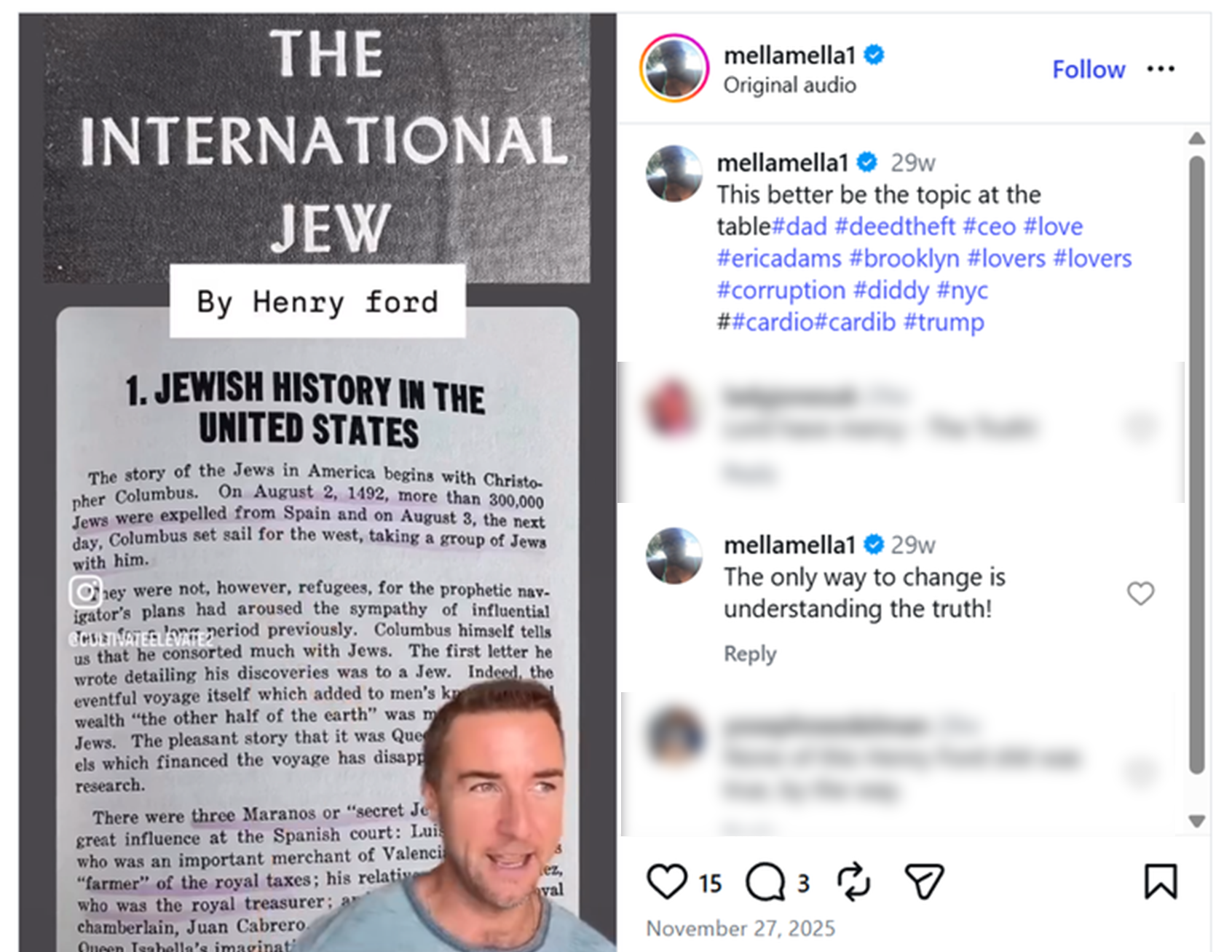
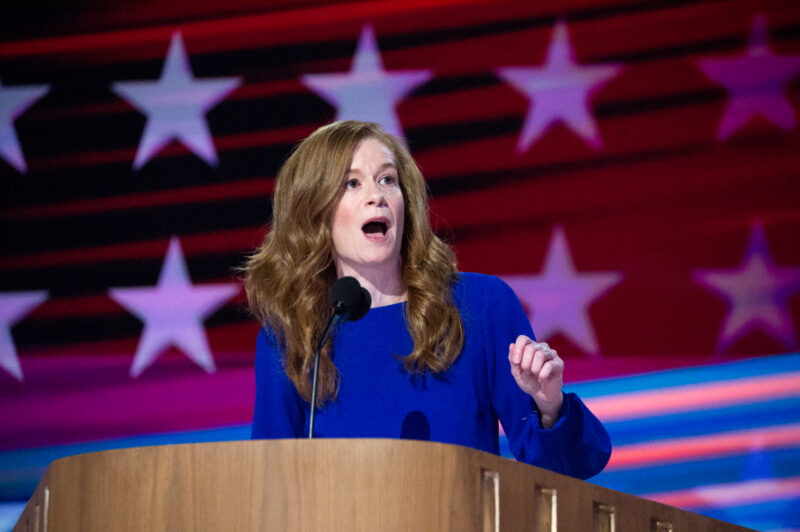
An activist that two politicians from the Democratic Socialists of America helped elevate to a leadership position in the Brooklyn Democratic Party on Tuesday posted a vitriolic antisemitic screed to her Instagram last year — declaring as “the truth” a notorious work beloved by Adolf Hitler that describes a Jewish world conspiracy.
Carmella Charrington was part of an army of left-wing insurgents who captured office on Tuesday: in her case, the role of district leader in the Brooklyn Democratic Party, an unpaid but important position that elects the party’s influential chairperson and plays a significant role in nominating judges and filling jobs at the city Board of Elections.
Although the DSA itself did not formally endorse Charrington for the post, two of its most important local figures campaigned with her and helped her make the ballot: state Sen. Jabari Brisport and state Assembly candidate Eon Huntley, who defeated an incumbent lawmaker in a closely watched race earlier this week.
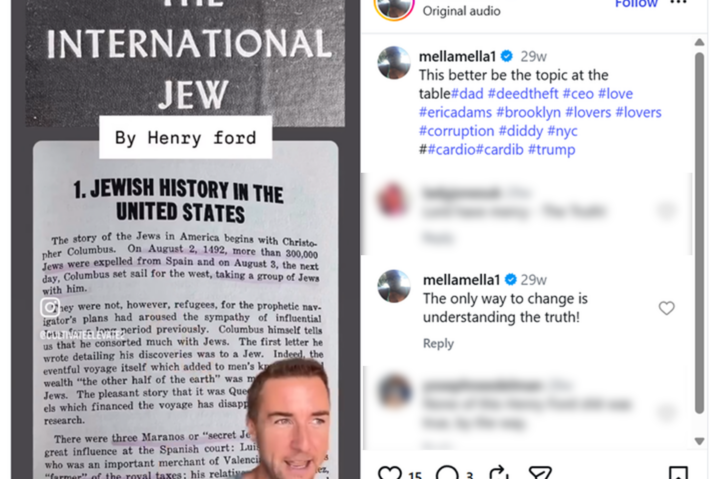
Charrington’s candidacy was part of a broader campaign to depose the present centrist leadership of the official party organization. But in November 2025, Charrington shared a video to her Instagram account — which features various photos and videos of herself at Brisport and Huntley’s joint campaign headquarters — promoting the “hidden history” in industrialist Henry Ford’s notorious 1920s series of conspiracy pamphlets, The International Jew.
“This better be the topic at the table#dad #deedtheft #ceo #love #ericadams #brooklyn #lovers #lovers #corruption #diddy #nyc ##cardio#cardib #trump,” Charrington captioned the since-deleted post, adding in the comments: “The only way to change is understanding the truth!”
The video itself is a summary and update of Ford’s century-old conspiracy theories, presented by a wellness influencer.
“You find out who owns all the social media, and then who also owns the tobacco industry, the cotton industry, the banking industry, the theater, the newspaper, the radio, and then we can clearly see who owns the government as well,” the speaker in the video says. “This is why in school things like reading the Bible, praying, celebrating Christmas, got to get rid of all that. Then it gets deeper when you find out who brought in all the liquor and all the drugs, and also made people into drunks during the Great Depression, because the same people caused the Great Depression.”
The video further asserts that Jewish people created plastic surgery to “blend in,” “brought the slaves” to America, established the gay rights movement and plotted the infamous 1921 massacre of Black residents of Tulsa, Okla. It asserts Jewish people are “always changing their names” and variously call themselves Zionists, Communists and Bolsheviks.
It then pivots to the issue that propelled Tuesday’s socialist sweep: Israel.
“It gets deeper when you talk about Palestine and the takeover of that with the Rothschilds, same people, and the whole Palestine thing connects back to the Rothschilds, who are the bankers, who then control everything, including the schools,” the speaker continues. “All the media and the newspapers and the radios are owned by a small group of people who control everything.”
The video concludes with an image promoting the Swedish neo-Nazi film series “Europa: The Last Battle,” the conspiracy tome The Curse of Canaan: A Demonology of History, the Holocaust denial tracts of Fred Leuchter and the anti-Israel pamphlet Zionism: The Terrible Secret of the Cold War.
Reached by Jewish Insider, Charrington maintained that she was not prejudiced, but also insisted the video “was some facts.” She repeatedly told the reporter to “get your rabbi,” as she intended to hold a future “roundtable” on what she called a “bullying community.”
“There’s so much harm that your community has done to me,” she said. “It’s a problem in our community and it needs to be addressed.”
Charrington rose to prominence as part of a legal fight over possession of her family’s brownstone in the historically Black but fast-gentrifying Brooklyn neighborhood of Bedford-Stuyvesant. She alleged in numerous media appearances that she was the victim of deed theft, a form of fraud, but New York state Attorney General Letitia James’ office determined it was a complicated but legal inheritance dispute.
In one of several phone calls with JI, Charrington railed against Jewish investors she accused of gaining access to her home and a Jewish judge who sentenced her to six days on Rikers Island for contempt of court.
Helping to promote her cause has been another leading DSA official: New York City Councilman Chi Ossé, who was arrested demonstrating outside the home in April. The incident inspired New York City Mayor Zohran Mamdani to create a new Office of Deed Theft Prevention.
Ossé, for his part, stressed in a phone conversation with JI that he had not endorsed Charrington for district leader and was unfamiliar with her posting history.
“We condemn this antisemitism and bigotry in the harshest possible terms,” Ossé said in a subsequent written statement to JI. “There is no room for this kind of hate in Brooklyn. I reject it completely.”
Brisport similarly said he was unaware of Charrington’s views but repeatedly refused to answer whether he would have supported her for party office had he seen the video she shared — or if he considered such beliefs disqualifying for a person to hold power in the Democratic Party. Huntley, the nominee for Assembly, did not respond to repeated calls or emails.
However, the two DSA leaders subsequently sent a joint statement denouncing the content of the video, and harping on the right-wing elements of its message.
“The antisemitic post that Carmella shared has no place in our movement. This incident illustrates exactly what antisemitism does — it misdirects the justified anger of working people and oppressed communities away from systems of power and onto Jews,” they wrote. “We are committed to working with all constituents and fellow electeds alike to unlearn and dismantle these deeply antisemitic, anti-LGBT, and anti-communist narratives which hurt and divide our communities.”
JI also contacted Mark Hanna, a Mamdani ally and Brooklyn district leader who served as election attorney for the insurgent slate on which Charrington ran. Hanna is also the treasurer of American Priorities PAC, a committee dedicated to combatting the influence of AIPAC and uplifting anti-Israel candidates.
“Any kind of antisemitism or Islamophobia or hatred I’m not going to be supportive of,” Hanna said in an initial phone conversation.
After JI sent him the video, he wrote back that he hoped the post “can be a teachable moment.”
“I will have to speak with her about it,” he wrote. “I want to work with Carmella on issues related to deed theft and the other concerns she has in her community, and I think calling her in to learn and ensure inclusivity, rather than calling out for a repost, will be more fruitful.”
Hitler reportedly kept German translations of The International Jew in his office, where he also displayed a portrait of Ford. He praised the American industrialist in Mein Kampf, and in 1938 awarded him the Grand Cross of the Order of the German Eagle, a medal the Nazi leader created to honor foreign allies of his genocidal regime.
Klain claimed ‘the tattoo was a skull and crossbones to remember his fallen comrades from his service in Afghanistan’ — an explanation the campaign itself has not previously offered
Kevin Dietsch/Getty Images
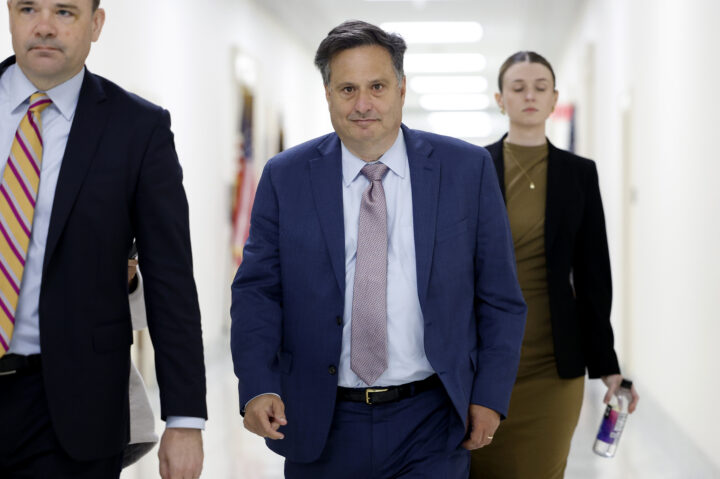
Ron Klain, the White House chief of staff under President Joe Biden, leaves an interview in the Rayburn House Office Building on July 24, 2025 in Washington, DC.
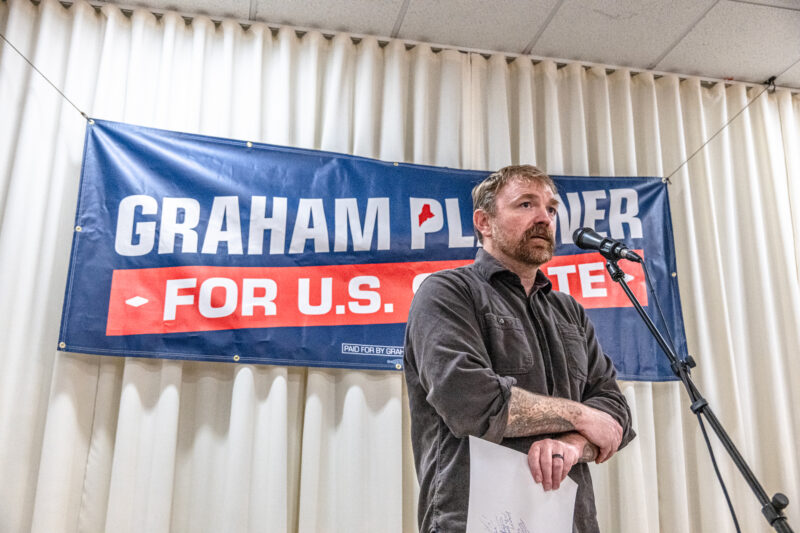
Ron Klain, the former chief of staff to President Joe Biden, defended Maine Democratic Senate nominee Graham Platner’s tattoo of a Nazi symbol in a comment responding to the Republican Jewish Coalition on Instagram.
The RJC, after Platner’s victory in Tuesday’s primary election, called on Senate Minority Leader Chuck Schumer (D-NY) to rescind his support for Platner. Klain, in a comment on the RJC’s Instagram post, declared, “This is just a partisan attack. The tattoo was a skull and crossbones to remember his fallen comrades from his service in Afghanistan.” Platner was deployed to Iraq, not Afghanistan, when he got the tattoo.
Platner has denied that he knew what the symbol was until late last year, when the campaign was contacted by media about it, but has not claimed, as Klain did, that it was intended to memorialize fallen comrades.
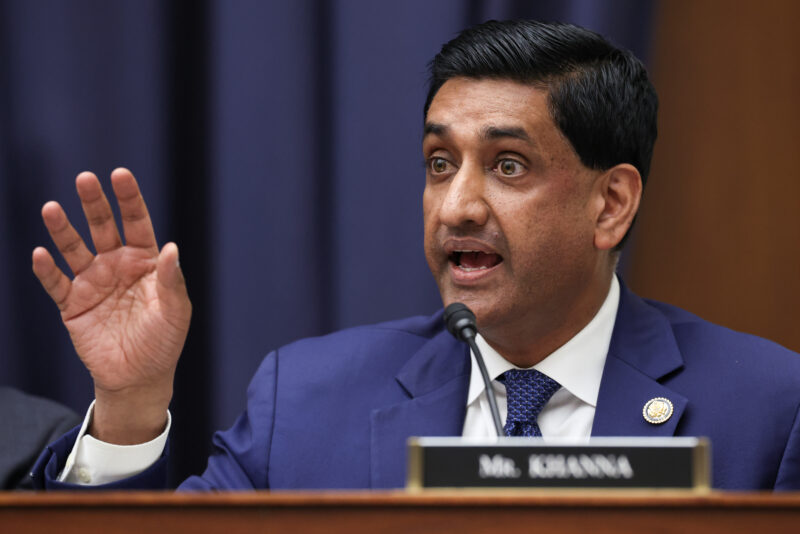
Klain, now the chief legal officer at Airbnb, has reportedly been quietly backing and advising Platner’s campaign, as well as several other prominent progressives, including New York City Mayor Zohran Mamdani, potential presidential candidate Rep. Ro Khanna (D-CA), California gubernatorial candidate Xavier Becerra, New York congressional candidate Jack Schlossberg and Sen. Ed Markey (D-MA).
But he had previously declined to comment to Politico last week on his political activities, and had otherwise not discussed his involvement with Platner.
Platner’s former romantic partner, Lyndsey Fifield, who has accused him of domestic abuse, has said that he described the tattoo to her as “my Totenkopf” and would joke about it being a Nazi symbol. She said that Platner told her that he and his Marine colleagues chose the symbol because they saw a parallel between themselves and the Nazi SS as a “death unit.”
Fifield shared text messages with The New York Times showing that she had informed friends that Platner had a tattoo of a Nazi symbol in August 2025, months before it became public knowledge.
The RJC said on X that “Klain’s pathetic rationalization of a clear Nazi symbol is a total disgrace,” and that, as a former U.S. Holocaust Memorial Museum board member, “Klain absolutely knows better.”
“Every Jewish family in America knows what the insignia of the Nazi SS — the unit that ran the death camps — looks like and Klain knows exactly what it is too,” the group said.
Following his victory in Maine’s primaries on Tuesday, some Senate Democrats who appeared wary of Platner after the domestic abuse allegations once again appear to be rallying around him.
“I think Graham showed a great deal of support in the primary, and I think … that’s going to build momentum and will assure that we win Maine,” Sen. Kirsten Gillibrand (D-NY), who chairs the Democratic Senatorial Campaign Committee, told CNN.
‘I have never and would never support any such heinous conspiracy theories,’ Rabb pushed back in a statement to JI

U.S. House of Representatives
Reps. Josh Gottheimer (D-NJ) and Jared Moskowitz (D-FL)
Reps. Jared Moskowitz (D-FL) and Josh Gottheimer (D-NJ) expressed concerns about Chris Rabb’s Democratic congressional primary victory in Philadelphia this week, which is likely to send the Pennsylvania state legislator to Washington next year in a deep-blue district.
They expressed particular concern about a post shared on Rabb’s Instagram account that described the Bondi Beach Hanukkah terror attack in Sydney as a false flag operation, which Rabb’s campaign has attributed to an unnamed former staffer and disavowed.
In a new statement to Jewish Insider, Rabb pushed back, emphasizing his connections to the Jewish community and explaining that the post was shared by a former contractor with whom the campaign had cut ties, without his approval.
Moskowitz noted that mass shootings are a particularly personal topic for him given that he graduated from Marjory Stoneman Douglas High School, the site of one of the largest school shootings in U.S. history.
“I had a shooting at my high school, 14 kids were killed, three adults. [Former Rep.] Marjorie Taylor Greene called that a false flag event. To see someone on my side of the aisle see a mass shooting and call it a false flag is obviously tremendously disappointing,” Moskowitz told JI on Thursday.
He said that such rhetoric also feeds into a cycle of escalation that leads to comments like those from antisemitic Texas Democratic congressional candidate Maureen Galindo, who called for imprisoning and castrating Zionists.
“How did we get here?” Moskowitz asked. “It’s because of statements like [Rabb] said, and statements that many other people say, and the stuff that goes online. It’s the constant escalatory behavior.”
Gottheimer said he was “deeply concerned about the things [Rabb] has said and shared” as well as “who he campaigned with,” naming Hasan Piker, the far-left streamer who has repeatedly espoused antisemitic sentiments and support for terrorism in particular.
“Whether that was some sort of campaign gimmick or his deeply felt beliefs — we’ll see,” Gottheimer said.
Rabb pushed back hard in a lengthy statement to JI, again denying any knowledge of the Bondi Beach post.
“The Bondi Beach Instagram story was reposted to my account without my knowledge or consent by a vendor with whom my campaign has severed ties. Accusations to the contrary are extraordinarily troubling because they misrepresent my deep and enduring commitment to combatting antisemitism and standing with the Jewish community here in Philadelphia and around the world. There is no place for such destructive and shameful hate,” Rabb said. “I have never and would never support any such heinous conspiracy theories.”
Rabb also emphasized longtime connections to the Jewish community — growing up in a Black and Jewish neighborhood and working with Jewish communities during his time in office to fight white Christian nationalism and bigotry, and noted the longtime alliance between the Black and Jewish communities to fight racism.
“These accusations ignore my life-long connection to the Jewish community amid multi-generationial ties to Jewish friends and neighbors borne of shared struggle and resistance to systems of harm,” Rabb continued. “I am proud that Philadelphia’s Jewish community was at the heart of my campaign – including many volunteers and staff, all the way up to our campaign manager. In Congress, I will do everything in my power to prevent violence against Jewish folks — or any other people — because I firmly believe in protecting and supporting the safety and equality of all.”
Rep. Jamie Raskin (D-MD), who endorsed Rabb, defended him.
“I was concerned about [the Bondi Beach post], but they said it was someone on the staff and he disowned it immediately. He disavowed it,” Raskin said. “I spent some time with him, and he’s a very smart and thoughtful and decent guy.”
Makia Green is a D.C. activist who founded a nonprofit that advocates for prison abolition
Pete Kiehart for The Washington Post via Getty Images
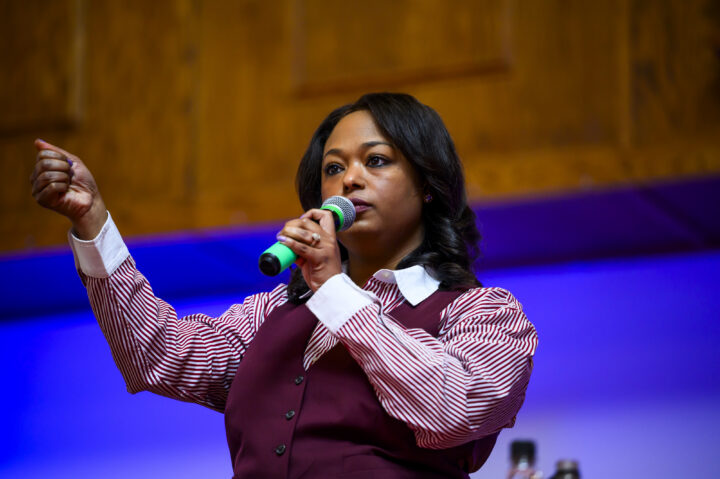
Mayoral candidate Janeese Lewis George speaks during the Free DC candidate forum, an event for constituents to meet and question candidates for mayor.
The highest-paid staffer on Washington, D.C., mayoral candidate Janeese Lewis George’s campaign has a social media history showing deep-seated hostility toward Israel and adherence to far left views on the Middle East, according to a review of the staffer’s public posts.
Makia Green, Lewis George’s political director, posts frequently on Instagram, often a mix of photos or videos of herself alongside TikTok videos that she downloads and shares to her own profile. Green is a local activist who founded a nonprofit called Harriet’s Wildest Dreams that advocates for prison abolition.
In the months after the Oct 7, 2023, Hamas attacks in Israel, Green’s posts on Instagram, where she has 6,400 followers, regularly centered on anti-Israel advocacy.
One video she shared in Dec. 2023 called Israel an “imaginary state.” Another post that month featured a video with someone saying “Israel is a bitch, so evil.”
In November, weeks after the Oct. 7 attacks, Green shared a video of a woman who called it “sickening” that Israeli actress Gal Gadot was screening footage of Hamas’ atrocities.
At least two posts featured videos that appeared to defend the Houthis, an Iran-backed militia in Yemen that began attacking Israel and commercial vessels in the Red Sea after Oct. 7. One, from Jan. 2024, showed an Irish parliamentarian criticizing the European Union for its concern about the Houthis’ attacks on global shipping.
A Dec. 2023 post included a video with a woman who said that “Yemen is the only nation militarily backing the people of Palestine.” The caption to the post expressed support for the Boycott, Divestment and Sanctions movement.
The captions to many of Green’s posts in late 2023 and 2024 called on her followers to advocate for the Palestinian cause. In Jan. 2024, she wrote “from the river to the sea, Palestine will be free,” alongside a video showing pro-Palestinian protesters with bullhorns outside the home of Sen. Chris Van Hollen (D-MD), shouting that his wife should be “ashamed.”
Green’s posts reveal a deep commitment to BDS, including calls to boycott Starbucks because of its support for “genocide.” (Starbucks was the target of anti-Israel activists in the fall of 2023 because of its posture toward pro-Palestinian members of its union.)
“My views are my own,” Green’s Instagram bio states. She did not respond to a request for comment.
Green’s posts have come under scrutiny as Lewis George continues to face questions about her own views on Israel.
At a candidate forum hosted by the Jewish Community Relations Council on Thursday, Lewis George was asked to specify her views on Zionism — an issue that has become a flashpoint in the race after she said in a Democratic Socialists of America endorsement questionnaire that she would reject the “Zionist lobby.”
Lewis George said at the event that she would not exclude any segment of the Jewish community but avoided sharing her opinion about Zionism. She is a member of the Metro DC DSA chapter and earned the group’s endorsement in the mayoral race.
“I will refrain from going on any political junkets to Israel. I will also not attend events focused on obfuscating the realities of occupation or promoting Zionism and apartheid,” Lewis George wrote in the DSA questionnaire.
Asked whether she supports BDS, Lewis George did not answer, but said she supports “the right of all people, including Palestinians, to use nonviolent strategies like boycotts and calls for divestment to build a more just world.”
A spokesperson for Lewis George’s campaign did not respond to multiple inquiries seeking comment about whether Green advises Lewis George on Israeli-Palestinian matters or if their views align.
In her anti-Israel messages, Green also regularly took aim at Democrats. One video she shared in Dec. 2023 showed a man describing both Donald Trump and Joe Biden as “horrible choices.” In a post several months later, Green shared a video encouraging Democrats to support the Uncommitted movement to protest Biden’s support for Israel. She routinely highlighted anti-Israel protests at events hosted by Biden and Vice President Kamala Harris.
In one post with a “ceasefire” caption, from Jan. 2024, Green boosted a video that escalated from criticism of the president to the entire country.
“F*** the United States government and every member that belongs to that shit,” a woman said in the video.
The Chabad-raised New Yorker has been wrapping tefillin with tech founders, financiers and celebrities on the sidelines of the elite Milken Conference in L.A.
Gabby Deutch
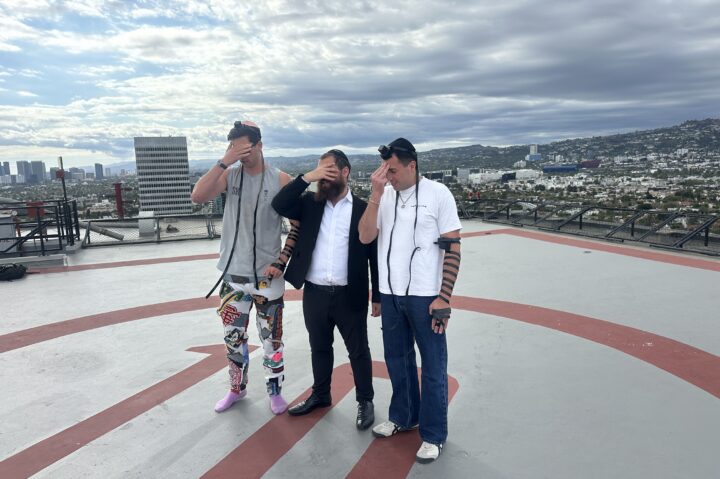
Yossi Farro wrapped tefillin with Ozzy Marriott and Sebastian Moftakhar on top of an office building on Wilshire Blvd in Los Angeles
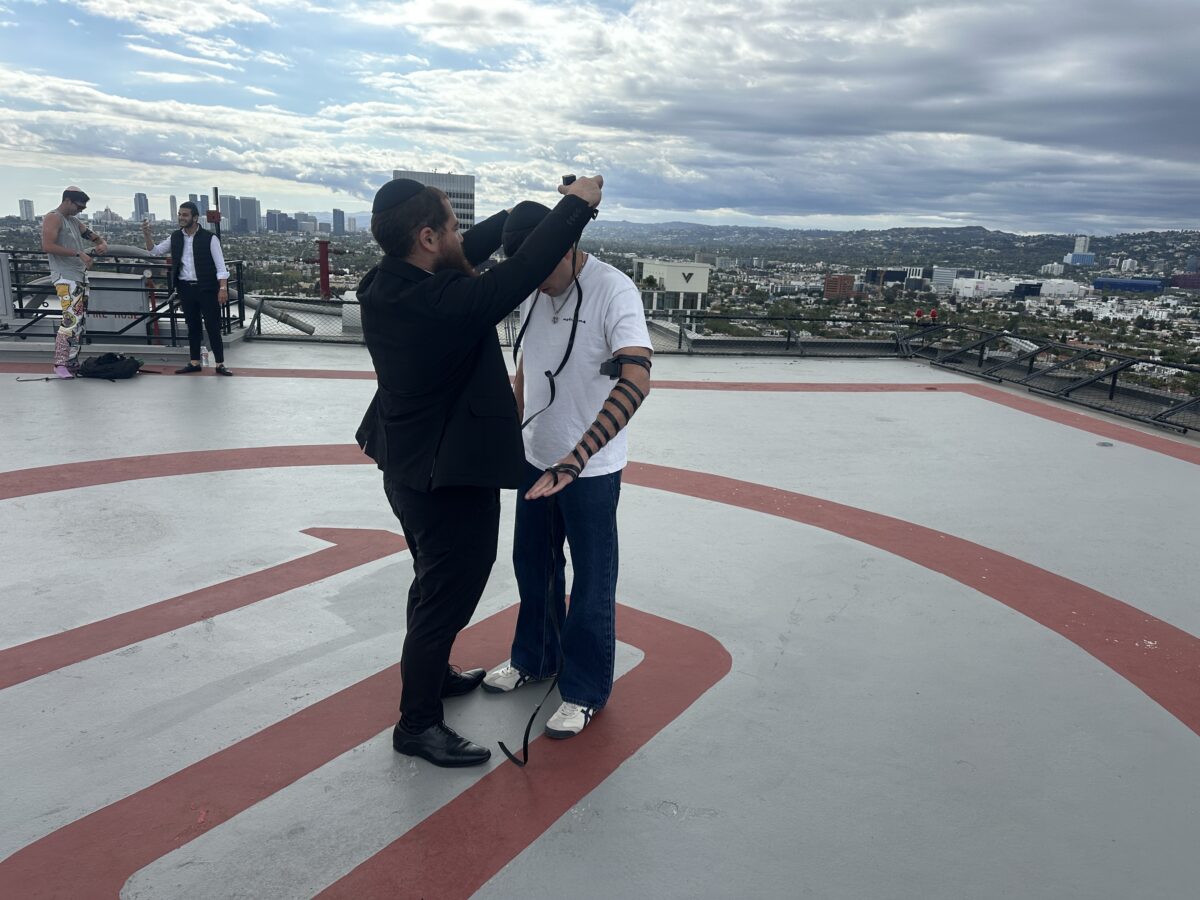
LOS ANGELES — Yossi Farro stepped onto the helipad, taking in the panoramic view of Los Angeles: the Hollywood sign in front of him, the skyscrapers of downtown L.A. behind him, all of it surrounded by mountains. But he was not there to take in the view, aside from assessing its value as a backdrop for an Instagram video.
Farro was standing atop a Wilshire Boulevard office building on Tuesday afternoon to wrap tefillin with two budding Jewish entrepreneurs in their 20s, and to record all of it for social media.
“What’s your message to the world?” Farro asked the two men, in a video that was posted to his 43,000 Instagram followers moments after it was recorded. “Be proud,” one said. “Try your best,” said the other, whose father owns the building.
“Amazing,” Farro said energetically to the camera. “Have an amazing day.”
Farro grew up in New York as a Hasidic Jew, part of the Chabad-Lubavitch movement. His long, wispy beard and no-frills outfit — black jacket, loose-fitting white button down shirt, black pants — stood in contrast to the more fashion-forward looks of the men he was visiting that day.
But while Farro might look more Crown Heights than Beverly Hills, he has the camera-ready comfort that only a 22-year-old who has grown up being influenced by, well, influencers could have. It’s also safe to say his confidence comes at least in part from the Chabad movement, where from the time he was a teenager he was tasked with approaching strangers with a simple question: “Are you Jewish?”
The goal is to get them to do a mitzvah, which for men usually means wrapping tefillin, the practice of donning a pair of leather black boxes that contain passages from the Torah. It’s an act that Orthodox Jews perform daily.
“Join me as I Wrap the most Powerful Jews in the World,” Farro’s Instagram bio reads. Look through his stories, and you’ll see actors and startup founders and CEOs. When a major elite gathering is happening, expect to find Farro on the sidelines, such as this week’s Milken Institute Global Conference in Beverly Hills.
He didn’t get into the actual event, where tickets run into the high five figures. Farro doesn’t currently have a full-time gig; he told Jewish Insider he is inspired by the entrepreneurs he meets. In between brief run-ins with high-powered members of the tribe, he is sleeping at a friend’s place.
But Farro was spotted around L.A. all week long, spending time at nearby hotels and a Lag Ba’Omer party for Milken attendees. He wrapped tefillin with music executive and entrepreneur Scooter Braun, KIND Snacks founder Daniel Lubetzky and Mark Suster of Upfront Ventures, the largest venture capital firm in L.A. He posted a photo with Reddit founder Alexis Ohanian, whom he ran into outside a Beverly Hills hotel. Approaching some of the world’s most influential and successful people does not seem to scare Farro: After Oaktree Capital Management co-founder Howard Marks told Farro he is not Jewish during a run-in at a Beverly Hills Starbucks, Farro Googled him — and learned he was lying. They did not wrap tefillin together, but “we grabbed a picture and ended up bonding over both growing up in New York.”
“I get a little nervous, but never too nervous to ask,” Farro said in an elevator down from the helipad. He was on his way to meet some other people to wrap, before heading to the airport to catch a flight to San Francisco to try to wrap tefillin with Joe Lonsdale, founder of Palantir and founder and managing partner at 8VC. (Farro met Alex Karp, Palantir’s CEO, a couple weeks ago.)
Farro’s tefillin-influencer journey began three years ago, when he was walking in Los Angeles and asked the rapper Lil Dicky to wrap tefillin. (Farro did not know who he was.) Not long after, he ended up doing the same with the actors James Franco and Jeremy Piven.
His tefillin big break came one year after the Oct. 7, 2023, Hamas terror attacks. For months he had been sending DMs on X to Bill Ackman, the hedge fund manager and Harvard alum who became a vocal critic of his alma mater’s handling of antisemitism. Farro got his phone number, and three weeks after making a pitch to wrap tefillin together, Ackman agreed to do it, on the anniversary of the attacks. Farro’s post on X with pictures from their tefillin date has more than 2 million views.
So how does a young Chabad guy who hasn’t even formally earned his “rabbi” title yet, let alone gotten a job, fly around the country to exclusive gatherings to get high-profile Jews to do a mitzvah that many non-Orthodox Jews know very little about? Persistence, confidence and a very high tolerance for awkwardness. Belief — in himself, and in God — helps too.
“What’s my message? Why am I doing it? Bring godliness to everywhere, spread light, spread faith,” Farro said. “Just remember, wherever you go, wherever you are, there’s always a higher power.”
The offending post featured two pigs labeled ‘U.S. Imperialism’ and ‘Zionism’

Lance King/Getty Images
A general view of the Duke University Chapel on the campus of Duke University on November 23, 2025 in Durham, North Carolina.
Duke University suspended its Students for Justice in Palestine chapter on Tuesday, one month after students began submitting complaints about an antisemitic Instagram post from the group, which depicted the U.S. and Israel as two pigs frothing at the mouth.
The post, which has since been removed from Duke SJP’s Instagram page, was advertising a March 19 general meeting of the group, an on-campus discussion about “Iran, Zionism and US imperialism.”
The flyer featured an illustration by artist Emory Douglas originally published in the newspaper The Black Panther in 1970, depicting the snarling two pigs holding the torch of liberty and the Star of David, labeled “U.S. Imperialism” and “Zionism.”
According to The Duke Chronicle, the university’s student newspaper, 10 students filed complaints with Duke’s Office of Institutional Equity after the flyer was published on March 13. Citing the complaints and previous conduct issues, Duke Student Affairs suspended the group and froze its funding, according to the Chronicle.
Noah Hamid, a sophomore political science major, commended the suspension, telling Jewish Insider that “part of the reason I chose Duke is that the administration has done a good job of protecting students on both sides.”
Duke’s SJP chapter has been “less aggressive” than chapters on other elite campuses, said Hamid, who serves as a community impact fellow for the Israel on Campus Coalition.
Still, the group has been behind several disruptive incidents on campus since the Oct. 7, 2023, terrorist attacks in Israel. Demonstrators from Duke SJP disrupted a November 2024 on campus event featuring former Israeli Attorney General Avichai Mandelblit, accussing him of supporting illegal occupation and genocide, leading to an investigation by Duke into violations of its Pickets, Protests, and Demonstrations policy.
“A decision like [the SJP suspension] is not made relative to a single action but reflects a broader pattern of behavior that SJP has exhibited,” continued Hamid. “This is the right decision and the timeline [it took for administration] to make the decision is also a sign of it being fair. This isn’t a rash response. It’s them responding appropriately to reactions from the community.”
Duke University did not respond to a request for comment from JI asking how long the suspension is expected to last.
Of 150 reported accounts and 103 reported posts linked to white supremacist networks, designated Foreign Terrorist Organizations and vendors selling Nazi merchandise, Instagram removed only 11 accounts and 8 posts

Ismail Kaplan/Anadolu via Getty Images
Instagram logo displayed on a mobile phone screen in front of a computer screen displaying Meta logo in Ankara, Turkiye, on April 10, 2026.
A new report reveals that Instagram failed to remove 93% of reported extremist and hateful content, tying the trend directly to Meta’s efforts to roll back content moderation last year. The changes lifted some speech restrictions, allowing incendiary content to remain on the platform, fueling what the Anti-Defamation League report calls a surge of antisemitism.
The ADL report, “How Meta’s Content Moderation Changes Risk Turning Instagram into a Hub for Hate,” released on Wednesday, identified 105 accounts affiliated with white supremacist Nick Fuentes’ “groyper” network, with more than 1.4 million combined followers. Those accounts frequently posted antisemitic conspiracy theories, Holocaust denial and pro-Hitler content.
The report highlights that in May 2025, shortly after the rollback, Fuentes noted that his content continues to spread on Instagram despite him personally having been banned since 2021, writing on Telegram that Instagram “relaxed its content moderation” and had “stopped taking my clips down.”
Oren Segal, ADL’s senior vice president for counter-extremism and intelligence, said that the proliferation of antisemitism on Instagram is a direct outcome of the changes in policy at Meta, its parent company.The rollback included ending the platform’s third-party fact-checking program and replacing it with a system modeled after the community notes feature on Elon Musk’s X.
At the time, some Jewish leaders expressed concern that the move would “open the floodgates to content” that could target Jewish communities and individuals, and called the decision a “step back” in the fight against rising antisemitism.
Meta had said the relaxed guidelines aim to “allow more speech by lifting restrictions on some topics that are part of mainstream discourse.” Meta, also the owner of Facebook and WhatsApp, simultaneously said that it planned to crack down on “high severity violations,” such as pro-terrorism content. Meta CEO Mark Zuckerberg cited the results of the 2024 U.S. presidential election as the underlying decision to move to a “community note” model, calling it a “cultural tipping point towards, once again, prioritizing speech.” Zuckerberg said that third-party moderators were “too politically biased” and it was “time to get back to our roots around free expression.”
“When a platform used by 80 percent of American adults under 30 allows pro-Hitler content to rack up millions of views, Holocaust denial to spread unchecked and terrorist organizations to fundraise openly, we’re not talking about a policy disagreement,” said Segal. “We’re talking about a public safety crisis. Mark Zuckerberg acknowledged Meta would ‘catch less bad stuff’ after the rollback. Our research proves he was right, and the consequences are deeply concerning.”
Furthermore, the study found more than 340,000 followers across accounts directly or indirectly linked to U.S.-designated Foreign Terrorist Organizations, including the Popular Front for the Liberation of Palestine. It also identified more than 3.2 million views on content from a single extremist merchandise vendor selling apparel with Nazi symbols including Sonnenrads, Totenkopfs and SS bolts.
The ADL Center on Extremism researchers conducted testing between January and February 2026, by reporting 253 pieces of violative content through Instagram’s standard user reporting system. Of 150 reported accounts and 103 reported posts linked to white supremacist networks, designated Foreign Terrorist Organizations and vendors selling Nazi merchandise, Instagram removed 11 accounts and 8 posts. In 20 cases, Instagram explicitly stated it lacked the bandwidth to review the reports, according to the ADL.
According to Meta’s Community Standards, the company does not allow “organizations or individuals that proclaim a violent mission or are engaged in violence to have a presence on our platforms.” The company asserts that it removes any glorification or support of designated Foreign Terrorist Organizations, Specially Designated Global Terrorists, and any groups that organize or advocate for violence against civilians, including Taliban, ISIS and Al-Qaida.
Despite this official policy, ADL researchers found many active accounts that praise these groups, identifying at least 23 accounts that spread Islamic State and Al-Qaida propaganda. The accounts often post an image or video that glorifies organizations that meet Meta’s terrorism definition with caption text that is unrelated to the subject matter — like a synopsis of the movie “Home Alone” or gardening advice — potentially in an effort to evade detection.
A spokesperson for Meta told Jewish Insider after the report was released that “over two-thirds of the accounts and posts flagged by the ADL were removed prior to the publication of this report, while some did not violate our policies.” ADL told JI its figures were based on a two-week window from submitting a report to getting a response from the platform.
The 14-page report was released shortly before an upcoming Meta shareholder vote, scheduled for the end of May.
Last month, an AI-generated Instagram account called “Rabbi Goldman,” which featured a fake Orthodox rabbi spreading antisemitic conspiracies to its more than 1.4 million followers, was taken offline following major backlash from Jewish groups and one Democratic lawmaker — yet several similar, hate-peddling accounts have emerged with little to no public action from Meta.
This report was updated on April 15 to include a statement from Meta.
The report from Combat Antisemitism Movement found the platform has actively recommended this content to millions of users

Illustration by Jonathan Raa/NurPhoto via Getty Images
The Instagram logo is being displayed on a smartphone among other social media networks in this photo illustration in Brussels, Belgium, on January 22, 2024.
An AI-generated Instagram account portraying an Orthodox-looking rabbi is pushing antisemitic conspiracy theories to its more than 1.4 million followers, and it’s not the only one, a study published this week about antisemitic content on the social media platform has found.
An account called “Rabbi Goldman” “uses fake, AI-created authority figures to spread hate” in “a troubling and growing tactic,” according to the report, published on Wednesday by the Combat Antisemitism Movement.
The 12-page report, titled “Engineered Exposure: How Antisemitic Content Is Pushed and Amplified to Millions Across Instagram,” documents 100 posts that researchers described as antisemitic, pushed directly to Instagram accounts over a 96-hour period from March 19-22.
These posts, actively suggested by the platform’s recommendation systems, generated more than 5.3 million likes and 3.8 million shares, with an estimated reach of 150 to 280 million users, according to the report.
CAM defined antisemitic posts as ones that invoke conspiracy theories — such as Jews controlling the media or manipulating global conflicts — and posts that claim Jews, often referred to as “Zionists,” are linked to demonic forces or satanic imagery, all of which have been used to justify antisemitic violence.
The report raises particular concern around the creation of “closed content environments,” in which users are repeatedly fed similar antisemitic themes, with little or no countervailing content.
“This type of algorithmic clustering reaffirms dangerous beliefs, contributing to a process of radicalization that can have lethal real-world consequences,” the report states. Researchers identified 12 AI-generated “rabbis” with a combined following of 2.1 million Instagram users, all of which promote classic antisemitic stereotypes.
The “Rabbi Goldman” account features many of these, including one video in which the “rabbi,” wearing a tuxedo and seemingly seated in a luxury airplane, claims that Jews utilize empty private jets to evade taxes. The community note attached to the clip reads, “This is an AI generated rabbi who is trying to scam you by selling a fake 9$ get rich handbook. This account is ran by scammers based in south India.”

Meta, which is the parent company of Instagram — as well as Facebook and WhatsApp — did not respond to a request for comment from Jewish Insider about the report’s findings.
“Simply put, this is evidence of a broad systemic failure on the part of Instagram and Meta,” Sacha Roytman, the CEO of CAM, said in a statement. “When a platform actively recommends content that dehumanizes Jews to mass audiences, we are no longer talking about a simple oversight or a mistake in the algorithmic design. We are talking about infrastructure that normalizes hatred at scale that must be addressed immediately.”
“CAM is calling on Meta to go beyond basic enforcement and take real responsibility. What’s been uncovered here must be taken seriously. This isn’t a fringe problem. Rather, it points to a broader, systemic issue with global reach, shaping how millions of people encounter and engage with antisemitic ideas in 2026,” the report states.
Last year, Meta received pushback from Jewish leaders when it introduced a new community-driven fact-checking system, ending its third-party fact-checking program and replacing it with a system modeled after the community notes feature on Elon Musk’s X. Some Jewish leaders expressed concern that the move would “open the floodgates to content” that could target Jewish communities and individuals, and called the decision a “step back” in the fight against rising antisemitism.
Dangerous implications of social media have extended beyond the Jewish community, with a jury in Los Angeles ruling on Wednesday that Meta, as well as Google, are liable for creating addictive products that caused a teenager’s depression and anxiety. The verdict marks the first time juries have decided that tech companies are at least partially liable for distress online and offline.
The mayor deflected when asked about Jewish Insider’s revelations that his wife liked Instagram posts glorifying Hamas assault
ANGELA WEISS/AFP via Getty Images
New York City Mayor Zohran Mamdani answers questions on October 17, 2025 in New York City.
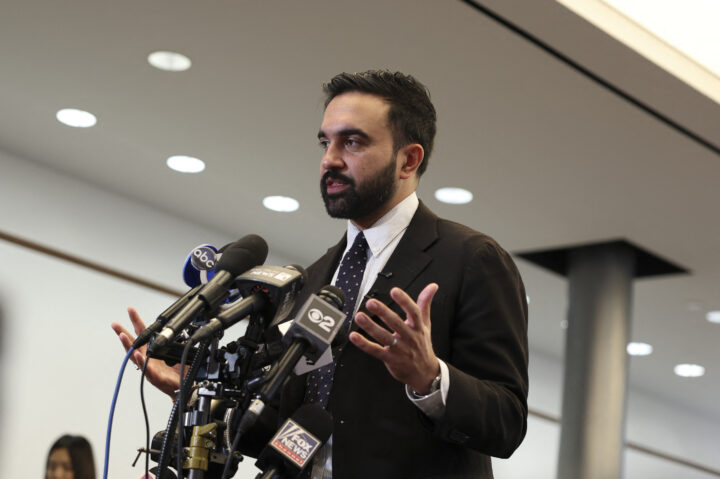
New York City Mayor Zohran Mamdani would not speak to Jewish Insider’s findings that his wife, First Lady Rama Duwaji, had liked Instagram posts that justified and even glorified the Oct. 7 attacks on Israel.
The mayor would not directly address JI’s revelations that his wife had liked posts that approvingly shared stills from the livestreamed assault and promoted a protest that supported the terrorist action the following day — a protest Mamdani himself had condemned at the time.
“My wife is the love of my life, and she’s also a private person who has held no formal position on my campaign or in my City Hall,” Mandani said at a press briefing Friday morning. “I, however, was elected to represent all eight-and-a-half million people in this city, and I believe that it’s my responsibility, because of that role, to answer any questions about my thoughts and my policies and my decisions.”
His comments appear to be an effort to differentiate Duwaji, who has no official municipal or political role, and the wife of Rep. Dan Goldman (D-NY), whom the New York Times reported earlier this week had liked and shared multiple posts attacking activists critical of Israel while serving as the congressman’s campaign treasurer.
But the mayor’s defense contrasts with his remarks in an interview from January, when he referred to Duwaji as “the best advocate” and credited her with lobbying him to close public schools for a snow day after a student reached her by email.
Duwaji, who met Mamdani on a dating app in 2021 and married him in early 2025, is an increasingly prominent Syrian-American illustrator whose work appeared in a New Yorker piece on conditions in Gaza following her husband’s election last fall, and whose style and presence in high society has received widespread attention.
A post that Duwaji liked from the day of the attack — which saw nearly 1,200 Israelis and foreign workers killed, thousands wounded, 251 civilians and military personnel kidnapped and numerous episodes of sexual assault — labeled images of attackers breaching the barrier between Israel and Gaza and riding in a captured Israeli Defense Forces vehicle as “Systemic change for collective liberation” and valorized the bloody onslaught as “resistance.”
Another post, from the controversial Times Square protest the day after, includes a clip of a crowd chanting “Every colonized people, every occupied people has the right to self-defense” and features images of signs and banners declaring “WHEN PEOPLE ARE OCCUPIED, RESISTANCE IS JUSTIFIED” and “RESISTANCE AGAINST OCCUPATION IS A HUMAN RIGHT.”
The post is from the account of the pro-China, pro-Russia, pro-Iran nonprofit the People’s Forum, which organized the demonstration with the Democratic Socialists of America and other far-left groups. The caption explicitly declares the purpose of the day-after rally as “to stand with Palestinian resistance.”
As of Friday afternoon, Duwaji’s likes of these posts remain visible to her followers.
Mamdani, previously a state assemblyman known for his outspoken criticism of Israel, was at pains during the mayoral campaign to condemn the Hamas attacks. He today represents the largest Jewish population in the world outside of Israel.
“Mayor Mamdani has been clear and consistent: Hamas is a terrorist organization, October 7th was a horrific war crime, and he has condemned that violence unequivocally,” a City Hall spokesperson said in a statement to JI on Thursday.
NYC First Lady Rama Duwaji showed support for far-left orgs applauding Hamas rampage
John Lamparski/Bloomberg via Getty Images
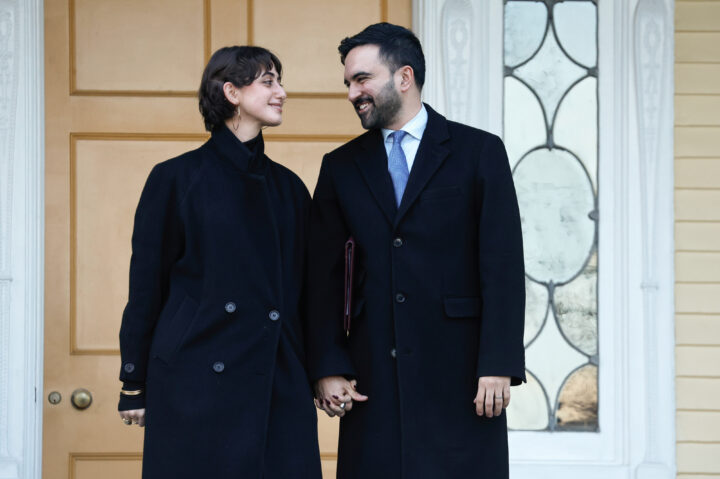
Zohran Mamdani, mayor of New York, and his wife Rama Duwaji during a news conference at Gracie Mansion in New York, US, on Monday, Jan. 12, 2026.
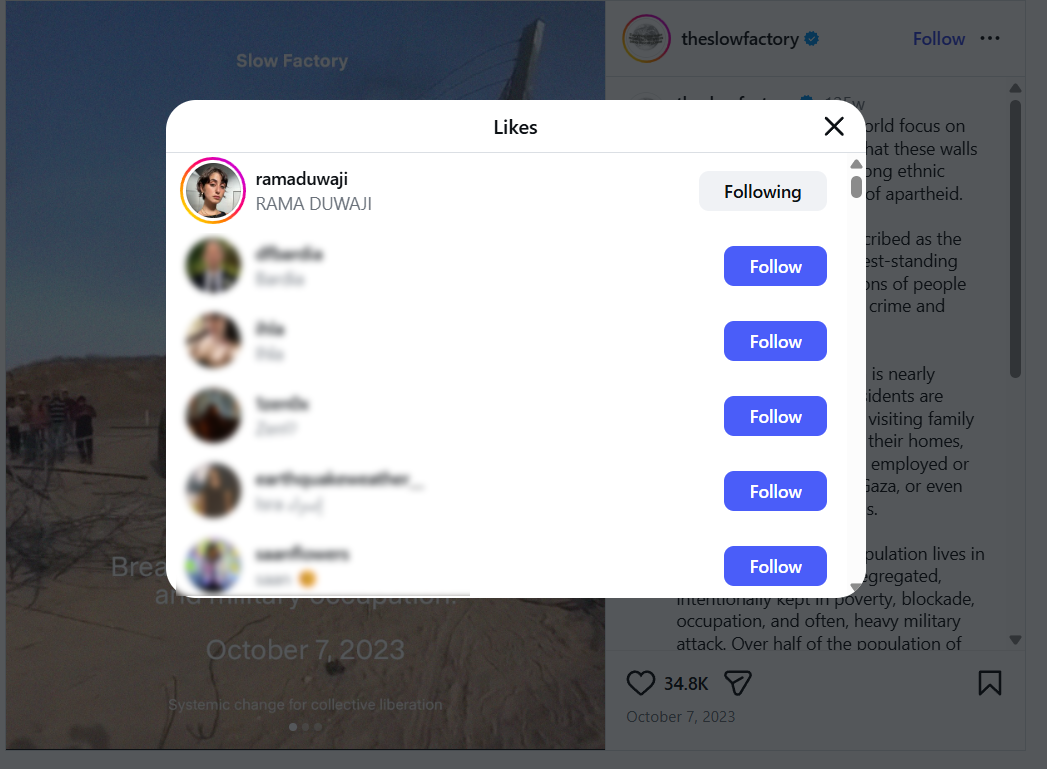
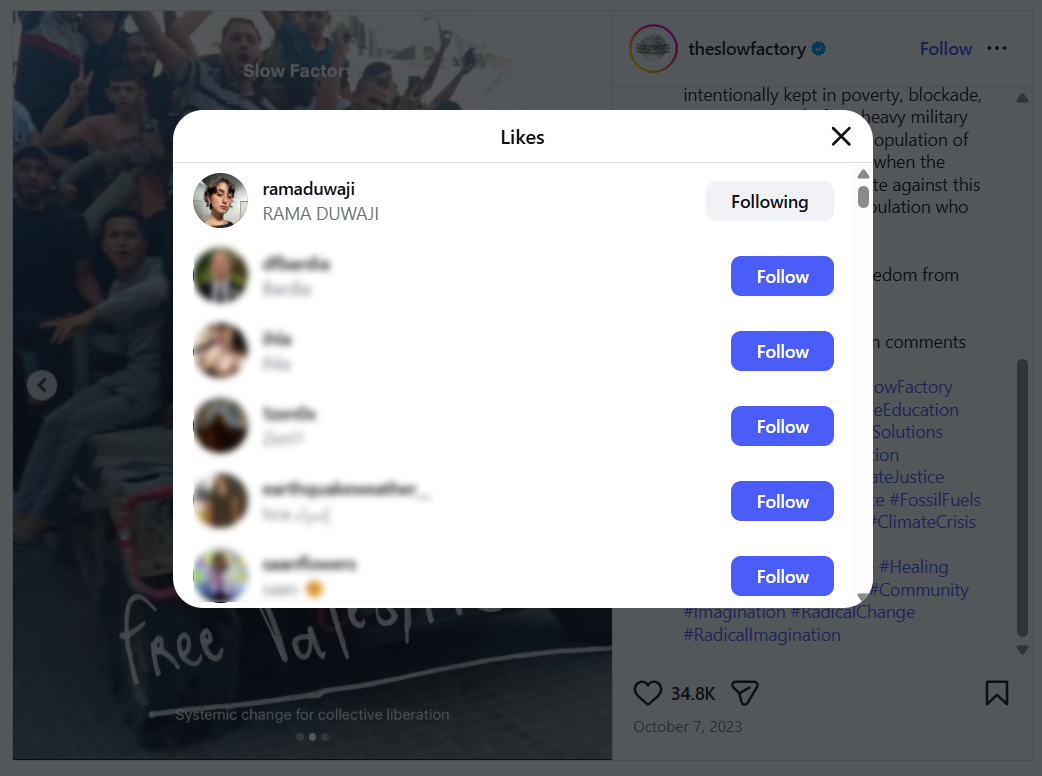
New York City Mayor Zohran Mamdani spent the mayoral campaign distancing himself from the most radical anti-Israel elements of his leftist movement, but an examination of his wife’s social media activity reveals she liked multiple Instagram posts cheering on Hamas’ Oct. 7, 2023, assault.
The posts liked by Rama Duwaji, a Syrian-American artist, unambiguously celebrated the terrorist attack, which saw nearly 1,200 Israelis and foreign workers killed, thousands wounded, 251 civilians and military personnel kidnapped and numerous episodes of sexual assault.
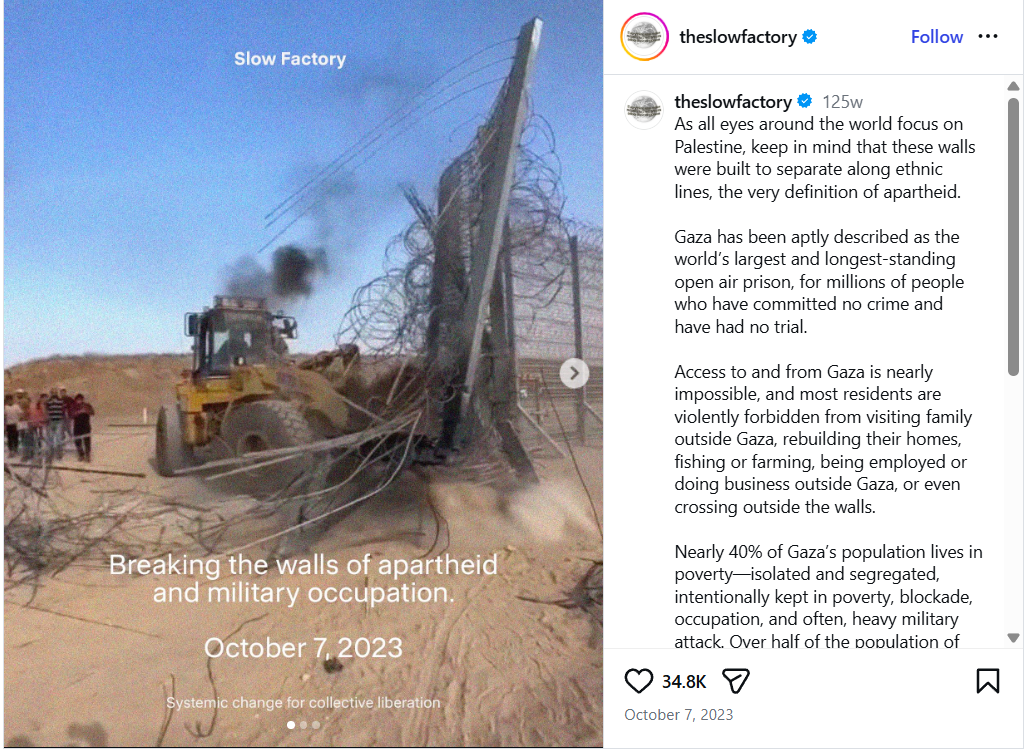
The first post, shared on the day of Hamas’ onslaught, came from The Slow Factory, which bills itself as “a school, knowledge partner and climate innovation organization” that “center[s] the voices and ideas of the Global Majority (Black, Indigenous, and other people of color) to share their knowledge outside the boundaries of institutions & oppressive systems.”
The Instagram post shows stills from participants’ livestreamed footage of the attack: first of a bulldozer that terrorists used to breach the barrier separating Israel from Gaza, the second of attackers riding on a captured IDF vehicle. Printed on the former are the words “Breaking the walls of apartheid and military occupation,” and on the latter “Resisting apartheid since 1948,” and on both the slogan “Systemic change for collective liberation.”
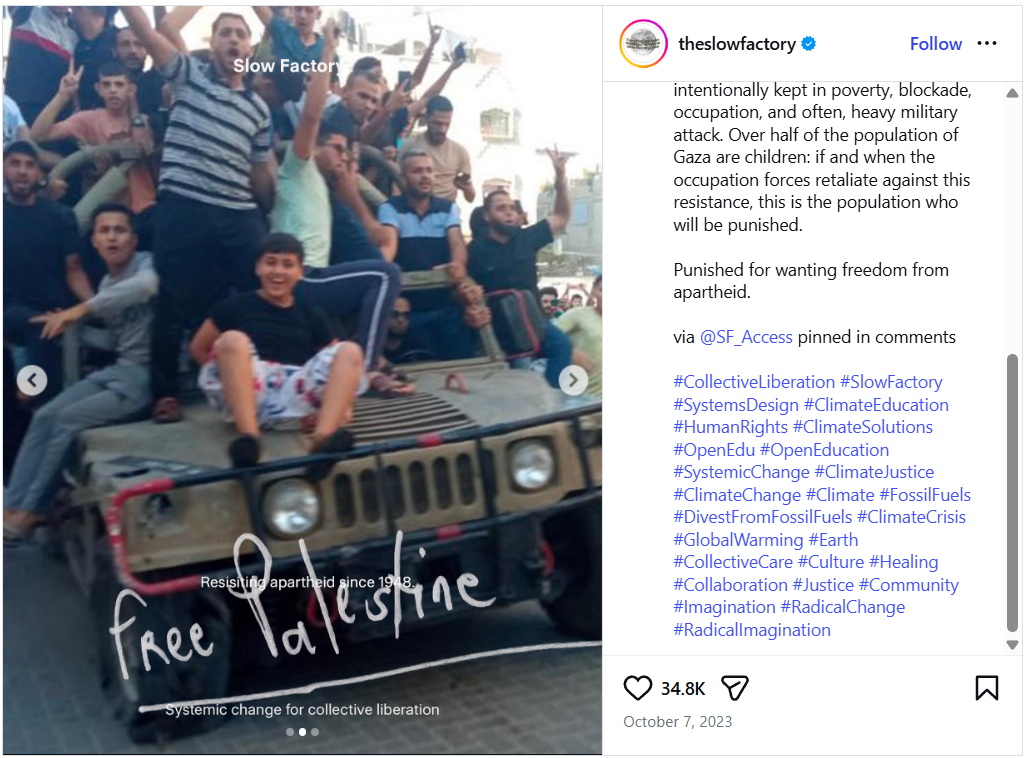
The extensive caption on the post laments that “if and when the occupation forces retaliate against this resistance” Gazans will be “punished for wanting freedom from apartheid.”
Duwaji, who met Mamdani on a dating app in 2021 and married him in early 2025, liked this post and others using a personal account in her own name, on which she has posted her often-political illustrations and with which the mayor has interacted in the past. She has used it also to directly criticize Israeli policy.
The unapologetic tone of the Slow Factory Post contrasts radically with the mayor’s debate-stage messaging on the attack, which characterized Hamas’ actions as “war crimes,” even as he continually lambasted the Israeli military response.
Duwaji did not respond to multiple requests for comment, and the mayor’s office would not answer questions regarding his feelings about her online activity, or whether they had discussed the Oct. 7 attacks at the time. Rather, his team repeated his standard line on the bloody terrorist rampage.
“Mayor Mamdani has been clear and consistent: Hamas is a terrorist organization, October 7th was a horrific war crime, and he has condemned that violence unequivocally,” a City Hall spokesperson said in a statement to Jewish Insider.
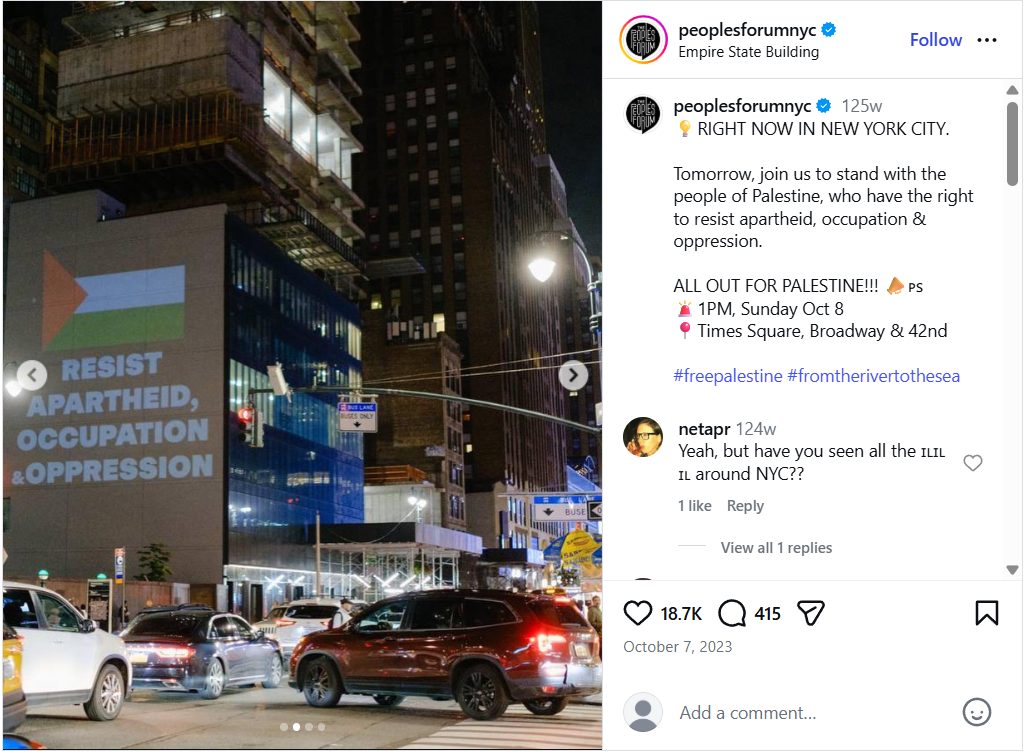
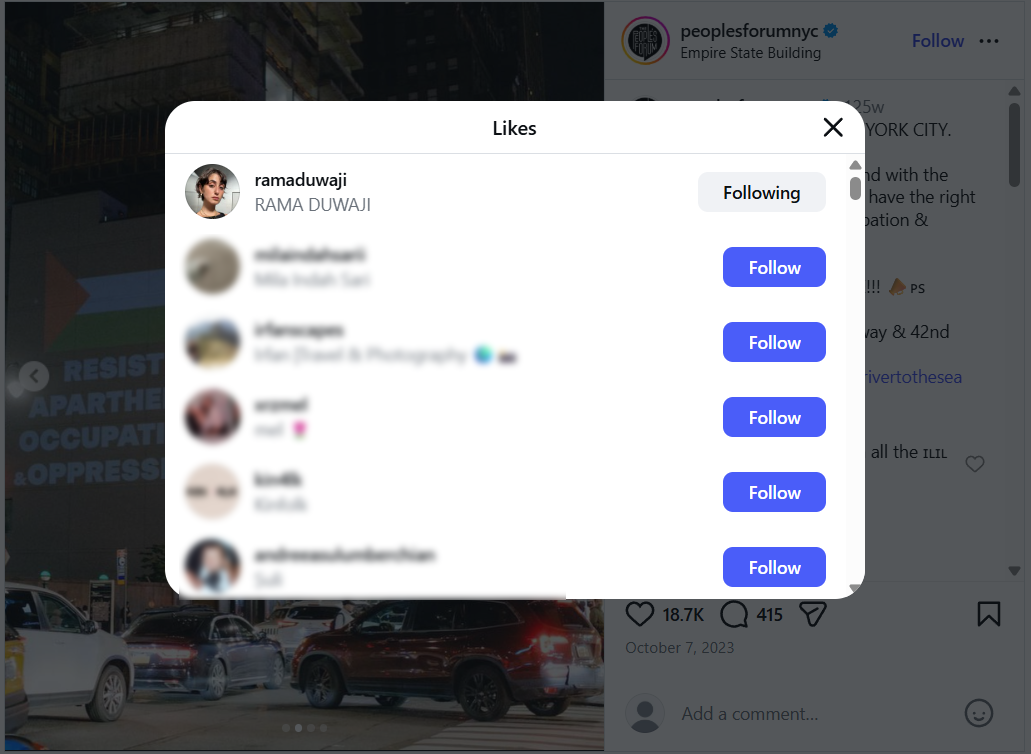
It is unclear when Duwaji liked the Slow Factory post, or the materials that the People’s Forum — part of Shanghai-based Maoist tech mogul Neville “Roy” Singham’s network of nonprofits promoting pro-China, pro-Russia and pro-Iran propaganda — posted to Instagram on Oct. 8, 2023. Duwaji, again using her personal account, liked two posts from protests the organization led alongside the Democratic Socialists of America and allied organizations in Times Square one day after the attack on Israel.
Mamdani, then a state assemblymember, publicly criticized the rally at the time for “making light” of Hamas’ massacre of civilians.
But the posts his then-girlfriend approved of on Instagram enthusiastically justify both the rally and the terrorist actions.
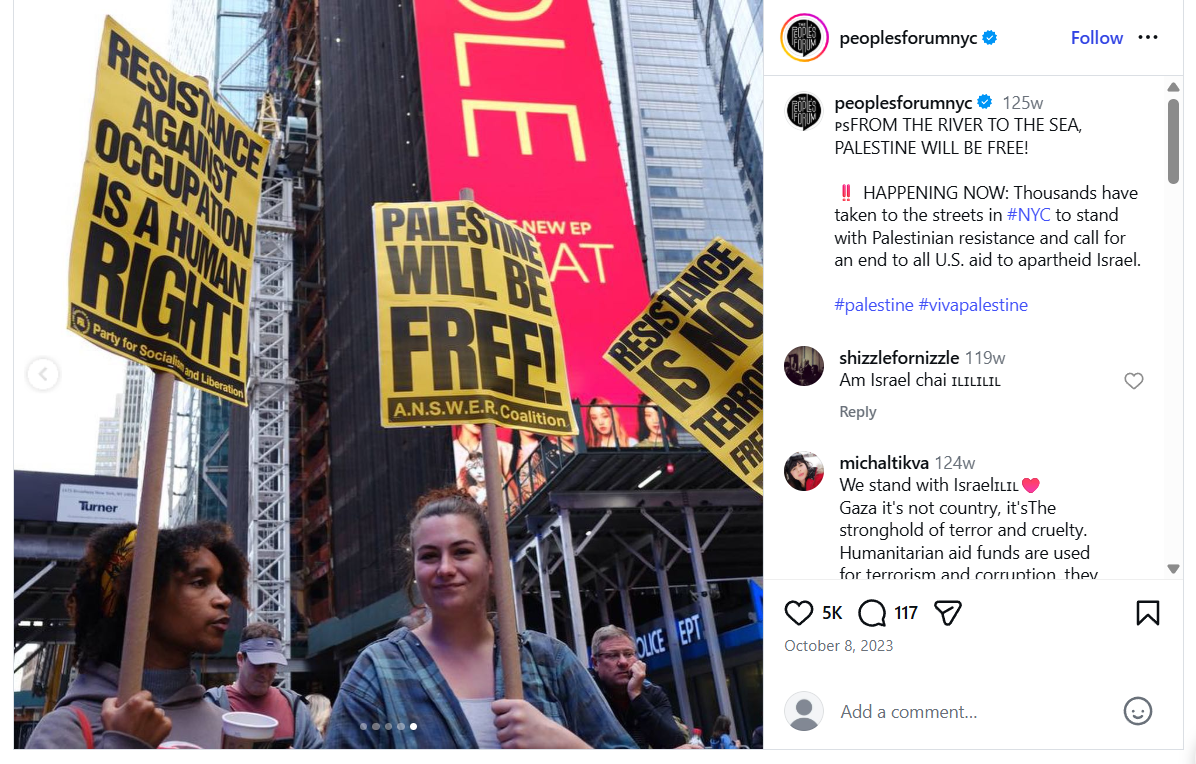
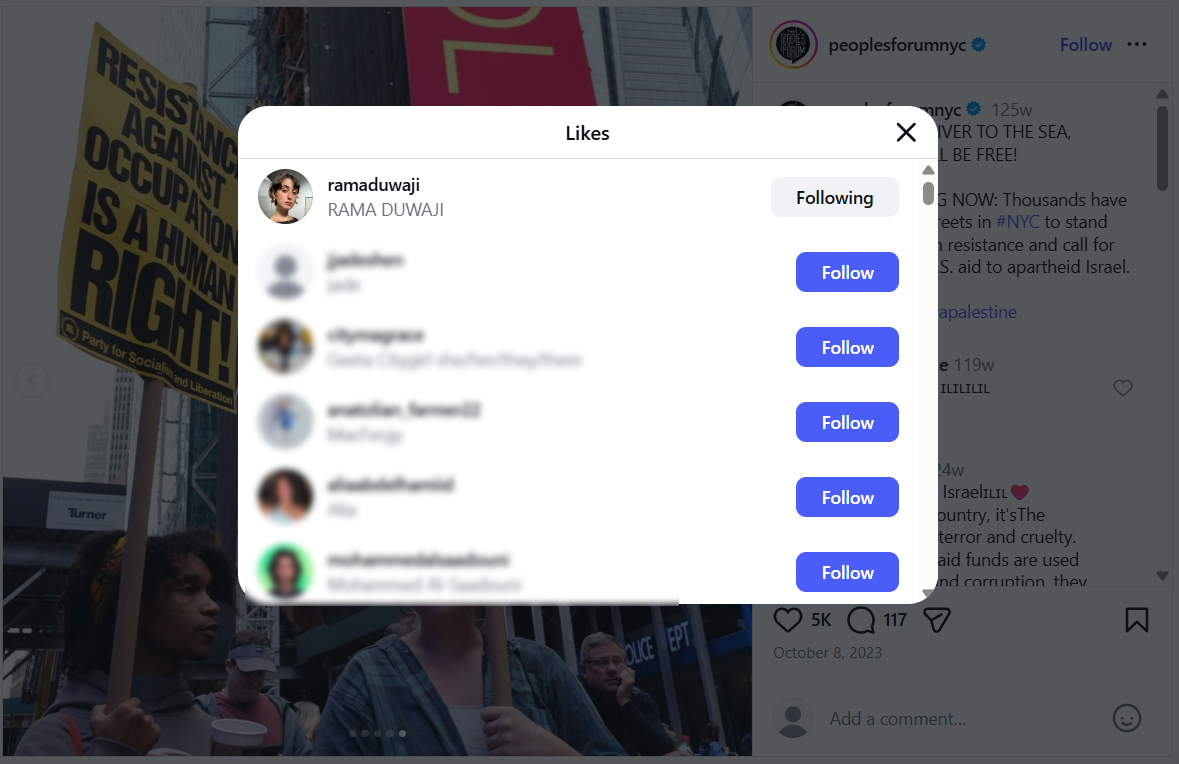
Both captions feature the slogan “from the river to the sea” — often understood as calling for the total elimination of Israel from the lands between the Jordan River and the Mediterranean Sea — and one includes a clip of the crowd chanting, call-and-response style: “Every colonized people, every occupied people has the right to self-defense.”
The images in that post show signs and banners declaring “WHEN PEOPLE ARE OCCUPIED, RESISTANCE IS JUSTIFIED” and “RESISTANCE AGAINST OCCUPATION IS A HUMAN RIGHT.”
“Thousands have taken to the streets in #NYC to stand with Palestinian resistance and call for an end to all U.S. aid to apartheid Israel,” the caption on the post reads.
JI’s findings come amid a growing focus on political spouses: earlier this week, The New York Times reported that the wife of Rep. Dan Goldman (D-NY) had liked or shared numerous controversial posts, including some attacking activists critical of Israel.
The Texas Senate candidate has leaned into attacks against Israel, even as he runs in a reliably Republican state
Elizabeth Conley/Houston Chronicle via Getty Images
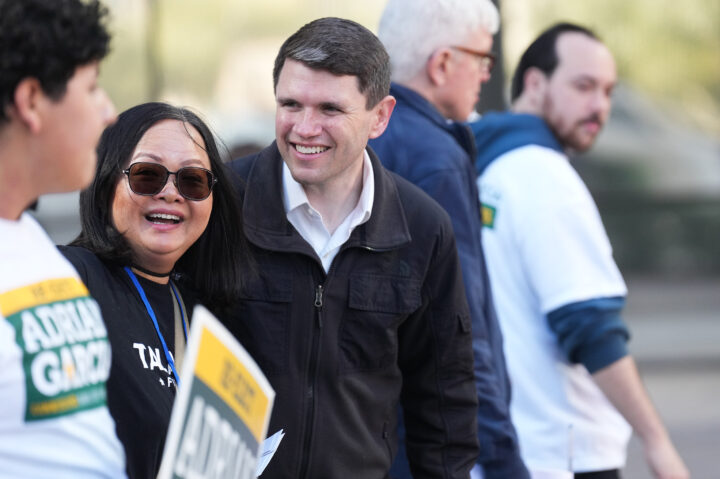
Senate candidate James Talarico walks along the Martin Luther King Jr. Unity Parade in Houston on Monday, Jan. 19, 2026.
Texas state Rep. James Talarico, a Democratic candidate for Senate in the state, has disavowed AIPAC and pledged not to take support from the group on the campaign trail.
But in late 2019, he attended an AIPAC event alongside a major donor to his campaign, according to a contemporaneous Instagram post about the event posted by an AIPAC supporter.
The post has been circulating online in recent days, driving discussion in progressive circles.
Since mounting his Senate bid, Talarico has vowed not to accept support from AIPAC or J Street, and has faced criticism from some in the Jewish community who believe he is singling out AIPAC in particular.
“I refuse to be complicit in the death and destruction in Gaza, and I will never use your tax dollars to support the killing in that part of the world, and it makes me sick to my stomach to see what’s happening,” Talarico said at an event last year. “I hope in this campaign here in Texas we can send a crystal-clear message to the rest of the country that we are done being complicit.”
Asked for comment on Talarico’s attendance at the AIPAC event, campaign spokesperson JT Ennis said, “James has been clear on his position on what is happening in Israel and Gaza. If anyone has questions on where James stands, they should look at his record, his extensive public comments, and the issues page on his website.”
Talarico has vowed to support efforts to ban some weapons sales to Israel and accused Israel of war crimes.
The same AIPAC supporter who shared the post with Talarico in 2019 was a major donor to his 2020 campaign; Talarico posted repeatedly on X about the donor offering to match up to $10,000 in donations to his campaign.
Talarico has also faced scrutiny on the campaign trail for accepting donations for his statehouse campaigns from a pro-gambling super PAC, Texas Sands PAC, funded by prominent pro-Israel GOP donor Miriam Adelson.
The Texas state representative is one a growing number of Democratic candidates who previously affiliated with or sought support from AIPAC but have since disavowed the group on the campaign trail amid increasing progressive hostility toward the pro-Israel organization, including Reps. Seth Moulton (D-MA), Valerie Foushee (D-NC), Deborah Ross (D-NC), Morgan McGarvey (D-KY), former New York Assemblyman Michael Blake and Evanston, Ill., Mayor Daniel Biss.
‘Finally getting it Nick,’ Bowman commented on a video of Fuentes saying Republicans are ‘better’ for Israel than working people

Spencer Platt/Getty Images
Former Rep. Jamaal Bowman (D-NY) speaks at the National Action Network’s (NAN) three-day annual national convention on April 07, 2022 in New York City.
Jamaal Bowman, the far-left former House member who is pursuing an appointment as New York City Mayor-elect Zohran Mamdani’s public schools chancellor, recently posted a comment on Instagram supporting remarks from neo-Nazi Nick Fuentes.
Bowman made the comment on an Instagram reel posted by Fuentes in September, which featured the antisemitic commentator making the case that Republicans weren’t a “better” choice than Democrats for working people, but were instead “better” for Israel, the oil and gas industry, Silicon Valley and Wall Street. The caption on the video, which has 2.6 million views and more than 239 thousand likes, reads: “The type of Racist ifw [I f*** with].”
“Finally getting it Nick. Now go a step further,” Bowman wrote in the comment, which was still up as of Thursday evening. “This is the same playbook they use to divide and conquer us based on race to maintain their oligarchy. It’s us, against the oligarchy. Now no more racist bullshit from you.”
Bowman, a former middle school principal, lost his bid for a second term in the House to Rep. George Latimer (D-NY) in the Democratic primary, in part because of his radical views toward Israel and extreme rhetoric.
Now out of Washington, Bowman revealed to supporters last month that he has been “pushing hard” for Mamdani to name him as schools chancellor so he could lead a “revolution in our public schools,” according to the New York Post. Bowman made the comments during a Zoom call in early November organized by the Democratic Socialists of America’s NYC chapter.
“I’m an educator, lifelong educator. When we get universal child care, y’all, it’s going to lead to a revolution in our public schools!” Bowman said on the call.
Sheikha Al-Mayassa bint Hamad Al Thani has amplified the far-left New York City mayoral candidate on her social media

PATRICK BAZ/Qatar Pavillon/AFP via Getty Images
Qatar's Al-Mayassa bint Hamad bin Khalifa Al-Thani attends a ceremony marking Qatar's first official participation in the Venice Architecture Biennale on May 8, 2025.
A prominent member of Qatar’s royal family is boosting Zohran Mamdani, a far-left Queens state assemblyman, in his campaign for mayor of New York City.
In recent posts to Instagram, Sheikha Al-Mayassa bint Hamad Al Thani, the sister of Qatar’s emir, has promoted Mamdani’s bid as he competes in a tight race against former New York Gov. Andrew Cuomo, his top rival in today’s Democratic primary election.
The Qatari royal has touted favorable polling for Mamdani while amplifying a recent campaign video in which the democratic socialist is seen embracing his mother, the renowned Indian-American director Mira Nair, on a city-length walk through Manhattan on Friday.
In a comment below the video, Sheikha Al Mayassa posted a string of flame emojis voicing her approval of Mamdani’s feat.
Sheikha Al Mayassa, who chairs a number of the Gulf state’s leading cultural organizations including the Doha Film Institute and Qatar Museums, has a personal connection to Mamdani’s family, having hosted his mother in Doha in 2022 for the world premiere of the musical adaptation of Nair’s hit film “Monsoon Wedding,” according to media reports.
In an interview with a Qatari lifestyle magazine at the time, Nair said that Sheikha Mayassa “has loved the movie but also supported the inception of this musical over several years from New York to India to here.”
In recent years, the Gulf state has faced criticism from U.S. lawmakers for hosting Hamas’ leadership and human rights abuses including mistreatment of migrant workers during the World Cup, when Nair’s musical was presented as part of a cultural program that coincided with the tournament held in Doha.
Meanwhile, in 2013, Nair rejected an invitation to attend the Haifa Film Festival in Israel as a guest of honor — saying that she would “go to Israel when apartheid is over.”
Mamdani, for his part, does not appear to have publicly commented on the support from Sheikha Al Mayassa or on Qatar more broadly. While he has stressed a message of affordability during the race, he has drawn backlash over his harsh criticisms of Israel.
Mamdani, who has also endorsed boycotts targeting Israel, has indicated that he will not visit the Jewish state if elected, arguing that he does not believe that such a trip is necessary “to stand up for Jewish New Yorkers.”
Meta is reportedly not allowing CUAD to appeal the decision
Victor J. Blue for The Washington Post via Getty Images
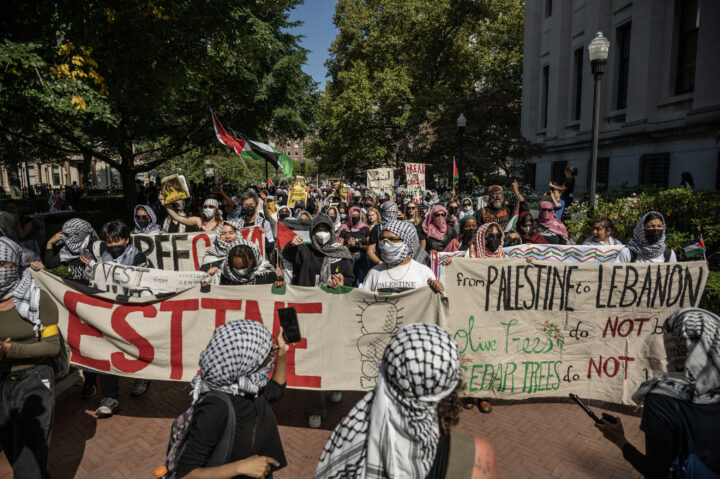
Students protest against the war in Gaza on the anniversary of the Hamas attack on Israel at Columbia University in New York, New York, on Monday, October 7, 2024.
The Instagram page of the anti-Israel coalition Columbia University Apartheid Divest was disabled on Monday for the second time since the Oct. 7 Hamas terrorist attacks, a spokesperson for Meta confirmed to Jewish Insider.
The account belonging to CUAD, a coalition of at least 80 Columbia student groups that was formed in 2016 and has gained renewed support since Hamas’ attacks on Oct. 7, 2023, was initially suspended in December 2024.
Columbia’s chapter of Students for Justice in Palestine, a member of the coalition, was banned from Meta in August 2024. At the time, a spokesperson for Meta, the company that owns Instagram, Facebook and WhatsApp, told JI that the account was disabled for repeated violations of Meta’s dangerous organizations and individuals policies.
According to Meta’s policies, the company does “not allow organizations or individuals that proclaim a violent mission or are engaged in violence to have a presence on our platforms.”
The coalition has ramped up its anti-Israel demonstrations, as the university entered into ongoing negotiations with the Trump administration over its handling of antisemitism on campus. The White House cut $400 million from Columbia’s federal funding earlier this month over its failure to address campus antisemitism.
Meta declined to comment on its latest decision to remove CUAD from the platform on Monday. CUAD remains active on several other social media platforms, including X and Telegram.
“This comes after a long and concerted effort from corporations and imperial powers to erase the Palestinian people,” CUAD wrote on X, claiming that this time around Meta is giving “no option for appeal.”
The accounts were only reinstated after Jewish Federations of North America intervened and contacted Meta directly

Justin Sullivan/Getty Images
A pedestrian walks in front of a new logo and the name 'Meta' on the sign in front of Facebook headquarters on October 28, 2021 in Menlo Park, California.
With the first anniversary of the Oct. 7 terror attacks approaching, JEWISHcolorado — a Denver-based nonprofit affiliated with the Jewish Federations of North America — posted on Instagram on Oct. 1 about the organization’s Oct. 7 commemoration event. Concerns about antisemitism meant attendees would need to register in advance, and JEWISHcolorado needed to give them time to do so before the start of Rosh Hashanah.
The post, though, did not successfully reach community members. That’s because soon after sharing it, JEWISHcolorado’s Instagram account was disabled. When the account manager tried to appeal the suspension, an automated email informed the JEWISHcolorado staff that their account, with 895 posts and nearly 2,500 followers, was “permanently disabled,” with all of its content set to be “permanently deleted,” according to messages shared with Jewish Insider.
JEWISHcolorado was one of at least four local Jewish federations in the United States to have accounts on Meta-run platforms disabled after posting in the lead-up to the anniversary of the Oct. 7 attacks. They did not receive any answers from Meta regarding why they had been suspended, leading some to question whether they were being targeted for the content of their posts — sharing information about Oct. 7.
“We suspect maybe it had something to do with our posting, but it’s an automated message that says you violated community guidelines. We don’t consider that to be so,” said Renee Rockford, president and CEO of JEWISHcolorado. The reasoning, according to a message from Meta, was that Meta does not “allow people on Instagram to pretend to be a business or speak for them with our permission.”
The Facebook account of the Jewish Federation of San Antonio was disabled in mid-September. Similar to JEWISHcolorado, they were removed for alleged “impersonation,” according to Kayde Jones, director of marketing and communications at the San Antonio federation.
Jones and her colleagues had no way of explaining themselves, or finding out who Meta believed them to be impersonating.
“It was as if we were completely wiped off the Facebook Earth,” said Jones. “It’s very hard to get in touch with anybody at Meta. There’s no phone calls. There’s no customer service that’s readily available.” Attempts to appeal the decision through Meta’s platforms were unsuccessful.
All of the disabled accounts have since been restored — JEWISHcolorado’s after four days, and the San Antonio federation’s after nearly two weeks. But it took the involvement of a staff member at JFNA, the national advocacy arm representing Jewish Federations, who reached out to a contact at Meta directly.
It’s not clear if someone had reported the Jewish federation accounts, or if Meta’s automated systems erroneously detected these accounts. None of them had ever previously had their accounts disabled.
“We are very grateful these issues were resolved, which seems to indicate that Meta is not intentionally targeting Jewish pages,” Niv Elis, a JFNA spokesperson, told JI. “That said, the fact that pages were taken down over Oct. 7 commemoration posts was very disappointing and indicates that there is clearly a problem that still needs to be fixed.”
A spokesperson for Meta did not respond to a request for comment on Monday.
People familiar with the singer’s visit deny she was paid, while official organizers remain tight-lipped

marcen27/flickr
Demi Lovato performs in Scotland last year.
As the buzz around pop singer Demi Lovato’s recent trip to Israel continues to reverberate, the funders and organizers of her visit are remaining tight-lipped about everything — including their identities. Meanwhile rumors, inaccuracies and sensationalizing have kept the story in the headlines both in Israel and around the world.
Who initiated and funded Lovato’s trip? Was she paid to come to Israel? Why did she visit, apologize and then delete the apology?
While the majority of the trip organizers refused to speak publicly, Jewish Insider interviewed several figures associated with Lovato’s visit to make sense of the situation.
Lovato — a 27-year-old Grammy-nominated singer with six studio albums, several top 10 singles and more than 74 million Instagram followers — paid a quiet visit to Israel last month, touring the country from top to bottom. Upon her return to the United States, she uploaded three Instagram posts about her trip, calling Israel “absolutely magical” and writing that she is “grateful for the memories” made during her visit.
Unsurprisingly, Lovato was bombarded with negative feedback from BDS advocates and anti-Israel activists, which led her to post and quickly delete an apology on her Instagram story. “I’m sorry if I’ve hurt or offended anyone, that was not my intention,” she wrote. “This was meant to be a spiritual experience for me, NOT A POLITICAL STATEMENT and now I realize it hurt people and for that I’m sorry.”
Yediot Aharonot originally reported that Lovato was paid $150,000 to visit Israel — a third of which was funded by the Israeli government — a claim that reverberated among BDS activists. But the newspaper later quietly edited its article, saying instead that the trip — which was free for the singer — cost $150,000 overall.
“As far as I know, [Lovato] didn’t receive a shekel to come here,” Moish Yaul, the spokesman for the Jerusalem Affairs Ministry, told JI. Rather, he said, the costs of the trip for her and her entourage were fully covered by several sources. Yaul said that the Jerusalem and Foreign Ministries together contributed around 200,000 shekel (approximately $57,000), and the rest was paid for by other private donors. During her visit, Lovato toured the City of David accompanied by Jerusalem Affairs Minister Ze’ev Elkin.
A Los Angeles-based source familiar with the details of the trip said the original Yediot report was “totally bogus.” Lovato herself commented on an Instagram post that cited Yediot’s reporting and denied she was ever paid: “This is actually not true at all,” she wrote. “This is in fact a lie. I never got paid. Simple.”
The popular singer was accompanied on the trip by her mother, Dianna De La Garza, who made it clear even after Lovato’s deleted apology that she had no regrets about the trip.
“We celebrated life and Christianity as we learned about the Jewish faith while listening to the Muslim Call to Prayer,” De La Garza wrote on Instagram alongside a photo of her and Lovato at the Western Wall. “There was no fighting, no judgement, no cruel words…only love. And I will undoubtedly, unapologetically go again one day.”
Industry insiders speculate that Lovato removed the apology post quickly because it violated a confidentiality agreement signed ahead of the trip. The singer was likely told not to reveal, as she did in the Instagram story, that she “accepted a free trip to Israel in exchange for a few posts.” One source familiar with the trip said that the funders themselves likely also signed a confidentiality agreement, explaining their reluctance to speak publicly about the trip.
Ari Ingel, the director of the Creative Community for Peace nonprofit, said while his organization was not involved in planning Lovato’s trip, it was disheartening to see how things played out.
“These weren’t her fans leaving messages, these were boycott activists, bots and trolls who were targeting her and her fans, in a successful attempt to turn her influential social media feed into their own bully pulpit,” said Ingel. “She took a spiritual trip to Israel, like millions of people every year, from all faiths and backgrounds, and boycott activists hijacked her social media page to turn it into something political.”
Ingel said CCFP — who were part of the team that brought actress and singer Hailee Steinfeld to Israel this summer — would have better prepared Lovato for the response she might face: “We would have advised that she disabled comments on all three [Instagram] posts from the beginning.”
Ashley Perry, the president of Reconectar, which seeks to reconnect the descendants of Spanish and Portuguese Jewish communities, met with Lovato and her mother while they were in Israel.
“Apparently she had done a DNA test in the past, and found out she had significant Jewish ancestry,” Perry said. Lovato met with Perry to explore that, and told him about her maternal family name and her family’s geographic roots. “It was clear to me that they definitely have Sephardic Jewish ancestry,” he said. “They were very, very excited and very, very interested and it seems like — from the meeting — they were interested to learn more.”
Perry, a veteran of the Foreign Ministry and longtime political advisor, said it was unfortunately no surprise that Lovato faced such a backlash.
“I know for a fact that they did prepare her, and she was aware that there are active forces who will try and get her to distance herself from the trip,” he said. “But no one can prepare you for the barrage of bloody pictures people post, claiming to be from Gaza but often from other Middle Eastern wars. Nothing can prepare you for that. The pictures are almost all a lie, but someone who’s not familiar with this sort of tactic will understandably will feel quite upset.”
Perry said it was his understanding that the government contributed around $50,000 toward the costs of the trip, but that “neither Demi Lovato herself nor anyone around her was paid.”
The organizers and backers of the trip, Perry said, “prefer not to be named.”
Israel Schachter, the co-founder and CEO of CharityBids, which organizes travel adventures for charity auctions and nonprofits, shared a Facebook post about Lovato’s trip before the backlash, implying he played a role in her visit. “Thanks to Shalva National Center, Aish HaTorah, Eitiel Goldwicht, City of David, Ancient Jerusalem, Yad Vashem: World Holocaust Center, Jerusalem and the many, many, other people and organizations who were involved in making this happen,” he wrote.
Contacted by JI, Schachter said he does “not wish to comment any further on the matter, nor am I at liberty to discuss any of the details.”
And Lovato herself continued to be on the defense about the trip and its fallout, replying to posts from fans and others across Instagram.
“I don’t have an opinion on Middle Eastern conflicts,” she commented on one Instagram post, “nor is it my place to have one being an American singer and you’re asking me to choose a side?”
Please log in if you already have a subscription, or subscribe to access the latest updates.
 Continue with Google
 Continue with Apple