








































































The donor list of the campaign and two supporting committees reveal 'America First, Israel Never' Dan Bilzerian enjoyed a kind of crossover appeal: not so much across the aisle as around the political horseshoe
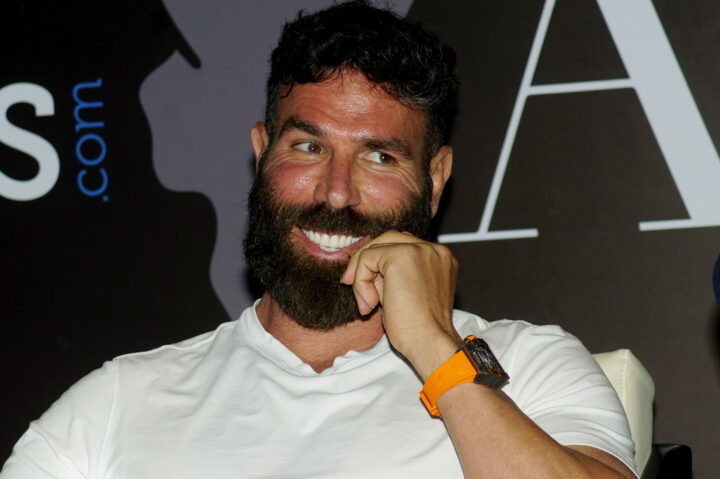
Prodip Guha/Getty Images
Dan Bilzerian on Sept. 13, 2019 in Mumbai, India.


 Add JewishInsider on Google
Examining the campaign finance reports of neo-Nazi influencer Dan Bilzerian prompts the question of who exactly would want to be associated with the hate-mongering candidate, who was badly defeated last week in his primary bid against Jewish congressman Rep. Randy Fine (R-FL). The next question is who would want to be associated with his associates.
In an age of dog whistles, Bilzerian leads a blaring Wagnerian orchestra of antisemitism. He made his name as an online influencer who dabbled in Holocaust denial and conspiracy theories about a Jewish role in everything from the John F. Kennedy assassination to 9/11. He capped his congressional campaign with an ad praising Adolf Hitler and featuring AI images of his opponent “the fat Jew Randy” sprouting horns.
So why would anybody give him their money — let alone thousands upon thousands of dollars?
The donor list of the campaign and two supporting committees reveal the “America First, Israel Never” candidate enjoyed a kind of crossover appeal: not so much across the aisle as around the political horseshoe.
Bilzerian’s biggest underwriters, after the candidate himself, are a couple of Georgia attorneys: Rawan and Ibrahim Awad, who together donated a combined $25,303 to Bilzerian’s committees. But Ibrahim Awad has also given heavily this cycle to left-wing, anti-Israel candidates — $7,000 to Michigan Senate contender Abdul El-Sayed, $4,000 to the failed comeback bid of former Rep. Cori Bush (D-MO), $3,500 to New Jersey House candidate Adam Hamawy, $1,000 to Rep. Delia Ramirez (D-IL) and $1,000 to the Democratic Socialists of America’s Darializa Avila Chevalier in New York.
Closer to home, Awad also gave $1,000 to former far-right Rep. Marjorie Taylor Greene (R-GA). In the years since the Oct. 7, 2023, Hamas attacks, he has given sizable sums to Rep. Ilhan Omar (D-MN), Rep. Rashida Tlaib (D-MI), former Rep. Jamaal Bowman (D-NY), and Green Party presidential contender Jill Stein.
Bilzerian also drew support from a number of his fellow travelers on the extreme right: at least $2,860 from fellow antisemitic internet personality Jake Shields; $2,500 from veteran conservative donor and Unz Review contributor Eugene Kusmiak, who has railed against “entrenched Jewish supremacism” and written that “the most intelligent humans” are antisemitic; and $7,380.40 from serial entrepreneur Kyle Kinsel, who markets canned water under a brand associated with alt-right comedian Tony Hinchcliffe, infamous for his incendiary routine at a 2024 Trump rally that mocked multiple minority groups, including Jews.
The one issue uniting these far-left and far-right candidates? Opposition to Israel.
Another illustrative example is California businessman Tony Bushala, whose money has similarly flowed to Israel’s critics on both ends of the political spectrum. Besides the $2,663.06 to Bilzerian, this cycle Bushala has shoveled $7,000 to Rep. Derek Tran (D-CA); $2,500 to Rep. Ro Khanna (D-CA); $1,250 to Michigan House candidate Aisha Farooqi; $4,100 to Bush; $1,000 to imploded Maine Senate candidate Graham Platner; and smaller amounts to Tlaib, El-Sayed, Rep. Summer Lee (D-PA), DSA House nominee Claire Valdez in New York and former New York City Comptroller Brad Lander’s ouster of Rep. Dan Goldman (D-NY).
At the same time, he’s given $4,734.58 to Rep. Thomas Massie (R-KY) and Mark Newgent, a primary challenger to Rep. Mark Self (R-TX), both of whom leaned into an extreme anti-Israel message in their unsuccessful campaigns this year.
Bushala also donated $2,000 in January to the far-right Anti-Zionist America PAC, which alleges on its website that “Zionism has taken over the U.S. government,” resulting in “subservience to Israel in word and deed.” The committee’s founder has called the Oct. 7 attacks a “false flag” and labeled Jewish people “the synagogue of Satan.”
There was a notable overlap in some of Bilzerian’s top donors and that of racist and antisemitic Florida gubernatorial candidate James Fishback, who finished in third place in the state’s GOP primary. Bilzerian’s committees got at least $12,000 from one of Fishback’s most generous supporters: attorney Hassan Shibly, who previously ran Florida’s Council on American-Islamic Relations chapter before resigning amid allegations of domestic abuse. As JI reported previously, Shibly is a longtime supporter of Omar’s, as well as of other left-wing candidates aiming to overturn the U.S.-Israel relationship.
Shibly did not respond to questions for this piece. However, contacted in July about his gift to Fishback, he denied holding any personal prejudice, and identified his opposition to U.S. aid to Israel as “one of the most significant reasons for my support.”
UDP’s latest ad blitz came in the immediate wake of Michigan’s bitter Democratic Senate primary earlier this month, where the group spent over $30 million on a failed effort to thwart Abdul El-Sayed
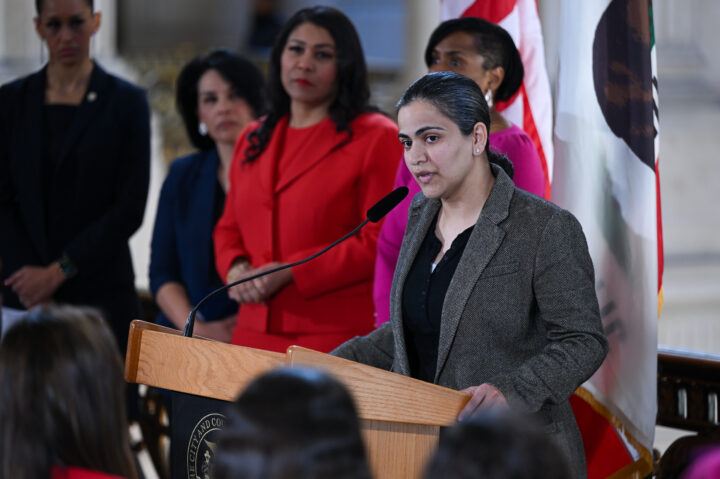
Tayfun Coskun/Anadolu Agency via Getty Images
State Sen. Aisha Wahab speaks during the Bay Area Abortion Rights Coalition (BAARC) and commemoration of the 50th Anniversary of Roe v. Wade event at the City Hall in San Francisco, California, on January 25, 2023.
As primary election season comes to an end, AIPAC is closing out its involvement in a dramatic cycle with an unexpected foray into a low-profile California House race on Tuesday where Israel has not been among the top issues.
In the last two weeks, AIPAC’s super PAC, the United Democracy Project, has spent nearly $2.5 million in an effort to defeat Aisha Wahab, a progressive state senator competing in a special election runoff against Melissa Hernandez, a moderate Democrat who serves on the Bay Area Rapid Transit board and is the former mayor of the East Bay city of Dublin.
The aggressive maneuver, which appears to be AIPAC’s last investment before the general election, has raised eyebrows among some Jewish leaders and Democratic strategists in the state, who see Wahab as favored to replace disgraced former Rep. Eric Swalwell (D-CA) in California’s 14th District, despite the flood of recent attacks against her from UDP and other allied groups.
Still, one Democratic strategist who is familiar with the runoff said that outside polling has shown a tighter race than some observers are predicting.
In the special election primary, Wahab claimed first place with 43%, while Hernandez had just 17% of the vote. But two Republican candidates on the ballot also tallied about 25% of the vote, with the GOP vote likely to swing heavily to the more moderate Hernandez.
UDP’s latest ad blitz came in the immediate wake of Michigan’s bitter Democratic Senate primary earlier this month, where the group spent over $30 million on a failed effort to thwart Abdul El-Sayed, a far-left former public health official who refused to recognize Israel’s right to exist as a Jewish state. (UDP is likely to return in the general election to help boost former GOP Rep. Mike Rogers, El-Sayed’s opponent, according to sources familiar with its plans.)
The narrow loss in Michigan marked a major blow for AIPAC, whose super PAC has seen mixed results overall in key Democratic House contests this cycle as its involvement runs the risk of backfiring in the party. While UDP notched some key victories in states including Maryland, Illinois and Missouri, the group has faced scrutiny even from some supporters for its strategy in picking other races, such as in New Jersey, where its involvement in one primary helped inadvertently elevate a fierce critic of Israel to a seat in the House.
Some Jewish leaders in the San Francisco Bay Area voiced puzzlement over AIPAC’s engagement in the runoff, saying that its decision to target Wahab had backfired in the progressive-minded district — where she is using its attacks to rally supporters to her campaign while portraying Hernandez as a shill for the group.
One Jewish leader backing Hernandez who has met with Wahab, the first Afghan American and Muslim to serve in the California State Senate, said he feared UDP’s attack ads, which have not focused on Middle East policy, could drive her to embrace more hostile positions on Israel.
During the campaign, Wahab has accused Israel of genocide in Gaza and, in a recent interview with antisemitic influencer Hasan Piker, said she would support the Block Bombs Act, which would impose sweeping restrictions on weapons sales and transfers to Israel.
But the Jewish leader, speaking anonymously to address a sensitive issue, told Jewish Insider that Wahab is “not a member of the Squad,” supports a Jewish state as well as a Palestinian state and “wants a strong relationship with the Jewish community” — even as she has acknowledged disagreements on key issues that have stoked some tensions in the runoff.
“This is not someone who wants to see Israel disappear, and I’m worried this simplistic approach to the primaries is going to push someone like Wahab further away from the community,” the Jewish leader said of UDP’s spending. “There’s a general consensus among the East Bay political class that Wahab is the likely winner,” he said. “We’re all just scratching our heads and we’re not sure what they’re seeing here.”
A spokesperson for UDP declined to comment on its decision to enter the race.
Andrew Lachman, the former president of California Jewish Democrats, told JI that Wahab “has worked well with the California Jewish Legislative Caucus in the past, but the pressures are different when running for Congress because the state legislature does not do foreign policy.”
UDP’s new spending has been met by recent expenditures from J Street, the progressive Israel advocacy group, and American Priorities, a new anti-Israel super PAC created to counter AIPAC’s presence in Democratic primaries — both of which are backing Wahab.
“I hope I’m wrong,” the Jewish leader told JI. “I hope AIPAC is seeing something I’m not and that there is a chance.”
Reps. Jared Moskowitz (D-FL) and Debbie Wasserman Schultz (D-FL) are the latest DSA targets
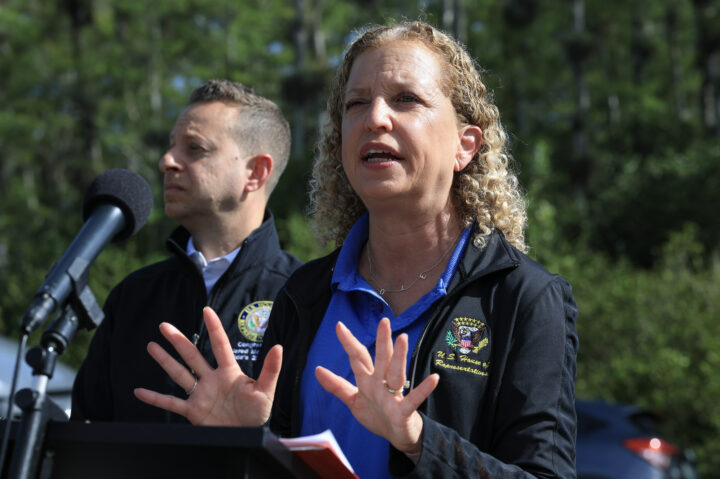
Joe Raedle/Getty Images
Reps. Jared Moskowitz (D-FL) and Debbie Wasserman Schultz (D-FL) speak to the media before a visit to the Dade-Collier Training and Transition Airport on July 12, 2025 in Ochopee, Florida.
Reps. Jared Moskowitz (D-FL) and Debbie Wasserman Schultz (D-FL), two Florida Jewish Democrats known as champions of Israel, are facing primary battles on Tuesday against Democratic Socialists of America-aligned candidates who have made criticism of the incumbents’ stances on Israel major planks of their campaigns.
Moskowitz, running in a heavily Jewish south Florida district, faces a challenge from DSA member Oliver Larkin.
Wasserman Schultz is facing a slew of Democratic opponents after redistricting broke up her previous district. She decided to run instead in a plurality Black seat, a decision that has sparked controversy in both the state and on the Hill. Her most prominent challenger is Elijah Manley, a former DSA member who converted to Judaism as an adult.
Larkin and Manley — alongside progressive Senate candidate Angie Nixon, who faces Jewish Democrat Alex Vindman — rallied on Friday with Rep. Rashida Tlaib (D-MI), one of the most prominent critics of Israel in the House. The event was forced to relocate after the original business hosting the event, The Venue Fort Lauderdale, cancelled the reservation following backlash from Democratic state Rep. Michael Gottleib and others, including far-right commentator Laura Loomer.
“Once we became aware of the full scope and nature of the event and reviewed the publicly circulated promotional materials, we immediately began addressing the matter. Due to security concerns as well as the welfare of attendees and staff, the decision was then made that the event would not proceed at our property,” The Venue said in a statement. “The Venue Fort Lauderdale is Jewish-owned and operated and our values and commitment to the Jewish community are deeply important to us.”
Local media reported that a second venue also backed out of hosting the event before organizers were able to secure a third location, where the event went forward.
Larkin, Tlaib and Nixon also attended a Shabbat event organized by Jewish Voices for Peace. JVP did not identify any Jewish leaders attending the Shabbat event on the invitation.
In spite of the national attention toward the races, longtime Democratic insiders in the state are skeptical that far-left politics is a winning formula in Florida.
“I don’t think this entire state is great for that,” Steve Schale, a longtime Florida Democratic strategist said, pointing to the defeats of former gubernatorial candidate Andrew Gillum and Sen. Bernie Sanders’ (I-VT) presidential campaign in the state.
Mitch Ceasar, a former chair of the Broward County Democratic Party and a former state Democratic chairman, agreed that far-left and anti-Israel positions aren’t likely to have much purchase in the Sunshine State. “I don’t think either one of those things plays in Florida like it would in New York or some other places.”
Neither Larkin nor Manley have picked up the prominent national endorsements of figures such as Sanders or Rep. Alexandria Ocasio-Cortez (D-NY) that have been a boon to other progressive congressional hopefuls. Manley, for his part, secured the endorsement of Rep. Ro Khanna (D-CA).
But other far-left figures have been rallying in support of Larkin in particular, including antisemitic streamer Hasan Piker; far-left Democratic nominees Darializa Avila Chevalier, Claire Valdez and Melat Kiros; former Rep. Jamaal Bowman (D-NY); childrens’ entertainer Ms. Rachel; former Ohio state Sen. Nina Turner; and anti-Israel activist Linda Sarsour.
Manley also appeared on Piker’s livestream show.
Moskowitz — despite an unrelenting barrage of attacks from Larkin’s campaign — has largely stuck to a positive message and declined to engage directly with Larkin.
But Moskowitz has said he believes that he’s “being targeted simply because of my faith and being pro-Israel” and that Larkin has embraced supporters who have “repeatedly trafficked in antisemitic rhetoric and hostility toward the Jewish community.”
Moskowitz has raised nearly $3 million, but has reserved close to $2 million of that for the general election. Larkin raised $689,000 and would enter the general election with just $170,000 left on hand.
Ceasar said Larkin’s campaign has also brought in “a lot of very anti-Jewish overtones,” which have raised particular concerns in light of the public death threats and assassination attempts that Moskowitz has faced.
Schale said he’s been dubious of polling and other data the Larkin campaign has put out that has suggested Larkin is gaining ground on Moskowitz. He added that a Larkin victory would virtually guarantee that Democrats lose the seat in November.
“I remain skeptical that that race is actually going to be all that close,” Schale said, emphasizing that the district, geographically and demographically, is very different from most of the other districts where DSA candidates have had success, including being less urban, older and heavily Jewish.
A poll from Larkin’s campaign on Aug. 5 of 403 likely voters showed Moskowitz leading Larkin by two points, while a Moskowitz poll on July 22 showed Moskowitz leading by 36 points.
Ceasar agreed that Moskowitz should win reelection, noting his strong fundraising performance and that his new district shares about half of its territory with the previous one. “Jared’s a hard worker,” Ceasar said.
He also emphasized that Moskowitz is a well-known quantity in the district since the beginning of his political career.
An individual close to Moskowitz’s campaign noted that half of the expected voters have already voted early, and that the district is generally older. The district is also 25% Jewish and 25% Hispanic — mostly of Cuban and Venezuelan ancestry, populations that are generally hostile to socialist policies. The source noted that the district is deeply purple — split around evenly among Democrats, Republicans and Independents.
All of those factors are likely to favor Moskowitz. There’s also been an effort among Republican-leaning Orthodox Jewish voters to re-register as Democrats to vote for Moskowitz in the primary.
Another source who requested anonymity to speak freely told Jewish Insider they expect Moskowitz to win, but said that his one potential vulnerability is that he’s been somewhat absent from local Democratic club meetings and other gatherings in the district. Moskowitz has also faced criticism, including from the Sun Sentinel — which declined to reendorse him — for failing to appear with or debate Larkin.
Moskowitz, who has young children, faced a credible assassination attempt in 2024 and repeated death threats and other harassment, largely tied to his Jewish identity.
The source said, however, that Moskowitz is very well-known and well-liked and has a long history in the district, and noted that his father was also a leader in the Broward County Democratic Party.
Schale said he was skeptical of a characterization of Moskowitz as disengaged. The lines of the district, Schale noted, changed around three months ago and around 40% of the district is new to him, so campaigning on the ground in much of the district would have been difficult before then as well. He said he’s found Moskowitz to be “incredibly in-touch with his constituents” and “responsive” to them throughout his career.
Caesar told JI that Wasserman Schultz remains the favorite in her race in part because her opponents failed to consolidate. Some Black community leaders had hoped to narrow the field to a head-to-head challenge against Wasserman Schultz, but ultimately the other candidates declined to do so.
Democrats have expressed frustrations with Republicans for creating the redistricting situation, accusing them of deliberately stoking racial tensions through their decisions in drawing the district boundaries in addition to carving up Democratic-held seats.
“I hate the situation all around,” Schale said.
“What the Republicans are doing is they’re going for what I would call a political [Buy One, Get One], and that is that they’re seeking to steal Democratic districts in Florida, while also creating racial disharmony,” Ceasar said.
Wasserman Schultz, Ceasar noted, maintains a substantial fundraising advantage over her opponents. She’s raised $3.3 million, far surpassing Manley’s $1 million, former Broward County Mayor Dale Holeness’ $394,000, former Rep. Sheila Cherfilus McCormick’s (D-FL) $389,000 and rapper and free speech activist Luther Campbell’s $163,000.
The seat has a plurality Black population but not necessarily a majority, and includes a diverse set of communities, Schale noted.
“I’ve talked to several people that think she probably is going to win,” Schale said. “She’s probably in the strongest position to win this thing, but assuming she wins, she’s going to have a very real challenge on Day 1 to build trust in the community with folks who feel like she shouldn’t have run there … and to deliver in a real way. The one thing about her that I know is she’s as tireless as any human being I’ve ever known and she’ll work her tail off.”
Though Manley’s campaign has gained the most national attention, as well as endorsements from some local newspapers, Schale said that Holness is likely to be a strong candidate as well. Cherfilus-McCormick, he said, likely still maintains a base of support in spite of the scandals that led to her resignation from Congress earlier this year, while Campbell has also been an interesting and unique candidate.
“I wouldn’t be surprised if Elijah finished second if he doesn’t win. I also wouldn’t be surprised if Dale was [second],” Schale said. “I don’t know that [Holness] is raising the kind of money and communicating in the same way, but he’s also got a substantially deeper relationship with the district than Elijah does.”
He said Manley’s path to victory would be if other candidates split the more moderate vote and he’s able to squeeze through to victory with around 30% of the vote. With significant Black, Caribbean, Cuban, Venezuelan and Colombian voting populations, “just demographically, the district isn’t set up well for a socialist. And also … a good chunk of them came there escaping socialism.”
A third pro-Israel Jewish Democrat, Rep. Lois Frankel (D-FL), is also facing a challenge that’s gone largely unreported at the national level. Rick Stark, the chair of the Florida Democratic Party’s Jewish Caucus, said that Frankel’s reelection race may be flying under the radar as a true contest.
Her main opponent, Victoria Doyle, who is running to Frankel’s left and has expressed hostility toward AIPAC, has loaned her own campaign $325,000. Frankel is in a much stronger position financially, having raised $2.2 million.
Stark, who lives in Frankel’s district, said he hasn’t seen much outreach from Doyle’s campaign, but noted that Democrats have been particularly hostile this cycle toward older and long-tenured Democratic leaders like Frankel.
“I do think [Frankel] pulls it off, [but] I think it’s going to be a lot closer than [people are] thinking,” Stark said. “A lot of the young folks are tired of us old folks.”
Schale said he hadn’t heard any indication that Frankel’s race would be competitive.
“Our campaign is directed at fighting Donald Trump‘s policies and not on attacking other Democrats. I’m laser-focused on building an affordable America, protecting our Social Security and Medicare, and fighting Trump’s threat to our democracy,” Frankel said in a statement to JI.
In the Senate race, Schale predicted victory for Vindman, a military veteran and National Security Council whistleblower, but said that Nixon is likely to put up a strong performance.
“Angie’s running a very energetic [campaign]. I think she’s created a bunch of buzz for herself,” Schale said. “I think Alex will win, but I wouldn’t be surprised if it’s not close-ish.”
He emphasized that many Florida voters will be unfamiliar with either candidate going into the polls — though Vindman has been able to communicate with more voters — but Nixon will have a base of voters in Jacksonville and Black voters statewide, beyond only progressive and DSA-aligned voters.
Stark said that Nixon had spoken at a Jewish Democratic Caucus Zoom event where she did not demonstrate a clear understanding of issues in the Middle East.
The mayor has inserted himself in the costly fight between Rabbi Stephanie Ruskay and lawyer Eli Northrup, spurning a key Jewish ally in the process
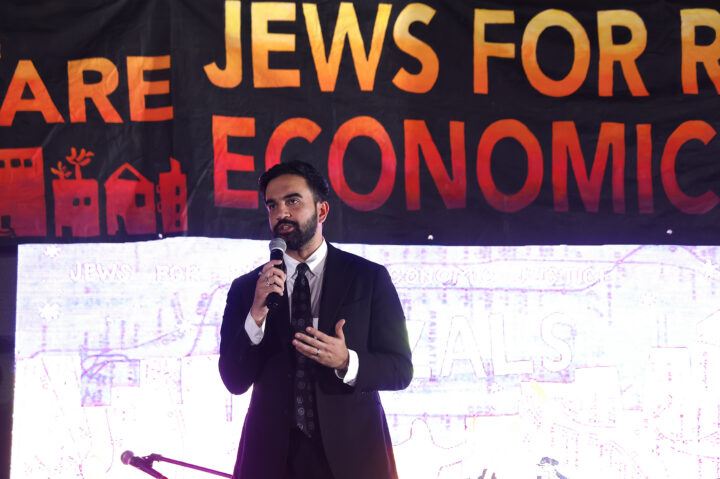
John Lamparski/Getty Images
Then-New York City mayoral candidate Zohran Mamdani speaks during the Jews For Racial And Economic Justice's Mazals Gala on September 10, 2025 in New York City.
New York City Mayor Zohran Mamdani’s slate of Israel-critical House candidates has received national media attention for months — but his intervention in a state-level race in Manhattan could also reverberate through the city’s Jewish community and beyond.
The mayor has interceded in a handful of state legislative races this cycle, but perhaps none so contentious as the race for the 69th Assembly District, which covers much of the Upper West Side of Manhattan as well as the Morningside Heights area adjacent to Columbia University.
The area is overwhelmingly progressive and boasts a large Jewish population. In the 2025 mayoral primary, it awarded Mamdani close to 59% of its vote over former Gov. Andrew Cuomo, and at the end of May the democratic socialist dove into the already costly race to replace sitting Assemblymember Micah Lasher, now a candidate for Congress.
By then, rival left-of-center Jewish factions had already lined up behind each candidate: the anti-Zionist Jews for Racial and Economic Justice behind public defender Eli Northrup, and a suite of long-standing Jewish elected officials — including City Comptroller Mark Levine and his predecessor Scott Stringer — with Rabbi Stephanie Ruskay, associate dean of The Rabbinical School at the Jewish Theological Seminary. A Stringer-backed PAC supporting Ruskay is among several spending heavily in the district.
Notably, Ruskay’s prominent backers also include her longtime friend and mentor, former Manhattan Borough President Ruth Messinger, one of Mamdani’s most prominent Jewish supporters. Multiple sources told Jewish Insider that Messinger had personally asked the mayor not to get involved in the race, but Mamdani did so anyway, even releasing one of his signature social media videos featuring Northrup.
“I don’t discuss political endorsements,” Messinger told JI at an event earlier this month. “I’m working with and supporting the mayor, and I’m working very strongly for Stephanie’s election.”
Mamdani political advisor Morris Katz did not respond to repeated queries about the mayor’s decision to flout a key Jewish ally.
Besides serving in the leadership of one of the central institutions of Conservative Judaism, Ruskay is the daughter-in-law of longtime UJA-Federation of New York CEO John Ruskay. If victorious, she would be the first female rabbi elected to a state Legislature in the U.S.
Like other Jewish Democrats representing the Upper West Side, she has criticized some Israeli policies — including signing a petition from the left-wing group T’ruah in October 2023 that decried IDF airstrikes in Gaza and urged the creation of a “humanitarian corridor” to provide supplies to civilians — while proclaiming her pride and affinity toward the Jewish state, including by participating in the Israel Day on Fifth Parade earlier this month.
“New York City is home to the largest Jewish population outside of Israel, and at a time when antisemitism is on the rise, gatherings like this matter,” Ruskay wrote on X. “They remind us of the deep bonds between New York’s Jewish community and Israel, and of the strength, resilience, and vibrancy of Jewish life.”
Northrup, who is a member of JFREJ but not the Democratic Socialists of America, has also emphasized his Jewish identity, going so far as to include an image from his bar mitzvah on his campaign literature. But he has expressed ambivalence about Zionism, though he has acknowledged “Israel exists and it’s a nation.”
A victory for Northrup on Tuesday would mean more than just a triumph for Mamdani over his Ruskay-backing rivals — including Council Speaker Julie Menin, who leapt into the fray shortly after the mayor — according to veteran political consultant Hank Sheinkopf. It would signify a seismic upheaval for the district, where a strong and stable liberal Zionist political machine headed by retiring Rep. Jerry Nadler (D-NY) long reigned.
On the other hand, Sheinkopf argued Ruskay taking the seat would show that the old neighborhood order remains intact, and that some progressive Jews may be starting to sour on the mayor, especially after his recent attacks on AIPAC.
“If Northrup wins, it tells you that the deep left is more organized than the center left, and the Upper West Side is going to undergo a significant change,” Sheinkopf told JI. “If Ruskay wins, what it says is that local concerns are more important than [Mamdani’s] movement, and people are beginning to understand who he really is.”
‘We don’t need your money (it’s probably coming from AIPAC anyways),’ the shop wrote in a since-deleted social media post
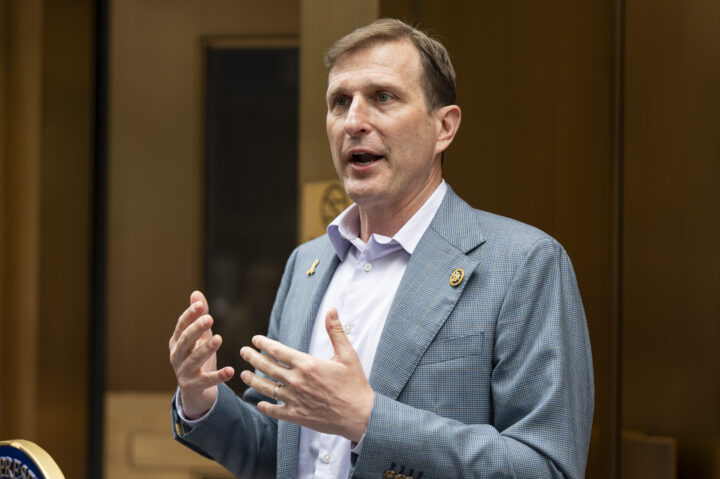
Mostafa Bassim/Anadolu via Getty Images
Rep. Dan Goldman (D-NY) speaks to members of the press during a press conference on ICE practices in immigration courts outside Ted Weiss Federal Building in New York, U.S., May 29, 2025.
The Department of Justice’s Civil Rights Division is investigating a Brooklyn cafe after it banned Rep. Dan Goldman (D-NY) from its store, posting discriminatory messages online that accused the congressman of enabling genocide and tying him to AIPAC.
“Federal law prohibits public accommodations such as coffee shops from discriminating against patrons based on their race, religion, or national origin. These actions are not only reprehensible, they’re potentially illegal. The Civil Rights Division has opened an investigation, and will bring an enforcement action if warranted,” Harmeet Dhillon, the DOJ’s assistant attorney general for civil rights, said.
“We see that you stopped by our shop today for a coffee. Do you see how it doesn’t taste like genocide juice?” Poetica Coffee in Williamsburg wrote in a since-deleted Instagram post with an image of Goldman standing at the register. “We don’t serve racists, fascists, homophobes, genocide enablers. Too bad we didn’t recognize you right away, or we would have turned you away.”
“We don’t need your money (it’s probably coming from AIPAC anyways),” the post continued. “Don’t ever come to Poetica.” The shop said it refunded Goldman for his $9.82 purchase.
The coffee shop is owned by Parviz Mukhamadkulov, who has frequently used social media to share posts condemning Israel. Poetica Coffee’s website claims it serves “whoever walks through the door is treated with unconditional dignity.”
Goldman is facing a primary challenge from former New York City Comptroller Brad Lander in Tuesday’s election. Both candidates are Jewish and self-identified “progressive Zionists,” although in a debate earlier this month Goldman declined to join Lander in calling the Israeli military actions a “genocide.”
Brad Lander, Claire Valdez, and Darializa Avila Chevalier are all demonizing the Jewish state in the runup to Tuesday’s primary
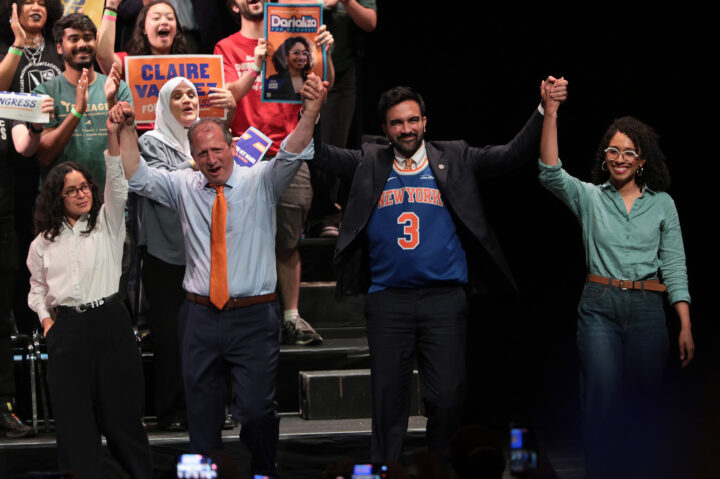
Michael M. Santiago/Getty Images
Congressional candidates Claire Valdez, Brad Lander and Darializa Avila Chevalier with Mayor Zohran Mamdani at King's Theater on June 18, 2026 in New York City.
The battle for three Democratic congressional primaries in New York City has been defined by a conflict more than 5,000 miles away, with candidates spending the final days before Tuesday’s primary echoing the fiercely anti-Israel rhetoric that helped elevate Mayor Zohran Mamdani to power.
All three of the mayor’s favored contenders for the House — former City Comptroller Brad Lander, Assemblymember Claire Valdez and doctoral student Darializa Avila Chevalier — underscored their criticism of Israel and its U.S. supporters as early voting began in the contested districts.
Avila Chevalier took time in a televised debate on Tuesday to accuse the country of “apartheid” while seeming to compare the actions of Jewish settlers in the West Bank and the IDF in the Gaza Strip to gentrification in the district where she hopes to unseat Rep. Adriano Espaillat (D-NY) and other majority-minority areas.
“I saw so many connections between what was happening to Palestinians there in Palestine and what was happening to so many communities across the U.S., particularly Black and Latino communities, who have been priced out and pushed out of our homes,” said Avila Chevalier, who — like most candidates affiliated with the Democratic Socialists of America — draws her strongest support from predominantly white and highly educated residents of the district.
“When we talk about displacement in the West Bank and Gaza, it is a very similar, visually similar situation, where people who have been in a place for generations, are being displaced because of corporate interests, because of folks who are coming in, claiming the land over, and buying it up and kicking the people who live there out.”
Avila Chevalier, who has come under fire for attending an anti-Israel demonstration one day after the Oct. 7 attacks, added during the debate that the “very institutions” involved in both the Holy Land and urban America are the same.
Valdez, vying against Brooklyn Borough President Antonio Reynoso for the seat of retiring Rep. Nydia Velazquez (D-NY), has similarly brought Middle Eastern issues into the race for the district spanning parts of Brooklyn and Queens. As a new PAC, Real Fight NYC, began spending hundreds of thousands on ads attacking her record and boosting that of her opponent, the sculptor-turned-socialist lawmaker inaccurately suggested pro-Israel interests were behind the effort.
“Is it actually AIPAC?” Valdez speculated in a thread on X. “This is a well-established pattern from AIPAC and its affiliates, especially when there’s only one candidate who’s been clear and consistent against the genocide.”
Reynoso in fact has been a fierce critic of Israeli policy during the race, and the American Federation of Teachers subsequently identified itself as the main sponsor of the ad campaign. Valdez has neither apologized for nor retracted her remarks.
Even former City Comptroller Brad Lander, the lone self-described progressive Zionist among the mayor’s endorsees, spent his final TV face-off against Rep. Dan Goldman (D-NY) on Monday criticizing the incumbent for his past support for aid packages to Israel and his refusal to call the military campaign in the Gaza Strip “a genocide.” The day before, Lander held a rally with Mamdani and a bevy of left-wing Jewish and Muslim activist groups, which he took as another occasion to condemn Israel.
“We’re united around a belief that a better world is possible — one in which we don’t compromise on anyone’s humanity. One in which we are not complicit in occupation and genocide,” he wrote on X. “One in which everyone has a home they can afford, with no bombs falling on it, in a place where they are both safe and free.”
Mamdani, for his part, vowed at a rally for the trio Thursday evening that they would help combat “monsters” that he claimed dominate the political process. The only such quarry he called out by name, though, was AIPAC.
“AIPAC, for whom the only thing more frightening than democracy being allowed to run its course is an end to genocide and [Israeli Prime Minister] Benjamin Netanyahu’s wars,” the mayor told the roaring crowd.
American Priorities’ spending has aided two Democratic Socialists of America-backed House hopefuls while drawing scrutiny over contributions from GOP donors and AI investors
Erik McGregor/LightRocket via Getty Images
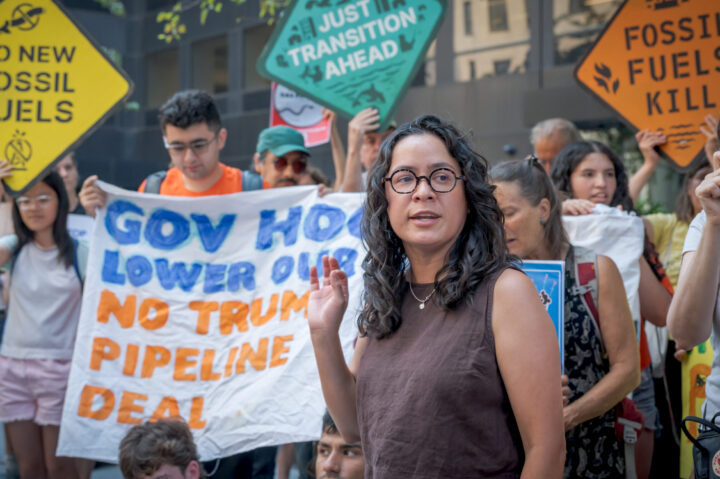
NY Assemblymember Claire Valdez
American Priorities, a new super PAC created as a progressive counterweight to pro-Israel spending in Democratic primaries, has drawn scrutiny in recent weeks for accepting contributions from donors who have given to Republicans — even as its allies on the far left have accused AIPAC, a chief rival, of serving as a Trojan horse to advance GOP-linked interests in safe blue districts.
Meanwhile, filings show that the anti-Israel group has received $250,000 from a tech executive whose firm is developing AI data centers in New York State. That money has boosted two democratic socialist House candidates in New York City who oppose efforts to expand data centers.
Claire Valdez, a state assemblymember running to succeed retiring Rep. Nydia Velazquez (D-NY), and Darializa Avila Chevalier, an anti-Israel activist who is challenging Rep. Adriano Espaillat (D-NY), have benefited from over $2 million in estimated support from American Priorities in the final stretch of their closely contested primaries set for next Tuesday.
But the source of the group’s spending has not neatly aligned with the values its preferred candidates have promoted during their campaigns, underscoring the degree to which American Priorities has become a liability as well as a financial lifeline while emerging as a dominant player in the midterms.
Both Valdez and Avila Chevalier, for instance, have advocated for a federal moratorium on AI data center construction — despite the significant contribution to American Priorities from Nazar Khan, the co-founder of TeraWulf, a bitcoin mining company pivoting to AI infrastructure development. The firm is now pressing to move forward with proposed construction of an AI data center in New York’s Finger Lakes region, which has faced local opposition from residents questioning its environmental impact.
TeraWulf is also in the process of expanding another data center in western New York that “is expected to rank among the largest” facilities of its kind in North America, according to a February press release.
Khan did not respond to a request for comment from Jewish Insider, nor did campaign representatives for Valdez or Avila Chevalier.
Brad Lander, the former New York City comptroller mounting a challenge to Rep. Dan Goldman (D-NY), has also said he favors an AI data center moratorium. American Priorities has indicated that it would spend on his behalf as part of a multimillion-dollar pledge to elevate Mayor Zohran Mamdani’s endorsed slate of far-left House candidates, but it has yet to do so as it has focused on Valdez and Avila Chevalier, who are also backed by the Democratic Socialists of America.
The anti-Israel group has helped elevate a range of House candidates on the left this election cycle. But its aggressive spending in New York City has stoked backlash, particularly in light of its small handful of donors who have also given to far-right Republicans such as former Rep. Marjorie Taylor Greene (R-GA) and recently ousted Rep. Thomas Massie (R-KY).
For his part, Espaillat, a veteran incumbent backed by AIPAC, has accused Avila Chevalier of accepting support from “a millionaire in Texas” who “funded [Texas Gov.] Greg Abbott,” a reference to Hussein Mahrouq, who has contributed $525,000 to American Priorities in recent months.
Avila Chevalier, who vows to ban super PAC money from elections on her campaign website, has denied knowledge of American Priorities’ spending, though she has not discouraged the group from engaging in her primary.
“I control my campaign and the money that my campaign receives,” Avila Chevalier, whose past inflammatory social media posts have featured in attack ads from pro-Espaillat groups, said recently.
Meanwhile, Brooklyn Borough President Antonio Reynoso and City Councilmember Julie Won, who are both facing Valdez in the primary in the 7th District, teamed up in a joint statement last week to accuse their opponent of reneging on her pledge to reject super PAC spending.
“Claire has turned what should have been a race about our records and vision for the people of Brooklyn and Queens into a Super PAC-driven negative election,” Reynoso and Won wrote.
Valdez, who has sought to highlight small-dollar donations, has cautiously justified the super PAC investments as a response to heavy spending from the AI and crypto industries as well as AIPAC. “The way that some people are countering that is by also spending money,” she said last week.
Earlier this week, Valdez drew criticism for falsely speculating that AIPAC was behind a newly formed super PAC, Real Fight NYC, that is spending to boost Reynoso’s campaign. But AIPAC’s super PAC, United Democracy Project, said it had no involvement, while the American Federation of Teachers took credit for a large donation.
While AIPAC has been a regular source of attacks from Valdez and Avila Chevalier, the group’s super PAC has not been directly involved in their primaries.
‘It is pathetic that in the state with the fourth largest Jewish population in the United States, we don't have that,’ local Jewish leader Jeff Grayzel said
Michael M. Santiago/Getty Images
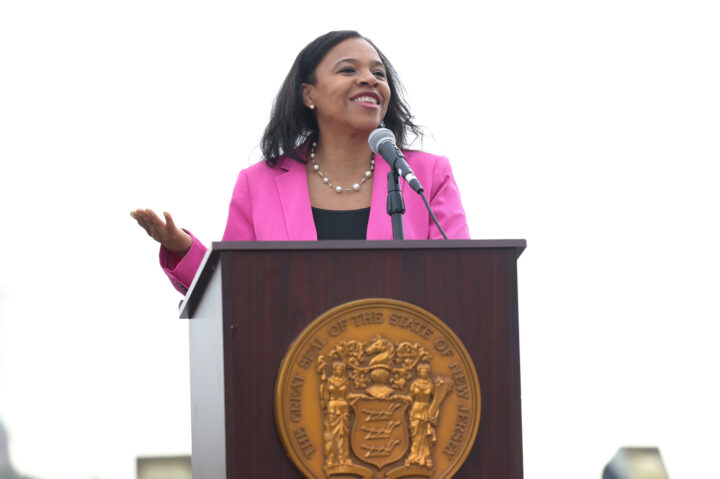
New Jersey Lt. Gov. Tahesha L. Way, speaks during a Naturalization Ceremony at Liberty State Park on September 17, 2024 in Jersey City, New Jersey.
Two Democratic candidates running in the crowded special election to replace New Jersey Gov.-elect Mikie Sherrill, including the state’s current secretary of state and lieutenant governor, criticized the state Assembly for failing to pass legislation codifying the International Holocaust Remembrance Alliance’s working definition of antisemitism.
Their comments came during a virtual forum hosted by the Jewish Democratic Council of America on Tuesday evening with most of the candidates in the race for the northern New Jersey House district, though some including Essex County Commissioner Brendan Gill, the likely front-runner, were missing; Gill was expected to join but organizers said he had unexpected family obligations.
“I, too, take offense that my own state did not adopt IHRA, and I will definitely move this forward as your congresswoman,” New Jersey’s lieutenant governor and secretary of state, Tahesha Way, said.
Multiple sources blamed the state’s governor and other senior Democratic officials for killing the bill due to concerns about political blowback from progressives targeting Democratic lawmakers who would vote for it.
Way issued a statement expressing similar support last week after the legislation failed to move forward in the legislature. “As we witness an alarming rise in antisemitism across our country, we must be unequivocal: hate has no place in our society. I will always stand by the Jewish community, and I support legislation adopting the International Holocaust Remembrance Alliance’s working definition of antisemitism in the New Jersey Assembly and will wholeheartedly support similar federal legislation if elected to Congress.”
Candidate Jeff Grayzel, the deputy mayor of Morris Township and a local Jewish leader who testified before the New Jersey Assembly in support of the bill, also expressed frustration that the legislation had failed, when similar legislation has passed in a majority of states.
“It is pathetic that in the state with the fourth largest Jewish population in the United States, we don’t have that,” Grayzel said.
In addition to her comments on the IHRA legislation, Way also emphasized her work with the New Jersey-Israel Commission, which falls under her purview as secretary of state, to address campus antisemitism, and said she would back efforts to “streamline access” to Nonprofit Security Grant Program funding.
She said that her trip with an American Jewish Committee delegation to Israel in 2019 “really underscored … the strong alliance between the U.S. and Israel,” and emphasized the need to rebuild Gaza without Hamas and to expand the Abraham Accords, as well as pursue a two-state solution.
Former Rep. Tom Malinowski (D-NJ), viewed as another top contender in the field, said that leaders need to police antisemitism on their own sides, while arguing that the far left “hates our leadership” and that the far right leads the GOP. He also called for proper resources and funding to combat domestic extremism, an effort he said is being undermined by shifting federal resources to immigration enforcement, and called for regulation of social media.
He said that he had a “perfect pro-Israel voting record in Congress as a pro-Israel Democrat,” while accusing Israeli Prime Minister Benjamin Netanyahu of dragging the war in Gaza out for his own interests, and calling for more pressure on both sides to continue the ceasefire agreement.
Grayzel, in his opening statement, described himself as a “proud Jew and a proud Zionist” and declared unequivocally that “anti-Zionism is antisemitism,” adding that he is running for Congress in part to stand up for the Jewish people.
He pushed back on suggestions from a fellow candidate that Israel is depriving members of its Arab population of equal rights, and emphasized his support for unconditional aid to the Jewish state.
Passaic County Commissioner John Bartlett noted that he had spent a year living in Israel studying at Hebrew University, experiencing the daily security threats that Israelis face. He said that he supports the continued U.S.-Israel relationship and rejected “arbitrary distinctions between offensive and defensive weapons.”
“I recognize the relationship between the United States and Israel as fundamental and rooted in shared democratic values. I’ve also heard loud and clear from you, your kids and your rabbis that families need to feel safe right here in New Jersey again. You can count on me to be a consistent and outspoken ally in Congress,” Bartlett said.
He also condemned those who are targeting the Jewish community over political differences with Israel, and said that he supports the IHRA working definition and the Antisemitism Awareness Act.
Army veteran and venture capitalist Zach Beecher noted that his wife is Jewish and they are raising their son Jewish, and highlighting his experience in combat in the Middle East. He called for expanded NSGP funding and greater Holocaust education.
He said he “categorically support[s] security assistance and the right of Israel to defend itself” following the Oct. 7, 2023, Hamas attacks on Israel.
Other candidates took a more hesitant stance toward support for Israel while expressing support for its right to exist.
Analilia Mejia, who leads a progressive advocacy group, said, “Israel has the responsibility to ensure freedom for all those who live within it,” and said U.S. funding should go “towards peace” and defensive systems “and not bombs.”
Community advocate Anna Lee Williams said, “I’m someone who really promotes peacebuilding and long-term diplomatic strategies so that we can properly support that. I think that’s the main thing — I just want to move forward in terms of, how do we use our partnership to value human rights and make sure that we are holding the Israeli government accountable when they are hurting people.”
Attorney J-L Cauvin, who has gone viral for his impersonations of President Donald Trump, said Netanyahu is “something of a monster,” and had “spit in the face of Joe Biden and is dragging America’s moral authority through the gutter.” Cauvin said that he wants to see less U.S. aid flowing to Israel.
On antisemitism, Cauvin highlighted his own experience with discrimination as the son of an immigrant and as a mixed-race person, arguing that he knows “how to fight it probably better than most people in this race.” He said that he had personally broken with a friend over his “disgusting” reaction to Oct. 7. He largely blamed Trump for the rise in antisemitism, saying he had given a “license to discriminate and speak horribly.”
Williams said her longtime partner is Jewish, and that they have had conversations about the fear that the Jewish community is feeling. She called for steps to make the Jewish community feel safe, to combat antisemitism online and in AI and to improve education.
Throughout the event, several of the candidates described the Trump administration’s policies, particularly its deportation efforts, as fascist and drew comparisons to the Nazi regime.
Grayzel said that the Jewish community “knows where fascism leads. We have an experience of what happened in Germany, and what happened in Minnesota last week is the next step in that fascist process,” referring to the killing of a woman by an Immigration and Customs Enforcement officer.
“We all know how the Nazis terrorized Jews in Germany, and ICE is now terrorizing our immigrants here in this country,” Grayzel said. “But I am so scared, so, so scared as a Jew of where this country is headed and how ICE is treating people and terrorizing them. It absolutely needs to stop.”
Malinowski agreed, describing the ICE arrests as “proto-fascist operations that we’re seeing on our street.”
Williams said, of recent ICE raids, “For those of us who are part of the Jewish community, and for anyone who studies history, alarm bells should be going off.”
Beecher alleged that a slogan displayed behind Homeland Security Secretary Kristi Noem at a news event this week echoed SS rhetoric, a characterization disputed by historians.
Please log in if you already have a subscription, or subscribe to access the latest updates.
 Continue with Google

 Continue with Apple