














































































‘Should the president make the decision to recommence … we would have all the authorities necessary to do so,’ the defense secretary told lawmakers
SAUL LOEB / AFP via Getty Images
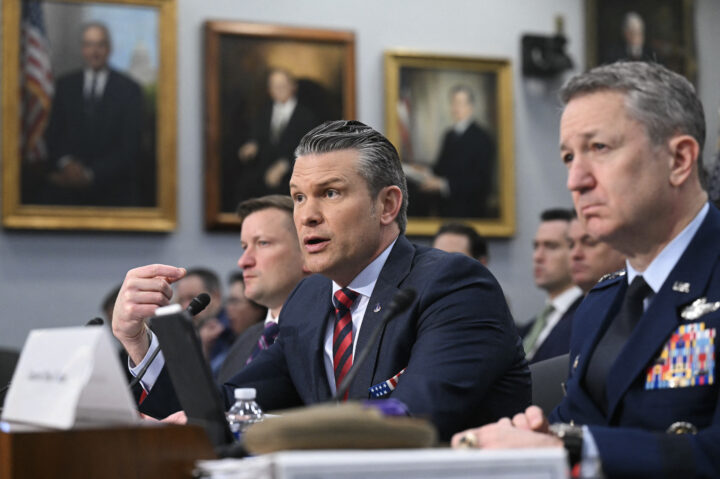
Secretary of Defense Pete Hegseth (C) and Chairman of the Joint Chiefs of Staff Gen. Dan Caine (R) testify during a House Committee on Appropriations, Subcommittee on Defense hearing to examine the 2027 budget for the Department of Defense on Capitol Hill in Washington, DC, on May 12, 2026.


 Add JewishInsider on Google
Defense Secretary Pete Hegseth said during a Senate Appropriations Committee hearing on Tuesday that the Trump administration does not plan to and does not believe it needs to seek congressional approval should it decide to resume military operations in Iran, further sidelining Congress at a time when a growing number of Republicans are becoming hesitant about continued U.S. military operations.
Sen. Lisa Murkowski (R-AK), who has been working on an Authorization for Use of Military Force to set parameters for the operation in Iran, said that the War Powers Act makes clear that the administration must terminate hostilities within 60 days without congressional approval, a timeline that expired on April 28. She said it did not appear, despite the administration’s assertions, that the hostilities in the Gulf had actually ended.
“Our view is that, should the president make the decision to recommence, that we would have all the authorities necessary to do so,” Hegseth responded.
Hegseth and other top military leaders testified to both the Senate and House Appropriations Committees on Tuesday.
During the hearing, which took place a day before President Donald Trump is set to depart for China to meet with President Xi Jinping, Sen. Lindsey Graham (R-SC) emphasized that Beijing is “propping up Russia and Iran” and that it would have a significant capability to pressure Iran into changing course if it were to cease purchasing oil from Iran.
Graham also continued to voice concerns about Pakistan’s role as a mediator in the U.S.-Iran talks, citing a report from the day prior about Pakistan hosting Iranian military aircraft on its military bases. Both Hegseth and Gen. Dan Caine, the chairman of the Joint Chiefs of Staff, declined to comment on those reports.
“That tells me we should be looking maybe for somebody else to mediate” between the U.S. and Iran. “No wonder this damn thing is going nowhere,” Graham told the military officials. “I appreciate all you’ve done, I’m very supportive of it, but when it comes to Pakistan and China, enough already.”
Jules Hurst III, the acting Pentagon comptroller, said that the cost of the war thus far, including munitions used in the war, is around $29 billion, a sum that Democrats countered seemed low.
Hurst acknowledged that estimate didn’t include the potentially sizable costs for rebuilding U.S. installations damaged or destroyed in Iranian counterattacks. He said that the costs of such rebuilding would be dependent on the U.S.’ posture and needs going forward and potential contributions from host countries.
He indicated it could also increase further depending on costs for repairing or replacing damaged aircraft.
Hegseth and Caine insisted that the U.S. maintains sufficient munitions stockpiles to carry out any missions that are required, though Caine said that he appreciated efforts by Congress to provide funding for more munitions production.
Hegseth also asserted that the war had been massively successful in achieving the U.S.’ goals, and that the U.S. has the capabilities for a range of scenarios including resuming the war, to ensure that it will end on the U.S.’ terms.
“There are lots of different discussions with our negotiating team, they’re happening … different drafts, different perspectives. It’s a very dynamic situation where a negotiated settlement could be the outcome here, where Iran does not have nuclear capabilities,” Hegseth said. He sidestepped questions about the specific terms of the ceasefire agreement.
Pressed on whether Iran’s support for terrorism and ballistic missile program are part of negotiations, Hegseth said that the negotiations are not his responsibility but “we have world-class negotiators” and “the core of it is the nuclear weapons issue” but “those other factors are always a factor.”
Asked by Sen. Susan Collins (R-ME), chair of the Senate Appropriations Committee, whether the U.S. had anticipated the closure of the Strait of Hormuz, Caine declined to discuss the specific advice he provided to the administration but said that the military had considered the full range of potential consequences.
“It seems to me that there’s been a different plan almost daily [for] dealing with this problem,” Collins said.
Caine said that the issue of the Strait of Hormuz is a complex one, as Iran uses small boats and low-cost drones to attack larger vessels, but urged Iran to “think wisely about their next moves” and open the waterway voluntarily.
Hegseth emphasized the effectiveness of the U.S. blockade of Iranian ports, insisting that “the economic pressure that creates on them greatly outstrips the pressure on us. … Nothing’s going in that we don’t allow to go in. And trust me, when we look at what Iran’s thinking about that — they know they can’t break it.”
He repeatedly dodged questions about specific plans for reopening the strait and securing trade moving through it in the short-term. He said that there are “certainly” military means by which the strait could be re-opened, but said that a diplomatic deal is the “preferred long-term approach.”
On both sides of the aisle, in both hearings, senior lawmakers raised questions about the administration’s decision to split off more than $300 billion of the proposed $1.5 trillion defense budget request into a proposed partisan reconciliation package, rather than trying to pass it through regular order. That request was also finalized prior to the war in Iran.
Lawmakers warned that reconciliation packages would not be a sustainable path to growing and maintaining U.S. defense capabilities in the long term, and that a third reconciliation package might not be feasible at all this year.
Hegseth said the numerous recent violations were expected as the U.S. launched its mission to escort ships through the Strait of Hormuz
Chip Somodevilla/Getty Images
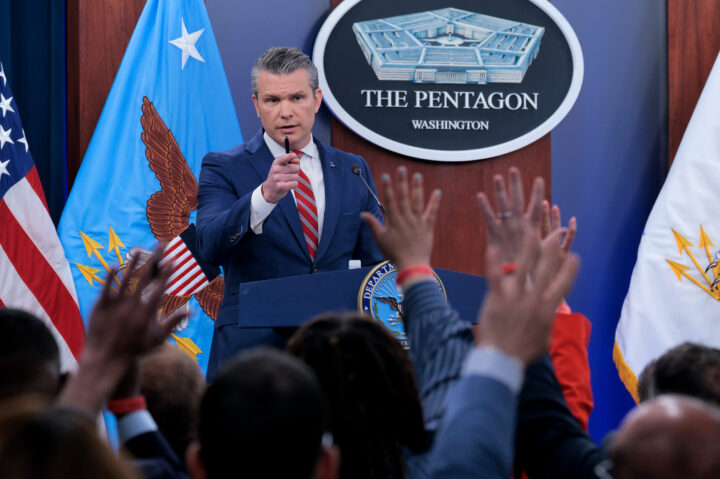
Secretary of Defense Pete Hegseth calls on reporters during a press briefing at the Pentagon on May 05, 2026 in Arlington, Virginia.
Defense Secretary Pete Hegseth said on Tuesday that the ceasefire between the U.S. and Iran was still in effect, despite numerous ceasefire violations by both sides in recent days.
“No, the ceasefire is not over,” Hegseth said during a press briefing at the Pentagon alongside Chairman of the Joint Chiefs of Staff Gen. Dan Caine. “Ultimately, this is a separate and distinct project,” Hegseth said of the new U.S. mission to escort commercial shipping vessels through the Strait of Hormuz, “and we expected there would be some churn at the beginning, which happened, and we said we would defend and defend aggressively, and we absolutely have.”
“Iran knows that, and ultimately, the president is going to make a decision whether anything were to escalate into a violation of a ceasefire. But certainly, we would urge Iran to be prudent in the actions that they take, to keep that underneath this threshold,” the defense secretary continued.
President Donald Trump announced on Sunday that U.S. forces would ensure the Strait of Hormuz is reopened to commercial traffic by escorting vessels and deflecting missile and drone attacks from Iran. Referring to the operation as “Project Freedom,” Trump warned on Monday that Iran would be “blown off the face of the earth” if the regime attempted to interfere.
Hegseth continued, “This is about the straits. This is about freedom of navigation. This is about international waterways. This is about free flow of commerce, all the things that happened before and that only Iran is contesting. So right now, the ceasefire certainly holds, but we’re going to be watching very, very closely.”
Caine said similarly that even though Iran has fired on commercial vessels nine times, seized two container ships and attacked U.S. forces more than 10 times since the ceasefire began, that is all “below the threshold of restarting major combat operations.”
Hegseth was pressed by reporters whether Trump was considering seeking congressional authorization to continue military operations in Iran, as many lawmakers believe the president has run out the 60-day clock for a war launched without congressional approval.
“Our view is … that ultimately, with the ceasefire, the [60-day] clock stops. If it were to restart, that would be the president’s decision. That option is always there, and Iran knows that, and that’s why their choices on freedom are important,” Hegseth said. “The president retains the opportunity and the capabilities — more capabilities than we have at the start of this — to restart major combat operations if necessary.”
Asked about alleged assertions by Israeli Prime Minister Benjamin Netanyahu and Mossad Director David Barnea that Israel would not abide by or participate in the ceasefires in Iran or Lebanon, Hegseth rejected claims that Israel was forcing the American president’s hand.
“I will say those questions are based on the false premise that somehow President Trump is being pulled in by Prime Minister Netanyahu to any of these actions,” Hegseth told reporters. “President Trump has led at every step of this based on his view of American interests and America First, and we’re grateful that Israelis have been very capable partners at many steps of this.”
“They may have some objectives at times that are slightly different than ours, but there’s only one hand on the wheel ultimately directing this, whether it’s Project Freedom or previously Operation Epic Fury, and it’s President Trump,’ he continued. “So we’re grateful for their input, their insights, the existential nature of the threat they face from an Iranian bomb, the capabilities that they can bring to that, but ultimately the coordination will happen with the leadership of President Trump.”
John Phelan was on Capitol Hill meeting with the leaders of the Armed Services Committee minutes before the Pentagon announced his dismissal on social media — a move that caught even Senate Majority Leader Thune off guard

Tasos Katopodis/Getty Images
Secretary of War Pete Hegseth and Secretary of the Navy John Phelan stand together as U.S. President Donald Trump announced the creation of the “Trump-class” battleship during a statement to the media at Trump’s Mar-a-Lago estate on December 22, 2025 in Palm Beach, Florida.
Defense Secretary Pete Hegseth did not give advance notice to senior Republican senators before announcing on Wednesday that he was firing Navy Secretary John Phelan and had already tapped his replacement, causing surprise and confusion on Capitol Hill.
“I found out about it the way everybody else did,” Senate Majority Leader John Thune (R-SD) told Jewish Insider of the Pentagon’s announcement on social media of Phelan’s dismissal.
Reached for comment, the Pentagon referred JI to Pentagon spokesperson Sean Parnell’s statement on X — the first public announcement of the news.
“Secretary of the Navy John C. Phelan is departing the administration, effective immediately. On behalf of the Secretary of War and Deputy Secretary of War, we are grateful to Secretary Phelan for his service to the Department and the United States Navy,” Parnell said on X. “We wish him well in his future endeavors.”
After taking part in White House meetings earlier Wednesday, Phelan was on Capitol Hill in the afternoon for a pair of pre-scheduled meetings, the first with Sen. Roger Wicker (R-MS), the chairman of the Senate Armed Services Committee, and the second immediately after with Sen. Jack Reed (D-RI), the committee’s ranking member. Phelan’s departure was posted to the Pentagon’s social media pages minutes after Phelan walked out of Reed’s office, a source familiar with the matter told JI.
A GOP senator on the committee who spoke to Reed and Wicker after the Pentagon announced Phelan’s immediate dismissal told JI that the topic of Phelan’s future in his role did not come up in either meeting, and that none of the three men was expecting such a move.
“This was a total surprise to Senate Republican leadership, to the two leaders of the Armed Services Committee and, clearly, to the secretary of the Navy himself,” the senator said.
Senators on the committee privately expressed concern to JI over Phelan’s firing, which comes amid as the U.S. is maintaining a naval blockade of Iranian ports and has begun boarding Iranian-linked tankers around the world, with three U.S. aircraft carriers on station or en route to the Middle East.
“I mean, I’m sure there are going to be some questions asked about the reasons, etc.,” Thune told JI. “But hopefully the authorizing committee will get a briefing and be informed about some of these decisions.”
Prior to his role at the Defense Department, Phelan ran an investment firm and was a major fundraiser for President Donald Trump’s presidential campaign. Phelan and other administration officials had reportedly been clashing over how best to grow the U.S. shipbuilding industry, a longtime challenge, though Phelan has heralded his own close relationship with Trump.
Hegseth’s term has also been marked by ongoing friction with other senior officials in the department, including Army Secretary Daniel Driscoll, and the firings of multiple top officials. Hegseth fired Army chief of staff Gen. Randy George earlier in April.
Phelan is being replaced by Under Secretary of the Navy Hung Cao, a former House and Senate candidate in Virginia.
The defense secretary also alluded to targeting energy infrastructure if Iran doesn’t agree to concessions in order to end the war
AUL LOEB / AFP via Getty Images
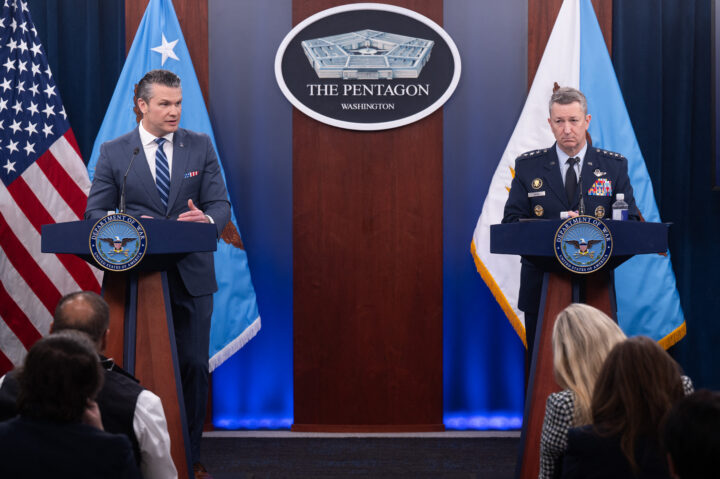
(L/R) Secretary of Defense Pete Hegseth speaks alongside Chairman of the Joint Chiefs of Staff General Dan Caine during a press briefing at the Pentagon in Washington, DC, on April 16, 2026.
Defense Secretary Pete Hegseth warned on Thursday that U.S. forces are “maximally postured” to resume military operations in Iran, and specifically target energy infrastructure, should the country’s current leaders not agree to a negotiated settlement to end the war.
Hegseth made the comments during a press briefing at the Pentagon on Thursday morning alongside Joint Chiefs of Staff Chairman Gen. Dan Caine and Admiral Brad Cooper, the commander of U.S. Central Command. The defense secretary spoke directly to Iranian leadership in his opening remarks, cautioning that while President Donald Trump would “rather not have to” resume operations and go after Iran’s energy industry, the U.S. was prepared to do so if negotiations failed.
“There is an alternative, as our negotiators have said. You, Iran, can choose a prosperous future, a golden bridge, and we hope that you do for the people of Iran. In the meantime, and for as long as it takes, we will maintain this successful blockade,” Hegseth said. “But if Iran chooses poorly, then they will have a blockade and bombs dropping on infrastructure, power and energy.”
Hegseth said that CENTCOM was continuing “to implement an ironclad blockade” and ensuring “that our forces are maximally postured to restart combat operations should this new Iranian regime choose poorly and not agree to a deal. That is what we urge this morning, that this new Iranian regime choose wisely.”
“To the KH [Kataib Hezbollah] leadership and IRGC leadership: We’re watching you. Our capabilities are not the same, our military and yours,” Hegseth said. “Remember, this is not a fair fight, and we know what military assets you are moving and where you are moving them to. While you are digging out — and this is exactly what you’re doing, digging out of bombed out and devastated facilities — we are only getting stronger.”
Caine clarified during his remarks that the U.S. is not blockading the Strait of Hormuz in its entirety; rather, “the U.S. action is a blockade of Iran’s ports and coastline.”
“Let me be clear, this blockade applies to all ships regardless of nationality heading into or from Iranian ports,” Caine said. “Enforcement will occur inside Iran’s territorial seas and in international waters.”
In his message to Iranian leaders, Hegseth emphasized the work U.S. military and intelligence forces have done since the start of the ceasefire to ensure their readiness in the event of diplomatic efforts failing.
“You have no defense industry, no ability to replenish your offensive or defensive capabilities. You only have what you have. You know that and we know that. You can move things around but you can’t actually rebuild. You can dig out for now but you can’t reconstitute,” Hegseth said to the Iranians. “But we can. We are reloading with more power than ever before, and better intelligence, even more importantly better intelligence, than ever before.”
“As you expose yourself with your movement to our watchful eye, we are locked and loaded on your critical dual-use infrastructure, on your remaining power generation and on your energy industry,” he continued. “We would rather not have to do it, but we are ready to go at the command of our president.”
Plus, Kristi Noem gets the boot

Tom Williams/CQ-Roll Call, Inc via Getty Images
Reps. Thomas Massie, (R-KY), left, and Ro Khanna, (D-CA), conduct a news conference outside a Department of Justice office in NoMa on Monday, February 9, 2026.
Good Thursday afternoon,
This P.M. edition is reserved for our premium subscribers — offering a forward-focused read on what we’re tracking now and what’s coming next.
It’s me again — Danielle Cohen-Kanik, U.S. editor at Jewish Insider and curator, along with assists from my colleagues, of the Daily Overtime. Please don’t hesitate to share your thoughts and feedback by replying to this email.
📡On Our Radar
Notable developments and interesting tidbits we’re tracking
President Donald Trump announced he’s replacing Kristi Noem as homeland security secretary with Sen. Markwayne Mullin (R-OK), after Noem had rankled the president and some Republican members of Congress with her oversight of widespread turmoil at the agency, among other issues. Mullin still needs to be confirmed by the Senate to assume the post.
Mullin, if confirmed, would take the helm of DHS amid its continued partial shutdown, and as it has repeatedly come under fire for its handling of issues related to antisemitism from lawmakers and Jewish community groups. Noem, meanwhile, will become special envoy to a new security initiative for the Western Hemisphere being launched by Trump this weekend…
House Speaker Mike Johnson (R-LA) and other GOP leadership called on Rep. Tony Gonzales (R-TX) to drop out of his reelection race, after the lawmaker admitted yesterday to having an affair with a staffer who later committed suicide. Gonzales is headed to a May runoff with his primary opponent, social media influencer Brandon Herrera; if Gonzales does step aside, Herrera, who has a history of antisemitic posts about the Holocaust, is all but guaranteed the GOP nomination in a solidly Republican district…
Trump said he “[has] to be involved in the appointment” of the next Iranian leader, in an interview with Axios, “like with Delcy [Rodriguez] in Venezuela.” He called Mojtaba Khamenei, son of the late Supreme Leader Ayatollah Ali Khamenei who has emerged as his father’s likely successor, “unacceptable.” The president’s comments seem to widen the administration’s stated war aims, which have thus far focused on eliminating Iran’s naval, air and nuclear assets.
Trump also insisted in the interview that Israeli President Isaac Herzog issue a pardon for Prime Minister Benjamin Netanyahu “today,” as he wants Netanyahu “to focus on the war and not on the f**king court case. I want the only pressure on Bibi to be the fighting against Iran”…
Some Democratic lawmakers — including Sens. Jack Reed (D-RI), Gary Peters (D-MI), Tim Kaine (D-VA) and Elissa Slotkin (D-MI) — told Politico they won’t “rule out” voting in favor of an emergency supplemental funding request to shore up the military should one come from the administration amid the campaign against Iran, despite widespread Democratic condemnation of the White House’s failure to consult Congress beforehand…
A vote on a war powers resolution to stop the military campaign in Iran failed in the House this afternoon 219-212, with two Republicans — Reps. Thomas Massie (R-KY) and Warren Davison (R-OH) — crossing the aisle in support and four Democrats — Reps. Greg Landsman (D-OH), Henry Cuellar (D-TX), Jared Golden (D-ME) and Juan Vargas (D-CA) — breaking with their party to oppose it.
Reps. Josh Gottheimer (D-NJ) and Jared Moskowitz (D-FL) both changed their positions and voted in favor of the resolution, weeks after Moskowitz told Jewish Insider — before the campaign began — that its sponsors “should just rename [the resolution] the Ayatollah Protection Act because that’s what it does.” Asked by JI about the shift in his stance today, Moskowitz answered, “I didn’t flip at all. Circumstances have changed since my first statement”…
Antisemitic podcaster Tucker Carlson’s latest extreme rhetoric took aim at the Chabad Lubavitch movement, with sweeping conspiratorial language accusing the Hasidic sect of seeking to start a “religious war” amid the U.S. and Israeli strikes on Iran, JI’s Gabby Deutch reports.
Carlson argued in an episode of his show that dropped last night that Jews see the war against Iran as an opportunity to feud with Islam and to target Christians. Carlson’s remarks prompted outrage among Chabad’s backers, who pointed out that Chabad emissaries have for decades played a crucial role in connecting American Jews to their faith and to each other…
In a conversation with ABC News, Trump said this afternoon that Tucker “has lost his way. I knew that a long time ago, and he’s not MAGA. MAGA is saving our country. … Tucker is really not smart enough to understand that”…
In a discussion with the New York Post, Trump railed against European countries which have continued to oppose the campaign against Iran, calling Spain “a loser” and the U.K. “very disappointing.” Canadian Prime Minister Mark Carney, meanwhile, said today that the Iran war is a “failure” of the international order, but would not “categorically rule out” Canada’s participation…
Iran’s indiscriminate attacks are bringing allies together worldwide: Ukrainian President Volodymyr Zelensky said he’s deploying specialists to assist the U.S. after Washington requested “specific support in protection” against Iranian Shahed drones, which Ukraine has been battling for several years as Russia has regularly deployed them, and the European Union and Gulf Cooperation Council held a joint meeting to discuss Iran’s “unjustifiable, unprovoked, and unlawful attacks”…
The New York Times profiles Lt.-Gen. Eyal Zamir, the IDF’s chief of staff, as he helps lead Israel’s efforts in the campaign against Iran…
⏩ Tomorrow’s Agenda, Today
An early look at tomorrow’s storylines and schedule to keep you a step ahead
Keep an eye out in Jewish Insider for a look at Jack Cocchiarella, the progressive Gen Z podcaster who has made a name for himself hosting high-profile Democratic candidates — including California Gov. Gavin Newsom in New Hampshire tonight — and who has recently taken a turn towards bashing Israel.
Team Israel will play its first games of the 2026 World Baseball Classic on Saturday against Venezuela and on Sunday against Nicaragua.
Also Sunday, AJ Edelman, the Israeli Olympic bobsled team pilot, will speak in conversation with Neil Goldman at Chabad of West Village in New York.
Birthright Israel’s Excelerate26 summit is also taking place in New York this weekend, with keynote speeches on Sunday from Robert Kraft, owner of the New England Patriots; Anne Neuberger, former deputy national security advisor during the Biden administration; and Sheryl Sandberg, former COO of Meta.
We’ll be back in your inbox with the Daily Overtime on Monday. Shabbat Shalom!
MILITARY UPDATE

Tehran also attacked Azerbaijan for the first time, launching drones that injured two at Nakhchivan International Airport
ABOUT-FACE

The Arizona senator’s outspoken commentary has repeatedly placed blame for the military operation on Israel, leading one Jewish Democrat to pull her support
Plus, Qatar rebuffs Iranian diplomacy

Kayla Bartkowski/Getty Images
Sen. John Cornyn (R-TX) speaks with press in the Hart Senate Office Building on April 07, 2025 in Washington, DC.
Good Wednesday afternoon,
This P.M. edition is reserved for our premium subscribers — offering a forward-focused read on what we’re tracking now and what’s coming next.
It’s me again — Danielle Cohen-Kanik, U.S. editor at Jewish Insider and curator, along with assists from my colleagues, of the Daily Overtime. Please don’t hesitate to share your thoughts and feedback by replying to this email.
📡On Our Radar
Notable developments and interesting tidbits we’re tracking
On the fifth day of the joint U.S.-Israeli military campaign against Iran, Secretary of Defense Pete Hegseth announced the accomplishment of several key objectives, Jewish Insider’s Matthew Shea reports, including that “the leader of the unit” responsible for the assassination attempt on President Donald Trump in November 2024 “has been hunted down and killed.”
Hegseth also revealed that an American submarine sank an Iranian warship by torpedo, the first time such a thing has been accomplished since World War II. Responding to concerns over whether the U.S. will be able to maintain enough munitions throughout the conflict, Hegseth dismissed “stories and speculation,” instead asserting: “Iran cannot outlast us”…
Iranian Foreign Minister Abbas Araghchi called Qatar’s foreign minister, Sheikh Mohammed bin Abdulrahman Al Thani, to insist that Iranian drones and missiles attacking Qatar are really directed at U.S. assets and “not intended to target the Gulf state.”
Al Thani “categorically rejected” that claim, according to Qatar’s foreign ministry, “citing the civilian and residential areas inside the country struck by the attacks.” He told Araghchi that Iran’s actions do not “indicate any genuine desire for de-escalation or resolution” and are trying to drag Qatar into a war “that is not theirs”…
Israeli Prime Minister Benjamin Netanyahu called the White House Monday to ask about intelligence that indicated the U.S. might be communicating with Iran, Axios reports, which administration officials told him was false. A New York Times report found that Iran’s Ministry of Intelligence had indirectly sent a message to the CIA attempting to start negotiations to end hostilities…
NATO air defense systems shot down an Iranian missile that was flying through Iraq and Syria on its way toward Turkey, the Turkish defense ministry said this morning. It’s the first attack by Iran on a NATO country’s territory. The U.K. and France, also NATO countries, are sending additional planes and warships to the region after Iran targeted a British base in Cyprus…
White House Press Secretary Karoline Leavitt, asked about reports of the U.S. arming Kurdish militias to assist in regime change in Iran, told reporters that Trump has spoken to Kurdish leaders in recent days about the U.S. military base in northern Iraq, but “any report suggesting that the president has agreed to any such plan” about arming the Kurds “is completely false and should not be written”…
Leavitt also said that the U.S. is now coordinating with Spain on the military operation in Iran, after Trump threatened yesterday to cut off all trade with Madrid over its refusal to let the U.S. use military bases on its soil and its lack of defense spending. Spain categorically denied that it is cooperating with the U.S. or has changed its position at all…
Secretary of State Marco Rubio held phone calls with Turkish Foreign Minister Hakan Fidan, Cypriot Foreign Minister Constantinos Kombos and Italian Foreign Minister Antonio Tajani about the campaign against Iran. Turkey and Cyprus have both faced attacks by Iranian projectiles, while Italy summoned its Iranian ambassador to protest the attack on Cyprus…
Trump indicated he’s close to offering his endorsement to Sen. John Cornyn (R-TX), who beat expectations by finishing ahead of right-wing Texas Attorney General Ken Paxton in yesterday’s primary. While both Republicans are headed to a May runoff, a Trump endorsement would make Cornyn the clear favorite to win the Republican nomination — and alleviate a lot of GOP anxiety over the possibility that a scandal-plagued Paxton could lose to state Rep. James Talarico, the newly minted Democratic nominee…
In North Carolina, Rep. Valerie Foushee (D-NC) holds a narrow lead over her far-left opponent, Durham County Commissioner Nida Allam, who has indicated she will seek a recount. Foushee said in a statement that she would “welcome the opportunity” for a recount and is “confident that the Democratic voters of North Carolina will have nominated me to serve a third term”…
Hegseth will headline a fundraiser next week for Rep. Zach Nunn (R-IA), after four servicemembers who were previously stationed in his district were killed by an Iranian drone in Kuwait on Sunday. Nunn, who has been a staunch ally of Israel in the House, is facing a competitive reelection race as Democrats target his seat in their attempt to take back the chamber…
⏩ Tomorrow’s Agenda, Today
An early look at tomorrow’s storylines and schedule to keep you a step ahead
Keep an eye out in Jewish Insider for a breakdown of the Senate’s consideration of the Iranian war powers resolution, led by Sens. Tim Kaine (D-VA) and Rand Paul (R-KY), which is currently on track to fail on a procedural vote.
The House Foreign Affairs Committee will hold a hearing on “advancing national security through diplomacy” with Sarah Rogers, the under secretary of state for public diplomacy.
The Muslim World League will host an interfaith iftar gathering on Capitol Hill.
IN THE CROSSHAIRS

Also Wednesday, an Israeli F-35I fighter jet shot down an Iranian YAK-130 fighter jet over Tehran, marking the first time an F-35 jet shot down a manned fighter aircraft, IDF says
PUSHING BACK
Republicans and some Democrats insisted Trump made the decision, while other Democrats said that the timing of the onset of hostilities was impacted by Israel’s plans
Plus, Alex Soros boosts antisemitic conspiracy theorist
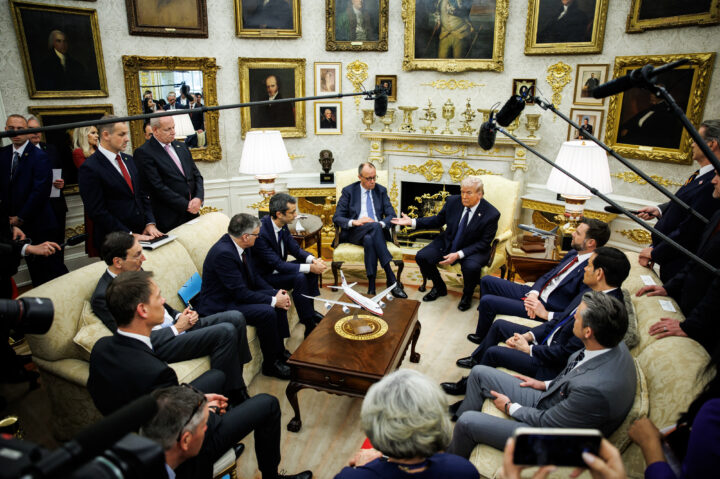
Samuel Corum/Sipa/Bloomberg via Getty Images
Friedrich Merz, Germany's chancellor, center left, and US President Donald Trump during a meeting in the Oval Office of the White House in Washington, DC, US, on Tuesday, March 3, 2026.
Good Tuesday afternoon,
This P.M. edition is reserved for our premium subscribers — offering a forward-focused read on what we’re tracking now and what’s coming next.
It’s me again — Danielle Cohen-Kanik, U.S. editor at Jewish Insider and curator, along with assists from my colleagues, of the Daily Overtime. Please don’t hesitate to share your thoughts and feedback by replying to this email.
📡On Our Radar
Notable developments and interesting tidbits we’re tracking
The Trump administration emphatically denied reports, based on partial comments made by Secretary of State Marco Rubio yesterday, that Israel forced the U.S. to launch the operation against Iran.
“If anything, I might’ve forced Israel’s hand,” President Donald Trump told reporters while meeting with German Chancellor Friedrich Merz in the Oval Office today. “You see, we were having negotiations with these lunatics, and it was my opinion that they [Iran] were going to attack first.”
Defense Secretary Pete Hegseth boosted the president’s comments, saying, “This is 100% correct,” while Rubio insisted his original remarks were misrepresented…
Trump continues to share optimistic assessments of the war’s progress: he told Politico that Iran is running out of missile launchers while claiming the U.S. has “a virtually unlimited supply” of weapons, saying, “wars can be fought ‘forever,’ and very successfully, using just these supplies”…
The Israeli Air Force struck a building where senior clerics had gathered to elect Iran’s next supreme leader, Israeli Ambassador to the U.S. Yechiel Leiter told CNN, “and there’s a very good chance that the electors won’t be readily available for any further meetings”…
Trump is open to backing militias in Iran who will work to mount regime change, U.S. officials told The Wall Street Journal, after he held phone calls with Kurdish leaders who maintain armed groups along the Iran-Iraq border.
Trump has wavered in recent comments on his vision for the future of Iran, saying today that “somebody from within” might be the best option to lead, rather than individuals like exiled former crown prince, Reza Pahlavi. At the same time, Trump told reporters, “Most of the people we had in mind are dead. And now we have another group, they may be dead also. Pretty soon we’re not gonna know anybody”…
Trump ordered the U.S. Development Finance Corporation to provide political risk insurance for all maritime trade traveling through the Gulf, as oil traffic has essentially halted and energy prices have soared. The U.S. Navy will also, if necessary, begin physically escorting tankers through the Strait of Hormuz, Trump said…
Ukrainian President Volodymyr Zelensky offered his country’s assistance to the UAE, as the Gulf country has been targeted by over 1,000 Iranian drones and missiles since the operation began Saturday. Ukraine has become particularly skilled in combating Iranian Shahed drones, something the UAE has little experience with, as Russia has regularly used them in its attacks on Ukraine…
The U.S. Embassy in Saudi Arabia was struck with two Iranian drones, with no casualties reported; the embassy was closed, along with U.S. embassies in Kuwait and Beirut. The State Department ordered the mandatory departure of all non-emergency personnel in several countries and has begun “actively securing military aircraft and charter flights for American citizens who wish to leave” the region…
The International Atomic Energy Agency confirmed that Iran’s underground Natanz nuclear enrichment plant was struck in the course of hostilities in recent days. Trump has claimed the site was rendered inoperable during the U.S.’ June 2025 strikes…
Alex Soros, one of the progressive movement’s most influential donors, boosted a social media post today about U.S. casualties in the war with Iran from Max Blumenthal, a prominent anti-Israel conspiracy theorist, Jewish Insider‘s Matthew Kassel reports.
Soros also praised Spain for its refusal to allow the U.S. to use joint bases on its soil, calling Madrid the “leader of the free world” and reprimanding other European countries for not doing the same…
After issuing a statement solely attacking the U.S. and Israel over the campaign against Iran — which provoked backlash from members of the Iranian dissident and diaspora communities — New York City Mayor Zohran Mamdani acknowledged the “systematic repression” of the Iranian people by the regime, while declining to criticize the late Supreme Leader Ayatollah Ali Khamenei, JI’s Will Bredderman reports.
Even as he acknowledged Tehran’s bloody suppression of protesters, Mamdani did not directly answer a reporter’s question at a press conference today about whether the Middle Eastern nation was better off without the radical cleric who ruled for nearly 37 years…
Amazon Web Services operations are “significantly impaired” after three of its data centers in the Middle East were struck by Iranian drones — two directly hit in the UAE and one sustaining damage in Bahrain. The strikes “caused structural damage, disrupted power delivery to our infrastructure, and in some cases required fire suppression activities that resulted in additional water damage,” AWS said…
⏩ Tomorrow’s Agenda, Today
An early look at tomorrow’s storylines and schedule to keep you a step ahead
Keep an eye out in Jewish Insider for a look at the results of today’s high-stakes primary elections in North Carolina and Texas and their implications for pro-Israel voters.
The Heritage Foundation will hold an event to launch its 2026 “Index of U.S. Military Strength” with remarks from Sen. Jim Banks (R-IN) and Reps. August Pfluger (R-TX), Pat Harrigan (R-TX) and Matt Van Epps (R-TN).
The U.S. Commission on International Religious Freedom will release its annual report tomorrow on Capitol Hill.
SQUARING OFF

A trio of Mamdani backers united with tech and real estate investors to boost anti-Israel candidates
PARTY PERSPECTIVE

Speaking at J Street’s national summit, Sen. Tim Kaine also said ‘virtually all’ Democratic senators now seek the group’s endorsement
The defense secretary told lawmakers that the deal ‘remains to be signed’ and said he could not divulge information about the timeline or cost

Win McNamee/Getty Images
Air Force One sits on the tarmac on May 12, 2025, at Joint Base Andrews, Maryland.
Defense Secretary Pete Hegseth confirmed on Wednesday that the memorandum of understanding between the Trump administration and Qatar for the gift of a luxury jet worth $400 million to join the Air Force One fleet has not been completed and signed.
Hegseth and Joint Chiefs of Staff Chairman Gen. Dan Caine were pressed repeatedly on the terms of the contract allowing for the U.S. to formally accept the Boeing 747 jumbo jet from Qatar while testifying before the Senate Appropriations defense subcommittee on the Pentagon’s proposed fiscal year 2026 budget. The two largely declined to answer questions on the subject given the public setting, though the defense secretary acknowledged that the MOU was still being worked on.
“Any specifics about future aircraft that could be Air Force One can’t be discussed here, but there is a conversation about a memorandum of understanding. A memorandum of understanding remains to be signed,” Hegseth said in response to Sen. Jack Reed (D-RI) asking if the U.S. was currently in possession of the jet.
Hegseth declined to answer Reed’s subsequent questions about the price of the contract to reconfigure the aircraft, saying he would provide it to the senator’s office but could not divulge that information in public. He offered the same response when Reed asked about the delivery time for the reconfiguration contract.
Reed pointed out that the terms of the contract originally signed with Boeing to deliver the next Air Force One jets were public while criticizing the secrecy around this deal.
“The Boeing information was public knowledge — the delivery date, the cost, the course overruns — but this is not, because this is not only a bad deal for the American public, it is just gratifying the presidency, that’s all it is,” Reed said.
Later in the hearing, Hegseth again confirmed to Sen. Chris Murphy (D-CT) that the MOU was still not signed. The Connecticut senator then pressed the defense secretary on the need for the Qatari jet, noting that the extensive modifications and security enhancements may keep it from being usable before Boeing’s new fleet of Air Force Ones are ready in 2028.
“It doesn’t stand to reason that you will be able to retrofit the plane from Qatar much sooner than 2028 so I’m trying to understand what the gap is that we’re trying to fill. If this contract ends up being a half a billion dollars and the gap only ends up being six months, that doesn’t sound like a wise investment for this committee to make,” Murphy said.
Hegseth replied by pointing to the repeated delays from Boeing in delivering on their new fleet. “I don’t know that’s a firm fixed date yet, unfortunately, that can be counted on,” Hegseth said.
A senior Air Force official testified at a House Armed Services subcommittee hearing last month that Boeing had told the service that it could potentially deliver the fleet by 2027 if certain requirements were lifted.
After Hegseth told Murphy it was his understanding that the plane would be transferred to Trump’s presidential library at the conclusion of his term, the Connecticut senator replied: “Why would we ask the American taxpayer to spend upwards of $1 billion on a plane that would then only be used for a handful of months and then transferred directly to the president?”
Hegseth emphasized the importance of the modifications to “ensure the safety and security of the president of the United States,” but did not address Murphy’s question directly.
Sen. Brian Schatz (D-HI) pressed Hegseth on whether the Department of Defense or the Qataris initiated conversations about the jet and how the transaction came to be. Hegseth said he would need to “go back and review” the details and did not go into specifics, to which Schatz asked, “I think it kind of matters who’s asking, doesn’t it?”
“I think this is illegal and unconstitutional and I won’t rant about that, but I actually think from the standpoint of our collective responsibilities it very much matters what the paper flow was. Who started these conversations? Did it come out of the White House, did it come out of the secretary of state or the president or the SEC Def [secretary of defense] or at a lower level or ambassadors?” Schatz asked.
“We’re entitled to know, because we can agree or disagree about the propriety of this, but my basic request of you is that if we’re going to disagree, let’s disagree with the same set of facts. Let’s have the documentation on the Qatari aircraft,” he continued.
Joint Chiefs Chairman Gen. Dan Caine: ‘I think they'd use it to pressure Israel. I don't know whether they would use it’

Anna Moneymaker/Getty Images
Defense Secretary Pete Hegseth speaks alongside Joint Chiefs of Staff Air Force Gen. Dan Caine during a hearing with the Senate Appropriations Committee in the Dirksen Senate Office Building on June 11, 2025 in Washington, DC.
Defense Secretary Pete Hegseth and Joint Chiefs of Staff Chairman Gen. Dan Caine declined to definitively say on Wednesday whether they believed Iran would use a nuclear weapon if it acquired one.
As they testified before the Senate Appropriations defense subcommittee, Sen. Lindsey Graham (R-SC) asked Hegseth and Caine to provide their “professional military judgement” on whether they agreed with Israel’s assessment that Tehran would use a nuclear weapon against the Jewish state.
“I think they would potentially do that,” Caine said. “I think they’d use it to pressure Israel. I don’t know whether they would use it.”
“I think Israel believes, and quite understandably, that it is an existential threat to their existence, and that in the hands of the wrong Iranian, a cleric or a radical, that they would seek to use it,” Hegseth said.
Graham replied to Hegseth, “Well, is this a radical cleric that exists there today? If he’s not, who the hell would be? So I’m trying to get everybody to think, let’s don’t do what we did in the ‘30s. They’re going to use a nuclear weapon if they get it.”
The South Carolina senator began his questioning on the topic by asking Hegseth and Caine if each thought the world “miscalculated Hitler in the ‘20s and ’30s,” which both men responded to affirmatively. “We certainly did not understand the scope of the threat, yes,” Hegseth replied.
“The guy wrote a book [saying that] I want to kill all the Jews and nobody believed him. … The danger of that is like 50 million people get killed. So let’s not do that now,” Graham said.
After asking Hegseth and Caine about the Iranian nuclear program, Graham pressed both about China’s intentions in Taiwan and Russia’s plans in Europe beyond Ukraine while encouraging them to take a tougher posture on U.S. adversaries.
“Listen, I like what you’re doing. I just think we got to get this stuff right. Iran cannot have a nuclear weapon because they’ll use it. They’re homicidal maniacs who are religious Nazis. China is an expansionist power who will take Taiwan if we don’t deter them. Russia will dismember Ukraine and keep going if we don’t stop them,” Graham told the two.
Graham then turned to the issue of radical Islamic terrorism and asked if al-Qaida would use a nuclear weapon if it acquired one. “A nuclear weapon in the hands of al-Qaida would be a very bad thing,” Hegseth replied.
“Is there a whole lot of difference between a nuclear weapon in the hands of al-Qaida and the Ayatollah in Iran? I don’t think so. They just have a different religious reason to do it,” Graham said.
At a Senate hearing, @LindseyGrahamSC asked Defense Secretary Pete Hegseth and Joint Chiefs of Staff Chairman Gen. Dan Caine whether they believed Iran would use a nuclear weapon if it acquired one.
— Jewish Insider (@J_Insider) June 11, 2025
"I’m trying to get everybody to think, let’s don’t do what we did in the ‘30s.… pic.twitter.com/e6U7nIKwPS
Graham is set to introduce a resolution on Thursday affirming that the only acceptable outcome of U.S. nuclear talks with Iran would be the total dismantlement of its enrichment program.
Many Republicans on Capitol Hill have expressed concern that the Trump administration could agree to a deal with terms similar to former President Barack Obama’s 2015 nuclear agreement.
For his part, Graham has expressed confidence that Trump would not allow for any enrichment, citing recent private conversations with the president.
Please log in if you already have a subscription, or subscribe to access the latest updates.
 Continue with Google

 Continue with Apple