














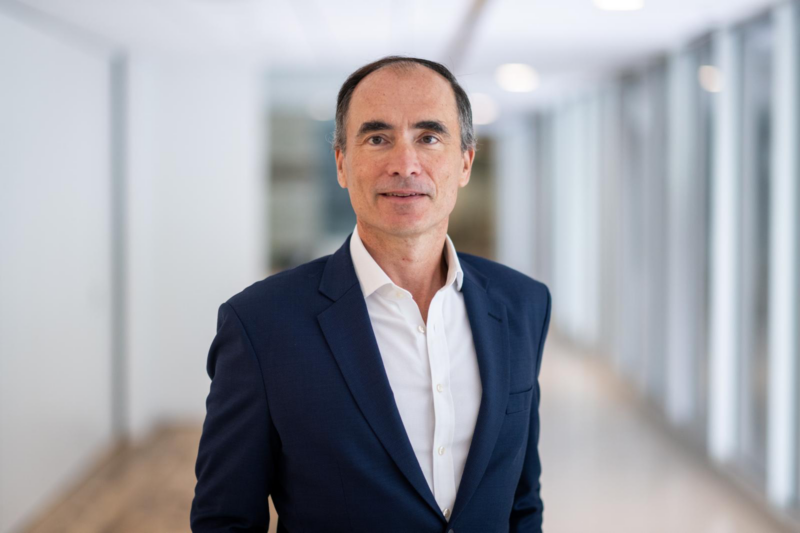




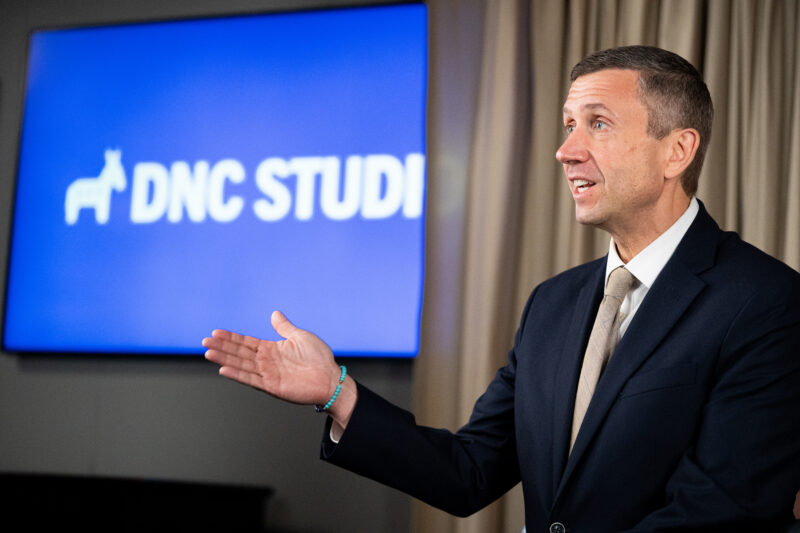













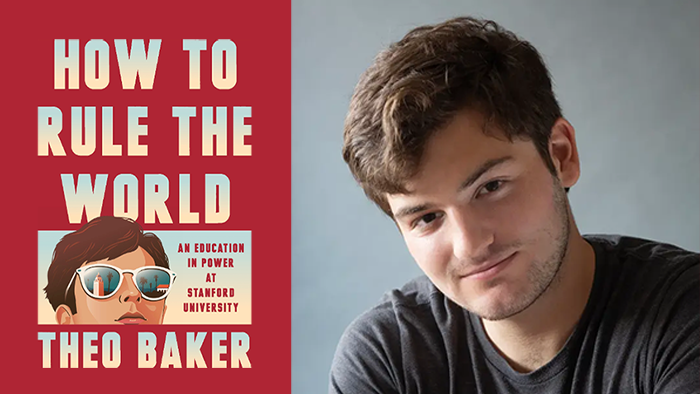
Discussing his new book 'How to Rule the World: An Education in Power at Stanford University,' Baker revealed to JI details about his turbulent and impactful college years


 Add JewishInsider on Google
Theo Baker describes himself as “an accidental journalist.” But at just 21, his writing has already sent shockwaves through the academic world.
As a freshman at Stanford University in 2022, he exposed then-President Marc Tessier-Lavigne’s decades-long pattern of manipulated data and research in scientific papers he co-authored or supervised, ultimately leading to his resignation. Baker, the son of New York Times reporter Peter Baker and New Yorker columnist Susan Glasser, became the youngest recipient of the George Polk Award for his reporting on Tessier-Lavigne.
During his sophomore year, Baker published a much-discussed essay in The Atlantic called “The War at Stanford,” exploring campus culture following the Oct. 7, 2023, terrorist attacks in Israel. He called college “a factory of unreason” and argued that anti-Israel demonstrations and rhetoric had created a pervasive climate of fear, accusing Stanford of failing to adequately condemn the attacks or protect Jewish students, all while training the next generation of tech and industry leaders.
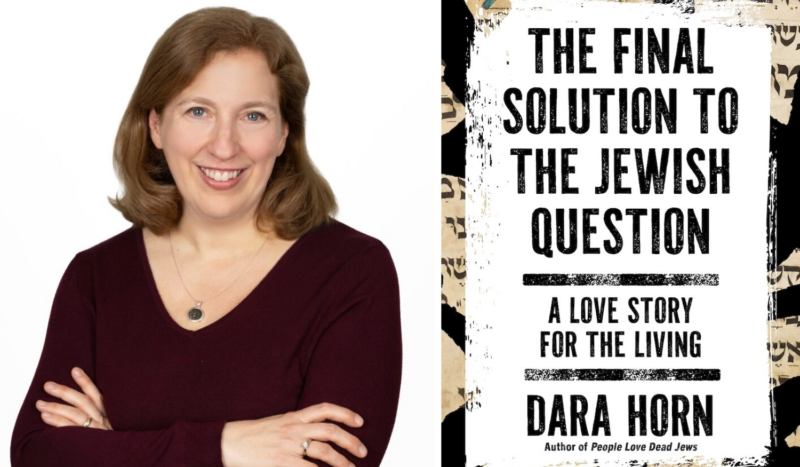
Baker reflects on his turbulent college years in his new memoir and exposé, How to Rule the World: An Education in Power at Stanford University, published earlier this month. The book lays bare an elite university corrupted by Silicon Valley’s pursuit of power, all while Stanford saw a historic rise of antisemitism.
Whether it was navigating the release of ChatGPT or grappling with the impact of the Oct. 7 attacks, Baker said every year of his experience at the elite Palo Alto, Calif., university presented a unique challenge. Weeks away from graduation, Baker spoke with Jewish Insider about his past four years on campus, the role that technology plays in rising antisemitism — and what the future might hold for universities.
Jewish Insider: You’ve described yourself as coming from a home with “just a tiny bit of cultural Judaism.” How has covering antisemitism changed your Jewish identity? What about your relationship with Israel?
Theo Baker: In fall 2022, I went home for Thanksgiving and said, “There’s so much antisemitism at Stanford.” I was shocked by that. It’s not something I really countered growing up. As soon as I arrived at Stanford — even in the first week — someone asked me, “why are all Jews so rich?”
By the end of that year — and this is before Oct. 7 —- someone in my dorm, a kid who was Jewish, talked about being Jewish for the first time and someone put a bunch of swastikas and an image of Hitler on his door later that day.
So Jewishness is an identity and not one I would have placed much investment in prior to coming to college. It was something that I knew about myself but was not particularly salient. Certainly, I, like many college students in the last few years, have been made to feel more Jewish just by the circumstances around us. It was certainly interesting to be here on campus as a reporter when the biggest story happening was something that also intersected with my own background.
I have not taken trips to Israel [in college] but I lived in Israel briefly when my dad was the Jerusalem correspondent for The New York Times. I’ve tried to center my reporting on the things I have expertise on. Stanford is 7,000 miles away from Israel. It’s so fascinating that it became such an important issue for people, and then disappeared seemingly so quickly from the public conversation.
JI: You wrote that extremism had made it “normal for students to be harassed and intimidated for their faith, heritage, or appearance.” You described a campus environment where to get into a party you had to say things like “f**k Israel” at the door. Do you think campus culture has improved since then? Do you expect other issues to eventually overshadow the fixation with Israel on campuses? How come the Iran war didn’t spark as many protests?
TB: Certainly the focus has shifted dramatically. Stanford has not been a real hub of activism. It’s been a place where people have been more focused on their dorm-based startups. For one year, things were very different. Pretty quickly that [anti-Israel protests] dissipated come fall 2024. The tensions are still there, yet they’ve become far less visible. This all-consuming fixation with Israel is still certainly a thing for some quadrants of campus but is no longer the dominant narrative.
Many of the protests were fashionable because you could join them as a pregame to a party — literally. The vast majority of students didn’t come into 2023 with the Middle East being their focus and at this point I don’t think it is either for most of them.
Higher ed and academia perceives itself as under attacks from the federal government at the moment. A lot of attention has been focused on that, obviously a closer-to-home thing than Israel. But I also think people became less interested.
JI: Do you think elite universities can fix this problem and what would it take? Has the threat of losing federal funding has actually changed anything?
TB: Universities have become so sprawling that they’ve lost a sense of cohesive identity.
Yes [the threats made an impact but] it’s a mixture of things.
JI: Your Atlantic piece on Stanford antisemitism made you a target — you’ve described receiving death threats and messages saying you should be “cooked alive.” Are you expecting similar backlash from this book or do you think the current moment is less tense?
TB: There are a range of reactions, as you might expect. I’m grateful that both with that piece and this book there are people who care about these conversations and reasonable people can have differing interpretations.
Sophomore year I had events canceled because of “security threats.” I did an event at Stanford for the book [last week] and no one shouted at me. So that’s a little different. I haven’t gotten as many death threats. Higher ed right now, though, is a very charged landscape so people have different reactions to things they perceive as a critique.
JI: What reaction have you gotten from the Jewish community to the book? Who is the target audience? What should Jewish students reading this book take away from it?
TB: I hope different people can find different things of value in this book. The Jewish community on campus is very engaged. A lot of organizers belong to the Jewish community and some of them have opened up to me about their own experiences in relation to the book.
What I’m describing at Stanford is an inner world that is necessarily exclusive, necessarily kept obfuscated from the rest. That matters because these are the future masters of the universe who are going to assume their rightful place among the tech masters of the world. So understanding how they are being trained — all too frequently trained to cut corners to get ahead — that has a real salience for all our lives given the sheer dominance of technology.
JI: Your reporting on President Tessier-Lavigne, which led to his resignation, demonstrated the power of students holding institutions accountable. Do you believe student journalists have generally succeeded in covering campus antisemitism fairly and making a meaningful impact since Oct. 7, or have they fallen short?
TB: The student journalism community is a wonderful one. The past few years have been really tough for student journalists, the same we’ve seen for professionals doing this work in the “real world.” Sometimes that’s magnified on campus because you’re reporting on your peers. The number of threats and doxxing that has been targeted at journalists just doing their jobs is horrifying.
Institutions have arrested journalists just for covering college protests. A lot of student journalists have done important work in the last few years to document this important cultural story from the ground, from the campuses where these fights are breaking out.
JI: Your book describes Stanford as a place training kids to “rule the world.” What does it mean for American Jewish life — and American values in general — that so many future tech and political leaders are being educated in environments where antisemitism is largely unchecked?
TB: In addition to antisemitism, one of the major trends we’ve seen on college campuses in the last few years is a lack of engagement with high-quality information. This is a huge problem. The way students have come to grapple with the world is often filtered with unreliable sources that are intentionally distorting the facts and events of the world. One of the results of that is the rising surge of antisemitism, clearly prevalent among my generation. The overt antisemitism, expressed explicitly in polls, is significantly higher among people my age than even 10 years older. A big part of that technology and social media.
The people building those echo chambers are the same ones who are being trained on this campus to learn that getting ahead at any cost means putting yourself first.
JI: Do you think this is a Gen Z problem specifically, or is it more about the ideological framework that’s taken hold on elite campuses that your generation inherited?
TB: Our [Gen Z’s] manifestation of antisemitism is unique. So much of antisemitism is the denial of antisemitism, like Holocaust reductionalism and the anti-victim narrative refusing to allow Jews to be victims of a hate crime because they are somehow seen as a category you’re punching up at. That’s a big thing on college campuses. Part of that is how people grew up on the internet.
JI: A 2024 report from a Stanford committee focused on addressing antisemitism stated that although antisemitism manifested itself in classrooms, campus protests and among friend groups, “no venue has provided a wider and more uninhibited berth for the expression of hostility toward Jews and Israelis than social media.” How have you seen social media and AI exacerbate antisemitism — especially at Stanford which is a leader in technology?
TB: ChatGPT arrived two months after [my freshman year class arrived]. Already there’s a huge gap between what the freshmen coming in now who had ChatGPT throughout high school are like versus the kids who were seniors when we were freshmen.
Stanford is a vanguard of a lot of trends we see sweeping higher education — the same way Silicon Valley trends tend to filter out into broader society, the same thing is true for Stanford. It was true of the patent licensing program and corporate partnership programs. One of the biggest trends we’ve seen here in the last few years — and certainly we’ve seen filter out into the rest of higher ed — is this corporatization of the university, where students are no longer just people or teenagers, but they’re commodities that have to be both protected and buttered up. Something you can make your riches off of.
JI: The book examines how power operates at elite universities, particularly regarding who receives institutional protection and who is left vulnerable. Based on your reporting, did you find a direct link between the donor and venture capital influence you document and how these schools manage concerns raised by Jewish students?
TB: The most important thing to understand is that the attitudes of these institutions are shaped by their relationship to money and power. Stanford likes to think of itself as an underdog institution, a place where renegade outsiders build for the sake of it and that is what has created all the innovation and fortune that has followed. Stanford is very far from an underdog right now. It’s annual budget is higher than [more than 100] countries. The result of that is governance by corporate structure — this is a place with more administrators than undergraduate students.
You see that reflected in all facets of student life [including how] the administration is going to respond to antisemitism. Everything is filtered through the lens of donors and protecting the ability to fundraise at the level of billions of dollars Stanford has historically been at. Everything is filtered not as seeing students as going through a formative experience, but as commodities that have to be protected and preserved just as products of any business are seen.
JI: Jewish Insider spoke with you in 2024. Now that you’re about to graduate and have the perspective of all four years — what has changed for you? Do you think what happened at Stanford after Oct. 7 was unique in any ways or just part of a broader and systemic trend across elite institutions?
TB: Certainly very few of the things that happened at Stanford after Oct. 7 are unique to Stanford. Individual circumstances and behaviors may be, but the broader trends are all completely reflective of what we saw at basically every major institution.
Now with a couple of years of perspective, it’s still a hard thing to explain to some degree.
Everything was intense and quickly faded to the background. Universities got themselves into trouble by setting a standard for themselves that they weren’t equipped to hold onto when it came to the Middle East. They adopted the path of least resistance. In that sense, nothing has changed even if the words being uttered are different ones. The primary motivation isn’t an ideological one for why these universities were making statements on political causes routinely that aligned with the liberal perspective in the past, or why they are making statements now that appear to be in favor of academic freedom. For the most part, all of that is still guided by political expediency regardless of what the actual politics are.
JI: What would you advise a Jewish student considering attending Stanford or another elite university today?
TB: Universities for the most part are about finding your people. It’s still very much possible to do that. It’s important to keep your eyes open and observe the things happening around you because so much of what we’re seeing on college campuses right now is a representation of these broader national trends in terms of our politics, culture and technology that are important to understand and reckon with. I don’t think we properly understand the implications of having such a rancorous political climate, what it looks like to have these new technologies like ChatGPT taking on such an important role in our lives.
Every person going to college right now is well positioned to observe things that are important for our society going forward, and the lessons we draw from that have a huge impact and influence on everything.
I hope Stanford is a hyperconcentrated version of the modern university. It takes everything and turns the dial up to 11. It’s an interesting sociological experiment to look at what is happening here and see how that is reflected in what is happening in the rest of higher ed.
Angelina Han Hicks had planned, with two co-conspirators, to attack Congregation Beth Israel, a synagogue and day school, which closed its campus on Wednesday
Screenshot/Google Maps
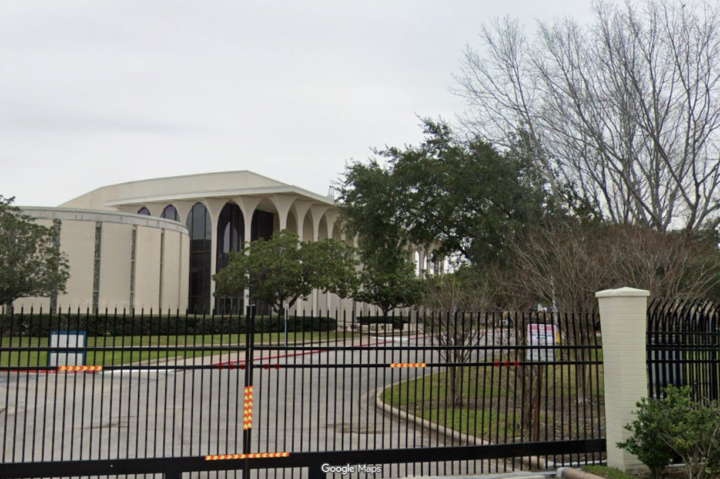
Congregation Beth Israel in Houston
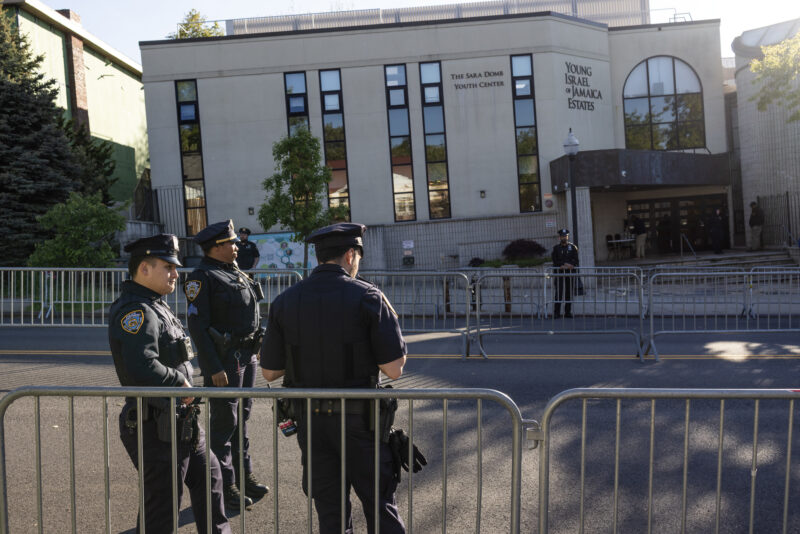
A young woman was charged Thursday in a conspiracy to “kill as many Jews as possible” by driving through a Houston synagogue.
Angelina Han Hicks, 18, a resident of North Carolina, was arrested Wednesday and charged, according to the Davidson County Sheriff’s Office, with felony conspiracy to commit assault with a deadly weapon and felony conspiracy to commit murder for her plotted attack on Congregation Beth Israel, the oldest synagogue in Texas.
The Federal Bureau of Investigation Charlotte Field Office received information on Tuesday that Hicks “was believed to be targeting members of the Jewish Community for a potential act of violence,” according to the sheriff’s office.
Law enforcement found evidence in Hicks’ home that she and co-conspirators were planning a mass-casualty event, according to the Houston Chronicle. Hicks allegedly conspired with two men referred to as “Teegan” and “Angel,” whose last names have not been disclosed, to commit murder of members of the synagogue. Warrants laying out the felony accounts state the attack was allegedly planned for about two years from now — April 21, 2028.
“The conspiracy is to kill as many Jews as possible by driving through a congregation at a synagogue,” a court order stated.
Congregation Beth Israel, which also runs a Jewish day school, responded to the threat by closing its campus for the day on Wednesday. The Jewish Federation of Greater Houston said events planned to celebrate Israel’s Independence Day were still held.
The plotted terrorist attack comes weeks after an assailant rammed a vehicle full of explosives into a Michigan synagogue, in what local law enforcement called a “targeted act of violence against the Jewish community.”
Agustina Cruz was the first recipient of an award promoted by the U.S. Embassy in Buenos Aires and the city’s Holocaust museum that is named after a group of Germans who openly protested Hitler

Dina Brookmyer
Inside the Shapell Center of the U.S. Holocaust Memorial Museum
Until this month, 21-year-old Agustina Cruz had never left Argentina. Before this year, she had never even been to Buenos Aires, which is more than 900 miles southeast of her hometown of Palpalá, a small city of 60,000 people located in Jujuy, a region known for soaring rock formations.
That all changed earlier this year when she became the inaugural recipient of the White Rose Award, a prize administered by the U.S. Embassy in Argentina and the Buenos Aires Holocaust Museum. The award was named for a group of Germans who openly protested Adolf Hitler and the Nazis’ extermination of Jews.
Cruz won the award for advocating for the Romani, a community so marginalized in Argentina that people accused her of “getting into the mouth of the devil” — a Spanish expression — simply for publicly supporting a Roma family in the face of taunting from her classmates.
But her planned trip this month to Washington, where she was slated to visit the U.S. Holocaust Memorial Museum and tour the city, almost fell apart due to ignorance and hate.
One of Cruz’s university professors had initially told her that she would get an excused absence for missing class. But once that professor found out that Cruz would be on a trip to learn about the Holocaust, the professor said Cruz could not miss class, because the trip was sponsored by a Jewish organization.
“She shouldn’t be discriminated against for doing the right thing herself,” said Marc Stanley, who served as U.S. ambassador to Argentina from 2022 until January of this year. He worked with the Holocaust Museum of Buenos Aires on the award, and accompanied Cruz to Washington earlier this month after she decided to make the trip and risk a failing grade in her course.
“In my community, there’s lots of ignorance. They do not respect the Roma community,” Cruz told Jewish Insider via a translator at the end of an eventful day at the Holocaust Museum in Washington, which included a two-hour private tour and a meeting with a Holocaust survivor. As she described the bullying she faced for standing up for embattled members of the Roma community, Cruz began to cry.
She had learned about the White Rose Award from her teacher, Lorena Rosa Blanca, who accompanied her on the trip to Washington. Cruz was selected as the winner by a panel in Buenos Aires that included Stanley and Jewish, Christian and Muslim leaders.
“She’s a very strong girl who suffered discrimination at school,” Rosa Blanca told JI.
As Cruz walked through the museum, she recorded video of nearly everything her Spanish-speaking tour guide said, including when he told her that her work is important “for humankind.” She paused at a panel about the Roma, which explained that “long-held prejudices were fueled by Nazi racism.” Between 250,000 and 500,000 members of the Roma community were killed by the Nazis. Cruz took in the exhibits with awe and horror, including a section about the Nazis who hid out in Argentina after the end of the war.
“I feel so enriched by all of this information,” Cruz said afterward. “I’m thinking of using social media, perhaps TikTok or some other social media [platform], to reach out to teenagers and open their eyes to the history, to all the suffering, and to the fact that we are all human beings, and we all deserve to enjoy human rights.”
The project had a diplomatic goal, in addition to the educational goal for the recipient. Educating about the Holocaust — and about tolerance — is an American value that U.S. emissaries abroad have a duty to promote, Stanley explained.
“I think human rights is certainly a U.S. value,” Stanley said. “Making known that we both [the U.S. and Argentina] have museums like this, that we both constantly battle against discrimination against marginalized communities, is something that I worked on as U.S. ambassador. Showing that we’re in the same fights with Argentina, that we’re all in the same boat, I think is important.”
Cruz, now studying social work as a university student, said she plans to let her peers know “that they should not be afraid to speak up to defend other people, other people who may be different.”
Suzanna Tarica, an 85-year-old Holocaust survivor who was born in France in 1940, listened intently as Cruz shared her story.
“What you’re doing is what I want to do also,” Tarica told Cruz. “We are looking at accomplishing the same goal, which is tolerance, understanding and peace — and to get rid of ignorance.”
Five reflections on how Oct. 7 reshaped politics, diplomacy, advocacy, higher ed, and Jewish life
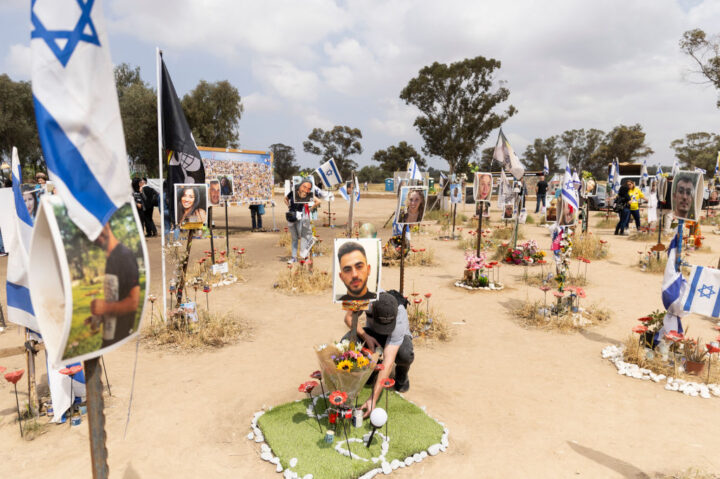
RE’EIM, ISRAEL — Visitors pay tribute at the site of the Nova music festival massacre.
The far-left assemblyman’s supporters celebrated his presumed win with incendiary social media posts while New York Jewish leaders and lawmakers debate next steps

Michael M. Santiago/Getty Images
New York City Mayor Zohran Mamdani and former Comptroller Brad Lander speak with members of the press as they greet voters on Broadway on June 24, 2025 in New York City.
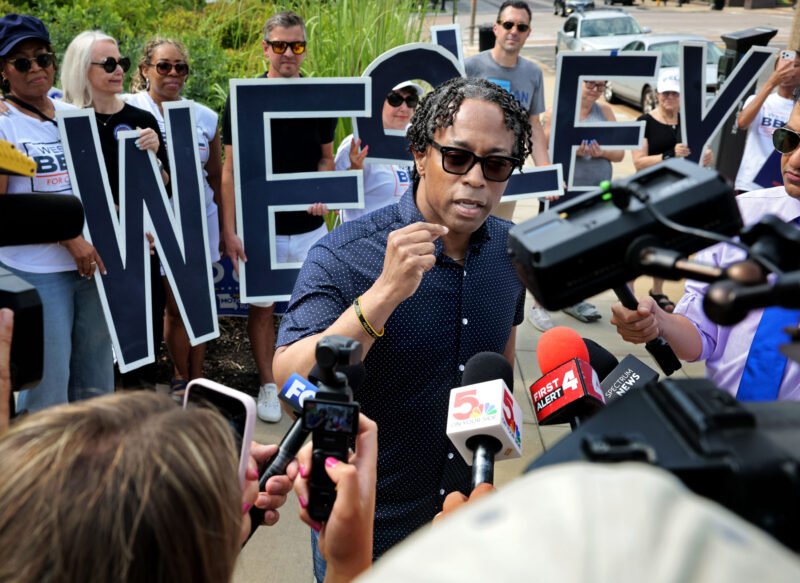
Zohran Mamdani’s commanding performance in New York City’s Democratic mayoral primary on Tuesday night underscored how the 33-year-old assemblyman, a democratic socialist from Queens, successfully built a coalition extending well beyond his far-left base of support.
But while his focus on affordability resonated with many voters across the five boroughs who rejected former New York Gov. Andrew Cuomo, Mamdani’s all-but-certain victory has also empowered some of his more extreme supporters to espouse incendiary rhetoric that his critics say has helped fuel a rise in antisemitism in the city.
In celebrating the presumed upset by a candidate with a long record of anti-Israel activism, many of Mamdani’s allies on the far left have promoted calls to “globalize the intifada,” a motto he had refused to condemn in the final stretch of the campaign, while attacking “Zionists” and using threatening language that has raised alarms within the city’s mainstream Jewish community.
“Consider the intifada globalized,” one prominent Mamdani supporter wrote on social media, using a phrase that critics interpret as violent incitement against Jews — and echoing a number of comments invoking similar language in the wake of the bitterly contested primary.
“The last 24 hours will be an inflection point in history for Zionism and the entity,” said another backer with a relatively sizable following on social media.
“Tonight we celebrate,” a like-minded Mamdani enthusiast added in an ominously worded post. “Tomorrow we get the lists from Zohran and the round up begins.”
Mamdani, for his part, has avoided such rhetoric throughout the campaign, even as he has not fully distanced himself from radical elements of the pro-Palestinian movement in which he has long been an outspoken figure, particularly during his four years serving in Albany.
In the closing week of the race, he controversially defended calls to “globalize the intifada,” doubling down in a radio interview a day before the election, where he suggested that the phrase “has a variety of meanings to a variety of people,” but clarified that he does not himself use it now.
Earlier in the campaign, while speaking to Jewish voters during a candidate town hall, Mamdani also refused to disavow Hasan Piker — an antisemitic influencer who has stoked controversy for justifying Hamas’ Oct. 7, 2023, terror attacks — after joining the podcaster’s widely viewed show for an extensive interview.
“I do not have regrets of speaking to any interviewer, to any journalist, to any podcaster, because ultimately, my message is consistent in all of those mediums,” Mamdani said in May. “And it’s a message that I want to have reach as many people as possible while making clear what my values are and my statements.”
In his victory speech late Tuesday night, Mamdani — a longtime supporter of the Boycott, Divestment and Sanctions movement against Israel — sought to assuage Jewish voters’ concerns about his positions on the Middle East, saying he is among “millions of New Yorkers who have strong feelings about what happens overseas.”
“While I will not abandon my beliefs or my commitments, grounded in a demand for equality, for humanity,” Mamdani said, “you have my word to reach further, to understand the perspectives of those with whom I disagree, and to wrestle deeply with those disagreements.”
Despite engaging in diplomacy as he tries to widen his support base for a competitive general election, Mamdani’s critics allege that his perceived lack of interest in drawing red lines on threatening rhetoric toward Israel and its supporters has helped create a permission structure for the far left to use language that has alienated many Jewish Democrats from the party they have long called home.
That Mamdani appears to have claimed a decisive win even before all votes have been tallied — and in a place home to the largest Jewish population of any city in the world, no less — has also spurred anxiety among Jewish community leaders that he will likely maintain his dominant position in the general election, all while continuing to ignore the mounting pressure to more forcefully address extreme statements issued by his supporters.
“Does it not matter because we lost?” one Jewish leader, who had backed Cuomo, said on Wednesday, voicing skepticism that Mamdani will feel he needs to confront the fringes of his movement to prevail in what is expected to be a crowded general election to unseat Eric Adams, the scandal-scarred mayor now running for reelection as an independent.
Even within Mamdani’s campaign, some of his staffers have drawn scrutiny for their polarizing commentary on Israel and other issues. A campaign videographer, Donald Borenstein, has advocated for Israel’s elimination, writing in a since-deleted social media post late last year that “Palestine will be free, Lebanon will stand strong, and the fascist state of Israel will fall in our lifetimes.”
“It is time for Mr. Mamdani to move from disturbance to responsibility and to unambiguously reject and reign in these actors with whom he has been strongly associated,” said Rabbi Moshe Hauer, the executive vice president of the Orthodox Union, before citing a line from Mamdani’s speech on Tuesday. “He needs to prioritize the safety and security of New Yorkers over his ‘strong feelings about what happens overseas.’”
Meanwhile, Mamdani’s political director, Julian Gerson, has voiced sympathy for Luigi Mangione, the accused killer of a health-care executive in Manhattan last year — arguing that he “is adored not only because he dared to target a leader of one of the most vile, self-enriching industries darkening our society today, but because he dared to defy the stasis of nihilistic rejection.”
In a statement on Wednesday, Rabbi Moshe Hauer, the executive vice president of the Orthodox Union, called on Mamdani, a self-described anti-Zionist, to disavow “the rhetoric and actions of those whose opposition to Zionism has driven them to work to instill fear and intimidation in Jews who support Israel.”
“It is time for Mr. Mamdani to move from disturbance to responsibility and to unambiguously reject and reign in these actors with whom he has been strongly associated,” Hauer continued, before citing a line from Mamdani’s speech on Tuesday. “He needs to prioritize the safety and security of New Yorkers over his ‘strong feelings about what happens overseas.’”
A spokesperson for Mamdani’s campaign did not respond to a request for comment from Jewish Insider on Wednesday.
As Democratic leaders who stayed out of the primary are now forced to confront Mamdani’s stunning rise, many have sidestepped his divisive positions on Israel in favor of praising his political acumen and broad-based message about the city’s affordability crisis, even if most have so far stopped short of endorsing him.
Senate Minority Leader Chuck Schumer (D-NY), for example, congratulated Mamdani on “an impressive campaign that connected with New Yorkers about affordability, fairness and opportunity,” he said in a social media post on Wednesday.
The Senate leader, who has equated anti-Zionism and BDS with antisemitism, did not comment on Mamdani’s record on Israel issues.
Rep. Jerry Nadler (D-NY), on the other hand, chose to endorse Mamdani on Wednesday, an imprimatur from a veteran Jewish congressman that could help broaden Mamdani’s outreach to skeptical Jewish voters who lean progressive. Nadler, who called Mamdani’s win a “repudiation” of President Donald Trump, said he spoke to the assemblyman about “his commitment to fighting antisemitism” and “all bigotry and hate.”
Still, some lawmakers continued to air their concerns about Mamdani, including Rep. Laura Gillen (D-NY), whose Long Island swing district is heavily Jewish. “Socialist Zohran Mamdani is too extreme to lead New York City,” she said in a critical statement posted to social media, arguing that “he has demonstrated a deeply disturbing pattern of unacceptable antisemitic comments which stoke hate at a time when antisemitism is skyrocketing.”
Mamdani, who would be the city’s first Muslim mayor, has rejected accusations of antisemitism, claiming his opponents have weaponized the issue to score “political points,” while vowing to increase city funding for hate crimes prevention by 800% if he is elected.
“No question that we will have to get behind Adams,” Leon Goldenberg, an executive board member of the Flatbush Jewish Community Coalition, told JI. “The two big questions: Does Adams get the Republican line and does Cuomo run? Adams needs the Republican line and Cuomo to stay out of the race. Then he stands a slight chance.”
With some Democrats divided over Mamdani, the Orthodox Jewish community, which backed Cuomo during the primary, is now expected to unite behind Adams as he seeks reelection, according to multiple people familiar with the matter.
The mayor’s team had been eager to face Mamdani in the general election rather than Cuomo — whose coalition of Black and Jewish voters largely overlaps with Adams. Cuomo, who conceded on Tuesday, has not indicated if he will run on a separate ballot line.
“No question that we will have to get behind Adams,” Leon Goldenberg, an executive board member of the Flatbush Jewish Community Coalition, told JI. “The two big questions: Does Adams get the Republican line and does Cuomo run? Adams needs the Republican line and Cuomo to stay out of the race. Then he stands a slight chance.”
The GOP nominee, Curtis Sliwa, often dismissed as a gadfly, ran unopposed in the primary this week.
But even as Mamdani’s opponents, who believe his campaign has enabled increasingly vitriolic rhetoric toward Israel, game out 11th-hour strategies to defy his path to the mayor’s office, one well-placed Jewish leader suggested such efforts seem unlikely to succeed for the moment — hinting at a reordered political calculus.
“People are talking about it, but many people who have the resources don’t think that the math is there right now,” he said. “The mayor is deeply unpopular — and we learned last night that you cannot win an election on Black turnout and pro-Israel, Orthodox Jewish support.”
Please log in if you already have a subscription, or subscribe to access the latest updates.
 Continue with Google
 Continue with Apple